

1 Introduction
Science communication is increasingly recognised as a strategic component of contemporary research systems, reflecting a shift from viewing the public as passive recipients of scientific information towards understanding communication as a multidimensional practice encompassing dialogue, participation, inclusion and public engagement with diverse publics [Trench & Bucchi, 2010; Bucchi & Trench, 2021]. It has consequently become an international field of research and professional practice shaped by diverse theoretical, institutional and contextual perspectives [Gascoigne et al., 2020]. Accordingly, science communication is understood not only as the dissemination of scientific knowledge but also as an institutional practice through which research organisations foster meaningful engagement with society [National Academies of Sciences, Engineering, and Medicine, 2017].
Within this broader landscape, itinerant science popularisation initiatives have emerged as an important strategy for extending public engagement beyond permanent science communication infrastructure. Through travelling exhibitions, mobile science programmes and outreach activities, these initiatives bring scientific experiences to schools and communities with limited access to research institutions [Polino & Castelfranchi, 2012; Norberto Rocha & Marandino, 2017]. Unlike museums and science centres, which are concentrated primarily in urban areas, itinerant initiatives are designed to reach geographically dispersed populations while complementing existing science communication infrastructures.
Despite the international expansion of science communication, opportunities for public engagement remain unevenly distributed because organisational and territorial conditions shape both programme implementation and participants’ experiences [Gascoigne et al., 2020]. These disparities are particularly evident in Latin America, where science communication has expanded considerably but remains concentrated in large metropolitan areas [Polino & Castelfranchi, 2012; Reynoso-Haynes et al., 2020]. Many organisations continue to operate under financial, organisational and human-resource constraints that limit strategic planning, evaluation and sustained public engagement, highlighting the need for context-sensitive implementation strategies [Fernández Polcuch et al., 2016; Patiño Barba et al., 2019; Massarani et al., 2025].
Mexico reflects these regional dynamics. Although science popularisation has expanded through universities, public research centres, museums and governmental initiatives, opportunities for sustained public engagement remain concentrated in major urban centres, while many peri-urban and rural communities continue to experience limited access to science communication activities [Patiño Barba et al., 2017; Reynoso-Haynes et al., 2020]. National educational indicators further emphasise the importance of complementary opportunities for public engagement with science beyond formal educational settings [Organisation for Economic Co-operation and Development, 2023b, 2023a]. In this context, itinerant science popularisation initiatives provide an important means of extending scientific experiences to populations with limited opportunities to engage directly with research institutions [Feliú-Mójer, 2022].
Although previous studies have documented the educational value and public reception of itinerant science popularisation initiatives, comparatively little empirical evidence has examined how programme implementation is shaped by recurring organisational and contextual conditions or how such evidence can inform future practice, particularly in peri-urban settings. Existing evaluations have focused primarily on participant satisfaction, learning outcomes and public engagement indicators, with comparatively less attention devoted to the organisational arrangements and contextual factors influencing programme implementation [Entradas & Bauer, 2017; Lozano & Mora, 2008; Reynoso Haynes, 2008]. Programme implementation should therefore be understood not merely as a logistical process but as an integral component of science communication practice that influences accessibility, inclusion and the quality of public engagement.
Against this background, this Practice Insight uses Puerta Politécnica al Cosmos, organised by the Centro de Investigación en Ciencia Aplicada y Tecnología Avanzada (CICATA Altamira), Instituto Politécnico Nacional (IPN), Mexico, as an instrumental case for examining programme implementation within an itinerant science popularisation initiative in a peri-urban region of north-eastern Mexico. The Mobile Polytechnic Planetarium (Figure 1) exemplifies the immersive educational experiences through which the initiative sought to engage its audiences.
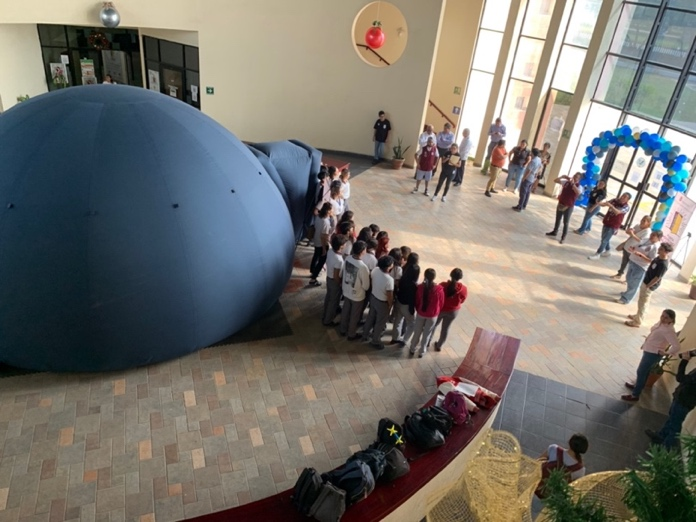
Rather than evaluating a single initiative, this Practice Insight uses an instrumental case to identify recurring implementation conditions and derive analytically transferable implementation insights. By shifting the analytical emphasis from programme outcomes to the conditions shaping programme delivery, the study offers an analytical perspective that can inform the planning, adaptation, delivery and evaluation of itinerant science popularisation initiatives in comparable peri-urban and territorially underserved settings.
2 Methodology
2.1 Research design
We employed an instrumental case study design [Stake, 1995] within a convergent mixed-methods framework [Creswell & Plano Clark, 2017] to examine programme implementation in Puerta Politécnica al Cosmos (PPC). This approach brought together complementary quantitative and qualitative evidence from the visitor survey, collaborator survey and student interviews, allowing programme implementation to be examined from multiple perspectives.
We analysed each dataset independently to preserve its distinctive analytical contribution before integrating the findings through analytical triangulation (Section 2.4). This analytical structure supported systematic comparison across participant groups without collapsing the differences between the evidence generated by each source [Denzin, 2017].
The study aimed to generate analytically transferable implementation knowledge concerning the processes through which itinerant science popularisation initiatives are planned, delivered and experienced under peri-urban conditions. Throughout this study, implementation knowledge refers to the explanatory understanding derived from the analytical integration of complementary evidence, whereas implementation insights denote the practical implications derived from that knowledge for future programme planning, adaptation, delivery and evaluation.
2.2 Study context, participants and data collection
We conducted this study during the implementation of Puerta Politécnica al Cosmos (PPC), a three-day itinerant astronomy popularisation initiative organised by CICATA Altamira (IPN) in Altamira, Tamaulipas, Mexico, from 4 to 6 December 2024. The initiative sought to extend science communication opportunities to peri-urban communities with limited access to permanent science communication infrastructure. Altamira forms part of the metropolitan area of Southern Tamaulipas and represents a peri-urban setting where metropolitan connectivity coexists with educational inequalities, limited permanent science communication infrastructure and accessibility challenges. According to the 2020 Population Census, the municipality had 269,790 inhabitants, an average educational attainment of 9.8 years, and relatively low completion rates for upper-secondary (18.5%) and higher education (11.7%) [Instituto Nacional de Estadística y Geografía, 2020]. Despite its proximity to the neighbouring cities of Tampico and Ciudad Madero, opportunities to participate in science communication activities are often more limited than in larger urban centres because of the scarcity of permanent science communication infrastructure and mobility constraints affecting access for some communities. The initiative featured the Mobile Polytechnic Planetarium, the Images of the Cosmos exhibition, interactive workshops, astronomical observations, public lectures and complementary science engagement activities. Although hosted by a public research centre, the initiative was free of charge and open to the general public.
More than 1,000 people attended the initiative over the three-day period, including members of the general public from Altamira, Tampico, Ciudad Madero and other nearby localities across the region, as well as organised school groups. While the initiative was publicly promoted throughout the metropolitan area of Southern Tamaulipas, the organised school visits were primarily coordinated with primary, lower secondary, upper secondary and higher education institutions serving peri-urban communities in Altamira. This required advance scheduling of visits and coordination of school transport to facilitate participation. These territorial and organisational characteristics shaped several aspects of programme delivery, as the research centre is located within an industrial corridor with limited public transport and uneven accessibility across the metropolitan area. Consequently, institutional coordination, scheduled visits and organised school transport were essential to facilitating participation. This combination of unrestricted public access and organised educational visits provided an appropriate context for examining programme implementation under peri-urban conditions.
To examine programme implementation using complementary sources of evidence, we collected data from three participant groups, each fulfilling a distinct analytical function within the mixed-methods design.
The first group comprised 404 visitors who completed a structured questionnaire immediately after participating in the initiative. This group included both members of the general public and students attending organised school visits, reflecting the initiative’s dual access model, which combined unrestricted public participation with institutionally coordinated educational visits. We used non-probability convenience sampling because participation depended on visitors’ availability at the end of their visit. For organised school groups, participation was further constrained by institutional timetables and return transport schedules. This dataset documented visitors’ immediate experiences and perceived learning following participation in the initiative and supported exploratory comparisons according to participant occupation (students versus non-students) and age group.
The second group comprised 30 collaborators directly involved in planning, organising and delivering the initiative. Because the number of collaborators was limited, we used total population sampling and invited all collaborators to complete a mixed-methods questionnaire during the days following programme implementation. This dataset provided evidence on organisational coordination and programme implementation from the perspective of those directly involved in delivering the initiative.
The third group comprised 40 students who participated in semi-structured interviews conducted three to six months after the event. The interviews were scheduled in collaboration with the participating educational institutions, which facilitated follow-up with students from primary, lower secondary, upper secondary and higher education. We used purposeful sampling to identify information-rich participants from these educational levels, selecting ten students from each educational level to capture a broad range of educational experiences within the initiative. This dataset documented how participants retrospectively interpreted their programme experiences and the implementation process, providing evidence on retrospectively reported learning, sustained engagement and retrospective reflections on programme implementation.
The complete data collection instruments are provided in Supplementary materials S2–S4.
2.3 Data sources and analytical architecture
We developed three complementary data collection instruments as part of a convergent mixed-methods strategy to examine programme implementation. The visitor questionnaire (Supplementary material S2), collaborator questionnaire (Supplementary material S3) and semi-structured student interview guide (Supplementary material S4) were designed concurrently within a shared analytical framework. Although tailored to different participant groups, the three instruments were intentionally aligned through an overarching analytical architecture that established common analytical dimensions while allowing each data source to contribute complementary evidence according to its specific analytical role. Table 1 summarises this analytical architecture by presenting the three data sources, their corresponding instruments, the shared analytical dimensions, the types of evidence generated and the primary analytical role of each source [Fetters et al., 2013].
| Data source |
Data collection instrument |
Shared analytical dimensions |
Type of evidence generated |
Primary analytical role |
| Visitors |
Structured questionnaire (S2) |
Educational experiences; organisational coordination; participant engagement; operational constraints |
Quantitative indicators and coded qualitative thematic evidence |
Documents participants’ immediate experiences and perceived learning following programme participation. |
| Collaborators |
Mixed-methods questionnaire (S3) |
Educational experiences; organisational coordination; participant engagement; operational constraints |
Quantitative organisational indicators and coded qualitative thematic evidence |
Documents organisational coordination and collaborators’ perspectives on programme implementation. |
| Students |
Semi-structured interviews (S4) |
Educational experiences; organisational coordination; participant engagement; operational constraints |
Binary-coded qualitative evidence |
Documents retrospective accounts of programme implementation, retrospectively reported learning and sustained engagement. |
To ensure methodological transparency and analytical consistency, we developed source-specific qualitative codebooks (Supplementary material S1) for the open-ended questions included in the visitor and collaborator questionnaires, as well as for the semi-structured student interviews. Each codebook included operational definitions, coding rules, inclusion and exclusion criteria, illustrative examples and analytical memos tailored to the characteristics of its corresponding qualitative data source. Rather than applying a single coding framework across all sources, each codebook operationalised the shared analytical dimensions while ensuring traceability from the original qualitative evidence to the subsequent cross-source integration and maintaining conceptual comparability across the study.
Together, this analytical architecture provided the conceptual framework that guided the triangulation strategy described in the following section.
2.4 Triangulation and analytical integration
We analysed each dataset using procedures appropriate to its quantitative or qualitative characteristics before integrating the resulting evidence through analytical triangulation. This sequential analytical strategy ensured that each data source contributed evidence according to its methodological characteristics prior to cross-source comparison.
Survey responses from the visitor questionnaire (including members of the general public and students) and the collaborator questionnaire were analysed using descriptive and exploratory inferential statistics. Descriptive analyses (frequencies, percentages, means and standard deviations) summarised participant and organisational perspectives on programme implementation, whereas exploratory inferential analyses examined differences according to occupation (students versus non-students) and age group (< 18 versus ≥ 18 years), using Mann-Whitney U tests for Likert-type variables and Pearson’s χ2 tests for dichotomous indicators, with effect sizes reported as r and Cramér’s V, respectively (Supplementary material S5).
Qualitative evidence from the three datasets was analysed using source-specific qualitative codebooks (Supplementary materials S1A–S1C), with coding procedures adapted to the characteristics of each dataset. Open-ended responses from the visitor and collaborator questionnaires were thematically coded and summarised as frequencies of coded thematic mentions, whereas semi-structured interview transcripts were organised into binary case-by-code matrices from which coded case frequencies were derived. To ensure the reliability of the qualitative analysis, two researchers independently applied the corresponding codebooks to a subset of the qualitative data and achieved substantial inter-coder agreement (Cohen’s κ > 0.80) before completing the remaining coding.
The quantitative indicators, coded thematic summaries and binary-coded interview case frequencies were subsequently incorporated into a comparative analytical matrix organised around the shared analytical dimensions presented in Table 1. Rather than merging the original datasets, this matrix provided a structured framework for systematically examining convergent, complementary and divergent evidence while preserving the methodological integrity of each source.
Analytical triangulation was then conducted through iterative comparison and integrated interpretation of the evidence assembled within the comparative matrix. Recurring implementation conditions were identified whenever convergent or complementary evidence consistently indicated organisational, operational or contextual factors influencing programme implementation across at least two data sources.
We subsequently derived transferable implementation insights by interpreting the recurring implementation conditions in terms of their practical significance for planning, adapting, delivering and evaluating future itinerant science popularisation initiatives. Accordingly, the analytical triangulation comprised two complementary stages: (1) identifying recurring implementation conditions through the systematic integration of quantitative findings, coded thematic summaries and binary-coded interview evidence; and (2) deriving transferable implementation insights through their interpretation.
2.5 Ethical considerations
The study was conducted in accordance with internationally recognised ethical principles for research involving human participants. Participation was voluntary throughout all stages of the study, and informed consent was obtained from all adult participants before data collection. For school-aged participants, data were collected during organised educational visits authorised by the participating educational institutions and coordinated with the research centre.
Questionnaire responses were collected anonymously, and all interview transcripts were anonymised before analysis. No personally identifiable information was retained during data processing, analysis or reporting. Choosing whether or not to participate had no influence on individuals’ access to the programme or on their involvement in its activities.
These procedures ensured voluntary participation, confidentiality and responsible research practice while supporting the ethical management of all datasets integrated throughout the study.
3 Integrated findings from the analytical triangulation
Several participant characteristics were relevant for interpreting programme implementation. Although Puerta Politécnica al Cosmos was designed as an open event for the general public, the visitor sample was predominantly composed of students (86.6%), with adolescents aged 12–17 years representing the largest age group (49.5%). Educational institutions constituted the principal dissemination channel for the initiative (82.3%). More than half of the visitors resided in Altamira (52.2%), followed by Tampico (25.0%) and Ciudad Madero (18.3%), indicating that the initiative primarily reached audiences from its local peri-urban context while also extending its reach across the surrounding metropolitan area. Furthermore, 78.1% of visitors reported that this was their first participation in a science communication activity. The collaborator sample comprised organisers, workshop facilitators, speakers and logistical support staff with varying levels of experience in science communication, ranging from experienced practitioners to individuals participating in this type of initiative for the first time. Detailed participant characteristics are presented in Supplementary material S5.
Within this participant context, the integrated analysis identified four recurring implementation conditions capturing how educational activities, organisational coordination and contextual factors interacted during programme delivery. Rather than presenting findings separately for each instrument, evidence from the visitor survey, collaborator survey and student interviews was integrated through analytical triangulation to identify the recurring implementation conditions summarised in Table 2. These recurring implementation conditions constitute the analytical basis from which transferable implementation insights may be derived.
|
Recurring implementation condition |
Visitor survey evidence (N = 404) |
Collaborator survey evidence (N = 30) |
Student interview evidence (N = 40) |
Cross-source interpretation |
Implementation insights |
|
Immersive educational experiences |
Mobile Polytechnic Planetarium most valued activity (n = 232); learned something new (n = 357); Planetarium identified as favourite activity (n = 158). |
Public interest in scientific activities (M = 4.63/5); visitors’ perceived understanding of scientific content (M = 4.30/5). |
Planetarium recalled (n = 40); participatory workshops recalled (n = 32); Images of the Cosmos exhibition recalled (n = 24). |
Convergent evidence indicates that immersive and participatory activities promoted visitor engagement, facilitated understanding of scientific concepts and generated memorable educational experiences. |
Prioritise immersive, participatory and experiential activities as the core educational strategy of itinerant science popularisation initiatives. |
|
Coordinated organisational arrangements |
Overall organisation positively evaluated (M = 4.22/5); accessibility and logistics (M = 4.04/5). |
Organisation rated 5/5 (n = 21); clear operational information received (n = 25); adequate operational resources (n = 22). |
Overall organisation positively evaluated (n = 39); overcrowding reported (n = 10); image-quality issues reported (n = 10). |
Integrated evidence indicates that positive visitor experiences depended upon effective organisational coordination while also highlighting operational challenges associated with visitor flow and technical resources. |
Programme planning should integrate logistical coordination, communication, staffing and technical resource management to sustain implementation quality under conditions of high visitor demand. |
|
Participant engagement and perceived learning |
Increased interest in science (n = 304); learned something new (n = 357); willingness to attend future editions (n = 380). |
Active visitor participation (n = 26); positive programme impact (n = 26); contribution to fostering scientific vocations (n = 24). |
Learned something new (n = 37); shared learning with others (n = 37); sought additional science-related information (n = 14). |
Complementary evidence indicates that participant engagement extended beyond immediate programme participation through perceived learning, subsequent knowledge sharing and participants’ continued exploration of scientific content. |
Evaluation of itinerant science popularisation initiatives should consider both immediate educational outcomes and evidence of sustained engagement with scientific content following programme participation. |
|
Operational constraints and future programme development |
Planetarium comfort and audiovisual issues (n = 22); Planetarium audiovisual quality (n = 21); requests for additional activities (n = 11). |
Activities and visitor experience (n = 7); organisation and logistics (n = 6); accessibility and transport (n = 6); equipment and technical resources (n = 6). |
Improve audiovisual conditions (n = 14); increase resources or visitor capacity (n = 11); improve visitor circulation and internal organisation (n = 2). |
Across the three datasets, recurring priorities concerned technical infrastructure, accessibility, visitor management and organisational logistics, identifying areas for future programme improvement despite consistently positive overall evaluations. |
Continuous multi-source evaluation should be incorporated into programme planning to identify operational priorities and support iterative programme improvement and long-term sustainability. |
Taken together, the integrated findings demonstrate consistent convergence across the three data sources despite their different perspectives and forms of evidence. This convergence enabled the identification of the recurring implementation conditions presented in Table 2 and provided the empirical foundation for the transferable implementation insights derived through analytical triangulation.
4 Discussion
The integrated findings suggest that programme implementation in itinerant science popularisation initiatives is best understood as a dynamic organisational process in which educational design, organisational coordination and territorial context interact continuously throughout programme delivery. This interpretation highlights the principal practice innovation emerging from the study by shifting attention from participant outcomes to the organisational and contextual processes that shape how science communication initiatives are planned, adapted and sustained under peri-urban conditions. In doing so, the study extends previous approaches by demonstrating that implementation knowledge can be generated not only through evaluating participant responses but through understanding how interacting implementation conditions shape programme delivery.
Organisational coordination emerged as a key implementation process underpinning programme delivery. Across the integrated evidence, accessibility, visitor circulation, communication, scheduling and operational logistics collectively influenced both participants’ experiences and the delivery of educational activities under the practical constraints of a peri-urban setting. The finding that educational institutions constituted the principal dissemination channel for the initiative indicates that implementation extended beyond operational management during programme delivery to include institutional partnerships and audience outreach before the event itself. This broader organisational process helped establish the conditions through which the initiative reached its intended audiences within the local territory. This interpretation is consistent with previous research demonstrating that sustained public engagement depends upon the institutional arrangements enabling research organisations to engage diverse publics over time [Entradas & Bauer, 2017; Entradas, 2022]. While these studies primarily examined institutional communication capacities, the present findings extend this perspective by demonstrating that organisational coordination constitutes an operational capability encompassing institutional collaboration, audience outreach and programme delivery, enabling itinerant science popularisation initiatives to function effectively beyond permanent science communication infrastructure.
The integrated findings likewise indicate that educational experiences cannot be interpreted independently of the implementation processes through which they are delivered. Immersive activities such as the Mobile Polytechnic Planetarium, interactive workshops and exhibitions promoted participant engagement, immediate and retrospectively reported learning. Their educational value, however, depended on the capacity to create meaningful experiences for audiences with limited previous exposure to organised science communication activities, as reflected in the high proportion of first-time participants. This interpretation complements contemporary perspectives that conceptualise science communication as participatory, dialogic and experience-based [Trench & Bucchi, 2010; Bucchi & Trench, 2021; Fähnrich, 2021], while demonstrating that educational innovation and implementation capacity are mutually dependent components of successful science communication practice.
Territorial context likewise emerged as an active component shaping programme delivery. Rather than serving merely as the geographical setting for programme implementation, peri-urban conditions influenced organisational decisions, educational delivery and operational adaptation throughout the initiative. The predominance of visitors from Altamira indicates that implementation effectively prioritised engagement within its intended territorial context while simultaneously extending participation to neighbouring municipalities. These contextual characteristics reinforced the importance of accessibility, logistical adaptation and institutional flexibility in enabling participation under heterogeneous territorial conditions. They also required continuous negotiation between competing implementation priorities, including expanding accessibility while maintaining educational quality, coordinating diverse participant groups under operational constraints, and adapting programme delivery within available organisational resources. Rather than representing programme shortcomings, these implementation trade-offs illustrate how successful programme delivery depended upon continually balancing educational, organisational and contextual priorities throughout the initiative. This interpretation reinforces previous observations concerning territorial inequalities in science communication across Latin America [Polino & Castelfranchi, 2012; Patiño Barba et al., 2019; Reynoso-Haynes et al., 2020; Massarani et al., 2025], while also resonating with recent work that conceptualises science communication as a situated practice shaped by the characteristics of the communities and contexts in which it takes place [Orthia et al., 2021; Feliú-Mójer, 2022].
Together, these findings demonstrate the value of analytical triangulation for generating implementation knowledge by identifying recurring implementation conditions across educational, organisational and territorial dimensions. Integrating complementary evidence from audience characteristics, organisational processes and contextual conditions provided a more comprehensive understanding than any individual dataset alone. Rather than privileging participant outcomes or organisational perspectives in isolation, analytical triangulation revealed how complementary forms of evidence converged to explain programme delivery across multiple dimensions. The resulting implementation insights provide analytically transferable guidance to support the planning, adaptation, delivery and evaluation of itinerant science popularisation initiatives operating in similarly resource-constrained and territorially underserved settings.
5 Conclusions
The Puerta Politécnica al Cosmos case demonstrates that successful implementation of itinerant science popularisation initiatives in peri-urban settings depends on more than the delivery of engaging educational activities. Effective programme delivery also requires organisational coordination and territorial adaptation that make educational activities accessible, manageable and meaningful for diverse audiences. The four recurring implementation conditions identified in this study synthesise these interdependent dimensions and the implementation trade-offs involved in balancing educational ambitions, accessibility, visitor demand and available organisational resources.
By moving beyond participant-focused assessments, this Practice Insight demonstrates the value of integrating complementary evidence across educational, organisational and contextual dimensions to generate implementation knowledge. The resulting implementation insights offer analytically transferable guidance for planning, adapting, delivering and evaluating itinerant science popularisation initiatives operating in peri-urban and other territorially underserved settings while contributing to evidence-informed science communication practice.
As an instrumental case study, the findings are not intended to be statistically generalisable beyond this case. Nevertheless, the analytical approach adopted here provides an analytically transferable framework for examining programme implementation across different organisational and territorial contexts. Future research should investigate how recurring implementation conditions and implementation trade-offs vary across institutional, organisational and territorial settings through comparative case studies, longitudinal research and cross-context analyses, thereby contributing to the cumulative development of implementation knowledge in science communication.
Acknowledgments
The authors gratefully acknowledge the support provided by the Secretaría de Ciencia, Humanidades, Tecnología e Innovación (SECIHTI) through a postdoctoral fellowship, which made this research possible.
The authors also acknowledge the use of the artificial intelligence (AI) tool ChatGPT (OpenAI) solely to assist with language editing and stylistic refinement of the manuscript. The AI tool was not used in the conception or design of the study, data collection, data analysis, interpretation of the findings, or the formulation of the scientific conclusions. All scientific content and final editorial decisions remain the sole responsibility of the authors.
Declaration of competing interests
The authors declare that they have no financial, institutional or personal competing
interests that could have influenced the preparation, interpretation or publication of this
manuscript.
References
-
Bucchi, M., & Trench, B. (Eds.). (2021). Routledge handbook of public communication of science and technology (3rd ed.). Routledge. https://doi.org/10.4324/9781003039242
-
Creswell, J. W., & Plano Clark, V. L. (2017). Designing and conducting mixed methods research (3rd ed.). SAGE Publications.
-
Denzin, N. K. (2017). The research act: a theoretical introduction to sociological methods. Routledge. https://doi.org/10.4324/9781315134543
-
Entradas, M. (2022). Public communication at research universities: moving towards (de)centralised communication of science? Public Understanding of Science, 31(5), 634–647. https://doi.org/10.1177/09636625211058309
-
Entradas, M., & Bauer, M. M. (2017). Mobilisation for public engagement: benchmarking the practices of research institutes. Public Understanding of Science, 26(7), 771–788. https://doi.org/10.1177/0963662516633834
-
Fähnrich, B. (2021). Conceptualizing science communication in flux — a framework for analyzing science communication in a digital media environment. JCOM, 20(03), Y02. https://doi.org/10.22323/2.20030402
-
Feliú-Mójer, M. I. (2022). Advancing inclusion through culturally relevant science communication: a perspective from Puerto Rico. JCOM, 21(07), C04. https://doi.org/10.22323/2.21070304
-
Fernández Polcuch, E., Bello, A., & Massarani, L. (2016). Políticas públicas e instrumentos para el desarrollo de la cultura científica en América Latina. UNESCO, RedPOP. https://unesdoc.unesco.org/ark:/48223/pf0000245206
-
Fetters, M. D., Curry, L. A., & Creswell, J. W. (2013). Achieving integration in mixed methods designs — principles and practices. Health Services Research, 48(6pt2), 2134–2156. https://doi.org/10.1111/1475-6773.12117
-
Gascoigne, T., Schiele, B., Leach, J., Riedlinger, M., Lewenstein, B. V., Massarani, L., & Broks, P. (Eds.). (2020). Communicating science: a global perspective. ANU Press. https://doi.org/10.22459/CS.2020
-
Instituto Nacional de Estadística y Geografía. (2020). Características educativas de la población. https://www.inegi.org.mx/temas/educacion/
-
Lozano, M., & Mora, C. S. (Eds.). (2008). Evaluando la comunicación de la ciencia: una perspectiva latinoamericana. CYTED, AECID, DGDC-UNAM.
-
Massarani, L., García Guerrero, M., & Reynoso Haynes, E. (Eds.). (2025). Comunicar la ciencia en Iberoamérica: un sobrevuelo por la región. Fiocruz – Casa de Oswaldo Cruz, RedPOP, Universidad Autónoma de Zacatecas, Dirección General de Divulgación de la Ciencia, UNAM. https://doi.org/10.48779/5dac-8729
-
National Academies of Sciences, Engineering, and Medicine. (2017). Communicating science effectively: a research agenda. The National Academies Press. https://doi.org/10.17226/23674
-
Norberto Rocha, J., & Marandino, M. (2017). Mobile science museums and centres and their history in the public communication of science. JCOM, 16(03), A04. https://doi.org/10.22323/2.16030204
-
Organisation for Economic Co-operation and Development. (2023a). PISA 2022 results. Country notes: Mexico. https://www.oecd.org/en/publications/pisa-2022-results-volume-i-and-ii-country-notes_ed6fbcc5-en/mexico_519eaf88-en.html
-
Organisation for Economic Co-operation and Development. (2023b). PISA 2022 results. Volume I: The state of learning and equity in education. OECD Publishing. https://doi.org/10.1787/53f23881-en
-
Orthia, L. A., McKinnon, M., Viana, J. N., & Walker, G. (2021). Reorienting science communication towards communities. JCOM, 20(03), A12. https://doi.org/10.22323/2.20030212
-
Patiño Barba, M. L., González del Castillo, J. P., & Massarani, L. (2019). Public engagement in science: mapping out and understanding the practice of science communication in Latin America. Anais da Academia Brasileira de Ciências, 91(1), e20171000. https://doi.org/10.1590/0001-3765201920171000
-
Patiño Barba, M. L., Padilla González, J., & Massarani, L. (2017). Diagnóstico de la divulgación de la ciencia en América Latina: una mirada a la práctica en el campo. Fibonacci Innovación y Cultura Científica, RedPOP.
-
Polino, C., & Castelfranchi, Y. (2012). The ‘communicative turn’ in contemporary techno-science: Latin American approaches and global tendencies. In B. Schiele, M. Claessens & S. Shi (Eds.), Science communication in the world: practices, theories and trends (pp. 3–17). Springer. https://doi.org/10.1007/978-94-007-4279-6_1
-
Reynoso Haynes, E. (2008). La comunicación de la ciencia y la evaluación de programas para formar comunicadores. In M. Lozano & C. S. Mora (Eds.), Evaluando la comunicación de la ciencia: una perspectiva latinoamericana (pp. 193–206). CYTED, AECID, DGDC-UNAM.
-
Reynoso-Haynes, E., Herrera-Lima, S., Nepote, A. C., & Patiño-Barba, L. (2020). Mexico: from simple and centralised to expansion, diversity and complexity. In T. Gascoigne, B. Schiele, J. Leach, M. Riedlinger, B. V. Lewenstein, L. Massarani & P. Broks (Eds.), Communicating science: a global perspective (pp. 567–596). ANU Press. https://doi.org/10.22459/cs.2020.24
-
Stake, R. E. (1995). The art of case study research. SAGE Publications.
-
Trench, B., & Bucchi, M. (2010). Science communication, an emerging discipline. JCOM, 09(03), C03. https://doi.org/10.22323/2.09030303
About the authors
Ma. Luisa Montes-Rojas holds a Ph.D. in Communication from Pompeu Fabra University, Spain, and is a research professor at the Autonomous University of Tamaulipas, Mexico. She is a member of Mexico’s National System of Researchers (SNII) and holds PRODEP recognition. Her research focuses on public communication of science, visual communication, information design and the evaluation of science popularisation initiatives. She also participates in academic networks and research projects promoting science communication and public engagement.
E-mail: mlmontes@docentes.uat.edu.mx
Felipe Caballero-Briones holds a Ph.D. from the University of Barcelona, Spain, and is a Full Professor at CICATA Altamira, Instituto Politécnico Nacional (IPN), Mexico. He is a Level III member of Mexico’s National System of Researchers (SNII) and a member of the Mexican Academy of Sciences. His research focuses on advanced materials for energy, health and environmental applications. He also promotes science communication through public outreach activities, educational initiatives and astronomy-related programmes.
E-mail: fcaballero@ipn.mx
David Alonso Leija-Román holds a Ph.D. in Information and Documentation in the Knowledge Society from the University of Barcelona, Spain, and is a research professor at the Autonomous University of Tamaulipas, Mexico. He is a member of Mexico’s National System of Researchers (SNII). His research focuses on digital preservation, cultural heritage and information management. He founded the Ibero-American Association for Digital Preservation (APREDIG) and promotes knowledge exchange and public awareness of long-term digital preservation.
E-mail: dleija@docentes.uat.edu.mx
Supplementary material
Available at https://doi.org/10.22323/354220260812132955