
1 Introduction
Recent literature in science communication studies and cognate fields highlights the pivotal role of funding agencies and grant funding in driving the recent expansion of science communication activities [Conceição et al., 2020; Gertrudix et al., 2021; López-Pérez & Olvera-Lobo, 2019; Palmer & Schibeci, 2014]. The inclusion of communication activities among the conditions established by funding bodies in competitive grant schemes is widely regarded as a key factor in this trend [Banse et al., 2025; Koivumäki & Wilkinson, 2020; Palmer & Schibeci, 2014]. Grantees are nowadays expected to undertake science communication activities within the framework of research projects financially supported by funding agencies, although differences persist in how ‘science communication’ is defined and the purposes it serves [Palmer & Schibeci, 2014]. The influence of competitive funding on science communication is particularly pronounced in Europe, given that the European Commission has historically been among the funding bodies most committed to supporting science communication [Conceição et al., 2020; Weingart et al., 2021].
Against this background, there is a paucity of research focusing on project-based science communication (PBSC). PBSC refers to communication activities conducted within the framework of externally funded research projects (e.g. EU-funded projects) that aim to inform different target audiences about the project’s goals and developments, as well as the science underpinning it [Arboledas-Lérida, 2025; Palmer & Schibeci, 2014]. Since grant funding is expected to grow as a funding mechanism for research globally [Reale, 2017], it is advisable for science communication scholars to gain a greater acquaintance with PBSC and with the distinct institutional setting for science communication created by grant funding.
This Practice Insight seeks to expand the existing body of knowledge on PBSC by undertaking a comparative analysis of the communication activities conducted within research projects that meet the following criteria: 1) they are led by an institution based in either Poland or Portugal; 2) they have been funded under the now defunct Horizon 2020 Research and Innovation Programme of the European Commission;1 and 3) they have received more than €1 million in total funding. The purpose is to ascertain whether the ‘legal obligation’ to communicate the project and its outcomes, as mandated by the European Commission, is fulfilled by the research initiatives under scrutiny. In other words, we aim to determine whether EU-funded projects maintain a separate online identity — comprising a dedicated webpage and active social media accounts — and whether additional outreach activities targeting stakeholders, citizens, and the media are likewise conducted. Additionally, we test whether the overall budget available for the project represents a significant factor in research consortia’s propensity to engage in communication.
Prior research addressing the ‘policy priorities’ embedded in grant funding and science communication-focused science policy has noted the need to determine how (or indeed if ) funding agencies’ general guidelines are translated into concrete communication practice and outcomes [Biermann et al., 2025; Conceição et al., 2020]. To partially address this research gap, we aim to examine whether projects led by institutions in Portugal and Poland have complied with the requirements of the European Commission concerning the communication of the project, its outcomes, and its underlying science, as mandated by Article 38 of Horizon 2020’s Model Grant Agreement. By adopting a comparative perspective, this paper moves beyond the prevailing approach to the communication activities — proxied by their outputs — of research projects funded under Horizon Europe and Horizon 2020, which has tended to focus on individual countries [see Arboledas-Lérida, 2025; Gertrudix et al., 2021; López-Pérez & Olvera-Lobo, 2019]. By comparatively scrutinising projects led by institutions in two different national contexts, this Practice Insight enhances the generalisability of research findings on PBSC and enables us to explore dimensions of the ‘policy push’ to science communication [Weingart et al., 2021] through grant funding that might otherwise remain unnoticed. This includes examining how the policy mechanisms implemented at the supranational level interact with, and in turn influence, pre-existing national science communication patterns or ‘landscapes’ [per Mejlgaard et al., 2012].
2 Communicating externally funded research projects
2.1 PBSC as a distinct science communication setting
This Practice Insight builds on the premise that PBSC constitutes a distinct institutional setting for the communication of science. The following characteristics stand out.
Unlike many other communication activities, especially when scientists themselves act as science communicators, PBSC involves a clear ‘institutional mandate’ [per Fecher & Hebing, 2021] requiring research consortia to implement a communication plan. This plan is generally developed throughout the duration of the initiative and is intended to inform general audiences and selected stakeholders about the progress made [Arboledas-Lérida, 2025; Gertrudix et al., 2021; Koivumäki & Wilkinson, 2020]. The inclusion of specific criteria relating to science communication in funding programmes represents a general tendency at both the national and the supranational level [Banse et al., 2025; Koivumäki & Wilkinson, 2020], even though the particular approach adopted in each case may be more or less stringent [Palmer & Schibeci, 2014].
Relevant to our present concerns, the ‘institutional mandate’ for PBSC in the case of EU-funded projects is articulated through the legal obligation to communicate the project and its outcomes, as set out in Article 38 and Article 17 of the Model Grant Agreements for Horizon 2020 and Horizon Europe, respectively. This legal requirement applies across all pillars and to all implementing agencies (e.g. Euroatom, the European Research Council, etcetera), and accompanies other changes introduced in Horizon 2020 that led to an unprecedented degree of ‘institutionalisation’ of science communication [Conceição et al., 2020; Simone, 2018].
While it has been argued that contemporary science communication practice may lack ‘strategy’ and a stronger orientation towards goals [Besley et al., 2019], PBSC is by definition strategic, systematic, and goal-oriented. Not only are the Communication & Dissemination Work Packages (hereafter C&D WPs) generally planned in advance and implemented throughout the entire duration of the project, but they are also required to define their own communication goals — and the Key Performance Indicators (KPIs) that will be used for evaluation — while contributing to the overall objectives of the project.2
The dedicated C&D WP in research projects often has a separate budget, which is negotiated internally between partners prior to the submission of the project proposal. While funding has been identified as a critical factor in enabling or constraining science communication across various contexts [see Wilkinson et al., 2023], PBSC may be relatively more sensitive to funding levels: since communication activities cannot generally draw resources from other work packages within the project, or the organisations managing them may be unwilling or unable to partially cover expenses with their own budgets, the available funding for the C&D WP possibly determines to a large extent the scale and depth of communication activities.
Finally, PBSC may add an additional layer of complexity to the already intricate institutional configuration of contemporary science communication [Banse et al., 2025; Koivumäki & Wilkinson, 2020]. In the cases of Horizon 2020 and Horizon Europe specifically, larger projects generally include a ‘communication partner’ within the consortium from the proposal development stage onwards, and responsible for managing the C&D WP. In addition, the project is expected to develop an identity of its own that is reducible to none of the participating partners [Arboledas-Lérida, 2025]. This arrangement may create tensions and conflicts between research and communication partners, particularly when communication professionals must grapple with contradictory pressures and where there is no alignment between their interests and those of scientists concerning the project and its communication [Banse et al., 2025; Koivumäki & Wilkinson, 2020].
2.2 PBSC in Portugal and Poland
This Practice Insight forms part of a broader project entitled ‘A comprehensive analysis of science communication in EU-funded projects in Poland’. The project pursues a broadening of our understanding of PBSC as a distinct institutional setting for the practice of science communication.
A central objective of this initiative is to assess the extent to which projects led by Polish institutions and funded under Horizon 2020 complied with the requirement to communication the project and its outcomes. In order to develop a comparative case study, Portugal was selected on the basis of a twofold rationale. On the one hand, there is virtually no research on PBSC in either Portugal or Poland, a circumstance which hinders our understanding of PBSC generally.3 On the other hand, while both Portugal and Poland perform similarly in terms of funding secured under Horizon 2020 — so that a relatively homogeneous influence of grant funding could be expected — their respective national science communication landscapes differ markedly [Mejlgaard et al., 2012].4 Portugal has a relatively mature science communication landscape that has been actively supported by funding agencies and political institutions at least since the 1980s [Entradas et al., 2020]; by contrast, Poland possesses a ‘developing’ [Mejlgaard et al., 2012] science communication landscape, closer in its actual configuration to those in other Eastern European countries and characterised by limited political and institutional support [Gajewski, 2022]. By comparing these two countries, we can gain additional insights into how the policy dispositions of the European Commission with regard to science communication interact with, and in turn reinforce or transform, pre-existing institutional, organisational, and policy orientations towards science communication.
3 Methodology
This Practice Insight applies a methodological procedure developed by the author for analysing communication activities in a different set of EU-funded research projects [Arboledas-Lérida, 2025]. This approach, in turn, represents an adaptation of Gertrudix et al.’s [2021] MACOMED model, and incorporates elements from López-Pérez and Olvera-Lobo [2019]. Using the CORDIS database, a dataset was created comprising all research projects funded under Horizon 2020 with at least €1 million in funding, and led by either a Portuguese or a Polish institution. The funding threshold guarantees the inclusion of large-scale projects, while filtering for the leading institution (rather than, for example, a participating institution) ensures that Polish and Portuguese institutions have directly or indirectly been involved in communication activities, since the leading institution is, by definition, responsible for overall coordination and for supervising all work packages. The final dataset includes 68 projects led by Polish institutions, and 153 by Portuguese ones (listed in Annex I of Supplementary material).
To assess the extent to which the projects identified have conducted communication activities that result in, and are channelled through, a separate online identity, the following levels of analysis were considered:
- Web presence. This level codes for the presence or absence of a website or webpage that belongs to the project as such, accessible, and operational at the time of data collection. Independent searches were conducted when the link available in CORDIS was missing, led to a website unrelated to the project, or was broken.
- Social media presence. We coded whether there are active social media accounts associated with the project’s online identity (as of April–May 2025). The focus is primarily on mainstream, general-purpose social media platforms, including Twitter (now, X), Facebook, LinkedIn, YouTube, and Instagram. We also coded for social media channels other than these (e.g. Bluesky, Threads) when available. Academia-oriented social media platforms (e.g. ResearchGate) were not coded. Identification of social media profiles relied on the information available on the website; however, independent searches were conducted when the latter was missing or when social media buttons or links were not available.
-
Outreach activities traceable online. At this level, we considered outreach activities (i.e. targeting the general public and/or the media, in the spirit of the EC’s guidelines for communication) that are traceable through the information available on the website/webpage, and distinct from the use of social media platforms as such. An in-depth analysis of the website’s content was needed; accordingly, a systematic browsing procedure was developed as part of the coding scheme (see Annex II, for full details). The following types of outreach activities were considered:
- Press releases.
- Press clippings.
- Flyers, brochures, leaflets, and similar material.
- Podcasts.
- Newsletters.
- Public events, including public lectures, educational activities for high school students, participation in science fairs and festivals, museums exhibitions, etcetera. The criterion was that the activity was explicitly framed as targeting the general public.
- Interview with journalists or communication experts, excluding those interviews that are organised and carried out by partners from the research project itself.
- Other outreach activities different from the previous categories (e.g., theatre plays, op-eds).
Using the CORDIS database, identification information was gathered for all projects. Items included the type of leading institution, funding levels, and the funding scheme under which the project was awarded grant money. Table 1 presents the main indicators.
The coding sheet is available as Annex II in the Supplementary material. The coding process was carried out during April–May 2025. A validation test was conducted beforehand: after intensive training, both the author and an independent coder coded a subset of 20 projects. Krippendorff’s Alpha indicates a strong level of agreement (α = 0.85). Intercoder agreement per coding category is provided in Annex II. Upon this validation, the author proceeded to code the remaining projects.
4 Results
As indicated, Table 1 presents the main indicators concerning the characteristics of the analysed projects. Horizon 2020 projects led by Portuguese and Polish institutions are comparable across several dimensions, including average funding levels per project and the distribution of projects along the funding threshold — with a skewed concentration at the bottom, i.e. projects with less than €4 million in funding. Importantly, there is also a concentration of projects in the two funding schemes that have been identified in a different context as potentially less conducive to communication activities — but for diametrically opposed reasons [see Arboledas-Lérida, 2025] — namely, SME Instrument (Phase II) grants and ERC grants. These two types of grants account for more than 60% of all projects led either by Portuguese or by Polish institutions.
| Portugal | Poland | ||
| Average funding | €4,027,099.89 | €4,433,257.687 | |
| Standard deviation in funding | €5,210,612 | €2,717,075 | |
|
Type of leading institution |
Higher Education | 42 (27.4%) | 12 (17.6%) |
|
Research organisations | 73 (27.4%) | 27 (39.7%) | |
|
Private for-profit | 37 (24.2%) | 22 (32.3%) | |
|
Other (including Public bodies) | 1 (0.6%) | 7 (10.3%) | |
|
Funding level |
< €4 million | 125 (81.6%) | 48 (70.5%) |
|
Between €4 million and €8 million | 11 (7.2%) | 11 (16.2%) | |
|
> €8 million | 17 (11.1%) | 9 (13.2%) | |
|
Grant/funding scheme |
Research and Innovation Action (RIA) | 14 (9.1%) | 3 (4.4.%) |
|
Innovation Action (IA) | 20 (13.1%) | 7 (10.3%) | |
|
European Research Council grant (ERC) | 74 (48.3%) | 23 (33.8%) | |
|
Coordination and Support Action (CSA) | 19 (12.4%) | 10 (14.7%) | |
|
SME Instrument (Phase II) | 25 (15.7%) | 19 (28%) | |
|
Other | 1 (0.6%) | 6 (8.8%) | |
|
Project’s end date |
Concluding before 1 January 2022 | 50 projects | 26 projects |
|
Concluding after 1 January 2022 | 103 projects | 42 projects | |
It is plausible to infer from the data that the influence of grant funding on communication activities is relatively uniform across both groups of projects, since there are no substantial differences in major funding parameters that may account for ostensible divergences in communication practices and outputs.
4.1 Web presence
Figure 1 shows graphically the differences between the web presence of Poland-led and Portugal-led projects.
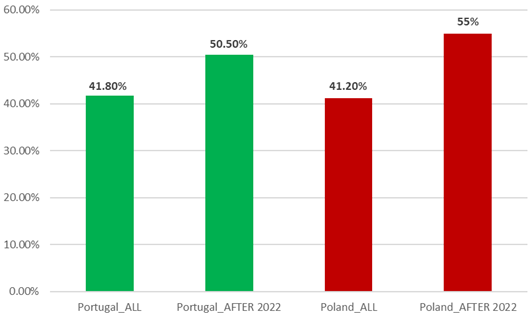
For the entire group of Poland-led projects (Poland_ALL), 29 out of 68 (41.1%) have a separate web presence, while the remaining 39 (58.9%) do not. Similar proportions are observed in projects led by Portuguese institutions (Portugal_ALL), since 64 out of 153 (41.8%) do have a separate web presence, and the remaining 89 (58.2%) do not (58.2%).
After controlling for project’s end date by focusing on projects whose conclusion was due on 1 January 2022 or later, initiatives with a separate web presence now constitute the majority: 53 out of 103 (51.4%) in Portugal (Portugal_AFTER 2022), and 23 out of 42 (54.8%) in Poland (Poland_AFTER 2022). The improvement is appreciable yet moderate, since a sizeable number of more recent projects still lack the web presence expected by the European Commission as part of their communication activities.
4.2 Social media
Figure 2 graphically represents the proportion of projects with and without social media presence for Portugal-led and Poland-led projects, including results obtained when filtering out older projects. Among all projects led by Portuguese institutions (Portugal_ALL), 68 out of 153 have a social media presence (44.4%). The proportion increases significantly when focusing exclusively on the most recent projects (Portugal_AFTER 2022): 52 out of 102 projects concluding after 1 January 2022 possess at least one social media account (51%). For Poland-led projects, only 20 out of 68 initiatives have social media presence (Poland_ALL), which represents a meagre 29%. In this case, controlling for project’s end date (Poland_AFTER 2022) has no effect, since a similar proportion is found (28.5%; 12 out of 42 projects). This is an ostensible difference that may be indicative of underlying distinct science communication practices across the two national contexts.
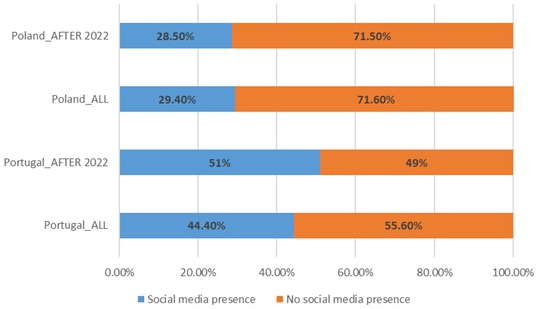
Table 2 reports the results regarding the social media channels being used by projects.
|
Portugal |
Poland |
|
|
Total projects with SM accounts |
68 (44.4%) |
20 (29%) |
|
With more than one SM account |
49 (72% of all projects with social media presence) |
14 (70% of all projects with social media presence) |
|
Twitter (now, X) |
51 (75%) |
14 (73.6%) |
|
Average followers |
411 |
505.9 |
|
|
28 (41.2%) |
13 (68.4%) |
|
Average followers |
715.1 |
588.4 |
|
|
37 (54.4%) |
11 (52.6%) |
|
Average followers |
628.1 |
728.2 |
|
Youtube |
29 (42.6%) |
8 (42.1%) |
|
Average subscribers |
57.8 |
19.8 |
|
|
13 (19.1%) |
3 (15.7%) |
|
Average followers |
213.9 |
35.5 |
|
Other |
2 (2.9%) |
0 |
| Note:
percentages
given
in
brackets
correspond
to
the
proportion
of
projects
using
the
social
media
channel
out
of
all
research
projects
with
social
media
presence.
Number
of
followers
as
per
date
of
data
collection
(April–May,
2025). | ||
Despite the wide divergences in the uptake of specific social media platforms, the proportion of projects that are active on more than one is relatively similar — and equally high — for Poland-led and Portugal-led projects. This suggests that, as far as PBSC in EU-funded projects is concerned, the prevailing communication strategy involves the mobilisation of multiple social media channels simultaneously.
Interestingly, Twitter (now, X) is the most frequently used social media channel in both groups, even though it is not the one with the largest number of followers — hence, the greatest potential impact — for either Poland-led or Portugal-led initiatives. Facebook emerges as the social media platform with the greatest number of average followers in Portugal-led initiatives, whereas LinkedIn holds that position in the case of Poland-led ones. Instagram remains marginal overall, with marked disparities in terms of followers between Poland-led and Portugal-led initiatives. In turn, Youtube performs the worst in terms of follower count — and potential impact — for both groups, even though nearly half of all projects maintain a Youtube channel. Evidence of the use of social media platforms other than these ‘major’ ones (Flickr and Bluesky) was found in only two Portugal-led projects.
4.3 Other outreach initiatives
As seen above, fewer than half of the projects under examination possess a separate web presence or maintain social media accounts. Additional outreach activities that are traceable online are even more marginal, as reported in Table 3.
|
Portugal |
Poland |
|
|
Total projects conducting outreach activities |
43 (28.1% of Projects_ALL) |
17 (25% of Projects_ALL) |
|
Recent projects conducting outreach activities |
37 (36.3% of Projects_AFTER 2022) |
15 (35.7% of Projects_AFTER 2022) |
| Type of outreach activities (Projects_ALL)
| ||
|
Press releases |
10 (23.2% of all Portugal-led projects conducting outreach activities) |
2 (12.5% of all Poland-led projects conducting outreach activities) |
|
Press clippings |
12 (27.9%) |
5 (31.2%) |
|
Brochures, leaflets, and similar |
12 (27.9%) |
4 (25%) |
|
Podcasts |
6 (13.9%) |
1 (6.6%) |
|
Newsletters |
11 (25.5%) |
6 (37.5%) |
|
Public events (for the general public) |
17 (39.5%) |
4 (25%) |
|
Interviews with journalists/ communication experts |
14 (32.5%) |
3 (12.5%) |
|
Other |
15 (34.8%) |
0 |
Whether we consider the whole population of research projects (Projects_ALL), or focus exclusively on those with a more recent end date (Projects_AFTER 2022), outreach activities targeting the citizens and the media are rare. Once again, this is a far cry from the European Commission’s policy dispositions concerning the communication of projects, since it clearly indicates that involving multiple audiences is mandatory and that a ‘two-way exchange’ is to be favoured as well [European Commission, 2019]. Overall, Portugal-led projects have a more balanced representation of outreach activities compared to their Poland-led counterparts, the latter concentrating their efforts on newsletters and press clippings (37.5% and 31.2% of all projects engaging in outreach, respectively). By contrast, the type of activity that predominates in Portugal-led projects is ‘Public event’ (i.e., live events targeting the general public or specific subgroups), utilised by 39.5% of all projects with outreach activities. Moreover, Portugal-led projects show a greater tendency to deploy different communication and engagement formats (grouped under the category ‘Other’), including, inter alia, theatre plays, op-eds, or the editing of newspaper supplements. Lastly, consolidated popularisation formats, such as podcasts, still represent a minority of outreach activities in both groups. Nor are strategies and activities targeting the media (e.g. press releases and interviews) used profusely.
4.4 Relationship between funding and prevalence of communication activities
With the purpose of assessing the influence of funding on the propensity of research consortia to develop a separate online identity for the project, and to engage in further outreach activities, a series of binary logistic regressions were conducted.5 Total funding was defined as the independent continuous variable, and Web presence, Social media presence, and Outreach, respectively, were treated as dependent binary variables, adopting a value of 1 when there was a web presence, at least one social media profile, or at least one outreach activity, and 0 otherwise.
The results are presented in Table 4. For the analysis to be meaningful, we focused exclusively on Projects_AFTER 2022, leaving aside those that concluded prior to 1 January 2022. Including them would introduce an important distortion: as mentioned earlier, our analysis is highly sensitive to project’s end date, given that websites are often discontinued once the project ends, and the coding of outreach activities crucially hinges on whether there is a separate web presence from which evidence can be taken.
| Country | Odds ratio | McFadden R2 | p-value | |
| Web presence | Portugal | 1.11 | 0.030 | 0.086 |
| Poland | 1.17 | 0.074 | 0.079 | |
| Social media presence | Portugal | 2.22 | 0.191 | 0.006 |
| Poland | 1.13 | 0.067 | 0.071 | |
| Outreach activities | Portugal | 1.17 | 0.070 | 0.015 |
| Poland | 1.14 | 0.071 | 0.061 | |
While all the relationships were positive, only a minority are significant at the conventional p-value < α (0.05). Results for Poland must consequently be treated tentatively, but they nevertheless indicate a potential influence of funding on communication activities. By contrast, the results for Portugal are more clear-cut: except for Total funding_Web Presence, the remaining regressions are statistically significant (p-value < α (0.05)), positive, and indicate an influence from weak (Total funding_Outreach) to moderate (Total funding_Social Media Presence). Portugal-led projects display greater sensibility towards increases in funding with regard to their communication activities — especially when setting up social media channels and conducting additional outreach activities — while it remains a task for future research to elucidate why funding is only a marginally significant factor for implementing C&D WPs in EU-funded projects led by Polish institutions.
5 Discussion and conclusion
The analysis above reveals striking similarities, but also notable differences, in the communication of science conducted within the framework of research projects led by Polish and Portuguese institutions and funded under Horizon 2020.
The most salient finding is that projects engaging in communication activities constitute a minority. Specifically, fewer than half of research projects — both Poland-led and Portugal-led — undertake communication activities that result in the creation and maintenance of a separate identity for the project. Outreach activities targeting citizens and the media occur even less frequently. However, after controlling for the effect of the project’s end date, the situation improves slightly, particularly in the case of Portugal-led projects. Among initiatives with an end date of 1 January 2022 or later, Portugal-led projects with a web or social media presence constitute the majority. By contrast, controlling for this factor in Poland-led projects proves relevant only to web presence, and neither to social media presence nor to outreach activities.
There are notable commonalities between the two groups of projects in their use of social media platforms. Twitter (now, X) is the most widely used platform, a finding consistent with the historic preference for the microblogging site by researchers [Torres-Salinas et al., 2024], and which may consequently indicate that ‘dissemination’ may be favoured to the detriment of ‘communication’ within the framework of Communication and Dissemination Work Packages in EU-funded projects. At the other end of the spectrum, Instagram is gradually gaining traction, although it must be noted that this study focuses on H2020 projects — i.e. initiatives that might have begun well before Instagram became an established platform. Facebook and LinkedIn have the highest average number of followers — and thus the greatest potential impact — for Portugal-led and Poland-led projects, respectively. This pattern may reflect distinct approaches to the communication of the project and its outcomes in each national context: Poland-led projects may prioritise ‘stakeholders’ and global professional communities, which are more easily reachable through LinkedIn; whereas Portugal-led projects may favour engaging non-expert audiences and demonstrating greater sensitivity to local issues, as evidenced by the observed frequent use of Portuguese for communication in many Facebook pages. Finally, there is only marginal uptake of social media platforms beyond the ‘major’ ones.
Outreach initiatives are even less generalised than web and social media tools in the communication of EU-funded projects led by Portuguese and Polish institutions. With the proviso that not all the outreach activities coded in this study for can genuinely be classified as ‘dialogical’ or ‘participatory’ science communication (although several can), their relatively low incidence across projects may indicate that such communication formats are more costly, more challenging to implement, and, in some cases, may produce unexpected or undesirable outcomes [Biermann et al., 2025; Koivumäki & Wilkinson, 2020].
Alongside the distinct patterns in social media use, outreach activities represent the most pronounced difference between Poland-led and Portugal-led projects in the communication of EU-funded projects. While the proportion of projects implementing outreach activities is broadly comparable (even when controlling for project’s end date), the preferred formats differ markedly. Portugal-led projects deploy a broader spectrum of communication activities, a phenomenon consistent with prior findings on the diversity of public engagement activities conducted by Portuguese research institutions [Entradas et al., 2020].
Finally, our analysis reveals a mixed influence of funding on the propensity of research consortia to develop a separate identity for projects (comprising both a website and one or more social media accounts), and to engage in additional outreach activities. While the effect of funding is positive across the board (with odds ratios being positive in all models), it is statistically significant only for Portugal-led projects. For Poland-led initiatives, by contrast, binary logistic regression models are not statistically significant for any of the dependent variables, thereby signalling a lack of sensitivity to funding levels across the full range of communication activities.
The results from this study are consistent with prior research focusing on EU-funded projects’ communication outputs [Arboledas-Lérida, 2025; Gertrudix et al., 2021; López-Pérez & Olvera-Lobo, 2019]. The general pattern emerging from all these analyses is that the communication of the project and its outcomes is not the prevailing tendency, legal obligations notwithstanding. Furthermore, the effect of funding on the propensity of research consortia to implement communication activities remain uncertain, since existing studies report effects ranging from marginal to moderate in some cases [Arboledas-Lérida, 2025], and no effect in others [Gertrudix et al., 2021]. This paper points simultaneously in both directions, since positive effects of funding has proved statistically significant for one group of projects (Portugal-led) but not for the other (Poland-led). Consequently, the findings allow us to infer that there may be factors affecting the communication of EU-funded projects that are not directly related to the institutional setting created by the European Commission through its research funding schemes and its support for science communication.
More specifically, it may be tentatively suggested that funding earmarked to communication activities within the framework of EU-funded projects interacts in complex ways with pre-existing ‘science communication landscapes’ in Portugal and Poland. Projects led by institutions in these two countries not only adopt distinct communication patterns — above all, in terms of social media use and the types of outreach activities implemented — which are not immediately explained by either available funding (average funding levels are comparable) or differentiated requirements according to the type of grant (the ‘legal obligation’ to communicate the project applies across all funding pillars and project types under Horizon 2020); but they also show distinct sensitivity to funding levels. This latter finding invites reconsideration of the implications of Mejlgaard et al.’s [2012] distinction between Poland’s ‘developing’ [see also Gajewski, 2022] and Portugal’s ‘developed’ [Entradas et al., 2020, for an historical overview] science communication landscapes. As far as PBSC is concerned, a ‘developed’ science communication may imply the existence of structural conditions that enable researchers and academic institutions to leverage EU funding for communication purposes. This may account for the greater sensitivity to funding observed in Portugal-led projects. By contrast, Polish organisations may be struggling with unique challenges associated with its ‘developing’ science communication landscape that cannot be addressed solely through the allocation of funding to C&D WPs. Unravelling the specific circumstances hindering the communication of EU-funded projects in Poland is a task for future research. A useful starting point would be to survey the perceptions and experiences of communication experts in Poland involved in the communication of Horizon 2020 and Horizon Europe research projects.
As evidence accumulates suggesting that research consortia in EU-funded projects are not consistently fulfilling their ‘legal obligation’ to communicate the project and its outcomes, concerns may be raised regarding the appropriateness of such a policy approach to the otherwise laudable purpose of promoting science communication across the European Research Area. It certainly begs the question of why the inclusion and development of a viable plan of communication became legally binding for consortia in the first place, given that the supervisory mechanisms required to ensure compliance seem not to be in place. With the benefit of hindsight, it may also be argued that potentially detrimental effects arise from the multiplication of research projects with attached communication responsibilities [see Koivumäki & Wilkinson, 2020] — a ‘fragmentation’ [per Koivumäki & Wilkinson, 2020] of science communication that the European Commission’s policy orientation did not anticipate and may now be exacerbating. The current negotiations on the next Framework Programme for Research and Innovation provide a window of opportunity to reconsider — and even radically transform — the ‘institutionalisation’ [Simone, 2018] of science communication through grant funding at the European level. Ideally, this would involve adopting an approach that better caters to the specific needs of different projects and consortia in relation to science communication, while acknowledging differences in project scope, grant types, and the feasibility of sustaining communication efforts throughout the project lifecycle.
The paper is not without shortcomings: on the one hand, the degree of generalisability of results is limited because the comparative case study includes only two countries (Portugal and Poland) and one funding scheme (Horizon 2020). Future research should expand our findings by analysing communication activities in projects funded under Horizon Europe and led by institutions from countries not examined so far. On the other hand, establishing a funding threshold as selection criterion necessarily narrows the scope of the enquiry. Partial automation of the coding process would make it possible to include all research projects led by institutions in particular countries, irrespective of funding levels. However, unlike the previous constraint, this limitation does not substantially affect our findings: if a sizeable proportion of projects receiving more than €1 million in funding do not undertake communication activities, it is unlikely that initiatives with even less funding would engage in substantial science communication.
Despite these limitations, the author is confident that this study will help science communication scholars recognise the importance of PBSC, and will stimulate reflection on the appropriateness of making science communication activities mandatory in competitive research funding schemes.
References
-
Arboledas-Lérida, L. (2025). Communication of science in research projects funded under Horizon Europe and led by Spanish institutions. Revista Española de Documentación Científica, 48(3), 1744. https://doi.org/10.3989/redc.2025.3.1744
-
Banse, L., Fischer, L., & Hendriks, F. (2025). Tug of war or pulling together? Comparing reciprocal task role expectations of professional communicators and scientists in organizational science communication. International Journal of Strategic Communication. https://doi.org/10.1080/1553118x.2025.2566919
-
Besley, J. C., O’Hara, K., & Dudo, A. (2019). Strategic science communication as planned behavior: understanding scientists’ willingness to choose specific tactics. PLoS ONE, 14(10), e0224039. https://doi.org/10.1371/journal.pone.0224039
-
Biermann, K., Banse, L., & Taddicken, M. (2025). “It’s mostly a one-way street, to be honest”: the subjective relevance of public engagement in the science communication of professional university communicators. JCOM, 24(01), A03. https://doi.org/10.22323/2.24010203
-
Conceição, C. P., Ávila, P., Coelho, A. R., & Costa, A. F. (2020). European action plans for science-society relations: changing buzzwords, changing the agenda. Minerva, 58(1), 1–24. https://doi.org/10.1007/s11024-019-09380-7
-
Entradas, M., Junqueira, L., & Pinto, B. (2020). The late bloom of (modern) science communication. In T. Gascoigne, B. Schiele, J. Leach, M. Riedlinger, B. V. Lewenstein, L. Massarani & P. Broks (Eds.), Communicating science: a global perspective (pp. 693–714). Australian National University Press. https://doi.org/10.22459/CS.2020
-
European Commission. (2019). H2020 Programme. AGA — Annotated Model Grant Agreement. Version 5.2. https://ec.europa.eu/research/participants/data/ref/h2020/grants_manual/amga/h2020-amga_en.pdf
-
Fecher, B., & Hebing, M. (2021). How do researchers approach societal impact? PLoS ONE, 16(7), e0254006. https://doi.org/10.1371/journal.pone.0254006
-
Gajewski, W. (2022). Beyond the needs of science — can opennes and reflexivitiy push the Polish science communication further? JCOM, 21(04), C05. https://doi.org/10.22323/2.21040305
-
Gertrudix, M., Rajas, M., Romero-Luis, J., & Carbonell-Alcocer, A. (2021). Comunicación científica en el espacio digital. Acciones de difusión de proyectos de investigación del programa H2020. El Profesional de la Información, 30(1), e300104. https://doi.org/10.3145/epi.2021.ene.04
-
Koivumäki, K., & Wilkinson, C. (2020). Exploring the intersections: researchers and communication professionals’ perspectives on the organizational role of science communication. Journal of Communication Management, 24(3), 207–226. https://doi.org/10.1108/jcom-05-2019-0072
-
López-Pérez, L., & Olvera-Lobo, M.-D. (2019). Participación digital del público en la ciencia de excelencia española: análisis de los proyectos financiados por el European Research Council. El Profesional de la Información, 28(1), e280106. https://doi.org/10.3145/epi.2019.ene.06
-
Mejlgaard, N., Bloch, C., Degn, L., Nielsen, M. W., & Ravn, T. (2012). Locating science in society across Europe: clusters and consequences. Science and Public Policy, 39(6), 741–750. https://doi.org/10.1093/scipol/scs092
-
Palmer, S. E., & Schibeci, R. A. (2014). What conceptions of science communication are espoused by science research funding bodies? Public Understanding of Science, 23(5), 511–527. https://doi.org/10.1177/0963662512455295
-
Reale, E. (2017). Analysis of national public research funding (PREF) — Final report. European Commission. Joint Research Centre. https://doi.org/10.2760/19140
-
Simone, A. (2018). Steering research and innovation through RRI. What horizon for Europe? JCOM, 17(03), C02. https://doi.org/10.22323/2.17030302
-
Torres-Salinas, D., Docampo, D., Arroyo-Machado, W., & Robinson-Garcia, N. (2024). The many publics of science: using altmetrics to identify common communication channels by scientific field. Scientometrics, 129(7), 3705–3723. https://doi.org/10.1007/s11192-024-05077-1
-
Weingart, P., Joubert, M., & Connoway, K. (2021). Public engagement with science — origins, motives and impact in academic literature and science policy. PLoS ONE, 16(7), e0254201. https://doi.org/10.1371/journal.pone.0254201
-
Wilkinson, C., Milani, E., Ridgway, A., & Weitkamp, E. (2023). Motivations and deterrents in contemporary science communication: a questionnaire survey of actors in seven European countries. International Journal of Science Education, Part B, 13(2), 131–148. https://doi.org/10.1080/21548455.2022.2139165
Notes
1. Research and Innovation Framework Programmes are the main funding instrument leveraged by the European Commission to finance research activities — rather than institutions — across the European Research Area. Horizon 2020 ran from 2014 to 2020, and was the single funding programme for research and technological development with the largest budget on record, only to be outdone by its successor, Horizon Europe (2021–2027).
2. In fact, in the Model Grant Agreement for Horizon 2020 [European Commission, 2019], the European Commission states that it expects communication activities to be ‘effective’ as well as ‘coherent’ and ‘strategic’, to address multiple audiences, and to showcase both the project’s goals and the EC’s general policy orientation (including the enhancement of economic competitiveness and the solving of societal problems being sought through grant funding for research, among others).
3. That Spain has been the favoured case study so far [Arboledas-Lérida, 2025; Gertrudix et al., 2021; López-Pérez & Olvera-Lobo, 2019] may result from the Spanish scientific system’s conspicuous dependence on European funding. In terms of participation and funding attraction in both Horizon 2020 and Horizon Europe, Spain has performed much better than what could be expected according to the country’s scientific capabilities (as proxied by total expenditure in R&D in proportion to GDP). It has thus been postulated that the country’s science communication landscape has been profoundly influenced by the communication of EU-funded projects [Gertrudix et al., 2021].
4. See details in ‘Horizon 2020 country profiles’. Available at: https://research-and-innovation.ec.europa.eu/statistics/framework-programme-facts-and-figures_en.
5. Binary logistic regression is the most appropriate statistical technique when, as in our models, the independent variable is continuous (‘Total funding’) while the dependent variables are binary (Yes/No). Results are to be interpreted as the odds that the dependent variable changes for a one-unit increase in funding. Since there are enough events per model (e.g., Poland-led projects with social media presence), our results are unlikely to be driven by sparse-data bias.
About the author
Luis Arboledas-Lérida is a postdoctoral researcher currently in a fellowship granted by the NAWA Agency under its 6th Ulam NAWA Program. Since the beginning of his doctoral studies, he has published 12+ research papers in internationally renowned journals, such as Public Understanding of Science, Minerva, Critical Sociology, or Capital & Class. Luis’s research interests cover the entire spectrum of science and technology as a historically determined social practice — from the economic determinants of ‘knowledge-intensive commodities’ to the propagandistic character of much public communication of science. The author is currently conducting a study on the social division of labour within academic laboratories and research groups, and how it may affect the predisposition towards, and actual involvement in, public communication activities on the part of research workers (i.e., Ph.D. researchers, postdocs and other Ph.D. holders in non-managerial positions).
E-mail: luis.arbooledas@gmail.com
Supplementary material
Available at https://doi.org/10.22323/161220260322080116
Annex I. Complete list of research projects
Annex II. Coding sheet. H2020 Portugal-led & Poland-led research projects: coding categories and
instructions