
1 Introduction
Citizen science (CS) is increasingly recognized as a valuable approach across disciplines, offering both scientific and societal benefits [Brouwer & Hessels, 2019; Fraisl et al., 2022; Ruiz-Mallén et al., 2016]. Broadly defined as ‘a way to actively involve citizens in scientific endeavours that generate new knowledge or understanding’ [Haklay et al., 2021], the scope of CS ranges from scientist-led to citizen-initiated projects [Land-Zandstra et al., 2021]. It promises improved data quality, greater societal relevance of research, and inclusive, dialogic science communication that fosters mutual knowledge literacy, learning, and public trust [Brouwer & Hessels, 2019]. Motivations for participation vary — from enthusiasm for science, a need for (locally) relevant knowledge to frustration or concerns about conventional scientific approaches [Rotman et al., 2012; Wagenknecht et al., 2021]. This is especially evident in CS initiatives undertaken in contested contexts related to the living environment; settings where tensions arise over what constitutes valid knowledge, how scientific evidence is used and whose interests are subsequently served. Here, citizen scientists often perceive “conventional science” done by institutions in their living environment as distant, biased, or incomplete, for example in research focused on air quality [Allen, 2018; Vegt, Elberse, Rutjens et al., 2023] or noise pollution [Berti Suman & van Geenhuizen, 2020; Vegt et al., 2025]. These bottom-up CS efforts, described by Berti Suman and Alblas [2023] as ‘reactive, uninvited citizen science’, challenge institutional expertise by producing independent data and insights. This study will focus specifically on these specific CS contexts.
Two perspectives often guide the analysis of CS: the productivity view, which highlights citizens’ contributions to knowledge production, and the democratization view, which focuses on how CS challenges scientific authority and integrates public perspectives into research and policy [Sauermann et al., 2020]. These views are not mutually exclusive; many studies operate in the space between them [Yu et al., 2025]. This study positions itself within that middle ground as well, by focusing on the experiences of individual citizen scientists, to learn more about how they perceive both the production of knowledge, including their role therewith, and the way the knowledge is used in contested CS contexts in the living environment.
Understanding these individual perspectives is pivotal to improving the organization of CS and understanding how it can strengthen science-society relations. This is particularly relevant in CS projects related to the living environment, where scientific, local, and experiential knowledge intersect. Beyond generating data, CS creates a space where different knowledge forms are negotiated and made meaningful from diverse perspectives. In this context, science communication in CS is not merely a supporting tool, but a constitutive part of the process through which knowledge is co-produced and legitimacy negotiated [Davies, 2022; Wagenknecht et al., 2021]. As the Latin root communicare (‘to share’ or ‘to make common’), suggests, science communication involves more than just transferring information: it also involves making knowledge ‘common’; e.g., accessible, relevant, and meaningful across perspectives. Therefore, in contentious, value-laden CS contexts, where the boundaries between science and society are blurred, understanding how shared meaning is negotiated becomes particularly important.
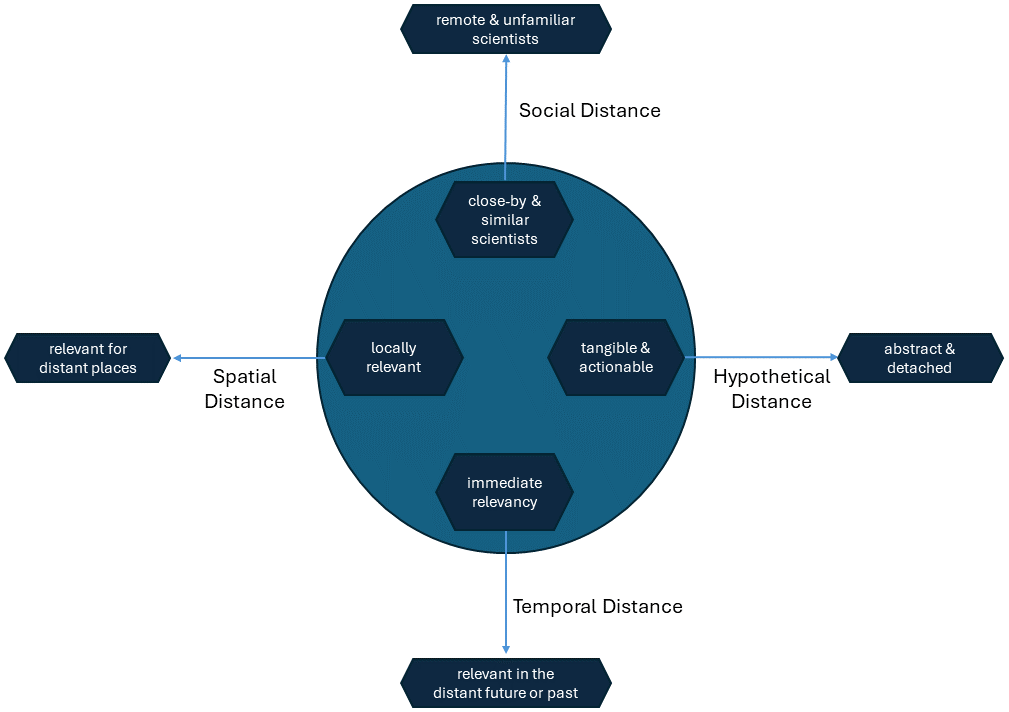
To explore this, we utilize the Psychological Distance to Science (PSYDISC) framework [Većkalov et al., 2024]. PSYDISC was developed as a domain-general framework for understanding trust in science and science scepticism. Recent studies indicate that strategies aimed at reducing psychological distance across its four dimensions may help support trust in science in various ways [Rutjens & Hornsey, 2025; Većkalov et al., 2025]. As a framework grounded in social psychology, PSYDISC is suitable to apply to the current research focus on individual-level perceptions, examining how people personally experience and evaluate science across four dimensions: social (are scientists relatable or remote?), spatial (is science locally relevant?), temporal (is science relevant now or in the distant future or past?), and hypothetical (is science tangible and actionable, or abstract?).
With this study, we wish to contribute to ongoing efforts to clarify the psychological dynamics at play in CS contexts and to make trust-building more actionable in participatory settings [Skarlatidou et al., 2024]. This research, therefore, tries to bridge disciplinary gaps, by connecting insights from social psychology with broader science and technology studies (STS) perspectives [Mahr et al., 2018]. By foregrounding individual citizen scientists’ reflections on psychological proximity and distance in different scientific approaches, this research engages with productivity and democratization views as well: participants reflect on how they did, or did not, feel close to science while they were contributors to scientific knowledge production themselves, as well as how scientific knowledge from either CS or conventional sources was legitimized, applied, or dismissed. As such, drawing on three Dutch CS case studies in the living environment, the current work aims to explore how participatory practices intersect with citizen scientists’ sense of proximity or distance to locally relevant science, and how they may foster (dis)trust in locally relevant science. In the following sections we provide a more in-depth exploration of the literature relevant to the introduced concepts, followed by the formulation of research questions that align with the aims of the current study, and provide further details regarding the case studies.
2 Theoretical framework: psychological distance to policy-relevant science and citizen science
The PSYDISC framework, based on Construal Level Theory [CLT; Trope & Liberman, 2010], highlights how individuals perceive the relevance and accessibility of science [Rutjens, 2025; Većkalov et al., 2024]. CLT is regularly applied in science communication research — particularly in climate change contexts — to examine how reducing psychological distance can increase message relevance and engagement [Wang et al., 2021; Duan et al., 2022]. As explained earlier, it identifies four interconnected dimensions: social distance (the perceived difference or remoteness between oneself and scientific actors), spatial distance (how geographically distant science is perceived), temporal distance (how far science is perceived in time) and hypothetical distance (the perceived abstractness or detachedness of science) — see Figure 1. Low distance means scientists or science is experienced as socially relatable, relevant and near in space and time, as well as tangible and actionable [Većkalov et al., 2024]. Psychological distance and psychological proximity can be interpreted as opposite ends of the same continuum.
2.1 Psychological distance and trust
The PSYDISC framework was developed as a way to understand science rejection across different domains using a malleable, domain-general predictor. Recent research suggests that strategies emphasizing proximity — through the four elements of psychological distance to science — could be employed as a way to enhance trust in science [Rutjens & Hornsey, 2025; Većkalov et al., 2025]. Trust in science, however, is a multifaceted concept influenced by various interrelated factors, such as the interplay between source characteristics, message content, and personal beliefs [Hendriks et al., 2016]. For instance, individual tendencies, emotional responses, and general trust in scientific systems all contribute to how science is perceived [Bedessem et al., 2023]. When it comes to trust in scientists specifically, stereotypes and perceptions of their benevolence, ability, integrity, and morality are key factors [Besley et al., 2021; Gligorić et al., 2025; Rutjens & Heine, 2016], along with communication style and perceived warmth [Fiske & Dupree, 2014]. Moreover, trust in scientists may extend to other actors and media that reference them, suggesting a potential spillover effect in science communication [Brewer & Ley, 2013]. CS projects, particularly in contested contexts where trust is an issue, provide a valuable setting to examine how trust is negotiated through psychological distance. They help identify which aspects of CS, e.g., project design or citizen-scientist interaction, foster or hinder perceptions of proximity to and trust in locally relevant science as it is experienced in real-world settings.
2.2 Citizen science and PSYDISC
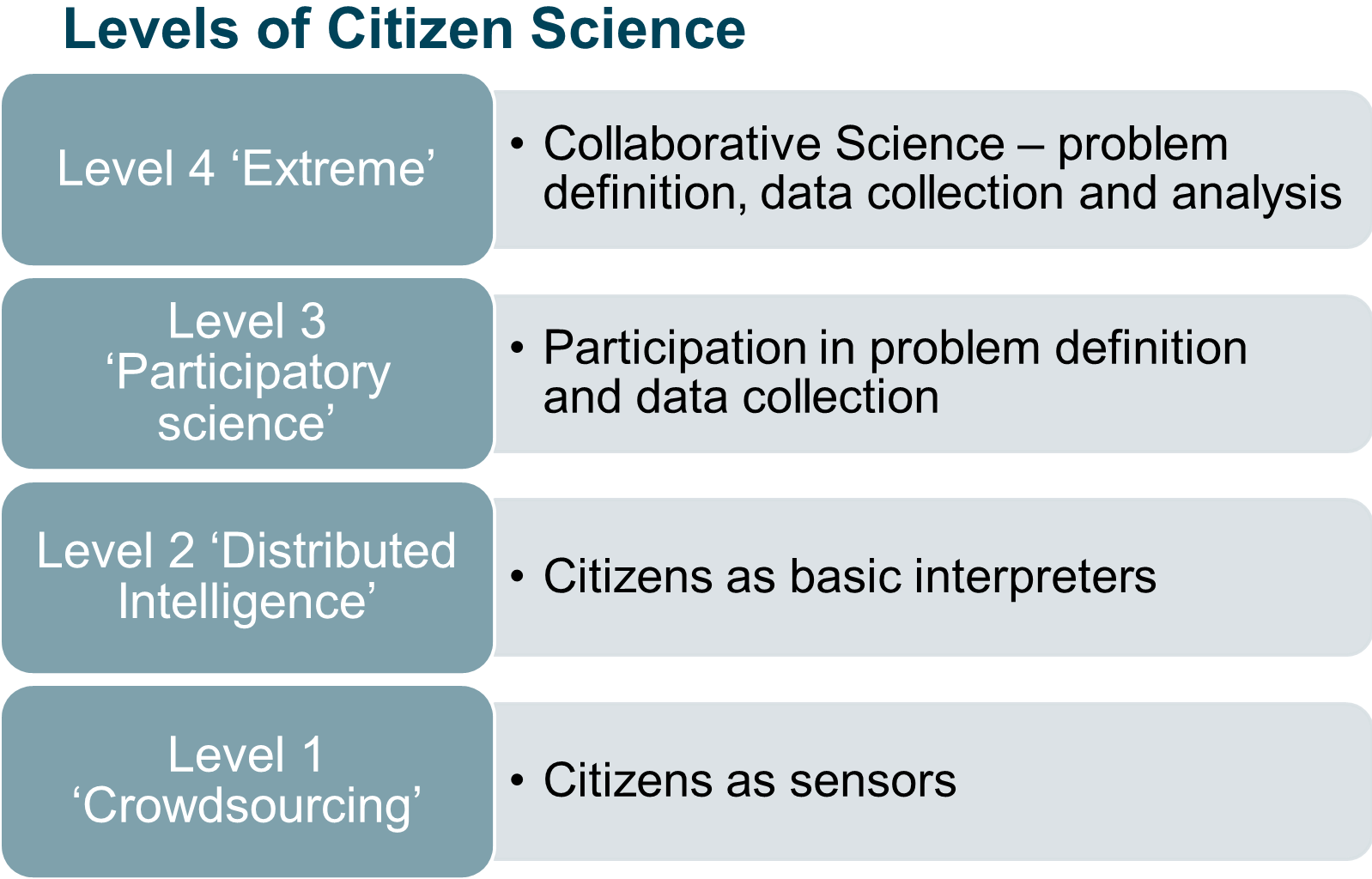
The CS projects examined in this study are marked by high levels of collaboration between citizens and scientists. Collaboration in CS can take many forms, including co-designing research questions, developing methodologies, and collecting data [Haklay, 2013, — see Figure 2]. Recent technological advances, such as sensors and smartphone applications, have further enabled widespread public participation, particularly in environmental research [Mazumdar et al., 2018]. The most participatory forms of CS (Levels 3 and 4) engage citizens throughout the whole research process.
In such settings, the CS approach is likely to foster psychological proximity to the science that is locally relevant. What remains to be understood, however, is how this proximity comes about, and which specific features of the CS project contribute to it. The high level of involvement and collaboration in CS projects provides a rich context for examining all four PSYDISC dimensions, as participants engage with science in ways that likely relate to each of them. CS projects such as those analysed here are therefore particularly well-suited for exploring how psychological distance is shaped in relation to different scientific approaches, by citizens who have encountered both conventional and participatory approaches. Moreover, by unpacking how individuals interpret and evaluate science through personal experience, this study also sheds light on how meaningful dialogue and collaboration can be fostered between citizen scientists and representatives of institutional science [Irwin, 1995]. This aligns with broader shifts in science communication: from deficit models, which largely assume public ignorance, to dialogue and engagement models that emphasize mutual learning, shared authority, and respect for diverse knowledge systems [Bucchi & Trench, 2021; Davies, 2022; Holford et al., 2023].
2.3 Conceptual clarifications
In this study, in relation to locally relevant science, we distinguish between psychological distance, trust, trustworthiness perceptions, and the object of trust. As described earlier, psychological distance is about how science and scientific actors are experienced in relation to the self; it being (socially) relatable, locally and temporally relevant, tangible and or actionable (or not) [Većkalov et al., 2024]. Trust refers to a willingness to rely on said scientific knowledge under conditions of uncertainty, whereas trustworthiness refers to perceived qualities of the trustee, such as integrity, benevolence, ability [Mayer et al., 1995], and openness — a more recently conceptualization as a distinct trustworthiness dimension [Besley et al., 2021]. Trust judgments can be directed at multiple things, including individual scientists, scientific institutions, approaches or a body of knowledge. We therefore use trust in locally relevant science as an umbrella term, while specifying the object of trust where relevant in the analysis.
Conceptually, we treat psychological distance as a contextual condition that shapes how science is experienced, and trustworthiness perceptions as evaluative judgments that inform trust. Importantly, references to experienced psychological distance do not imply a lack of scientific literacy or a general distrust of science in participants. Rather, perceived distance reflected how science was experienced in relation to participants’ lived environment, concerns, and opportunities for engagement, often articulated through comparisons between CS and other scientific approaches, discussed during the interviews. Finally, we use the term conventional science to refer to locally relevant research that relies on established disciplinary frameworks and methods (such as air quality or noise modelling). This type of research is primarily conducted by professional scientists within institutional settings and does not directly involve citizens in its research process. Importantly, we use the terms conventional and citizen science descriptively rather than normatively. They are intended solely to distinguish between different approaches to doing science, not to suggest that one is inherently better or worse than the other.
In short, this the study explores whether and how CS participation shapes individuals’ psychological distance to science. It also examines how this (reduced or reinforced) distance relates to trust in locally relevant science in various ways. Adopting the perspective of individual citizen scientists, the study situates their experiences within broader debates on productivity and democratization in science. It addresses the following research questions:
-
Which factors contribute to citizen scientists’ experience of psychological distance to science in CS contexts towards the
- CS approach
- Conventional scientific approach
- How do citizen scientists experience relationships between psychological distance and trust in the scientific approaches involved in the case studies?
3 Methodology
In this study, three Dutch CS case studies are analysed: Farmers and Neighbours (project 1),1 Citizen monitoring network ‘train traffic in America’ (project 2)2 and Measuring Noise and Experience around Schiphol Airport Together (project 3).3 The methodology involved a systematic qualitative analysis of interviews conducted with citizen scientists from these projects, focusing on the four elements of psychological distance.
The case studies are centered on residents measuring aspects of their living environment: one focused on air quality and two on noise pollution. All three projects fall in CS participation level category 3 or 4, which means that citizens were involved in (almost) all stages of the study. A common feature across these cases is that participants perceived the environmental issues they were studying as having a negative impact on their health, well-being and/or quality of life. Each case has previously been documented in separate reports and publications, addressing the project-specific research questions [Devilee et al., 2024; Vegt, Elberse, Rutjens et al., 2023; Vegt, Mabjaia et al., 2023; Vegt et al., 2025]. While this study partially draws on data collected for those studies, it reanalyses the material through a distinct PSYDISC lens.
3.1 Case studies overview and researcher positionality
Project 1 and 2 were mostly initiated by local residents in rural southern Netherlands. In both, the research institute (The Dutch National Institute for Public Health and the Environment, or ‘RIVM’) acted as an independent facilitator, providing scientific support while respecting community initiative. Project 3, by contrast, was a top-down initiative commissioned by the government and conducted in the Amsterdam metropolitan region. However, the project was designed as a co-creative process as well, with the RIVM and citizens jointly defining research questions, collecting data, and interpreting results. The collected citizen sensor data is publicly available on the ‘Measuring Together’-platform.4
- Project 1 ‘Farmers and Neighbours’: launched in 2019 to monitor air quality and odour nuisance, in this project both farming and non-farming residents participated. Two rounds of interviews were conducted after the report and final presentation of the project had been held and the study results had been made public; only those with non-farming participants, conducted between November 2021 and February 2022, were included here to maintain consistency across groups.
- Project 2 ‘Citizen monitoring network ‘train traffic in America’’: running from 2020 to early 2024, this project addressed railway noise. Citizens co-developed research questions and installed 18 sound meters throughout the village. They also collected experiential data on the impact of noise on daily life. Interviews were conducted in May 2023, after the results had been shared with participants but before formal report publication.
- Project 3 ‘Measuring Noise and Experience around Schiphol Airport Together’: started in 2021 and finalized in 2024, this project involved citizens in monitoring aircraft noise and its perceived effects. Participants helped define the scope of the research, contributed experiential data and put up sensors. Interviews were conducted between March and April 2024, after the public release of preliminary results.
3.2 Researcher positionality
The author team for this manuscript was not identical to the teams coordinating the separate CS projects [see Devilee et al., 2024; Vegt, Elberse, Rutjens et al., 2023; Vegt, Mabjaia et al., 2023; Vegt et al., 2025]. Beyond interviewing or coding, the first and second authors were also involved in the day-to-day coordination of Project 2. In Projects 1, and 3, the first author’s role was limited to conducting interviews with (a subset of) participants and leading the coding process. The second, third, and fourth authors were not involved in project coordination, interviewing, or coding in Projects 1 and 3. All authors had varying levels of prior experience with CS.
3.3 Participant recruitment and interview process
Participants were recruited from all three projects, resulting in a total of 34 interviews. See Table 1 for an overview of participants and characteristics.
|
Case study |
Total participants |
Mean age |
Male/female ratio |
Interview period |
|
| 1 |
Farmers and Neighbours |
11 |
63.2 |
5M / 6F |
Nov 2021 and Feb 2022 |
| 2 |
Citizen monitoring network ‘train traffic in America’ |
11 |
64.1 |
5M / 6F |
May 2023 |
| 3 |
Measuring Noise and Experience around Schiphol Airport Together |
12 |
62.3 |
6M / 6F |
March–April 2024 |
|
Total |
34 |
63.6 |
16M / 18F | ||
Interviews followed semi-structured guides tailored to each project’s focus. In project 1, questions primarily addressed trust between different actors and trust in the CS research and its results. Project 1 was conducted as the initial case study and informed subsequent refinement of the analytic focus for Project 2 and 3. In project 1, trust-related questions were guided by the trustworthiness dimensions outlined by Mayer et al. [1995]. Psychological distance and openness were not explicitly incorporated into the interview guide at the time of data collection for Project 1. However, during initial familiarization and early coding of the transcripts, participants repeatedly raised issues that aligned with psychological distance (e.g., perceived closeness to scientists and institutions, relevance of research outcomes, and research impact) as well as openness/transparency, which has also been identified as an additional component of trust in more recent work [Besley et al., 2021]. These themes therefore informed the development of the analytic framework and were incorporated as themes into the interview guides for Project 2 and 3, which included prompts on both relevant aspects of psychological distance and trust-related dimensions. The interview guidelines for all case studies are available in the Supplementary material.
When a researcher had an active operational role, e.g., frequent contact with CS participants, interviews with those participants were conducted by another researcher to avoid potential bias resulting from the researchers’ involvement and familiarity. All interviewers were employed at the RIVM at the time of data collection and were familiar with CS as a research context. Every interview was audio-recorded and transcribed verbatim.
3.4 Data analysis
Although interviews were conducted in three separate project contexts using project-specific guides [for additional details on project planning, see Devilee et al., 2024; Vegt, Elberse, Rutjens et al., 2023; Vegt, Mabjaia et al., 2023; Vegt et al., 2025], this study analysed the full set of interview transcripts using a shared analytic framework to enable cross-case comparison. We conducted a thematic analysis in MAXQDA [Braun & Clarke, 2023], combining deductive and inductive coding. The four PSYDISC dimensions (social, hypothetical, temporal, and spatial distance) served as the primary deductive coding categories. Trust in scientist-related codes were analysed primarily in relation to social distance, as they reflected perceived relational proximity to scientists and institutions (e.g., shared values and responsiveness). Additional subcodes (e.g., transparency, systemic distrust) were developed where they emerged consistently across interviews and were applied systematically across the dataset.
Coding was led by the first author of this paper, with additional coding and reviewing of codes done by additional RIVM researchers (see Table 2) to support reflexive engagement with the data and challenge interpretive assumptions. We followed Braun and Clarke’s [2023] reflexive thematic analysis approach, where coding is understood as an interpretive, researcher-driven process. As such, we did not calculate intercoder reliability coefficients, as these assume a single correct interpretation. Instead, we ensured analytic rigor through iterative discussion, independent review of coded material, and refinement of the coding framework, which are more in line with the epistemological foundations of this study. Discussions between researchers focused on exploring and refining code meanings, boundaries, and the interpretation of excerpts, rather than on achieving consensus or establishing a single “correct” reading of the data. To enhance transparency and allow readers to assess the grounding of our interpretations, we provide extensive illustrative quotations in the tables throughout discussing the results of this study.
|
Project |
Main coder |
Cross-checking / reviewing codes |
|
| 1 |
Farmers and Neighbours |
Author 1 |
Coder 2 (part of the CS project team) + Coder 3 (uninvolved in the CS project) |
| 2 |
Citizen monitoring network ‘train traffic in America’ |
Author 1 |
Coder 4 (part of the CS project team) + Coder 5 (uninvolved in the CS project) |
| 3 |
Measuring Noise and Experience around Schiphol Airport |
Author 1 |
Coder 4 (uninvolved in the CS project) + Author 2–4 (uninvolved in the CS project) reviewing interpretations & quotes |
| Note.
The
first
author’s
role
varied
across
case
studies.
In
Projects 1
and 3,
involvement
was
limited
to
interviewing
and
coding,
whereas
in
Project 2
the
first
author
was
also
involved
in
project
coordination
and
participant
contact.
For
participants
with
whom
the
first
author
had
regular
contact,
interviews
and
coding
were
conducted
by
other
researchers. | |||
3.5 Ethical considerations
All participants provided informed consent prior to taking part in the interview, including consent for audio recording and transcription. They were informed that their participation was voluntary and that they could withdraw from the study at any time without having to provide a reason. Anonymity and confidentiality were ensured throughout the research process. The coding process was collaboratively reviewed to minimize bias and ensure an accurate representation of participant perspectives. In line with the principles of CS, the citizen scientists who participated in the interviews will receive a summary of the research findings, and related publications will be shared with the communities involved.
4 Results
Analysis revealed how participants experienced psychological distance in CS contexts, towards different scientific approaches concerning their living environment, sometimes extending to (trust in) locally relevant science: encompassing scientists, scientific methods or results. In all case studies, citizen scientists indicated that their engagement in the CS projects was (at least partially) driven by dissatisfaction with conventional scientific approaches to the issue in the environment.
Although the PSYDISC framework guided the analysis, participants’ experiences did not always map neatly onto its dimensions, as is common in qualitative research. Where relevant, we make our analytic choices explicit to support clarity and transparency. In addition to this, some participants raised broader concerns related to systemic trust in locally relevant science, which fell outside the scope of PSYDISC. Although these themes may not map directly onto psychological distance from an individual perspective, they provide important contextual insight into trust in locally relevant science in CS settings. To preserve the analytical focus of this study, these themes are not examined in detail here. However, for transparency and context, additional analysis and illustrative quotes of coded segments on systemic trust-related themes are provided in the Supplementary material (sections 3.1 and 3.2).
4.1 Social distance
Social distance concerns the perceived relational closeness or similarity between citizens and professional scientists producing scientific knowledge. In the CS projects examined here, this dimension was primarily shaped through direct, interpersonal interaction with scientists.
Across cases, proximity seemed to function less as an outcome and more as a condition for evaluation: once scientists were interacted with, participants assessed how they communicated and responded to them. While PSYDISC conceptualizes social distance primarily in terms of perceived scientists’ dissimilarity and unfamiliarity, in our data it was primarily shaped through interactional processes between citizen scientists and researchers. In other words, interaction seemed to primarily serve as an entry point, while evaluative judgments determined whether this translated into perceived psychological closeness or reinforced distance. Social distance was therefore shaped by the perceived quality of scientists’ engagement rather than by contact or (dis)similarity alone. Participants’ reflections on these interactions were consistently aligned with established trustworthiness dimensions [integrity, ability, benevolence, and openness — Mayer et al., 1995; Besley et al., 2021], which we have therefore used to guide our coding. We conceptualize perceptions of individual scientists’ trustworthiness as an evaluative layer that emerges from experienced social proximity, rather than as a primary analytic framework. This analytical step is detailed in the subsection ‘Proximity to individual scientists: evaluating their integrity, ability, benevolence and openness’.
Although participants’ evaluations primarily concerned individual scientists, some extended these assessments to the institutions scientists represented. This spillover occurred when institutions were ‘encountered’ through direct, embodied interaction with their researchers rather than as abstract systems. How this spillover to institutional trust manifests in the data is discussed under a separate heading (‘from interactions with individual scientists to trust in scientific institutions’).
4.1.1 Proximity to individual scientists: evaluating their integrity, ability, benevolence and openness
Experiencing proximity to individual scientists prompted participants to assess scientists’ conduct and intentions in more evaluative terms. Perceived honesty and independence is categorized as integrity; expertise and competence as ability; attentiveness and care for participants’ interests as benevolence; and accessibility of scientists and their willingness to listen as openness. Quotes are organized per subtheme in the accompanying tables, with symbols indicating increased (+), reduced (−), or mixed (±) trust.
4.1.2 Integrity
With regard to integrity, participants’ perceptions were closely tied to how reduced social distance enabled insight into scientists’ independence and honesty (see Table 3). When scientists were experienced as approachable and willing to engage openly, participants felt better able to assess whether researchers acted independently and were not unduly influenced by external pressures. In such cases, reduced social distance strengthened perceptions of integrity and, in turn, confidence in the collaboration (1, 2).
When doubts arose, proximity functioned as a mechanism for verification: participants described how direct interaction allowed them to ask questions, seek clarification, and evaluate scientists’ impartiality firsthand (3). A recurring marker of integrity was whether citizen scientists experienced having a genuine say in the project; not only rhetorically, but in concrete decisions about research design or interpretation (4). While most participants described the scientists involved as neutral and professional, one participant in the government-commissioned case study remained uncertain about researchers’ independence, perceiving subtle steering of the project and questioning whether scientists were fully free to act autonomously (5).
|
Illustrative quotes: social distance — integrity |
Theme(s) |
|
| 1 |
So, I think it went well. I also think it was good that [researcher] acted as an independent chairperson for the group. I think it was conducted in a scientifically independent manner. — [PROJECT1]_03 |
Integrity + |
| 2 |
Well, I think you are truly independent. You don’t take sides. Just facts, and I trust that, to be honest. — [PROJECT2]_07 |
Integrity + |
| 3 |
There were moments when one of the agricultural entrepreneurs tried to influence the advisory group, and for a moment, it seemed like [researcher] might give in. But I spoke with them about it. Sometimes people need to be made aware of how others manoeuvre and manipulate. But we could always talk about it, which I really appreciated.’ — [PROJECT1]_05 |
Integrity ±, Ability + |
| 4 |
We were promised that we would set up the project together, without any predetermined outcomes — and that’s exactly how it went. In a pleasant way, too, because I got along well with [researchers]. It wasn’t just strictly project-based; there was also a more natural, informal connection. That way it didn’t feel like work at all. — [PROJECT3]_03 |
Integrity + Benevolence + |
| 5 |
I felt he was being steered a little too much. That was my impression. He had to operate within certain frameworks or assignments, and I could sense that at times. — [PROJECT3]_11 |
Integrity − |
4.1.3 Ability
Perceptions of scientists’ abilities were similarly mediated by proximity, particularly through communication practices that kept participants connected to the scientific process (see Table 4). Well-organized meetings, clear explanations, and structured engagement contributed to a sense that scientists were competent and professionally grounded, reinforcing confidence in their expertise (1, 2). Participants generally trusted scientists’ technical ability and research skills through these interactions (3, 4).
It was important for participants to receive regular updates from the scientists to maintain a sense of psychological proximity to the scientific process and its outcomes. Frequent communication helped keep the science relevant and ‘alive’ for participants (5). Differences emerged in how much communication individuals needed (6), but when updates were delayed or absent, participants reported frustration and, in some cases, disengagement. Brief (informal) updates would have helped preserve proximity, which then would reinforced confidence in scientists’ ability to steer the project effectively (7).
|
Illustrative quotes: social distance — ability |
Theme(s) |
|
| 1 |
The way the evenings were organized was well done and well-prepared. Bringing the parties together — I thought that was good. It also came across as very professional. It was clear, and it was explained what would happen and when. — [PROJECT1]_02 |
Ability + Openness + |
| 2 |
[Researcher] also gave people space to express frustrations, which I think is part of his job. He did that well, and I appreciated it. He’s good at it. — [PROJECT3]_04 |
Ability + Benevolence + |
| 3 |
There is a lot of expertise, on so many topics ( …) It makes me trust the research more. — [PROJECT1]_11 |
Ability + |
| 4 |
They really know what they’re talking about, and I have no complaints about that myself. — [PROJECT2]_04 |
Ability + |
| 5 |
Certainly in the app group, that you are involved there ( …) Also during the research weeks regular messages. That works fine. — [PROJECT2]_02 |
Ability + Openness + |
| 6 |
I don’t need to know more about what they’re doing at every moment… Because I have another life. I like to go read a book and then I don’t need to know all that. If we have a meeting and I’m available, I’ll be there. And if not, it’s fine as well. So I’m fine with how it is. — [PROJECT2]_03 |
Ability + Openness − |
| 7 |
Sometimes there was too much silence, and I started wondering, ‘Did I miss something?’ ( …) It could have been addressed by email — just a little update like, ‘We’ve encountered some issues, three people were sick, and we’re just getting back on track’. Something to keep people in the loop, so they didn’t feel like the project had stalled. You had to chase down this information yourself sometimes, and that was a bit disappointing. — [PROJECT3]_08 |
Ability +− Openness + |
4.1.4 Benevolence
Benevolence was primarily experienced through everyday interactions that conveyed attentiveness and care (see Table 5). Participants associated reduced social distance with moments in which scientists appeared genuinely interested in their concerns, contributions, and well-being. Friendly and supportive guidance participants received was mentioned as being appreciated (1) and feelings of reassurance were described when they were able to engage in discussions and raise issues freely. Small, practical gestures combined with friendly engagement, such as visiting participants’, helping resolve technical issues, or responding promptly to logistical questions, were mentioned as signals that scientists cared about participants’ interests and experiences (2, 3). These interactions reinforced the sense that collaboration was not purely instrumental, but grounded in mutual respect and concern.
|
Illustrative quotes: social distance — benevolence |
Theme(s) |
|
| 1 |
The guidance on the matter, such as measuring, is well done. Always friendly. — [PROJECT1]_11 |
Benevolence + Ability + |
| 2 |
[Interviewer: So what then makes you trust the project?] Well, the way we communicate with each other, the way we discuss matters, and how the researcher approaches us, and how we can approach the RIVM about issues. It gives a good feeling, yes. — [PROJECT2]_05 |
Benevolence + |
| 3 |
I had one experience [with the researcher] about the placement of the sound meter. I’m not sure what their name was, but that went well. That was pleasant. — [PROJECT3]_07 |
Benevolence + |
4.1.5 Openness
Scientists being accessible made it possible for participants to be open about things that came up in the research process (see Table 6). When an issue arose, citizens could easily ask questions or check something with them (3). While participants noted that physical distance of scientists sometimes posed challenges, they emphasized that their availability and responsiveness (via phone or on-site visits) helped maintain a sense of relational continuity and trust. This suggests that psychological proximity of scientists’ can be preserved even in the absence of geographic proximity (4).
|
Illustrative quotes: social distance — openness |
Theme(s) |
|
| 1 |
But what I really appreciated was that [researcher] is a very pleasant person to work with. ( …) And, of course, I also saw them struggle with dilemmas ( …) but they consistently handled them very well. — [PROJECT1]_03 |
Openness + Benevolence + Integrity + |
| 2 |
Every measuring device naturally has its own limitations in a certain way. But if that’s explained well and there’s honest communication about it… — [PROJECT1]_08 |
Openness + Integrity + |
| 3 |
If you had a question, you got a quick response. Sometimes I’d ask, ‘How does this work?’ or ‘Why is that?’ and within half a day, you’d get an answer. — [PROJECT3]_05 |
Openness + Ability + |
| 4 |
It’s just that sometimes it can be a bit challenging. You’re a bit further away. ( …) It can make things a bit tricky, and then we connect either by phone or… but yes, if needed, you were also there on-site and so were your predecessors, so yes, that’s fine overall. — [PROJECT2]_09 |
Openness ± |
| 5 |
And with the informational session, how it was presented, the people who spoke, how the explanation with the meters was given. Yes, I felt that it was solid, that it made sense. ( …) And I think that scientists should always keep doing this, explaining things clearly in simple terms without getting bogged down in their own research jargon. If people understand it, they will go along with it. — [PROJECT2]_06 |
Openness + Ability + |
| 6 |
I thought [researcher] was a real scientist. Sometimes, though, I found it hard to follow them. I didn’t always understand, and that could be frustrating. If you don’t understand, it’s easy to disengage. — [PROJECT3]_09 |
Openness − |
| 7 |
If you’re not that technical and then you have to deal with those techno nerds, I thought that could be improved a bit. Maybe have someone else read it first, if you’re giving instructions, to make sure it’s understandable. — [PROJECT3]_06 |
Openness − |
| 8 |
In my experience, you have always been very approachable… listening. Not immediately saying how something should be done, but providing a listening ear and giving good advice in response. — [PROJECT2]_02 |
Openness + Benevolence + |
| 9 |
I found the communication with [researcher] pleasant. They were also very patient because, of course, I had some very annoying, nitpicky remarks. They were open and receptive to that. — [PROJECT3]_11 |
Openness + Benevolence + |
Furthermore, participants valued transparency, particularly when scientists openly acknowledged uncertainties or dilemmas. Rather than undermining confidence, such openness made scientists appear more relatable and ‘human’, fostering trust (1, 2).
Clear and understandable explanations about the science being done during citizen-scientist interactions also contributed to openness, by enhancing participants’ understanding of scientific procedures and results (5). For example, raw data from sensor-measurements often require calibration, but because these adjustments were discussed openly during the project, they did not undermine trust. Conversely, when communication became overly technical or unclear, particularly noted in [PROJECT3], participants described the science as becoming distant and harder to relate to (6, 7). Openness was thus not only about transparency of information, but also about receptiveness to citizen scientists’ input (8) and feedback (9), reinforcing their sense of being taken seriously as collaborators.
4.1.6 From interactions with individual scientists to trust in scientific institutions
While trustworthiness judgments were primarily formed through interaction with individual scientists, participants sometimes extended these evaluations to the institutions that scientists represented. This section describes how perceptions of individual researchers shaped broader views of institutional science (see Table 7).
|
Illustrative quotes — from interactions with individual scientists to trust in scientific institutions |
|
| 1 |
I’d give the RIVM a very high rating — let’s say a solid ‘good’. ( …) I was surprised by how open and accessible the RIVM was. ( …) I must say that especially with [name of the head scientist] … Those direct lines that we had with you were very pleasant. The RIVM was much less the remote institution than what I initially thought. — [PROJECT1]_09 |
| 2 |
So my esteem for the institution has also increased. Personally, too, I must say. — [PROJECT2]_01 |
| 3 |
I found it very good that [the researcher] acted as an expert and neutral party. I don’t think the project could have succeeded without the involvement of the RIVM. — [PROJECT1]_01 |
| 4 |
And I also have a reasonable amount of trust in the integrity of the scientists, that they try not to be controlled by politics, but rather form their own opinions. I also realize that things sometimes go wrong in this regard. But at this moment, I can’t think of a better system. I think it must be this way, and that’s why I also think that your institution is important. — [PROJECT1]_10 |
| 5 |
I think it is an independent national institution; it has a scientific status in that respect and is therefore, you may assume, independent. That is how I have experienced it in the project, in this research. They [the RIVM-scientists] look at things very carefully, I do not feel like there’s any kind of bias to it. — [PROJECT3]_01 |
| 6 |
That you were shocked [by the results], right? Because, yeah, the researcher said, for instance, that they were truly impressed by the impact. So, if we tell people, ‘Even the RIVM was shocked’, that makes a bigger impact than if we say, ‘We were shocked’. — [PROJECT2]_09 |
Direct interaction with the researchers reduced the perceived psychological distance to the research institution itself, which translated for some into a higher regard for or trust in the institution as a whole (1, 2). The independent expert role that was fulfilled by RIVM-scientists further reinforced trust in the organization (3), with participants reporting to value the independence of scientists and in extension to the institute, believing they aimed to remain unbiased by political influences. This perception enhanced trust in the institution’s role and importance in society (4, 5).
The way scientists responded to citizen scientists’ findings strongly linked with how the institution they represented was perceived. For instance, participants would say, ‘So-and-so from the RIVM said this, so the RIVM also thinks…’, underscoring how perspectives on the individual scientist translated into perspectives onto the institution in these cases. When RIVM-researchers expressed genuine concern or surprise, for participants it underscored the institution’s investment in the project, making participants feel their contributions were meaningful and valued by it as well (6).
4.2 Spatial and temporal distance
Spatial and temporal distance relate to how an issue is perceived in terms of its physical location and timing. Themes related to these dimensions were frequently articulated together in relation to how environmental issues were experienced and investigated in everyday life. We therefore discuss spatial and temporal distance jointly, while retaining the conceptual distinction between them. This approach reflects how participants themselves described proximity and distance, and allows us to preserve analytic clarity without artificially separating closely intertwined experiences.
Our analysis identified two relevant subthemes, relating to how a scientific approach addressed spatial and temporal aspects of the problem (noise, air quality, odour) and how these aspects were experienced (in ‘local and time-related complexities of the issue’), as well as how transparency of spatial and temporal data was linked to psychological proximity and trust (in ‘transparent and accessible spatial and temporal data’).
4.2.1 Local and time-related complexities of the issue
In these case studies, citizen scientists felt a sense of proximity to science when it focused on localized and immediate aspects of environmental issues, tailoring inquiry to the lived realities of residents; something they associated more with the CS approach than with conventional science (see Table 8). Participants emphasized the importance of capturing spatial and temporal variations that shaped their daily experiences, such as peaks, frequencies, and the influence of weather or geography (1). They saw conventional methods as often overlooking these nuances. As a result, they viewed localized measurement as essential for accurately representing the complexity of the problem in their specific contexts (2).
Many participants saw a CS approach as superior compared to conventional science in this regard, as it provided data that reflected their direct environment, rather than relying on generalized or distant calculations or measurements (3, 4, 5), and was mentioned as a key factor in trust in CS data (6). While both CS and conventional science adhered to scientific rigor and reliability in the perception of citizen scientists, they felt the ‘story’ told through CS was more representative of their situations. By reflecting local realities in a way conventional science failed to (7), CS gave them an opportunity to engage meaningfully with the science that was affecting their lives. This created proximity to the science they were doing together, as well as a shared understanding and a common language to address the issue in the living environment in a way that did justice to its complexity.
|
Illustrative quotes — local complexities |
|
| 1 |
So, if the wind just happens to be blowing from the east in summer and it’s sultry, and all those fans are on, then I might smell something once in a while. ( …) I really believe in the science. I always say, ‘to measure is to know’. — [PROJECT1]_09 |
| 2 |
And that is a very big advantage of the method. We applied sensors on the building facade, but also in different places, and that also gave a good result. At my place, the train drives practically through the garden, but we also hung meters at people’s homes who live 20, 30, 40, 50 meters from the railway line. You see a measurable and tangible difference. — [PROJECT2]_05 |
| 3 |
If you want to assess this problem, you need to do it locally, as specifically as possible, down to the postal code level. The sound differs significantly depending on the area and intensity. — [PROJECT3]_10 |
| 4 |
I mean, when I’m trying to sleep and then a fucking airplane flies over… It creates, I think, a much more nuanced picture, like how many decibels people experience there in the middle of the night? And how severe is that disturbance? — [PROJECT3]_06 |
| 5 |
This is no longer about an hourly average, but rather about the noise you actually hear now. — [PROJECT3]_05 |
| 6 |
I think that our own measurements are very important and I trust those, because the sound meter is hanging both at the garage behind the house, and inside the house as well. — [PROJECT2]_06 |
| 7 |
If you don’t live here as a scientist yourself, it’s hard to have that experience. ( …) I think this makes it more clear. — [PROJECT3]_12 |
4.2.2 Transparent and accessible spatial and temporal data
Participants highly valued the proximity (accessibility and transparency) of CS data (see Table 9), particularly because it allowed them to view real-time measurements (temporal) at specific locations (spatial) (1). This capability increased their confidence in the findings, as it provided confirmation of what was happening at a given place and time (2, 3). Participants also appreciated the ability to compare specific locations over time through the CS approach (4, 5). Sensors, visibly installed on buildings, enabled citizens to observe their operation, check whether they were still functioning, and access the data produced by individual sensors via an online platform. This visibility helped to demystify the scientific process and reinforced trust in the results — especially in contrast to conventional scientific methods and results that were not transparent to the public and often hard to find (6, 7). Interestingly, even when some participants did not fully understand the technology or how the measurements worked, they still expressed trust in the data (8).
|
Illustrative quotes — transparent and accessible data |
|
| 1 |
We could ask questions whenever we wanted and the explanations were clear. So, what more could we want? We even exchanged datasets. — [PROJECT2]_08 |
| 2 |
I checked the data very often ( …). Does what I see on that [CS data] platform match what I see and hear outside right now? Is it the same? I also liked that there was another meter nearby ( …). You could see: if that plane flies there, they’re experiencing more annoyance than us here. — [PROJECT3]_07 |
| 3 |
Everyone has their own microphone that produces data, and you can be sure that data is accurate. ( …) I can check it through an app. I can just check what… Especially last night, around four o’clock, I was awake and a huge train went by. I can check on the app, if I want to, how loud that train was — [PROJECT2]_10 |
| 4 |
For instance, now, there’s a runway closed nearby, and we have more disturbance. I can take a week or a day from before the closure and compare: where are the differences? How much difference in decibels is there? That’s huge. I know it, but it’s also very helpful to visually demonstrate how it works. — [PROJECT3]_01 |
| 5 |
We know many trains pass here, and the number of heavy trains has clearly increased in recent years. That’s evident from the measurements. It’s not surprising, but it’s good to have it measured and confirmed. — [PROJECT2]_11 |
| 6 |
Well, to show it clearly, like putting a mark on the seal, that gives people confidence. Yes, so make it visible, use a few resources to show what is happening inside that barn. — [PROJECT1]_07 |
| 7 |
Because those sensors of yours, they hang on the wall, aimed at the track, but those from [Dutch Rail Infrastructure Manager], I don’t know how they measure. They don’t come here to measure on the wall façade. ( …) I don’t know how they do it. — [PROJECT2]_04 |
| 8 |
I’ve occasionally wondered: how can such a little tube… measure that? And how can, how can you see that on the computer, where you are sitting? ( …) How, how can it be that such a little tube provides that information? And yes, of course, experts have figured that out ( …) So yeah, I just assume [laughs] that the data, that it, is correct. — [PROJECT1]_04 |
4.3 Hypothetical distance
Hypothetical distance pertains to the perceived tangibility and applicability of science, and whether its outcomes are seen as relevant, concrete and impactful. In the data, two subthemes have been identified that can be seen as related to hypothetical distance. The first theme is about the perceived concreteness or relevance of the science, and how well it reflects the experienced reality of the issue for participants (in ‘tangibility and relevance through experience-data’). The second theme is about whether science is perceived as actionable and impactful to bring about change or impact the issue in a way that matters (in ‘science addressing the problem and (potentially) influencing policy’).
4.3.1 Tangibility and relevance through experience-data
Participants often emphasized that the CS research felt personally relevant because it aligned with their own concerns and questions. Importantly, residents could influence the research design, particularly the questions being asked, making the science more meaningful and tailored to their specific contexts (Table 10). By engaging directly, they could actively reduce the perceived distance between themselves and the science they were involved in (1). Some explicitly linked this involvement to increased trust in the scientific approach used in the CS projects (2, 3).
For many citizen scientists, incorporating lived experiences into the research process helped bridge the gap between abstract science and everyday reality. Being able to share their subjective perceptions — such as how they experienced the environmental issue and its emotional impact — made the research feel more relevant and connected to their daily lives. These contributions helped translate personally significant yet previously intangible elements of the issue (e.g., a sense of stress, feelings of frustration, sleep disturbance) into concrete outcomes, thereby reducing hypothetical distance (4, 5). This was particularly evident when in one project the ‘experiences reporting app’ failed to function properly, which participants saw as a major shortcoming (6). They viewed experiential data not only as essential for assessing the issue’s impact but also as a way to generate credible, evidence-based acknowledgment of community experiences — fostering trust in the research process (7). For some, this validation countered previous feelings of being ignored or dismissed by authorities, institutions, or science itself. CS gave them credibility and helped reduce feelings of stigma or of being labelled as overreacting (8).
The integration of experience-based knowledge also sparked reflection on its scientific status. Participants described how CS enabled them to move beyond isolated anecdotes (N = 1) toward the collective articulation of shared concerns, supported by concrete data (N = many). This transition helped frame the problem as a broader social reality, rather than an individual complaint, making it feel more legitimate, visible, and actionable (9). Still, while this type of input enhanced the research’s relevance, some participants acknowledged that it might be perceived as less objective or scientific. This tension reflects the value participants placed on combining different forms of knowledge — something they felt CS enabled effectively (10).
|
Illustrative quotes — experience data |
|
| 1 |
When you participate in something, it’s nice to have something tangible that allows you to see something. ( …) Looking back, I think: if I hadn’t had that, I might have been more like, ‘Oh well, whatever’. It connects, it makes it alive, vibrant for me. I really need that. — [PROJECT3]_01 |
| 2 |
What do we want with this project? We initiated it ourselves. We want to know: what’s the impact of the noise? That already gives a sense of ownership. If you have that, and you align it with the purpose, the results are likely to be optimal. Whether the findings are positive or not is secondary. If people are involved in the research and actively engaged, they accept the outcomes better, even if the results show that nothing can be done. That sense of involvement is crucial. — [PROJECT2]_09 |
| 3 |
You see, when you’re actively participating yourself, you naturally have more control over whether it actually aligns with reality — whether what you’ve measured matches the actual situation. — [PROJECT2]_11 |
| 4 |
But I think experiences are an important part as well. With those, you get a much better and accurate picture of how the situation really is. — [PROJECT2]_07 |
| 5 |
On one hand, there’s the measuring itself, that’s technical, that’s good. On the other hand, there’s expressing the experience, which is a different aspect altogether. ( …) But for me, at least when I joined, that was the most important thing: gaining insight into the experience itself. — [PROJECT3]_11 |
| 6 |
I found that app really insufficient. For me, it didn’t work ( …). In my view, it could have been used much more extensively, and yes, I find that disappointing. — [PROJECT1]_02 |
| 7 |
I already suspected it, but now it’s finally proven that the situation isn’t great. — [PROJECT1]_02 |
| 8 |
It isn’t accepted or taken seriously. ( …) the person on the phone [from the railway organization] acted like I was nobody. ( …) By the end [of the conversation], they realized they had crossed a line and apologized multiple times, but the damage was done. They had already dismissed me, not taken me seriously, and pushed me aside. ( …) That was my personal experience, but it reflects a broader feeling shared by others as well. — [PROJECT2]_05 |
| 9 |
Then, when the study came out and suggested that hypersensitivity to noise might affect up to a third of the population, I thought: maybe that’s what it is. For me, that was a kind of connection with others who experience the same thing. It was also reassuring to know I don’t need to see a psychiatrist — this is just how it is. ( …) Of course, the problem is just as bad as before, but now I feel like I have something to hold on to. — [PROJECT3]_02 |
| 10 |
Data can say much, but it reveals little about the emotions tied to those data points. Maybe it’s a little less factual, but combining both provides a broader perspective. — [PROJECT3]_12 |
4.3.2 Science addressing the problem and (potentially) influencing policy
Regarding how hypothetical distance is also about the actionability and usefulness of science, participants perceived CS as having the potential to bridge a gap between science and both society and policy (see Table 11). When it came to societal concerns, participants viewed CS as a way to provide concrete, lived evidence of local problems, which helped make the issue more visible and acknowledged (1). They saw this as a form of societal impact: strengthening public awareness, civic engagement, and recognition of local experiences. Participants hoped that this societal relevance could also feed into policy impact — for example, influencing decisions on their living environments or shaping policy agendas. However, many remained sceptical that this awareness alone would translate into meaningful policy action. While they trusted the scientific validity of CS research, they were also aware that policy change often depends on more than raising awareness. As one participant put it, the real challenge lies not in showing that something matters, but in ensuring follow-up action is taken (2). Still, participants believed CS could offer a platform for engaging policymakers and creating openings for political recognition. When policymakers were more closely involved (for example, if a municipal worker attended project meetings) or when CS results were tied to formal reporting structures, participants saw greater potential for CS findings to be taken seriously in policy (3). At the same time, some remained cautious, expressing concern that CS outcomes might be used to delay or deflect policy action as well, leaving them uncertain whether any real change would follow (4).
Participants emphasized the importance of perceived legitimacy in amplifying the potential of CS findings. In particular, they highlighted the role of reputable institutions, such as the RIVM, in increasing the scientific credibility and policy relevance of CS. When findings were seen as coming from trusted or official bodies, participants felt they had more weight in political discussions and were harder to dismiss (5, 6).
|
Illustrative quotes — science addressing the problem and (potentially) influencing policy |
|
| 1 |
Well, the research they conducted previously is, of course, well-known. I think policy was also based on that. So it’s a great addition if you can now show: yes, but we’ve measured it differently this time, and here are the differences. That, yes, I think it can lead to new insights. So, I’m not saying something will change within a year, but in the long term, I think it can definitely help. — [PROJECT2]_01 |
| 2 |
The project contributed to accurate measurements. But this is just the beginning. If follow-up research isn’t accompanied by action, the stack of reports grows, but nothing improves. — [PROJECT1]_05 |
| 3 |
At first, they were very dismissive, saying: ‘Yeah, what do we gain from such noise measurements? Nothing will be done with it anyway. It’s not a legal matter’. ( …) But I think… Last week, [a municipal policy advisor] was there too. They were hired by the municipality. I think, if [the advisor] takes this message to the alderman, the alderman might start reconsidering, like: yes, something is really going on there. So, in that sense, I think… judging by [the advisor’s] reactions and attitude, they were surprised and saw potential in it. — [PROJECT2]_05 |
| 4 |
It can also have negative effects. Some people might use uncertainty in the findings to delay actions, saying: ‘We don’t know for sure yet, so there’s nothing to worry about’. — [PROJECT1]_10 |
| 5 |
I think it only strengthens the outcomes, right? Especially when policymakers say: ‘Hey, this has been verified by the RIVM so it must be reliable’. — [PROJECT2]_11 |
| 6 |
This is an important building block because it comes from an authoritative institution. So the combination of the findings and the fact that it’s from the RIVM helps us enormously. ( …) That was also a reason to participate with the RIVM, because a) you’re assured it will be done professionally, and b) you can use the outcomes elsewhere without them being dismissed. — [PROJECT3]_03 |
5 Discussion
This study sheds light on the specific conditions in CS research that can bring the scientific practices under consideration psychologically closer and foster greater trust in it. The two research questions guiding this work were: (1) which factors contribute to citizen scientists’ experience of psychological distance to science in CS contexts towards the CS approaches and conventional approaches? And (2) how do citizen scientists experience relationships between psychological distance and trust in the scientific approaches utilized in the case studies?
Interestingly, themes related to psychological distance and trust emerged consistently throughout the interviews, even when participants were not explicitly prompted on these topics, demonstrating the usefulness of the PSYDISC framework for interpreting participants’ responses in a theoretically meaningful way. In all three case studies, citizens and scientists engaged in close collaboration — sharing questions, concerns, and lived experiences, and jointly defining research questions. It made science a shared endeavour; something co-owned and co-shaped — something nearby. This reduced social distance was central to how trust was built in CS. Our findings suggest that in CS contexts, this is not only a matter of perceived social similarity, but is actively negotiated through interaction, and that social proximity may be relationally constructed rather than solely based on identity. Aligning with earlier findings, scientists who were perceived as honest, competent, benevolent, and open were viewed as trustworthy (institutional) partners, instead of distant experts, [Besley et al., 2021; Brewer & Ley, 2013]. Through this mutual engagement, scientists became aware of specific concerns and knowledge gaps that conventional science had overlooked — especially those rooted in participants’ spatial and temporal distance experiences regarding the issue at hand in their living environment. This underscores the importance of genuine dialogue over one-way communication, noted before in science communication research [Bucchi & Trench, 2021; Holford et al., 2023], and suggests that social proximity can act as a gateway to reducing these other dimensions of psychological distance. Yet, hypothetical distance — the perception that science is tangible and can lead to actionable change — remained fragile. While many viewed CS knowledge as tangible, understandable and grounded in their realities, scepticism grew when results failed to produce visible change. This nuance builds on findings by Većkalov et al. [2024], who identified hypothetical distance as a strong and consistent predictor of science scepticism across domains. Our results suggest that even when science feels concrete and useful, trust hinges on its perceived success in delivering real-world outcomes.
5.1 Broader reflections and lessons
This research shows that in policy-relevant environmental contexts, CS is experienced as a more inclusive and context-sensitive alternative to conventional science, which brings us back to two key perspectives on CS: knowledge production and democratization [Sauermann et al., 2020]. A social psychological lens shows how CS’s participatory nature fosters conditions — such as proximity, relevance, and shared ownership — that lead participants to experience it psychologically closer compared to conventional science, which can translate to trust. An STS perspective adds that CS seems to produce socially robust knowledge, which tends to be more accepted in its context [Seijger et al., 2016; Vegt et al., 2025], while also revealing how entrenched power structures can still resist or co-opt CS outcomes in contested contexts. In other words, while CS, or elements of it, can foster proximity, it should not be reduced to an instrument for bridging psychological distance or producing trust. Rather, participants’ experiences point to distrust as embedded in broader histories of marginalization and systemic injustice; dynamics that CS may expose but cannot erase.
This has important implications for science communication, especially in contested, policy-relevant environmental settings. The social proximity fostered in CS points to the kind of integrative science communication increasingly being called for [Bucchi & Trench, 2021; Holford et al., 2023; Wagenknecht et al., 2021]. Creating space for genuine engagement, where scientists listen and incorporate citizens’ questions, concerns, and knowledge, appears to be a key condition under which trust may develop. In this light, collaboration with communities can be both meaningful and strategic: rather than positioning citizens as external stakeholders, these processes foreground those directly affected by scientific work as participants in knowledge production. Such partnerships enhance the relevance of science, strengthens relationships, and broadens its societal support base. This is especially crucial because science does not operate in a vacuum; it is shaped by, and can be misused within, political arenas. A more reflexive scientific practice acknowledges these entanglements and the power dynamics that influence scientific authority. Thus, participatory or co-creative approaches can contribute to aligning scientific practices with societal concerns [Brouwer & Hessels, 2019] and may help safeguard science’s credibility and legitimacy in policy-making about the living environment. At the same time, however, participatory approaches such as CS also come with challenges, relating to governance, sustained engagement, and resource requirements [European Commission, 2020]. Utilizing a CS approach should therefore be context-dependent rather than universally preferable.
5.2 Limitations
This study draws on a small number of Dutch case CS studies, which constrains broader generalizability. Moreover, participants self-selected into the projects and may have been more positively inclined toward scientific engagement and CS than other members of the general public. The participants that we interviewed were on average on the older side; this aligns with specific citizen scientist characteristics in the environmental domain [Pateman et al., 2021]. However, it should be considered that the experiences of participation may differ across age groups, and the results may not fully reflect the perceptions and experiences of younger citizen scientists. Additionally, while coding was cross-checked by multiple researchers, no formal intercoder reliability metrics were calculated. Although this is consistent with reflexive thematic analysis [Braun & Clarke, 2023], it may limit the reproducibility of coding decisions and should be considered when interpreting the findings.
A particular complexity of these projects lies in the dual role of the RIVM. As the Netherlands’ national institute for public health and the environment, the RIVM produces ‘official scientific knowledge’; knowledge that has, at times, become the focus of societal contestation, such as vaccine safety or nitrogen emissions from livestock farms [Blankesteijn et al., 2014; Hill & Weulen Kranenbarg, 2025]. In the CS projects examined here, however, RIVM scientists also acted as collaborators alongside citizens, co-producing new, localized knowledge. This dual identity may have influenced participants’ experiences of proximity and trust: while working together likely reduced social distance, the institutional association with previously contested science may have remained a subtle undercurrent or influenced answers to be more socially desirable.
Additionally, in the cases studied here, reduced psychological distance seemed to foster trust largely because the involved scientists were willing and able to engage reflexively with citizen scientists: listening to concerns, explaining constraints, and remaining open to alternative forms of knowledge. Dialogue in these settings helped align expectations rather than inflate them, as scientific expertise was respected by citizens while experiential expertise was taken seriously by scientists. This suggests that the trust-supporting effects of psychological proximity are conditional on the quality of interaction and on scientists’ professional and institutional freedom to practice responsive, socially robust science. Where participation is instrumental, constrained, or poorly facilitated (for example, when scientists are unwilling or unable to engage meaningfully) greater proximity may fail to reduce actual psychological distance or may even reinforce scepticism.
5.3 Future research
Future research could develop in two main directions. First, to deepen our understanding of psychological distance and trust in CS contexts, studies could test these findings in larger or (quasi-)experimental settings. This would allow us to assess how CS participation shapes psychological distance and trust in science across a broader population of citizen scientists, responding to the call of Skarlatidou et al. [2024] mentioned earlier. Building on Bedessem et al. [2021], future work could also compare how CS versus conventional science is perceived by the wider public across policy domains. Exploring whether CS fosters trust beyond direct participants would shed light on its broader potential to bridge science-society divides.
Second, future research should address the bottleneck of hypothetical distance and the democratization of knowledge in CS projects focused on the living environment. Given the fragility of hypothetical distance, it would be beneficial to examine how science communication can sustain closeness when CS does not lead to (immediate) policy change, but to keep the science ‘alive’ afterwards for the participants, as well as to bring CS findings to attention at policymakers. Storytelling approaches offer promising tools for this [Rüfenacht et al., 2021; Wehn et al., 2021]. It would also be interesting to dive deeper into the afterlife of CS findings: how they are used, resisted, or politicized, and which communication strategies can safeguard CS legitimacy when power dynamics intervene — for instance, through early engagement with decision-makers and alignment with policy processes [von Gönner et al., 2023].
Together, these directions point to the need for an integrative research agenda that combines insights from social psychology, STS, and science communication, not only to understand how CS is experienced compared to more conventional approaches, but also to strengthen how it is designed, communicated, and sustained.
References
-
Allen, B. L. (2018). Strongly participatory science and knowledge justice in an environmentally contested region. Science, Technology, & Human Values, 43(6), 947–971. https://doi.org/10.1177/0162243918758380
-
Bedessem, B., Dozières, A., Prévot, A.-C., & Julliard, R. (2023). Science knowledge and trust in science in biodiversity citizen science projects. JCOM, 22(01), A05. https://doi.org/10.22323/2.22010205
-
Bedessem, B., Gawrońska-Nowak, B., & Lis, P. (2021). Can citizen science increase trust in research? A case study of delineating Polish metropolitan areas. Journal of Contemporary European Research, 17(2), 304–321. https://doi.org/10.30950/jcer.v17i2.1185
-
Berti Suman, A., & Alblas, E. (2023). Exploring citizen science over time: sensing, technology and the law. Sustainability, 15(5), 4496. https://doi.org/10.3390/su15054496
-
Berti Suman, A., & van Geenhuizen, M. (2020). Not just noise monitoring: rethinking citizen sensing for risk-related problem-solving. Journal of Environmental Planning and Management, 63(3), 546–567. https://doi.org/10.1080/09640568.2019.1598852
-
Besley, J. C., Lee, N. M., & Pressgrove, G. (2021). Reassessing the variables used to measure public perceptions of scientists. Science Communication, 43(1), 3–32. https://doi.org/10.1177/1075547020949547
-
Blankesteijn, M., Munnichs, G., & van Drooge, L. (2014). Contested science: public controversies about science and policy. Rathenau Instituut. https://www.rathenau.nl/en/kennis-voor-transities/contested-science
-
Braun, V., & Clarke, V. (2023). Toward good practice in thematic analysis: avoiding common problems and be(com)ing aknowing researcher. International Journal of Transgender Health, 24(1), 1–6. https://doi.org/10.1080/26895269.2022.2129597
-
Brewer, P. R., & Ley, B. L. (2013). Whose science do you believe? Explaining trust in sources of scientific information about the environment. Science Communication, 35(1), 115–137. https://doi.org/10.1177/1075547012441691
-
Brouwer, S., & Hessels, L. K. (2019). Increasing research impact with citizen science: the influence of recruitment strategies on sample diversity. Public Understanding of Science, 28(5), 606–621. https://doi.org/10.1177/0963662519840934
-
Bucchi, M., & Trench, B. (2021). Rethinking science communication as the social conversation around science. JCOM, 20(03), Y01. https://doi.org/10.22323/2.20030401
-
Davies, S. R. (2022). STS and science communication: reflecting on a relationship. Public Understanding of Science, 31(3), 305–313. https://doi.org/10.1177/09636625221075953
-
Devilee, J., Mabjaia, N., Volten, H., Haaima, M., Sahai, A., & Reedijk, M. (2024). Samen meten aan geluid en beleving rond de luchthaven Schiphol. Een verkennend citizen science-onderzoek naar kortetermijnhinder in het kader van de Programmatische Aanpak Meten Vliegtuiggeluid [RIVM-rapport 2024-0057]. Rijksinstituut voor Volksgezondheid en Milieu (RIVM). https://doi.org/10.21945/RIVM-2024-0057
-
Duan, R., Zwickle, A., & Takahashi, B. (2022). Refining the application of construal level theory: egocentric and nonegocentric psychological distances in climate change visual communication. Environmental Communication, 16(1), 92–107. https://doi.org/10.1080/17524032.2021.1964999
-
European Commission. (2020). Best practices in citizen science for environmental monitoring. Commission staff working document SWD(2020) 149 final. Publications Office of the European Union. https://data.consilium.europa.eu/doc/document/ST-9973-2020-INIT/en/pdf
-
Fiske, S. T., & Dupree, C. (2014). Gaining trust as well as respect in communicating to motivated audiences about science topics. Proceedings of the National Academy of Sciences, 111(supplement_4), 13593–13597. https://doi.org/10.1073/pnas.1317505111
-
Fraisl, D., Hager, G., Bedessem, B., Gold, M., Hsing, P.-Y., Danielsen, F., Hitchcock, C. B., Hulbert, J. M., Piera, J., Spiers, H., Thiel, M., & Haklay, M. (2022). Citizen science in environmental and ecological sciences. Nature Reviews Methods Primers, 2(1), 64. https://doi.org/10.1038/s43586-022-00144-4
-
Gligorić, V., Reinhardt, C., Nieuwenhuijzen, E., de Castro, J. O., Feddes, A. R., van Kleef, G. A., & Rutjens, B. T. (2025). The role of worldviews, radicalization risk factors, and personality in harassment of scientists. Scientific Reports, 15(1), 1261. https://doi.org/10.1038/s41598-025-85208-7
-
Haklay, M., Dörler, D., Heigl, F., Manzoni, M., Hecker, S., & Vohland, K. (2021). What is citizen science? The challenges of definition. In K. Vohland, A. Land-Zandstra, L. Ceccaroni, R. Lemmens, J. Perelló, M. Ponti, R. Samson & K. Wagenknecht (Eds.), The science of citizen science (pp. 13–33). Springer. https://doi.org/10.1007/978-3-030-58278-4_2
-
Haklay, M. (2013). Citizen science and volunteered geographic information: overview and typology of participation. In D. Sui, S. Elwood & M. Goodchild (Eds.), Crowdsourcing geographic knowledge: Volunteered Geographic Information (VGI) in theory and practice (pp. 105–122). Springer. https://doi.org/10.1007/978-94-007-4587-2_7
-
Hendriks, F., Kienhues, D., & Bromme, R. (2016). Trust in science and the science of trust. In B. Blöbaum (Ed.), Trust and communication in a digitized world: models and concepts of trust research (pp. 143–159). Springer. https://doi.org/10.1007/978-3-319-28059-2_8
-
Hill, J. M., & Weulen Kranenbarg, M. (2025). Polluted nature, polluted debate: a longitudinal analysis of disinformation around the nitrogen crisis in the Netherlands. European Journal on Criminal Policy and Research, 31(3), 451–475. https://doi.org/10.1007/s10610-025-09624-1
-
Holford, D., Fasce, A., Tapper, K., Demko, M., Lewandowsky, S., Hahn, U., Abels, C. M., Al-Rawi, A., Alladin, S., Boender, T. S., Bruns, H., Fischer, H., Gilde, C., Hanel, P. H. P., Herzog, S. M., Kause, A., Lehmann, S., Nurse, M. S., Orr, C., … Wulf, M. (2023). Science communication as a collective intelligence endeavor: a manifesto and examples for implementation. Science Communication, 45(4), 539–554. https://doi.org/10.1177/10755470231162634
-
Irwin, A. (1995). Citizen science: a study of people, expertise and sustainable development. Routledge. https://doi.org/10.4324/9780203202395
-
Land-Zandstra, A., Agnello, G., & Gültekin, Y. S. (2021). Participants in citizen science. In K. Vohland, A. Land-Zandstra, L. Ceccaroni, R. Lemmens, J. Perelló, M. Ponti, R. Samson & K. Wagenknecht (Eds.), The science of citizen science (pp. 243–259). Springer. https://doi.org/10.1007/978-3-030-58278-4_13
-
Mahr, D., Göbel, C., Irwin, A., & Vohland, K. (2018). Watching or being watched: enhancing productive discussion between the citizen sciences, the social sciences and the humanities. In S. Hecker, M. Haklay, A. Bowser, Z. Makuch, J. Vogel & A. Bonn (Eds.), Citizen science: innovation in open science, society and policy (pp. 99–109). UCL Press. http://www.jstor.org/stable/j.ctv550cf2.14
-
Mayer, R. C., Davis, J. H., & Schoorman, F. D. (1995). An integrative model of organizational trust. The Academy of Management Review, 20(3), 709–734. https://doi.org/10.2307/258792
-
Mazumdar, S., Ceccaroni, L., Piera, J., Hölker, F., Berre, A. J., Arlinghaus, R., & Bowser, A. (2018). Citizen science technologies and new opportunities for participation. In S. Hecker, M. Haklay, A. Bowser, Z. Makuch, J. Vogel & A. Bonn (Eds.), Citizen science: innovation in open science, society and policy (pp. 303–320). UCL Press. https://doi.org/10.14324/111.9781787352339
-
Pateman, R., Dyke, A., & West, S. (2021). The diversity of participants in environmental citizen science. Citizen Science: Theory and Practice, 6(1), 9. https://doi.org/10.5334/cstp.369
-
Rotman, D., Preece, J., Hammock, J., Procita, K., Hansen, D., Parr, C., Lewis, D., & Jacobs, D. (2012). Dynamic changes in motivation in collaborative citizen-science projects. In CSCW ’12: Proceedings of the ACM 2012 conference on Computer Supported Cooperative Work (pp. 217–226). Association for Computing Machinery. https://doi.org/10.1145/2145204.2145238
-
Rüfenacht, S., Woods, T., Agnello, G., Gold, M., Hummer, P., Land-Zandstra, A., & Sieber, A. (2021). Communication and dissemination in citizen science. In K. Vohland, A. Land-Zandstra, L. Ceccaroni, R. Lemmens, J. Perelló, M. Ponti, R. Samson & K. Wagenknecht (Eds.), The science of citizen science (pp. 475–494). Springer. https://doi.org/10.1007/978-3-030-58278-4_24
-
Ruiz-Mallén, I., Riboli-Sasco, L., Ribrault, C., Heras, M., Laguna, D., & Perié, L. (2016). Citizen science: toward transformative learning. Science Communication, 38(4), 523–534. https://doi.org/10.1177/1075547016642241
-
Rutjens, B. T. (2025). Psychological distance to science. Trends in Cognitive Sciences, 29(7), 594–596. https://doi.org/10.1016/j.tics.2025.05.009
-
Rutjens, B. T., & Heine, S. J. (2016). The immoral landscape? Scientists are associated with violations of morality. PLoS ONE, 11(4), e0152798. https://doi.org/10.1371/journal.pone.0152798
-
Rutjens, B. T., & Hornsey, M. J. (2025). The psychology of science rejection. In Advances in experimental social psychology (pp. 243–280, Vol. 71). Elsevier. https://doi.org/10.1016/bs.aesp.2024.10.002
-
Sauermann, H., Vohland, K., Antoniou, V., Balázs, B., Göbel, C., Karatzas, K., Mooney, P., Perelló, J., Ponti, M., Samson, R., & Winter, S. (2020). Citizen science and sustainability transitions. Research Policy, 49(5), 103978. https://doi.org/10.1016/j.respol.2020.103978
-
Seijger, C., Otter, H. S., van Tatenhove, J., & Dewulf, G. (2016). Socially robust knowledge in coastal projects. Environmental Science & Policy, 55, 393–407. https://doi.org/10.1016/j.envsci.2015.03.004
-
Skarlatidou, A., Haklay, M., Hoyte, S., van Oudheusden, M., & Bishop, I. J. (2024). How can bottom-up citizen science restore public trust in environmental governance and sciences? Recommendations from three case studies. Environmental Science & Policy, 160, 103854. https://doi.org/10.1016/j.envsci.2024.103854
-
Trope, Y., & Liberman, N. (2010). Construal-level theory of psychological distance. Psychological Review, 117(2), 440–463. https://doi.org/10.1037/a0018963
-
Većkalov, B., Zarzeczna, N., McPhetres, J., van Harreveld, F., & Rutjens, B. T. (2024). Psychological distance to science as a predictor of science skepticism across domains. Personality and Social Psychology Bulletin, 50(1), 18–37. https://doi.org/10.1177/01461672221118184
-
Većkalov, B., Zarzeczna, N., van Harreveld, F., & Rutjens, B. T. (2025). Psychological distance to science affects science evaluations. Journal of Social Issues, 81(1), e12663. https://doi.org/10.1111/josi.12663
-
Vegt, K., Mabjaia, N., Boomsma, C., Bolders, A., Volten, H., White, K., Elberse, J., & Joosten, E. (2023). Burgermeetnetwerk Spoor America — Geluidhinder door treinverkeer met citizen science in kaart gebracht [RIVM-rapport 2023-0351]. Rijksinstituut voor Volksgezondheid en Milieu (RIVM). https://doi.org/10.21945/RIVM-2023-0351
-
Vegt, K. R., Elberse, J. E., Rutjens, B. T., Voogt, M. H., & Baâdoudi, F. (2023). Impacts of citizen science on trust between stakeholders and trust in science in a polarized context. Journal of Environmental Policy & Planning, 25(6), 723–736. https://doi.org/10.1080/1523908x.2023.2253164
-
Vegt, K. R., Elberse, J. E., Rutjens, B. T., & Hessels, L. K. (2025). Make America quiet again: achieving socially robust knowledge on noise pollution through citizen science. Public Understanding of Science, 34(8), 1066–1087. https://doi.org/10.1177/09636625251338190
-
von Gönner, J., Herrmann, T. M., Bruckermann, T., Eichinger, M., Hecker, S., Klan, F., Lorke, J., Richter, A., Sturm, U., Voigt-Heucke, S., Brink, W., Liedtke, C., Premke-Kraus, M., Altmann, C., Bauhus, W., Bengtsson, L., Büermann, A., Dietrich, P., Dörler, D., … Bonn, A. (2023). Citizen science’s transformative impact on science, citizen empowerment and socio-political processes. Socio-Ecological Practice Research, 5(1), 11–33. https://doi.org/10.1007/s42532-022-00136-4
-
Wagenknecht, K., Woods, T., Nold, C., Rüfenacht, S., Voigt-Heucke, S., Caplan, A., Hecker, S., & Vohland, K. (2021). A question of dialogue? Reflections on how citizen science can enhance communication between science and society. JCOM, 20(03), A13. https://doi.org/10.22323/2.20030213
-
Wang, S., Hurlstone, M. J., Leviston, Z., Walker, I., & Lawrence, C. (2021). Construal-level theory and psychological distancing: implications for grand environmental challenges. One Earth, 4(4), 482–486. https://doi.org/10.1016/j.oneear.2021.03.009
-
Wehn, U., Ajates, R., Fraisl, D., Gharesifard, M., Gold, M., Hager, G., Oliver, J. L., See, L., Shanley, L. A., Ferri, M., Howitt, C., Monego, M., Pfeiffer, E., & Wood, C. (2021). Capturing and communicating impact of citizen science for policy: a storytelling approach. Journal of Environmental Management, 295, 113082. https://doi.org/10.1016/j.jenvman.2021.113082
-
Yu, S., Cornips, L., Steen, T., Giest, S., Crompvoets, J., Rajabifard, A., Aryal, J., & Jukić, T. (2025). Researching or researching with the public? A systematic review on knowledge co-production through citizen science. Science and Public Policy, 52(3), 375–405. https://academic.oup.com/spp/article/52/3/375/7945897
Notes
1. https://www.samenmeten.nl/initiatieven/boeren-en-buren-burgerwetenschap-in-landelijk-gebied.
2. https://www.samenmeten.nl/projecten/burgermeetnetwerk-spoor-america.
3. https://www.samenmeten.nl/initiatieven/samen-meten-vliegtuiggeluid.
4. https://samenmeten.rivm.nl/dataportaal/.
About the authors
Kirsten Vegt is a Ph.D. candidate at Leiden University and the National Institute for Public Health and the Environment (RIVM) in the Netherlands. Her research explores the intersection of psychological distance to and trust in science, and the social robustness of policy-relevant science through citizen engagement.
E-mail: kirsten.vegt@rivm.nl Bluesky: @kirstenvegt
Janneke Elberse is senior researcher and advisor at the National Institute for Public Health and the Environment. Her research is focused on collaboration between science and society, for example by means of citizen science. Most of her research is practice based and oriented on the healthy living environment.
E-mail: janneke.elberse@rivm.nl
Bastiaan Rutjens is an associate professor at the psychology department of the University of Amsterdam, where he runs the Psychology of Science lab. His research interests are in social and cultural psychology, within which he focuses on the psychology of belief systems and worldviews. Most of his research targets the psychology of science.
E-mail: B.T.Rutjens@uva.nl
Laurens Hessels is a senior researcher at the Rathenau Instituut and a professor by special appointment at the Centre for Science and Technology Studies, Leiden University. His work focuses on research governance, in particular when it comes to the participation of practitioners and citizens in scientific research and the evaluation of societal impact.
E-mail: l.hessels@rathenau.nl
Supplementary material
Available at https://doi.org/10.22323/225420260411072705
1. Interview guidelines
2. Codebook
3. Additional results with illustrative quotes outside the framework of PSYDISC