
1 Introduction
To communicate science in more impactful and meaningful ways, scientists and science communicators often seek innovative and creative strategies for their communication efforts [Wilkinson &Weitkamp, 2016]. Arts-based strategies are increasingly being employed for science communication [Januchowski-Hartley et al., 2018; Lesen et al., 2016], which the literature indicates can lead to greater engagement with and learning of scientific topics [Braund &Ahmed, 2019; Gurnon et al., 2013; Januchowski-Hartley et al., 2018; Varela Amaral et al., 2015]. Beyond science communication, stories are also widely used in other spheres of communicative practice, for example, in marketing, to foster positive connections between consumers and brands and enhance consumers’ willingness to purchase [Lundqvist et al., 2013], or increase their acceptance of new technology [Appel et al., 2016].
Stories promote engagement with scientific topics [Irani &Weitkamp, 2023] and also possess characteristic features that other modes of science communication may lack. Stories are familiar to everyone: we learn through narratives from childhood [Finkler &León, 2019], they have been integrated into all human cultures [ElShafie, 2018; Haven, 2007] and they can contextualise new information, including scientific concepts [ElShafie, 2018; Weitkamp, 2019]. Stories can also challenge people’s long-held views and influence their behaviours [Braddock &Dillard, 2016; Riedlinger et al., 2019]. They are pervasive [Weitkamp, 2019], spanning casual daily conversations to pivotal political decision-making processes. By engaging audiences both emotionally and cognitively [Martinez-Conde et al., 2019], stories can enhance the comprehension of information within the story [Mar et al., 2021] and increase fact recall [Mar et al., 2021; Negrete &Lartigue, 2010], thereby facilitating learning [Avraamidou &Osborne, 2009; Kaplan &Dahlstrom, 2017; Lejano et al., 2013]. Indeed, it has been argued that human minds use narrative structure to process the information they receive [Haven, 2007; Weitkamp, 2019], meaning that before evaluating new information, humans tend to create stories with this information first [Haven, 2007].
Stories can be conveyed through different modalities, ranging from conventional modes including text, audio, or video to newer formats like virtual reality [Danny Han &Orlowski, 2024; Yuen &Mak, 2021] as well as hybrid formats such as text narratives enhanced with visual elements [Ma &Yang, 2022]. This versatility provides researchers and practitioners with another advantage: the ability to communicate science in a mode best suited to their target audience and specific communication purpose(s).
In this essay, we explore stories and their potential as tools for science communication. Science communication scholarship now recognises the co-existence of multiple strategies, informed by deficit and participatory models of science communication depending on context, audience and purpose [Coletti et al., 2022; Metcalfe, 2022]. We argue that storytelling inherently supports some of the aims of participatory approaches and we show how stories can be utilised for different science communication purposes, including persuasion and learning. Finally, we consider whether storytelling could be a preferred approach for engaging audiences when circumstances compel a deficit approach.
2 The anatomy and psychology of narratives
‘Narrative’ and ‘story’ are distinct terms in literary theory; however, for the purposes of this essay, we use them interchangeably. We adopt a very simple definition of narrative/story to encompass the various types of narratives employed in previous science communication studies [e.g., Fletcher, 2019; Murphy et al., 2015; Negrete, 2021]: a series of chronologically and causally connected events, often involving characters in those events and at least one narrator. It should also be noted that, although the primary focus here is fictional narratives, some of the affordances discussed can also apply to non-fictional narratives.
2.1 Narrative structure and features
Several narrative features are relevant for science communication contexts and provide useful interpretative framing for the definition offered above. According to Lacey [2000], the main difference between narratives and other forms of information communication is that narratives present information as a connected series of events with a logical causal sequence. Lacey [2000] uses the example of a conventional, step-by-step recipe to show that causality alone is insufficient for a series of events to qualify as a narrative. Arguing that a simple beginning-middle-end structure is on its own inadequate, Todorov [1971] demonstrated that narratives must include a causal transformation (a form of logical change). This transformation also applies to narrative characters because they also change throughout the narrative. Todorov [1971] suggested that narrative structure should be slightly more complicated than a beginning, a middle, and an end, and proposed a 5-stage model, based on an introduction describing a state of equilibrium, a disruption to that equilibrium by some action, recognising the disruption, attempting to resolve the disruption and reinstating a new equilibrium.
Beyond structure, stories contain features that influence their effectiveness as a means of science communication. One key feature is characterisation [Abbott, 2020]. Stories can involve characters, including protagonists and villains, whose actions drive the story. In a conventional story, a protagonist confronts a problem (that has disrupted the equilibrium) and the story unfolds as they solve the problem [ElShafie, 2018]. Well-developed characters are particularly significant because they can motivate the audience to relate to them and remain engaged with the story [ElShafie, 2018; Olson, 2015].
Additionally, most stories belong to a distinct genre, involve a setting, a theme(s), and at least one narrator. Authors can develop all these features carefully to craft effective stories that engage audiences. In the context of science communication, the goal is to craft stories so that scientific concepts can be communicated clearly and engagingly, making science concepts memorable and, often, actionable.
2.2 How stories affect the audience
While recognising that the general role of stories in human life is significant [Graesser et al., 1994; Mar et al., 2021], it is equally crucial to explore their underlying effects on the mind and body. Identifying these effects helps explain why stories are such powerful and engaging tools for communicating science. Research in psychology and neuroscience has studied the wide-ranging effects of stories on individuals, revealing impacts across different aspects of human cognitive and affective systems. Research also shows that stories can influence other cognitive functions, in addition to learning processes and fact retention. Mar [2018] highlights the positive relationship between social cognition and engagement with fictional stories (and the characters within them), noting that as stories focus on characters and their interactions, they provide opportunities for people to exercise social cognitive abilities [Mar, 2018]. Other studies have suggested the benefits of stories for language and literacy. For example, Mar and Rain [2015] investigated the relationship between undergraduate students’ language abilities and exposure to narrative fiction or expository nonfiction. It was found that narrative fiction was a better predictor of verbal abilities compared to expository nonfiction.
Equally important, the experience of fiction is intertwined with emotions [Mar et al., 2011; Martinez-Conde et al., 2019]. Emotions stimulated by literary fiction can influence our cognitive processing even after the reading experience has ended [Mar et al., 2011]. By featuring and evoking emotions (e.g., fear and joy), stories engage audiences affectively [Immordino-Yang, 2011] and shape audience behaviour. For example, Sanders-Jackson [2014] found that both positive and negative emotions in stories were positively associated with audience members’ intention to stop smoking. Furthermore, research suggests that the greater a narrative’s capacity to evoke emotions that deeply connect with an audience’s experiences and values (a concept known as emotional resonance) the greater its potential to enhance memory and promote behaviour change [Rigby &Lee, 2024].
3 Science communication models
Effective science communication is increasingly significant as science becomes more complex [Bornmann &Mutz, 2015], with many global issues requiring science-based solutions [Bilandzic &Sukalla, 2019; Nan et al., 2015]. Recent models of science communication, including the Integrated Model of Science Communication (IMSC) and the Deweyan Model of Science Communication (DMSC), provide useful perspectives on the role of storytelling for effective communication. The IMSC foregrounds identity, culture, and social norms, factors well-established in science communication research but often overlooked in practice [Longnecker, 2016]. For example, emotional states can promote or hamper the learning process that occurs in response to science communication attempts, depending on whether the audience experiences positive or negative emotions [Longnecker, 2016]. Similarly, the DMSC argues for a shift in science communication focus from information transfer (the focus of the deficit model) to experience and meaning-making [Halpern &Elliott, 2022]. In the DMSC model, the experiences that individuals have with science and the meaning they derive from those experiences, become central to science communication [Halpern &Elliott, 2022]. Like the IMSC, the DMSC considers certain additional factors significant for science communication, including individuals’ prior experiences with science and the context of their current engagement with science — such as their mood, surroundings and state of mind [Halpern &Elliott, 2022].
In considering science communication models, some conclusions can be drawn. Firstly, in most contexts, newer models of science communication offer more capacity for audience contribution. Secondly, deficit model approaches to science communication are useful in certain circumstances and may even be preferred over other models. Deficit model approaches can be less dependent on time and resources than more participatory-style communication models. Finally, effective science communication may adapt strategies informed by combining different models [Metcalfe, 2019]. The latter conclusion is consistent with Metcalfe’s [2019; 2022] argument that a science communication activity rarely reflects only deficit, dialogue or participatory communication features.
This conclusion emphasises the need for novel and flexible strategies for science communication initiatives. In this regard, storytelling may be an effective and flexible approach for two reasons. Firstly, stories are already widely used by science communicators for outcomes such as improving learning and engagement with science [Fletcher, 2019; Negrete, 2005; Negrete &Lartigue, 2010]. For example, it has been shown that facts can be recalled more easily in the long term when they are conveyed through stories rather than expository texts [Negrete, 2005; Negrete &Lartigue, 2010]. Secondly, the key elements emphasized in IMSC and DMSC (such as emotional engagement and meaning-making) are also central to stories, further emphasizing their potential. The following section discusses different ways stories can be used for science communication purposes, including meeting participatory science communication objectives.
4 Narrative strategies and science communication
In the context of science communication, stories can be employed to elicit varying levels of involvement from the audience (Figure 1).
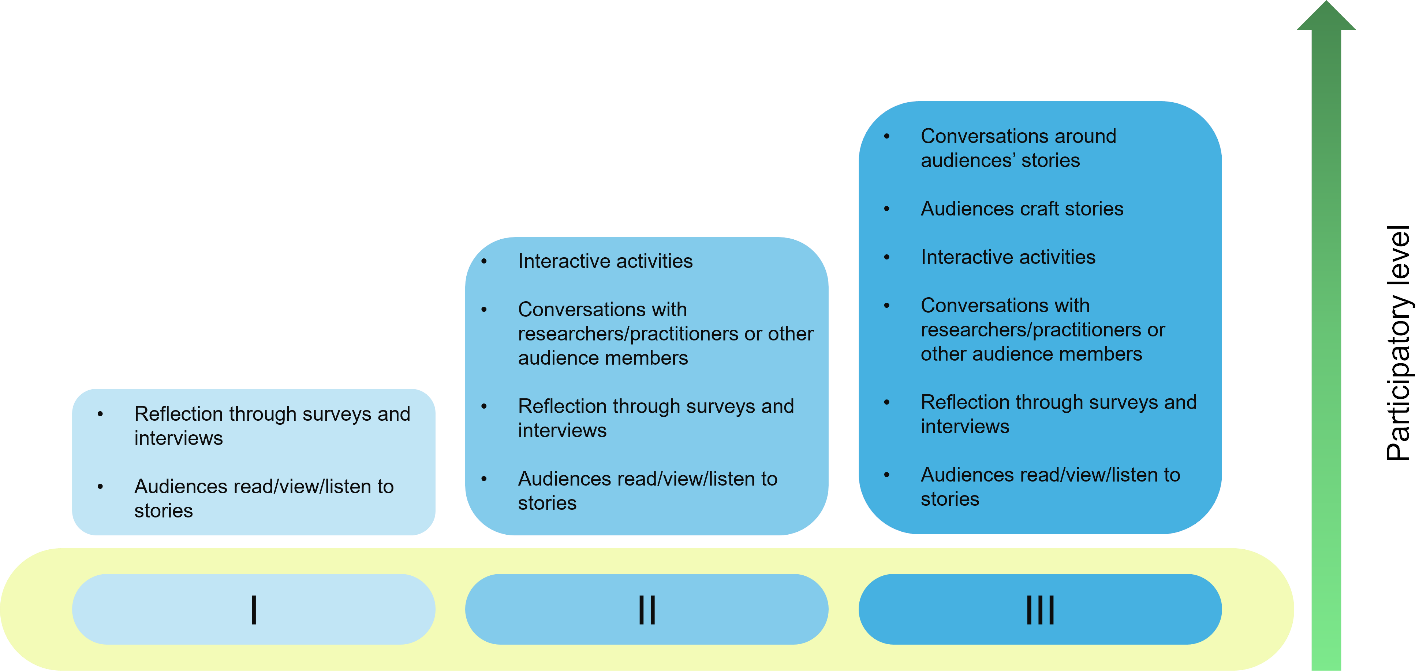
The first category of such strategies includes the use of stories to convey scientific information and then measure how successfully stories conveyed this information. For example, some studies have investigated the effectiveness of stories in terms of overall engagement with science [Finkler &León, 2019; Howell et al., 2025], others in terms of learning scientific information [Negrete &Lartigue, 2010], and others in terms of persuading audiences [Borrayo et al., 2017; Sun et al., 2019]. The audience is often exposed to a story (by reading, listening, or viewing) and then asked to answer questions either through surveys or interviews. The stories used in such an approach may describe a scientific process, focus on scientific results, or communicate complex scientific topics in accessible ways [Gould et al., 2023]. While story audiences can make meaningful and deep contributions through their responses, this approach is the most limited one in terms of audience participation because it involves largely passive engagement. The advantage of this approach is that it is inexpensive and less complex to design or deliver compared to the strategies described below.
In a second category of storytelling strategies, audiences are exposed to stories but take a more participatory role through engaging in a conversational activity with researchers, practitioners, or other audiences either during the process of storytelling, or after. Initiatives based on focus groups, workshops, or citizen science programs, fit within this category. For example, Gould et al. [2023] used story-based workshops about the research process and findings of an investigation of harmful algal blooms to promote two-way dialogue with communities. Participatory storytelling workshops can be effective at promoting learning, encouraging empathy, and generating conversation among a wide range of audiences of different backgrounds [Rotmann, 2017].
In a third type of storytelling strategy, audience members become storytellers themselves. A story/dialogue method (S/D-M) workshop is an example of such a strategy [Labonté, 2011; Labonté et al., 1999]. In this method, participants engage with each other (some of them become storytellers) and reflect upon stories they have listened to through dialogues [Labonté et al., 1999]. Other scholars have also used similar storytelling approaches. Harcourt et al. [2021] held workshops where participants wrote fictional future adaptation stories in which disturbing climate-related incidents happened and were addressed. The writing process was accompanied by group discussions and activities. They found that storytelling workshops could be used to support adaptation planning at the local, regional, and national scales. Similarly, de Hosson et al. [2018] ran workshops with teenagers to create one-page narrative comics based on a scientific presentation. The authors argued that approaches such as this one could help individuals think critically about the information presented to them in science stories [de Hosson et al., 2018]. This kind of storytelling workshop has been shown to have other benefits besides helping promote science communication, such as enhancing self-confidence and trust among adolescents [Rizzi et al., 2020] and improving comprehension through stories shared by others [Savvidou, 2010].
Regarding the categories above, there are two interesting points to consider. First, science communication initiatives can be designed to combine these types of storytelling or fall somewhere in between, incorporating elements from more than one category. For example, a workshop may be designed where participants are exposed to stories and later create their own stories. Secondly, it may be argued that the first category of audience involvement lacks a participatory element, while the second and third categories clearly employ participatory methods. However, this does not mean that the first category should be regarded as ineffective or unable to pursue objectives usually associated with participatory science communication, as the next section explains.
5 Stories and audience engagement
While reading stories may seem to be a passive activity, psychological theories suggest otherwise: we take an active, responsive role in the story, similar to attending a social event or joining a game, changing our habitual selves in doing so [Mar &Oatley, 2008; Nijhof &Willems, 2015]. According to simulation theory, story “…is a kind of simulation, but one that runs on minds rather than on computers” [Oatley, 2002, p. 41]. Drawing on Bakhtin’s suggestions that novels are a platform for dialogue — not only among characters but also between readers and characters, or between readers and the writer — Oatley posits that stories are about meetings. These fictional meetings, much like real-life meetings, can produce emotions, memories, and thoughts [Oatley, 1999]. Particularly, when readers identify with a character or the narrator (becoming ‘one’ with them [Slater &Rouner, 2002]), they take on the characters’ goals and plans, and experience emotions and thoughts depending on how those plans go [Oatley, 1999]. These experienced emotions are real, meaning they are the reader’s genuinely experienced emotions [Oatley, 2002, 2016]. In summary, fiction reading has an active nature and enables “an affiliative joining of reader and author, or reader and characters” [Oatley, 1999, p. 452].
Transportation theory further supports the engaging nature of story reading. Transportation happens when a reader’s attention, feelings, and imagery are cohesively focused on story events [Green &Brock, 2000], requiring active engagement to be “transported” into the narrative world [Green &Brock, 2002]. Transported readers lose access to some aspects of the real world when they accept the author’s story world [Green &Brock, 2002]. For example, a transported reader may not notice someone entering or leaving their room, or they may be less aware of real-world facts that contradict narrative assertions [Green &Brock, 2000].
Finally, stories can stimulate mental responses in readers that are not inferences, but “mental products of readers’ participation in a narrative” [Polichak &Gerrig, 2002, p. 72]. An example of such responses is when readers mentally cry “behind you!” as a serial killer stealthily approaches the protagonist. Gerrig [1993] calls these responses participatory responses or p-responses, and suggests that they are produced through the same processes that cause similar effects in real-life conversations. According to Gerrig [1993], readers are generally cast as side-participants by authors, occasionally becoming mere ‘overhearers’. These roles are similar to real-life conversational roles, where a side-participant is someone who is expected to understand and potentially participate in the conversation, and an overhearer is someone who may be actively excluded from comprehension and interaction and to whom utterances are not directed [Polichak &Gerrig, 2002]. When engaged with a story, readers produce different kinds of p-responses that contribute to the emotional influence narratives have on them [Polichak &Gerrig, 2002]. According to Polichak and Gerrig [2002], p-responses are likely to happen only if a certain level of engagement with the story has been achieved.
Taken together, simulation, transportation, and p-response theories suggest that reading stories is inherently engaging, with the potential to be participatory. This is significant for science communication: unlike expository texts that primarily transmit information, stories inherently invite audiences to engage. Therefore, storytelling can foster forms of cognitive and emotional engagement [Green &Brock, 2000; Mar &Oatley, 2008; Polichak &Gerrig, 2002] associated with participatory ideals, although passive consumption (e.g., reading or listening) does not in itself constitute participation in the dialogic or co-creative sense.
6 Implications for science communication
Narrative strategies for science communication have been discussed here in terms of the level of audience involvement or engagement they offer. The strategies discussed here can broadly be classified into three categories based on the level of audience engagement they provide: from highly participatory strategies, where audiences craft stories themselves to minimally participatory ones, where audiences simply read or view stories (see Table 1 for their possible applications in science communication). Using psychological theories, we argue that any narrative strategy (including merely reading appropriately crafted stories) increases audience engagement with science communication, in comparison with conventional modes of science communication, such as reading expository text. The theories discussed in this paper suggest that reading stories involves the active engagement of readers in a simulated world through transportation, resulting in p-responses in readers, and influencing their emotional and cognitive experiences.
|
Engagement level |
Audience role or positioning |
Example uses in science communication |
|
Narrative strategy I |
Reading/listening/viewing a story to enhance engagement and learning of scientific topics |
|
|
Reading/listening/viewing a story to shift attitudes and behaviours |
|
|
|
Narrative strategy II |
Reading/listening/viewing a story to enhance engagement and learning of scientific topics or influence persuasion |
|
|
Running complementary activities and discussion sessions to promote audience reflection and participation in scientific conversations | ||
|
Narrative strategy III |
Reading/listening/viewing a story to enhance engagement with and learning of scientific topics or influence persuasion |
|
|
Running storytelling workshops to teach participants how to craft science stories | ||
|
Running discussion sessions to promote audience reflection and participation in scientific conversations | ||
We have also argued that factors such as emotional engagement and meaning-making, key elements of newer models of science communication (such as IMSC and DMSC), are likewise central to stories. In this sense, storytelling can create conditions that are conducive to participatory science communication purposes and ideals, even in its simplest forms. The audience engagement effects generated by storytelling strategies, together with the alignment between narrative features and elements of new science communication models, support the value of storytelling as an established and effective avenue for science communication research and practice. These advantages are particularly valuable in science communication contexts where storytelling can complement participatory science communication. For example, distributing science information embedded in stories that resonate with communities may provide an effective means of communicating to the public about the significance of vaccines. This can be a step before, or part of, a participatory science communication campaign for raising public awareness of vaccines. Additionally, because stories are familiar tools for people from any backgrounds, researchers and practitioners can use them to reach a wide range of audiences. Furthermore, because narratives exist in various modalities and can be applied through diverse strategies, stories can easily be adapted to different contexts. Therefore, unlike conventional methods such as expository texts, stories have the capacity to expand the impact of science communication and enhance peoples’ involvement in the communicative process.
Despite the potential of stories to support participatory science communication, more research is needed to investigate a spectrum of storytelling strategies and their effectiveness for science and health communication. Future research should therefore investigate and compare the three categories of narrative strategies described in this paper in terms of their effectiveness for engaging audiences with science across different contexts (e.g., vaccine hesitancy and robotics). Examining the effectiveness of these strategies among audiences with different cultural and social backgrounds could also help determine which storytelling strategies resonate with which audience groups and subject matter.
Finally, it should be noted that although narratives provide unique advantages for science communication, they alone do not guarantee outcomes like better public understanding or acceptance of scientific findings. Poorly crafted narratives or those involving unscientific claims can lead to audience disengagement from science or misperceptions about science. Therefore, fostering collaboration between scientific experts and skilled writers in the design and implementation of all types of narratives should be prioritised in future research and practice, as such collaboration could enhance accuracy, clarity, and engagement in science communication.
7 Conclusion
This essay builds on recent work demonstrating that the deficit model of science communication continues to have applications and argues that story-based science communication may be able to address some of the model’s perceived limitations related to audience engagement and contribute meaningfully to participatory approaches. Narrative strategies share key features with contemporary models of science communication (i.e., IMSC and DMSC) and are a globally familiar format that is adaptable across different modes, forms, and activities. Considering audience engagement and psychological theories of narrative experience, we argue that while narrative strategies differ in the level of participation they offer, even the simplest storytelling strategy (audiences reading, listening, or viewing a narrative) can engage audiences compared with conventional science communication approaches centred on expository communication.
Conflict of interests
The authors declare no conflict of interest.
References
-
Abbott, H. P. (2020). Defining narrative. In The Cambridge introduction to narrative (3rd ed., pp. 12–28). Cambridge University Press. https://doi.org/10.1017/9781108913928
-
Appel, M., Krause, S., Gleich, U., &Mara, M. (2016). Meaning through fiction: science fiction and innovative technologies. Psychology of Aesthetics, Creativity, and the Arts, 10(4), 472–480. https://doi.org/10.1037/aca0000052
-
Avraamidou, L., &Osborne, J. (2009). The role of narrative in communicating science. International Journal of Science Education, 31(12), 1683–1707. https://doi.org/10.1080/09500690802380695
-
Bilandzic, H., &Sukalla, F. (2019). The role of fictional film exposure and narrative engagement for personal norms, guilt and intentions to protect the climate. Environmental Communication, 13(8), 1069–1086. https://doi.org/10.1080/17524032.2019.1575259
-
Bornmann, L., &Mutz, R. (2015). Growth rates of modern science: a bibliometric analysis based on the number of publications and cited references. Journal of the Association for Information Science and Technology, 66(11), 2215–2222. https://doi.org/10.1002/asi.23329
-
Borrayo, E. A., Rosales, M., &Gonzalez, P. (2017). Entertainment-education narrative versus nonnarrative interventions to educate and motivate Latinas to engage in mammography screening. Health Education &Behavior, 44(3), 394–402. https://doi.org/10.1177/1090198116665624
-
Braddock, K., &Dillard, J. P. (2016). Meta-analytic evidence for the persuasive effect of narratives on beliefs, attitudes, intentions, and behaviors. Communication Monographs, 83(4), 446–467. https://doi.org/10.1080/03637751.2015.1128555
-
Braund, M., &Ahmed, Z. (2019). Drama as physical role-play: actions and outcomes for life science lessons in South Africa. Journal of Biological Education, 53(4), 412–421. https://doi.org/10.1080/00219266.2018.1490799
-
Coletti, A., McGloin, R., Oeldorf-Hirsch, A., &Hamlin, E. (2022). Science communication on social media: examining cross-platform behavioral engagement. The Journal of Social Media in Society, 11(2), 236–263. https://thejsms.org/index.php/JSMS/article/view/995
-
Danny Han, D.-I., &Orlowski, M. (2024). Emotional responses to narrative content: a comparative study on consumer food choice intentions. Computers in Human Behavior, 155, 108191. https://doi.org/10.1016/j.chb.2024.108191
-
de Hosson, C., Bordenave, L., Daures, P.-L., Décamp, N., Hache, C., Horoks, J., Guediri, N., &Matalliotaki-Fouchaux, E. (2018). Communicating science through the Comics &Science Workshops: the Sarabandes research project. JCOM, 17(02), A03. https://doi.org/10.22323/2.17020203
-
ElShafie, S. J. (2018). Making science meaningful for broad audiences through stories. Integrative and Comparative Biology, 58(6), 1213–1223. https://doi.org/10.1093/icb/icy103
-
Finkler, W., &León, B. (2019). The power of storytelling and video: a visual rhetoric for science communication. JCOM, 18(05), A02. https://doi.org/10.22323/2.18050202
-
Fletcher, J. M. (2019). Travelling towards 2050: climate change, storytelling and the future of travel [Doctoral Thesis]. University of Otago. https://hdl.handle.net/10523/8923
-
Gerrig, R. J. (1993). Experiencing narrative worlds: on the psychological activities of reading. Routledge. https://doi.org/10.4324/9780429500633
-
Gould, R. K., Gonzalez, M. N., &Graff, J. (2023). Using science fiction and design thinking in workshops to share research results with low-income, marginalized communities. Science Communication, 45(5), 665–688. https://doi.org/10.1177/10755470231199167
-
Graesser, A. C., Singer, M., &Trabasso, T. (1994). Constructing inferences during narrative text comprehension. Psychological Review, 101(3), 371–395. https://doi.org/10.1037/0033-295x.101.3.371
-
Green, M. C., &Brock, T. C. (2000). The role of transportation in the persuasiveness of public narratives. Journal of Personality and Social Psychology, 79(5), 701–721. https://doi.org/10.1037/0022-3514.79.5.701
-
Green, M. C., &Brock, T. C. (2002). In the mind’s eye: transportation-imagery model of narrative persuasion. In M. C. Green, J. J. Strange &T. C. Brock (Eds.), Narrative impact: social and cognitive foundations (pp. 315–342). Lawrence Erlbaum Associates. https://doi.org/10.4324/9781410606648
-
Gurnon, D., Voss-Andreae, J., &Stanley, J. (2013). Integrating art and science in undergraduate education. PLoS Biology, 11(2), e1001491. https://doi.org/10.1371/journal.pbio.1001491
-
Halpern, M. K., &Elliott, K. C. (2022). Science as experience: a Deweyan model of science communication. Perspectives on Science, 30(4), 621–656. https://doi.org/10.1162/posc_a_00398
-
Harcourt, R., Bruine de Bruin, W., Dessai, S., &Taylor, A. (2021). Envisioning climate change adaptation futures using storytelling workshops. Sustainability, 13(12), 6630. https://doi.org/10.3390/su13126630
-
Haven, K. (2007). Story proof: the science behind the startling power of story. Libraries Unlimited. https://doi.org/10.5040/9798216019312
-
Howell, E. L., Behrman, S. L., Kirschner, E., &Goodwin, S. S. (2025). Storytelling in science film: narrative engagement relates to greater knowledge, interest, and identification with science. Science Communication, 47(2), 211–249. https://doi.org/10.1177/10755470241269885
-
Immordino-Yang, M. H. (2011). Me, my “self” and you: neuropsychological relations between social emotion, self-awareness, and morality. Emotion Review, 3(3), 313–315. https://doi.org/10.1177/1754073911402391
-
Irani, M., &Weitkamp, E. (2023). Factors affecting the efficacy of short stories as science communication tools. JCOM, 22(02), Y01. https://doi.org/10.22323/2.22020401
-
Januchowski-Hartley, S. R., Sopinka, N., Merkle, B. G., Lux, C., Zivian, A., Goff, P., &Oester, S. (2018). Poetry as a creative practice to enhance engagement and learning in conservation science. BioScience, 68(11), 905–911. https://doi.org/10.1093/biosci/biy105
-
Kaplan, M., &Dahlstrom, M. (2017). How narrative functions in entertainment to communicate science. In K. H. Jamieson, D. M. Kahan &D. A. Scheufele (Eds.), The Oxford handbook of the science of science communication (pp. 310–319). Oxford University Press. https://doi.org/10.1093/oxfordhb/9780190497620.013.34
-
Labonté, R. (2011). Reflections on stories and a story/dialogue method in health research. International Journal of Social Research Methodology, 14(2), 153–163. https://doi.org/10.1080/13645579.2010.492131
-
Labonté, R., Feather, J., &Hills, M. (1999). A story/dialogue method for health promotion knowledge development and evaluation. Health Education Research, 14(1), 39–50. https://doi.org/10.1093/her/14.1.39
-
Lacey, N. (2000). Narrative and genre: key concepts in media studies. Bloomsbury Academic.
-
Lejano, R. P., Tavares-Reager, J., &Berkes, F. (2013). Climate and narrative: environmental knowledge in everyday life. Environmental Science &Policy, 31, 61–70. https://doi.org/10.1016/j.envsci.2013.02.009
-
Lesen, A. E., Rogan, A., &Blum, M. J. (2016). Science communication through art: objectives, challenges, and outcomes. Trends in Ecology &Evolution, 31(9), 657–660. https://doi.org/10.1016/j.tree.2016.06.004
-
Longnecker, N. (2016). An integrated model of science communication — more than providing evidence. JCOM, 15(05), Y01. https://doi.org/10.22323/2.15050401
-
Lundqvist, A., Liljander, V., Gummerus, J., &van Riel, A. (2013). The impact of storytelling on the consumer brand experience: the case of a firm-originated story. Journal of Brand Management, 20(4), 283–297. https://doi.org/10.1057/bm.2012.15
-
Ma, Z., &Yang, G. (2022). Show me a photo of the character: exploring the interaction between text and visuals in narrative persuasion. Journal of Health Communication, 27(2), 125–133. https://doi.org/10.1080/10810730.2022.2065387
-
Mar, R. A. (2018). Stories and the promotion of social cognition. Current Directions in Psychological Science, 27(4), 257–262. https://doi.org/10.1177/0963721417749654
-
Mar, R. A., Li, J., Nguyen, A. T. P., &Ta, C. P. (2021). Memory and comprehension of narrative versus expository texts: a meta-analysis. Psychonomic Bulletin &Review, 28(3), 732–749. https://doi.org/10.3758/s13423-020-01853-1
-
Mar, R. A., &Oatley, K. (2008). The function of fiction is the abstraction and simulation of social experience. Perspectives on Psychological Science, 3(3), 173–192. https://doi.org/10.1111/j.1745-6924.2008.00073.x
-
Mar, R. A., Oatley, K., Djikic, M., &Mullin, J. (2011). Emotion and narrative fiction: interactive influences before, during, and after reading. Cognition and Emotion, 25(5), 818–833. https://doi.org/10.1080/02699931.2010.515151
-
Mar, R. A., &Rain, M. (2015). Narrative fiction and expository nonfiction differentially predict verbal ability. Scientific Studies of Reading, 19(6), 419–433. https://doi.org/10.1080/10888438.2015.1069296
-
Martinez-Conde, S., Alexander, R. G., Blum, D., Britton, N., Lipska, B. K., Quirk, G. J., Swiss, J. I., Willems, R. M., &Macknik, S. L. (2019). The storytelling brain: how neuroscience stories help bridge the gap between research and society. The Journal of Neuroscience, 39(42), 8285–8290. https://doi.org/10.1523/jneurosci.1180-19.2019
-
Metcalfe, J. (2019). Comparing science communication theory with practice: an assessment and critique using Australian data. Public Understanding of Science, 28(4), 382–400. https://doi.org/10.1177/0963662518821022
-
Metcalfe, J. (2022). Science communication: a messy conundrum of practice, research and theory. JCOM, 21(07), C07. https://doi.org/10.22323/2.21070307
-
Murphy, S. T., Frank, L. B., Chatterjee, J. S., Moran, M. B., Zhao, N., Amezola de Herrera, P., &Baezconde-Garbanati, L. A. (2015). Comparing the relative efficacy of narrative vs nonnarrative health messages in reducing health disparities using a randomized trial. American Journal of Public Health, 105(10), 2117–2123. https://doi.org/10.2105/ajph.2014.302332
-
Nan, X., Dahlstrom, M. F., Richards, A., &Rangarajan, S. (2015). Influence of evidence type and narrative type on HPV risk perception and intention to obtain the HPV vaccine. Health Communication, 30(3), 301–308. https://doi.org/10.1080/10410236.2014.888629
-
Negrete, A. (2005). Fact via fiction: stories that communicate science. In N. Sanitt (Ed.), Motivating science: science communication from a philosophical, educational and cultural perspective (pp. 95–102). The Pantaneto Press. https://doi.org/10.13140/RG.2.1.5110.1207
-
Negrete, A. (2021). Remembering rhythm and rhyme: memorability of narratives for science communication. Geoscience Communication, 4(1), 1–9. https://doi.org/10.5194/gc-4-1-2021
-
Negrete, A., &Lartigue, C. (2010). The science of telling stories: evaluating science communication via narratives (RIRC method). Journal of Media and Communication Studies, 2(4), 98–110. https://academicjournals.org/journal/JMCS/article-abstract/A4F2DA010848
-
Nijhof, A. D., &Willems, R. M. (2015). Simulating fiction: individual differences in literature comprehension revealed with fMRI. PLoS ONE, 10(2), e0116492. https://doi.org/10.1371/journal.pone.0116492
-
Oatley, K. (1999). Meetings of minds: dialogue, sympathy, and identification, in reading fiction. Poetics, 26(5–6), 439–454. https://doi.org/10.1016/s0304-422x(99)00011-x
-
Oatley, K. (2002). Emotions and the story worlds of fiction. In M. C. Green, J. J. Strange &T. C. Brock (Eds.), Narrative impact: social and cognitive foundations (pp. 39–69). Lawrence Erlbaum Associates. https://doi.org/10.4324/9781410606648
-
Oatley, K. (2016). Fiction: simulation of social worlds. Trends in Cognitive Sciences, 20(8), 618–628. https://doi.org/10.1016/j.tics.2016.06.002
-
Olson, R. (2015). Houston, we have a narrative: why science needs story. The University of Chicago Press.
-
Polichak, J. W., &Gerrig, R. J. (2002). “Getup and win!”: participatory responses to narrative. In M. C. Green, J. J. Strange &T. C. Brock (Eds.), Narrative impact: social and cognitive foundations (pp. 71–96). Lawrence Erlbaum Associates. https://doi.org/10.4324/9781410606648
-
Riedlinger, M., Massarani, L., Joubert, M., Baram-Tsabari, A., Entradas, M., &Metcalfe, J. (2019). Telling stories in science communication: case studies of scholar-practitioner collaboration. JCOM, 18(05), N01. https://doi.org/10.22323/2.18050801
-
Rigby, B. D., &Lee, R. (2024). Creating emotional resonance in advertising language strategies and consumer identity. Journal of Linguistics and Communication Studies, 3(3), 1–13. https://doi.org/10.56397/JLCS.2024.09.01
-
Rizzi, V., Pigeon, C., Rony, F., &Fort-Talabard, A. (2020). Designing a creative storytelling workshop to build self-confidence and trust among adolescents. Thinking Skills and Creativity, 38, 100704. https://doi.org/10.1016/j.tsc.2020.100704
-
Rotmann, S. (2017). “Once upon a time…” Eliciting energy and behaviour change stories using a fairy tale story spine. Energy Research &Social Science, 31, 303–310. https://doi.org/10.1016/j.erss.2017.06.033
-
Sanders-Jackson, A. (2014). Rated measures of narrative structure for written smoking-cessation texts. Health Communication, 29(10), 1009–1019. https://doi.org/10.1080/10410236.2013.830205
-
Savvidou, C. (2010). Storytelling as dialogue: how teachers construct professional knowledge. Teachers and Teaching, 16(6), 649–664. https://doi.org/10.1080/13540602.2010.517682
-
Slater, M. D., &Rouner, D. (2002). Entertainment-education and elaboration likelihood: understanding the processing of narrative persuasion. Communication Theory, 12(2), 173–191. https://doi.org/10.1111/j.1468-2885.2002.tb00265.x
-
Sun, Y., Lee, T. K., &Qian, S. (2019). Beyond personal responsibility: examining the effects of narrative engagement on communicative and civic actions. Journal of Health Communication, 24(6), 603–614. https://doi.org/10.1080/10810730.2019.1643954
-
Todorov, T. (1971). The 2 principles of narrative. Diacritics, 1(1), 37–44. https://doi.org/10.2307/464558
-
Varela Amaral, S., Forte, T., Ramalho-Santos, J., &Girão da Cruz, M. T. (2015). I want more and better cells! — An outreach project about stem cells and its impact on the general population. PLoS ONE, 10(7), e0133753. https://doi.org/10.1371/journal.pone.0133753
-
Weitkamp, E. (2019). Narrative, drama, and science communication. In D. R. Gruber &L. C. Olman (Eds.), The Routledge handbook of language and science (pp. 239–252). Routledge. https://doi.org/10.4324/9781351207836
-
Wilkinson, C., &Weitkamp, E. (2016). Creative research communication: theory and practice. Manchester University Press.
-
Yuen, A. S. Y., &Mak, W. W. S. (2021). The effects of immersive virtual reality in reducing public stigma of mental illness in the university population of Hong Kong: randomized controlled trial. Journal of Medical Internet Research, 23(7), e23683. https://doi.org/10.2196/23683
About the authors
Masoud Irani is a Ph.D. student at Deakin University’s School of Communication and Creative Arts. He is also a writer with a passion for science and a focus on using stories as powerful tools for communicating complex ideas and knowledge. His research explores how science stories can engage diverse audiences, influence attitudes and behaviors, and promote understanding.
E-mail: m.irani@deakin.edu.au
Dr. Gabi Mocatta is an interdisciplinary academic who researches science communication as it relates to climate change, environment and natural hazards risk. She is a Senior Research Fellow in Climate Science Communication with the Climate Futures Research Group, School of Geography, Planning and Spatial Sciences at the University of Tasmania. She is vice-President of the Environmental Communication Division of the International Communication Association, and was a 2025 Fulbright Scholar.
E-mail: Gabi.Mocatta@utas.edu.au
Paul Venzo (Ph.D.) is an Associate Professor in Writing, Literature &Culture at Deakin University’s School of Communication and Creative Arts. He is the Course Director for English-Creative Writing, English-Literature, English-Children’s Literature and Gender and Sexuality Studies majors in the Bachelor of Arts, as well as the Writing major in the Bachelor of Creative Arts. He is also a Deputy Director of the Bachelor of Arts.
E-mail: paul.venzo@deakin.edu.au
Dr. Alexander Hall is an interdisciplinary scholar whose research explores the representation of science in popular media. With a background in the history of science, Dr. Hall leads the Science in Society Lab at McMaster University, where he conducts mixed-methods research that empirically examines how pressing scientific issues impact, interact with, and are perceived by diverse communities. Dr. Hall is an Assistant Professor in the School of Interdisciplinary Science at McMaster, where he teaches on the Integrated Science and Life Sciences programs.
E-mail: halla45@mcmaster.ca