

1 Introduction
Government science organizations in the U.S. have historically been known for using one-way communication on social media [Lee & VanDyke, 2015; Lee et al., 2018]. For example, in their content analysis, Lee and VanDyke [2015] found that government science organizations such as the National Oceanic and Atmospheric Administration and National Institutes of Health rarely encouraged a dialogue and simply posted new announcements and articles on social media and left it at that [Lee & VanDyke, 2015]. However, in recent years, these organizations have begun to use two-way communication, engaging with their followers in a more “dialogue-oriented way” [Guenther et al., 2023, p. 861], including the use of humour on social media [Guenther et al., 2023; Humm & Schrögel, 2020]. Government science organizations such as the National Park Service (NPS) and the Oklahoma Department of Wildlife Conservation (ODWC), for example, are breaking from this traditional approach by making their social media content humorous, witty, and full of sass.
Matthew Turner, social media specialist for the NPS, said in an interview that the goal of applying humour is to interact and engage with their audiences “in the hopes of humanizing a 100-year-old government agency” [Driehaus, 2023, para. 13]. Similarly, Sarah Southerland, former social media specialist for the ODWC said the goal “was just to talk more like the people around us and less like this unfriendly, unapproachable government account” [Denwalt, 2024, para. 5]. However, not everyone prefers government agencies to use humour; Turner has also said, “There’s always going to be those people you wouldn’t want to stand next to at a party, right? Or prefer their government agencies to be by the book and very stoic” [Graham, 2024, para. 11].
These recounts by social media specialists spark interesting questions for investigation: what happens when government science organizations’ use of humour contradicts people’s expectations of them? And how does this influence how these people view the organization? On one hand, this violation of expectations could be a pleasant surprise, leading to more positive evaluations of the source [McGraw & Warren, 2010]. On the other hand, for individuals who would rather government agencies adhere to a more formal and traditional approach, such violations could result in more negative outcomes [Warren & McGraw, 2016]. Currently, it remains unclear if and how government organizations’ use of humour on social media might affect how people perceive them. However, as more organizations lean toward this strategy on social media, understanding the potential benefits and risks of using humour has become increasingly important.
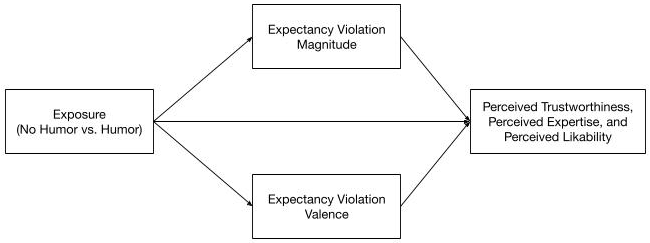
Therefore, this study examined how exposure to humorous social media posts regarding three different wildlife issues (climate change, human-wildlife interaction, and human-caused wildfires) affected viewers’ perceptions of the source in regard to trustworthiness, expertise, and likability and tested expectancy violations magnitude (EVM) and expectancy violation valence (EVV) as parallel mediators. In doing so, we sought to gain a better understanding of how being funny on social media might change the way government science organizations are perceived.
2 Literature review
2.1 When expectations are violated
Individuals enter a social situation expecting others to act or communicate in a certain way based on social norms, personal characteristics, and contexts [Burgoon et al., 2016]. When an individual behaves contrary to expectations, a violation occurs [Burgoon et al., 2016]. That violation — which may be positive or negative in valence — determines how others react [Burgoon et al., 2016]. Humour — the communication of incongruent meanings that result in mirth [Martin, 2007] — is perceived when the valence violation is positive rather than negative [McGraw & Warren, 2010]. That is, when people experience an unexpected situation, but perceive it as non-threatening or benign, then mirth may occur [McGraw & Warren, 2010].
Scientists and science organizations may be expected to act or communicate in a certain way that based on certain social norms. For example, a scientist may be expected to maintain a serious and/or polite communication style based on social norms. However, if they go against that expectation, a violation occurs, which may, in turn, influence audiences’ attitudes and behaviours such as social media engagement, behavioural intentions, and perceptions of the source [Yuan et al., 2019; Yuan & Lu, 2020; Zhang & Lu, 2022]. Science organizations, specifically, are known for maintaining serious and straightforward tones on social media platforms [Lee & VanDyke, 2015; Lee et al., 2018], However, the outcomes depend on the valence of the violation.
The valence of the violation. The outcomes of expectancy violations can be dynamic due to the effects of violation valence. When viewing a humorous message, the valence of the expectancy violation depends on the perceived level of threat of the message [McGraw & Warren, 2010]. If the violation is negative in valence [as presumed by Yuan et al., 2019; Yuan & Lu, 2020; Zhang & Lu, 2022], this may lead to negative message outcomes. To steer away from negatively valenced, threatening violations, organizations should ensure that their humour is only mildly threatening at most, does not make fun of certain groups viewers may see as their in-group, and promotes action regarding an issue rather than avoidance [Warren & McGraw, 2016]. A light-hearted joke from a government agency may be perceived as humorous because they are unexpected, and the surprise is non-threatening. However, a joke from a government organization that pokes fun at someone’s serious injury may be seen as threatening and, therefore, not perceived as humorous.
The current study examined humour that is intended to elicit positive affect rather than negative; that is, the humour in the posts is only mildly threatening, do not poke fun of certain groups, and promotes action rather than avoidance. We did not know how exactly the posts will be perceived in regard to expectancy violation magnitude (EVM) and expectancy violation valence (EVV). Therefore, we asked the following research question:
- Research Question 1a-b:
-
What is the effect of the humorous wildlife messages on (a) expectancy violation magnitude (EVM) and (b) expectancy violation valence (EVV)?
2.2 Effects on perceptions of the organization
This study focuses on how the government science organization is perceived after posting a humorous social media post about a wildlife science issue. The science communication scholarship has examined three main source evaluations as dependent variables in studies examining humorous science messages: perceived trustworthiness, perceived expertise, and perceived likability. Perceived trustworthiness refers to “the degree of confidence in the communicator’s intent to communicate assertions [they] consider[s] most valid” [Hovland et al., 1953, p. 21]. Perceived expertise is “the extent to which a communicator is perceived to be a source of valid assertions” [Hovland et al., 1953, p. 21]. A similar concept, perceived likability, refers to individuals’ attitudes toward the message source [Roskos-Ewoldsen et al., 2002].
In the science humour literature, it is well-established that humour leads to more negative evaluations of the source in regard to perceived trustworthiness [Frank et al., 2025; Yeo et al., 2025], perceived expertise [Yeo et al., 2020], and perceived likability [Yeo et al., 2020, 2021] unless the message is found to be, indeed, humorous to the viewer. For example, in a recent study testing satirical and anthropomorphic science social media posts, Frank et al. [2025] found that mirth significantly mediated the effect of humour on participants’ perceived likability and legitimacy of the source; the direct effect of humour on these source evaluations were negative. That is, in order for humour to not hinder source perceptions, the joke must be funny and perceived as such. Other recent studies produced similar results in regard to science communication in multiple communication contexts [see Frank et al., 2025; Yeo et al., 2020, 2021, 2025]. However, what is unclear is how humour affects these source evaluations apart from perceived mirth. EVT may provide insight.
According to Burgoon [2015], expectancy violations’ effect on source evaluations are dependent on the valence of the violation. In theory, if the violation is a pleasant surprise (i.e., positive valence), this will lead to more positive communicative outcomes; and if the violation is an unpleasant surprise (i.e., negative valence), this will lead to more negative communicative outcomes [Burgoon, 2015; e.g., Bullock & Hubner, 2020; Johnson & Lewis, 2010; Yuan et al., 2019]. Yuan et al. [2019], for example, found that positive expectancy violations resulting from exposure to a scientist using polite language led to positive source likability perceptions. In the same study, negative violations resulting from exposure to a scientist using aggressive language led to negative source-likeability perceptions [Yuan et al., 2019]. Similarly, in a political humour context, Bullock and Hubner [2020] found that participants who experienced expectancy violations when shown a pun posted by a political candidate on social media reported lower levels of perceived credibility. Based on this literature, the relationship between expectancy violation and evaluations of the source is largely determined by the valence of the violation.
As previously mentioned, research combining EVT and humour in marketing has found that when expectations are violated in a situation, but the valence of that violation is positive (or non-threatening), perceived humour may be experienced; conversely, without violations or positive valence of violations if present, perceived humour may not be experienced [McGraw & Warren, 2010]. In these science contexts, it is important to know why humour may (or may not) lead to negative evaluations of the source apart from the absence of mirth. It could be that for some who experience a pleasant surprise when viewing a science joke find the joke funny and, in turn, evaluate the source in a positive manner, and for others who experience an unpleasant surprise when viewing the joke are not experiencing humour, and, in turn, evaluating the source negatively. This study is less concerned with the level of mirth experienced — as the mediating role of mirth in the relationship between science humour and source evaluations are well-established — and more concerned with the mechanisms and reasons behind how the sources of the post are evaluated when they use humour which could indicate why the viewer found the post funny or not. Thus, we posed the following hypothesis:
- Hypothesis 2a-c:
-
EVM and EVV will mediate the relationship between exposure to a humorous message and (a) perceived expertise, (b) perceived trustworthiness, and (c) perceived likability in parallel.
2.3 The current study
The current study uses messages regarding three different wildlife issues as stimuli, each deemed important by government wildlife agencies in the US: climate change, human-wildlife interaction, and human-caused wildfires. According to the U.S. Fish & Wildlife Service [n.d.], “[a] growing body of evidence links accelerating climate change with observed changes in fish and wildlife, their populations, and their habitats across the United States” [para. 1]. Similarly, the National Park Service [2025] notes on their website that by communicating about climate change they hope to “help develop a public that is engaged with national parks, supportive of climate change response, and motivated to take practical action to become climate friendly” [para. 2]. Humour has been studied in the context of climate change; in fact, it is one of the more commonly studied issues in the science humour space [see Kaltenbacher & Drews, 2020], but the study of humorous climate change messages in the context of wildlife conservation is sparce. Decreasing human-wildlife interactions is also an issue of interest for the NPS; unsafe interactions between human park visitors and wildlife inhabitants in the parks can be dangerous for both parties [National Park Service, 2024a]. Some parks have adopted the Keep Wildlife Wild campaign which focuses on providing tips for park visitors on safe wildlife observation [National Park Service, 2024b]. Research regarding human-wildlife interaction communication is a growing field of research [e.g., Abrams et al., 2020, 2023, 2025], but humorous strategies for this campaign have not been evaluated in the literature, to our knowledge. Lastly, human-caused wildfire prevention is, arguably, the most famous campaign related to wildlife in the U.S. to date and has featured the Smokey Bear spokescharacter since 1944 [Ad Council, n.d.]. Minimizing human-caused wildfires continues to be a major initiative for wildlife organizations today and is a major principle of the Leave No Trace Campaign [n.d.].
In addition to the above research questions and hypotheses, we were also interested in if there were any notable differences between these three issues in our study. Therefore, we posed the following research question:
3 Method
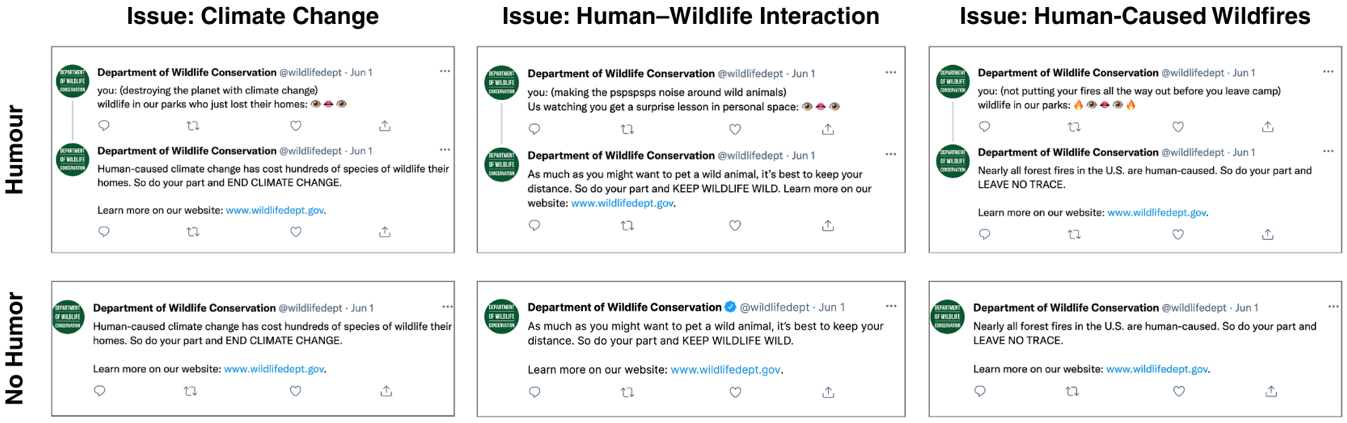
A between-subjects experimental design — issue (climate change versus human-wildlife interaction versus human-caused wildfires) Õ message strategy (humour versus no humour) — was used to examine the effect of humorous wildlife messages on expectancy violations and source evaluations. Stimuli were social media posts regarding wildlife issues posted by the fictitious account Department of Wildlife Conservation (@WildlifeDept) on X.
After agreeing to take part in the study, participants were asked questions regarding their personal level of involvement in and knowledge of the issue they were randomly assigned. They were then shown their assigned message and asked to report their level of expectancy violations experienced while reading the post, the extent the post was a (un)pleasant surprise, and their views of the organization that posted the message in terms of perceived expertise, trustworthiness, and likability. Finally, they answered demographic questions. The full instrument and data for this study can be found on the OSF.io page created for this project: https://osf.io/bk2ys/overview?view_only=23d35622e2a04ad68ab1b69680385a1a.
3.1 Participants
The target population for this study was U.S. adults. Using CloudResearch Connect, 800 participants were recruited on the evening of January 17, 2025. Participants were recruited to match U.S. Census values on several demographics — gender identity, age, household income, region, race, and education. Of the 800 participants recruited, 798 participants passed attention checks, did not speed through the online survey experiment, and did not skip items. A power analysis conducted using G*Power [Faul et al., 2007, 2009] confirmed that this sample size was adequate to detect small effect sizes (80% power, Cohen’s d = 0.20). Participants were paid $1 for their participation in the 7-minute study. This study was approved by The University of Alabama Institutional Review Board (24-10-8012).
Half of all participants identified as women (399, 50%) and 55.89% (446) indicated that in important elections they tend to vote for the Democratic Party candidate. Participants had a wide range of education levels, but a bachelor’s degree was the most common highest level of education obtained (313, 39%). There was also a diverse range of race and ethnicity; most participants identified as white (596, 74.69%), Black or African-American (115, 14.41%), or Hispanic or Latino (112, 14.04%), but members of other ethnic groups participated, as well, including Asian or Asian-American (49, 6.14%), Native American or Alaska Native (13, 1.63%), and Native Hawaiian or Pacific Islander (3, 0.38%). Full demographics can be found in the OSF.io page for this study.
3.2 Stimuli
A total of six fictitious social media posts were created for the study. These posts appeared as a
post thread from a fictitious organization called the Department of Wildlife Conservation
(@WildlifeDept) on X (see Figure 1). Efforts were made to make the stimuli as close to a real-life
social media post by the National Park Service as possible. According to an interview, Matt Turner,
social media specialist for the NPS, stated that he used a joke to grab people’s attention and
then included important information about the issue when creating posts on X [Childs,
2024]. This format was adopted for the stimuli in this study. The humorous stimuli open
with a joke: a scenario where the viewer is doing an action not friendly to wildlife.
Another character’s (e.g., animal impacted by the behaviour) reaction is then shown in the
form of an emoji series (  ) that is most often associated with an exaggerated look of
shock or surprise when experiencing a cringey or awkward scenario on social media
[Hickey, 2025]. There was then a follow-up post to the joke with information regarding
the impacts of the issue (e.g., an animal losing its home due to climate change) and a
website is linked where the viewer can learn more about the issue. Non-humorous
stimuli only displayed the second post in the threat that contained the information and
did not include the joke. The emojis in the message act as humour markers, as emojis
have been found to cue message intention (such as humour) in computer-mediated
communication scenarios [see Adams, 2012; Dresner & Herring, 2010; Thompson & Filik, 2016].
In the stimuli here, the jokes intend to elicit mirth without adding information to the
post.
) that is most often associated with an exaggerated look of
shock or surprise when experiencing a cringey or awkward scenario on social media
[Hickey, 2025]. There was then a follow-up post to the joke with information regarding
the impacts of the issue (e.g., an animal losing its home due to climate change) and a
website is linked where the viewer can learn more about the issue. Non-humorous
stimuli only displayed the second post in the threat that contained the information and
did not include the joke. The emojis in the message act as humour markers, as emojis
have been found to cue message intention (such as humour) in computer-mediated
communication scenarios [see Adams, 2012; Dresner & Herring, 2010; Thompson & Filik, 2016].
In the stimuli here, the jokes intend to elicit mirth without adding information to the
post.
3.3 Pilot study
A pilot study was conducted to ensure that the humorous posts were perceived as more humorous than their nontumorous counterparts. Participants for this pilot study (N = 602) were also recruited using CloudResearch Connect and paid $1 for their participation. In the pilot study, participants were asked to rate how not funny/funny, not amusing/amusing, not entertaining/entertaining, and not humorous/humorous they found the message to be on a 7-point scale. The humorous messages were perceived as significantly more mirthful than the non-humorous messages when analysing the issues combined [t(600) = -10.41, p < .001, d = -0.85, Mean Difference = -1.44]. These differences were also found when analysing each issue separately see Table 1.
| Issue | t | df | p | Mean Diff. | Cohen’s d |
| Issues Combined | 10.48 | 612 | < .001 | -1.44 | -0.85 |
| Climate Change | -3.88 | 199 | < .001 | -0.89 | -0.55 |
| Human-Wildlife Interaction | -9.00 | 207 | < .001 | -1.94 | -1.25 |
| Human-Caused Wildfires | -7.18 | 202 | < .001 | -1.55 | -1.01 |
One-way ANOVA tests show there were, however, differences between issues on their level of mirth (Humour Condition: F(2, 304) = 33.53, p < .001; No Humour Condition: F(2, 292) = 13.65, p < .001). A post-hoc Bonferroni correction test showed that these differences were between all issues in the humour condition. Therefore, conditions were also analysed separately in the main study.
3.4 Measures
Expectancy violation magnitude (mediator). Expectancy violation magnitude (EVM) was measured using a scale revised from Lu and Yuan [2021]. On a 7-point Likert-type scale (1 = Strongly disagree, 7 = Strongly agree), participants were asked to rate their level of agreement with three statements: (1) “The organization’s tweet was appropriate for a government science organization”, (2) “The organization wrote in a way I would expect most government science organizations to write”, and (3) “The organization used a normal writing style for a government science organization”. All of these statements were reverse scored so that a higher score indicated a greater of violation magnitude, and a lower score indicated a lower violation magnitude (M = 3.27, SD = 1.66, α = .89).
Expectancy violation valence (mediator). Expectancy violation valence (EVV) was measured by asking participants to rate their level of agreement with three statements on a 7-point Likert-type scale (1 = Strongly disagree, 7 = Strongly agree). These statements were: (1) “The organization’s tweet was a pleasant surprise”, (2) “The organization’s tweet was highly inappropriate” (reversed), and (3) “The organization’s tweet was an unpleasant surprise” (reversed). A greater EVV score indicated a more positive violation valence (a pleasant surprise) and a lower score indicated a more negative violation valence (an unpleasant surprise). When verifying the reliability of this scale, the Cronbach’s alpha coefficient did not meet reliability standards (α = .67). Deleting the first item improved the reliability score to an acceptable level (α = .97) and the measure with the two latter items was used in the study (M = 5.20, SD = 1.32, α = 0.97). A correlation test found that EVM and EVV had a moderate, negative relationship (r = -0.41). Correlations between all variables are displayed in Table 2.
| 1 | 2 | 3 | 4 | 5 | |
| 1. EVM | — | ||||
| 2. EVV | -0.41∗∗∗ | — | |||
| 3. Perceived Trustworthiness | -0.50∗∗∗ | 0.68∗∗∗ | — | ||
| 4. Perceived Expertise | -0.55∗∗∗ | 0.67∗∗∗ | 0.88∗∗∗ | — | |
| 5. Perceived Likability | -0.43∗∗∗ | 0.64∗∗∗ | 0.78∗∗∗ | 0.76∗∗∗ | — |
| Note:
EVM = Expectation
Violation
Magnitude.
EVV = Expectation
Violation
Valence.
∗∗∗p < .001.
| |||||
Perceptions of the organization (dependent variables). Expertise was measured using a measure derived from McCroskey and Young [1981]. Participants were asked how unintelligent/intelligent, untrained/trained, inexpert/expert, uninformed/informed, incompetent/competent, and stupid/bright they believed the account that posted the message was on a 7-point scale. A higher score indicated a greater level of expertise, and a lower score indicated a higher level of expertise (M = 5.63, SD = 1.42, α = .97).
Trustworthiness was measured using a scale also derived from McCroskey and Young [1981]. Participants were asked how dishonest/honest, untrustworthy/trustworthy, dishonourable/honourable, immoral/moral, unethical/ethical, and phony/genuine they believed the account that posted the message was on a 7-point scale. A higher score indicated a greater level of trustworthiness, and a lower score indicated a lower level of trustworthiness (M = 5.74, SD = 1.40, α = .89).
Finally, likability was measured using a 4-item scale used in previous science humour research [see Yeo et al., 2021] — (1) “This organization seems friendly”, (2) “This organization seems likable”, (3) “This organization seems warm”, and (4) “This organization seems approachable”. Participants were asked to rate their level of agreement with each statement on a 7-point Likert-type scale (1 = Strongly disagree, 7 = Strongly agree). A higher score indicated that the participant liked the source, and a lower score indicated that the participant did not like the source (M = 5.32, SD = 1.50, α = .98).
Control variables. As humour has been found to affect people with varying degrees of involvement with the issue at hand differently [for an overview, see Weinberger & Gulas, 2019], issue involvement was controlled for in the models. Participants were asked to rate their level of agreement with six items pertaining to their level of involvement (e.g., “I think about the impact of [issue] a great deal”, “The impact of [issue] is a personally relevant topic for me”). Items were derived from Golebie and van Riper [2023] and Quick and Stephenson [2007]. In order to show participants items that pertained to the issue they were assigned (climate change, human-caused wildfires, or feeding and petting wild animals), the piped text feature in Qualtrics was used. Participants rated their level of agreement on a 7-point Likert-type scale (1 = Strongly disagree, 7 = Strongly agree). A higher score on the scale indicated the participant felt highly involved with the issue, and a lower score indicated the participant felt not very involved with the issue (M = 4.13, SD = 1.61, α = .94).
In addition, because of the political nature of the climate change issue (for an overview see ), we controlled for political ideology in the models regarding the climate change issue condition. Political ideology was measured on a 7-point scale (1 = Very conservative, 2 = Conservative, 3 = Conservative-leaning, 4 = Moderate, 5 = Liberal-leaning, 6 = Liberal, 7 = Very liberal; M = 4.53, SD = 1.84). Participants also had an option to not answer this item (n = 9); these were coded as missing data points.
3.5 Data analysis
Hayes’ [2022] PROCESS Model 4 was used to test the conceptual model (see Figure 2) using the PROCESS macro for SPSS 30. As there were three dependent variables (perceived trustworthiness, perceived expertise, and perceived likability) and PROCESS only allows for one dependent variable per model, separate models were used for each dependent variable. Also, because there were differences in level of mirth for each issue in the pilot study, issues were run together (controlling for issue condition) and separately. A total of twelve PROCESS models were run. Results of these models are described below.
4 Results
4.1 RQ1a-b: humour’s effect on EVV and EVM
We first analysed data with the issues combined to ascertain what the results of our study were overall and then separately to examine the nuances between the issues. All beta coefficients reported are unstandardized. Simple regression analyses found that exposure to the humorous stimuli had a negative effect on perceived trustworthiness (B = -0.35, SE = 0.10, p < .001) and perceived expertise (B = -0.37, SE = 0.10, p < .001). This aligns with findings from other researchers who have examined science humour’s effect on perceived trustworthiness and expertise. Adding EVM and EVV to the model flipped the sign of the effect of humour on perceived trustworthiness (B = 0.20, SE = 0.08, p < .01) and perceived expertise (B = 0.27, SE = 0.08, p < .001). The simple regression examining humour’s effect on likability produced a null result (B = 0.01, SE = 0.11, p = .897); however, adding EVM and EVV to the equation changed this effect to a significant positive one (B = 0.59, SE = 0.09, p < .001).
In the PROCESS models testing the conceptual model, the direct effect of humour on the three outcome variables were significant and positive significant and positive in the combined model, with more variable effects across individual issues (see Table 3). Exposure to a humorous message also had a significant positive direct effect on the mediator EVM; humour had a significant negative effect on the mediator EVV, answering RQ1a-b. All direct effects of the stimuli on these the mediators and outcome variables from the PROCESS models are displayed in Table 3.
|
EVM Effect (SE) [95% CI] |
EVV Effect (SE) [95% CI] |
Perceived Trust Effect (SE) [95% CI] |
Perceived Expertise Effect (SE) [95% CI] |
Perceived Likability Effect (SE) [95% CI] |
|
|
Climate Change |
1.70 (0.18) [1.31, 2.04] |
-0.75 (0.16) [-1.06, -0.45] |
0.31 (0.15) [-0.01, 0.60] |
0.45 (0.15) [0.16, 0.74] |
0.63 (0.16) [0.32, 0.94] |
|
Human-Wildlife Interactions |
1.54 (0.16) [1.23, 1.85] |
-0.12 (0.13) [-0.38, 0.14] |
0.29 (0.15) [-0.01, 0.58] |
0.11 (0.13) [-0.15, 0.37] |
0.50 (0.14) [0.23, 0.77] |
|
Human-Caused Wildfires |
1.29 (0.18) [0.94, 1.64] |
-0.12 (0.15) [-0.40, 0.187] |
0.07 (0.13) [-0.19, 0.32] |
0.11 (0.12) [-0.13, 0.35] |
0.46 (0.16) [0.15, 0.76] |
|
Issues Combined |
1.50 (0.10) [1.29, 1.70] |
-0.30 (0.09) [-0.41, -0.12] |
0.18 (0.08) [0.02, 0.33] |
0.25 (0.08) [0.10, 0.40] |
0.55 (0.09) [0.38, 0.72] |
| Note:
bold
indicates
a
significant
relationship.
Issue
used
as
a
covariate
for
models
with
issues
combined.
Political
ideology
used
as
a
covariate
for
the
climate
change
issue
models.
Issue
involvement
was
used
as
a
covariate
in
all
of
the
models.
EVM = Expectation
Violation
Magnitude.
EVV = Expectation
Violation
Valence.
Climate
Change
(n = 258),
Human-Wildlife
Interactions
(n = 269),
Human-Caused
Wildfires
(n = 266),
Issues
Combined
(n = 798).
| |||||
4.2 H1a-c: EVV and EVM will mediate the effect of humour on perceptions of the source
In the models with issues combined, both of the mediators significantly mediated the effect of humour on participants’ perceptions of the source in parallel; the total effect of these models were significant and negative (see Table 4). That is, when humorous messages violated expectations, the valence of those violations were negative, indicating an unpleasant surprise. This was found in the models predicting perceived trustworthiness, perceived expertise, and perceived likability, and supports H1a-c. All indirect effects and total effects of the humorous stimuli on the dependent variables can be found in Table 4.
|
Indirect Effects via EVM Effect (BSSE) [95% CI] |
Indirect Effects via EVV Effect (BSSE) [95% CI] |
Total Effects Effect (SE) [95% CI] |
|
| Perceived Trustworthiness | |||
| Climate Change |
-0.42 (0.10) [-.62, -0.22] |
-0.39 (0.09) [-0.57, -0.23] |
-0.80 (0.13) [-1.07, -0.55] |
| Human-Wildlife Interactions |
-0.36 (0.08) [-0.52, -0.22] |
-0.06 (0.07) [-0.21, 0.07] |
-0.43 (0.12) [-0.67, -0.21] |
| Human-Caused Wildfires |
-0.32 (0.07) [-0.46, -0.18] |
-0.07 (0.09) [-0.25, 0.11] |
-0.38 (0.13) [-0.64, -0.13] |
| Issues Combined |
-0.36 (0.05) [-0.46, -0.27] |
-0.18 (0.06) [-0.29, -0.07] |
-0.54 (0.08) [-0.70, -0.39] |
| Perceived Expertise | |||
| Climate Change |
-0.55 (0.11) [-0.76, -0.34] |
-0.39 (0.09) [-0.58, -0.22] |
-0.93 (0.14) [-1.21, -0.67] |
| Human-Wildlife Interactions |
-0.43 (0.08) [-0.59, -0.27] |
-0.06 (0.07) [-0.20, 0.07] |
-0.48 (0.12) [-0.73, -0.25] |
| Human-Caused Wildfires |
-0.42 (0.08) [-0.58, -0.27] |
-0.06 (0.08) [-0.22, 0.10] |
-0.35 (0.13) [-0.61, -0.09] |
| Issues Combined |
-0.46 (0.05) [-0.57, -0.36] |
-0.17 (0.05) [-0.27, -0.07] |
-0.63 (0.08) [-0.80, -0.48] |
| Perceived Likability | |||
| Climate Change |
-0.50 (0.11) [-0.73, -0.28] |
-0.40 (0.09) [-0.59, -0.23] |
-0.90 (0.15) [-1.20, -0.61] |
| Human-Wildlife Interactions |
-0.35 (0.09) [-0.53, -0.18] |
-0.07 (0.08) [-0.24, 0.08] |
-0.43 (0.14) [-0.70, -0.16] |
| Human-Caused Wildfires |
-0.29 (0.08) [-0.45, -0.14] |
-0.06 (0.08) [-0.23, 0.10] |
-0.35 (0.13) [-0.61, -0.09] |
| Issues Combined |
-0.38 (0.06) [-0.49, -0.28] |
-0.18 (0.06) [-0.29, -0.07] |
-0.56 (0.09) [-0.73, -0.40] |
| Note:
bold
indicates
a
significant
relationship.
Issue
used
as
a
covariate
for
models
with
issues
combined.
Political
ideology
used
as
a
covariate
for
the
climate
change
issue
models.
Issue
involvement
was
used
as
a
covariate
in
all
of
the
models.
EVM = Expectation
Violation
Magnitude.
EVV = Expectation
Violation
Valence.
BSSE = Bootstrapped
Standard
Error.
Climate
Change
(n = 263),
Human-wildlife
interaction
(n = 269),
Human-Caused
Wildfires
(n = 266),
Issues
Combined
(n = 798).
| |||
The results of the models uncover a suppression effect or inconsistent mediation — an effect present when the direct and indirect effects have opposite signs [MacKinnon et al., 2000]. In our mediation model, the direct effects of humour on source evaluations were positive, and the indirect effects of the mediators on them and total effects of the models were negative. In other words, humour had a positive effect on perceptions of the organization in regard to trustworthiness, expertise, and likability, but also triggered negatively valenced expectancy violations which, when triggered, led to more negative evaluations of the source overall.
4.3 RQ2: differences between issues
Research Question Two sought to describe any differences there were in the models of the three issues examined. Similar results to the models with issues combined were found when examining the issues separately, especially in the model examining the humorous climate change messages. However, in the human-wildlife interaction models and the human-caused wildfires models, humour had a null effect on EVV but still maintained a significant, positive effect on EVM and a significant, negative total effect. This means that for these two issues, EVM alone mediated the effect of humour on source evaluations; the valence of those violations did not play a significant role in their evaluations of the source when viewing a humorous wildlife message.
The direct effect of the stimuli on perceived likability of the source was positive and significant for all issues. In addition, in the models with issues combined, humour had a significant, positive effect on all of the perception outcomes examined here. However, there was no detectable effect of humour on the perceived trustworthiness and perceived expertise when examining issues separately with the exception of the humorous climate change message’s effect on perceived expertise which was a significant, positive one. This indicated that in instances where there is expectation violation without strong valence interpretation, the outcome of humorous wildlife messages may not hinder these perceptions, and it may even enhance likability and perceived expertise (in some cases).
5 Discussion
The present study examines the effects of exposure to humorous wildlife messages on expectancy violations and perceptions of the organization posting the message. This study extends our understanding of science humour and EVT in a couple of ways. First, this study found that, overall, the humorous wildlife science messages examined led to more negative evaluations of the source in regard to trustworthiness and expertise, in the simple regressions without considering EVM or EVV. This finding went along the lines of findings from other research in this space. But when including these mediators in the model and holding them at a constant, the effect is positive. Additionally, in the PROCESS models testing our conceptual model, EVM and EVV significantly and negatively mediate the relationship between humour and source evaluations in regard to perceived trustworthiness, perceived expertise, and perceived likability. That is, science humour led to more negative expectancy violations (an unpleasant surprise) and then, indirectly, led to more negative evaluations of the source. Second, while most science humour studies have examined humour as used by individual scientists, this study extends it to an organizational science communication context; that is, the humour in the stimulus messages were from a government science organization rather than a single scientist. This study also extends EVT into an organizational communication context, whereas it has mainly developed in the interpersonal communication field. Finally, this study examines effects across three environmental issues (which varied significantly on their level of mirth) to better understand how humour may influence perceptions when communicating about different environmental issues. There were slight differences in the models examining issues separately. These findings and their contribution to the science communication literature and social media practice are discussed below:
It is well-established in the science humour space that in order for humour to not lead to negative evaluations of the source, it must be perceived as humorous [see Frank et al., 2025; Yeo et al., 2020, 2021, 2025]. Here we add to the knowledge regarding science humour by clarifying why or why not humour may not be perceived: negatively valenced expectancy violations. Work in marketing has found that in order for humour to be perceived, expectations must be violated in a positive way; that is, it must be a pleasant surprise rather than an unpleasant one [McGraw & Warren, 2010]. While this study did not measure perceived mirth after exposure to the stimuli, based on theory and previous findings, we may assume that negatively valenced violations resulted in a lower level of mirth which, in turn, led to more negative evaluations of the source. This is an important finding for our understanding of how humour works in a science communication context that had not been uncovered in the previous studies: why mirth may not have been perceived. When government science organizations surprise audience by using humour, it might not be surprising them in the way the organization might hope.
In the models examining the climate change issue condition, exposure to a humorous message had a negative effect on EVV while it did not in the other issue conditions. These differences could be due to the politically contentious nature of the issue, the level of mirth experienced while reading the messages, or a combination of the two. As previously noted in the methodology section, while humorous messages were perceived as significantly more mirthful than their non-humorous counterparts, there were significant differences between the issues. Specifically, the humorous message regarding human-wildlife interaction was perceived as the funniest of all the humorous messages, and the climate change message was perceived as the least funny. In fact, the level of mirth pilot study participants reported experiencing while reading the humorous climate change messages was nearly the same as the level of mirth of those reading the non-humorous human-wildlife interaction humorous messages. Based on these results, there may be differences when using humour to communicate politically charged science issues such as climate change versus less controversial issues. There also may be a ‘sweet spot’ of humor in regard to its effects on source perceptions which should be examined in future studies (i.e., when is humor too funny? When is it not funny enough? And when is it just right?). When humour is not funny enough or pertains to a controversial issue, this may lead to negatively valenced expectancy violations rather than neutral, as this study found.
Future studies should seek to uncover how these organizations can use humour in a way that does not violate expectations in a negative way and for which audiences humour might work best for because as Matt Turner, NPS social media specialist said, “There’s always going to be those people you wouldn’t want to stand next to at a party, right? Or prefer their government agencies to be by the book and very stoic” [Graham, 2024, para. 11]. For instance, studies that specifically segment audiences humour works (or does not work) best for in regard to age, need for humour, science curiosity, and perceived relevance may better uncover how social media practitioners may take advantage of the positive outcomes of using humour and avoid the negative outcomes. Future research may also examine EVM and EVV across different humour types and other social media strategies such as using conversational human voice in a science communication context.
Despite the interesting findings, several limitations warrant further consideration in future research. First, this study did not consider different types of humorous messages such as wordplay and satire. Humour type has been found to be a significant predictor of expectancy violations and source credibility perceptions [Ramsey, 2024; Zhang & Lu, 2022], future research can further link humour types to specific source credibility factors. Second, although our experimental design established the causality between humour and source credibility and humour and expectancy violations, the causal relationship between expectancy violations and source credibility could not be measured. Future studies with this goal in mind should manipulate expectancy violation. Additionally, cross-sectional methods make it difficult to capture the necessary information to analyse changes over time [Henry & Slater, 2008]. Thus, longitudinal evidence is needed in future research. And finally, this study did not measure mirth experienced directly in this study. This study sought to uncover a mechanism that viewers use when evaluating an organization that posts a humorous science message rather than test mirth’s mediating effect in this relationship, as mirth’s influence has been well-established in the literature. In doing so, we hoped to shine a light on why humour may or may not lead to positive evaluations of the source outside of mirth. Future studies should examine how EVM, EVV, and mirth work in tandem or sequentially to better understand how individuals come to view a message as funny or not and how this might influence how they evaluate the source’s trustworthiness, expertise, and likability.
References
-
Abrams, K. M., Dietsch, A., & Bice, C. (2025). Shaping camper behavior to protect wildlife: effects of a social marketing approach in national parks. Environmental Communication, 19(8), 1467–1487. https://doi.org/10.1080/17524032.2025.2483280
-
Abrams, K. M., Leong, K., Melena, S., & Teel, T. (2020). Encouraging safe wildlife viewing in national parks: effects of a communication campaign on visitors’ behavior. Environmental Communication, 14(2), 255–270. https://doi.org/10.1080/17524032.2019.1649291
-
Abrams, K. M., Molder, A. L., Nankey, P., & Leong, K. (2023). Encouraging respectful wildlife viewing among tourists: roles for social marketing, regulatory information, symbolic barriers, and enforcement. Social Marketing Quarterly, 29(1), 67–86. https://doi.org/10.1177/15245004231153085
-
Ad Council. (n.d.). About the Smokey Bear PSA campaign. Smokey Bear. Retrieved February 12, 2026, from https://smokeybear.com/smokeys-story/about-the-smokey-bear-campaign
-
Adams, A. C. (2012). On the identification of humor markers in computer-mediated communication. In Papers from the 2012 AAAI Fall Symposium. No. 2: Artificial Intelligence of Humor. Association for the Advancement of Artificial Intelligence. https://cdn.aaai.org/ocs/5554/5554-23777-1-PB.pdf
-
Bullock, O. M., & Hubner, A. Y. (2020). Candidates’ use of informal communication on social media reduces credibility and support: examining the consequences of expectancy violations. Communication Research Reports, 37(3), 87–98. https://doi.org/10.1080/08824096.2020.1767047
-
Burgoon, J. K. (2015). Expectancy violations theory. In C. R. Berger, M. E. Roloff, S. R. Wilson, J. P. Dillard, J. Caughlin & D. Solomon (Eds.), The international encyclopedia of interpersonal communication (pp. 1–9). Wiley. https://doi.org/10.1002/9781118540190.wbeic102
-
Burgoon, J. K., Bonito, J. A., Lowry, P. B., Humpherys, S. L., Moody, G. D., Gaskin, J. E., & Giboney, J. S. (2016). Application of expectancy violations theory to communication with and judgments about embodied agents during a decision-making task. International Journal of Human-Computer Studies, 91, 24–36. https://doi.org/10.1016/j.ijhcs.2016.02.002
-
Childs, J. W. (2024, March 8). Meet the man behind the national park service’s hilarious social media. The Weather Channel. https://weather.com/travel/news/news/2024-03-08-national-park-service-social-media-matt-turner
-
Denwalt, D. (2024, June 28). Meme queen behind Oklahoma Wildlife Department’s hilarious social media to leave state job. The Oklahoman. https://www.oklahoman.com/story/news/state/2024/06/28/oklahoma-department-of-wildlife-twitter-handler-moving-on/74248536007/
-
Dresner, E., & Herring, S. C. (2010). Functions of the Nonverbal in CMC: emoticons and illocutionary force. Communication Theory, 20(3), 249–268. https://doi.org/10.1111/j.1468-2885.2010.01362.x
-
Driehaus, E. (2023, September 3). Why did public-land agencies get snarky on social media? Sierra. https://www.sierraclub.org/sierra/why-did-public-land-agencies-get-snarky-social-media
-
Faul, F., Erdfelder, E., Buchner, A., & Lang, A.-G. (2009). Statistical power analyses using G*Power 3.1: tests for correlation and regression analyses. Behavior Research Methods, 41(4), 1149–1160. https://doi.org/10.3758/brm.41.4.1149
-
Faul, F., Erdfelder, E., Lang, A.-G., & Buchner, A. (2007). G*Power 3: a flexible statistical power analysis program for the social, behavioral, and biomedical sciences. Behavior Research Methods, 39(2), 175–191. https://doi.org/10.3758/bf03193146
-
Frank, A. L., Cacciatore, M. A., Yeo, S. K., & Su, L. Y.-F. (2025). Wit meets wisdom: the relationship between satire and anthropomorphic humor on scientists’ likability and legitimacy. JCOM, 24(01), A04. https://doi.org/10.22323/2.24010204
-
Golebie, E. J., & van Riper, C. J. (2023). Enhancing aquatic invasive species outreach through values-framed messages. Environmental Communication, 17(1), 67–86. https://doi.org/10.1080/17524032.2022.2156574
-
Graham, J. (2024, March 10). Matt Turner is having more pun than we are. Deseret News. https://www.deseret.com/deserertnews/2024/03/10/national-park-service-matt-turner-twitter-social-media/
-
Guenther, L., Wilhelm, C., Oschatz, C., & Brück, J. (2023). Science communication on Twitter: measuring indicators of engagement and their links to user interaction in communication scholars’ Tweet content. Public Understanding of Science, 32(7), 860–869. https://doi.org/10.1177/09636625231166552
-
Hayes, A. F. (2022). Introduction to mediation, moderation, and conditional process analysis: a regression-based approach (3rd ed.). The Guilford Press.
-
Henry, K. L., & Slater, M. D. (2008). Assessing change and intraindividual variation: longitudinal multilevel and structural equation modeling. In A. F. Hayes, M. D. Slater & L. B. Snyder (Eds.), The SAGE sourcebook of advanced data analysis methods for communication research (pp. 55–87). SAGE Publications. https://doi.org/10.4135/9781452272054.n3
-
Hickey, D. (2025). What does the eye lips eye emoji really mean? WikiHow. https://www.wikihow.com/Eye-Mouth-Eye-Emoji
-
Hovland, C. I., Janis, I. L., & Kelley, H. H. (1953). Communication and persuasion: psychological studies of opinion change. Yale University Press.
-
Humm, C., & Schrögel, P. (2020). Science for all? Practical recommendations on reaching underserved audiences. Frontiers in Communication, 5, 42. https://doi.org/10.3389/fcomm.2020.00042
-
Johnson, D. I., & Lewis, N. (2010). Perceptions of swearing in the work setting: an expectancy violations theory perspective. Communication Reports, 23(2), 106–118. https://doi.org/10.1080/08934215.2010.511401
-
Kaltenbacher, M., & Drews, S. (2020). An inconvenient joke? A review of humor in climate change communication. Environmental Communication, 14(6), 717–729. https://doi.org/10.1080/17524032.2020.1756888
-
Leave No Trace. (n.d.). Principle 5: minimize campfire impacts. Retrieved February 12, 2026, from https://lnt.org/why/7-principles/minimize-campfire-impacts/
-
Lee, N. M., & VanDyke, M. S. (2015). Set it and forget it: the one-way use of social media by government agencies communicating science. Science Communication, 37(4), 533–541. https://doi.org/10.1177/1075547015588600
-
Lee, N. M., VanDyke, M. S., & Cummins, R. G. (2018). A missed opportunity?: NOAA’s use of social media to communicate climate science. Environmental Communication, 12(2), 274–283. https://doi.org/10.1080/17524032.2016.1269825
-
Lu, H., & Yuan, S. (2021). What motivates information sharing about disaster victims on social media? Exploring the role of compassion, sadness, expectancy violation, and enjoyment. International Journal of Disaster Risk Reduction, 63, 102431. https://doi.org/10.1016/j.ijdrr.2021.102431
-
MacKinnon, D. P., Krull, J. L., & Lockwood, C. M. (2000). Equivalence of the mediation, confounding and suppression effect. Prevention Science, 1(4), 173–181. https://doi.org/10.1023/a:1026595011371
-
Martin, R. A. (2007). The psychology of humour: an integrative approach. Elsevier Academic Press.
-
McCroskey, J. C., & Young, T. J. (1981). Ethos and credibility: the construct and its measurement after three decades. Central States Speech Journal, 32(1), 24–34. https://doi.org/10.1080/10510978109368075
-
McGraw, A. P., & Warren, C. (2010). Benign violations: making immoral behavior funny. Psychological Science, 21(8), 1141–1149. https://doi.org/10.1177/0956797610376073
-
National Park Service. (2024a). 7 ways to safely watch wildlife. Retrieved February 12, 2026, from https://www.nps.gov/subjects/watchingwildlife/7ways.htm
-
National Park Service. (2024b). Keep wildlife wild. Retrieved February 12, 2026, from https://www.nps.gov/jotr/keep-wildlife-wild.htm
-
National Park Service. (2025). Share the story. Retrieved February 12, 2026, from https://www.nps.gov/subjects/climatechange/communication.htm
-
Quick, B. L., & Stephenson, M. T. (2007). Authoritative parenting and issue involvement as indicators of ad recall: an empirical investigation of anti-drug ads for parents. Health Communication, 22(1), 25–35. https://doi.org/10.1080/10410230701310273
-
Ramsey, M. C. (2024). An examination of university students’ perceptions of physicians’ humor usage, source credibility, and fear of physician. Communication Research Reports, 41(1), 25–35. https://doi.org/10.1080/08824096.2023.2292671
-
Roskos-Ewoldsen, D. R., Bichsel, J., & Hoffman, K. (2002). The influence of accessibility of source likability on persuasion. Journal of Experimental Social Psychology, 38(2), 137–143. https://doi.org/10.1006/jesp.2001.1492
-
Thompson, D., & Filik, R. (2016). Sarcasm in written communication: emoticons are efficient markers of intention. Journal of Computer-Mediated Communication, 21(2), 105–120. https://doi.org/10.1111/jcc4.12156
-
U.S. Fish & Wildlife Service. (n.d.). Impacts. Retrieved February 12, 2026, from https://www.fws.gov/initiative/climate-change/impacts
-
Warren, C., & McGraw, A. P. (2016). When does humorous marketing hurt brands? Journal of Marketing Behavior, 2(1), 39–67. https://doi.org/10.1561/107.00000027
-
Weinberger, M. G., & Gulas, C. S. (2019). The emergence of a half-century of research on humour in advertising: what have we learned? What do we still need to learn? International Journal of Advertising, 38(7), 911–956. https://doi.org/10.1080/02650487.2019.1598831
-
Yeo, S. K., Anderson, A. A., Becker, A. B., & Cacciatore, M. A. (2020). Scientists as comedians: the effects of humor on perceptions of scientists and scientific messages. Public Understanding of Science, 29(4), 408–418. https://doi.org/10.1177/0963662520915359
-
Yeo, S. K., Cacciatore, M. A., Su, L. Y.-F., McKasy, M., & O’Neill, L. (2021). Following science on social media: the effects of humor and source likability. Public Understanding of Science, 30(5), 552–569. https://doi.org/10.1177/0963662520986942
-
Yeo, S. K., Freiling, I., Yeon, J., Zhang, J. S., McKasy, M., Cacciatore, M. A., Su, L. Y.-F., & Siskind, S. R. (2025). Examining the use of aggressive satirical humor on perceptions of trustworthiness in communication about renewable energy. Science Communication. https://doi.org/10.1177/10755470251345746
-
Yuan, S., Besley, J. C., & Ma, W. (2019). Be mean or be nice? Understanding the effects of aggressive and polite communication styles in child vaccination debate. Health Communication, 34(10), 1212–1221. https://doi.org/10.1080/10410236.2018.1471337
-
Yuan, S., & Lu, H. (2020). “It’s global warming, stupid”: aggressive communication styles and political ideology in science blog debates about climate change. Journalism & Mass Communication Quarterly, 97(4), 1003–1025. https://doi.org/10.1177/1077699020904791
-
Zhang, A. L., & Lu, H. (2022). No laughing matter: exploring the effects of scientists’ humor use on Twitter and the moderating role of superiority. Science Communication, 44(4), 418–445. https://doi.org/10.1177/10755470221114352
About the authors
Ch’Ree Essary, Ph.D. is an assistant professor in the Department of Advertising and Public Relations at The University of Alabama. She is interested in how scientists and science organizations can effectively and ethically do public relations in a way that fosters dialogic relationships, increases interest and engagement, and encourages attitudes and behavior that enhance both the health of the members of these publics and the environment in which they live.
E-mail: cessary@ua.edu Bluesky: @chree-essary
Junyan Lu is a Ph.D. student in the College of Communication and Information Sciences at The University of Alabama. He received his M.A. from the City University of Hong Kong. His research interests include strategic communication, organizational misinformation and its correction, and organization-public relationship management.
E-mail: jlu32@crimson.ua.edu Bluesky: @jlu32
Katie Cushing is a graduate student in the Department of Advertising and Public Relations at The University of Alabama. Her research focuses on corporate social responsibility and climate change communication, with a particular interest in how emotional and attributional framing strategies influence public perceptions of corporate sustainability efforts. She is especially interested in how organizations can communicate environmental responsibility in ways that generate meaningful engagement and dialogic relationships with their audiences.
E-mail: krcushing@crimson.ua.edu Bluesky: @katiecushing77