

1 Introduction
A central aim of science communication is to engage audiences and make science accessible to the public [McKinnon & Vos, 2015; Nerghes et al., 2022]. While global trust in science is still moderately high [Cologna et al., 2025], the rising number of people with anti-science attitudes [Philipp-Muller et al., 2022] and the changing media landscape favouring fast-paced and emotionally laden content [Bubela et al., 2009] has led to a call among scholars to find new ways of making their scientific products accessible to the public. One commonly proposed solution is the use of storytelling [Borowiec, 2023; ElShafie, 2018; Joubert et al., 2019; Olson, 2015]. The challenge is that storytelling is a complex technique, regarded by many as more of an art than a science, whose success depends on a vast number of variables like form, length, relatability, plot, dramatic arc, metaphors, and more [Cormick, 2019]. While some empirical data exists on the potency of these factors [Flusberg et al., 2017; Reagan et al., 2016], more research is needed to get a complete understanding about the best practices of storytelling in science communication to guarantee success. The present study aims to address this gap by investigating specific factors that distinguish effective stories and their relationship to audience engagement in the context of science communication.
2 Theoretical background
2.1 Storytelling in science communication
Science communication is often described in terms of two broad models. The public understanding of science (PUS) model assumes that increasing scientific literacy is primarily a matter of transmitting accurate information from experts to the public [Rabelista-Nijhof, 2020; Dahlstrom & Ho, 2012]. This approach can be effective for conveying knowledge, but it tends to overlook other goals of science communication, such as fostering interest, enjoyment, awareness, and attitudes toward science [Burns et al., 2003]. In contrast, the public engagement in science and technology (PEST) model emphasises dialogue, participation, and the integration of scientific knowledge with people’s values, beliefs, and behavioural intentions [Rabelista-Nijhof, 2020]. Although in practice, there has always been a mixture of both models of communication, policy documents and scholarly discussions have increasingly promoted PEST principles as a normative ideal [Trench, 2008]. By recognising that audiences interpret information through existing values and experiences, PEST-oriented approaches encourage communicators to create content that is meaningful, emotionally resonant, and personally relevant. Within this framework, storytelling is increasingly valued as an effective communication tool [Olson, 2015].
While some argue that storytelling with its anecdotal and subjective nature is incompatible with the notion of scientific accuracy, others see it as a potent catalyst for engagement and persuasion [Bilandzic et al., 2020]. Nowadays, most scholars tend to the notion that storytelling is a powerful tool that can be used to promote both scientific information and misinformation [Dahlstrom, 2021]. Hence, the engaging nature of stories is desirable for fostering interest in science as long as no misinformation is present, and stories are used across different fields like public health, marketing and environmental science [Dahlstrom & Ho, 2012; Dahlstrom et al., 2017]. On top of those measurable benefits, Davies et al. [2019] argue that science communication is also a form of culture, which is experiential and emotional. Subsequently, scientific storytelling adds value to the cultural dimension of science communication.
2.2 Benefits of stories: narrative engagement and narrative persuasion
The potency of storytelling is underpinned by a wealth of data. Research showed that stories are often more engaging and easier to process [Bullock et al., 2021] than other information formats. For example, Kreuter et al. [2010] found that informational videos on cancer prevention using a narrative approach were rated more positively than didactic, non-narrative videos. Neurological research supports this effect; Grall et al. [2021] found that listening to stories activates similar brain areas across participants, unlike non-story formats. Further, Zak [2015] showed that videos with a narrative arc increased participants’ oxytocin and cortisol levels more than the same video without a narrative arc, pointing towards higher emotional engagement and attentional focus in recipients of a story.
The advantageous effect of stories is not limited to engagement: research has also shown that stories can be more persuasive than non-narrative formats. The effect of storytelling was found for a variety of variables like interest [Arya & Maul, 2012], policy support [Murphy et al., 2013; Thibodeau et al., 2015], and prejudice [Johnson et al., 2013]. There is also evidence from science communication research studies that these effects are apparent. For example, Niederdeppe et al. [2011] show that informational texts in a story format were more effective than evidence texts at shaping opinions on the responsibility for addressing the American obesity problem. In another study, stories evoked more positive evaluations of gene editing in agriculture than non-stories [Yang & Hobbs, 2020]. Further, Finkler and Leon [2019] found that 93.6% of participants watching a scientific video in a story format on responsible whale watching intended to adopt the recommended behaviours. Another study found that the kind of story told matters as well: participants were more inclined to engage in conversational behaviours when they read a story where climate change was framed as a war, rather than a race [Flusberg et al., 2017]. The overall advantage of stories with regard to persuasion and engagement has been validated by meta-analytic research [Braddock & Dillard, 2016; van Laer et al., 2014], also specifically regarding science communication [Shen et al., 2015]. This can be explained by the emotional effects of science narratives model (EESN), which states that science narratives elicit positive effects mediated by emotions like empathy, curiosity and interest [Bilandzic et al., 2020].
However, several researchers have found no advantage for stories, even when looking at similar outcome variables [Ecker et al., 2020; Wang & Shen, 2019; Wirtz & Kulpavaropas, 2014; Zebregs et al., 2015], and some studies even found an advantage for non-narrative formats [Bekalu et al., 2018; de Graaf et al., 2017]. These overall positive, yet mixed results are mirrored in a meta-analysis conducted by Braddock and Dillard [2016], who found that in sum, stories are indeed more persuasive than other message formats, but effect sizes varied widely between studies reviewed. Moderators such as fictionality, presentation medium, research design, belief type, and intention orientation were explored but showed no significant effects. This aligns with previous research in which identification was either higher or lower in the story condition than in the non-story condition, depending on the specific story presented [Fischer & Thies, 2024]. Braddock and Dillard [2016] called for more research to identify influencing factors on narrative potency, and the present study seeks to answer this call by examining specific content elements of narrative style, here called narrative depth, and their relationship with relevant outcome variables like perceived story quality, transportation and topic interest.
2.3 The decisive characteristics: narrative depth?
Understanding how to tell a good story is challenging for reasons including the lack of a clear definition, a gap criticized by Haven [2007] in Story Proof . Empirical research studies often fail to specify what they mean when using the terms “story” or “narrative”, and only a few studies provide access to the stories used [Dahlstrom et al., 2017]. This lack of clarity is problematic for narrative research, as definitions such as those offered by researchers or even the Oxford Dictionary [Oxford University Press, 2024] often describe a story as merely a “connected series of events” (e.g., “I went to the store and bought some milk”). Haven [2007] argues that such simplistic definitions fail to capture what makes stories engaging or impactful. Instead, he offers an alternative definition: “A detailed, character-based narration of a character’s struggles to overcome obstacles and reach an important goal” [p. 79]. Building on this definition, Haven discusses various elements that are essential for crafting engaging and persuasive stories. Among these, the inclusion of vivid, sensory details and the portrayal of a protagonist’s emotions and motivations are particularly noteworthy. These elements are critical for providing context, significance, and relevance to the narrative experience. Drawing on Haven’s work and other supporting research, this study focuses on these two aspects of narrative depth because they are both theoretically grounded and amenable to experimental manipulation.
2.3.1 Details with vivid imagery
The argument that the presence of sensory details might be related to perceived story quality and engagement is well underpinned by theory and data. In his book “The Literary Mind”, Turner [1996] describes how the mind uses parable as a mental technique to map one story over another, a fundamental process of making sense of the world. He asserts that sensory details provided by the story guide this process. Further, Tannen [2007] asserts that details allow communicators to create images, and these images help recipients to imagine scenes, which in turn evoke emotions and engagement. Additionally, he claims that details offer a way for the audience to interpret meaning internally through images or scenes described by the speaker. This form of internal evaluation tends to be convincing and memorable because it involves the recipient actively interpreting the narrative. Dahlstrom and Rosenthal [2018] tested these assumptions empirically in a study about climate change denial and found a slight advantage of stories containing rich vivid imagery compared to stories without vivid imagery and nonstories, but only when the perceived negative influence of the message was low. Further empirical data is provided by Sadoski et al. [2000], who found that more concrete texts are comprehended better, recalled better, and are perceived as more interesting than less concrete texts. They explain this based on dual-coding theory, which posits that concrete language leads to better information processing as it taps into both verbal and imaginative learning [Paivio, 1969]. Sadoski et al. [1988] conducted a study where students read three short stories and evaluated each paragraph based on its imagery, emotional impact, and significance to the story. Their findings revealed that certain paragraphs were frequently rated highly on all three aspects by a substantial number of readers, suggesting a connection between a paragraph’s importance, its imagery and its emotional resonance. The Transportation-Imagery Model highlights the importance of evoking imagery as a key aspect of narrative effectiveness [Green et al., 2013], although this proposition has faced criticism for a lack of sufficient empirical investigation [Sukalla, 2018]. The present study contributes to addressing this gap.
2.3.2 Protagonist emotions and motivations
Another way stories exert their power is through their emotional captivity [Mallan, 1997]. Learning about a character’s motivations and emotions fosters connection, enhances absorption into the story, and simplifies information processing [Haven, 2007]. Research suggests simply being exposed to a character’s perspective (through their thoughts and emotions) naturally leads to a sense of identification with that character and a connection to their values [Cohen, 2006; Leech & Short, 2007], and identification has been found to be closely related to transportation and engagement [Appel & Richter, 2010; Howell et al., 2025]. This phenomenon can be explained through evolutionary psychology, which suggests that attending to social information has historically been crucial for human survival [Mar & Oatley, 2008]. Supporting empirical evidence comes from de Graaf et al. [2012], who investigated how participants’ identification with characters holding opposing viewpoints was affected by emphasising one character’s perspective. Their findings revealed that participants were more likely to form stronger connections with characters whose inner thoughts and emotions were portrayed. In sum, these findings suggest that a detailed description of a character’s emotions and motivations could lead to higher narrative engagement.
2.4 A potent moderator: perceived story quality?
Following Haven’s [2007] argumentation, narrative depth elements like vivid imagery and protagonist information are expected to enhance perceived story quality, a subjective measure reflecting the audience’s evaluation of a narrative’s overall appeal. Irani and Weitkamp [2023] argue that story quality is an essential factor for the efficacy of short stories as science communication tools, but it remains underexplored in narrative research [Braddock & Dillard, 2016]. This study addresses this gap by examining how audiences evaluate the quality of narratives.
2.5 The psychological mechanism: transportation?
When consuming a story, recipients sometimes enter an altered state of mind induced by the story, called transportation, as conceptualized in the Transportation-Imagery Model [Green & Brock, 2000]. Melanie Green [2008] describes this state as the “feeling of being lost in the world of a narrative, of being completely immersed in a story and leaving the real world behind” [p. 1]. Transportation is associated with focused attention, identification with the protagonist(s), and mental imagery of the events. This effect is not limited to novels but can also occur in relatively short narratives, making it relevant for diverse communication contexts. Importantly, transportation has been shown to influence attitudes by reducing counterarguing, lowering resistance to persuasion, and evoking stronger emotional responses [Green & Brock, 2000]. These mechanisms allow stories to resonate more deeply with audiences, fostering openness to new ideas or perspectives. Transportation and identification are related concepts, but while identification involves relating to characters, transportation captures the broader experience of narrative immersion, with both processes often occurring simultaneously [Wimmer et al., 2021]. The importance of transportation in the context of science communication is underscored by a study by Sun et al. [2019], where participants read a text about factors contributing to obesity in either a narrative or a non-narrative format, then their behavioural intention regarding communication and policy support was measured. While there was no overall significant difference between the groups, there was still an indirect effect between transportation and the outcome variables. Several factors, such as topic familiarity and story quality, have been identified as increasing the likelihood of transportation [Green, 2021; Green & Brock, 2000], underscoring the importance of investigating these variables in storytelling research.
2.6 An important outcome: topic interest?
According to the PEST model of science communication [Dahlstrom & Ho, 2012], topic interest is a critical outcome in the context of science communication, as it reflects the audience’s curiosity and motivation to engage further with a subject. This construct combines cognitive and affective dimensions, encompassing an individual’s evaluation of a topic’s importance alongside their enthusiasm for learning more [Hidi & Renninger, 2006]. In science communication, fostering topic interest is essential for bridging the gap between complex scientific concepts and audience engagement. When audiences find a topic compelling, they are more likely to invest cognitive resources in understanding the material, retain information, and ideally develop a positive attitude toward science. This aligns directly with key goals of science communication, including increasing public understanding, promoting informed decision-making, and inspiring lifelong interest in scientific inquiry [Borowiec, 2023]. Furthermore, topic interest can be viewed as a persuasive outcome, as it represents a favourable shift in the audience’s attitudes toward the subject. Stories play a unique role in fostering topic interest, as they emotionally and cognitively engage audiences through mechanisms such as transportation [van Laer et al., 2014]. A recent study could find that viewers of scientific narrative films who experienced higher narrative engagement indeed showed higher topic interest [Howell et al., 2025]. By immersing readers in a compelling narrative, stories can spark curiosity and motivate deeper exploration of the subject matter. Thus, understanding how narrative elements influence topic interest provides valuable insights into optimizing storytelling strategies for science communication.
2.7 Summary and hypotheses
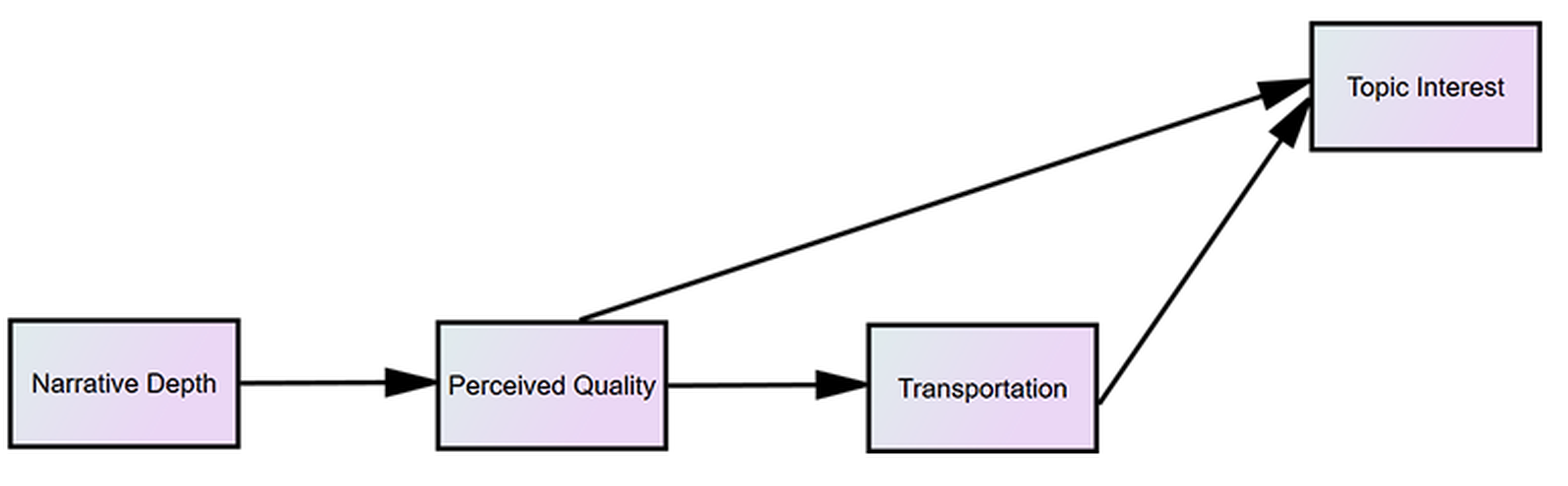
As discussed, stories can be highly engaging and persuasive in science communication, though some studies have reported inconsistent effects. This highlights the need for experimental research to identify variables that enhance narrative potency. The present study addresses this gap with two objectives: first, to model the relationships between the amount of narrative depth, perceived story quality, transportation, and topic interest using SEM (see Figure 1); and second, to evaluate which specific elements of narrative depth most effectively enhance narrative engagement and persuasion. For the first objective, the following direct and indirect effects are hypothesized:
- H1:
-
The amount of narrative depth elements present has a direct positive effect on perceived story quality.
- H2:
-
Perceived story quality has a direct positive effect on transportation.
- H3:
-
Perceived story quality has a direct positive effect on topic interest.
- H4:
-
Transportation has a direct positive effect on topic interest.
- H5:
-
The effect of perceived story quality on topic interest is mediated by transportation.
For the second objective, specific narrative elements will be compared according to the following hypotheses:
- H6:
-
Participants reading a scientific story with vivid imagery evaluate the story more positively than participants reading a basic story.
- H7:
-
Participants reading a scientific story with protagonist emotions and motivations evaluate the story more positively than participants reading a basic story.
- H8:
-
Participants reading a scientific story with both vivid imagery and protagonist emotions and motivations evaluate the story more positively than participants reading a basic story.
- H9:
-
Participants reading a scientific story with both vivid imagery and protagonist emotions and motivations evaluate the story more positively than participants reading a story with only vivid imagery.
- H10:
-
Participants reading a scientific story with both vivid imagery and protagonist emotions and motivations evaluate the story more positively than participants reading a story with only protagonist emotions and motivations.
On an exploratory basis, the present study will also analyse the effect of several recipient- and text characteristics such as previous topic knowledge, education level, age, participant gender, protagonist gender and gender matching.
3 Method
3.1 Participants
An a priori power analysis using G*Power [Faul et al., 2007] showed that 492 participants were needed to obtain a power of 0.8 for a medium effect size (f = 0.15) and an alpha level of α = .05. To ensure robustness, n = 600 participants were recruited via Prolific, a crowdsourcing platform. Participants were required to be fluent in German, as the study materials were presented in this language. They received approximately £ 1.00 in compensation for their participation. After excluding 30 participants who failed both attention checks or completed the survey in less than two minutes, the final sample consisted of n = 570. The mean age was 33 years (SD = 10.69), ranging from 18–78 years. 45.6% of participants identified as female, 52.8% identified as male and 1.6% as diverse. 68.9% of participants had a university degree, while 31.1% had none.
4 Materials
4.1 Independent variables: stories
The AI language model Chat GPT was used to generate initial drafts for two short fictional stories about a female researcher named Jean. The prompts used were: “Write a scientific short story about a female neuroscientist/astronomer named Jean that contains 5 scientific facts about neuroscience/astronomy”. Researchers then checked the facts for accuracy and refined the drafts for stylistic consistency and narrative flow, creating two base stories. Additional versions were developed to incorporate narrative depth elements, namely vivid imagery, information about Jean’s emotions and motivations, or both elements. Finally, versions were created where Jean was male to control for protagonist gender, resulting in a total of 16 stories averaging 580 words. The original stories and an English translation can be found in the Supplementary material.
4.2 Dependent variables: questionnaires
Perceived story quality. Perceived story quality was measured using a single-item scale: “Now state how well you liked the story presented. If possible, answer from your gut, without thinking too long”, rated from 0 (not at all) to 10 (extremely). The single-item approach was chosen for two reasons. First, it aimed to capture participants’ overall subjective evaluation of the story without imposing assumptions about the specific factors contributing to story quality. Second, recent research suggests that single items are frequently as valid and reliable as multi-item scales [Allen et al., 2022].
Increase of topic interest. During the literature review, no questionnaire could be found that was suitable to measure the increase of interest towards a topic after reading a text. Hence, a self-developed questionnaire was used, containing 7 items on a 7-point Likert scale. Two versions of this questionnaire were created, one for neuroscience and one for astronomy. Example items included “The text has increased my interest in neuroscience” or “The text did not motivate me to learn more about astronomy”. Internal consistency of the questionnaire was tested in a pilot study (n = 27, Cronbach’s α = .9), in which participants were sampled from one of the researchers’ private spheres.
Transportation. Transportation was measured via the transportation scale of the Narrative Quality Assessment Tool by Kim et al. [2017]. The scale contains 6 items on a 7-point Likert scale. An example item is “I wanted to know more about what happens next to the character”. This scale was preferred over the original scale by Green and Brock [2000] as it is shorter and designed to capture transportation in a broader range of storytelling contexts.
4.3 Manipulation checks
To assess whether the stories were perceived as intended, participants were asked to rate the amount of vivid imagery and information about Jean’s emotions and motivations present in the story. To achieve this, participants had to state their level of agreement to the statements: “The story presented contained many vivid images” and “The story presented contained a lot of information about Jean’s feelings and motivations” on a 1–7 Likert scale.
4.4 Procedure
Ethical approval was obtained by the ethics commission of TU Braunschweig (Approval: FV-2024-15) on July 15 before the recruitment process began. Participants completed the online survey via LimeSurvey, with the option to use either a desktop or mobile device. First, participants read the privacy policy and had to fill out the informed consent. If they agreed to it, they were instructed to specify their prolific ID so that their financial compensation could be allocated accordingly. Then, participants were randomly assigned to read 1 of 16 story texts. Next, participants had to answer the manipulation checks. Afterwards, participants had to fill out the questionnaires measuring perceived story quality, transportation and increase of topic interest. Then, participants were instructed to state the amount of prior knowledge about the topic presented on a scale from 1–10. Finally, demographic variables were measured, namely gender, age, education level and parent’s education level. The median completion time for the study was 7 minutes and 48 seconds.
5 Results
5.1 Statistical analyses
Descriptive and inferential analyses (see Table 1) were conducted using SPSS (Version 28). Structural equation modelling was performed using the AMOS add-on, and mediation and moderation analyses were conducted using the PROCESS plugin [Hayes, 2018].
|
Scale |
M |
SD |
α |
|
1. Perceived story quality |
7.12 |
2.05 |
– |
|
2. Transportation |
4.57 |
1.47 |
.9 |
|
3. Topic Interest |
4.65 |
1.40 |
.9 |
| Note:
∗= p < .05,
∗∗= p < .01,
perceived
story
quality
was
measured
using
a
single-item
approach,
which
is
why
Cronbach’s
alpha
is
not
applicable
to
that
scale. | |||
5.2 Normality considerations
An assessment of normality revealed that most variables demonstrated acceptable skewness and kurtosis values, with critical ratios within or near the recommended range of ±2. Perceived story quality exhibited significant negative skewness (c.r. = -6.416), and the multivariate critical ratio (c.r. = 3.452) indicated moderate deviation from multivariate normality. However, given the large sample size (n = 570) and the robustness of structural equation modelling to minor normality violations, these deviations were unlikely to substantially affect the results. Bootstrapping was used to address potential issues with standard errors.
5.3 Manipulation checks
5.3.1 Vivid imagery
Participants reading the story intended to have vivid imagery rated the story as having more vivid imagery than the basic story (t(274) = 2.331, p = .021, d = .281), but only slightly and not significantly more than the story containing only protagonist emotions and motivations (t(286) = .702, p = .483, d = .083). Regarding the story intended to have both vivid imagery and protagonist emotions and motivations, participants rated it as having more vivid imagery than the basic story (t(280) = 3.005, p = .003, d = .364) and numerically higher but not significantly more than the story with only protagonist emotions and motivations (t(292) = 1.457, p = .146, d = .17).
5.3.2 Protagonist emotions and motivations
Participants reading the story intended to have protagonist emotions and motivations rated the story as having more protagonist emotions and motivations than the story without narrative depth (t(280) = 8.053, p < .001, d = .96) and the story with only vivid imagery (t(286) = 7.267, p < .001, d = .857). Regarding the story intended to have both vivid imagery and protagonist emotions and motivations, participants rated it as having more protagonist emotions and motivations than the story without narrative depth (t(280) = 7.943, p < .001, d = .947) and the story with only vivid imagery (t(286) = 7.157, p < .001, d = .844). Overall, these results suggest that the operationalization of narrative depth was effective, as stories with vivid imagery and protagonist emotions and motivations were rated appropriately higher on their respective dimensions compared to stories without these features.
5.4 Controlling for topic and protagonist’s gender effects
To ensure that differences in text evaluation related to narrative depth were not influenced by the story’s topic or the protagonist’s gender, a nested model comparison was conducted. The primary models, in which story topic and protagonist gender were pooled, were compared to more complex models that accounted for these variables as separate groups. This analysis tested whether including these variables explained additional variance in the outcomes. The F-tests for nested models revealed that the complex models did not significantly improve fit compared to the simpler models for perceived story quality (F(12,554) = .953, p = .493), topic interest (F(12,554) = .208, p = .998), or transportation (F(12,554) = .013, p = .999). These results indicate that neither the protagonist’s gender nor the story topic significantly influenced the findings.
5.5 Structural equation modelling
To test the hypothesized relationships (H1–H5) regarding the effects of narrative depth, perceived story quality, transportation, and topic interest, a Structural Equation Modelling (SEM) analysis was conducted (see Figure 2). Narrative depth was operationalized as a four-level ordinal variable reflecting increasing inclusion of narrative elements (level 1 = none, level 2 = vivid imagery only & emotions/motivations only, level 3 = both vivid imagery and emotions/motivations). In the SEM analyses, this variable was treated as approximately continuous, which is appropriate given its ordered structure and the large sample size. The model fit the data well across all indices. For instance, the chi-square test was non-significant (χ2(2) = 1.066, p = .587), and the RMSEA was .000 (90% CI: .000–.069), with a PCLOSE of .862. Incremental fit indices such as the CFI (1.000) exceeded .95, indicating excellent fit.
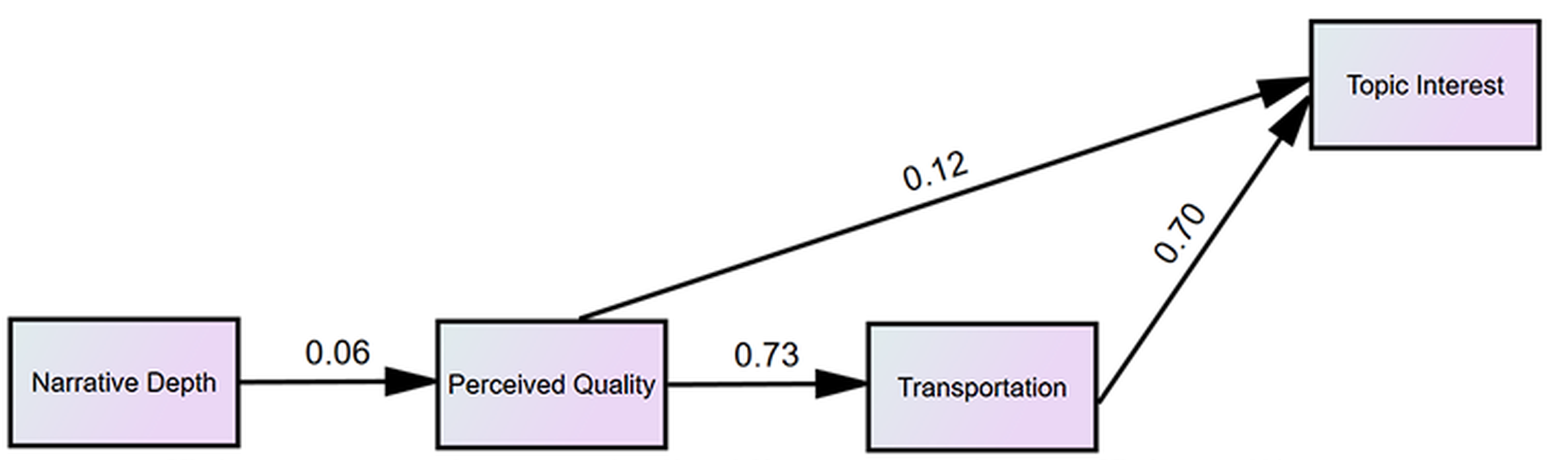
Regarding specific relationships, narrative depth did not have a significant direct effect on perceived story quality (β = .057, p = .174), failing to support H1. However, perceived story quality had a strong positive effect on transportation (β = .733, p < .001), supporting H2. Transportation also had a strong positive effect on topic interest (β = .697, p < .001), and perceived story quality had a small but significant direct effect on topic interest (β = .121, p = .001), supporting H3 and H4. The indirect effect of perceived story quality on topic interest, mediated by transportation, was substantial (β = .511, p < .001), providing evidence for H5.
5.6 Groupwise comparisons
Hypotheses H6–H10 were not supported, as no significant differences in perceived story quality were observed between any of the story conditions. Participants who read the story with vivid imagery did not evaluate it more positively than those who read the basic story (t(274) = .624, p = .533, d = .075). Similarly, participants who read the story with protagonist emotions and motivations did not evaluate it more positively than those who read the basic story (t(280) = .860, p = .391, d = .102). Additionally, the combination of vivid imagery and protagonist emotions and motivations did not result in significantly higher evaluations compared to the basic story (t(280) = 1.356, p = .176, d = .162), vivid imagery alone (t(286) = .692, p = .490, d = .082), or protagonist emotions and motivations alone (t(292) = .557, p = .578, d = .065). These results suggest that the inclusion of vivid imagery, protagonist emotions and motivations, or their combination did not significantly impact subjective evaluations of story quality.
5.7 Exploratory analyses
To examine the potential influence of previous knowledge on the topic, Pearson correlation analyses were conducted. Significant positive correlations were found between previous knowledge and perceived story quality (r = .309, p < .001), transportation (r = .260, p < .001), and topic interest (r = .182, p < .001). These findings suggest that familiarity with the topic is associated with higher evaluations of the story, greater narrative engagement, and increased interest in the subject matter.
Participant gender also influenced key outcomes. Women reported significantly higher levels of perceived story quality (t(559) = 2.016, p = .044, d = .169), increase of topic interest (t(559) = 2.26, p = .024, d = .192), and transportation (t(559) = 3.44, p < .001, d = .291) than men. These results indicate small to moderate effects; with gender differences most pronounced in transportation.
Education level was also found to influence some outcomes. Participants without a university degree reported significantly higher levels of topic interest (t(559) = 2.176, p = .03, d = .197) and transportation (t(559) = 3.115, p = .002, d = .282) compared to those with a university degree. However, no significant differences were observed for perceived story quality (t(559) = 1.272, p = .204, d = .115). These findings indicate small to moderate effects for topic interest and transportation, but no effect for story quality.
Age was not significantly correlated with any of the outcomes. No relationships were found between age and perceived story quality (r = .009, p = .828), topic interest (r = -.022, p = .603), or transportation (r = -.03, p = .469). These results suggest that age does not influence participants’ evaluations, engagement, or interest in the narrative.
To explore whether the gender match between participants and the story’s protagonist influenced the outcome variables, independent-samples t-tests were conducted comparing conditions with matched versus unmatched gender. Results indicated no significant differences for perceived story quality (t(568) = 1.005, p = .315, d = .084), transportation (t(568) = -.277, p = .782, d = -.023), or topic interest (t(568) = -.713, p = .476, d = -.060). These findings suggest that gender matching between participants and protagonists does not significantly influence story evaluations, engagement, or interest in the topic presented.
5.8 Discussion
The present study sought to investigate how specific narrative elements, termed narrative depth, influence perceived story quality, transportation, and topic interest in the context of science communication. By combining structural equation modelling (SEM) and experimental group comparisons, the study examined both the overarching relationships between these constructs and the distinct effects of vivid imagery and protagonist-focused information. The findings provide valuable insights into the mechanisms underlying audience engagement with scientific stories, highlighting the important role of transportation in mediating the effects of perceived story quality on topic interest. At the same time, the absence of significant group differences in perceived story quality suggests a need to re-evaluate assumptions about the universal effectiveness of specific narrative depth elements. Taken together, these findings suggest that the psychological experience of transportation — rather than the presence of specific narrative depth elements — is central to fostering audience interest in scientific topics. The insignificant effects of vivid imagery and protagonist-focused content indicate that enhancing a story’s surface features is not necessarily sufficient to meaningfully shift perceptions of story quality or engagement. One possible explanation is that there is no straightforward ‘recipe’ for crafting an effective story; storytelling remains in many ways an art rather than a formulaic procedure, and single elements may exert their influence only in combination or within broader narrative structures. For researchers, this underscores the need to investigate additional or more holistic narrative components [e.g. the And-But-Therefore structure as proposed by Olson, 2015] that may play a stronger role in shaping audience engagement. Further, it may be crucial to analyse recipient variables like gender or education level, as these appear to moderate the potency of specific types of stories. For practitioners, the findings suggest that storytelling can be a powerful tool, but not all narrative enhancements guarantee improved audience responses, highlighting the importance of carefully tailoring narrative strategies to specific contexts and audiences.
The SEM analysis demonstrated that the hypothesized model fit the data well, showing that the hypothesised relationships were consistent with the observed data. This strong model fit suggests that the theoretical framework is appropriate for capturing relationships among these variables and highlights their relevance in capturing key mechanisms of narrative engagement. Specifically, the model revealed that perceived story quality strongly influences transportation, supporting H2. This finding is consistent with Green and Brock’s [2000] claim that “good” stories more effectively evoke transportation, while also emphasising the subjective nature of story quality. Furthermore, topic interest was influenced directly by both perceived story quality and transportation, with an additional indirect effect of perceived story quality on topic interest mediated by transportation. These results support H3–H5 and offer valuable insights: good science stories foster curiosity and a willingness to learn [Irani & Weitkamp, 2023], and this effect can be largely explained by the experience of transportation, replicating previous research [Howell et al., 2025]. However, as the constructs were measured rather than manipulated, the results should be interpreted as indicative of associations rather than definitive causal effects. Future research experimentally manipulating these variables would be valuable to establish causal mechanisms.
However, when it comes to identifying factors that improve perceived story quality, the present study did not yield statistically significant results. Neither the presence of vivid imagery nor the inclusion of protagonist emotions and motivations had a significant effect, leading to the rejection of H1 and H6–H10. One possible explanation for these null findings is that perceived story quality is a highly subjective and multifaceted construct, where manipulating a single narrative element may not produce a sufficiently large impact to achieve statistical significance. While Dahlstrom and Rosenthal [2018] found an advantage of science stories when vivid imagery was present, this effect was small and only present when the perceived negative influence of the message was low. Further, the stories with more narrative depth were longer than those without, and it is unclear how text length might have affected evaluation of the stories. Nevertheless, as illustrated in Figure 1, the differences in evaluation, although insignificant, consistently aligned with the hypothesized directions. Coupled with the study’s large sample size, this consistency might suggest the possibility of a small effect of narrative depth on perceived story quality, as research has demonstrated that message types generally have small effect sizes on persuasiveness [O’Keefe & Hoeken, 2021], although the evidence remains insufficient to draw firm conclusions. While it can therefore be recommended that storytellers include vivid imagery and protagonist motivation and emotions into their stories to potentially achieve subtle benefits, future research should aim to find more potent factors that increase perceived story quality more significantly.
The exploratory analyses provided additional insights into how individual differences influence story engagement and evaluation. Women reported higher levels of perceived story quality, transportation, and topic interest compared to men. This aligns with the findings of van Laer et al. [2014], who reported that women are more transported by stories than men across 45 studies. In contrast, the present study found no significant effect of gender matching between the story’s protagonist and the participant on these outcomes. This result diverges from Chen et al. [2016], who identified a positive relationship between gender matching and character identification, further highlighting the distinction between identification and transportation as separate constructs [Tal-Or & Cohen, 2010]. These findings suggest that storytelling may be particularly effective for engaging female audiences in science communication.
Additionally, the present study found that individuals with higher education levels reported greater transportation and higher topic interest compared to those without a university degree. This finding may be specific to the scientific context of the stories used in this study, as van Laer et al.’s [2014] meta-analysis did not observe such effects for stories in general. It is plausible that the scientific nature of the narratives used here contributed to lower levels of transportation among individuals with lower education, rather than the storytelling format itself. This effect might partially be explained by topic familiarity, as both the aforementioned meta-analysis and this study have shown that topic familiarity is associated with narrative engagement, and it is plausible that recipients with higher education were more familiar with the scientific stories presented. Hence, future research should explore whether storytelling is also effective for audiences with lower educational backgrounds in the context of science communication. On the other hand, these findings suggest that storytelling can be an effective tool for engaging more educated audiences in scientific topics.
Conclusively, the present study builds on previous research on storytelling in science communication, showing that it may be a promising strategy, yet not a one-size-fits-all solution for goals of science communication like enhancing comprehension of scientific issues, supporting evidence-based choices, and fostering sustained curiosity about science [Borowiec, 2023; Dahlstrom, 2014; Kreuter et al., 2010; Niederdeppe et al., 2011; Shen et al., 2015]. Science communicators should be aware of current research results specifying the conditions under which stories stimulate persuasive outcomes, while being aware of potential ethical considerations [Dahlstrom, 2014].
Several limitations of the present study should be noted. First, the operationalisation of narrative depth elements involved a creative process that inevitably allowed for some degree of subjective interpretation. Although manipulation checks confirmed that participants perceived the operationalisations as intended, different writers might have produced alternative texts that yielded different results. While two story templates were used to diversify the stimuli, the inclusion of additional templates could have helped to mitigate potential idiosyncratic effects of specific texts. Second, the study focused exclusively on two narrative depth elements — vivid imagery and protagonist emotions and motivations — selected for their theoretical grounding [Haven, 2007] and feasibility for operationalisation. However, other potentially influential elements, such as the presence of a character’s struggle or an overarching goal, were not examined. Future research should investigate whether these or other narrative components may have a stronger impact on narrative engagement. Third, the study utilised only scientific narratives as stimuli, which may limit the generalisability of the findings to non-scientific contexts. Hence, it would be valuable to explore whether the observed patterns hold across different genres to provide a broader understanding of narrative engagement.
Despite its limitations, the present study has several notable strengths. First, it combines structural equation modelling with experimental group comparisons, providing a comprehensive approach to understanding the relationships between narrative depth, transportation, and topic interest. This dual methodology allows for both theoretical validation and practical exploration of specific narrative elements, enhancing the robustness of the findings. Second, the study’s large sample size (n = 570) increases power and improves the precision of estimates, while also enabling meaningful subgroup analyses. Third, the careful operationalisation of vivid imagery and protagonist emotions and motivations, supported by manipulation checks, demonstrates rigorous experimental control and provides a solid foundation for future investigations into narrative depth. Finally, the study’s focus on the context of science communication addresses a critical gap in the literature, offering valuable insights into how storytelling can engage audiences and foster interest in scientific topics — a pressing challenge in today’s media landscape.
Funding statement
The authors received no financial support for the research, authorship, and/or publication of this
article.
Data availability
The datasets generated during and/or analysed during the current study are available in the OSF
repository, https://osf.io/4g8u9/?view_only=3a94215cc1474e368fa62bab75205497.
References
-
Allen, M. S., Iliescu, D., & Greiff, S. (2022). Single item measures in psychological science: a call to action. European Journal of Psychological Assessment, 38(1), 1–5. https://doi.org/10.1027/1015-5759/a000699
-
Appel, M., & Richter, T. (2010). Transportation and need for affect in narrative persuasion: a mediated moderation model. Media Psychology, 13(2), 101–135. https://doi.org/10.1080/15213261003799847
-
Arya, D. J., & Maul, A. (2012). The role of the scientific discovery narrative in middle school science education: an experimental study. Journal of Educational Psychology, 104(4), 1022–1032. https://doi.org/10.1037/a0028108
-
Bekalu, M. A., Bigman, C. A., McCloud, R. F., Lin, L. K., & Viswanath, K. (2018). The relative persuasiveness of narrative versus non-narrative health messages in public health emergency communication: evidence from a field experiment. Preventive Medicine, 111, 284–290. https://doi.org/10.1016/j.ypmed.2017.11.014
-
Bilandzic, H., Kinnebrock, S., & Klingler, M. (2020). The emotional effects of science narratives: a theoretical framework. Media and Communication, 8(1), 151–163. https://doi.org/10.17645/mac.v8i1.2602
-
Borowiec, B. G. (2023). Ten simple rules for scientists engaging in science communication. PLoS Computational Biology, 19(7), e1011251. https://doi.org/10.1371/journal.pcbi.1011251
-
Braddock, K., & Dillard, J. P. (2016). Meta-analytic evidence for the persuasive effect of narratives on beliefs, attitudes, intentions, and behaviors. Communication Monographs, 83(4), 446–467. https://doi.org/10.1080/03637751.2015.1128555
-
Bubela, T., Nisbet, M. C., Borchelt, R., Brunger, F., Critchley, C., Einsiedel, E., Geller, G., Gupta, A., Hampel, J., Hyde-Lay, R., Jandciu, E. W., Jones, S. A., Kolopack, P., Lane, S., Lougheed, T., Nerlich, B., Ogbogu, U., O’Riordan, K., Ouellette, C., … Caulfield, T. (2009). Science communication reconsidered. Nature Biotechnology, 27(6), 514–518. https://doi.org/10.1038/nbt0609-514
-
Bullock, O. M., Shulman, H. C., & Huskey, R. (2021). Narratives are persuasive because they are easier to understand: examining processing fluency as a mechanism of narrative persuasion. Frontiers in Communication, 6, 719615. https://doi.org/10.3389/fcomm.2021.719615
-
Burns, T. W., O’Connor, D. J., & Stocklmayer, S. M. (2003). Science communication: a contemporary definition. Public Understanding of Science, 12(2), 183–202. https://doi.org/10.1177/09636625030122004
-
Chen, M., Bell, R. A., & Taylor, L. D. (2016). Narrator point of view and persuasion in health narratives: the role of protagonist–reader similarity, identification, and self-referencing. Journal of Health Communication, 21(8), 908–918. https://doi.org/10.1080/10810730.2016.1177147
-
Cohen, J. (2006). Audience identification with media characters. In J. Bryant & P. Vorderer (Eds.), Psychology of entertainment (pp. 183–197). Routledge. https://doi.org/10.4324/9780203873694
-
Cologna, V., Mede, N. G., Berger, S., Besley, J., Brick, C., Joubert, M., Maibach, E. W., Mihelj, S., Oreskes, N., Schäfer, M. S., van der Linden, S., Abdul Aziz, N. I., Abdulsalam, S., Shamsi, N. A., Aczel, B., Adinugroho, I., Alabrese, E., Aldoh, A., Alfano, M., … Zwaan, R. A. (2025). Trust in scientists and their role in society across 68 countries. Nature Human Behaviour, 9(4), 713–730. https://doi.org/10.1038/s41562-024-02090-5
-
Cormick, C. (2019). Who doesn’t love a good story? — What neuroscience tells about how we respond to narratives. JCOM, 18(05), Y01. https://doi.org/10.22323/2.18050401
-
Dahlstrom, M. F. (2014). Using narratives and storytelling to communicate science with nonexpert audiences. Proceedings of the National Academy of Sciences, 111(supplement_4), 13614–13620. https://doi.org/10.1073/pnas.1320645111
-
Dahlstrom, M. F. (2021). The narrative truth about scientific misinformation. Proceedings of the National Academy of Sciences, 118(15), e1914085117. https://doi.org/10.1073/pnas.1914085117
-
Dahlstrom, M. F., & Ho, S. S. (2012). Ethical considerations of using narrative to communicate science. Science Communication, 34(5), 592–617. https://doi.org/10.1177/1075547012454597
-
Dahlstrom, M. F., Niederdeppe, J., Gao, L., & Zhu, X. (2017). Operational and conceptual trends in narrative persuasion research: comparing health- and non-health-related contexts. International Journal of Communication, 11, 4865–4885. https://ijoc.org/index.php/ijoc/article/view/6629
-
Dahlstrom, M. F., & Rosenthal, S. (2018). Third-person perception of science narratives: the case of climate change denial. Science Communication, 40(3), 340–365. https://doi.org/10.1177/1075547018766556
-
Davies, S. R., Halpern, M., Horst, M., Kirby, D., & Lewenstein, B. (2019). Science stories as culture: experience, identity, narrative and emotion in public communication of science. JCOM, 18(05), A01. https://doi.org/10.22323/2.18050201
-
de Graaf, A., Hoeken, H., Sanders, J., & Beentjes, J. W. J. (2012). Identification as a mechanism of narrative persuasion. Communication Research, 39(6), 802–823. https://doi.org/10.1177/0093650211408594
-
de Graaf, A., van den Putte, B., Nguyen, M.-H., Zebregs, S., Lammers, J., & Neijens, P. (2017). The effectiveness of narrative versus informational smoking education on smoking beliefs, attitudes and intentions of low-educated adolescents. Psychology & Health, 32(7), 810–825. https://doi.org/10.1080/08870446.2017.1307371
-
Ecker, U. K. H., Butler, L. H., & Hamby, A. (2020). You don’t have to tell a story! A registered report testing the effectiveness of narrative versus non-narrative misinformation corrections. Cognitive Research: Principles and Implications, 5(1), 64. https://doi.org/10.1186/s41235-020-00266-x
-
ElShafie, S. J. (2018). Making science meaningful for broad audiences through stories. Integrative and Comparative Biology, 58(6), 1213–1223. https://doi.org/10.1093/icb/icy103
-
Faul, F., Erdfelder, E., Lang, A.-G., & Buchner, A. (2007). G*Power 3: a flexible statistical power analysis program for the social, behavioral, and biomedical sciences. Behavior Research Methods, 39(2), 175–191. https://doi.org/10.3758/bf03193146
-
Finkler, W., & Leon, B. (2019). The power of storytelling and video: a visual rhetoric for science communication. JCOM, 18(05), A02. https://doi.org/10.22323/2.18050202
-
Fischer, P., & Thies, B. (2024). Stories as a tool in science communication: an experimental analysis. International Journal of Science Education, Part B, 14(3), 418–432. https://doi.org/10.1080/21548455.2023.2285743
-
Flusberg, S. J., Matlock, T., & Thibodeau, P. H. (2017). Metaphors for the war (or race) against climate change. Environmental Communication, 11(6), 769–783. https://doi.org/10.1080/17524032.2017.1289111
-
Grall, C., Tamborini, R., Weber, R., & Schmälzle, R. (2021). Stories collectively engage listeners’ brains: enhanced intersubject correlations during reception of personal narratives. Journal of Communication, 71(2), 332–355. https://doi.org/10.1093/joc/jqab004
-
Green, M. C. (2008). Transportation theory. In The international encyclopedia of communication. Wiley. https://doi.org/10.1002/9781405186407.wbiect058
-
Green, M. C. (2021). Transportation into narrative worlds. In L. B. Frank & P. Falzone (Eds.), Entertainment-education behind the scenes: case studies for theory and practice (pp. 87–101). Palgrave Macmillan. https://doi.org/10.1007/978-3-030-63614-2_6
-
Green, M. C., & Brock, T. C. (2000). The role of transportation in the persuasiveness of public narratives. Journal of Personality and Social Psychology, 79(5), 701–721. https://doi.org/10.1037/0022-3514.79.5.701
-
Green, M. C., Strange, J. J., & Brock, T. C. (Eds.). (2013). Narrative impact: social and cognitive foundations. Psychology Press. https://doi.org/10.4324/9781410606648
-
Haven, K. F. (2007). Story proof: the science behind the startling power of story. Libraries Unlimited.
-
Hayes, A. F. (2018). Introduction to mediation, moderation, and conditional process analysis: a regression-based approach (2nd ed.). The Guilford Press.
-
Hidi, S., & Renninger, K. A. (2006). The four-phase model of interest development. Educational Psychologist, 41(2), 111–127. https://doi.org/10.1207/s15326985ep4102_4
-
Howell, E. L., Behrman, S. L., Kirschner, E., & Goodwin, S. S. (2025). Storytelling in science film: narrative engagement relates to greater knowledge, interest, and identification with science. Science Communication, 47(2), 211–249. https://doi.org/10.1177/10755470241269885
-
Irani, M., & Weitkamp, E. (2023). Factors affecting the efficacy of short stories as science communication tools. JCOM, 22(02), Y01. https://doi.org/10.22323/2.22020401
-
Johnson, D. R., Jasper, D. M., Griffin, S., & Huffman, B. L. (2013). Reading narrative fiction reduces Arab-Muslim prejudice and offers a safe haven from intergroup anxiety. Social Cognition, 31(5), 578–598. https://doi.org/10.1521/soco.2013.31.5.578
-
Joubert, M., Davis, L., & Metcalfe, J. (2019). Storytelling: the soul of science communication. JCOM, 18(05), E. https://doi.org/10.22323/2.18050501
-
Kim, W., Shin, C.-N., Larkey, L. K., & Roe, D. J. (2017). Development and validation of the narrative quality assessment tool. Journal of Nursing Measurement, 25(1), 171–183. https://doi.org/10.1891/1061-3749.25.1.171
-
Kreuter, M. W., Holmes, K., Alcaraz, K., Kalesan, B., Rath, S., Richert, M., McQueen, A., Caito, N., Robinson, L., & Clark, E. M. (2010). Comparing narrative and informational videos to increase mammography in low-income African American women. Patient Education and Counseling, 81(Supplement 1), S6–S14. https://doi.org/10.1016/j.pec.2010.09.008
-
Leech, G. N., & Short, M. H. (2007). Style in fiction: a linguistic introduction to English fictional prose (2nd ed.). Pearson Longman.
-
Mallan, K. (1997). Storytelling in the school curriculum. Educational Practice and Theory, 19(1), 75–82. https://doi.org/10.7459/ept/19.1.09
-
Mar, R. A., & Oatley, K. (2008). The function of fiction is the abstraction and simulation of social experience. Perspectives on Psychological Science, 3(3), 173–192. https://doi.org/10.1111/j.1745-6924.2008.00073.x
-
McKinnon, M., & Vos, J. (2015). Engagement as a threshold concept for science education and science communication. International Journal of Science Education, Part B, 5(4), 297–318. https://doi.org/10.1080/21548455.2014.986770
-
Murphy, S. T., Frank, L. B., Chatterjee, J. S., & Baezconde-Garbanati, L. (2013). Narrative versus nonnarrative: the role of identification, transportation, and emotion in reducing health disparities. Journal of Communication, 63(1), 116–137. https://doi.org/10.1111/jcom.12007
-
Nerghes, A., Mulder, B., & Lee, J.-S. (2022). Dissemination or participation? Exploring scientists’ definitions and science communication goals in the Netherlands. PLoS ONE, 17(12), e0277677. https://doi.org/10.1371/journal.pone.0277677
-
Niederdeppe, J., Shapiro, M. A., & Porticella, N. (2011). Attributions of responsibility for obesity: narrative communication reduces reactive counterarguing among liberals. Human Communication Research, 37(3), 295–323. https://doi.org/10.1111/j.1468-2958.2011.01409.x
-
O’Keefe, D. J., & Hoeken, H. (2021). Message design choices don’t make much difference to persuasiveness and can’t be counted on — not even when moderating conditions are specified. Frontiers in Psychology, 12, 664160. https://doi.org/10.3389/fpsyg.2021.664160
-
Olson, R. (2015). Houston, we have a narrative: why science needs story. University of Chicago Press. https://doi.org/10.7208/chicago/9780226270982.001.0001
-
Oxford University Press. (2024). Story. In Oxford Learner’s Dictionaries. https://www.oxfordlearnersdictionaries.com/definition/english/story
-
Paivio, A. (1969). Mental imagery in associative learning and memory. Psychological Review, 76(3), 241–263. https://doi.org/10.1037/h0027272
-
Philipp-Muller, A., Lee, S. W. S., & Petty, R. E. (2022). Why are people antiscience, and what can we do about it? Proceedings of the National Academy of Sciences, 119(30), e2120755119. https://doi.org/10.1073/pnas.2120755119
-
Rabelista-Nijhof, A. (2020). Narrative transportation, identification, and storytelling in environmental (science) communication: immersing audiences in a story. ScienceOpen Preprints. https://doi.org/10.14293/PR2199.000068.v1
-
Reagan, A. J., Mitchell, L., Kiley, D., Danforth, C. M., & Dodds, P. S. (2016). The emotional arcs of stories are dominated by six basic shapes. EPJ Data Science, 5(1), 31. https://doi.org/10.1140/epjds/s13688-016-0093-1
-
Sadoski, M., Goetz, E. T., & Kangiser, S. (1988). Imagination in story response: relationships between imagery, affect, and structural importance. Reading Research Quarterly, 23(3), 320–336. https://doi.org/10.2307/748045
-
Sadoski, M., Goetz, E. T., & Rodriguez, M. (2000). Engaging texts: effects of concreteness on comprehensibility, interest, and recall in four text types. Journal of Educational Psychology, 92(1), 85–95. https://doi.org/10.1037//0022-0663.92.1.85
-
Shen, F., Sheer, V. C., & Li, R. (2015). Impact of narratives on persuasion in health communication: a meta-analysis. Journal of Advertising, 44(2), 105–113. https://doi.org/10.1080/00913367.2015.1018467
-
Sukalla, F. (2018). Narrative persuasion und Einstellungsdissonanz: ein konservativer Test der zentralen Wirkungszusammenhänge. Springer. https://doi.org/10.1007/978-3-658-20445-7
-
Sun, Y., Lee, T. K., & Qian, S. (2019). Beyond personal responsibility: examining the effects of narrative engagement on communicative and civic actions. Journal of Health Communication, 24(6), 603–614. https://doi.org/10.1080/10810730.2019.1643954
-
Tal-Or, N., & Cohen, J. (2010). Understanding audience involvement: conceptualizing and manipulating identification and transportation. Poetics, 38(4), 402–418. https://doi.org/10.1016/j.poetic.2010.05.004
-
Tannen, D. (2007). Talking voices: repetition, dialogue, and imagery in conversational discourse. Cambridge University Press. https://doi.org/10.1017/CBO9780511618987
-
Thibodeau, P. H., Perko, V. L., & Flusberg, S. J. (2015). The relationship between narrative classification of obesity and support for public policy interventions. Social Science & Medicine, 141, 27–35. https://doi.org/10.1016/j.socscimed.2015.07.023
-
Trench, B. (2008). Towards an analytical framework of science communication models. In D. Cheng, M. Claessens, T. Gascoigne, J. Metcalfe, B. Schiele & S. Shi (Eds.), Communicating science in social contexts: new models, new practices (pp. 119–135). Springer. https://doi.org/10.1007/978-1-4020-8598-7_7
-
Turner, M. (1996). The literary mind. Oxford University Press.
-
van Laer, T., de Ruyter, K., Visconti, L. M., & Wetzels, M. (2014). The extended transportation-imagery model: a meta-analysis of the antecedents and consequences of consumers’ narrative transportation. Journal of Consumer Research, 40(5), 797–817. https://doi.org/10.1086/673383
-
Wang, W., & Shen, F. (2019). The effects of health narratives: examining the moderating role of persuasive intent. Health Marketing Quarterly, 36(2), 120–135. https://doi.org/10.1080/07359683.2019.1575061
-
Wimmer, L., Friend, S., Currie, G., & Ferguson, H. J. (2021). Reading fictional narratives to improve social and moral cognition: the influence of narrative perspective, transportation, and identification. Frontiers in Communication, 5, 611935. https://doi.org/10.3389/fcomm.2020.611935
-
Wirtz, J. G., & Kulpavaropas, S. (2014). The effects of narrative and message framing on engagement and eating intention among a sample of adult Hispanics. Journal of Nutrition Education and Behavior, 46(5), 396–400. https://doi.org/10.1016/j.jneb.2013.12.005
-
Yang, Y., & Hobbs, J. E. (2020). The power of stories: narratives and information framing effects in science communication. American Journal of Agricultural Economics, 102(4), 1271–1296. https://doi.org/10.1002/ajae.12078
-
Zak, P. J. (2015). Why inspiring stories make us react: the neuroscience of narrative. Cerebrum, 2015, 2. https://www.ncbi.nlm.nih.gov/pmc/articles/PMC4445577/
-
Zebregs, S., van den Putte, B., de Graaf, A., Lammers, J., & Neijens, P. (2015). The effects of narrative versus non-narrative information in school health education about alcohol drinking for low educated adolescents. BMC Public Health, 15(1), 1085. https://doi.org/10.1186/s12889-015-2425-7
About the authors
Peter Fischer, M.Sc.
09/2014–07/2017: Psychology degree, bachelor — University of Groningen
10/2017–07/2020: Psychology degree, master — University of Vienna
01/2021–present: Ph.D. at Institute for Educational Psychology — TU Braunschweig
E-mail: peter.fischer@tu-braunschweig.de
Prof. Dr. Barbara Thies
1989–1996: Psychology degree (Diploma) — Ruhr-University Bochum
1996–1998: Research Associate (Educational Psychology) — Ruhr-University Bochum
1998–2010: Research Associate/Assistant (Educational Psychology) — University of
Vechta
2001: Ph.D. (Dr. phil.) — University of Vechta
2009: Habilitation (Venia Legendi: Psychology) — University of Vechta
2010–2011: Professor of Social Work — Emden/Leer University of Applied Sciences
2011–present: Professor of Educational Psychology — TU Braunschweig
E-mail: barbara.thies@tu-braunschweig.de
Supplementary material
Available at https://doi.org/10.22323/153420260208063651
Original texts
English texts