

1 Context
In science communication, particularly within conservation contexts, a central challenge is how to effectively motivate public engagement and behaviour change. While traditional dissemination or deficit-model approaches rely heavily on rational appeals, these strategies are often insufficient to inspire meaningful conservation action [Kidd, Bekessy & Garrard, 2019a; Toomey, 2023]. Recent research has demonstrated the effectiveness of emotional appeals in conservation communication [Nabi et al., 2018; Williamson & Thulin, 2022], and studies have also highlighted the contribution of emotions to higher levels of social media engagement [Berger & Milkman, 2012; Tao et al., 2021]. Emotional appeals in conservation communication are powerful because emotions serve not only as indicators of audience responses but also as mediators and moderators of cognitive processes and decision-making [Bagozzi et al., 1999]. On social media, affective content — positive or threat-based — can drive higher levels of engagement [Hart et al., 2025]. Among emotions investigated, fear and hope have attracted the most research attention [Kidd, Bekessy & Garrard, 2019b; Nabi et al., 2018], yet debate over their effectiveness persists.
Fear appeals in conservation aim to motivate action by increasing perceived threat severity and personal vulnerability [Williamson & Thulin, 2022]. This strategy is commonly used in communicating climate change [Cismaru et al., 2011; Feinberg & Willer, 2011; Nabi et al., 2018] and biodiversity loss [Kidd, Bekessy & Garrard, 2019b]. However, empirical evidence for their effectiveness remains limited and inconsistent [de Lange et al., 2022; Wenzel et al., 2023]. A primary concern is that fear appeals can undermine self-efficacy — the belief in one’s ability to achieve desired goals [Kidd, Garrard et al., 2019] — leading to feelings of helplessness rather than conservation actions [Landry et al., 2018; McAfee et al., 2019]. Some studies argue that efficacy is crucial for promoting action-level change [Tabernero & Hernández, 2011] and should therefore be an important aim of conservation communication [Gregg et al., 2021]. The Extended Parallel Process Model (EPPM) explains this paradox: fear appeals are more likely to lead to adaptive behavioural change when perceptions of threat are accompanied by high levels of efficacy [Ma et al., 2023]. Without sufficient efficacy, fear may trigger maladaptive responses such as rejection and denial [Carey et al., 2013].
Hope appeals, in contrast, are positive emotional appeals associated with efficacy and can promote donation [Jacobson et al., 2019], pro-environmental social norms [de Lange et al., 2022], and conservation outcomes [Ainsworth & Burns, 2020]. When messages emphasise efficacy, they indirectly increase participation through hope [Feldman & Hart, 2016]. Yet hope may also decrease perceived risk [Kidd, Bekessy & Garrard, 2019b], create fake hope, and lead to disengagement in conservation [Park et al., 2020]. Hence, although many researchers and conservationists promote optimism and hope in communication [McAfee et al., 2019], some argue that a balance between positive and negative appeals may be more effective [McAfee & Connell, 2019].
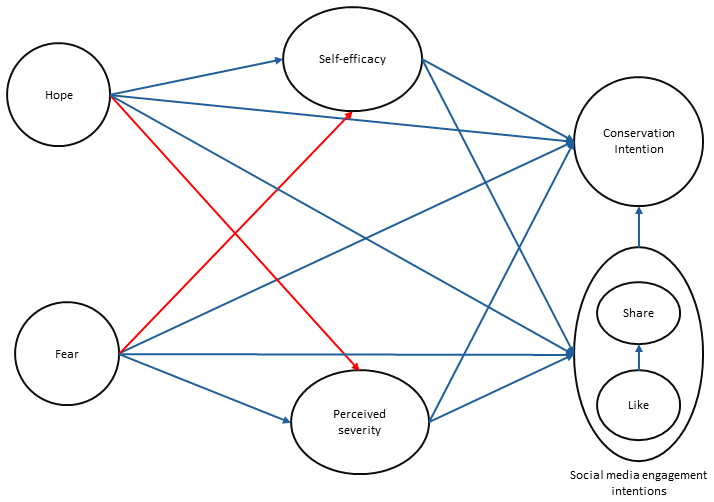
Given these mixed findings and context-dependent pathways [Kidd, Bekessy & Garrard, 2019a, 2019b], the first aim of this study is to examine the effects of hope and fear on conservation intentions for the endangered snow leopard (Panthera uncia), a species endemic to Central Asia [McCarthy et al., 2017]. Drawing on the literature, we propose a conceptual model in which hope is positively associated with self-efficacy but negatively associated with perceived severity, whereas fear increases perceived severity while reducing self-efficacy. Both emotions are hypothesised to positively influence conservation intentions (Figure 1).
1.1 Social media engagement
Social media engagement has been conceptualised as a multi-dimensional construct ranging from passive consumption to active content creation [Dolan et al., 2016; Ji et al., 2017]. Although the number of likes, reposts/retweets, and comments are common metrics for measuring social media engagement, they represent different levels of engagement [Ji et al., 2017] and result from different engagement mechanisms [Tenenboim, 2022]. Specifically, liking requires only intuitive cognition [Yang et al., 2020], whereas sharing involves greater cognitive effort [Kim & Yang, 2017]. Accordingly, the refined conceptual model (Figure 1) focuses on liking and sharing as two sequential forms of engagement, with a hypothesised path from liking to sharing.
Beyond online engagement metrics, empirical studies have linked social media engagement to offline conservation actions, particularly donation and volunteering. Volunteering is primarily driven by community ties and social integration [Asah & Blahna, 2012], whereas charitable giving is better explained by personal resources (e.g., income and education) and helping values [Jones, 2006]. Despite these distinct mechanisms, both donating and volunteering contribute substantively to conservation efforts.
Research has linked social media engagement to both donation and volunteering behaviours. For example, Büssing et al. [2019] conducted an empirical study examining the relationship between liking on social media and these two offline conservation behaviours. They found a strong correlation between the desire to like social media content and both outcome behaviours. Similarly, exposure to positive content about bees on social media was positively associated with greater engagement in conservation behaviours offline [Cruz Crespo & Cruz, 2023]. Boulianne [2023] also identified significant positive correlations between following non-profit organisations and both online and offline volunteering and donating, while Park and Jung [2023] reported similar findings for climate change mitigation intentions. These initial data suggest that social media engagement can be regarded as a first step towards conservation action.
Based on this evidence, the conceptual model was further refined by adding two sets of hypothesised pathways: 1. social media engagement intentions positively associated with conservation intentions; 2. hope and fear influence social media engagement intentions through the mediation of self-efficacy and perceived severity, respectively (Figure 1).
1.2 Demographic and cultural influences
Effective communication requires an understanding of how audiences receive, process, and respond to messages — a foundational principle of communication theory. The context of the audience affects the effectiveness of communication [Kappel & Holmen, 2019]. Recipients of communication are not “empty containers” of knowledge; rather, they process information based on their experience, cultural context, and personal circumstances. The model that considers the context of the recipient is termed the “contextual model” in science communication [Lewenstein, 2003]. It emphasises audience diversity [Weingart et al., 2021] and provides theoretical support for tailoring messages to different audiences according to their social backgrounds [Lewenstein, 2003].
Many studies have highlighted that the effectiveness of conservation messages is highly specific to the audiences [de Lange et al., 2022]. Information may not lead to conservation actions if it fails to engage with social and cultural contexts [Toomey, 2023]. People from different demographic and cultural backgrounds may hold distinct attitudes towards biodiversity and conservation [Kusmanoff et al., 2020], potentially affecting their responses to social media posts. Therefore, understanding audiences and tailoring messages accordingly is an important component of effective conservation communication [McAfee & Connell, 2019].
To systematically account for these differences, this study employs two established frameworks: Hall’s high- and low-context communication theory [Hall & Hall, 1990] and Hofstede’s six-dimensional model [Hofstede, 2011; Hofstede et al., 2010].
Hall’s high-and low-context theory describes cultural differences in communication styles [Hall & Hall, 1990]. In high-context cultures (e.g., Japan, Arab countries, and Mediterranean countries), communication is indirect, reserved, and relationship-oriented, favouring nonverbal cues and harmony [Würtz, 2005]. In low-context cultures (e.g., North America, the Scandinavian region, and German-speaking countries), communication tends to provide more detailed background context and is more direct, precise, and content-focused [An, 2003; Mele et al., 2021]. Beyond communication, the theory also extends to thinking styles and social relations: high-context cultures tend towards non-linear, self-clarifying thinking and deeper social involvement with clearer hierarchies, whereas low-context cultures favour linear, logical reasoning and prioritise efficiency over relationship maintenance [Kim et al., 1998; Würtz, 2005].
Hofstede’s model [Hofstede, 2011; Hofstede et al., 2010] operationalises culture through six empirically derived dimensions. Power Distance reflects the acceptance of hierarchical inequality and is relevant to how audiences respond to authority-based appeals (e.g., “experts recommend”). Individualism-Collectivism concerns the extent to which people in a society are integrated into groups and influences whether messages should emphasise personal benefits (individualistic) or community (collectivistic). Masculinity-Femininity concerns the distribution of values associated with competition/achievement versus cooperation/care. Uncertainty Avoidance shapes responses to messages about unpredictable environmental threats. Long-Term Orientation influences the weight given to future versus immediate consequences. Indulgence-Restraint concerns preferences for enjoyment-oriented versus restraint-oriented messaging.
Table 1 summarises these six dimensions alongside Hall’s high- and low-context theory. These dimensions provide a structured lens to hypothesise how cultural values may moderate emotional and behavioural responses to conservation messages.
|
Dimension |
Definition |
High-Score Indication (vs. Low-Score) |
| Hofstede’s Dimensions | ||
|
Power Distance (PDI) |
The level of inequality and the perception of it. |
Greater dependence of subordinates on superiors |
|
Individualism-Collectivism (IDV) |
The extent to which people in a society are integrated into groups. |
A more individualistic society (vs. a more collectivist society) |
|
Masculinity-Femininity (MAS) |
The distribution of values between the genders in a society. |
A relatively more masculine country (vs. more feminine country); emotional gender roles are more distinct |
|
Uncertainty Avoidance (UAI) |
The tolerance for unstructured situations in a society. |
A stronger need for predictability and rules |
|
Long-Term Orientation (LTO) |
The extent to which behaviour is oriented towards the future and present/past. |
A more long-term oriented society |
|
Indulgence-Restraint Dimension (IND) |
The extent to which people in a society fulfil or control the common human desire for enjoyment. |
A society positioned more towards indulgence |
| Hall’s Context Theory
| ||
|
High-Low Context |
The degree to which meaning is embedded in the context vs. the explicit message. |
Communication is more indirect, reserved, and understated, with a tendency to maintain harmony and a preference for nonverbal cues [vs. more direct, precise, and open communication, based on feelings or intentions; Würtz, 2005] |
The influence of images may vary across cultures. Images have been found to increase social media engagement by evoking stronger emotional responses [Zhu et al., 2021] and capturing audience attention [Hockley, 2008; Hockley & Bancroft, 2011], which may in turn increase willingness to donate [Baberini et al., 2015]. Cross-cultural research shows that individuals attend to images differently [Boduroglu et al., 2009; Chua et al., 2005; Zhang & Seo, 2015]. These cultural differences have been examined in business marketing: Chinese advertisements, for example, often feature more contextual detail than American advertisements [Liang et al., 2011; Liu, 2010].
Furthermore, eye contact is a key visual element. Images that create eye contact with viewers have been hypothesised to promote conservation intentions by enhancing prosocial responses in wildlife imagery [Manesi et al., 2016; Van Lange & Manesi, 2023; Wang et al., 2024]. However, the interpretation of eye contact is culturally coded: it may signal trustworthiness in low-context cultures but be perceived as unapproachable in high-context ones [Karandashev, 2021]. Despite its relevance, how image composition (e.g., background context) and eye contact function in cross-cultural conservation communication remains underexplored. Examining these factors may therefore provide further insights into how conservation posts can be optimised for emotional impact and engagement on social media.
On the other hand, the framing of conservation issues is also critical for providing accurate information and motivating action [Martell & Rodewald, 2020]. Negative framing can promote attitudes that prioritise human interests over wildlife protection, yet such messages are perceived as less credible than positive or neutral ones [Echeverri et al., 2017]. For donation behaviour, negative appeals tend to be more or equally effective than positive appeals in eliciting actual donations [Erlandsson et al., 2018; Martell & Rodewald, 2024], even though positive appeals generate more favourable attitudes towards the organisation [Erlandsson et al., 2018]. Conversely, Jacobson et al. [2019] found that positively framed videos can also increase donations, while another study revealed that motivational framing outperformed sacrifice framing in generating engagement and behavioural intentions [Gifford & Comeau, 2011].
Framing effects are not uniform across audiences: among respondents who place a high value on wildlife protection, both optimistic and pessimistic frames reduce intentions to adopt personal conservation actions, even as pessimistic frames increase their donation intentions [Martell & Rodewald, 2025]. Gender, age, income, and educational level are also potential moderators [Gifford & Comeau, 2011]. However, behavioural intentions are strongest when respondents’ emotional responses match the valence of the message frame — that is, negative emotions with pessimistic frames and positive emotions with optimistic frames [Martell & Rodewald, 2024].
While no consensus exists on whether positive or negative framing is superior, research on how their effects vary across demographics and culture also remains limited [Kidd, Bekessy & Garrard, 2019b]. The second aim of this study is therefore to examine which combinations of text framing and image characteristics are more effective in evoking hope and fear, and how their effectiveness is moderated by demographic characteristics and cultural dimensions. Positive text valence was hypothesised to be associated with hope, and negative text valence with fear.
2 Objective
Figure 2 presents the conceptual structure of our study and its two main research questions:
- RQ1:
-
How do messages of fear and hope relate to conservation intentions for snow leopards?
- RQ2:
-
Which combinations of text framing and image characteristics are more effective in evoking hope and fear?
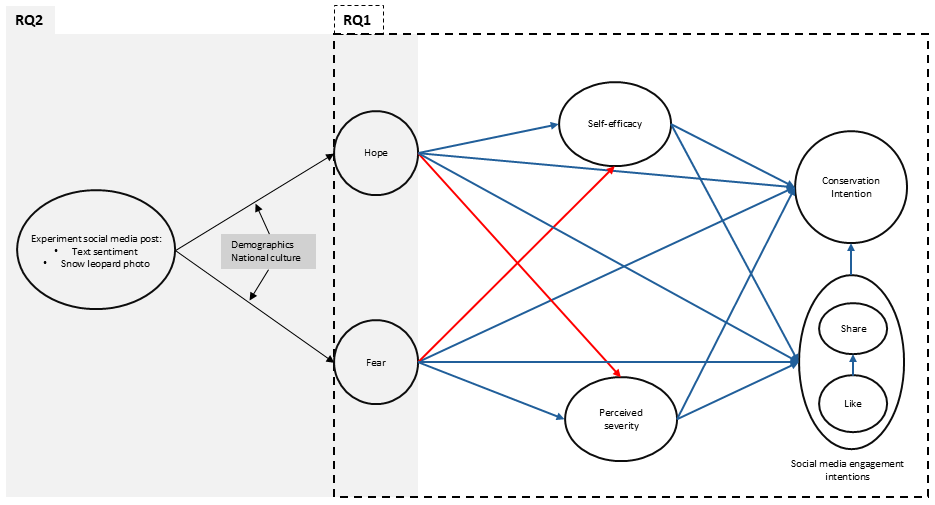
By addressing these two research questions, this study explores how social media posts about snow leopard conservation contribute to conservation intentions through hope and fear appeals, as well as how these relationships are influenced by audience demographics and cultural backgrounds.
3 Methods
3.1 Social media post design
Eight experimental social media posts were designed: two text valences (positive vs. negative) Õ four images (full shot vs. wide shot, with eye contact vs. without eye contact).
The positive and negative framing texts were developed based on information about projected change in snow leopard habitat size under climate change. Approximately 23% of snow leopard habitat is projected to be lost by 2070 under the Representative Concentration Pathway 8.5, the most extreme predicted climate change scenario [Li et al., 2016]. Other predictions based on different climate change scenarios range from a smaller decrease to a potential increase in the snow leopard habitat [Farrington & Li, 2024]. Therefore, the comparison between the current situation and the worst-case scenario prediction (-23%) was used as the basis for the experimental texts.
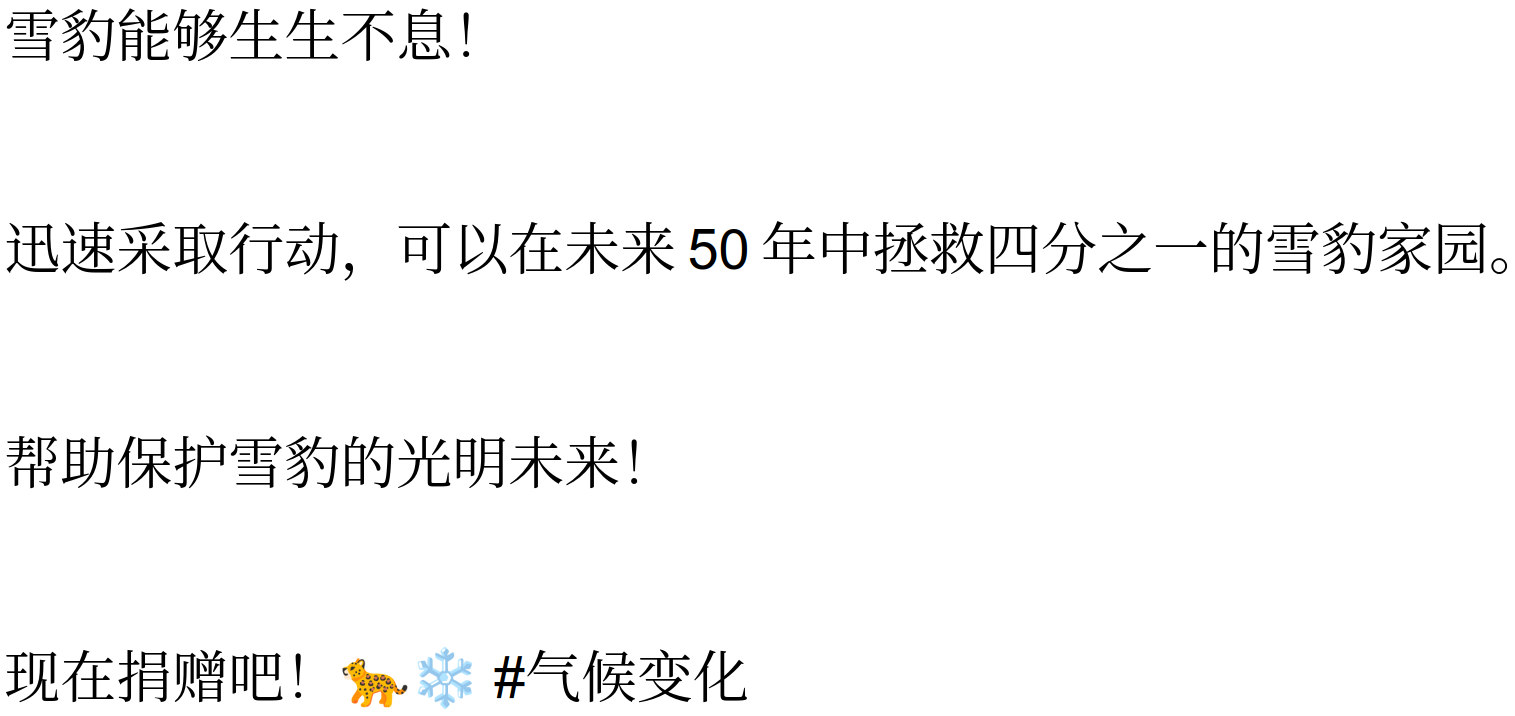
Text valence was validated using VADER [Valence Aware Dictionary for sEntiment Reasoning; Hutto & Gilbert, 2014]. The positively and negatively framed English texts were then professionally translated into Chinese for the survey:
Positive (VADER = 0.917):Snow Leopards can thrive!
Swift action can save a quarter of their homes from vanishing in the next 50 years.
Help secure a bright future for Snow Leopards!
Donate NOW!
#ClimateChange
Negative (VADER = -0.92):
Snow Leopards face a dire threat!
Inaction will lead to a quarter of their homes vanishing in the next 50 years.
Help prevent the devastating loss of Snow Leopards!
Donate NOW!
#ClimateChange

Two visual characteristics of wildlife photos were tested: the amount of contextual information in the background and the presence of eye contact. Variation in the amount of background was achieved through two shot types: full shots, which filled the frame with the full body of a snow leopard, and wide shots, which included more surrounding space and background information around the snow leopard (Figure 3).
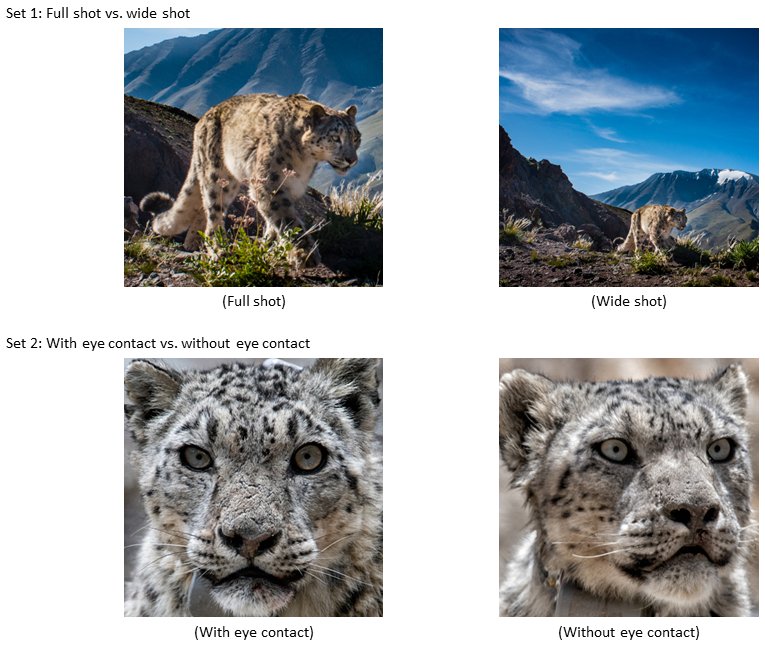
To mitigate the potential influence of answer sequence on participants’ choices, the order of the two images within each set was randomised for each participant.
3.2 Survey design and distribution
The survey was a self-completed questionnaire approved by the University of Otago Human Ethics Committee (Category “B”). It was designed to test the effects of experimental social media posts on hope and fear, as well as behavioural intentions related to snow leopard conservation. The full survey is provided in Appendix A.
The questionnaire consisted of six blocks for all participants:
- Prior Knowledge: a single question assessing self-reported knowledge about snow leopards on a 5-point scale [Parsons Leigh et al., 2020].
- Experimental Stimulus: participants were randomly assigned to view one of the eight experimental social media posts, which varied by image type (four levels) and text valence (two levels).
- Behavioural Intentions: participants rated their likelihood (1 = Very Unlikely to 5 = Very Likely) of engaging in five conservation-related behaviours (liking, sharing, looking for information, donating, and volunteering). Item order was randomised.
- Mediating Variables: participants indicated their agreement (1 = Strongly Disagree to 5 = Strongly Agree) with statements measuring the perceived severity of climate change threat to snow leopards and self-efficacy regarding personal action. Statements were adapted from Hornsey and Fielding [2016] and were presented in randomised order.
- Emotional Response: participants rated the extent (1 = Not at All to 5 = Extremely) to which the experimental post made them feel hope (measured using hopeful, optimistic, and encouraged) and fear (measured using worried, afraid, and anxious). The measurements were adapted from Hornsey and Fielding [2016] and Wenzel et al. [2023] and were presented in randomised order.
- Demographics: participants reported their country, gender, age, and education level.
To isolate the effect of the stimulus, a between-subjects design was employed: half of the participants completed Blocks 3 and 4 after viewing the stimulus (Block 2), while the other half completed these blocks before viewing the stimulus. This order was randomly assigned.
The survey was distributed in English and Chinese via the Qualtrics platform. It was disseminated organically through conservation non-governmental organisation (NGO) networks and social media between 28 January and 10 July 2024, with snowball sampling encouraged. No platform restrictions were applied. This purposive sampling strategy was employed because the study targeted audiences already interested in conservation — specifically, individuals who followed conservation NGOs and engaged with conservation content on social media. As the primary audience for this research included conservation practitioners and NGOs, aiming for a general population sample (many of whom may never view or interact with conservation-related social media posts) would have offered limited practical utility. Therefore, the sampling approach prioritised audiences of conservation organisations on social media for the intended offline application over statistical representativeness of the general population.
3.3 Survey data analysis
For RQ1, analyses were restricted to participants who viewed the experimental post before reporting their intentions and proposed mediating variables (perceived severity and self-efficacy). Partial Least Squares Structural Equation Modelling (PLS-SEM) was applied using SmartPLS 4 [Ringle et al., 2022], a method suitable for predictive and complex models without strict distributional assumptions [Hair et al., 2019]. The specified model (Figure 1) was evaluated in terms of indicator loadings, internal consistency reliability, convergent and discriminant validity, and collinearity. The significance of path coefficients was determined using bootstrapping [Hair et al., 2019].
For RQ2, composite scores for hope (mean of hopeful, optimistic, and encouraged) and fear (mean of worried, afraid, and anxious) were calculated as dependent variables. Each emotion was modelled separately using Generalised Linear Models. The core fixed effects were text valence (positive/negative) and image type (four categories). Demographic variables (age, gender, and education) and survey language were included as potential moderators.
Model optimisation was guided by the Akaike Information Criterion (AIC) and statistical significance of terms to avoid the limitations of stepwise regression [Whittingham et al., 2006]. Interaction effects were tested. To assess cultural moderation, each of Hofstede’s six cultural dimension scores [assigned based on reported country; Hofstede et al., 2010; The Culture Factor Group, n.d.] and a quantified Hall’s high- and low-context score [derived from the mapping provided by Meyer, 2014] were added individually to the optimised model. The model with the lowest AIC for each emotion was selected, and the results of the optimal model containing the strongest cultural moderator were reported. If the inclusion of a cultural dimension did not lower the AIC relative to the optimal model without the cultural dimension, cultural moderation was considered unsupported for that emotional outcome.
4 Results
From 28 January to 10 July 2024, a total of 2,079 people participated in the survey: 384 completed the English survey and 1,695 completed the Chinese survey. Responses were excluded if participants did not complete all compulsory survey blocks (Blocks 1–6). After incomplete responses were excluded, 1,414 responses were retained for analysis (262 in English and 1,152 in Chinese). A summary of the descriptive statistics for the survey responses is provided in Appendix B.
4.1 RQ1
A total of 649 responses were included in the PLS-SEM analysis. These participants viewed the experimental social media posts before responding to the questions about conservation intentions, self-efficacy, and perceived severity of the threat. Cronbach’s alpha for self-efficacy was 0.462, below the minimal threshold of 0.7 [Hair et al., 2019]. The indicator loadings of the positive and negative self-efficacy statements were 0.968 and 0.53, respectively. Therefore, only the positive self-efficacy statement was retained in the model as the measure of self-efficacy.
The PLS-SEM model met all evaluation criteria (Appendix C). The visualisation of the model is shown in Figure 4. Overall, the model explained 38.7% of the variance in conservation intentions, indicating moderate power of explanation [Henseler et al., 2009].
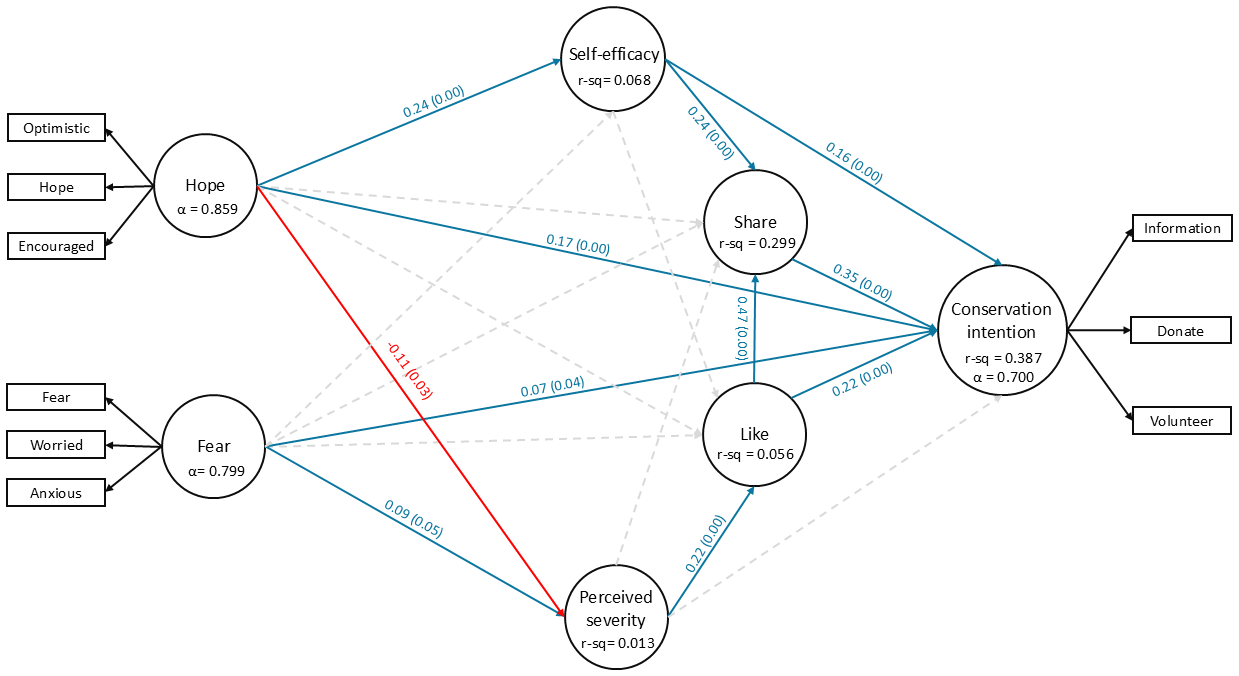
Multiple direct and indirect paths from emotions to conservation intentions were identified (Figure 4). Both hope and fear had significant direct positive effects on offline conservation intentions, although the coefficient of hope was more than twice that of fear. Hope positively predicted self-efficacy, which then positively predicted conservation intentions. Conversely, hope negatively predicted perceived severity, whereas fear was a marginally significant predictor of perceived severity. Perceived severity itself was not significantly associated with conservation intentions. No significant direct association was found between fear and self-efficacy.
For social media engagement, no significant direct associations were observed between hope or fear and liking or sharing intentions (Figure 4); instead, their effects occurred indirectly through the mediating variables. Specifically, self-efficacy positively predicted sharing intention, while perceived severity positively predicted liking intention. Liking intention was also positively associated with sharing intention. The model explained more variance in sharing intention (R2 = 0.299) than in liking intention (R2 = 0.056).
Finally, both liking and sharing intentions positively predicted conservation intentions, with sharing exhibiting a stronger coefficient than liking (Figure 4).
4.2 RQ2
Cronbach’s alpha values for hope and fear were 0.87 and 0.80, respectively, indicating a stable internal consistency among the items used to measure each emotion.
4.2.1 Hope
Hope was significantly predicted by text valence, image type, and demographic characteristics. Negative text valence strongly reduced hope (β = -0.88, SE = 0.28, p < 0.001) compared to positive text. Among the image types, wide shots evoked less hope than full shots (β = -0.22, SE = 0.16, p = 0.008), while photos without eye contact were associated with the lowest level of hope (β = -0.25, SE = 0.15).
Demographic characteristics were also significant predictors of hope (all p < 0.001). Male participants reported lower levels of hope in general (β = -0.79, SE = 0.39). Using participants aged 18–24 as the reference group, participants in the two age groups below 45 years reported lower levels of hope (β = -0.22 ± 0.07 and -0.10 ± 0.07, respectively), whereas participants in the three age groups above 45 years reported higher levels of hope (β = 0.17 ± 0.08, 0.13 ± 0.12, and 0.46 ± 0.16, respectively). Predicted hope generally increased with self-reported knowledge of snow leopards (β = 0.03 ± 0.07, 0.28 ± 0.07, 0.31 ± 0.08, and 0.24 ± 0.20, across increasing knowledge levels, respectively). Using high school education or below as the reference category, participants with bachelor’s degrees showed the lowest predicted level of hope (β = -0.68, SE = 0.40), followed by those with doctoral degrees (β = -0.36, SE = 0.58), and those with other graduate degrees or diplomas (β = -0.07, SE = 0.40).
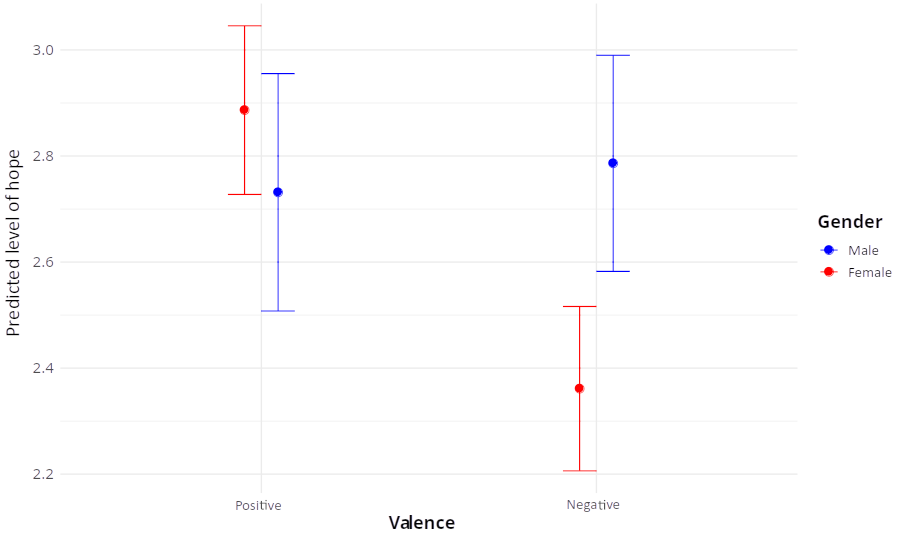
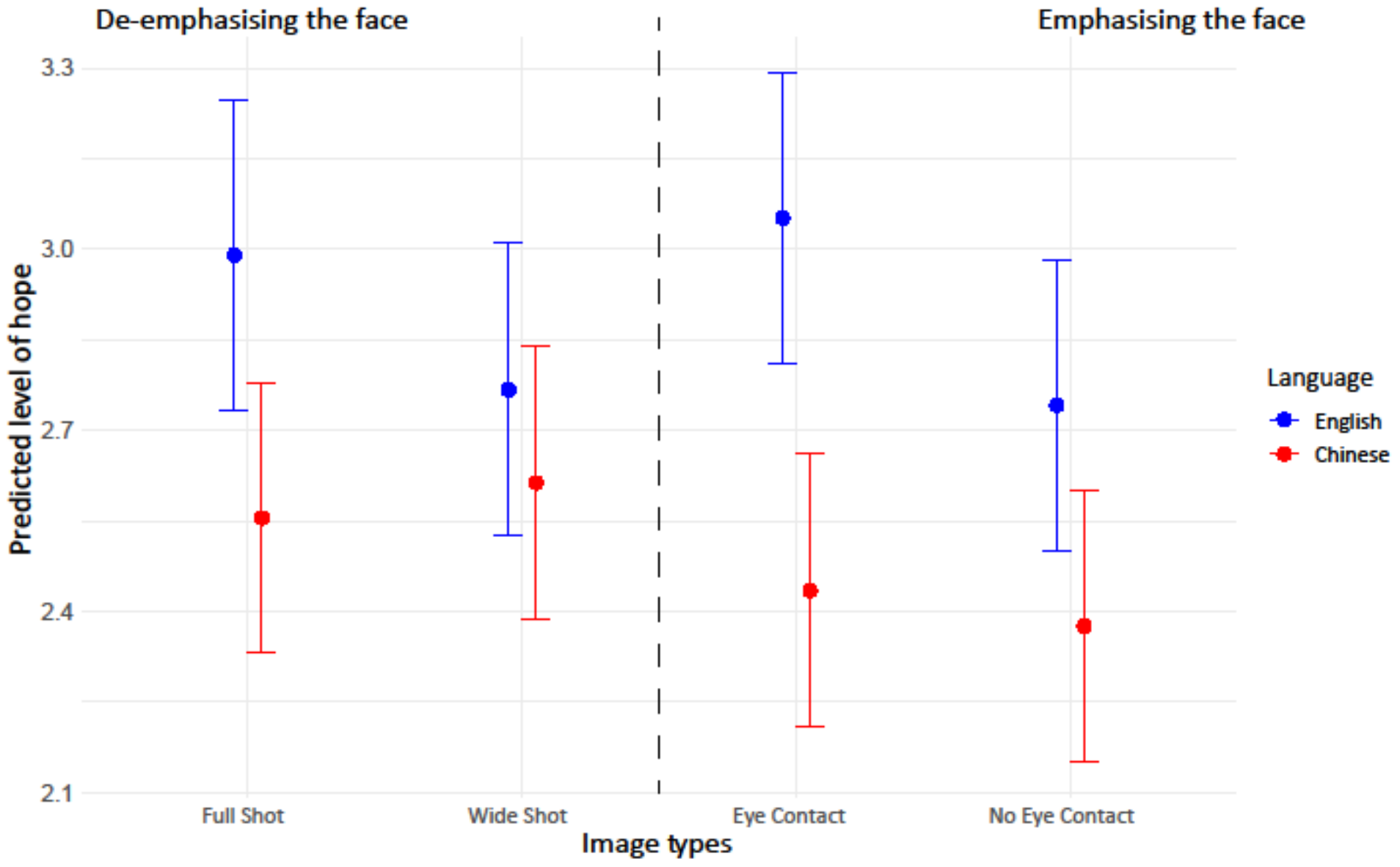
The impact of the text valence on hope was moderated by gender (p < 0.001). Although the levels of hope predicted by positive text were similar for female and male participants, the reduction in hope associated with negative text was substantially greater among female participants than among male participants (Figure 5). The effect of image type was moderated by survey language (p = 0.005; Figure 6). For example, while eye contact positively predicted hope in both language groups, this effect was stronger among English respondents. Chinese respondents reported higher predicted hope for images that de-emphasised the face (wide/full shots) than for close-up images with eye contact, a pattern not observed in English samples.
Cultural influences on evoking hope
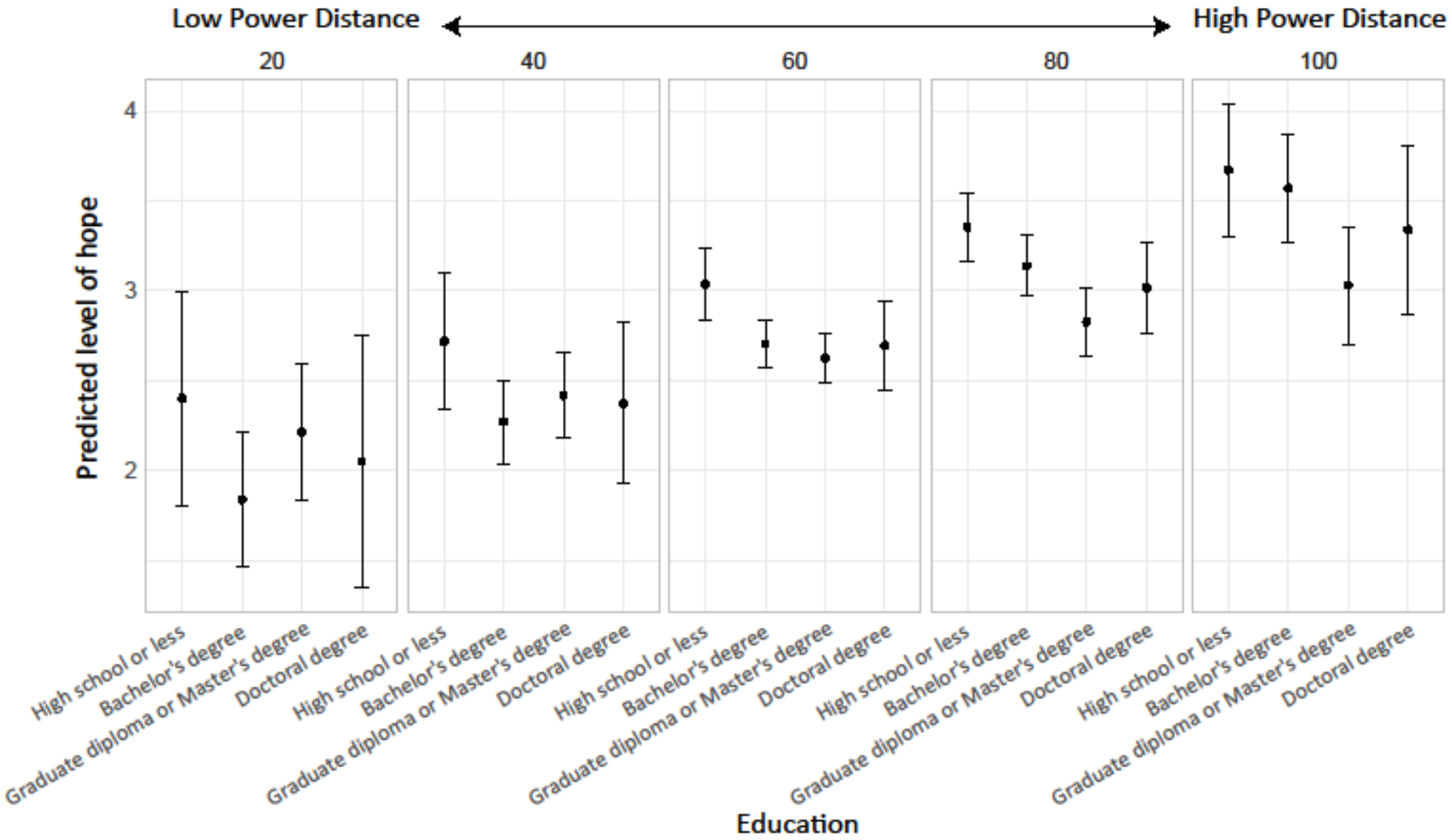
Power distance (the level of inequality and the perception of it) was the strongest cultural
moderator in the model predicting hope. It also showed a significant positive main effect on hope
(β = 0.01, SE = 0.007, p < 0.001).
The interaction between power distance and the level of education was a significant predictor of hope (p = 0.02). In general, predicted hope increased with power distance across most education levels. However, among participants with a graduate degree or diploma, predicted hope tended to decrease as power distance increased (Figure 7).
Power distance did not show any significant moderating effects on the impact of text valence or image types.
4.2.2 Fear
The level of fear was directly predicted by text valence, image type, and education. Negative valence increased predicted level of fear (β = 0.32, SE = 0.06, p < 0.001). Among the image types, photos without eye contact were most strongly associated with fear (β = 0.47, SE = 0.16), followed by photos with eye contact (β = 0.12, SE = 0.18), relative to the full-shot reference category. Wide shots were also associated with a slight increase in fear (β = 0.05, SE = 0.16, p = 0.03). Higher levels of education were associated with lower predicted level of fear (β = -0.25, -0.48, -0.46 for ascending education levels, all p < 0.001, relative to high school or less).
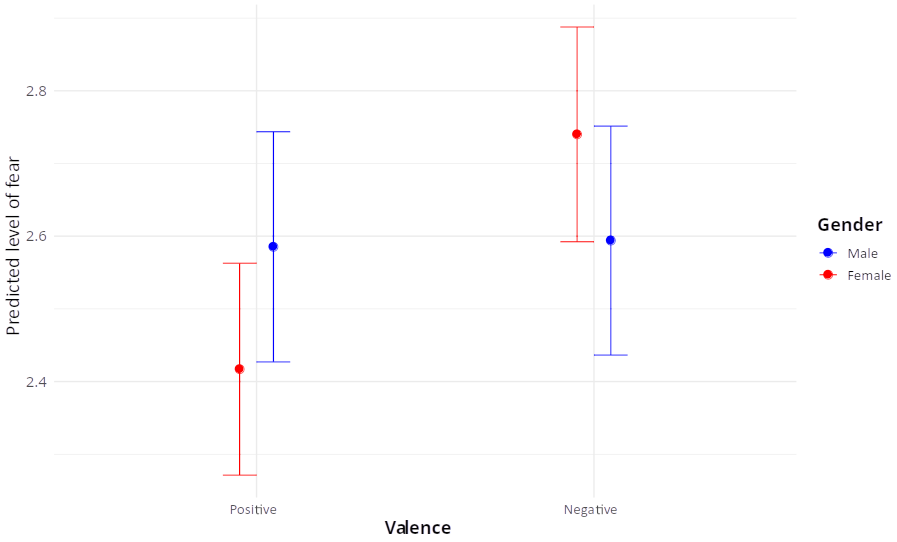
The effect of text valence on fear was moderated by gender (p = 0.004). The difference in fear evoked by positive and negative text was significant among female participants but negligible among male participants. Negative text was associated with higher predicted level of fear among female than among male participants (Figure 8).
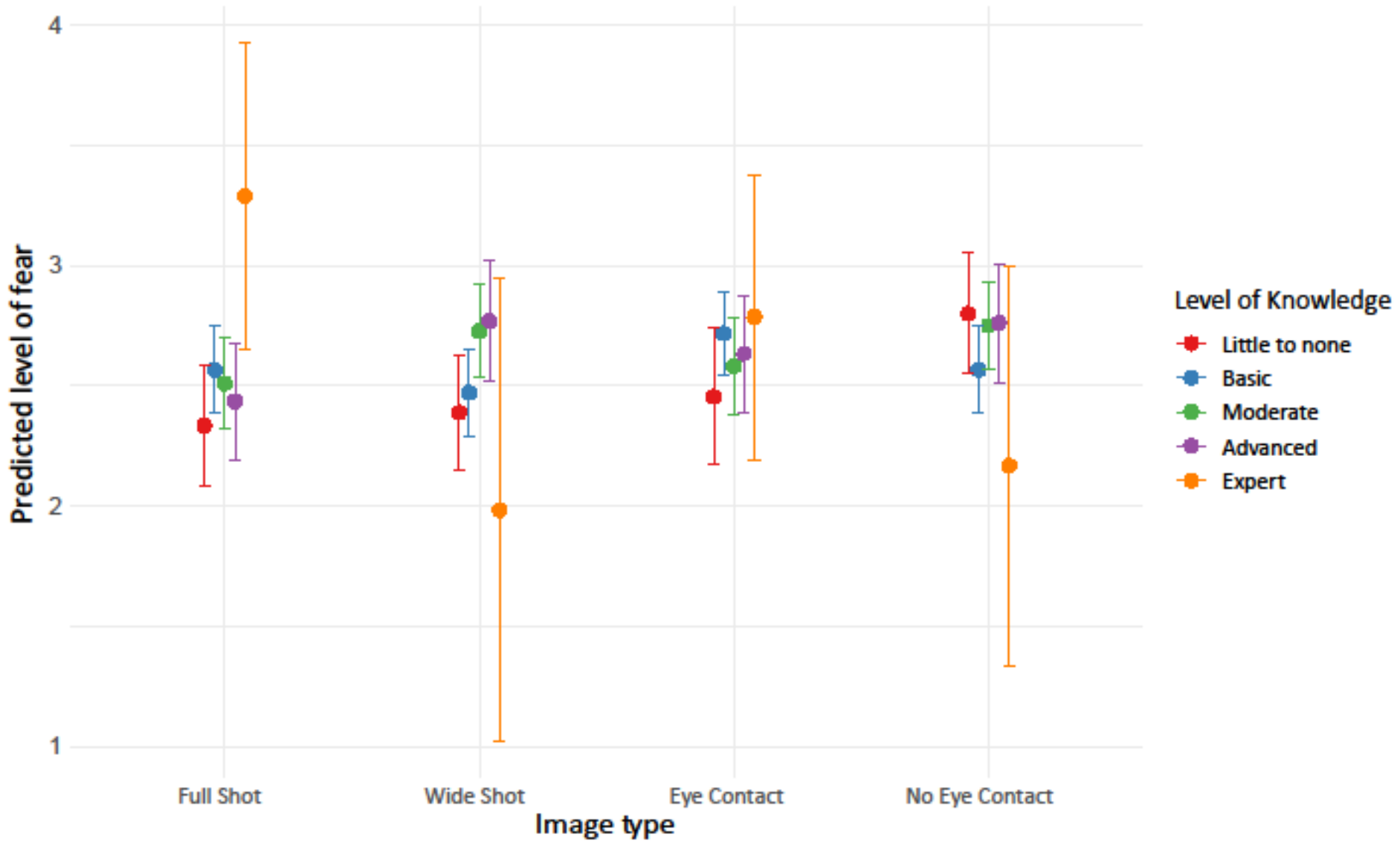
The impact of image types on fear was moderated by self-reported knowledge of snow leopards (p = 0.014; Figure 9). For participants with moderate or advanced self-reported knowledge, wide shots evoked more fear than full shots. Conversely, among participants reporting expert-level knowledge, full shots were associated with higher levels of fear. The effect of eye contact on fear also varied across knowledge levels.
Cultural influences on evoking fear
Uncertainty avoidance (tolerance for unstructured or uncertain situations) had a significant but
weak positive main effect on fear (β = 0.006, SE = 0.002, p = 0.02). It did not, however, show
any significant moderating effects on other predictors, including text valence, image
types, and demographic characteristics, indicating limited practical relevance in this
context.
5 Discussion
5.1 Hope and fear appeals in conservation communication
The experimental posts successfully generated the intended emotional appeals: positive text valence elevated hope and reduced fear, while negative valence elevated fear and reduced hope. This finding confirms that text valence can serve as a quantifiable design element for emotional framing.
Hope was positively associated with conservation intentions both directly and indirectly through self-efficacy, supporting the hope-appeal pathway [Jacobson et al., 2019; Kidd, Bekessy & Garrard, 2019b]. In contrast, the fear-appeal pathway was only partially supported. Although fear had a weak positive direct association with conservation intentions and perceived severity, perceived severity did not translate into conservation intentions in the context of snow leopard conservation.
The negative association between hope and perceived severity is consistent with the finding that hope can reduce perceived risk [Kidd, Bekessy & Garrard, 2019b]. However, because perceived severity was not a significant predictor of intention, the overall influence of hope remained positive. These findings underscore the potential utility of hope appeals in fostering conservation behaviours and highlight the role of self-efficacy in this process.
5.2 From social media engagement to offline conservation intentions
The RQ1 results (Figure 4) confirmed a positive association between intentions to engage with social media content (liking/sharing) and offline conservation intentions (donating, information gathering, and volunteering). This finding supports the view that social media engagement can function as entry-level conservation behaviours and serve as a gateway to higher-commitment actions [Boulianne, 2023; Büssing et al., 2019]. The online-offline connection highlights the value of social media as a conservation outreach tool and suggests that social media engagement may serve as a proxy for offline behavioural intentions, although further validation in real-world settings is needed.
The analyses also revealed mediating roles for self-efficacy and perceived severity in social media engagement intentions. Although previous research has shown that the emotional elements of social media posts can influence engagement metrics [Tao et al., 2021], hope and fear were not significant direct predictors of either of the two engagement types tested in this study. Perceived severity mediated the relationship between fear appeals and engagement and was positively associated with the intention to like, but not to share, a post. This suggests that participants tended to like rather than share social media posts that highlighted conservation risks and threats. By contrast, the effect of hope appeals was mediated by self-efficacy, which predicted only the intention to share. This indicates that social media users were more likely to share posts that increased their perceived ability to help mitigate conservation threats.
These results shed light on the distinct mechanisms underlying liking and sharing in conservation contexts. While they support the “social posturing” theory, which argues that people are more likely to share positive emotions or content that facilitates self-presentation on social media [Chen et al., 2022; Huang & Yeo, 2018], the findings contrast with a previous study suggesting that negative emotions about environmental problems are more likely to be shared [Zhang & Skoric, 2020]. For posts emphasising risks and threats, participants tended to express their support and recognition by liking the content. However, although liking may indicate a positive attitude towards the content, it represents a relatively passive form of engagement. In contrast, sharing entails greater commitment and message propagation and, in this study, was associated with enhanced self-efficacy. The relationship between liking and sharing suggests that increasing self-efficacy may help convert passive support into active dissemination, providing a potential strategic lever for more impactful communication.
5.3 Generating hope and fear by social media posts
The results highlight the role of image type in shaping emotional appeals. Full shots and eye-contact images enhanced hope, whereas wide shots and no-eye-contact images amplified fear. Consequently, pairing positive text with full shots or eye-contact images was associated with the highest levels of hope, whereas negative text combined with wide shots or no-eye-contact shots was more effective in eliciting fear.
The effectiveness of image types in eliciting hope was moderated by language. Chinese respondents generally reported higher levels of hope in response to images that de-emphasised the snow leopard’s face, possibly reflecting high-context cultural preferences. China is often characterised as a high-context culture, in which meaning is embedded in the context of communication [Hall & Hall, 1990; Meyer, 2014]. The responses from Chinese participants therefore showed characteristics associated with high-context cultures compared with the English responses, a high proportion of which came from the US, a low-context society in which communication tends to be more direct and explicit. Previous research has found that high-context cultures tend to feature a lower ratio of faces in their traditional paintings and social media profile photos [Huang & Park, 2013; Masuda et al., 2008]. A similar preference may also exist for wildlife photos, potentially resulting in differences in their effectiveness in evoking emotions. Hence, although animal portraits can increase the effectiveness of conservation communication [Whitley et al., 2021], their impact might be audience-dependent and more pronounced among audiences from low-context cultures.
Demographically, participants with high-school education or less reported stronger emotional responses in terms of both hope and fear, indicating that they may have been more emotionally influenced by the social media posts than participants with higher levels of education. However, no consistent directional trend was observed across other levels of education, suggesting that emotional appeals may be particularly effective among less formally educated audiences.
Gender differences were also evident. Female participants showed stronger emotional differentiation in response to text valence, whereas male participants reported less variability in their emotional responses. This finding seemingly implies that the emotional cues embedded in social media post text might be more effective at evoking the target emotions among female audiences than male audiences. However, this difference could reflect greater freedom and confidence in emotional expression among women rather than greater emotionality [Fischer, 1993]. Gender-role socialisation provides some support for this interpretation: individuals classified as having a feminine gender role (regardless of biological sex) and those working in traditionally female occupations have been associated with greater emotional expressivity [Brody, 1997; Yuan et al., 2021]. On the other hand, males, restricted by social norms, may hesitate to report intro-punitive emotions such as sadness and fear and tend to conceal their emotions. Emotions may be perceived as inconsistent with masculine identity and as indicators of vulnerability and weakness [Jansz, 2000].
5.4 Limitations and future research directions
Several limitations should be considered when interpreting the findings of this study. Firstly, the sample of the survey does not constitute a random or representative cross-section of the general English- or Chinese-speaking populations. The survey was disseminated organically through conservation NGO networks and social media using snowball sampling, intentionally targeting conservation-interested audiences in line with the study’s primary readership of conservation practitioners and NGOs. The results may therefore be influenced by self-selection biases, including greater motivation or prior knowledge about snow leopard conservation among participants. The findings should consequently be interpreted as evidence of psychological processes among engaged conservation audiences rather than as representative of the general population.
The survey did not include an explicit attention check, which is a standard best practice in online survey research. However, the survey was distributed organically through conservation NGO networks and social media to individuals who voluntarily chose to participate, and no monetary or course-credit incentive was offered. Consequently, there was no extrinsic motivation for respondents to rush through the survey to receive a reward. Nevertheless, the absence of an explicit attention check remains a methodological limitation, and future research should incorporate validated attention checks to formally identify careless responding.
Secondly, the RQ1 results showed limited explanatory power for the intention to like a social media post (Figure 4, R2 = 0.056), indicating that this intention may be influenced by factors beyond the pathways involving hope and fear appeals. Identifying these factors represents a potential direction for future research. The internal consistency of the self-efficacy scale, measured using Cronbach’s alpha, was below the commonly accepted threshold of 0.7. Consequently, only agreement with the statement “I can personally help reduce the threat of climate change to snow leopards by changing my behaviour” was included in the analysis. Future research could test alternative statements for measuring self-efficacy, as well as perceived threats to biodiversity conservation. Additionally, the current study did not measure broader environmental values or worldviews. Future research could incorporate these variables as controls to better isolate the effects of message framing.
Moreover, emotions were self-reported, which may have introduced a reporting bias, including the possibility that the observed gender differences reflect differences in emotional reporting rather than differences in actual emotional responses. In addition, although the experimental social media posts were designed to resemble real social media content, they were not published or circulated on actual social media platforms. As different platforms have different engagement dynamics [Coletti et al., 2022], the findings should therefore be interpreted with consideration of the platform-specific characteristics.
The study was also limited by the distinction between actual behaviours and behavioural intentions. Recognising that the effectiveness of conservation interventions should ideally be evaluated by behaviours [Nilsson et al., 2020], this study used behavioural intentions as indicators because conservation behaviours are often difficult to measure and observe. Previous research has identified gaps between intentions and actual behaviours in contexts such as pro-environmental purchases [Grimmer & Miles, 2017] and charitable giving [Nguyen et al., 2022]. Similarly, intentions to engage in biodiversity conservation may fail to fully translate into real-world actions because of various barriers [Kollmuss & Agyeman, 2002]. Moreover, observations of actual behaviours over time would enable conservationists to assess the duration of the effects of conservation messages, potentially informing the frequency component of communication strategy. By incorporating direct behavioural measures, such as field observations or partnerships with conservation organisations to track on-the-ground actions, future research could reduce reliance on self-reported intentions and provide a stronger assessment of actual behaviour changes when evaluating communication effectiveness.
The current study explored cross-national cultural differences but was unable to examine cultural variation within countries in greater detail. Cultural dimensions can also vary within countries [Chang et al., 2022; Kittler et al., 2011; Wang & Liu, 2019], and corresponding differences in communication effectiveness and audience preferences may therefore exist within individual countries. The frameworks used in this research classify cultural dimensions primarily at the national level. The culture of minority ethnic groups, for example, local communities in snow leopard habitat, have not yet been adequately captured by these frameworks. Their perceptions and preferences within their cultural contexts may nevertheless be critical to engaging local communities in conservation behaviours. Moreover, the livelihood and lifestyle of these local communities may be substantially different from the modern corporate setting (for example, the original survey in Hofstede’s framework). Consequently, the current survey questions may not be equally applicable to these populations. Future research should develop more inclusive survey items that accommodate a wider range of lifestyles and include minority ethnic groups in study samples. This would provide a richer and deeper understanding of how cultural diversity influences conservation communication and its effectiveness.
Finally, this study focused on a single charismatic species, the snow leopard. Therefore, findings may not extend to less popular or more controversial species. Future research should test the replicability of these findings across a broader range of taxa or ecosystems.
6 Conclusions
This study addresses a key challenge in conservation science communication: how to move beyond information dissemination and motivate behaviour change through strategic emotional appeals. By applying hope and fear appeals to social media content, this research provides preliminary evidence for a positive association between social media engagement intentions and offline conservation intentions. The findings highlight the roles of hope and self-efficacy in shaping conservation intentions in social media contexts, contributing to the emerging literature on emotional appeals in conservation.
Moreover, the study highlights the need to tailor social media posts to audiences with diverse demographic characteristics and cultural backgrounds. Effective conservation communication requires content that resonates with specific target audience groups, and the current study provides practical insights into how social media communication might be designed to enhance conservation engagement. Overall, the current study generates the following suggestions for designing effective social media posts about biodiversity conservation. These six lessons are summarised in Table 2.
|
Lesson |
Key finding |
Practical implication |
|
1. Match emotional appeal to engagement goal |
Hope appeals encourage sharing; fear appeals elicit likes. Both contribute to offline conservation intentions. |
Use hope-focused posts to increase reach (shares); use fear-focused posts to signal approval (likes). |
|
2. Target emotional appeals to specific audiences |
Emotional appeals are more effective among audiences with less than a bachelor’s degree and potentially among female audiences. |
Consider education level and gender when segmenting audiences for emotion-based messaging. |
|
3. Use text valence as an indicator of emotional response |
Positive text valence generates hope; negative text valence generates fear. |
Validate text valence (e.g., sentiment analysis) to predict emotional outcomes when framing the message. |
|
4. Pair text valence with congruent imagery |
Positive valence + full shot or eye-contact portrait → hope. Negative valence + wide shot or no-eye-contact portrait → fear. |
Match emotional tone of text with visual cues (proximity/eye-contact for hope; distance/no eye-contact for fear). |
|
5. Adapt imagery for cultural contexts |
For Chinese-speaking audiences, wide shots and images that de-emphasise faces are more likely to generate hope (compared with English-speaking audiences). |
Tailor visual content (e.g., amount of background context and facial cues) to cultural preferences. |
|
6. Consider cultural dimensions in message design |
Higher power distance → higher hope (hope appeals may be easier to apply). Higher uncertainty avoidance → higher fear (fear appeals may be easier to apply). |
In hierarchical societies, emphasise hope; in risk-averse societies, emphasise fear. |
References
-
Ainsworth, G. B., & Burns, G. L. (2020). ‘Although I use science, it’s an emotional thing’: conservation practitioners’ use of positive affect to frame messages about threatened birds. Australasian Journal of Environmental Management, 27(4), 351–377. https://doi.org/10.1080/14486563.2020.1830446
-
An, D. (2003). An empirical study of Hall and Hofstede’s cultural values: a content analysis of Internet advertising in Korea and the United States [Doctoral dissertation]. University of South Carolina.
-
Asah, S. T., & Blahna, D. J. (2012). Motivational functionalism and urban conservation stewardship: implications for volunteer involvement. Conservation Letters, 5(6), 470–477. https://doi.org/10.1111/j.1755-263x.2012.00263.x
-
Baberini, M., Coleman, C.-L., Slovic, P., & Västfjäll, D. (2015). Examining the effects of photographic attributes on sympathy, emotions, and donation behavior. Visual Communication Quarterly, 22(2), 118–128. https://doi.org/10.1080/15551393.2015.1061433
-
Bagozzi, R. P., Gopinath, M., & Nyer, P. U. (1999). The role of emotions in marketing. Journal of the Academy of Marketing Science, 27(2), 184–206. https://doi.org/10.1177/0092070399272005
-
Berger, J., & Milkman, K. L. (2012). What makes online content viral? Journal of Marketing Research, 49(2), 192–205. https://doi.org/10.1509/jmr.10.0353
-
Boduroglu, A., Shah, P., & Nisbett, R. E. (2009). Cultural differences in allocation of attention in visual information processing. Journal of Cross-Cultural Psychology, 40(3), 349–360. https://doi.org/10.1177/0022022108331005
-
Boulianne, S. (2023). Standby ties that mobilize: social media platforms and civic engagement. Social Science Computer Review, 41(3), 1001–1016. https://doi.org/10.1177/08944393211067687
-
Brody, L. R. (1997). Gender and emotion: beyond stereotypes. Journal of Social Issues, 53(2), 369–393. https://doi.org/10.1111/j.1540-4560.1997.tb02448.x
-
Büssing, A. G., Thielking, A., & Menzel, S. (2019). Can a like save the planet? Comparing antecedents of and correlations between environmental liking on social media, money donation, and volunteering. Frontiers in Psychology, 10, 1989. https://doi.org/10.3389/fpsyg.2019.01989
-
Carey, R. N., McDermott, D. T., & Sarma, K. M. (2013). The impact of threat appeals on fear arousal and driver behavior: a meta-analysis of experimental research 1990–2011. PLoS ONE, 8(5), e62821. https://doi.org/10.1371/journal.pone.0062821
-
Chang, C. H., Armsworth, P. R., & Masuda, Y. J. (2022). Environmental discourse exhibits consistency and variation across spatial scales on Twitter. BioScience, 72(8), 789–797. https://doi.org/10.1093/biosci/biac051
-
Chen, J., Yan, Y., & Leach, J. (2022). Are emotion-expressing messages more shared on social media? A meta-analytic review. Review of Communication Research, 10, 59–79. https://doi.org/10.12840/issn.2255-4165.034
-
Chua, H. F., Boland, J. E., & Nisbett, R. E. (2005). Cultural variation in eye movements during scene perception. Proceedings of the National Academy of Sciences, 102(35), 12629–12633. https://doi.org/10.1073/pnas.0506162102
-
Cismaru, M., Cismaru, R., Ono, T., & Nelson, K. (2011). “Act on climate change”: an application of protection motivation theory. Social Marketing Quarterly, 17(3), 62–84. https://doi.org/10.1080/15245004.2011.595539
-
Coletti, A., McGloin, R., Oeldorf-Hirsch, A., & Hamlin, E. (2022). Science communication on social media: examining cross-platform behavioral engagement. The Journal of Social Media in Society, 11(2), 236–263. https://www.thejsms.org/index.php/JSMS/article/view/995/
-
Cruz Crespo, Y. A., & Cruz, S. M. (2023). The role of social media activism in offline conservation attitudes and behaviors. Computers in Human Behavior, 147, 107858. https://doi.org/10.1016/j.chb.2023.107858
-
de Lange, E., Sharkey, W., Castelló y Tickell, S., Migné, J., Underhill, R., & Milner-Gulland, E. (2022). Communicating the biodiversity crisis: from “warnings” to positive engagement. Tropical Conservation Science, 15. https://doi.org/10.1177/19400829221134893
-
Dolan, R., Conduit, J., Fahy, J., & Goodman, S. (2016). Social media engagement behaviour: a uses and gratifications perspective. Journal of Strategic Marketing, 24(3–4), 261–277. https://doi.org/10.1080/0965254x.2015.1095222
-
Echeverri, A., Chan, K. M. A., & Zhao, J. (2017). How messaging shapes attitudes toward sea otters as a species at risk. Human Dimensions of Wildlife, 22(2), 142–156. https://doi.org/10.1080/10871209.2016.1272146
-
Erlandsson, A., Nilsson, A., & Västfjäll, D. (2018). Attitudes and donation behavior when reading positive and negative charity appeals. Journal of Nonprofit & Public Sector Marketing, 30(4), 444–474. https://doi.org/10.1080/10495142.2018.1452828
-
Farrington, J. D., & Li, J. (2024). Climate change impacts on snow leopard range. In D. Mallon & T. McCarthy (Eds.), Snow leopards (2nd ed., pp. 81–93). Elsevier. https://doi.org/10.1016/b978-0-323-85775-8.00037-6
-
Feinberg, M., & Willer, R. (2011). Apocalypse soon?: Dire messages reduce belief in global warming by contradicting just-world beliefs. Psychological Science, 22(1), 34–38. https://doi.org/10.1177/0956797610391911
-
Feldman, L., & Hart, P. S. (2016). Using political efficacy messages to increase climate activism: the mediating role of emotions. Science Communication, 38(1), 99–127. https://doi.org/10.1177/1075547015617941
-
Fischer, A. H. (1993). Sex differences in emotionality: fact or stereotype? Feminism & Psychology, 3(3), 303–318. https://doi.org/10.1177/0959353593033002
-
Gifford, R., & Comeau, L. A. (2011). Message framing influences perceived climate change competence, engagement, and behavioral intentions. Global Environmental Change, 21(4), 1301–1307. https://doi.org/10.1016/j.gloenvcha.2011.06.004
-
Gregg, E. A., Kusmanoff, A. M., Garrard, G. E., Kidd, L. R., & Bekessy, S. A. (2021). Biodiversity conservation cannot afford COVID-19 communication bungles. Trends in Ecology & Evolution, 36(10), 879–882. https://doi.org/10.1016/j.tree.2021.07.003
-
Grimmer, M., & Miles, M. P. (2017). With the best of intentions: a large sample test of the intention-behaviour gap in pro-environmental consumer behaviour. International Journal of Consumer Studies, 41(1), 2–10. https://doi.org/10.1111/ijcs.12290
-
Hair, J. F., Risher, J. J., Sarstedt, M., & Ringle, C. M. (2019). When to use and how to report the results of PLS-SEM. European Business Review, 31(1), 2–24. https://doi.org/10.1108/ebr-11-2018-0203
-
Hall, E. T., & Hall, M. R. (1990). Understanding cultural differences: Germans, French and Americans. Intercultural Press.
-
Hart, P. S., Feldman, L., Choi, S., Chinn, S., & Hiaeshutter-Rice, D. (2025). Climate change advocacy and engagement on social media. Science Communication, 47(3), 385–412. https://doi.org/10.1177/10755470241284934
-
Henseler, J., Ringle, C. M., & Sinkovics, R. R. (2009). The use of partial least squares path modeling in international marketing. In R. R. Sinkovics & P. N. Ghauri (Eds.), New challenges to international marketing (pp. 277–319). Emerald Group Publishing Limited. https://doi.org/10.1108/s1474-7979(2009)0000020014
-
Hockley, W. E. (2008). The picture superiority effect in associative recognition. Memory & Cognition, 36(7), 1351–1359. https://doi.org/10.3758/mc.36.7.1351
-
Hockley, W. E., & Bancroft, T. (2011). Extensions of the picture superiority effect in associative recognition. Canadian Journal of Experimental Psychology / Revue Canadienne de Psychologie Expérimentale, 65(4), 236–244. https://doi.org/10.1037/a0023796
-
Hofstede, G. (2011). Dimensionalizing cultures: the Hofstede model in context. Online Readings in Psychology and Culture, 2(1), 8. https://doi.org/10.9707/2307-0919.1014
-
Hofstede, G., Hofstede, G. J., & Minkov, M. (2010). Cultures and organizations. Software of the mind: intercultural cooperation and its importance for survival (3rd ed.). McGraw-Hill.
-
Hornsey, M. J., & Fielding, K. S. (2016). A cautionary note about messages of hope: focusing on progress in reducing carbon emissions weakens mitigation motivation. Global Environmental Change, 39, 26–34. https://doi.org/10.1016/j.gloenvcha.2016.04.003
-
Huang, C.-M., & Park, D. (2013). Cultural influences on Facebook photographs. International Journal of Psychology, 48(3), 334–343. https://doi.org/10.1080/00207594.2011.649285
-
Huang, L. V., & Yeo, T. E. D. (2018). Tweeting #Leaders: social media communication and retweetability of Fortune 1000 chief executive officers on Twitter. Internet Research, 28(1), 123–142. https://doi.org/10.1108/intr-08-2016-0248
-
Hutto, C., & Gilbert, E. (2014). VADER: a parsimonious rule-based model for sentiment analysis of social media text. Proceedings of the International AAAI Conference on Web and Social Media, 8(1), 216–225. https://doi.org/10.1609/icwsm.v8i1.14550
-
Jacobson, S. K., Morales, N. A., Chen, B., Soodeen, R., Moulton, M. P., & Jain, E. (2019). Love or loss: effective message framing to promote environmental conservation. Applied Environmental Education & Communication, 18(3), 252–265. https://doi.org/10.1080/1533015x.2018.1456380
-
Jansz, J. (2000). Masculine identity and restrictive emotionality. In A. H. Fischer (Ed.), Gender and emotion: social psychological perspectives (pp. 166–186). Cambridge University Press. https://doi.org/10.1017/CBO9780511628191.009
-
Ji, Y. G., Li, C., North, M., & Liu, J. (2017). Staking reputation on stakeholders: how does stakeholders’ Facebook engagement help or ruin a company’s reputation? Public Relations Review, 43(1), 201–210. https://doi.org/10.1016/j.pubrev.2016.12.004
-
Jones, K. S. (2006). Giving and volunteering as distinct forms of civic engagement: the role of community integration and personal resources in formal helping. Nonprofit and Voluntary Sector Quarterly, 35(2), 249–266. https://doi.org/10.1177/0899764006287464
-
Kappel, K., & Holmen, S. J. (2019). Why science communication, and does it work? A taxonomy of science communication aims and a survey of the empirical evidence. Frontiers in Communication, 4, 55. https://doi.org/10.3389/fcomm.2019.00055
-
Karandashev, V. (2021). Cultural models of emotions. Springer. https://doi.org/10.1007/978-3-030-58438-2
-
Kidd, L. R., Bekessy, S. A., & Garrard, G. E. (2019a). Evidence is key for effective biodiversity communication. Trends in Ecology & Evolution, 34(8), 693–694. https://doi.org/10.1016/j.tree.2019.05.010
-
Kidd, L. R., Bekessy, S. A., & Garrard, G. E. (2019b). Neither hope nor fear: empirical evidence should drive biodiversity conservation strategies. Trends in Ecology & Evolution, 34(4), 278–282. https://doi.org/10.1016/j.tree.2019.01.018
-
Kidd, L. R., Garrard, G. E., Bekessy, S. A., Mills, M., Camilleri, A. R., Fidler, F., Fielding, K. S., Gordon, A., Gregg, E. A., Kusmanoff, A. M., Louis, W., Moon, K., Robinson, J. A., Selinske, M. J., Shanahan, D., & Adams, V. M. (2019). Messaging matters: a systematic review of the conservation messaging literature. Biological Conservation, 236, 92–99. https://doi.org/10.1016/j.biocon.2019.05.020
-
Kim, C., & Yang, S.-U. (2017). Like, comment, and share on Facebook: how each behavior differs from the other. Public Relations Review, 43(2), 441–449. https://doi.org/10.1016/j.pubrev.2017.02.006
-
Kim, D., Pan, Y., & Park, H. S. (1998). High- versus low-context culture: a comparison of Chinese, Korean, and American cultures. Psychology & Marketing, 15(6), 507–521. 3.0.co;2-a" >https://doi.org/10.1002/(sici)1520-6793(199809)15:6<507::aid-mar2>3.0.co;2-a
-
Kittler, M. G., Rygl, D., & Mackinnon, A. (2011). Special review article: beyond culture or beyond control? Reviewing the use of Hall’s high-/low-context concept. International Journal of Cross Cultural Management, 11(1), 63–82. https://doi.org/10.1177/1470595811398797
-
Kollmuss, A., & Agyeman, J. (2002). Mind the gap: why do people act environmentally and what are the barriers to pro-environmental behavior? Environmental Education Research, 8(3), 239–260. https://doi.org/10.1080/13504620220145401
-
Kusmanoff, A. M., Fidler, F., Gordon, A., Garrard, G. E., & Bekessy, S. A. (2020). Five lessons to guide more effective biodiversity conservation message framing. Conservation Biology, 34(5), 1131–1141. https://doi.org/10.1111/cobi.13482
-
Landry, N., Gifford, R., Milfont, T. L., Weeks, A., & Arnocky, S. (2018). Learned helplessness moderates the relationship between environmental concern and behavior. Journal of Environmental Psychology, 55, 18–22. https://doi.org/10.1016/j.jenvp.2017.12.003
-
Lewenstein, B. V. (2003). Models of public communication of science and technology [Working paper]. https://hdl.handle.net/1813/58743
-
Li, J., McCarthy, T. M., Wang, H., Weckworth, B. V., Schaller, G. B., Mishra, C., Lu, Z., & Beissinger, S. R. (2016). Climate refugia of snow leopards in High Asia. Biological Conservation, 203, 188–196. https://doi.org/10.1016/j.biocon.2016.09.026
-
Liang, B., Runyan, R. C., & Fu, W. (2011). The effect of culture on the context of ad pictures and ad persuasion: the role of context-dependent and context-independent thinking. International Marketing Review, 28(4), 412–434. https://doi.org/10.1108/02651331111149958
-
Liu, J. (2010). Culture variation in the visual aspects of television commercials: comparing the use and effect of field information in Chinese and US television commercials [Master of Arts dissertation]. Clemson University. https://open.clemson.edu/all_theses/896
-
Ma, X., Yang, Y., & Chen, L. (2023). Promoting behaviors to mitigate the effects of climate change: using the extended parallel process model at the personal and collective level in China. Environmental Communication, 17(4), 353–369. https://doi.org/10.1080/17524032.2023.2181134
-
Manesi, Z., Van Lange, P. A. M., & Pollet, T. V. (2016). Eyes wide open: only eyes that pay attention promote prosocial behavior. Evolutionary Psychology, 14(2). https://doi.org/10.1177/1474704916640780
-
Martell, J. E. M., & Rodewald, A. D. (2020). Frames, facts, and the science of communicating environmental crises. Conservation Biology, 34(3), 766–768. https://doi.org/10.1111/cobi.13424
-
Martell, J. E. M., & Rodewald, A. D. (2024). Promoting conservation behaviors by leveraging optimistic and pessimistic messages and emotions. Society & Natural Resources, 37(4), 564–585. https://doi.org/10.1080/08941920.2023.2294847
-
Martell, J. E. M., & Rodewald, A. D. (2025). Wildlife values can inform strategic conservation communication efforts. Human Dimensions of Wildlife, 30(2), 182–200. https://doi.org/10.1080/10871209.2024.2346100
-
Masuda, T., Gonzalez, R., Kwan, L., & Nisbett, R. E. (2008). Culture and aesthetic preference: comparing the attention to context of East Asians and Americans. Personality and Social Psychology Bulletin, 34(9), 1260–1275. https://doi.org/10.1177/0146167208320555
-
McAfee, D., & Connell, S. D. (2019). Balancing the benefits of optimism and pessimism in conservation: a response to Kidd, Bekessy, and Garrard. Trends in Ecology & Evolution, 34(8), 692–693. https://doi.org/10.1016/j.tree.2019.05.004
-
McAfee, D., Doubleday, Z. A., Geiger, N., & Connell, S. D. (2019). Everyone loves a success story: optimism inspires conservation engagement. BioScience, 69(4), 274–281. https://doi.org/10.1093/biosci/biz019
-
McCarthy, T., Mallon, D. P., Jackson, R., Zahler, P., & McCarthy, K. (2017). Panthera uncia. Snow Leopard. The IUCN Red List of Threatened Species, e.T22732A50664030. https://doi.org/10.2305/iucn.uk.2017-2.rlts.t22732a50664030.en
-
Mele, E., Kerkhof, P., & Cantoni, L. (2021). Analyzing cultural tourism promotion on Instagram: a cross-cultural perspective. Journal of Travel & Tourism Marketing, 38(3), 326–340. https://doi.org/10.1080/10548408.2021.1906382
-
Meyer, E. (2014). The culture map: breaking through the invisible boundaries of global business. PublicAffairs.
-
Nabi, R. L., Gustafson, A., & Jensen, R. (2018). Framing climate change: exploring the role of emotion in generating advocacy behavior. Science Communication, 40(4), 442–468. https://doi.org/10.1177/1075547018776019
-
Nguyen, C., Faulkner, M., Yang, S., Williams, J., & Tong, L. (2022). Mind the gap: understanding the gap between intentions and behaviour in the charity context. Journal of Business Research, 148, 216–224. https://doi.org/10.1016/j.jbusres.2022.04.044
-
Nilsson, D., Fielding, K., & Dean, A. J. (2020). Achieving conservation impact by shifting focus from human attitudes to behaviors. Conservation Biology, 34(1), 93–102. https://doi.org/10.1111/cobi.13363
-
Park, A., Williams, E., & Zurba, M. (2020). Understanding hope and what it means for the future of conservation. Biological Conservation, 244, 108507. https://doi.org/10.1016/j.biocon.2020.108507
-
Park, S., & Jung, J. (2023). The interplay between social media virality metrics and message framing in influence perception of pro-environmental messages and behavioral intentions. Telematics and Informatics, 78, 101947. https://doi.org/10.1016/j.tele.2023.101947
-
Parsons Leigh, J., Fiest, K., Brundin-Mather, R., Plotnikoff, K., Soo, A., Sypes, E. E., Whalen-Browne, L., Ahmed, S. B., Burns, K. E. A., Fox-Robichaud, A., Kupsch, S., Longmore, S., Murthy, S., Niven, D. J., Rochwerg, B., & Stelfox, H. T. (2020). A national cross-sectional survey of public perceptions of the COVID-19 pandemic: self-reported beliefs, knowledge, and behaviors. PLoS ONE, 15(10), e0241259. https://doi.org/10.1371/journal.pone.0241259
-
Ringle, C. M., Wende, S., & Becker, J. M. (2022). SmartPLS 4 [Computer software]. https://www.smartpls.com/
-
Tabernero, C., & Hernández, B. (2011). Self-efficacy and intrinsic motivation guiding environmental behavior. Environment and Behavior, 43(5), 658–675. https://doi.org/10.1177/0013916510379759
-
Tao, W., Li, Z. C., Chen, Z. F., & Ji, Y. G. (2021). Public responses to nonprofit social media messages: the roles of message features and cause involvement. Public Relations Review, 47(2), 102038. https://doi.org/10.1016/j.pubrev.2021.102038
-
Tenenboim, O. (2022). Comments, shares, or likes: what makes news posts engaging in different ways. Social Media + Society, 8(4). https://doi.org/10.1177/20563051221130282
-
The Culture Factor Group. (n.d.). Country comparison tool. https://www.theculturefactor.com/country-comparison-tool
-
Toomey, A. H. (2023). Why facts don’t change minds: insights from cognitive science for the improved communication of conservation research. Biological Conservation, 278, 109886. https://doi.org/10.1016/j.biocon.2022.109886
-
Van Lange, P. A. M., & Manesi, Z. (2023). Reputation reminders: when do eye cues promote prosocial behavior? The Spanish Journal of Psychology, 26, e8. https://doi.org/10.1017/sjp.2023.4
-
Wang, R., Wang, Y., Chen, C., Huo, L., & Liu, C. (2024). How do eye cues affect behaviors? Two meta-analyses. Current Psychology, 43(2), 1084–1101. https://doi.org/10.1007/s12144-023-04395-6
-
Wang, X., & Liu, Z. (2019). Online engagement in social media: a cross-cultural comparison. Computers in Human Behavior, 97, 137–150. https://doi.org/10.1016/j.chb.2019.03.014
-
Weingart, P., Joubert, M., & Connoway, K. (2021). Public engagement with science — origins, motives and impact in academic literature and science policy. PLoS ONE, 16(7), e0254201. https://doi.org/10.1371/journal.pone.0254201
-
Wenzel, M., Rowland, Z., Nielsen, K. S., & Lange, F. (2023). The impact of perceived threat and perceived coping efficacy on individual actions toward biodiversity conservation: a registered report. Journal of Environmental Psychology, 88, 102038. https://doi.org/10.1016/j.jenvp.2023.102038
-
Whitley, C. T., Kalof, L., & Flach, T. (2021). Using animal portraiture to activate emotional affect. Environment and Behavior, 53(8), 837–863. https://doi.org/10.1177/0013916520928429
-
Whittingham, M. J., Stephens, P. A., Bradbury, R. B., & Freckleton, R. P. (2006). Why do we still use stepwise modelling in ecology and behaviour? Journal of Animal Ecology, 75(5), 1182–1189. https://doi.org/10.1111/j.1365-2656.2006.01141.x
-
Williamson, K. A., & Thulin, E. (2022). Leveraging emotion-behavior pathways to support environmental behavior change. Ecology & Society, 27(3), 27. https://doi.org/10.5751/ES-13363-270327
-
Würtz, E. (2005). Intercultural communication on web sites: a cross-cultural analysis of web sites from high-context cultures and low-context cultures. Journal of Computer-Mediated Communication, 11(1), 274–299. https://doi.org/10.1111/j.1083-6101.2006.tb00313.x
-
Yang, X., Ye, J., & Wang, X. (2020). Understanding different cognitive levels of social engagement: evidence from paid Q&A. ACIS 2020 Proceedings, 58. https://aisel.aisnet.org/acis2020/58
-
Yuan, J., Li, H., Long, Q., Yang, J., Lee, T. M. C., & Zhang, D. (2021). Gender role, but not sex, shapes humans’ susceptibility to emotion. Neuroscience Bulletin, 37(2), 201–216. https://doi.org/10.1007/s12264-020-00588-2
-
Zhang, B., & Seo, H.-S. (2015). Visual attention toward food-item images can vary as a function of background saliency and culture: an eye-tracking study. Food Quality and Preference, 41, 172–179. https://doi.org/10.1016/j.foodqual.2014.12.004
-
Zhang, N., & Skoric, M. M. (2020). Getting their voice heard: Chinese environmental NGO’s Weibo activity and information sharing. Environmental Communication, 14(6), 844–858. https://doi.org/10.1080/17524032.2020.1758184
-
Zhu, L., Davis, L. S., & Carr, A. (2021). A picture is not always worth a thousand words: the visual quality of photographs affects the effectiveness of interpretive signage for science communication. Public Understanding of Science, 30(3), 258–273. https://doi.org/10.1177/0963662520982535
About the authors
Dr. Yang Yu recently completed her Ph.D. in Science Communication from the University of Otago. Her dissertation, “Making a Solitary Big Cat Social: Strategies for Cross-cultural Conservation Communication”, used a mixed-methods approach to explore how to effectively leverage social media to communicate wildlife conservation, using the snow leopard as a case study. She now applies her expertise at a social media communication company, crafting narratives to share the stories of conservationists and engage diverse public audiences.
E-mail: yangyu0828@126.com
Wiebke Finkler: Senior Lecturer, Department of Marketing, University of Otago. Specialising in creative filmmaking and behaviour change communication for social good and conservation.
E-mail: wiebke.finkler@otago.ac.nz
Lloyd S. Davis: Stuart Professor of Science Communication, University of Otago. Particularly interested in the role that storytelling can play in enhancing science communication.
E-mail: lloyd.davis@otago.ac.nz
Supplementary material
Available at https://doi.org/10.22323/376020260919190957
Appendix A: Survey questionnaires and participant information sheets
Appendix B: Descriptive statistics of survey respondent demographics
Appendix C: Evaluation criteria for PLS-SEM model