

1 Introduction
To address climate change an effective and constructive dialogue between science and other areas of society is essential. This goes hand in hand with growing calls for the scientific community to actively engage with different publics and stakeholders [Bucchi & Trench, 2021] and aligns with the emergence of post-normal situations, in which uncertainty and stakes are high but robust solutions are nevertheless needed quickly (as it is the case with climate change) [Brüggemann et al., 2020; Funtowicz & Ravetz, 1993].
Policymakers rely on scientific evidence to understand these complex contemporary issues, and its use in policymaking is often linked to the normative expectation that policy decisions should be based on the most reliable facts available [Howell et al., 2020]. Science plays a crucial role in providing this knowledge, particularly because it is generally regarded as a trusted and authoritative source [Schäfer, 2016]. But the close link between science and politics also carries risks, as it can give the impression that science is working in the service of politics and is no longer independent, which can fuel scepticisms about science [Kotcher et al., 2017; McLaughlin et al., 2021]. Thus, the legitimacy of scientific advocacy remains a contested field both within the scientific community and the broader public.
In general, these interactions and mutual interdependencies are shifting the traditional boundaries between science and society, particularly between science and politics, calling them into question and forcing them to be renegotiated repeatedly [Schmid-Petri et al., 2022]. As a result, in both public communication and, even more so, in policy advice, each scientist must repeatedly decide for themselves to what extent they wish to advocate for specific policy measures and take a clear position [Peters, 2008; Pielke, 2007]. Such considerations are particularly salient in highly politicized fields like climate change, where the lines between scientific expertise and advocacy are frequently contested. Prior research has shown that climate scientists hold disparate views regarding the appropriateness of advocacy in these contexts [e.g., Cologna et al., 2021; Getson et al., 2021; Gundersen, 2020]. However, existing studies have primarily examined demographic characteristics or a limited number of isolated variables [Boykoff & Oonk, 2020; Cologna et al., 2021; Reiners et al., 2013], leaving a gap in understanding the broader range of factors shaping scientists’ own interpretation and accentuation of different forms of advocacy.
Against this background, the first aim of our study is to gain a deeper understanding in how climate scientists in Germany navigate the interface between science and politics and specifically to identify patterns in how they interpret and enact their own ‘advocacy roles’. Furthermore, studies have shown that climate scientists are frequently involved in public engagement and in providing policy advice [Cologna et al., 2021; Entradas et al., 2019]. Yet, empirical studies investigating actual policy advisory practices remain scarce, and little is known about how different role interpretations shape scientists’ communication and advisory behaviour. Thus, the second aim of our study is to analyse how the different interpretations of their roles affect concrete science communication activities. Concretely, our research questions are as follows: What distinct patterns can be observed in how climate scientists in Germany interpret their role at the science-policy interface? Which factors are associated with these different role interpretations? How does scientists’ public communication and policy advisory behaviour differ across role interpretations?
To answer our research questions, we conducted a quantitative online survey of scientists working at German research institutions in the field of climate change (N = 249).
2 Literature review: navigating the science-policy interface
The relationship between science and politics has often been described using a linear model in which scientists produce knowledge subsequently used by policymakers to inform policy. While this model has served as a useful heuristic for conceptualizing the science-policy interface, scholars emphasize that the relationship is typically far more complex [Brüggemann et al., 2020; Peters, 2008; Scheufele, 2014]. Policy decisions require balancing competing values and interests, and scientific findings rarely translate into a single clear policy implication [Lacey et al., 2018; Pielke, 2004; van den Hove, 2007]. These dynamics become particularly pronounced in contexts of post-normal science (PNS), marked by high uncertainty, contested values, high stakes and urgent decisions [Funtowicz & Ravetz, 1993] — of which climate change is a prominent example — blurring the boundaries between science, politics, and the public [Bray & von Storch, 2017; Schmid-Petri et al., 2022]. As a result, scientists must maintain a fragile balance: staying independent while remaining close enough to make an impact [Hoppe, 2010].
Against this backdrop, each scientist must decide how to understand their own role. Following Roedema et al. [2021, p. 4], in our understanding, “the concept of role refers to a scientist’s focus and desired contribution to science-society interactions”. Drawing on role identity theory, this is reflected in individual ‘role identities’, which we conceptualize as internalized cognitive schemas shaped through experience and social interaction, and influenced by pre-existing attitudes and value orientations [Banse et al., 2026; Serpe et al., 2020]. Each scientist possesses a unique set of such internalized role identities (RIDs), which guide how their role is interpreted, and which behaviours are perceived as appropriate in a given situation [Stets et al., 2020]. Consequently, even within the same professional and societal context, the role of being a scientist is understood differently, leading to variation in how scientists engage in science communication in general or specifically in policy advice [Banse et al., 2026]. In this paper, however, our focus is not on the general role definition of researchers; rather, we specifically examine how particular RIDs are manifested in the context of scientists’ policy advocacy. Building on existing definitions, we conceptualize advocacy as a form of communication in which scientists actively take a stance by endorsing policy measures or a certain policy idea [Lackey, 2007; Nelson & Vucetich, 2009] and seek to influence policy-making processes or public opinion [Getson et al., 2021; Messling et al., 2025]. Advocacy can occur both within institutionalized policy advice and in public science communication.
In practice, scientists must navigate and balance their roles across research, public communication, and policy advice, negotiating the tension between maintaining a value-free stance and engaging in more value-laden advocacy. In his typology, Pielke [2007] distinguishes four idealized types of scientists, reflecting different approaches to interacting with policy-making processes. The Pure Scientist focuses solely on research and refrains from engaging with policymakers, maintaining a distance from policy discussions. In contrast, the Science Arbiter engages with policymakers but limits this interaction to answering specific scientific questions, avoiding normative issues and broader political debates. The Issue Advocate, on the other hand, directly engages in the political process, emphasizing how scientific findings support a specific political agenda. In doing so these scientists seek to influence policy by advocating for particular courses of action based on scientific evidence. Finally, the Honest Broker of Policy Alternatives goes beyond simply providing facts or promoting a single agenda. This type involves presenting policymakers with a range of scientifically informed options, helping to “expand the scope of choice available to decision-makers” [Pielke, 2007, p. 17]. In contrast to Pielke’s categorical typology, Donner [2014] proposes a “continuum model” that emphasizes the fluid and dynamic nature of how scientists may appear in the public. In this model, science and advocacy are viewed as opposing poles. On the “science-dominant” end, judgments are more objective and grounded in empirical evidence, while on the advocacy end, judgments become more normative, influenced by personal values.
Building on the preceding discussion and Pielke’s [2007] theoretical conceptualization, we identify three dimensions that cut across his typology: knowledge brokering, issue advocacy, and research orientation. Knowledge brokering refers to the provision of information, the transformation of knowledge for non-academic audiences and engagement with policymakers [Meyer, 2010]; issue advocacy captures the extent to which individuals adopt and publicly express specific policy positions; and research orientation denotes the degree to which one’s research is directed toward achieving societal impact or the advancement of science. The varying configurations and intensities of these dimensions combine to form distinct patterns of individual role identities.
The legitimacy of scientific advocacy remains highly contested within the scientific community [Nelson & Vucetich, 2009]. Many climate scientists aspire to a value-free ideal, seeking to keep their work free from personal or political influences [Betz, 2013; Bray & von Storch, 2017; Gundersen, 2020; Sharman & Howarth, 2017], yet acknowledge that in practice scientific knowledge is frequently intertwined with subjective and political beliefs [van den Hove, 2007; Schmidt, 2015; Reiners et al., 2013; Steele, 2012]. Accordingly, climate scientists hold divergent views on the appropriate extent of political engagement. While there is broad consensus that policy decisions should be informed by scientific evidence and that scientists have a responsibility to provide relevant input [Getson et al., 2021; WiD, DZHW & NaWik, 2021], opinions diverge on how involved scientists should be in policy development. Some favor close collaboration with policymakers and active advocacy [Boykoff & Oonk, 2020; Cologna et al., 2021; Steel et al., 2004], while others prefer a clear separation between science and politics, viewing advocacy as outside the scientific role [Getson et al., 2021; Gundersen, 2020; van Eck, 2023]. Against this background our first research question is:
- RQ1:
-
What distinct patterns can be observed in how climate scientists in Germany interpret their role at the science-policy interface?
Another question that remains open is which factors influence how climate scientists position themselves along the dimensions of knowledge brokering, issue advocacy, and research orientation. Building on prior research, these influences can be systematized into structural/contextual and individual-level factors:
At the structural and contextual level, three dimensions can be distinguished. First, the normative and epistemic context captures how scientists situate science within society and policymaking, including the role they ascribe to science, the importance they attribute to scientific knowledge for policy decisions, and their perceived policy relevance and the influence of science. Second, the institutional context encompasses organizational and professional environments, including institutional support and incentives for engagement as well as perceived peer participation. With reference to social psychology, these aspects can be understood as perceived descriptive norms — that is, perceptions of what constitutes “common” or “typical behaviour” within a given context [e.g. Cialdini et al., 1991; Prentice, 2007]. Empirical studies suggest that such factors significantly shape scientists’ willingness to engage with the public or policymakers [e.g., Besley, Dudo, Yuan & Lawrence, 2018; Poliakoff & Webb, 2007; Bao et al., 2024]. Third, the issue-related context refers to characteristics of the policy field and public debate, such as perceived scientific uncertainty and perceived polarisation, climate change concern, satisfaction with current climate policy, and the perceived feasibility of mitigation. In this regard, Pielke [2007] argues that scientists’ positioning depends crucially on the degree of value consensus and the level of uncertainty: in contexts characterized by high uncertainty and low consensus, scientists are more likely to assume politically engaged roles, such as issue advocates or honest brokers — corresponding to higher levels of knowledge brokering and/or issue advocacy. Similarly, Brüggemann et al. [2020] show that in situations of post-normal science, scientists tend to act as “advocates of common goods” or brokers, adopting a more proactive stance toward public and political engagement [see also Nicolaisen, 2022].
At the individual level, factors include socio-demographic and professional characteristics, motivations, and perceived constraints. Empirical evidence shows that political orientation plays a role, with more left-leaning scientists expressing stronger support for engagement [Cologna et al., 2021]. Disciplinary background also matters, as social scientists tend to be more supportive of political engagement than natural scientists [Boykoff & Oonk, 2020], and female scientists are generally more favourable toward advocacy [Boykoff & Oonk, 2020; Reiners et al., 2013]. At the same time, concerns about reputation, credibility, and potential misuse of scientific findings can act as barriers to political engagement [Gundersen, 2020; van Eck, 2023]. Additional factors such as younger age, skills and a perceived sense of responsibility or duty to communicate further shape engagement patterns [e.g., Banse et al., 2026; Bao et al., 2024]. Based on these considerations we derive our second research question:
Depending on how scientists interpret their role and which set of role identities (RIDs) they have internalized with regard to advocacy, this has direct implications for how this role is enacted in practice and should therefore be reflected in their communication and policy advisory behaviour [e.g., Anglin et al., 2022; Roedema et al., 2021]. In this sense, concrete communication activities can be understood as both expressions of role identities and as practices through which these identities are continuously formed, shaped, and reshaped [Felt & Davies, 2020; Graminius, 2023].
Previous studies show that climate scientists recognize the need for effective communication with policymakers, viewing them as a key audience for their findings [Besley & Nisbet, 2013; Getson et al., 2021], and perceive their community as having significant influence on policy decisions [Stoutenborough et al., 2015]. Between 73% and 90% report having participated in at least one public communication activity annually [Cologna et al., 2021; Entradas et al., 2019], and climate scientists also engage in advocacy and policy evaluations in their online communication [Biermann et al., 2023]. While a substantial body of research addresses scientists’ strategies and objectives in public communication [Besley, Dudo & Yuan, 2018; Besley et al., 2019; Dudo & Besley, 2016; Post, 2016; Post & Ramirez, 2018], comparatively little is known about their policy advisory behaviour, as existing literature addresses this topic predominantly from a theoretical perspective [Donner, 2014; Pielke, 2007].
Against this background our third research question is:
- RQ3:
-
How does scientists’ public communication and policy advisory behaviour differ across role interpretations?
3 Methods
3.1 Study procedure and participants
To address our research questions, we conducted a standardized, quantitative online survey in the fall of 2024 targeting climate scientists working at German scientific institutions.
Since the group of scientists working on climate-related topics is extremely heterogeneous and it would not have been feasible to identify all scientists in Germany who deal with climate-related topics in their research in some way, we used the following definition to define our population: in this study, the term “climate scientist” is defined as an individual who (1) is engaged in natural scientific research, (2) specifically on the physical foundations of climate change or in mitigating its impacts and adapting to its consequences [Nicolaisen, 2022], and (3) is or has been employed at a German university or a non-university research institution. The second aspect of this definition aligns with the subject areas of the three working groups of the IPCC.
In a second step, we compiled a comprehensive list of relevant climate scientists meeting the above-mentioned definition by drawing on multiple data sources, including relevant databases, key publications, and major German climate research organizations. The databases included Past Global Changes (PAGES) and Wikidata entries on climatologists. Key publications, such as IPCC report authors, were also reviewed. Additionally, we consulted the websites of institutions such as the Alfred Wegener Institute (AWI), the Fraunhofer Cluster of Excellence Integrated Energy Systems (CINES), the Deutsches Klimakonsortium (DKK), the Mercator Research Institute on Global Commons and Climate Change (MCC), the Potsdam Institute for Climate Impact Research (PIK), and the Cluster “Climate, Climatic Change, and Society” (CLICCS) at the University of Hamburg, including all (on the respective websites) listed scientists meeting our definition in our survey pool.
The population consisted of 1838 German climate scientists who were invited via e-mail to fill out the questionnaire via SoSci-Survey. As climate science is a highly international field, the questionnaire was provided in English. An initial invitation was sent on 24 September 2024, four reminders were sent out to those who hadn’t been responding on 27 Sept, 2, 7, and 10 Oct. A total of 283 persons completed the survey. However, 34 respondents were excluded from the analysis because they indicated that they were not actively engaged in science, were not employed at a university or research organization, or were working in fields related to social, policy, or economic sciences.
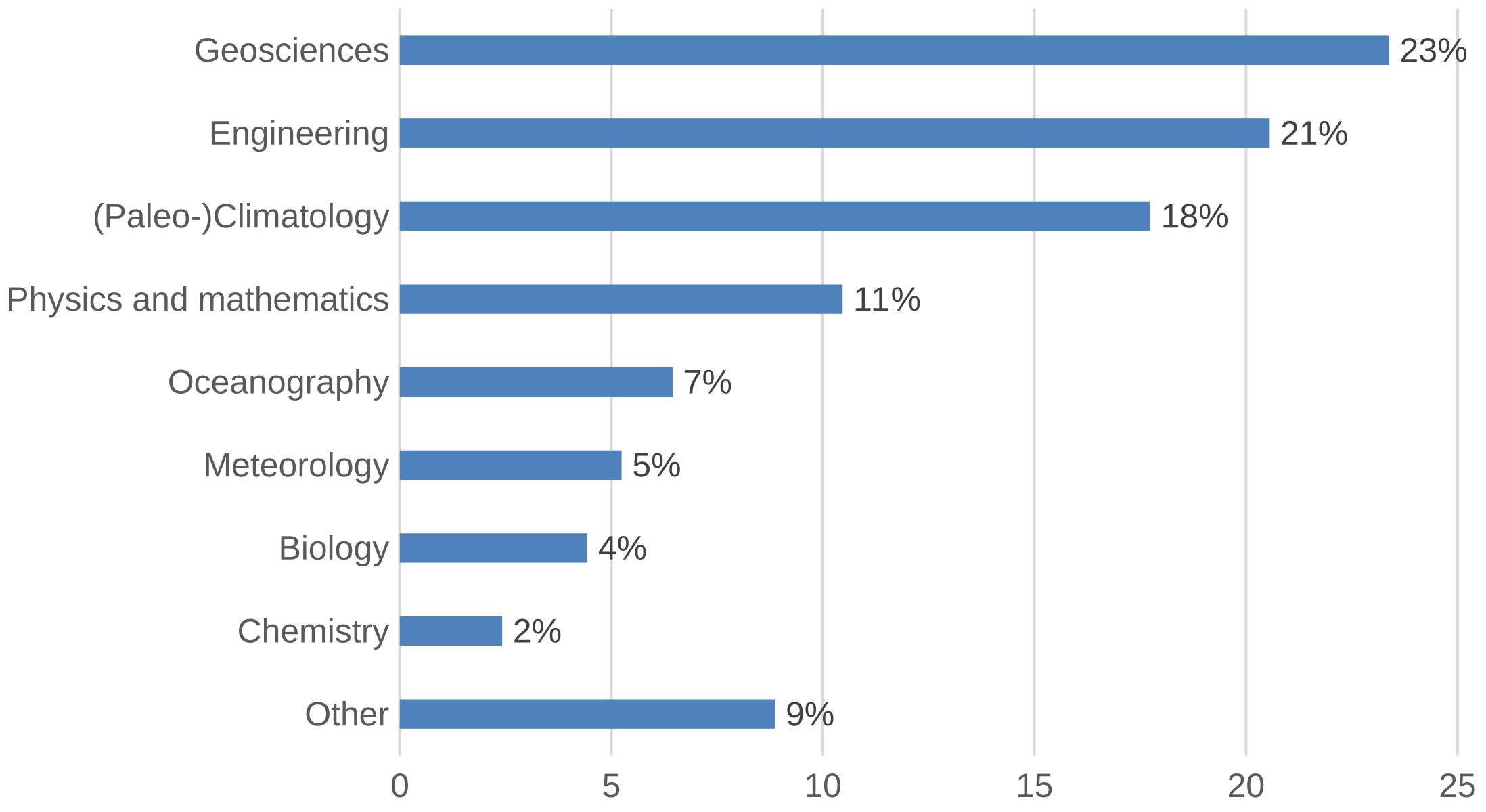
The final sample consisted of N = 249 participants, with a mean age of 46.53 years (SD = 13.37). Regarding gender, 67% identified as male, 31% as female, and 1% identified in other ways and another 1% chose not to answer the question. Employment distribution included 70% working at research organizations (e.g., Fraunhofer or Helmholtz institutes), 29% at universities, and 1% were retired. The sample encompassed a wide array of research fields; most participants were involved in geosciences (including areas such as geology or soil science), engineering or (paleo-)climatology (see Figure 1). The diversity within climate science was further evident as 9% selected “other” to describe their field, indicating specializations across disciplines and interdisciplinary. In terms of research focus, 48% indicated that the main part of their research relates to the physical scientific basis of climate, 21% to mitigation of climate change and 19% to adaption to climate change, with 12% opting not to specify. Participants represented a range of career stages: 18% were Ph.D. students, 23% postdocs, 4% junior or assistant professors, 25% professors, 16% (senior) scientists or researchers, 13% who did not identify with any of these categories and another % chose not to answer.
3.2 Measures1
Individual role identities at the science-policy interface. To measure respondents’ role identities regarding scientists’ engagement with policy and society, we used eight items capturing the three conceptual dimensions (see above): knowledge brokering, issue advocating, and research orientation. All items were measured on a five-point Likert scale ranging from 1 (“strongly disagree”) to 5 (“strongly agree”) and were adapted from Anderson and Betsill [2010].
Knowledge brokering was measured with three items assessing the perceived appropriateness of scientists providing expertise to policymakers: participation in advisory bodies (“It is appropriate for a scientist to join a formal assessment panel or scientific advisory committee”; M = 4.26, SD = 0.65), direct interactions with policymakers (“It is appropriate for a scientist to have direct interactions with policymakers”; M = 3.79, SD = 0.84), and informing policymakers through research (“It is appropriate for a scientist to inform policymakers through relevant research or assessments”; M = 4.32, SD = 0.65).
Issue advocating was measured with three items capturing the perceived appropriateness of scientists publicly supporting specific policy positions: policy advocacy (“It is appropriate for a scientist to advocate for a specific policy alternative to policymakers or in the public”; M = 3.34, SD = 0.99), public position-taking (“It is appropriate for a scientist to publicly take sides in a contested political issue”; M = 3.39, SD = 1.03), and use of scientific authority (“It is appropriate for a scientist to use his or her status as a scientist to argue for a cause, i.e., to call for more action on climate change”; M = 3.91, SD = 0.92).
Research orientation was measured with two items: scientific advancement (“It is appropriate for a scientist to conduct research solely for the advancement of scientific knowledge”; M = 3.48, SD = 1.15) and societal impact (“It is appropriate for a scientist to consider the societal impacts of their research”; M = 4.27, SD = 0.81).
To further characterize the identified profiles (RQ2), participants’ ratings on a set of items covering structural/contextual and individual-level factors were examined.
3.2.1 Structural and contextual level
At the structural and contextual level, three dimensions were assessed (see Table 1 for item wording and mean scores). Within the normative and epistemic context, four perceived roles of science in society were measured: knowledge generation, science communication, policy advisory, and influencing policy. Additionally, this dimension captured the perceived importance of science for policy [WiD, DZHW & NaWik, 2021], the respondents’ perceived policy relevance of their own research [Anderson & Betsill, 2010], and the possible policy contribution they believed climate scientists can make in addressing climate change. The institutional context was assessed through perceived institutional support for engagement [Anderson & Betsill, 2010] and perceived peer participation in such activities [Poliakoff & Webb, 2007]. Finally, the issue-related context encompassed perceived scientific uncertainty in climate science [Pielke, 2007], perceived discourse polarisation in public and political debates [Brüggemann et al., 2020], climate change concern, satisfaction with climate policy, and mitigation efficacy, reflecting the belief that sufficient political action can still mitigate climate change [Stoutenborough et al., 2015].
| M | SD | |
|
Normative and epistemic context | ||
|
Role of Science: “In your opinion, how important is each of the following tasks to the role of scientists?”1 | ||
|
Knowledge Generation: “Generating Knowledge” | 4.80 | 0.49 |
|
Science Communication: “Disseminating scientific knowledge to the public through science communication activities” | 4.22 | 0.78 |
|
Policy Advisory: “Communicating scientific findings directly to policymakers” | 3.89 | 0.89 |
|
Influencing policy: “Recommending specific policy solutions in public and political debates based on scientific findings” | 3.34 | 1.17 |
|
Importance of Science for Policy: items covering the perceived importance of scientific findings for policy decisions combined into a mean index (Mc Donald’s ω= .74).
| 4.04 | 0.69 |
|
Policy relevance of own research: “My own research is relevant to climate change related policies.” | 3.91 | 0.75 |
|
Possible policy contribution: “Climate scientists can make a meaningful contribution to climate change policy.” | 4.12 | 0.72 |
|
Institutional context | ||
|
Institutional support: “My institution values interaction with policymakers.” | 3.88 | 0.91 |
|
Peer participation: “My colleagues participate in political engagement activities.” | 3.44 | 0.88 |
|
Issue-related context | ||
|
Scientific uncertainty in climate science:” There is a high degree of scientific uncertainty in climate change research.” | 2.57 | 1.21 |
|
Climate change concern:” Taking action in climate change mitigation and/or adaptation is urgent.” | 4.71 | 0.56 |
|
Discourse polarisation: “The public and political debate on climate change is polarized.” | 4.20 | 0.56 |
|
Mitigation efficacy: “With sufficient political action climate change can still be mitigated.” | 3.65 | 1.04 |
|
Satisfaction with climate politics (mean index, McDonald’s ω= .74)
| 2.34 | 0.65 |
| Note.
Items
were
rated
on
a
five-point
Likert
scale
(1 = strongly
disagree
to
5 = strongly
agree).
1 Rated
on
a
five-point
scale
(1 = not
important
at
all
to
5 = very
important). | ||
3.2.2 Individual level
At the individual level, factors include socio-demographic and professional characteristics, motivations, and perceived constraints were measured
Sociodemographics. Participants indicated their gender identity (“a man”, “a woman”, “in some other way”) and provided their age in years. Political orientation was measured on a 5-point scale adapted from Boykoff and Oonk [2020], ranging from “very liberal” to “very conservative” (M = 2.01, SD = .73). Additionally, participants specified their workplace, selecting from options including university, research institute, industry, or other. Career level was assessed with categories including Ph.D. student, postdoctoral researcher, junior or assistant professor, professor, and other. For analysis, this variable was dichotomized into professors (including junior and assistant professors) versus non-professors. Lastly, primary academic discipline was specified, with categories adapted from Post [2016] and Cologna et al. [2021], including geography, geology, biology, oceanography, meteorology, (paleo-)climatology, physics, forestry, engineering, and an “other” option for additional fields.
Individual motivations and barriers. All items were rated on a five-point Likert scale. Credibility concern was assessed with the item “Scientists who engage in advocacy lose their scientific credibility” (M = 2.45, SD = 0.91). Concern about misuse of public statements was measured by the item “I am concerned that my public statements will be misused for political purposes” (M = 3.20, SD = 0.97). Perceived public expectations were assessed with the item “The public expects scientists to be engaged and to provide policy advice” [M = 3.54, SD = 0.78; Cologna et al., 2021], and perceived policy engagement duty was assessed with the item “I see policy engagement as my duty as a scientist” (M = 3.24, SD = 1.05).
Public communication and advisory activities (RQ3). Participants were asked about their contact with policymakers or the public concerning their research within the past year. Response options included: “Yes, I have been in contact with both policymakers and the public”, “Yes, but only with the public”, “Yes, but only with policymakers”, “No, I haven’t been in contact with either”, and “I do not know”. This variable served two purposes: first, as a filter, excluding participants who reported no contact from subsequent questions regarding their communication and advisory behaviours over the past year; second, for analysis, it was dichotomized into reported contact with policymakers and/or the public versus no contact.
Participants’ past communication with policymakers and the public was assessed across various communication styles with a total of nine items. These included reporting findings and facts, interpreting findings and facts, explaining possible outcomes of different policies, and addressing scientific uncertainties. Additionally, participants were asked about more advocacy-oriented communication activities, such as calling for climate action in general, advocating for specific policies, criticizing existing policies, and endorsing protests. Response options ranged from “never” to “7 or more times”. For analysis, these variables were dichotomized into “never” and “at least once”.
3.3 Data analysis
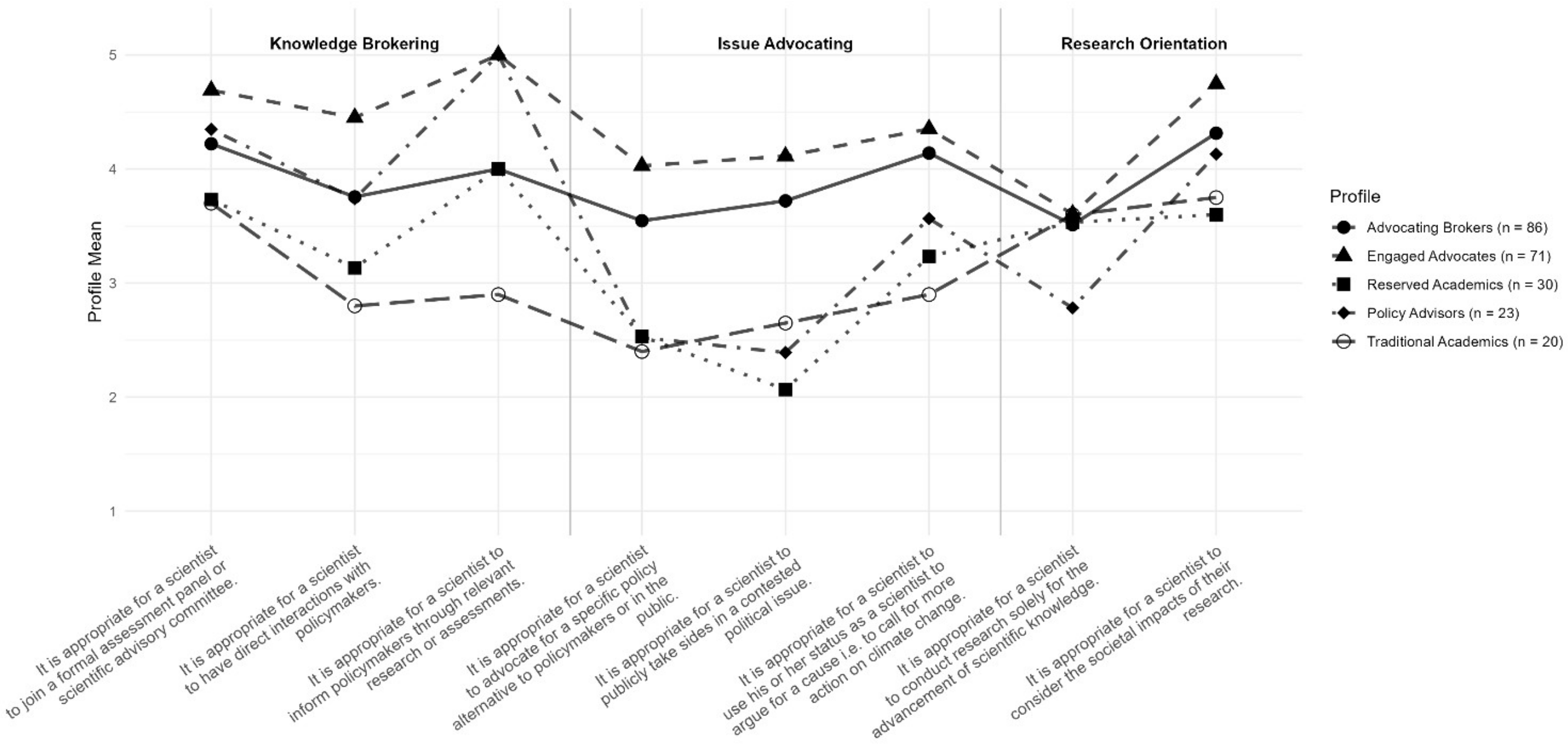
To answer RQ1 latent profile analysis (LPA) was conducted using the tidyLPA package in R. The basis for the LPA were all eight items capturing the aspects of the individual role identities at the science-policy interface (see results in Figure 2). The dataset was restricted to respondents with complete data on all indicators. Two multivariate outliers were identified based on the Mahalanobis distance and removed from the dataset, resulting in a final sample of N = 230. Multivariate normality was assessed using the Mardia’s test, which indicated significant deviations from normality (skewness = 373.33, p < .001; kurtosis = 5.65, p < .001). Following recommendations by Spurk et al. [2020], models were therefore estimated using a robust maximum likelihood estimator (MLR).
Models with increasing numbers of profiles were estimated and compared using the Akaike Information Criterion (AIC), the Bayesian Information Criterion (BIC), and the Bootstrap Likelihood Ratio Test (BLRT). Lower values of AIC and BIC indicate better model fit, while a significant BLRT (p < .05) indicates that a model with k profiles fits significantly better than a model with k-1 profiles. Classification quality was assessed using Entropy, where higher values reflect clearer profile separation (see Supplementary material). In addition, average posterior probabilities of class membership and profile sizes were examined. Following common guidelines, average posterior probabilities should exceed .70 and no profile should comprise less than 5% of the sample [Spurk et al., 2020; Stanley et al., 2017].
Based on these criteria, the five-profile solution was selected as the final model. The solution showed high classification accuracy (entropy = .93). The classification quality of the five-profile solution was further evaluated using the average posterior probabilities (AvePP) for each profile. The results indicated strong classification reliability across all profiles: Profile 1 (N = 23, AvePP = .95, SD = 0.08), Profile 2 (N = 71, AvePP = .98, SD = 0.05), Profile 3 (N = 20, AvePP = 1.00, SD = 0.00), Profile 4 (N = 30, AvePP = .92, SD = 0.12), and Profile 5 (N = 86, AvePP = .95, SD = 0.12). Furthermore, the identified profiles differed significantly in their mean levels across the three dimensions, as indicated by post hoc one-way ANOVAs (see Supplementary material Table A2).
4 Results
Our first research question asks what distinct patterns can be observed in how climate scientists in Germany interpret their role at the science-policy interface?
The largest group, Advocating Brokers (37%), combines support for knowledge brokering with the second-highest endorsement of issue advocacy. Respondents in this profile place considerable emphasis on the societal impacts of research while also valuing scientific advancement. Overall, they view both knowledge exchange and advocacy as integral parts of the scientific role.
The second largest group Engaged Advocates (31%) exhibits the highest levels of support across all items. They strongly endorse both knowledge brokering and are also the strongest proponents of all forms of issue advocacy. In doing so, they place particular emphasis on the societal impact of research, viewing it as a central responsibility of scientific work.
The Reserved Academics (13%) are characterized by comparably low support for knowledge brokering and very limited endorsement of advocacy. This group sees their primary role as informing policymakers through relevant research and assessments while deliberately refraining from prescribing specific solutions or taking explicit political positions. They also place comparatively little emphasis on the societal impacts of their research.
The Policy Advisors (10%) strongly support knowledge brokering but show limited support for advocacy, accepting primarily the use of scientific authority to argue for a cause. Respondents in this group are more strongly oriented toward societal impacts of research rather than scientific advancements. Thus, they primarily see scientists as honest and neutral brokers of knowledge whose research should profit to society.
Finally, the smallest group Traditional Academics (9%), exhibits the lowest levels of support for knowledge brokering and generally low endorsement of advocacy. Their research orientation is balanced between consideration of societal impacts and the advancement of scientific knowledge. This group favours a more traditional academic role, focusing primarily on generating rather than communicating knowledge.
Furthermore, we aimed to characterize the different types of scientists in greater detail. In the following, we jointly address the second and third research questions: how these types can be further described, in terms of the factors influencing their classification (Table 2), and how they differ in their communication behaviour in public science communication and interactions with policymakers (see Figures A1 and A2 in the Supplementary material for detailed results).
|
Advocating Brokers |
Engaged Advocates |
Reserved Academics |
Policy Advisors |
Traditional Academics |
|
|
N |
82 |
70 |
29 |
23 |
20 |
|
(%) |
(34%) |
(31%) |
(14%) |
(10%) |
(9%) |
| Normative and epistemic context
| |||||
|
Role of Science: Knowledge Generation |
4.84 |
4.85 |
4.77 |
4.78 |
4.60 |
|
(0.46) |
(0.42) |
(0.50) |
(0.52) |
(0.60) |
|
|
Role of Science: Science Communication |
4.24ab |
4.45b |
4.00ab |
4.48b |
3.80a |
|
(0.72) |
(0.75) |
(0.83) |
(0.59) |
(1.00) |
|
|
Role of Science: Policy Advisory |
3.76bc |
4.27d |
3.60ab |
4.27cd |
3.10a |
|
(0.84) |
(0.81) |
(0.62) |
(0.88) |
(0.97) |
|
|
Role of Science: Influencing Policy |
3.34b |
3.88c |
2.55a |
3.19abc |
2.65ab |
|
(1.03) |
(1.06) |
(1.12) |
(1.17) |
(1.31) |
|
|
Importance of Science for Policy |
4.19b |
4.17b |
3.62a |
4.12ab |
3.38a |
|
(0.54) |
(0.60) |
(0.82) |
(0.67) |
(0.81) |
|
|
Policy relevance of own research |
3.89ab |
4.03b |
3.90ab |
4.09b |
3.40a |
|
(0.71) |
(0.81) |
(0.66) |
(0.60) |
(0.88) |
|
|
Possible policy contribution |
4.09bc |
4.35c |
3.90ab |
4.26bc |
3.55a |
|
(0.77) |
(0.68) |
(0.62) |
(0.69) |
(0.69) |
|
| Institutional context | |||||
|
Institutional support |
3.80ab |
4.17b |
3.77ab |
4.14b |
3.25a |
|
(0.87) |
(0.82) |
(0.99) |
(0.71) |
(1.07) |
|
|
Peer participation |
3.49ab |
3.72b |
3.12a |
3.15ab |
2.95a |
|
(0.82) |
(0.78) |
(0.99) |
(0.88) |
(0.91) |
|
| Issue-related context | |||||
|
Scientific uncertainty in climate science |
2.53 |
2.44 |
2.63 |
2.32 |
3.15 |
|
(1.12) |
(1.31) |
(1.25) |
(1.21) |
(1.04) |
|
|
Climate change concern |
4.68a |
4.92b |
4.62a |
4.78ab |
4.25a |
|
(0.60) |
(0.33) |
(0.49) |
(0.67) |
(0.72) |
|
|
Discourse polarisation |
4.30b |
4.19ab |
3.79a |
4.45b |
4.10ab |
|
(0.66) |
(0.77) |
(1.01) |
(0.67) |
(0.91) |
|
|
Mitigation efficacy |
3.61 |
3.76 |
3.75 |
3.61 |
3.47 |
|
(1.03) |
(1.04) |
(0.97) |
(1.12) |
(1.07) |
|
|
Satisfaction with climate politics |
2.33 |
2.29 |
2.47 |
2.36 |
2.49 |
|
(0.70) |
(0.66) |
(0.47) |
(0.79) |
(0.55) |
|
| Individual level | |||||
|
Age |
45.82ab |
41.33a |
50.52b |
48.83ab |
51.95b |
|
(13.27) |
(11.36) |
(13.45) |
(12.01) |
(13.45) |
|
|
Gender – male % |
69 |
64 |
67 |
65 |
75 |
|
Career level – professor % |
24 |
30 |
40 |
26 |
45 |
|
Political orientation |
1.99a |
1.92a |
1.86a |
2.15ab |
2.73b |
|
(0.61) |
(0.78) |
(0.66) |
(0.75) |
(0.91) |
|
|
Credibility concern |
2.34ab |
2.15a |
2.81b |
2.91b |
2.76b |
|
(0.77) |
(0.78) |
(0.96) |
(1.15) |
(0.75) |
|
|
Concern about misuse of public statements |
3.06 |
3.09 |
3.44 |
3.55 |
3.40 |
|
(0.96) |
(0.91) |
(100) |
(0.96) |
(1.10) |
|
|
Public expectations |
3.50ab |
3.78b |
3.22a |
3.48ab |
3.28ab |
|
(0.87) |
(0.58) |
(0.80) |
(0.75) |
(0.76) |
|
|
Policy Engagement Duty |
3.24b |
3.80c |
2.63a |
3.17abc |
2.50a |
|
(0.90) |
(0.93) |
(1.07) |
(1.11) |
(1.00) |
|
| Outreach
| |||||
|
Reported contact with policymakers and/or the public in % |
72 |
80 |
90 |
96 |
70 |
| Note.
Means
are
based
on
a
five-point
Likert
scale
ranging
from
1
(“strongly
disagree”)
to
5
(“strongly
agree”).
Within
each
row,
mean
values
with
different
superscript
letters
indicate
significant
differences
at
p < .05
in
post
hoc
tests.
For
variables
meeting
the
homogeneity
of
variance
assumption
(Levene’s
test),
a
Bonferroni
post
hoc
test
was
applied;
otherwise,
a
Games-Howell
test
was
used. | |||||
The Advocating Brokers are the second youngest profile and have the lowest proportion of professors. Policy engagement duty as well as a comparatively high perception of discourse polarisation appear to be motivators for this group. Within the normative and epistemic context, they assign a high importance to science for policy. Apart from Traditional Academics, this profile reported the lowest rate of contact with policymakers or the public (72%), although generally viewing such contact as appropriate for scientists — suggesting a gap between attitude and own behaviour. Their outreach communication reflected comparatively high levels of advocacy behaviour (see Supplementary material).
The Engaged Advocates are the youngest and comparably female profile. Normatively, they view science communication, policy advisory, and policy influence as fundamental to the role of science in society. They perceive the policy relevance of their own research as high and believe the possible policy contribution of climate scientists to addressing climate change to be substantial. Institutional factors may influence their strong engagement orientation, reporting the highest perceived institutional support and peer participation across all profiles. Notably, this profile exhibits the highest level of climate change concern, which may reinforce their strong endorsement of advocacy. They perceive the least credibility concerns for scientists who engage in advocacy and express the highest policy engagement duty. Consistent with their role identity, they reported the highest frequency of advocacy-oriented communication in their outreach activities over the past year (see Supplementary material).
The Reserved Academics are the second oldest profile and the most politically liberal group, with the second highest proportion of professors. Normatively, they see the role of science primarily in the generation of knowledge, rather than in policy advisory or in influencing policy. Additionally, they perceive the least discourse polarisation around climate change among all profiles, and they report the lowest perceived public expectations for engagement as well as a comparatively weak policy engagement duty. Notably, 90% reported having had contact with audiences outside academia, which reflects their role identity that views the dissemination of knowledge as central. Their outreach communication reflects low levels of advocacy behaviour, consistent with their normative views (see Supplementary material).
The Policy Advisors have the second lowest proportion of professors and are, after the Traditional Academics, the least politically liberal profile. They report the highest credibility concern — which may explain their restrictive stance on advocacy despite an otherwise strong engagement orientation. Normatively, they view science communication and policy advisory as important and rate their own research as most policy-relevant among all profiles. They perceive the public climate change discourse as most polarised — which may further contribute to their cautious stance on advocacy. Nevertheless, 96% report having had contact with policymakers or the public, reflecting the strong societal orientation in their role identity. Still, despite viewing only one form of advocacy — the use of scientific authority to argue for a cause — as appropriate, this profile reported the second highest engagement across different forms of advocacy communication over the past year (see Supplementary material).
The Traditional Academics are, on average, the oldest and most politically conservative profile, with the highest proportion of male respondents and professors. Consistent with their role identity, they assign less importance to science communication and policy advisory than any other profile, viewing knowledge generation as the primary purpose of science. They assign the least importance of science for policy and rate their own research as least relevant to climate policy. Institutional factors appear to act as additional barriers for this group, as they report the lowest perceived institutional support for engagement and the lowest rate of perceived peer participation across all profiles. They express the least climate change concern and perceive comparatively little discourse polarisation. Accordingly, they report the lowest rate of contact with policymakers or the public across all profiles.
5 Discussion
The aim of our study was to (1) identify distinct patterns on how German climate scientists interpret their role at the science-policy interface, (2) identify additional factors that are associated with these role interpretations, and (3) analyse differences in actual communication and policy advisory behaviours across role interpretations. Of particular interest is examining the extent to which specific normative expectations are translated into concrete behaviours in a highly politicized field such as climate change.
Overall, the types we have identified correspond very well with the work of Pielke [2007] and previous empirical studies in this area [Cologna et al., 2021; Boykoff & Oonk, 2020; Entradas et al., 2019; Getson et al., 2021]. Our results show that most scientists identify with a type that considers public communication and political counselling important — though they differ in the extent to which they value such engagement and in how advocative they believe this communication should be. The two largest profiles — comprising 65% of the sample — broadly support advocacy, whereas the three smaller profiles reflect more restrictive views on the appropriate boundaries of scientific communication. Only a small minority, the Traditional Academics, can be considered as approximating the role of the “Pure Scientists” [Pielke, 2007] that prefer focusing solely on science and is detached from public and policy. Thus, our study empirically largely supports the assumptions of Brüggemann et al. [2020], who argue that scientists primarily position themselves as advocates and brokers in post-normal science situations [see also Cologna et al., 2021; Lubchenco, 1998; Schmidt, 2015; Steel et al., 2004].
While our exploratory results indicate that both individual and structural/contextual factors are associated with scientists’ understanding of their (advocacy) roles, a theoretically grounded account is still missing. Such an account would, on the one hand, explain how scientists internalize — or resist — advocacy roles, and on the other hand, clarify which factors determine in which situations scientists choose to take a clear political stance or refrain from doing so. Developing such a framework would provide a valuable contribution to the field and guide future research on the complex interplay between science and political engagement.
The fact that Traditional Academics are not only the smallest but also the oldest group suggests a generational shift in the self-conception as a scientist. Younger scientists increasingly view public engagement as an integral part of their professional responsibilities, alongside the production of scientific knowledge [Banse et al., 2026; Bucchi & Trench, 2021]. Additionally, while Traditional Academics are predominantly male, our data does not support previous findings suggesting that female scientists lean more towards advocacy [Boykoff & Oonk, 2020].
For most profiles, normative role understanding is reflected in their concrete communication and outreach behaviour. However, the rate of reported contact with policymakers or the public did not align straightforwardly with profile membership: scientists with higher endorsement of knowledge brokering and advocacy did not necessarily report more frequent contact. This suggests that actual engagement may depend less on normative orientations and more on situational factors — such as the availability of opportunities to engage. Nevertheless, when scientists do engage, their normative views appear to shape how they communicate: the Engaged Advocates reported the most frequent use of advocacy-oriented communication in their outreach activities, while the Reserved and Traditional Academics reported the least.
Our findings indicate that in post-normal situations [Funtowicz & Ravetz, 1993], the relationship between science and politics is not unidirectional. It is rather characterized by numerous dynamic interdependencies, with boundaries continuously renegotiated [Gieryn, 1983; Hoppe, 2010]; the different profiles we identified in our study demonstrate that scientists navigate these boundaries in various ways. That said, it is important to note that these profiles should not necessarily be understood as fixed categories. Scientists’ role positioning can shift depending on the situation or evolve over time — a perspective that aligns with Donner’s [2014] continuum model, which highlights the dynamic and fluid nature of scientific roles. Future research should explore these dynamics more closely, examining how role conceptions change across contexts and over time.
From a societal perspective and especially given the serious threats posed by climate change, it is both understandable and highly desirable that climate scientists advocate for climate protection measures and share their knowledge. However, if scientists advocate too strongly for specific policy actions, there is a risk that scientific evidence could be instrumentalized for political purposes, potentially leading to the perception that science itself is politically motivated [Kotcher et al., 2017; McLaughlin et al., 2021]. This perception threatens one of science’s most valuable assets — its independence and impartiality. Additionally, scientists lack a democratic mandate to endorse or determine specific policy measures. Rather than advocating for particular policies outright, scientists could instead present policymakers with scenario-based insights outlining the likely consequences of various actions (or inactions) — favouring “if-then” statements over absolute assertions.
Our study, of course, has several limitations. Although we compiled an extensive list of climate scientists working in Germany, only a relatively small number ultimately completed the survey. In this vein, and as with all survey-based studies, it is important to consider potential self-selection bias; scientists particularly interested in science communication and policy advice may have been more inclined to participate. Additionally, this resulted in relatively few responses for certain specific communication and advisory activities. To date, there is no validated scale for measuring specifically advocacy roles. Consequently, we had to compile items from various existing studies and develop some of our own. This approach may limit the reliability and validity of our measures, highlighting the need for future research to develop a dedicated, empirically validated scale. Furthermore, as noted above and in relation to Pielke’s [2007] framework, communication roles extend beyond simply communicating “to” the public or recommending specific policy solutions — for example, providing guidance on the likely outcomes of policy choices or listening to civic discourse. Pielke [2007] also emphasizes that acting as an honest broker often requires collaboration among scientists, since no single individual can fully evaluate all potential consequences of a policy. Future research should therefore consider both individual and collaborative aspects of policy-related engagement when operationalizing advocacy roles.
Additionally, for future research, studies with larger sample sizes or international comparisons would be valuable. Examining role patterns across countries with different contexts and distinct science communication ecosystems [Fischer et al., 2025] could yield interesting insights. Dialogical forms of communication in the context of scientific roles and advocacy were not considered here and should be further examined in future studies. Moreover, a more fine-grained assessment of policy and advisory activities — such as separate measures of time spent on different forms of engagement — could provide additional insights. Relatedly, our assessment captured general attitudes toward advocacy without asking respondents how they themselves understand or define the concept. Future, potentially qualitative, studies could build on this by exploring in greater depth how scientists engaged in policy advice conceptualize advocacy.
References
-
Anderson, L., & Betsill, M. (2010). Scientists’ perspectives on navigating the science-policy frontier. Annual Meeting of the American Political Science Association, September 2–5, 2010, Washington, USA. https://ssrn.com/abstract=1643185
-
Anglin, A. H., Kincaid, P. A., Short, J. C., & Allen, D. G. (2022). Role theory perspectives: past, present, and future applications of role theories in management research. Journal of Management, 48(6), 1469–1502. https://doi.org/10.1177/01492063221081442
-
Banse, L., Hendriks, F., & Taddicken, M. (2026). A new obligation or a natural extension? STEM scientists’ science communication in the context of their professional role identities. Science Communication, 48(4), 648–681. https://doi.org/10.1177/10755470251341839
-
Bao, L., Calice, M. N., Brossard, D., Scheufele, D. A., & Markowitz, E. M. (2024). Are productive scientists more willing to engage with the public? Science Communication, 46(1), 65–91. https://doi.org/10.1177/10755470231217682
-
Besley, J. C., Dudo, A., & Yuan, S. (2018). Scientists’ views about communication objectives. Public Understanding of Science, 27(6), 708–730. https://doi.org/10.1177/0963662517728478
-
Besley, J. C., Dudo, A., Yuan, S., & Lawrence, F. (2018). Understanding scientists’ willingness to engage. Science Communication, 40(5), 559–590. https://doi.org/10.1177/1075547018786561
-
Besley, J. C., & Nisbet, M. (2013). How scientists view the public, the media and the political process. Public Understanding of Science, 22(6), 644–659. https://doi.org/10.1177/0963662511418743
-
Besley, J. C., O’Hara, K., & Dudo, A. (2019). Strategic science communication as planned behavior: understanding scientists’ willingness to choose specific tactics. PLoS ONE, 14(10), e0224039. https://doi.org/10.1371/journal.pone.0224039
-
Betz, G. (2013). In defence of the value free ideal. European Journal for Philosophy of Science, 3(2), 207–220. https://doi.org/10.1007/s13194-012-0062-x
-
Biermann, K., Peters, N., & Taddicken, M. (2023). “You can do better than that!”: tweeting scientists addressing politics on climate change and Covid-19. Media and Communication, 11(1), 217–227. https://doi.org/10.17645/mac.v11i1.5961
-
Boykoff, M., & Oonk, D. (2020). Evaluating the perils and promises of academic climate advocacy. Climatic Change, 163(1), 27–41. https://doi.org/10.1007/s10584-018-2339-3
-
Bray, D., & von Storch, H. (2017). The normative orientations of climate scientists. Science and Engineering Ethics, 23(5), 1351–1367. https://doi.org/10.1007/s11948-014-9605-1
-
Brüggemann, M., Lörcher, I., & Walter, S. (2020). Post-normal science communication: exploring the blurring boundaries of science and journalism. JCOM, 19(03), A02. https://doi.org/10.22323/2.19030202
-
Bucchi, M., & Trench, B. (Eds.). (2021). Routledge handbook of public communication of science and technology (3rd ed.). Routledge. https://doi.org/10.4324/9781003039242
-
Cialdini, R. B., Kallgren, C. A., & Reno, R. R. (1991). A focus theory of normative conduct: a theoretical refinement and reevaluation of the role of norms in human behavior. Advances in Experimental Social Psychology, 24, 201–234. https://doi.org/10.1016/S0065-2601(08)60330-5
-
Cologna, V., Knutti, R., Oreskes, N., & Siegrist, M. (2021). Majority of German citizens, US citizens and climate scientists support policy advocacy by climate researchers and expect greater political engagement. Environmental Research Letters, 16(2), 024011. https://doi.org/10.1088/1748-9326/abd4ac
-
Donner, S. D. (2014). Finding your place on the science — advocacy continuum: an editorial essay. Climatic Change, 124(1–2), 1–8. https://doi.org/10.1007/s10584-014-1108-1
-
Dudo, A., & Besley, J. C. (2016). Scientists’ prioritization of communication objectives for public engagement. PLoS ONE, 11(2), e0148867. https://doi.org/10.1371/journal.pone.0148867
-
Entradas, M., Marcelino, J., Bauer, M. W., & Lewenstein, B. (2019). Public communication by climate scientists: what, with whom and why? Climatic Change, 154(1–2), 69–85. https://doi.org/10.1007/s10584-019-02414-9
-
Felt, U., & Davies, S. R. (Eds.). (2020). Exploring science communication: a science and technology studies approach. SAGE Publications. https://doi.org/10.4135/9781529721256
-
Fischer, L., Schäfer, M. S., & Schmid-Petri, H. (2025). Comparing science communication ecosystems: towards a conceptual framework for cross-national research on science communication. JCOM, 24(05), A02. https://doi.org/10.22323/148320250924054927
-
Funtowicz, S. O., & Ravetz, J. R. (1993). The emergence of post-normal science. In R. Schomberg (Ed.), Science, politics and morality: scientific uncertainty and decision making (pp. 85–123). Springer. https://doi.org/10.1007/978-94-015-8143-1_6
-
Getson, J. M., Sjöstrand, A. E., Church, S. P., Weiner, R., Hatfield, J. L., & Prokopy, L. S. (2021). Do scientists have a responsibility to provide climate change expertise to mitigation and adaptation strategies? Perspectives from climate professionals. Public Understanding of Science, 30(2), 169–178. https://doi.org/10.1177/0963662520966690
-
Gieryn, T. F. (1983). Boundary-work and the demarcation of science from non-science: strains and interests in professional ideologies of scientists. American Sociological Review, 48(6), 781–795. https://doi.org/10.2307/2095325
-
Graminius, C. (2023). Open letters and climate communication: the professional roles and identities of researchers in times of crisis. Environmental Communication, 17(6), 537–549. https://doi.org/10.1080/17524032.2023.2225765
-
Gundersen, T. (2020). Value-free yet policy-relevant? The normative views of climate scientists and their bearing on philosophy. Perspectives on Science, 28(1), 89–118. https://doi.org/10.1162/posc_a_00334
-
Hoppe, R. (2010). From “knowledge use” towards “boundary work”: sketch of an emerging new agenda for inquiry into science-policy interaction. In R. J. in ’t Veld (Ed.), Knowledge democracy: consequences for science, politics, and media (pp. 169–186). Springer. https://doi.org/10.1007/978-3-642-11381-9_13
-
Howell, E. L., Wirz, C. D., Scheufele, D. A., Brossard, D., & Xenos, M. A. (2020). Deference and decision-making in science and society: how deference to scientific authority goes beyond confidence in science and scientists to become authoritarianism. Public Understanding of Science, 29(8), 800–818. https://doi.org/10.1177/0963662520962741
-
Kotcher, J. E., Myers, T. A., Vraga, E. K., Stenhouse, N., & Maibach, E. W. (2017). Does engagement in advocacy hurt the credibility of scientists? Results from a randomized national survey experiment. Environmental Communication, 11(3), 415–429. https://doi.org/10.1080/17524032.2016.1275736
-
Lacey, J., Howden, M., Cvitanovic, C., & Colvin, R. M. (2018). Understanding and managing trust at the climate science-policy interface. Nature Climate Change, 8(1), 22–28. https://doi.org/10.1038/s41558-017-0010-z
-
Lackey, R. T. (2007). Science, scientists, and policy advocacy. Conservation Biology, 21(1), 12–17. https://doi.org/10.1111/j.1523-1739.2006.00639.x
-
Lubchenco, J. (1998). Entering the century of the environment: a new social contract for science. Science, 279(5350), 491–497. https://doi.org/10.1126/science.279.5350.491
-
McLaughlin, D. M., Mewhirter, J., & Sanders, R. (2021). The belief that politics drive scientific research & its impact on COVID-19 risk assessment. PLoS ONE, 16(4), e0249937. https://doi.org/10.1371/journal.pone.0249937
-
Messling, L., Lu, Y., & van Eck, C. W. (2025). Advocacy — defending science or destroying it? Interviews with 47 climate scientists about their fundamental concerns. Public Understanding of Science, 34(4), 479–494. https://doi.org/10.1177/09636625251314164
-
Meyer, M. (2010). The rise of the knowledge broker. Science Communication, 32(1), 118–127. https://doi.org/10.1177/1075547009359797
-
Nelson, M. P., & Vucetich, J. A. (2009). On advocacy by environmental scientists: what, whether, why, and how. Conservation Biology, 23(5), 1090–1101. https://doi.org/10.1111/j.1523-1739.2009.01250.x
-
Nicolaisen, P. B. (2022). A state of emergency or business as usual in climate science communication? A three-dimensional perspective on the role perceptions of climate scientists, climate journalists, and citizens. Science Communication, 44(6), 667–692. https://doi.org/10.1177/10755470221136220
-
Peters, H. P. (2008). Scientists as public experts. In M. Bucchi & B. Trench (Eds.), Handbook of public communication of science and technology (pp. 131–146). Routledge. https://doi.org/10.4324/9780203928240
-
Pielke, R. A. (2004). When scientists politicize science: making sense of controversy over The Skeptical Environmentalist. Environmental Science & Policy, 7(5), 405–417. https://doi.org/10.1016/j.envsci.2004.06.004
-
Pielke, R. A. (2007). The honest broker: making sense of science in policy and politics. Cambridge University Press. https://doi.org/10.1017/CBO9780511818110
-
Poliakoff, E., & Webb, T. L. (2007). What factors predict scientists’ intentions to participate in public engagement of science activities? Science Communication, 29(2), 242–263. https://doi.org/10.1177/1075547007308009
-
Post, S. (2016). Communicating science in public controversies: strategic considerations of the German climate scientists. Public Understanding of Science, 25(1), 61–70. https://doi.org/10.1177/0963662514521542
-
Post, S., & Ramirez, N. (2018). Politicized science communication: predicting scientists’ acceptance of overstatements by their knowledge certainty, media perceptions, and presumed media effects. Journalism & Mass Communication Quarterly, 95(4), 1150–1170. https://doi.org/10.1177/1077699018769668
-
Prentice, D. A. (2007). Prescriptive vs. descriptive norms. In R. F. Baumeister & K. D. Vohs (Eds.), Encyclopedia of social psychology (pp. 629–630). SAGE Publications. https://doi.org/10.4135/9781412956253
-
Reiners, D. S., Reiners, W. A., & Lockwood, J. A. (2013). The relationship between environmental advocacy, values, and science: a survey of ecological scientists’ attitudes. Ecological Applications, 23(5), 1226–1242. https://doi.org/10.1890/12-1695.1
-
Roedema, T., Broerse, J., & Kupper, F. (2021). “Who is going to believe me, if I say ‘I’m a researcher?’” — Scientists’ role repertoires in online public engagement. JCOM, 20(03), A03. https://doi.org/10.22323/2.20030203
-
Schäfer, M. S. (2016). Mediated trust in science: concept, measurement and perspectives for the ‘science of science communication’. JCOM, 15(05), C02. https://doi.org/10.22323/2.15050302
-
Scheufele, D. A. (2014). Science communication as political communication. Proceedings of the National Academy of Sciences, 111(supplement_4), 13585–13592. https://doi.org/10.1073/pnas.1317516111
-
Schmid-Petri, H., Bienzeisler, N., & Beseler, A. (2022). Effects of politicization on the practice of science. Progress in Molecular Biology and Translational Science, 188(1), 45–63. https://doi.org/10.1016/bs.pmbts.2021.11.005
-
Schmidt, G. A. (2015). What should climate scientists advocate for? Bulletin of the Atomic Scientists, 71(1), 70–74. https://doi.org/10.1177/0096340214563677
-
Serpe, R. T., Stryker, R., & Powell, B. (Eds.). (2020). Identity and symbolic interaction: deepening foundations, building bridges. Springer. https://doi.org/10.1007/978-3-030-41231-9
-
Sharman, A., & Howarth, C. (2017). Climate stories: why do climate scientists and sceptical voices participate in the climate debate? Public Understanding of Science, 26(7), 826–842. https://doi.org/10.1177/0963662516632453
-
Spurk, D., Hirschi, A., Wang, M., Valero, D., & Kauffeld, S. (2020). Latent profile analysis: a review and “how to” guide of its application within vocational behavior research. Journal of Vocational Behavior, 120, 103445. https://doi.org/10.1016/j.jvb.2020.103445
-
Stanley, L., Kellermanns, F. W., & Zellweger, T. M. (2017). Latent profile analysis: understanding family firm profiles. Family Business Review, 30(1), 84–102. https://doi.org/10.1177/0894486516677426
-
Steel, B., List, P., Lach, D., & Shindler, B. (2004). The role of scientists in the environmental policy process: a case study from the American west. Environmental Science & Policy, 7(1), 1–13. https://doi.org/10.1016/j.envsci.2003.10.004
-
Steele, K. (2012). The scientist qua policy advisor makes value judgments. Philosophy of Science, 79(5), 893–904. https://doi.org/10.1086/667842
-
Stets, J. E., Savage, S. V., Burke, P. J., & Fares, P. (2020). Cognitive and behavioral responses to the identity verification process. In R. T. Serpe, R. Stryker & B. Powell (Eds.), Identity and symbolic interaction: deepening foundations, building bridges (pp. 65–88). Springer. https://doi.org/10.1007/978-3-030-41231-9_3
-
Stoutenborough, J. W., Bromley-Trujillo, R., & Vedlitz, A. (2015). How to win friends and influence people: climate scientists’ perspectives on their relationship with and influence on government officials. Journal of Public Policy, 35(2), 269–296. https://doi.org/10.1017/s0143814x15000112
-
van den Hove, S. (2007). A rationale for science-policy interfaces. Futures, 39(7), 807–826. https://doi.org/10.1016/j.futures.2006.12.004
-
van Eck, C. W. (2023). The next generation of climate scientists as science communicators. Public Understanding of Science, 32(8), 969–984. https://doi.org/10.1177/09636625231176382
-
WiD, DZHW & NaWik. (2021). Wissenschaftskommunikation in Deutschland: Ergebnisse einer Befragung unter Wissenschaftler. Wissenschaft im Dialog, Deutsches Zentrum für Hochschul- und Wissenschaftsforschung, Nationales Institut für Wissenschaftskommunikation.
Notes
1. The complete questionnaire can be accessed via the anonymized OSF link: https://osf.io/jmfzq/overview?view_only=548d2efe1e89401a94bfe4c031a7328b.
About the authors
Paula Kolhep is a Ph.D. candidate at the Chair of Science Communication at the University of Passau. Her research interests include science communication with a focus on climate change communication, science-policy relations, and deliberative dynamics in social media environments.
E-mail: paula.kolhep@uni-passau.de
Hannah Schmid-Petri is Professor of Science Communication at the Department of Communication and Media Studies, University of Passau, Germany. Her research focuses on the interplay of online and offline communication, environmental communication, political communication, and computational social science.
E-mail: hannah.schmid-petri@uni-passau.de
Stephan Schlögl is a Post-Doc Researcher at the University of Passau. He studies political and science communication on social media from a perspective of public sphere theory.
E-mail: stephan.schloegl@uni-passau.de
Supplementary material
Available at https://doi.org/10.22323/171720260815152417