

1 Context
Climate change has increased attention to scientists’ public engagement, including communication, policy advice, advocacy and, in some cases, protest. Recent international evidence indicates that trust in scientists is generally high, although it varies across countries and political groups, as do views about scientists’ appropriate public roles [Cologna et al., 2025; Gauchat, 2012; McCright & Dunlap, 2011]. These differences become especially relevant when scientists move beyond communication and advice to endorse policies or participate in contentious action, where concerns about impartiality, credibility and professional boundaries are more salient [Lackey, 2007; Kotcher et al., 2017; Beall et al., 2017; Oreskes, 2020; Green, 2020].
Research has documented variation in scientists’ reported climate-related behaviours and in the practical, reputational and institutional barriers associated with those behaviours [Poliakoff & Webb, 2007; Dunwoody et al., 2009; Dablander, Sachisthal, Cologna et al., 2024]. A companion analysis of the survey used here shows that climate researchers report more civic action than non-climate researchers, especially advocacy, legal protest and civil disobedience [Dablander, Sachisthal & Haslbeck, 2024]. These studies show that climate engagement varies by form of action and by scientists’ research and professional contexts. A separate question concerns how scientists define the public roles that they consider legitimate.
The analysis distinguishes two judgements. The first concerns the scope of the public mandate: whether public action is expected mainly from climate-related scientists or from scientists more broadly. The second concerns the repertoire of legitimate engagement: whether that mandate extends from advocacy to protest. These judgements need not move together. Scientists may support broad advocacy while rejecting protest, or they may reserve a stronger public mandate for climate-related specialists. Examining how the two judgements are combined provides information that cannot be inferred from a single behaviour or barrier measure.
We analyse the Climate Change Engagement of Scientists survey dataset (v1.0.0), an international cross-sectional survey documented by Dablander, Sachisthal, Cologna et al. [2024]. A theory-guided, rule-based typology captures four configurations of the scope and repertoire dimensions. We examine how these configurations are associated with political self-placement, field and career structure, climate-research proximity and activist-network proximity, and how they correspond to reported behavioural repertoires. The analysis distinguishes the scope of authorised actors from the legitimacy of engagement forms, assesses whether their configurations have different correlates, and examines the extent to which normative role judgements correspond to retrospective self-reported behaviour. The role types are treated as normative orientations rather than fixed identities or behavioural classes.
2 Prior research
2.1 Engagement behaviours and barriers
Research on scientists’ public engagement has examined communication with publics and journalists, policy engagement, outreach and advocacy. It identifies individual motivations, perceived efficacy, time constraints, training, institutional incentives and reputational risks as correlates of participation [Ajzen, 1991; Poliakoff & Webb, 2007; Dunwoody et al., 2009; Jensen et al., 2008; Ecklund et al., 2012]. Research focused on barriers to engagement therefore explains important differences in scientists’ capacity, opportunity and willingness to participate in public life.
Climate-focused survey research also distinguishes among forms of public action. Dablander, Sachisthal, Cologna et al. [2024], using the dataset analysed here, examine advocacy, protest, public communication, lifestyle choices, barriers and willingness. Dablander, Sachisthal and Haslbeck [2024] show that climate researchers report more civic action than non-climate researchers, particularly advocacy and activism. These studies establish that reported engagement is multidimensional and that its frequency varies across research contexts.
Reported behaviour and reported barriers do not fully identify how respondents judge the proper public role of scientists. Two scientists may both refrain from protest because one lacks time or opportunity and the other regards protest as outside that role. A respondent may also report having participated in an action without regarding it as an appropriate expectation for scientists generally. Role-boundary orientation is therefore examined here as a distinct survey-based judgement about who should act publicly and through which forms of engagement.
2.2 Advocacy, protest and credibility
Research on scientists’ public positioning has examined the credibility consequences of moving from communicating evidence to endorsing policy responses or participating in contentious action. Classic accounts distinguish roles centred on neutral expertise from roles involving advocacy and identify possible consequences for credibility and perceived impartiality [Pielke, 2007; Lackey, 2007]. Experimental and survey studies find that these consequences vary with the issue, the controversy surrounding proposed solutions and the form of advocacy [Beall et al., 2017; Kotcher et al., 2017; Cologna et al., 2021, 2022].
Work on climate advocacy and activism further shows that public engagement is shaped by professional norms, identity considerations and anticipated reactions from peers and publics. Some scholars defend direct involvement, including protest and civil disobedience, in response to climate risks [Oreskes, 2020; Green, 2020; Capstick et al., 2022; Racimo et al., 2022]. Other studies examine the conditions under which such involvement is viewed as compatible with scientific roles. van Eck et al. [2024] question the neutrality ideal in climate science and activism, Messling et al. [2025] document competing views of advocacy as a public duty and a threat to impartiality, and Kallergi and Landeweerd [2025] distinguish several configurations of the scientist-activist relationship. A recent review concludes that the effects of scientist climate advocacy are context dependent and shaped by the advocate, audience, mode of advocacy and wider political and social context; it also identifies priorities for research on responsible and effective engagement [Finnerty et al., 2026]. The meanings and credibility implications of advocacy and activism vary across contexts.
In the survey analysed here, advocacy refers to promoting actions and policies intended to reduce the effects of climate change through public education, awareness raising and political engagement [Dablander, Sachisthal, Cologna et al., 2024]. The survey distinguishes advocacy from legal protest and civil disobedience for measurement purposes. In practice, awareness raising and political engagement may occur through protest, and the survey categories may overlap. Existing research establishes why these forms may carry different implications for credibility and professional identity. It leaves a further question about how scientists combine judgements concerning the legitimacy of these forms with judgements about which scientists should undertake them.
2.3 Boundary work, role negotiation and identity compatibility
Science and technology studies conceptualise scientific authority as socially produced through boundary work: efforts to demarcate legitimate science, expertise and public roles [Gieryn, 1983; Jasanoff, 1990]. Professional jurisdiction likewise depends on claims about who is authorised to speak and act in particular domains [Abbott, 1988]. Applied to climate engagement, this perspective directs attention to two jurisdictional questions: which scientists have a public mandate and which forms of action fall within that mandate.
Qualitative, mixed-method and ethnographic research shows that the relationship between scientific and activist roles is negotiated and may change over time. Finnerty et al. [2024a] describe how scientists manage tensions among objectivity, impartiality and environmental activism by redefining scientist identity or reframing scientific work. Their multinational study further shows that perceived compatibility between science and activism is more closely related to activist engagement than identification strength alone [Finnerty et al., 2024b]. Finnerty [2026] traces how participation in climate activism can reshape professional identity and produce hybrid scientist-activist identities. These studies describe role orientations as embedded in identity work and professional context, with the potential to change over time.
The present survey does not measure identity trajectories or hybrid identity formation. It instead records cross-sectional judgements about whether climate-related scientists or scientists broadly should engage more in advocacy and protest. The resulting categories identify recurring configurations of the scope and repertoire dimensions. Accordingly, the categories describe normative role orientations and do not represent latent psychological classes or stable activist identities.
2.4 Public reception and differentiation among scientists
Research on public reception examines how people evaluate scientists who communicate values, advocate policies or participate in activism. Politicisation cues can shape evaluations of scientific information and reinforce status quo preferences [Bolsen et al., 2014; Bolsen & Druckman, 2015]. Trust in scientists is generally high across countries, while levels of trust and expectations of public engagement vary across political and institutional contexts [Cologna et al., 2025]. Evidence reviewed by Finnerty et al. [2026] also indicates that public responses depend on the form and context of scientist advocacy.
Public responses to scientist engagement vary by form and context. Most studies treat the scientist’s position or action as the focal signal and give less attention to variation in the roles that scientists themselves regard as legitimate. Expert advice, specialist advocacy, broad advocacy and protest-inclusive engagement make different claims about scientific authority and public responsibility.
Existing research documents variation in scientists’ behaviours, engagement barriers, credibility concerns, identity negotiation and public reception. It has paid less attention to how scientists jointly define the scope of authorised public actors and the legitimate repertoire of engagement. The typology treats scope and repertoire as related but separable dimensions, compares their correlates and assesses their correspondence with reported public actions. Future reception research can test whether public and institutional responses vary across these configurations.
3 Objective and expectations
This study addresses three related questions. How are scientists’ role-boundary orientations configured across the scope of authorised public actors and the repertoire of legitimate engagement? How are these configurations associated with political, research, professional and network proximity? How do they relate to reported public actions?
The analysis uses a four-category typology to represent recurring combinations of the two dimensions: restriction of both scope and repertoire (Boundary defenders), a public mandate centred on climate-related specialists (Expert exceptionalists), a broad advocacy mandate (Institutional advocates), and a protest-inclusive mandate extending to scientists broadly (Movement pluralists). The four categories allow the scope and repertoire dimensions to be compared jointly across respondents.
Because the data are cross-sectional, the expectations concern patterned associations rather than causal effects. Political self-placement and activist-network proximity are expected to be associated primarily with protest-inclusive configurations. Climate-research proximity is expected to be associated more closely with the scope of the public mandate. Associations with field and career structure are treated as exploratory because disciplinary and institutional settings may support different role expectations.
4 Methods
4.1 Data
We analyse the Climate Change Engagement of Scientists survey dataset (v1.0.0), an international online cross-sectional survey of scientists collected and documented by Dablander, Sachisthal, Cologna et al. [2024]. Scientists and academics were identified through the Scopus database, and respondents came from 115 countries across fields and career stages [Dablander, Sachisthal, Cologna et al., 2024]. The survey was fielded from 23 May 2023 to 10 August 2023. In a survey item asking how respondents came across the survey, most reported receiving a personalised email invitation, with smaller shares reporting exposure through organisations, associations, or social media. The sample should therefore not be interpreted as a probability sample of all scientists. We treat estimated type shares and behaviour rates as descriptive of the analytic sample and focus the paper’s claims on within-sample associations and contrasts. The analysis proceeds at the respondent level (one row per respondent). The main respondent-level dataset contains N = 9,220 respondents.
4.2 Role-boundary items and type construction
We construct a rule-based typology of public-role and role-boundary orientations from four 1–5 agreement items that ask whether different groups of scientists should engage more in different forms of climate-related public action. The four items are: climate-related scientists should engage more in protests (RoleSci_1); scientists/academics broadly, including non-climate scientists, should engage more in protests (RoleSci_2); climate-related scientists should engage more in advocacy (RoleSci_3); and scientists/academics broadly, including non-climate scientists, should engage more in advocacy (RoleSci_4). Table 1 summarises how these two axes define the four role-boundary orientations used in the analysis.
|
Role type |
Scope |
Repertoire |
Defining pattern |
Interpretation |
|
Boundary defenders (restrictive) |
Limited for both climate-related scientists and scientists broadly. |
Restrictive toward advocacy and protest. |
Low support for advocacy and protest items. |
Keeps scientists’ public role close to research, communication and advice. |
|
Expert exceptionalists (climate-specialist mandate) |
Public role tied mainly to climate- related expertise. |
Permissive mainly toward climate- specialist advocacy; protest limited. |
Support concentrated on climate-related scientists’ advocacy. |
Gives climate specialists a stronger mandate than non- climate scientists. |
|
Institutional advocates (broad advocacy mandate) |
Public role extends to scientists broadly. |
Advocacy more legitimate than protest. |
Support for scientists broadly engaging in advocacy; weaker protest support. |
Allows scientists to speak, advise and advocate through public/institutional channels. |
|
Movement pluralists (protest-inclusive mandate) |
Public role extends to scientists broadly. |
Advocacy and protest both legitimate. |
High support across advocacy and protest items. |
Allows scientists’ public role to include advocacy and contentious collective action. |
| Note.
Types
are
constructed
from
RoleSci_1–RoleSci_4
among
complete
cases
(N = 9,180).
The
items
cross
two
axes:
scope
and
repertoire. | ||||
These items operationalise two conceptual axes. The scope axis distinguishes whether legitimate public action is understood as restricted mainly to climate-related specialists or extended to scientists more broadly. The repertoire axis distinguishes whether legitimate public engagement is limited to advocacy-oriented or institutional forms, or whether it also includes protest. Respondents with complete responses on all four role-boundary items are included in the type construction (N = 9,180). Respondents missing any of the four items are not assigned to a role type.
Operationally, we collapse each RoleSci item into oppose (1–2), neutral (3), and support (4–5). We then assign respondents to one of four types using explicit decision rules. Boundary defenders are the most restrictive group, showing low support for expanding both advocacy and protest roles. Expert exceptionalists support a public mandate primarily for climate-related scientists, especially for advocacy, while remaining cautious about extending the same mandate to scientists broadly.
Institutional advocates support a broad public mandate for scientists but keep the repertoire closer to advocacy and institutional channels. Movement pluralists endorse the broadest scope and the most expansive repertoire, including protest-inclusive engagement. For mixed patterns, reassignment uses mean agreement on protest and advocacy items (high >= 3.5; low <= 2.5), combined with the scope rule distinguishing climate-specialist from all-scientist mandates; full decision rules are provided in the supplementary coding-rules file. This procedure is rule-based and interpretive; it is not presented as a latent-class model.
4.3 Credibility items
Two additional items ask whether legal climate protest diminishes scientists’ credibility (Credibility_1) and whether climate advocacy diminishes scientists’ credibility (Credibility_2). These items are not used to define the four role types. We use them to interpret role-boundary orientations and, in behavioural robustness models, to examine whether associations between role types and reported actions remain after accounting for credibility concerns.
4.3.1 Predictors
The main predictors are political self-placement (1 = Left, 7 = Right), broad field, tenure status, career position, climate-research proximity, and activist-network proximity (InnerCircle; 0/1). Climate-research proximity measures the extent to which respondents’ research is related to climate change on a five-point scale (1 = Not at all, 5 = A great deal). Activist-network proximity indicates whether anyone close to the respondent engages in climate activism or advocacy (InnerCircle = 1). We include age (ordinal age-group code) and gender as controls. Because political self-placement is left-skewed in this sample, estimates at the far right of the scale should be interpreted cautiously.
4.4 Statistical approach
To examine how role-boundary types are structured by covariates, we estimate a multinomial logistic regression with role type as the dependent variable and Boundary defenders as the reference outcome. Categorical predictors are dummy-coded; Natural sciences is the reference category for field, no tenure is the reference category for tenure status, faculty/senior is the reference category for career position, and male is the reference category for gender. Political self-placement and climate-research proximity are treated as continuous predictors for parsimony; InnerCircle is binary; age is included as an ordinal control. The main model uses complete cases on the model variables (N = 9,049).
Because multinomial logit coefficients depend on the reference category and are difficult to interpret directly [Long & Freese, 2014], we emphasise average predicted probabilities (APP) [King et al., 2000; Hanmer & Kalkan, 2013]. For each focal value of a predictor (Political, Research, and InnerCircle), we set that value for all observations in the estimation sample, predict the probability of each role type, and average those probabilities across respondents.
4.4.1 Analysis of behavioural repertoires
To connect role-boundary orientations to reported behavioural repertoires, we first report observed behaviour rates by role type. For BehLegal and Beh_EngPub, we code realised participation as 1 when respondents report that they have already done the action and 0 otherwise. Other behaviour indicators are binary as recorded in the analytic dataset. These descriptive rates are interpreted as evidence of partial alignment between normative role-boundary orientations and reported actions, not as evidence that role types deterministically govern behaviour.
We also estimate exploratory logistic models for five behavioural outcomes: legal climate protest, climate advocacy, advocacy for climate-related institutional change, engagement with policymakers, and nonviolent civil disobedience. For each outcome, we estimate a covariates-only model, then add role type, and then add the two credibility items. For the two outcomes with directly corresponding barrier batteries (legal climate protest and climate advocacy), we estimate an additional sensitivity model using coalesced barrier indicators. The barrier items follow behavioural-status skip logic (not willing, willing but not yet participating, or already participating), so we use them only in sensitivity models.
4.5 Missing data and software
The role-type construction is restricted to respondents with complete RoleSci_1–RoleSci_4 responses. The main multinomial model and the behavioural models use listwise deletion on the variables included in each model [Little & Rubin, 2002]. No imputation is performed. All analyses were run in Python 3.13.5, using pandas 2.2.3 and NumPy 2.3.5 for data handling and statsmodels 0.14.6 for model estimation.
5 Results
All results are interpreted as associations in cross-sectional observational data.
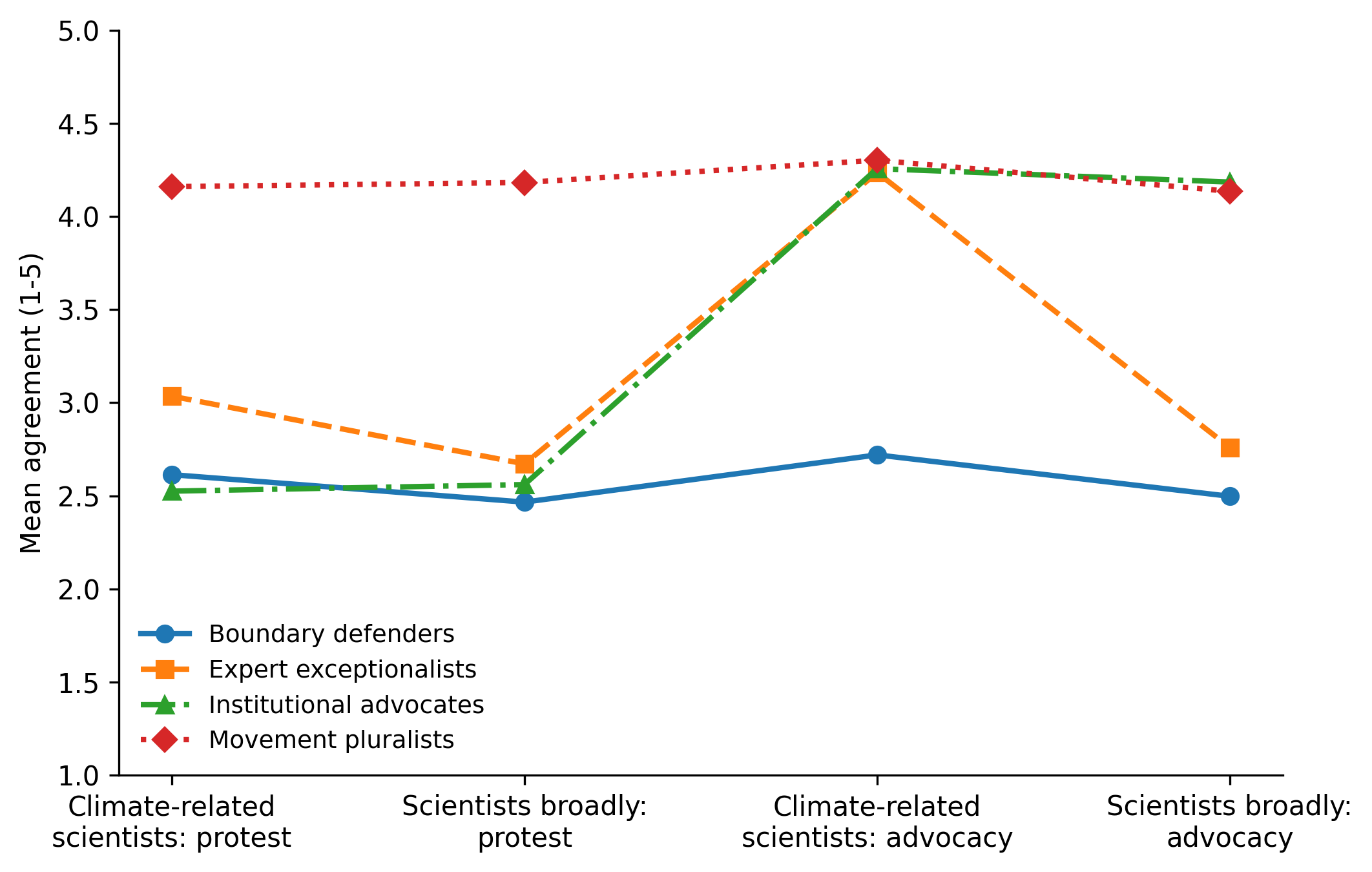
5.1 Role pluralisation and theory-guided role types (Figure 1)
The four role-boundary items show clear variation in how scientists evaluate legitimate public roles. The typology treats engagement orientations as varying along two dimensions: who is authorised to act publicly as a scientist and which engagement forms are considered legitimate. Among respondents with complete RoleSci_1–RoleSci_4 responses (N = 9,180), Boundary defenders account for 27.5%, Expert exceptionalists 18.3%, Institutional advocates 17.9% and Movement pluralists 36.3%. These proportions should be read as descriptive of the analytic sample, not as population prevalence estimates.
Figure 1 shows how the types map onto the four underlying items. Boundary defenders report the lowest mean agreement across the advocacy and protest items. Expert exceptionalists show high support for climate-related scientists’ advocacy but weaker support for extending advocacy or protest mandates to scientists broadly. Institutional advocates support advocacy by both climate-related scientists and scientists more broadly, while remaining more cautious about protest. Movement pluralists show high agreement across all four items, including both protest items. Figure 1 is consistent with a two-axis role-boundary classification based on scope and repertoire.
5.2 Structuring correlates of role types (Figure 2; Table 2)
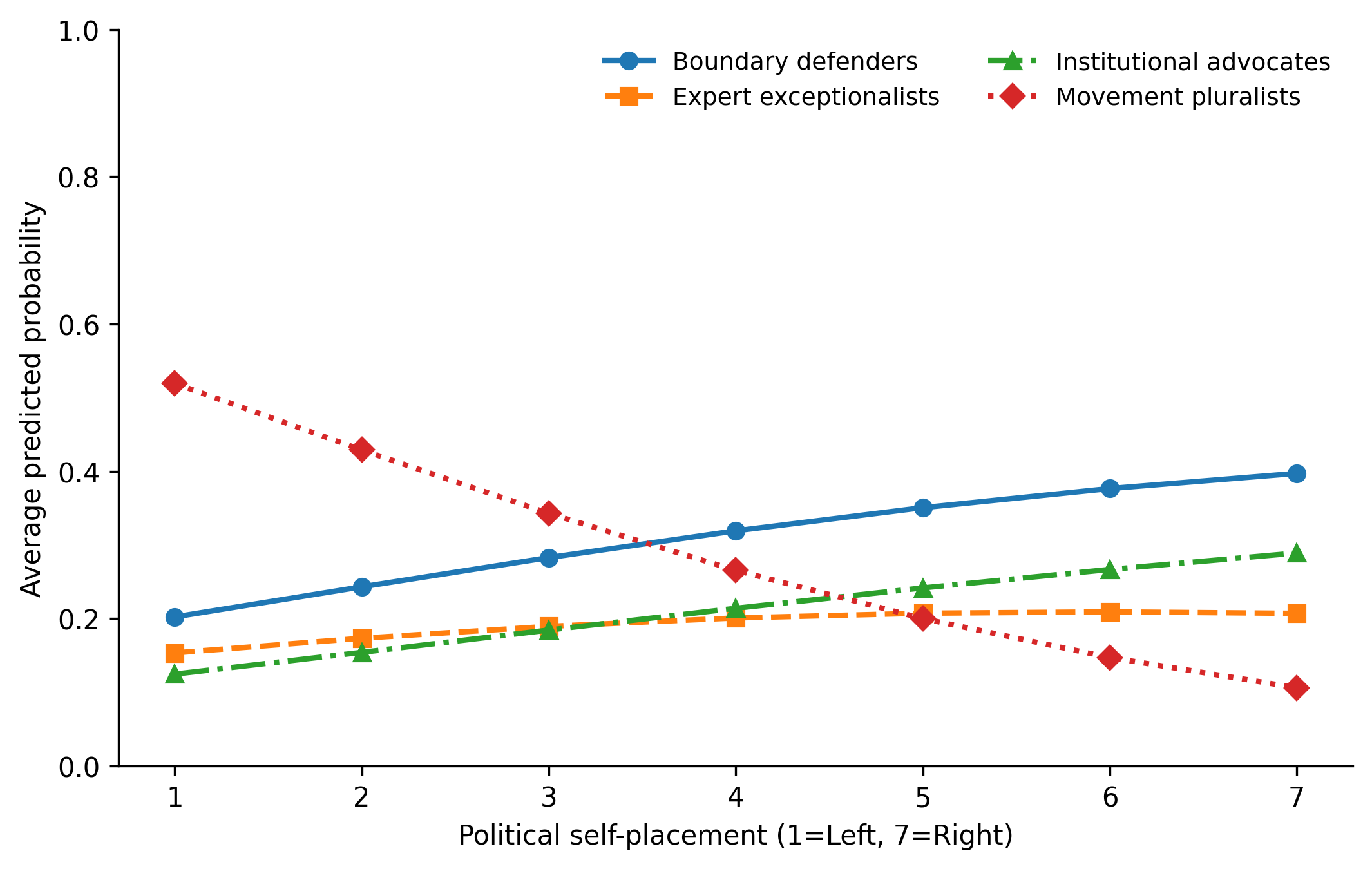
We interpret the model primarily through average predicted probabilities; Table 2 reports the coefficient estimates. The model is estimated on complete cases for the model variables (N = 9,049), with Boundary defenders as the reference outcome.
|
Predictor |
Expert exceptionalists |
Institutional advocates |
Movement pluralists |
|
Political self-placement (1 = Left, 7 = Right) |
-0.063∗ (0.028) |
0.028 (0.027) |
-0.382∗∗∗ (0.025) |
|
Climate-research proximity (1–5) |
-0.072∗∗ (0.024) |
0.070∗∗ (0.024) |
-0.008 (0.020) |
|
Activist-network proximity (InnerCircle = 1) |
0.034 (0.070) |
0.172∗ (0.070) |
0.465∗∗∗ (0.058) |
|
Age (ordinal age group code) |
-0.068∗ (0.032) |
0.038 (0.031) |
-0.007 (0.027) |
|
Field: Social & behavioural sciences (ref: Natural sciences) |
-0.164 (0.085) |
-0.266∗∗ (0.090) |
-0.184∗∗ (0.071) |
|
Field: Professions & applied sciences (ref: Natural sciences) |
0.085 (0.095) |
0.302∗∗∗ (0.092) |
-0.190∗ (0.085) |
|
Field: Other (ref: Natural sciences) |
0.080 (0.102) |
0.373∗∗∗ (0.099) |
0.077 (0.087) |
|
Field: Formal sciences (ref: Natural sciences) |
0.036 (0.175) |
-0.160 (0.199) |
-0.345∗ (0.167) |
|
Field: Humanities (ref: Natural sciences) |
-0.122 (0.239) |
-0.441 (0.278) |
0.119 (0.190) |
|
Tenure: Yes, tenured (ref: No) |
-0.046 (0.084) |
-0.055 (0.084) |
0.014 (0.073) |
|
Tenure: Yes, tenure-track (ref: No) |
0.135 (0.122) |
0.054 (0.125) |
0.052 (0.107) |
|
Career position: Early career (PhD/Postdoc) (ref: Faculty/Senior) |
0.094 (0.112) |
-0.034 (0.116) |
0.247∗ (0.096) |
|
Career position: Other (public/NGO/other) (ref: Faculty/Senior) |
0.047 (0.086) |
0.039 (0.085) |
0.001 (0.074) |
|
Gender: Female (ref: Male) |
0.060 (0.069) |
0.212∗∗ (0.070) |
-0.008 (0.059) |
|
Gender: Non-binary (ref: Male) |
-1.802∗ (0.750) |
-0.512 (0.480) |
-0.156 (0.320) |
|
Gender: Prefer to self-describe (ref: Male) |
-0.425 (0.604) |
-1.042 (0.786) |
0.014 (0.469) |
|
Gender: Prefer not to say (ref: Male) |
-1.196∗∗∗ (0.262) |
-0.993∗∗∗ (0.247) |
-1.128∗∗∗ (0.210) |
|
Constant |
0.294 (0.211) |
-1.021∗∗∗ (0.215) |
1.244∗∗∗ (0.181) |
| Note.
Coefficients
are
log-odds
with
standard
errors
in
parentheses.
The
reference
outcome
is
Boundary
defenders.
Complete-case
N = 9,049.
∗ p < .05,
∗∗ p < .01,
∗∗∗ p < .001. | |||
The predicted probability of Movement pluralism declines across the political self-placement scale. As Figure 2 shows, the average predicted probability of being a Movement pluralist declines from 0.519 at Political = 1 to 0.106 at Political = 7 (Delta = -0.413), while the probability of being a Boundary defender rises from 0.202 to 0.397 (Delta = +0.195). Institutional advocates also become more likely across the same range, increasing from 0.125 to 0.289. This pattern indicates that protest-inclusive role boundaries are strongly associated with political self-placement, even after accounting for field, tenure status, career position, climate-research proximity, activist-network proximity, age, and gender.
Activist-network proximity is associated with a higher predicted probability of Movement pluralism. Holding other covariates at their observed values, the predicted probability of being a Movement pluralist increases from 0.329 among respondents without activist-network proximity to 0.420 among those with such proximity. By contrast, climate-research proximity primarily differentiates the scope axis among engagement-positive types. Moving from the lowest to the highest value of climate-research proximity is associated with a decrease in Expert exceptionalists (0.206 to 0.157) and an increase in Institutional advocates (0.155 to 0.207), while Movement pluralists change little (0.368 to 0.362). Tenure status is not a reliable differentiator in the main model, whereas early-career respondents are somewhat more likely than faculty/senior respondents to be Movement pluralists relative to Boundary defenders.
5.3 Role types and behavioural repertoires (Table 3)
Table 3 links role-boundary orientations to reported behaviours. Respondents in all four role types report some public-facing action, including advocacy and protest. At the same time, the differences are systematic and are clearest for protest-related behaviours.
Movement pluralists report the highest rate of legal climate protest (37.7%), compared with 16.9% among Boundary defenders, 16.2% among Expert exceptionalists, and 12.3% among Institutional advocates. Nonviolent civil disobedience remains uncommon overall, but it is also concentrated among Movement pluralists (17.0%) relative to the other three types (about 5–6%). Differences are present but smaller for institutional and advocacy-oriented actions: Movement pluralists report higher rates of advocacy for climate-related institutional change (39.0% vs. 22.7% among Boundary defenders) and engagement with policymakers (23.5% vs. 16.2%). Institutional advocates report the highest rate of the general climate-advocacy item (35.5%), consistent with the interpretation that this type supports broad advocacy while remaining more cautious about protest.
| Behaviour | Boundary | Expert | Institutional | Movement | N | Δ |
| Legal climate protest | 16.9 | 16.2 | 12.3 | 37.7 | 9167 | 20.8 |
| Climate advocacy | 22.4 | 25.0 | 35.5 | 34.0 | 9169 | 11.5 |
| Institutional change advocacy | 22.7 | 22.6 | 29.9 | 39.0 | 9169 | 16.2 |
| Engaged policymakers | 16.2 | 17.2 | 20.3 | 23.5 | 9168 | 7.3 |
| Nonviolent civil disobedience | 5.8 | 5.2 | 5.7 | 17.0 | 9157 | 11.2 |
Additional exploratory models show that the associations weaken after credibility items and, where available, barrier indicators are added. Adding role type to covariate-only logistic models improves fit for all five behavioural outcomes. The Movement pluralist-Boundary defender difference for legal climate protest declines from 0.121 in the covariates-plus-role-type model to 0.091 after adding credibility items and to 0.084 in the barrier sensitivity model. For climate advocacy, the corresponding difference declines from 0.072 to 0.049 and then to 0.035. The attenuation indicates an incomplete correspondence between role-boundary orientations and reported behavioural repertoires.
6 Discussion
This study separates two normative judgements within scientists’ climate engagement: the scope of the public mandate and the repertoire of legitimate action. The four role types represent recurring configurations of these dimensions. Broad support for advocacy does not necessarily extend to protest, and support for public action may be directed mainly towards climate-related specialists or towards scientists more generally. The results also show that the two dimensions have different correlates and that role-boundary orientations correspond only partly with reported behaviour.
The typology distinguishes claims about authorised actors from claims about acceptable forms of engagement. Expert exceptionalists place the public mandate mainly with climate-related specialists. Institutional advocates extend that mandate to scientists broadly while giving greater legitimacy to advocacy than protest. Movement pluralists combine a broad mandate with a protest-inclusive repertoire. These configurations represent different jurisdictional claims about scientific public roles [Gieryn, 1983; Abbott, 1988; Jasanoff, 1990]. A single scale of engagement intensity would obscure these differences.
The two dimensions are associated with different respondent characteristics. Political self-placement and activist-network proximity are most closely associated with Movement pluralism, which combines broad authorisation with protest-inclusive engagement. Climate-research proximity shows a different pattern. It changes the probability of Movement pluralism very little and is instead associated with lower probability of Expert exceptionalism and higher probability of Institutional advocacy. Political and network location are therefore related mainly to the legitimacy of contentious action, whereas proximity to climate research is related mainly to the breadth of the public mandate. These are cross-sectional associations, but they are consistent with research showing that political context and movement networks shape how scientists evaluate advocacy and activism [McCright & Dunlap, 2011; Gauchat, 2012; Finnerty et al., 2024a, 2024b; Finnerty, 2026].
Dablander, Sachisthal and Haslbeck [2024] show that climate researchers report more climate-related civic action than non-climate researchers, including higher participation in advocacy and activism. In the present analysis, greater climate-research proximity is associated with a broader perceived mandate for institutional advocacy, without a comparable increase in protest-inclusive orientation. The two analyses therefore distinguish reported action from judgements about who should act and through which forms. A scientist may participate more actively or support a wider public mandate without treating protest as an expected scientific role.
Reported behaviour overlaps across all four role types. Respondents in every role type report some advocacy and protest, and the differences between Movement pluralists and Boundary defenders become smaller after credibility items and available barrier indicators are considered. The categories describe normative configurations and do not represent behavioural classes or stable activist identities. This interpretation is consistent with qualitative and ethnographic research showing that scientists negotiate professional and activist roles over time [Finnerty et al., 2024a, 2024b; Finnerty, 2026]. It also explains how barriers and role boundaries can operate together. Practical constraints shape the opportunity and cost of action, while role-boundary orientations concern whether particular actions are regarded as legitimate for scientists.
Credibility concerns connect these internal role judgements to research on public reception. The survey items indicate that some respondents treat avoidance of advocacy or protest as part of maintaining scientific credibility. Existing studies show that perceived credibility varies with the form of advocacy, the controversy surrounding proposed solutions and the way values are communicated [Beall et al., 2017; Kotcher et al., 2017; Cologna et al., 2022, 2024]. Public-reception research could therefore distinguish among expert advice, specialist advocacy, broad institutional advocacy and protest-inclusive engagement when examining trust or persuasion. Treating scientist advocacy as a single signal may combine public roles that make different claims about expertise, responsibility and political action.
The findings also suggest several directions for institutional and comparative research. Professional associations, universities and advisory bodies may authorise advocacy and protest differently, thereby making some role configurations easier to sustain than others. Cross-national research can examine whether political institutions and professional norms alter the distribution or correlates of these orientations. Longitudinal designs are needed to determine how role judgements, network ties and behaviour change together, while experiments can test whether public responses differ across the role configurations identified here. These approaches would extend the present analysis from within-science variation to the institutional formation and public reception of scientists’ public roles.
7 Limitations
The survey is not a probability sample of all scientists, so the reported type shares and behaviour rates describe the analytic sample rather than population prevalence. Although respondents come from many countries, the main models do not estimate country-specific variation in political context, professional norms or institutional arrangements. The measures are also self-reported and may be affected by recall and social desirability, especially for protest and civil disobedience [Tourangeau & Yan, 2007].
The survey treats advocacy, legal protest and civil disobedience as separate operational categories, but these forms of engagement may overlap in practice. Public education, awareness raising and political engagement can occur through protest, and respondents may interpret the categories differently. The analysis therefore compares the survey-defined categories without assuming that they describe mutually exclusive repertoires.
The cross-sectional design does not establish causal direction. Political orientation, activist-network proximity, role-boundary judgements and behaviour may influence one another over time. Political self-placement is also concentrated towards the left of the scale, making estimates at its right-hand end less precise. The typology is rule-based and may classify borderline response patterns imperfectly. It records current normative judgements and does not measure identity trajectories or the formation of hybrid scientist-activist identities. Accordingly, the results are interpreted as within-sample associations among role-boundary orientations, respondent characteristics and reported behaviour.
8 Conclusions
This study examines how scientists combine judgements about who should act publicly on climate change and which forms of engagement are legitimate. The four role-boundary configurations show that the scope of the public mandate and the repertoire of legitimate action are related but separable dimensions. Political self-placement and activist-network proximity are associated mainly with protest-inclusive orientations, whereas climate-research proximity is associated mainly with the breadth of the public mandate. The incomplete correspondence between these orientations and retrospective self-reported behaviour indicates that role-boundary orientations capture normative judgements rather than engagement intensity or activist identity. Future research can examine how institutions, national contexts and public responses shape these judgements and their relationship to behaviour over time.
Acknowledgments
We thank the Climate Change Engagement of Scientists project team for making the survey materials and documentation publicly available. We also thank colleagues and seminar participants for helpful feedback on earlier drafts. Any remaining errors are our own. This research received no specific grant from any funding agency in the public, commercial, or not-for-profit sectors.
Data, software and code availability
The anonymised survey data and code for the Climate Change Engagement of Scientists project
are available on Zenodo [Dablander, 2024] at https://doi.org/10.5281/zenodo.12187345.
Replication scripts and derived data used in this study will be deposited in a public
repository upon publication; they are available from the author(s) upon request during peer
review.
References
-
Abbott, A. (1988). The system of professions: an essay on the division of expert labor. The University of Chicago Press. https://press.uchicago.edu/ucp/books/book/chicago/S/bo5965590.html
-
Ajzen, I. (1991). The theory of planned behavior. Organizational Behavior and Human Decision Processes, 50(2), 179–211. https://doi.org/10.1016/0749-5978(91)90020-t
-
Beall, L., Myers, T. A., Kotcher, J. E., Vraga, E. K., & Maibach, E. W. (2017). Controversy matters: impacts of topic and solution controversy on the perceived credibility of a scientist who advocates. PLoS ONE, 12(11), e0187511. https://doi.org/10.1371/journal.pone.0187511
-
Bolsen, T., & Druckman, J. N. (2015). Counteracting the politicization of science. Journal of Communication, 65(5), 745–769. https://doi.org/10.1111/jcom.12171
-
Bolsen, T., Druckman, J. N., & Cook, F. L. (2014). How frames can undermine support for scientific adaptations: politicization and the status-quo bias. Public Opinion Quarterly, 78(1), 1–26. https://doi.org/10.1093/poq/nft044
-
Capstick, S., Thierry, A., Cox, E., Berglund, O., Westlake, S., & Steinberger, J. K. (2022). Civil disobedience by scientists helps press for urgent climate action. Nature Climate Change, 12(9), 773–774. https://doi.org/10.1038/s41558-022-01461-y
-
Cologna, V., Baumberger, C., Knutti, R., Oreskes, N., & Berthold, A. (2022). The communication of value judgements and its effects on climate scientists’ perceived trustworthiness. Environmental Communication, 16(8), 1094–1107. https://doi.org/10.1080/17524032.2022.2153896
-
Cologna, V., Knutti, R., Oreskes, N., & Siegrist, M. (2021). Majority of German citizens, US citizens and climate scientists support policy advocacy by climate researchers and expect greater political engagement. Environmental Research Letters, 16(2), 024011. https://doi.org/10.1088/1748-9326/abd4ac
-
Cologna, V., Kotcher, J., Mede, N. G., Besley, J., Maibach, E. W., & Oreskes, N. (2024). Trust in climate science and climate scientists: a narrative review. PLOS Climate, 3(5), e0000400. https://doi.org/10.1371/journal.pclm.0000400
-
Cologna, V., Mede, N. G., Berger, S., Besley, J., Brick, C., Joubert, M., Maibach, E. W., Mihelj, S., Oreskes, N., Schäfer, M. S., van der Linden, S., Abdul Aziz, N. I., Abdulsalam, S., Shamsi, N. A., Aczel, B., Adinugroho, I., Alabrese, E., Aldoh, A., Alfano, M., … Zwaan, R. A. (2025). Trust in scientists and their role in society across 68 countries. Nature Human Behaviour, 9(4), 713–730. https://doi.org/10.1038/s41562-024-02090-5
-
Dablander, F. (2024). fdabl/Climate-engagement-scientists: data and code for climate change engagement of scientists (v1.0.0) [Data set]. Zenodo. https://doi.org/10.5281/zenodo.12187345
-
Dablander, F., Sachisthal, M. S. M., Cologna, V., Strahm, N., Bosshard, A., Grüning, N.-M., Green, A. J. K., Brick, C., Aron, A. R., & Haslbeck, J. M. B. (2024). Climate change engagement of scientists. Nature Climate Change, 14(10), 1033–1039. https://doi.org/10.1038/s41558-024-02091-2
-
Dablander, F., Sachisthal, M. S. M., & Haslbeck, J. M. B. (2024). Climate actions by climate and non-climate researchers. npj Climate Action, 3, 105. https://doi.org/10.1038/s44168-024-00187-1
-
Dunwoody, S., Brossard, D., & Dudo, A. (2009). Socialization or rewards? Predicting U.S. scientist-media interactions. Journalism & Mass Communication Quarterly, 86(2), 299–314. https://doi.org/10.1177/107769900908600203
-
Ecklund, E. H., James, S. A., & Lincoln, A. E. (2012). How academic biologists and physicists view science outreach. PLoS ONE, 7(5), e36240. https://doi.org/10.1371/journal.pone.0036240
-
Finnerty, S. (2026). Scientists as activists: an ethnography of the ‘critical moments’ in scientists’ transition to climate activism. PLOS Climate, 5(2), e0000828. https://doi.org/10.1371/journal.pclm.0000828
-
Finnerty, S., Piazza, J., & Levine, M. (2024a). Between two worlds: the scientist’s dilemma in climate activism. npj Climate Action, 3, 77. https://doi.org/10.1038/s44168-024-00161-x
-
Finnerty, S., Piazza, J., & Levine, M. (2024b). Scientists’ identities shape engagement with environmental activism. Communications Earth & Environment, 5, 240. https://doi.org/10.1038/s43247-024-01412-9
-
Finnerty, S., Sachisthal, M., Cologna, V., Dablander, F., Messling, L., & van Eck, C. (2026). Climate advocacy and activism by scientists: a narrative review. PLOS Climate, 5(6), e0000942. https://doi.org/10.1371/journal.pclm.0000942
-
Gauchat, G. (2012). Politicization of science in the public sphere: a study of public trust in the United States, 1974 to 2010. American Sociological Review, 77(2), 167–187. https://doi.org/10.1177/0003122412438225
-
Gieryn, T. F. (1983). Boundary-work and the demarcation of science from non-science: strains and interests in professional ideologies of scientists. American Sociological Review, 48(6), 781–795. https://doi.org/10.2307/2095325
-
Green, J. F. (2020). Less talk, more walk: why climate change demands activism in the academy. Daedalus, 149(4), 151–162. https://doi.org/10.1162/daed_a_01824
-
Hanmer, M. J., & Kalkan, K. O. (2013). Behind the curve: clarifying the best approach to calculating predicted probabilities and marginal effects from limited dependent variable models. American Journal of Political Science, 57(1), 263–277. https://doi.org/10.1111/j.1540-5907.2012.00602.x
-
IPCC. (2023). Climate Change 2023: Synthesis Report. Contribution of Working Groups I, II and III to the Sixth Assessment Report of the Intergovernmental Panel on Climate Change (Core Writing Team, H. Lee & J. Romero, Eds.). Intergovernmental Panel on Climate Change. https://doi.org/10.59327/IPCC/AR6-9789291691647
-
Isopp, B. (2015). Scientists who become activists: are they crossing a line? JCOM, 14(02), C03. https://doi.org/10.22323/2.14020303
-
Jasanoff, S. (1990). The fifth branch: science advisers as policymakers. Harvard University Press. https://www.hup.harvard.edu/books/9780674300620
-
Jensen, P., Rouquier, J.-B., Kreimer, P., & Croissant, Y. (2008). Scientists who engage with society perform better academically. Science and Public Policy, 35(7), 527–541. https://doi.org/10.3152/030234208x329130
-
Kallergi, A., & Landeweerd, L. (2025). Science, activism, and climate action: navigating credibility, responsibility, and engagement. Journal of Academic Ethics, 23(4), 1759–1779. https://doi.org/10.1007/s10805-025-09626-y
-
King, G., Tomz, M., & Wittenberg, J. (2000). Making the most of statistical analyses: improving interpretation and presentation. American Journal of Political Science, 44(2), 347–361. https://doi.org/10.2307/2669316
-
Kotcher, J. E., Myers, T. A., Vraga, E. K., Stenhouse, N., & Maibach, E. W. (2017). Does engagement in advocacy hurt the credibility of scientists? Results from a randomized national survey experiment. Environmental Communication, 11(3), 415–429. https://doi.org/10.1080/17524032.2016.1275736
-
Lackey, R. T. (2007). Science, scientists, and policy advocacy. Conservation Biology, 21(1), 12–17. https://doi.org/10.1111/j.1523-1739.2006.00639.x
-
Little, R. J. A., & Rubin, D. B. (2002). Statistical analysis with missing data (2nd ed.). Wiley. https://doi.org/10.1002/9781119013563
-
Long, J. S., & Freese, J. (2014). Regression models for categorical dependent variables using Stata (3rd ed.). Stata Press. https://www.stata-press.com/books/regression-models-categorical-dependent-variables/
-
McCright, A. M., & Dunlap, R. E. (2011). The politicization of climate change and polarization in the American public’s views of global warming, 2001–2010. The Sociological Quarterly, 52(2), 155–194. https://doi.org/10.1111/j.1533-8525.2011.01198.x
-
Messling, L., Lu, Y., & van Eck, C. W. (2025). Advocacy — defending science or destroying it? Interviews with 47 climate scientists about their fundamental concerns. Public Understanding of Science, 34(4), 479–494. https://doi.org/10.1177/09636625251314164
-
National Academies of Sciences, Engineering, and Medicine. (2017). Communicating science effectively: a research agenda. National Academies Press. https://doi.org/10.17226/23674
-
Nisbet, M. C., & Scheufele, D. A. (2009). What’s next for science communication? Promising directions and lingering distractions. American Journal of Botany, 96(10), 1767–1778. https://doi.org/10.3732/ajb.0900041
-
Oreskes, N. (2020). What is the social responsibility of climate scientists? Daedalus, 149(4), 33–45. https://doi.org/10.1162/daed_a_01815
-
Pielke, R. A. (2007). The honest broker: making sense of science in policy and politics. Cambridge University Press. https://doi.org/10.1017/CBO9780511818110
-
Poliakoff, E., & Webb, T. L. (2007). What factors predict scientists’ intentions to participate in public engagement of science activities? Science Communication, 29(2), 242–263. https://doi.org/10.1177/1075547007308009
-
Racimo, F., Valentini, E., Rijo De León, G., Santos, T. L., Norberg, A., Atmore, L. M., Murray, M., Hakala, S. M., Olsen, F. A., Gardner, C. J., & Halder, J. B. (2022). Point of view: the biospheric emergency calls for scientists to change tactics. eLife, 11, e83292. https://doi.org/10.7554/eLife.83292
-
Scheufele, D. A. (2014). Science communication as political communication. Proceedings of the National Academy of Sciences, 111(supplement_4), 13585–13592. https://doi.org/10.1073/pnas.1317516111
-
Tourangeau, R., & Yan, T. (2007). Sensitive questions in surveys. Psychological Bulletin, 133(5), 859–883. https://doi.org/10.1037/0033-2909.133.5.859
-
van Eck, C. W., Messling, L., & Hayhoe, K. (2024). Challenging the neutrality myth in climate science and activism. npj Climate Action, 3, 81. https://doi.org/10.1038/s44168-024-00171-9
About the author
Youngjae Kim is an Associate Professor in the Department of Public Administration at Myongji University, Republic of Korea. He holds a Ph.D. in public policy. His research focuses on science and technology policy, science and technology studies (STS), and public administration. His recent work examines scientists’ public engagement, public perceptions of science and emerging technologies, and the effects of digital work environments on public employees’ well-being and organisational behaviour.
E-mail: ykim128@gmail.com
Supplementary material
Available at https://doi.org/10.22323/387820260812121949