

1 Context
Science journalism is an important intermediary between academic research and the public. Recently, however, it has needed to adapt to big changes [Weitkamp et al., 2021], such as the shift from traditional media to digital platforms while having fewer resources, requiring journalists to produce more in less time [Hoffmann, 2015; Weitkamp et al., 2021; Vogler & Schäfer, 2020]. These changes may have increased reliance on university press releases as sole sources of information, a less critical adoption of that information, or (partial) reproduction of its content (e.g., a practice described as “churnalism”) [Comfort et al., 2024; Lee & Merle, 2018; Vonk et al., 2024].
At the same time, universities themselves also place increasing value in using their own communication channels to promote their research to broader audiences, which befits their social responsibility to inform the public about science, alongside research and education [Czechowska-Derkacz et al., 2021]. This has led them to professionalize their communication [Autzen, 2014].
Both changes underscore the importance of effectively utilising university press releases to maximise societal impact of research in a meaningful way. However, factors that contribute to the success of this practice remain under-researched, and we believe that academic institutions can benefit from knowing if, and under what conditions, (visual) news factors affect webpage engagement and media uptake.
Using news value theory [Galtung & Ruge, 1965], we explore press release effectiveness in the context of media uptake, taking the multimodal nature of modern information dissemination into account. In line with calls from Caple and Bednarek [2016] and Rössler et al. [2011], we aim to elaborate this framework with news factors for visuals. While these studies looked at general news, we extend their work to science news specifically.
1.1 News values and factors
News value theory [Galtung & Ruge, 1965; further refined by e.g., Bell, 1991; Harcup & O’Neill, 2001, 2017] provides a lens through which we can understand news coverage.
Traditionally, news values have been defined as the characteristics or criteria that make events or issues ‘newsworthy’ and therefore more likely to be selected by journalists for news coverage [Galtung & Ruge, 1965]. Subsequent works have expanded and operationalized the concept in different ways, resulting in varying conceptualizations of both news values and newsworthiness [Bell, 1991; Caple & Bednarek, 2016].
Caple et al. [2020] highlighted four different perspectives: the material, social, cognitive, and discursive perspective. The material perspective suggests that news values are inherent qualities of events with specific characteristics such as proximity and magnitude. The social perspective views news factors as criteria that professionals, such as journalists, use to select news, viewing news values as socially shared criteria resulting from institutional routines and professional practices. The cognitive perspective views news values as mental frameworks, or cognitive cues, that influence subjective and personal judgement and selection choices by both journalists and audiences [Eilders, 2006]. Lastly, the discursive perspective suggests that news factors are constructed and communicated through language, framing, and imagery. This study adopts a combined discursive and cognitive approach to news values. From a discursive perspective, this study analyses news values that are constructed by science communicators in press releases. Additionally, this study incorporates a cognitive perspective by examining how these constructed news factors function as cognitive cues that influence both (journalistic) media uptake and audience interest and engagement.
Although the terms ‘news value’ and ‘news factor’ are often used interchangeably in literature [Caple et al., 2020], several scholars have argued that distinguishing between them is conceptually useful [e.g., Schafraad & Van Zoonen, 2020; Guenther et al., 2021]. ‘News factors’ generally refer to observable features or characteristics present in events or media content, which journalists or communicators can emphasize strategically [Temmerman & Mast, 2021; Schafraad & Van Zoonen, 2020; Guenther et al., 2021]. News values, by contrast, refer to the evaluative criteria through which journalists and audiences assess the newsworthiness of those characteristics [Badenschier & Wormer, 2012; Guenther et al., 2021; Schafraad & Van Zoonen, 2020].
As argued by Autzen [2018], news values can be viewed as proxies for broader communicative goals, practices and judgments, and thus the presence of particular textual and visual cues signals attempts by communicators to convey not only their own frames and narratives, but also expectations of what their audience may regard as important, interesting, or relevant. In many works, the term ‘news value’ has also been used interchangeably with ‘newsworthiness’, to reflect the overall allocated news value (or judgement of the news value) of an event or issue by journalists or consumers that results from the presence, combination and intensity of multiple news factors [Guenther et al., 2021].
For conceptual clarity and consistency, this paper uses the term ‘news factors’ to refer to the observable characteristics identified in the press releases under study, and the term ‘newsworthiness’ to refer to the overall evaluative outcome these factors may produce among journalists and audiences. Accordingly, the coding scheme used in this study should be interpreted as capturing textual manifestations of communicative objectives, rather than measuring news values as independent entities.
1.2 News factors for science news, the digital age, and visuals
Badenschier and Wormer [2012] conducted one of the first studies on news factors specifically for science news. In interviews with science editors and content analysis of German news, they found that ordinary news factors do not completely describe how science topics are selected and thus proposed an adaptation of the framework specifically for science news was necessary. They adapted the framework for science news contexts and incorporated factors like scientific relevance and public interest. Various studies since confirm the idea that news factors affect media uptake positively or negatively. Combined with stylistic characteristics, news factors, such as societal relevance, controversy, and impact seem to have positive effects [Brown Jarreau, 2014; Htoo et al., 2023; Leidecker-Sandmann et al., 2023; Rossmann et al., 2018; Zhang et al., 2016], while the use of technical terms or writing about fundamental research seem less likely to attract attention, and mixed results were found for exaggeration in press releases [Schat et al., 2018; Sumner et al., 2016], further emphasizing Harcup and O’Neill’s [2017] point that “no theory of news factors can explain everything”. In the context of health-related news, Kim [2015] showed that high informational utility, positive sentiment, controversy, emotional evocativeness, and familiar content was more likely to be widely read and shared. The start of the digital age enabled more direct interaction between scientists, journalists, and audiences. In response, concepts like shareworthiness and shareability were introduced.
Nowak-Teter and Łódzki [2024] argue that shareability is not a singular news value, but a multifaceted concept linked to online sharing behaviour. Harcup and O’Neill [2017] use this term in the context of sharing posts and making comments on news. Shareworthiness refers more to specific elements in the message, such as emotional appeals [Berger & Milkman, 2012; Brown et al., 2020; García-Perdomo et al., 2018; Karnowski et al., 2021; Nowak-Teter & Łódzki, 2024; Trilling & Knudsen, 2025].
Apart from the eight shareability factors described by Nowak-Teter and Łódzki [2024, celebrity and exclusiveness, emotionality, entertainment, inclusion of visuals, inclusion of videos, threat and fear, transparent positionality, and threat and fear], it seems practical utility may be very influential in the context of shareability [Berger & Milkman, 2012; Chiu et al., 2007; García-Perdomo et al., 2018]. For science communication specifically, Kim [2015] found that news articles on health topics with high practical utility are read and shared more.
Another aspect linked to news factors and the digital age is the increased use of visuals. Research shows press photography impacts selection processes in the news [Rössler et al., 2011]. Similarly, Caple and Bednarek [2016] argue visuals contribute to newsworthiness and call for further research into the application of news factors to visuals. Because visuals can shape how audiences perceive relevance and accessibility of an article, they may be an important component of newsworthiness that cannot be captured through textual content alone. This could be especially relevant for science journalism, where visuals can help explain complex, abstract or uncertain scientific information. Current research has yet to fully address visual news factors within the field of science news. This presents a promising avenue for further research to better understand the interplay between visuals and newsworthiness in the context of science journalism.
2 Objective
In this study, we aim to identify key news factors in textual and visual communication in science press releases that contribute to webpage engagement and media uptake.
Most research on news factors looked at content, not at impact such as webpage engagement and media uptake [Temmerman & Mast, 2021]. Additionally, most looked at text, rather than visuals [Caple & Bednarek, 2016; Rössler et al., 2011]. Finally, most studies looked at news in general, not science news specifically.
A study by Kroon and Schafraad [2013] did investigate the impact of news factors in Dutch university press releases on media uptake, but that study focused exclusively on traditional media, in a three month timeframe, considered only four news factors, and did not include visuals. Another study did explore the relation between news factors in press releases and media uptake, finding a positive relation between the total number of news factors in press releases and media uptake, and looked at visuals, showing no significant relation with media uptake, but their analyses was limited to the presence or absence of visuals and did not include whether or not these conveyed news factors [Vonk et al., 2024]. Neither of these studies considered multiple success metrics. Our objective is to fill that gap.
Universities regularly issue press releases to communicate about science with the public. These press releases often serve dual purposes. First, to inform journalists and encourage media coverage, aligning with the traditional role of press releases. Second, to engage audiences directly, functioning more like a news article than a press release [Vergunst, personal communication, January 10, 2025]. Given their dual purpose, it is valuable to study how university press releases perform across different success metrics. Because we analyse press releases as organisational communication products, our findings concern communicative framing and representation. They should not be interpreted as direct evidence of researchers’ intentions or of the subsequent public reception of the communicated research.
In this study, we focus specifically on two measures of success. First, the direct engagement on the university website. We measure this using website metrics, such as page views, time spent on page, and scroll depth. Second, the extent to which a press release is disseminated across other media. We measure this using Altmetric scores, which report on the uptake of a press release in digital news outlets, blogs, and social media platforms. These two measures of success reflect the dual purposes mentioned above, each with its own audience: media uptake for journalists, website metrics for broader audiences. In our analysis, we also compare both measures of success. While we do not necessarily expect the outcomes for both measures to be correlated, we do compare both measures of success in our analysis.
2.1 Research questions
Our main research question (RQ) is: What is the relationship between the number and types of news factors in textual and visual communication in press releases and press release success measures?
To go into more detail, we added four sub-questions focusing on four key aspects in this relationship: (SQ1) What is the relation between the number and type of news factors and webpage analytics? (SQ2) What is the relation between the number and type of news factors and media uptake? (SQ3) What are the differences between webpage metrics and media uptake metrics? And (SQ4) To what extent can news factors be applied to visuals in science communication?
3 Methods
In this study, we looked at 84 press releases published on the web page of Utrecht University’s Faculty of Science between September 1, 2022 and March 1, 2025. The start date was selected because it was when a new communication style was introduced at the university. The end date was the date of press release collection for the entire period.
To ensure coverage of general news factors, the influence of digital media, science news, specific news factors, and visuals specific news factors, our coding scheme included news factors identified by Badenschier and Wormer [2012], Caple and Bednarek [2016], Caple et al. [2020], Harcup and O’Neill [2017], and Nowak-Teter and Łódzki [2024]. See Appendix A (for more information on our selection of news factors and their sources), B (for our codebook) and C (for a justification of the news value selection) for a full rationale. The news factor ‘aesthetic appeal’ [Caple & Bednarek, 2016] proved an exception for the operationalisation as it is prone to subjectivity. Therefore, in contrast to other news factors that were operationalised with a coding scheme, this news factor was assessed through a focus group with science communicators (see Appendix D for a detailed description of our approach to assess aesthetic appeal).
We used a web scraper to retrieve press releases (see Appendix E for code) from the web page ( https://www.uu.nl/organisatie/faculteit-betawetenschappen/nieuws-agenda/nieuws).
Only press releases about a scientific publication were included in our sample. All text (including title and subheadings) and visuals were imported in NVivo (version 15) to be coded.
News factors were coded dichotomously as either present or absent (see Appendix B and D for details on the coding). All press releases were read from start to finish and each unique news factor was coded for. If a news factor occurred more than once in the press release, we still coded it once as being present in that press release. One exception was the news factor ‘aesthetic appeal’, which was a score of 0 to 6, reflecting science communicator votes on whether aesthetic appeal was present or not (see Appendix D). For visuals, the type of visual was also coded.
The metrics for success (page views, time spent on page, and scroll depth) were collected from the web page analytics by the university’s communication department. Page views are the number of visits per press release. Time spent on page is the average time visitors viewed a particular web page (hh:mm:ss). Scroll depth is the fraction of visitors who reach at least a scroll depth of 50%.
The metrics for success (in terms of media uptake) were collected from AltMetric. AltMetric tracks online attention to published research across social media, news outlets, and more (see https://help.altmetric.com/support/solutions/articles/6000233311-how-is-the-altmetric-attention-score-calculated- for details on how the score is calculated).
Twenty per cent of the dataset was independently coded by a second coder, reflecting common practice in content analysis reliability assessment. Given the high average intercoder reliability scores (Krippendorf’s alpha ranged from 0.73 to 1, with an average of 0.94 for coding of the texts, and from 0.81 to 1, with an average of 0.95 for coding of the visuals), and the fact that the coding scheme was piloted and refined prior to full coding, the remainder of the dataset that was coded by a single coder is unlikely to have introduced systemic bias.
To test relationships between news factors and success metrics, we looked at correlations (Spearman). News factors with fewer than five observations were excluded from analyses to prevent extreme imbalance in the distribution of presence and absence of the variables in our dataset, which would reduce statistical power and interpretability of the Spearman coefficient. Unless otherwise reported, analysis were performed on the total number of news factors.
3.1 Positionality
In this study, we focus on how academic research is represented and framed in university press releases. We treat these press releases not as neutral descriptions of research findings, but as strategic communication products produced within organisational and institutional findings. As one of our co-authors is a science communication practitioner and former university press officer, we emphatically acknowledge that press releases are produced by humans, and shaped by factors including organisational interests, communication objectives, and various practical considerations. We have done our best to remain conscious of this throughout the study.
4 Results
Our analysis of 84 press releases published by Utrecht University’s Faculty of Science revealed a median of 18 news factors per article, of which 13 textual and 5 visual. Overall, press releases had a minimum of 0 and maximum of 83 news factors.
The five most common textual news factors were eliteness (mention of the journal of publication and/or an (elite) institution), scientific relevance, the presence of audio-visual material, and environmental relevance. For visuals, the five most common types were: portrait photos, illustrations, research subjects, animals, and scientific illustrations. The five most common visual news factors were impact, personalisation of a scientist, negativity, superlativeness, and consonance. For text, all main codes (news factors) were observed in the sample (but not all subcodes, e.g., emotional appeal: anger; entertainment: sex; proximity: western counties; and range: few individuals). For visuals, some main codes were not observed: positivity, novelty, and eliteness (for subcodes, the code personalisation: citizen did not occur). See Appendix F (on news factor occurrence in the dataset) for a complete overview.
Significant correlations (p < .05) were found between the total number of news factors in a press release and page views (Spearman’s ρ = 0.34) and time spent on page (ρ = 0.29), but not other success metrics (see Table 1). Looking at textual news factors only, a correlation between the number of news factors and general media uptake (ρ = 0.22) emerges; the correlation with page views is still apparent but weaker (ρ = 0.26), but the correlation with time spent on page is no longer significant. For visuals, the total number of news factors still correlates with page views (ρ = 0.29) and time spent on page (ρ = 0.31). A lack of visuals in press releases was shown to correlate negatively with time spent on page (ρ = -0.24), but not with any of the other metrics.
|
Media uptake |
Social media uptake |
Pageviews |
Time on page |
Scroll depth (50%) |
|
|
Total number of all news factors |
0.19 |
0.09 |
0.34∗ |
0.29∗ |
-0.01 |
|
Total number of textual news factors |
0.22∗ |
0.15 |
0.26∗ |
0.2 |
0.02 |
|
Total number of visual news factors |
0.02 |
-0.03 |
0.29∗ |
0.31∗ |
-0.07 |
| Note.
∗indicates
Spearman
correlation
values
for
statistically
significant
relations
at
p < .05. | |||||
Some metrics were shown to correlate with each other. The number of page views per press release had a moderate correlation with time spent on page (ρ = 0.31), the AltMetric score correlated negatively with scroll depth (ρ = -0.24).
4.1 Text-based news factors and success metrics relations
Spearman correlation analyses showed significant relations between specific news factors in text and success metrics. All significant relations reported were small to moderate in strength (ρ = 0.21 to 0.37; see Figure 1).
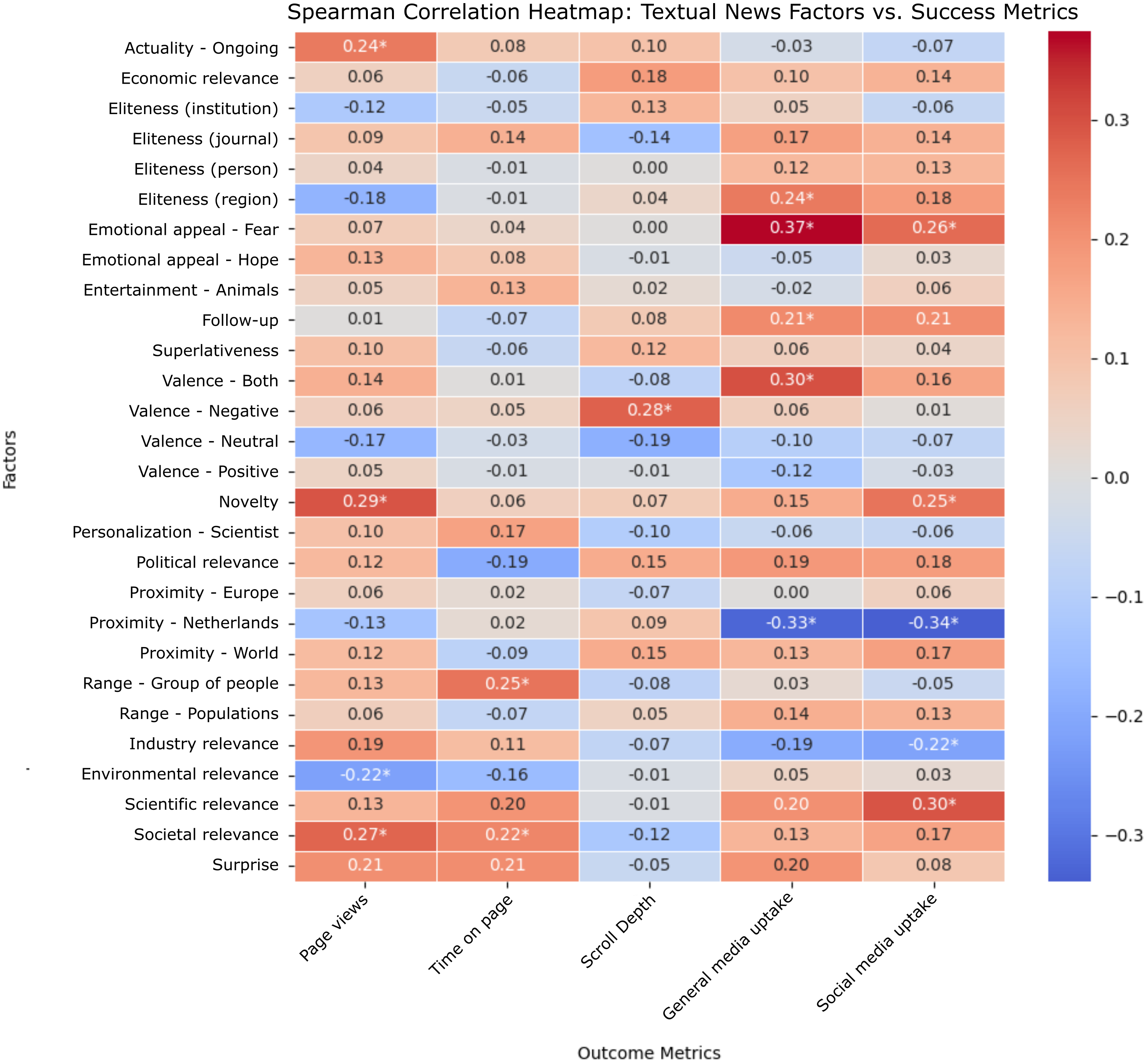
Societal relevance showed positive relations with page views and time spent on page (ρ = 0.27; and ρ = 0.22). Novelty and actuality showed a strong relation with page views (ρ = 0.29; and ρ = 0.24). Range showed a positive relation with time spent on page (ρ = 0.25). Negative valence showed a positive relation with scroll depth (ρ = 0.28). Finally, environmental relevance was shown to correlate negatively with page views (ρ = -0.22).
Fear-based emotional appeal showed a strong relation to general media uptake scores (ρ = 0.36) and the social media subscore (ρ = 0.26). Press releases with a follow-up on previous coverage, with mixed valence, and that mentioned specific regions showed positive relationships with media uptake (ρ = 0.21, ρ = 0.30, and ρ = 0.24). Press releases with novelty and scientific relevance showed positive relations with social media scores (ρ = 0.25; and ρ = 0.30). Proximity to The Netherlands showed a negative relation to both media uptake and social media scores (ρ = -0.33; and ρ = -0.34). Industry relevance showed a negative relation with social media scores (ρ = -0.22). Journal impact factor showed the strongest relation with media uptake and social media scores (ρ = 0.53; and ρ = 0.59).
4.2 Visual-based news factors and success metrics
For news factors in visuals, Spearman correlation analyses showed significant relations between specific news factors in visuals and success metrics. Similar to news factors in text, all significant relations were small to moderate in strength (ρ = 0.23 to 0.30; see Figure 2). Unlike the news factors in text, news factors in visuals showed no significant relation with media uptake, only with web page engagement.
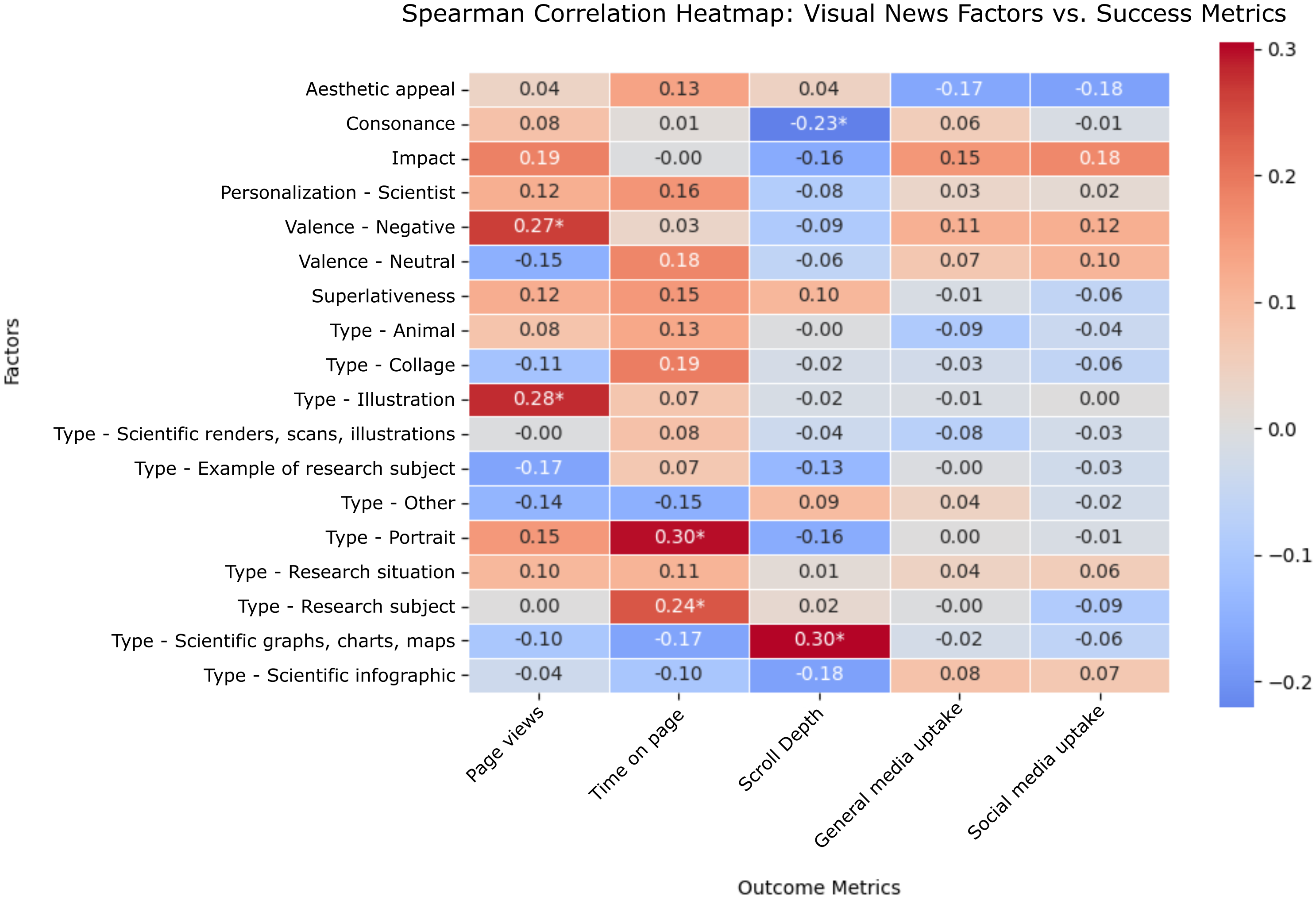
For the webpage analytics, several statistically significant relationships were found (p < .05), but no news factors correlated with more than one success metric.
The presence of illustration type visuals showed a positive relation to page views and a negative valence of visuals (ρ = 0.28; and ρ = 0.27). The presence of portrait type visuals and photos of the research subject showed a positive relation to time spent on page (ρ = 0.30; and ρ = 0.24). The presence of scientific graph, chart, or map type of visuals correlated positively with scroll depth (ρ = 0.30), whereas consonance correlated negatively (ρ = -0.23).
5 Discussion and conclusion
In this study, we examined how news factors in text and visuals in press releases relate to success metrics like web page engagement and media uptake.
5.1 The relation between news factors and success metrics (SQ1–3)
The relationship between news factors and success proved to be complex and quite metric-specific. As in previous research, the total number of news factors was significantly correlated with some of the success metrics. For practitioners, this indicates that checking the number of news factors in a press release, and, if possible, increasing them, may increase the success of that press release. However, in this study, this was mainly related to webpage engagement; media uptake seemed largely unaffected.
Importantly, this study focused on the presence and total number of news factors and did not take into account their intensity, frequency variation, or combinations. Prior research suggests that not only the presence but also the intensity and interplay of news factors may be crucial in determining newsworthiness and media selection [e.g., Guenther et al., 2021]. The absence of intensity measures in the present study is therefore a limitation. At the same time, examining combinations and intensity requires larger datasets than those used in this exploratory study, particularly given the relatively large number of news factors included.
Future research might examine the effects of how often a news factor appears in a press release to see whether this affects the relation, especially for the more prominent news factors that show promising relations in this study. Also, the sheer presence or absence and even the intensity may not tell the whole story, measuring the experienced intensity of news factors at the receiving end of the communication might also tell us more about how readers process news factor information in press releases.
One possible explanation for the mixed findings may be that the combination of our extensive codebook and a relatively modest sample size made it less likely to detect strong correlations across any or all success metrics. After all, when looking at total news factors, we include many news factors that do not correlate. It might be that press releases with many news factors are simply missing those few that actually do have an effect, and vice versa, those with only a few contain the ones that matter the most. This may be improved by a more condensed codebook or a larger sample size. However, a complicating factor is the lack of a controlled research environment; the priority of practitioners lies in producing functional press releases, rather than experimenting in a controlled manner with individual news factors.
Another explanation may be that university web page visitors are a different audience than those responsible for media uptake. This seems likely, since, at least in our case, only 2% of web page visitors are journalists [Vergunst, personal communication, February 10, 2026].
Looking at text and visuals separately, the metric-specific relations become more apparent.
For text, the only news factors related to one or more success metrics were novelty (media uptake and webpage engagement), fear (media uptake), proximity (to the Netherlands; media uptake), and societal relevance (webpage engagement).
Novelty correlated with the social media metric, perhaps because social media are generally considered fast media, for which novelty may be more important than for some other media. It seems likely that the correlation between fear and media uptake aligns with the “bad news is good news” adage in journalism. From a local perspective, the fact that proximity correlated well may not seem surprising, but our media uptake measures were derived from AltMetric scores, which are internationally oriented. A more in-depth exploration of media uptake is necessary to better understand this relation in this context. Somewhat surprisingly, societal relevance did correlate with webpage engagement, but not with media uptake. It may be that scientific institutes have different perspectives on what is societally relevant than journalists. This suggests that a qualitative study may be relevant here, with resulting insights that can benefit science communication practitioners.
We believe a lot of our results can be explained by the fact that the university webpage has a different intended target audience than most media included in the AltMetric scores. The negative relation between media uptake and webpage engagement seems to support that idea. On the one hand, this highlights an important limitation of this study: news value theory might not be the best lens through which to view this context. On the other hand, this does illustrate the importance of really knowing your audience. More insight into which news factors are most important to different segments of the general public might enable a more tailored use of these factors in content creation. The fact that out of all news factors, only novelty correlated with both webpage engagement and media uptake, seems to be in line with previous research emphasizing the importance of different news factors for different platforms [e.g., Turner, 2021].
Proximity, industrial relevance, environmental relevance, and the lack of graphic material were all negatively related to webpage engagement. For lack of graphic material, this observation seems to confirm existing beliefs that visuals play an important role in drawing and holding attention. However, for the other three we expected positive relations. Regarding environmental relevance, a possible explanation might be audience fatigue, which has been shown to lead to content avoidance [e.g., Gurr et al., 2022; Schumann, 2022]. For industrial relevance, website visitors may feel like the news is more targeted towards industry professionals than citizens. The negative relation between webpage engagement and proximity might have to do with the target audience of the webpage being already informed or aware of what happens in their direct proximity and a higher interest in news about events further away.
5.2 News factors and visuals (SQ4)
For visuals, none of the news factors correlated significantly to media uptake. This presents a notable contrast to the effect of visuals on webpage engagement, presented earlier in this section. One explanation may be that journalists prioritise text and visuals differently. This seems likely, as in practice visuals are often added after the news item has been selected and written, almost as an afterthought, and perhaps not even by the journalists themselves. This increases the chance that different people prioritise different aspects of the news event in these two mediums of information. Likewise, in practice, press officers may send different or no visual materials to journalists than they post on the webpage, potentially leading to a divergence in materials the target audience is exposed to [Vergunst, personal communication, February 10, 2026]. We argue that different powers are at play for visuals than for text in the context of news generation, and future research should look into this further. The contrast between the effects of visuals on media uptake and webpage engagement appears to further confirm the different audiences at play (journalists vs. the general public).
Compared to text, visual news factors showed little consistency. For example, only two of Caple and Bednarek’s [2016] news factors for visuals correlated with our success metrics. Most of the relations we found concerned visual content types. Negative visual valence seemed to attract initial interest, visuals showing humans and research subjects increased time spent on the page, and data visualisations seemed to encourage deeper scrolling. Consonance was negatively related to scroll depth, perhaps indicating that overly predictable or repetitive visuals reduce engagement. If this is the case, balancing text and visuals is crucial to optimise user experience and engagement.
The question of whether news value theory applies to visuals is still relatively new [Caple et al., 2020; Rössler et al., 2011], especially in science news contexts. While Caple and Bednarek’s [2016] framework proved to be partially applicable, several news factors were completely absent from our sample (e.g., positivity, novelty, and eliteness), and others appeared to require adaptation. This research shows that, similar to what Badenschier and Wormer [2012] did for text, revising the framework for science visuals is both feasible and worthwhile.
Should future research elaborate on this, we feel that the operationalisation of aesthetic appeal deserves more attention. Our practitioner-centred approach may have led to limited findings, whereas a recipient-centred approach may provide more insight into how the content is actually received, processed, and used.
Although our study was quite limited in sample size and investigated press releases from a single institution, which reduces generalizability and limits extrapolation of our results, we do believe that the high consistency in our materials enhances internal validity, while our use of AltMetrics seems promising for providing a broader view of media uptake. We believe this study can serve as a starting point for future research on practice and hope to expand this dataset.
It would be interesting to see how the relations are affected when we include other faculties of the same university, or different universities that may have different strategic communication goals [Autzen, 2018]. Especially when taking visuals into account, we propose to look beyond one institution, and even beyond one country, to be able to gain more insight into how intercultural differences affect the news flow. More often than not, news is international and today many science projects are performed by international consortia. It might be interesting to see how these consortia report on the same research in different counties, and investigate whether or not they purposefully tailored their press release to that country, and, if so, how, and what that means for the news flow per country.
References
-
Autzen, C. (2014). Press releases — the new trend in science communication. JCOM, 13(03), C02. https://doi.org/10.22323/2.13030302
-
Autzen, C. (2018). Academic press releases caught between theory and practice: making sense of a contested science communication practice [Ph.D. Thesis]. Det Samfundsvidenskabelige Fakultet, Syddansk Universitet. https://doi.org/10.21996/22116bae-318e-4094-a8a2-1aa4d64be5c6
-
Badenschier, F., & Wormer, H. (2012). Issue selection in science journalism: towards a special theory of news values for science news? In S. Rödder, M. Franzen & P. Weingart (Eds.), The sciences’ media connection — public communication and its repercussions (pp. 59–85). Springer. https://doi.org/10.1007/978-94-007-2085-5_4
-
Bell, A. (1991). The language of news media. Blackwell Publishers. https://smoschon.ntlab.gr/archives/courses/mda0405/notes/Bell_Media_and_Language.pdf
-
Berger, J., & Milkman, K. L. (2012). What makes online content viral? Journal of Marketing Research, 49(2), 192–205. https://doi.org/10.1509/jmr.10.0353
-
Brown, D. K., Lough, K., & Riedl, M. J. (2020). Emotional appeals and news values as factors of shareworthiness in Ice Bucket Challenge coverage. Digital Journalism, 8(2), 267–286. https://doi.org/10.1080/21670811.2017.1387501
-
Brown Jarreau, P. (2014). When quotes matter: impact of outside quotes in a science press release on news judgment. JCOM, 13(04), A02. https://doi.org/10.22323/2.13040202
-
Caple, H., & Bednarek, M. (2016). Rethinking news values: what a discursive approach can tell us about the construction of news discourse and news photography. Journalism, 17(4), 435–455. https://doi.org/10.1177/1464884914568078
-
Caple, H., Huan, C., & Bednarek, M. (2020). Multimodal news analysis across cultures. Cambridge University Press. https://doi.org/10.1017/9781108886048
-
Chiu, H.-C., Hsieh, Y.-C., Kao, Y.-H., & Lee, M. (2007). The determinants of email receivers’ disseminating behaviors on the Internet. Journal of Advertising Research, 47(4), 524–534. https://doi.org/10.2501/s0021849907070547
-
Comfort, S. E., Gruszczynski, M., & Browning, N. (2024). Building the science news agenda: the permeability of science journalism to public relations. Journalism & Mass Communication Quarterly, 101(3), 637–656. https://doi.org/10.1177/10776990211047949
-
Czechowska-Derkacz, B., Łosiewicz, M., & Świerk, K. (2021). Methods for disseminating research and its popularisation in the media — the impact of universities on society. Media Literacy and Academic Research, 4(2), 132–147. https://www.mlar.sk/wp-content/uploads/2021/12/8_Czechowska-Derkacz.pdf
-
Eilders, C. (2006). News factors and news decisions. Theoretical and methodological advances in Germany. Communications, 31(1), 5–24. https://doi.org/10.1515/COMMUN.2006.002
-
Galtung, J., & Ruge, M. H. (1965). The structure of foreign news. Journal of Peace Research, 2(1), 64–90. https://doi.org/10.1177/002234336500200104
-
García-Perdomo, V., Salaverría, R., Brown, D. K., & Harlow, S. (2018). To share or not to share: the influence of news values and topics on popular social media content in the United States, Brazil, and Argentina. Journalism Studies, 19(8), 1180–1201. https://doi.org/10.1080/1461670x.2016.1265896
-
Guenther, L., Ruhrmann, G., Zaremba, M. C., & Weigelt, N. (2021). The newsworthiness of the “March for Science” in Germany: comparing news factors in journalistic media and on Twitter. JCOM, 20(02), A03. https://doi.org/10.22323/2.20020203
-
Gurr, G., Schumann, C., & Metag, J. (2022). Negative effects of long-lasting media attention to public issues on recipients: conceptualizing issue fatigue. Studies in Communication Sciences, 22(2), 385–401. https://doi.org/10.24434/j.scoms.2022.02.007
-
Harcup, T., & O’Neill, D. (2001). What is news? Galtung and Ruge revisited. Journalism Studies, 2(2), 261–280. https://doi.org/10.1080/14616700118449
-
Harcup, T., & O’Neill, D. (2017). What is news? News values revisited (again). Journalism Studies, 18(12), 1470–1488. https://doi.org/10.1080/1461670x.2016.1150193
-
Hoffmann, C. P. (2015). Success measurement of scientific communication: the contribution of new media to the governance of universities. In I. M. Welpe, J. Wollersheim, S. Ringelhan & M. Osterloh (Eds.), Incentives and performance: governance of research organizations (pp. 291–306). Springer. https://doi.org/10.1007/978-3-319-09785-5_18
-
Htoo, T. H. H., Jin-Cheon, N., & Thelwall, M. (2023). Why are medical research articles tweeted? The news value perspective. Scientometrics, 128(1), 207–226. https://doi.org/10.1007/s11192-022-04578-1
-
Karnowski, V., Leiner, D. J., Sophie Kümpel, A., & Leonhard, L. (2021). Worth to share? How content characteristics and article competitiveness influence news sharing on social network sites. Journalism & Mass Communication Quarterly, 98(1), 59–82. https://doi.org/10.1177/1077699020940340
-
Kim, H. S. (2015). Attracting views and going viral: how message features and news-sharing channels affect health news diffusion. Journal of Communication, 65(3), 512–534. https://doi.org/10.1111/jcom.12160
-
Kroon, A., & Schafraad, P. (2013). Copy-paste of journalistieke verdieping? Een onderzoek naar de manier waarop nieuwsfactoren in universitaire persberichten nieuwsselectie en redactionele bewerkingsprocessen beïnvloeden. Tijdschrift voor Communicatiewetenschap, 41(3), 283–303. https://doi.org/10.5117/2013.041.003.283
-
Lee, N. M., & Merle, P. F. (2018). Media relations and universities: an assessment of digital newsrooms. Journal of Marketing for Higher Education, 28(2), 232–246. https://doi.org/10.1080/08841241.2018.1467991
-
Leidecker-Sandmann, M., Koppers, L., & Lehmkuhl, M. (2023). Correlations between the selection of topics by news media and scientific journals. PLoS ONE, 18(1), e0280016. https://doi.org/10.1371/journal.pone.0280016
-
Nowak-Teter, E., & Łódzki, B. (2024). What makes news shared on Facebook? Social media logic and content-related factors of shareability. Digital Journalism, 12(4), 451–475. https://doi.org/10.1080/21670811.2023.2218902
-
Rössler, P., Bomhoff, J., Haschke, J. F., Kersten, J., & Müller, R. (2011). Selection and impact of press photography. An empirical study on the basis of photo news factors. Communications, 36(4), 415–439. https://doi.org/10.1515/comm.2011.021
-
Rossmann, C., Meyer, L., & Schulz, P. J. (2018). The mediated amplification of a crisis: communicating the A/H1N1 pandemic in press releases and press coverage in Europe. Risk Analysis, 38(2), 357–375. https://doi.org/10.1111/risa.12841
-
Schafraad, P., & Van Zoonen, W. (2020). Reconsidering churnalism: how news factors in corporate press releases influence how journalists treat these press releases after initial selection. Communications, 45(s1), 718–743. https://doi.org/10.1515/commun-2019-2075
-
Schat, J., Bossema, F. G., Numans, M. E., Smeets, I., & Burger, P. (2018). Overdreven gezondheidsnieuws. Relatie tussen overdrijving in academische persberichten en in nieuwsmedia. Nederlands Tijdschrift voor Geneeskunde, 162(1), D1936. https://scholarlypublications.universiteitleiden.nl/handle/1887/62311
-
Schumann, C. (2022). When news topics annoy — exploring issue fatigue and subsequent information avoidance and extended coping strategies. Journalism and Media, 3(3), 538–556. https://doi.org/10.3390/journalmedia3030037
-
Sumner, P., Vivian-Griffiths, S., Boivin, J., Williams, A., Bott, L., Adams, R., Venetis, C. A., Whelan, L., Hughes, B., & Chambers, C. D. (2016). Exaggerations and caveats in press releases and health-related science news. PLoS ONE, 11(12), e0168217. https://doi.org/10.1371/journal.pone.0168217
-
Temmerman, M., & Mast, J. (Eds.). (2021). News values from an audience perspective. Springer. https://doi.org/10.1007/978-3-030-45046-5
-
Trilling, D., & Knudsen, E. (2025). Drivers of news sharing: how context, content, and user features shape sharing decisions on Facebook. Digital Journalism, 13(4), 723–744. https://doi.org/10.1080/21670811.2023.2255224
-
Turner, J. (2021). From newsworthiness to shareworthiness: understanding local news value judgements through an ethnographic study of hyperlocal media Facebook page audiences. In M. Temmerman & J. Mast (Eds.), News values from an audience perspective (pp. 165–186). Springer. https://doi.org/10.1007/978-3-030-45046-5_9
-
Vogler, D., & Schäfer, M. S. (2020). Growing influence of university PR on science news coverage? A longitudinal automated content analysis of university media releases and news media coverage in Switzerland, 2003–2017. International Journal of Communication, 14, 3143–3164. https://ijoc.org/index.php/ijoc/article/view/13498
-
Vonk, A. N., Bos, M., & van Sebille, E. (2024). Journalism versus churnalism: how news factors in press releases affect journalistic processing of ocean plastic research in newspapers globally. Journalism Studies, 25(16), 2031–2050. https://doi.org/10.1080/1461670x.2024.2409836
-
Weitkamp, E., Milani, E., Ridgway, A., & Wilkinson, C. (2021). Exploring the digital media ecology: insights from a study of healthy diets and climate change communication on digital and social media. JCOM, 20(03), A02. https://doi.org/10.22323/2.20030202
-
Zhang, Y., Willis, E., Paul, M. J., Elhadad, N., & Wallace, B. C. (2016). Characterizing the (perceived) newsworthiness of health science articles: a data-driven approach. JMIR Medical Informatics, 4(3), e27. https://doi.org/10.2196/medinform.5353
About the authors
Michelle ten Dam is a science communication researcher, project manager, and communications officer working on projects in mental health, biology, and biomedical sciences. She has a background in biomedical science and bioinformatics, as well as a Master’s degree in Science Education and Communication. Her work focuses on communicating scientific knowledge to diverse audiences and supporting effective communication within research projects.
E-mail: m.tendam@students.uu.nl
Nieske Vergunst is a science communication researcher and practitioner. She has a Ph.D. in Artificial Intelligence and has worked as a science communicator for Utrecht University’s Faculty of Science since 2015. From 2022 to 2024, she had a part-time position as a postdoctoral researcher at the Freudenthal Institute, studying the impact of public engagement. She has a strong interest in linking science communication research and practice, and in finding new audiences for science communication and public engagement.
E-mail: N.L.Vergunst@uu.nl
Mark Bos is assistant professor of Public Engagement and Science Communication at the Freudenthal Institute at Utrecht University, the Netherlands. His main research interest is on visual science and health communication, primarily in the public domain.
E-mail: m.j.w.bos@uu.nl
Supplementary material
Available at https://doi.org/10.22323/383620260709155700
Appendix A. Selected news factors
Appendix B. Codebook
Appendix C. Justification news factor selection
Appendix D. Aesthetic appeal assessment
Appendix E. Code for web scraper
Appendix F. News factor occurrence in the dataset