

1 Introduction
Science communication is undergoing a major transition in the age of global crises. There are no easy solutions to persistent problems such as political unrest and economic uncertainty, war and other conflicts, and climate change that infiltrate our daily lives in varying degrees. One of the areas where small advances can be made is effective science communication, which can ideally promote general literacy on scientific issues and be of help in bridging gaps between different stakeholders. A change for a better future necessitates both multi- and transdisciplinary research and more professional science communication. Science communication research has traditionally often been focused on individual researchers’ capabilities, above all else, but we argue that this transition necessitates a perspective shift to organisational structures. In this article, we focus attention on the research organisations and projects facilitating the output and use of research-based knowledge. The study introduces a theoretically argued framework for outlining the organisational features of science communication research. This is an important contribution for the field of science communication because, in our opinion, coordinated, multi-organisation collaboration can unlock unused potential in communicating research and thus mobilise impact in the processes on tackling global crises. By consolidating proven, effective practices of cooperation, organisation, and science communication, such approaches can better support not only researchers and communication professionals, but also scientific funders and political decision-makers around the world. In sum, we argue that structuring the fragmented research field and the new knowledge produced as a result will also benefit practical work in research projects.
A significant part of scientific research in the world is carried out collaboratively in research projects and consortia. Such collectives carry a great responsibility for communicating their results to colleagues and the public; however, the field of science communication has traditionally emphasised the individual (researcher) instead of a collective [Besley, 2020]. While precise data on the global extent of such collaborations are unavailable, many major research funding instruments in Europe — programmes such as Horizon Europe, as well as many national Research Councils — explicitly require cross-organisational, international, and/or interdisciplinary cooperation in research they deem eligible for funding [e.g., European Commission, 2024]. These collaborative efforts often take the form of projects, which we define in this article as temporary organisations. Central to the study of temporary organisations is the temporary organising process, i.e., the social interaction that takes place between individuals working together to achieve a specific, non-subjective goal [Packendorff, 1995]. Understanding these processes is essential as they shape how projects, or temporary research organisations, achieve their objectives.
In this article, temporary organising processes are approached through the communicative constitution of organisations (CCO) perspective. In recent decades, CCO has attracted considerable interest in the field of organisational communication [e.g., Basque et al., 2022]. In essence, CCO posits that communication plays a fundamental role in constituting and shaping the organisation itself, or as Schoeneborn et al. [2019, p. 476] (emphasis in original) describe, “CCO scholarship presents communication as the main force that creates, generates, and sustains — constitutes — what we consider to be organization and organizing practices.” Through the CCO lens, organisations do not pre-exist communication; instead, communication is constitutive of organising from the very beginning. CCO helps us understand how a temporary research organisation comes into being and performs towards its objectives through organising its actions. For a detailed discussion of CCO theory, see Basque et al. [2022].
Adapting the CCO perspective is not well-established in science communication research yet, so it is not easy to find practical examples of it. To describe organising in concrete terms, we can refer as an example to the launch of a new project, where it is customary that there is no concrete, shared understanding of the project’s organisational structure or shared identity — instead these are negotiated through communication as the project progresses. A strong shared identity, for example, can make the project’s participants feel that they belong together and are working towards a common goal. Usually, such constitutive communication processes and events are described without the research itself focusing on them. In some studies, it was described that numerous discussions and emails within the consortium were needed to clarify the goals at different stages of the project [König et al., 2013], or, in another project, the description of a work package (WP) left room for interpretation, so the team had to discuss and clarify the content and approach together after the project started [Edelenbos et al., 2017]. We advocate for the CCO perspective because it has shown its potential in theorising nontypical organising, such as fluid or temporary organisations [e.g., Schoeneborn et al., 2022] and it has been argued as being beneficial in examining projects [Sergi, 2022]. Thus, we argue that integrating the CCO perspective as an analytical framework can advance our understanding of the dynamics of collaborative research and science communication in research projects and consortia.
In addition to putting more emphasis on the CCO perspective and the organisational context, we argue that there is a need for an “organisational turn” [also Schäfer & Fähnrich, 2020; Besley, 2020] in the field of science communication research. This is because organisations play a pivotal role in science communication; yet, this area of study remains relatively under-researched [Schäfer & Fähnrich, 2020]. In an editorial in Journal of Communication Management, Schäfer and Fähnrich [2020] encourage scholars “to explore the intersection of organizational, strategic and science communication” [p. 148; emphasis added]. Steps in this direction have already been taken in recent research by studying the role conceptions of university communicators [Volk et al., 2023], subjective relevance and challenges of public engagement in science communication among professional university communicators in Germany [Biermann et al., 2025], the role of organisations in the public communication of science [Peters, 2022], communicating science in higher education and research institutions [Schwetje et al., 2020], and strategic interactions in science communication [Henke, 2025]. These advances respond to the need to understand science communication in organisational settings, which is useful for those who are engaged in science communication [Schäfer & Fähnrich, 2020].
This state-of-the-art literature review investigates how collaborative research projects are organised, and examines the relationship — the intersection mentioned above — between organisational structuring, strategic communication, and science communication practices. This type of research topic provides a good basis for examining cooperation and communication: Löhr et al. [2017] note that “managing large collaborative research projects is challenging. Current research projects focusing on real-world problems, such as food security or climate change, are highly complex organizational settings that tend to be international, inter-organizational, interdisciplinary, virtual, temporary and third-party funded” [2017, p. 323]. The complexity of actors may complicate coordination [Henke, 2025]. This literature review provides structured overview through which research gaps are identified and a CCO-based conceptual framework is proposed.
The organisational perspective in this type of setting is traditionally conceptualised as “communication within organisations” and its relation to science as “actor related.” This tradition also takes into account how informal conversations and texts constitute the organisation [e.g., Schäfer & Fähnrich, 2020]. In this particular type of research, the focus has been on practices and organisational culture. The traditional perspective is different from the CCO approach we propose in that CCO doesn’t see communication as taking place “within the organisation” as if in a kind of container [i.e. organisation pre-exists communication]. Instead, CCO sees communication as constituting the organisation, so its approach is quite the opposite to the traditional perspective.
The aim of this study is to integrate literature on the organisation of research organisations and analyse it through the CCO perspective. We operate on the premise that organisational structuring plays a critical role in shaping how research organisations practice science communication [Rödder, 2020]. According to a recent study, challenges in generating a shared sense of identity and purpose in large research projects may have negative impacts on science communication, particularly on its quality and cohesiveness [Koivumäki & Wilkinson, 2020]. Organisations can support science communication, but it is also important to understand the strategies, limitations, and role conflicts of the actors involved in order to develop a system that promotes effective science communication [Henke, 2025].
By analysing existing literature on this topic, we gain understanding on how collective science
communication practices have been dealt with in earlier studies. This is important because earlier
science communication literature has emphasised the individual, whereas more recently it has
been recognised that organisations’ opportunities to engage in strategic science communication
should be the focus as well. In order to engage in strategic science communication, an organisation
must have a shared understanding of its strategy and agreed-upon procedures concerning its
tactical deployment [Lindenfeld et al., 2025]. For these to come into effect, an organisation needs
internal discussions and negotiations on both the strategy and associated communicative
operations. On the basis of findings drawn from the literature review, this study proposes a
theoretical framework for understanding the organisational structuring of research
projects and the role of science communication within them through posing the following
questions:
- How is the organisational structuring of collaborative research projects conceptualised based on existing literature?
- How does the existing literature on collaborative research projects describe communication?
While there are studies from the past decade focusing on organisational structuring of temporary research organisations (projects and consortia), there remains no consensus on the factors that influence this process, and the role of communication in it has been largely overlooked. The literature review provides a foundation for empirical research on this topic. Moreover, in research consortia composed of individuals from multiple organisations, understanding key organising practices — such as decision-making, streamlining data processes, and managing conflicts — can facilitate smoother collaboration and support strategic goals. By generating new knowledge about organising and by directing attention to organising practices, this study can help such organisations develop more efficient collaboration strategies, ultimately improving project outcomes and impact.
The focus on formal projects brings forth the question of (communication/PR) strategy. According to Raupp [2017], strategic science communication can be defined as the deliberate internal and external communication of scientific organisations with the aim of maintaining and strengthening the legitimacy of the organisation. However, in the context of this review, it is important to note that strategic science communication and its objectives within temporary organisations may differ from those within established organisations. Strategic science communication can be considered an emerging area of research and practice [Raupp, 2017]. A meta-analysis conducted in the context of German-language science communication research [Fähnrich, 2018] shows that science organisations as strategic communicators have only begun to attract interest in the past decade. Furthermore, there has been a paucity of systematic treatment of the subject, with attention being addressed only sporadically and in small projects. The focus of application-oriented research in this field has been on enhancing the effectiveness of communication within science organisations.
Recently, behaviour change theories have been integrated into the strategic science communication toolkit with a view to enhancing the ability of communicators to make strategic decisions regarding communication [Besley & Dudo, 2022a]. The guidebook for strategic science communication emphasises the role of behavioural goals, objectives, and tactics in effective science communication [Besley & Dudo, 2022b]. To support individuals and organisations in their science communication efforts, a comprehensive textbook has recently been published. It covers topics including science communication strategy, audiences, tactics, skills and channels [Lindenfeld et al., 2025]. A recent study on strategic science communication has examined, for example, science podcasts [Yuan et al., 2022]. Research-based support for strategic science communication in the context of climate change communication is provided by Rowan et al. [2021]. In addition to these important perspectives, it can be argued that there is still a need for a stronger and theoretically argued organisational perspective in the literature on strategic science communication, reflecting the aforementioned organisational turn. In the context of research projects, it has been found that there may be a tendency to focus more on serendipitous than strategic communication [Wilkinson & Weitkamp, 2013; Jacob et al., 2022]. From this perspective, a more strategic approach could also benefit project-based science communication.
1.1 From communicative constitution of organisation to organisationality
Communication as a constituent of organisation has attracted scholarly interest since the 1990s [Ashcraft et al., 2009]. The roots of the CCO perspective lie in earlier ontological developments in communication, such as the linguistic turn [Ashcraft et al., 2009] and other language-based perspectives [Schoeneborn et al., 2019]. According to CCO thinking, organisation is constantly constituted through communication and interaction. In response to the question “What is an organisation?,” the CCO theory posits that it is more of a verb than a noun [e.g., Schoeneborn et al., 2019]. Thus, the CCO perspective argues that organisation doesn’t pre-exist communication but organisation is a continuous becoming of communicative processes.
The extant literature on organisations has focused on formal organisations, networks, and institutions. In addition to such complete organisations, researchers are interested in less established social order, ‘partial organisation’ [Ahrne & Brunsson, 2011] or ‘fluid’ organisations [Dobusch & Schoeneborn, 2015]. Researchers utilising CCO thinking have examined various forms of fluid organising in social collectives, including a bike commuters’ collective [Wilhoit & Kisselburgh, 2015], the hacker collective ‘Anonymous’ [Dobusch & Schoeneborn, 2015] and bicycle motocross (BMX) riders [Smith, 2022]. This line of research has highlighted the “adjective” or “attribute” dimension of organising and labeled it as ‘organisationality,’ instead of seeing organisation as an entity (noun) or a process (verb) [Schoeneborn et al., 2019; Dobusch & Schoeneborn, 2015]. Thus, through the concept of organisationality, organisation can exist more or less, and it is possible to explore the degree of organisation in social collectives throughout time and space [Schoeneborn et al., 2022]. Usually, this “organisation-ness” has been conceptualised through interconnected decision-making, actorhood, and identity [Dobusch & Schoeneborn, 2015; Smith, 2022]. Identity is produced through ‘identity claims’, speech acts that express and shape what the entity or actor is and how it acts. Collective actorhood distinguishes organisations from other social phenomena. Organisations become actors in relation to others, when the surrounding society grants them that status [Dobusch & Schoeneborn, 2015]. An organisation exists as long as interconnected decisions are made on behalf of the collective [Dobusch & Schoeneborn, 2015; Ahrne & Brunsson, 2011]. Thus, the organisationality framework is particularly suitable for examining temporary research organisations (e.g., research projects) with permeable borders and science communication responsibilities.
2 Methods
This study employs a state-of-the-art (SotA) review methodology, which is particularly suited to the synthesis of current knowledge on a selected research topic (i.e., the organisational and communicative practices of temporary research organisations). The SotA review focuses specifically on recent research and can also be used to identify research gaps [Grant & Booth, 2009]. A SotA review does not require the inclusion of studies using identical methodologies to perform a meta-analysis [Barry et al., 2022b]. Instead, the synthesis accommodates studies employing diverse methods, as SotA reviews assume the existence of multiple perspectives on the phenomena studied.
This review employs the six-step method developed by Barry et al. [2022a]:
- Determine initial research question and field of inquiry
- Determine timeframe
- Finalise research question(s) to reflect timeframe
- Develop search strategy to find relevant manuscripts
- Analyses
- Reflexivity
2.1 Data collection
The material for this literature review was gathered in July 2024 through searches in the Web of Science, Scopus, and EBSCO (Academic Search Elite) databases. The aim was to identify relevant articles that address the organisational structuring of research projects and science communication practices. The literature search was not restricted to studies within the field of communication, since organisational structuring may have been examined in other disciplines, such as management research. Due to the lack of well-established terminology in this field, multiple potential search terms were incorporated to describe organisation in temporary research settings. The selection of material was not confined to peer-reviewed articles; commentaries and research papers were also included, for example, because the aim of the SotA reviews is to determine how the phenomenon under investigation reached its current state [Barry et al., 2022b]. Thus, the aim was to make the search as comprehensive as possible.
Keywords were tested iteratively in the Web of Science database. In the Scopus database, searches were performed using keywords limited to article titles, abstracts, and keywords. The term ‘science communication’ in its various forms was selected as a primary search keyword. To narrow the scope to research organisations or networks, additional keywords were included; terms such as collaboration, cooperation, networking, and management were used to capture instances of inter-organisational collaboration. Search results were limited to recent English-language publications from the early 2010s onward. The search query included the following terms: “science communication” OR “communicating science” OR “scientific communication” AND “research organi?ation*” OR “scientific organi?ation*” OR “partial organi?ation*” OR “research network*” OR “scientific network*” OR consorti* AND organi?ation* OR collaborat* OR cooperat* OR network* OR management NOT medical* OR patient*.
The search yielded 185 articles, of which 169 were excluded. The selected articles were reviewed based on their titles and abstracts. Of the sixteen hits, eight were duplicates. Additional searches, including reference checks and Google Scholar queries, complemented the database search. Since the database search yielded only a few relevant results (8), the search was continued using the snowball method, which has been found to be an effective way to find high-quality sources in addition to database searches [Greenhalgh & Peacock, 2005]. This was conducted by reviewing the bibliographies of the selected publications. This yielded 12 publications that met the criteria. After removing duplicates from the database searches, 20 publications were selected as the final set of research material for this review. The selected publications focused on research (n=4) or both research and practice (n=16) in science communication. As the topic was the organisation and science communication of research projects or temporary organisations, publications dealing with these themes in projects or networks involving several different actors were selected as research material. Publications covering only one organisation were excluded. Also, literature that was not clearly relevant to the research questions was excluded. The selected literature focused on the organisational structuring between two or more research organisations aimed at facilitating collaboration. Although the methodology was rigorous, the decision to focus on English-language articles may have resulted in the exclusion of pertinent studies from non-English academic contexts. The number of publications and journals cited is listed in Table 1 below.
|
Journal name | Studies |
Citations |
| (n=20) | ||
|
Science and Public Policy | 5 |
Edelenbos et al. [2017], Fecher et al. [2023], Jeong & Choi [2015], Klenk & Hickey [2012] and Protogerou et al. [2013] |
|
Journal of Communication Management | 3 |
Besley [2020], Koivumäki & Wilkinson [2020] and Schäfer & Fähnrich [2020] |
|
Journal of Clinical and Translational Science | 1 |
Faro et al. [2023] |
|
Journal of Science Communication | 1 |
Bammer [2020] |
|
International Journal of Science Education (Part B — Communication and Public Engagement) | 1 |
Silva & Pinto [2023] |
|
Science Communication | 1 |
Hendriks & Bromme [2022] |
|
Implementation Science Communications | 1 |
Jacob et al. [2022] |
|
Frontiers in Communication | 1 |
McGreavy et al. [2022] |
|
East Asian Science, Technology and Society | 1 |
Lo et al. [2019] |
|
El Profesional de la información | 1 |
Canals et al. [2017] |
|
International Journal of Conflict Management | 1 |
Löhr et al. [2017] |
|
Information Communication & Society | 1 |
Mo [2016] |
|
Journal of Business Economics and Management | 1 |
Rimkunienė & Zinkeviciute [2014] |
|
Research Policy | 1 |
König et al. [2013] |
2.2 Analysis
In order to get an overview of the theme, the eligible articles were first compiled into a spreadsheet, and the following information was reviewed: authors, title, journal name, year of publication, type of publication, research problem, research subject, method, results, theoretical framework, sample, keywords, limitations, and recommendations.
A full-text analysis and thematic synthesis of the eligible studies were then conducted to extract the key findings. An inductive approach was used in creating the coding protocol. A new code was created on the first reading when a new perspective emerged. The analysis followed an iterative approach [e.g., Tracy, 2020]. As the analysis progressed, two levels of subcategories were created for the main categories and the original codes were refined. Finally, the relationship between the categories was determined.
2.3 Limitations
The study at hand has limitations. The sample size of the literature review seems moderate, but all relevant studies identified were included. The review only considered relatively recent, English-language literature. The data collection was conducted at a specific point in time, and new research may have been published during the publication process of this review. Due to the lack of standardised terminology, the search terms may not have captured all the terms used to discuss the organisation of temporary research organisations in the literature, potentially leaving out some relevant studies. Furthermore, the diverse methodologies of the included studies presented challenges for synthesising findings.
3 Results
This state-of-the-art literature review investigates the collaborative research settings and communication in multi-actor research projects. The focus of the research lies in the organisation of research activities. Another area of interest is the links between organisation and science communication in research projects where organisation may differ from the activities of permanent organisations. The study examines how the topic has been conceptualised in existing literature and what the relationship between the organisation of activities and science communication is in research projects.
The analysis reveals that the literature highlights three key perspectives: contextual conditions, cooperation, and communication. These are overlapping and intertwined processes and cannot be separated from each other.
3.1 Contextual conditions and cooperation
The analysis identified two main categories for references to organisation in the source articles of the review: (1) factors related to contextual conditions, and (2) factors related to cooperation. Contextual conditions encompassed, among other things, culture, infrastructure, institutional aspects, leadership and management and operating practices.
The categories and subcategories are listed in Table 2 below.
| Main category |
Subcategories |
| Contextual conditions |
Culture |
|
Infrastructure | |
|
Organisation (e.g. management, division of responsibilities, resources) |
|
|
Process factors | |
|
Operating practices |
|
|
Institutional aspects | |
|
Outreach activities | |
| Cooperation |
Collaboration |
|
Disciplinary cultures / interdisciplinary working |
|
|
Conflict management |
|
|
Environment |
|
|
Ethics |
|
|
International collaboration |
|
|
International research team |
|
|
Meetings |
|
|
Project conditions |
|
|
Project preparation |
|
|
Team characteristics |
|
|
Internationalisation |
|
|
Network collaborations / collaboration networks |
|
It is noteworthy that, unlike fluid organisations studied from an organisationality perspective, research projects differ in that their organisation also involves contextual factors, a kind of institutional structure, or formality, that supports joint action. It is possible that fluid organisations do not have a body that would provide such institutional structures and support for cooperation, or that there has been no need for them. In contrast, the organisations and researchers participating in research projects bring such structures to the cooperation. In addition, projects have a key actor, a responsible organisation, which can usually provide such facilities, or the research funder may influence the project’s operating practices, for example in terms of reporting practices or the guidelines or requirements it provides.
3.2 Communication in research projects
Communication, understood mainly as information transmission or dissemination, can be seen as a central theme of organisation in the review’s material, with references divided into seven categories: communication planning & strategy, communication environment, communication practices, means of communication, communication channels, organisational role of science communication and impact. The multiplicity of categories highlights the wide-ranging role of communication practice in organisations. Categories are summarised in Table 3.
| Main category |
Subcategories |
| Communication |
Communication planning & strategy |
|
Communication environment |
|
|
Communication practices | |
|
Means of communication |
|
|
Communication channels |
|
|
Organisational role of science communication |
|
|
Impact |
|
This review does not take a position on strategic communication as such. Instead, it examines the strategic nature of science communication in an organisational context. The connection between the organisation of research projects and their ability to produce strategic science communication remains unclear, giving the impression that the scientific community has not recognised this perspective as a valid topic for research yet. Instead, the reviewed material offers other perspectives on strategy.
For example, it is not known how strategically researchers think when they communicate [Koivumäki & Wilkinson, 2020]. Previous research suggests that they are more likely to be reactive and opportunistic rather than approach communication strategically [Wilkinson & Weitkamp, 2013]. Strategy is also mentioned in connection with the use of social media [Koivumäki & Wilkinson, 2020] and quality control [Fecher et al., 2023]. Furthermore, strategic communication is mentioned as shaping a large-scale transdisciplinary collaboration [McGreavy et al., 2022]. What seems to be lacking is the strategic planning for science communication in projects. For example, more attention is needed when it comes to designing the dissemination of research findings and their main takeaways to audiences beyond the scientific community [Jacob et al., 2022].
By analysing the material it is not possible to say how organisation takes place and what role communication plays in it. However, it is clear that the role of communication in promoting cooperation has been recognised; thus, the constitutive force of communication is present in an implicit manner. Factors mentioned as promoting cooperation include leadership style, various means of communication (such as face-to-face and virtual meetings, emails, conferences, and project websites) [e.g., Löhr et al., 2017], dialogue, and collaborative learning.
The projects studied may have had negative experiences if internal communication was inadequate and not planned [e.g., Edelenbos et al., 2017]. Communication was seen as a creator of quality [e.g., Fecher et al., 2023]. Communication can also be practiced, studied, and developed systematically and professionally as part of organisational development. In the BrainPOoL project [Edelenbos et al., 2017], satisfaction with internal project communication increased. One factor identified was that project partners communicated with each other in a professional manner. For example, during meetings, they showed respect for each other and listened to one another. It is recognised that organisations should provide sufficient support, guidance, and training opportunities for their researchers, in order to develop their science communication skills [Silva & Pinto, 2023].
In many cases, differences between scientific disciplines were seen as a factor affecting cooperation. On the one hand, they were seen as a resource and a source of rich perspectives, but on the other hand, they were also seen as a cause of conflicts and internal communication challenges if, for example, the concepts used differed between disciplines. In this context, different kinds of communication methods were highlighted as a means of resolving challenges and, on the other hand, effectively utilising the benefits of a multi-perspective approach. There were also differences between scientific disciplines in their attitudes toward science communication. Communication has been found to influence transdisciplinary collaboration in myriad ways, but further research is needed on how communication shapes collaborative practice [McGreavy et al., 2022]. On the other hand, collaboration, collaborative learning, and team science enhance co-operation and communication [Faro et al., 2023]. Thus, these phenomena are intertwined.
4 Discussion
The findings can be examined through the lens of CCO theory, more specifically through the concept of organisationality. It has previously been established that organisationality is constructed through actorhood, identity, and decision-making [Schoeneborn et al., 2022]. These observations have been made in connection with loosely coupled and fluid organisations, such as a hactivist network or a biker community. The articles used as material for this review, which focused on the cooperation of temporary organisations such as research projects, reveal these three components of organisationality, ‘actorhood’, ‘identity’, and ‘interconnected decision-making’. However, the fourth dimension that distinguishes these from the previously mentioned fluid organisations is ‘contextual conditions.’
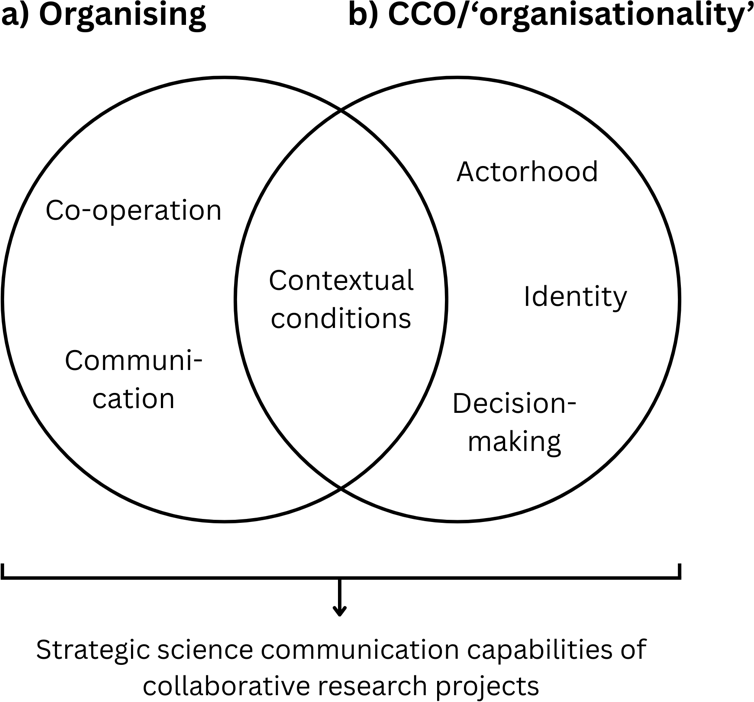
This observation is significant, because it indicates that forthcoming research will necessitate concepts that facilitate a multifaceted examination of cooperation in research projects. This is in response to the need for research on science communication in an organisational context, ‘an organisational turn’ [Schäfer & Fähnrich, 2020], and a transition from the examination of the skills of individual scientists to the enablement of organisations to implement strategic science communication [Besley, 2020]. The components of organisationality are described in Table 4.
|
Component of organisationality |
Point of view |
Study |
|
Actorhood (of the project) |
- Boundary work |
Klenk & Hickey [2012] |
|
- Actor characteristics & roles |
Protogerou et al. [2013] |
|
|
- Communication department as central body, with the capacity to
represent organisational interests |
Fecher et al. [2023] |
|
|
- Weak organisational connection especially amongst university
researchers |
Koivumäki & Wilkinson [2020] |
|
|
Identity (of the project) |
- Outreach activities shaping organisational identity |
Hendriks & Bromme [2022] |
|
- GOITs important framework for focusing attention on program
priorities |
Faro et al. [2023] |
|
|
- Developing common language |
Edelenbos et al. [2017] |
|
|
- Large-scale collaborations involve complex participation experiences, particularly when differences in power and issues of equity are foregrounded |
McGreavy et al. [2022] |
|
|
- Challenge in generating shared sense of identity and purpose
when numerous organisations involved |
Koivumäki & Wilkinson [2020] |
|
|
- Team level discussions |
Edelenbos et al. [2017] |
|
|
- Establishing a common ground took 1,5 years |
König et al. [2013] |
|
|
Interconnected |
- Need for improved communication & decision-making process |
Faro et al. [2023] |
|
decision-making |
- Participation (in project activities) closely linked to decision-making |
Löhr et al. [2017] |
|
(within the project) |
- Continuity supported by management: e.g. reliability regarding
implementation and control of jointly taken decisions |
König et al. [2013] |
|
Contextual conditions |
- Culture |
Synthesis of reviewed studies |
The analysis did not indicate that the reviewed studies had taken into account the impact of organisational practices on the implemented science communication in the project. However, the findings highlight the organisational features of temporary research projects and, thus, highlight the relevance of the organisational perspective also at the project level. However, because this study did not focus on the effectiveness of science communication, further research is needed to determine whether a well-organised and systematic project can produce more effective strategic science communication when compared to more loosely organised projects. This review suggests that a constitutive viewpoint to communication and CCO terminology of organisationality are useful ways to outline research under the the umbrella of the organisational turn of science communication.
This theoretical perspective can help temporary research organisations in reflecting their science communication practices through their organisationality. For example, paying attention to contextual conditions (e.g. how to share data safely between institutions) can support collaboration from the earliest planning stage. Furthermore, by recognising the organisationality of a research project through the factors outlined in Figure 1, a project could develop their shared practices for communicating the results of the project and find ways to bring a multidisciplinary viewpoint to their science communication. Then, the responsibility of conducting science communication of the results would not lie solely neither on the individual nor on the bigger research institutions behind the project team members; this sort of arrangement could enhance multidisciplinary popularisation of research-based knowledge, for example. In other words, acknowledging the organisationality of research projects can help in communicating the results of the project instead of individual researchers or studies, which can be beneficial in facing the complex issues of the complex world of today. Furthermore, organisational features of research projects can be a resource in reaching audiences outside the research community, which relates to strategic design of information dissemination [Jacob et al., 2022]. Altogether, CCO theory can help in explaining how an organisation is constituted through the formation of a temporary organisational identity and common ground in communication among research project members.
Projects can benefit from the perspectives offered by CCO. The actorhood of those involved in a project can be supported and encouraged through communication practices aiming for sharing of the outputs of individual studies among the project. For example, project researchers and communicators can share content produced in the project. The roles of the various actors in the project should also be clarified. The project organisation’s identity is created collectively in communication as the project progresses. Here, too, disciplinary differences must be considered and a common ground established. Jointly created project goals help to direct activities. It is important that participants identify that they belong to the project and find their participation meaningful, and also that project management is aware of the importance of the constitutive nature of communication. Interconnected decision-making is the third point to consider. Decision-making should be transparent, and decisions should be communicated clearly within the project. If the organisationality of a project is at the higher end, it is crucial to understand that all decisions related to the project concern the whole project (i.e., they are interconnected). What comes to science communication especially, interconnected decision-making should be encouraged for making sure the synergies the project has can be communicated to wider audiences, beyond traditional scientific publications. In addition, the aforementioned contextual conditions should be taken into account when considering the organisationality of such projects — that is, how they become organised and the degree to which they develop organisational characteristics.
In contrast to the fluid organisations previously examined within the context of CCO, the research projects under consideration are distinguished by their possession of a greater number of organisational characteristics (management, brand, influence of researchers’ home organisations, and practices). These projects gain organisationality at the crossroads of many formal institutions in a distinguishable way. It is notable, and a contribution this article makes for CCO theory, that also collectives with somewhat formal structures can be seen through the concept of organisationality. This notion highlights how formal structures don’t guarantee definite organisation-ness and how organisationality, as a matter of degree, is rooted in communicative practices.
5 Conclusions
This literature review and the resulting framework lay the foundation for studying the organisation of research projects. Previously, it has been suggested that moving from an individualistic approach in science communication towards strategic science communication capacity within organisations can enhance the quality of communication efforts [Besley, 2020]. We argue that by focusing on communication practices from the constitutive perspective, also temporary research organisations can develop their capacity as science communicators. By strengthening actorhood, identity, and interconnected decision-making, as well as acknowledging contextual conditions (e.g., in the form of resources) in collaborative research settings, an environment for more strategic science communication can be created. By leveraging these capabilities, a temporary organisation can establish shared goals that form the cornerstone of collaborative science communication [Besley & Dudo, 2022b]. Although earlier research does not provide information on the effects of organisation on science communication, it can be assumed from existing knowledge [e.g. Besley & Dudo, 2022a] that conditions enabling strategic science communication are likely to enhance a project’s science communication outputs and outcomes. In such a scenario, the project can strengthen its identity, actorhood, and decision-making, thereby making better strategic and tactical choices, based on common goals, and promoting everyone’s involvement thus creating a collective. For example, a shared sense of identity and purpose in large research projects can benefit the quality and cohesiveness of science communication [Koivumäki & Wilkinson, 2020]. However, more empirical research is needed on these aspects. This is important especially in the current environment where research funding is often sought through a variety of projects and consortia involving several organisations. This is also linked to the question of the capacity, skills, and resources that institutions have in order to support the communication needs of projects, both internally and externally.
The findings have implications for both communication theory (CCO) and science communication. In terms of CCO theory, previous research has highlighted that in addition to formal organisations, empirical research should target ‘fluid and precarious social formations’ that are not necessarily classified as organisations [Schoeneborn et al., 2019, p. 487]. In turn, science communication research has recently emphasised the importance of the organisational level as a new research focus, the organisational turn [Schäfer & Fähnrich, 2020]. In light of this review and in the context of strategic science communication in research projects, it appears that the organisational turn has not yet reached its full potential, and that more research at the organisational level, particularly on its impact on strategic science communication in temporary research organisations, is needed.
The practical implications of the research are of particular use to those working in research projects including collaboration (PIs, project researchers, interaction managers, and science communication professionals). The findings of the review can help guide future empirical research toward topics that generate new knowledge about collaboration in projects and help research institutes to unlock the science communication potential of temporary research organisations such as research projects. In future studies, it would be beneficial to empirically examine the processes of how communication shapes organisation in research projects. Additionally, it would be interesting to investigate how temporary research organisations engage in science communication and the role that organisation plays in the process.
The science communication environment has undergone many transitions in recent years. In future research, scholarly interest should focus not only on traditional face-to-face collaboration but also on digital interaction in research teams, whose role has grown globally in the 2020s in the aftermath of the COVID-19 pandemic, as many organisations have shifted to telework or a hybrid mode of operation. The advent of remote working opportunities, including virtual meetings and digital collaboration channels and tools, has also precipitated a paradigm shift in how communication and collaboration are conducted within research projects. In the context of funded research projects, the requirements and guidelines given by the funder may affect the administration and internal organisation in the project [König et al., 2013]. Thus, the funder’s role needs to be taken into account when examining these aspects in the future. Furthermore, in the forthcoming years, it is important to direct attention towards the potential of artificial intelligence and AI agents in the realm of research project organisation, and the manner in which they will transform the current conventions. These viewpoints were underrepresented in the reviewed literature.
Research projects and consortia generate a huge amount of new research data and findings globally. Temporary organisations have the power and responsibility to communicate research results as effectively as possible and to interact with key stakeholders, such as decision-makers. The transition towards well-organised, strategic, and effective joint research communication in multi-stakeholder consortia and research networks creates so many opportunities for an evidence-based future that it is desirable to support this goal through science communication research. This review takes a step in that direction.
Acknowledgments
The first author was supported by a working grant from the Finnish Association of Science Editors and Journalists. The funder had no influence on the conduct of the study or the preparation of the manuscript.
References
-
Ahrne, G., & Brunsson, N. (2011). Organization outside organizations: the significance of partial organization. Organization, 18(1), 83–104. https://doi.org/10.1177/1350508410376256
-
Ashcraft, K. L., Kuhn, T. R., & Cooren, F. (2009). Constitutional amendments: “materializing” organizational communication. Academy of Management Annals, 3(1), 1–64. https://doi.org/10.5465/19416520903047186
-
Bammer, G. (2020). Should science communication become part of a discipline of integration and implementation sciences (i2S)? JCOM, 19(04), C04. https://doi.org/10.22323/2.19040304
-
Barry, E. S., Merkebu, J., & Varpio, L. (2022a). State-of-the-art literature review methodology: a six-step approach for knowledge synthesis. Perspectives on Medical Education, 11(5), 1–8. https://doi.org/10.1007/s40037-022-00725-9
-
Barry, E. S., Merkebu, J., & Varpio, L. (2022b). Understanding state-of-the-art literature reviews. Journal of Graduate Medical Education, 14(6), 659–662. https://doi.org/10.4300/jgme-d-22-00705.1
-
Basque, J., Bencherki, N., & Kuhn, T. (Eds.). (2022). The Routledge handbook of the communicative constitution of organization (1st ed.). Routledge. https://doi.org/10.4324/9781003224914
-
Besley, J. C. (2020). Five thoughts about improving science communication as an organizational activity. Journal of Communication Management, 24(3), 155–161. https://doi.org/10.1108/jcom-03-2020-0022
-
Besley, J. C., & Dudo, A. (2022a). Strategic communication as planned behavior for science and risk communication: a theory-based approach to studying communicator choice. Risk Analysis, 42(11), 2584–2592. https://doi.org/10.1111/risa.14029
-
Besley, J. C., & Dudo, A. (2022b). Strategic science communication: a guide to setting the right objectives for more effective public engagement. Johns Hopkins University Press.
-
Biermann, K., Banse, L., & Taddicken, M. (2025). “It’s mostly a one-way street, to be honest”: the subjective relevance of public engagement in the science communication of professional university communicators. JCOM, 24(01), A03. https://doi.org/10.22323/2.24010203
-
Canals, A., Ortoll, E., Ortoll, E., Nordberg, M., & Nordberg, M. (2017). Collaboration networks in big science: the ATLAS experiment at CERN. El Profesional de la Información, 26(5), 961. https://doi.org/10.3145/epi.2017.sep.17
-
Dobusch, L., & Schoeneborn, D. (2015). Fluidity, identity and organizationality: the communicative constitution of Anonymous. Journal of Management Studies, 52(8), 1005–1035. https://doi.org/10.1111/joms.12139
-
Edelenbos, J., Bressers, N., & Vandenbussche, L. (2017). Evolution of interdisciplinary collaboration: what are stimulating conditions? Science and Public Policy, 44(4), 451–463. https://doi.org/10.1093/scipol/scw035
-
European Commission. (2024). Horizon Europe. https://research-and-innovation.ec.europa.eu/funding/funding-opportunities/funding-programmes-and-open-calls/horizon-europe_en
-
Fähnrich, B. (2018). Einflussreich, aber wenig beachtet? Eine Meta-Studie zum Stand der deutschsprachigen Forschung über strategische Kommunikation von Wissenschaftsorganisationen. Publizistik, 63(3), 407–426. https://doi.org/10.1007/s11616-018-0435-z
-
Faro, E. Z., Sauder, K. A., Norman, G. S., Anderson, A., Vélez-Vega, C., Napp, D., & Huddleston, K. C. (2023). A mixed-methods analysis to understand the implementation of a multistakeholder research consortium: Environmental influences on Child Health Outcomes (ECHO). Journal of Clinical and Translational Science, 7(1). https://doi.org/10.1017/cts.2023.620
-
Fecher, B., Kuper, F., Fähnrich, B., Schmid-Petri, H., Schildhauer, T., Weingart, P., & Wormer, H. (2023). Balancing interests between freedom and censorship: organizational strategies for quality assurance in science communication. Science and Public Policy, 50(1), 1–14. https://doi.org/10.1093/scipol/scac043
-
Grant, M. J., & Booth, A. (2009). A typology of reviews: an analysis of 14 review types and associated methodologies. Health Information & Libraries Journal, 26(2), 91–108. https://doi.org/10.1111/j.1471-1842.2009.00848.x
-
Greenhalgh, T., & Peacock, R. (2005). Effectiveness and efficiency of search methods in systematic reviews of complex evidence: audit of primary sources. BMJ, 331(7524), 1064–1065. https://doi.org/10.1136/bmj.38636.593461.68
-
Hendriks, F., & Bromme, R. (2022). Researchers’ public engagement in the context of interdisciplinary research programs: learning and reflection from boundary crossing. Science Communication, 44(6), 693–718. https://doi.org/10.1177/10755470221137052
-
Henke, J. (2025). Strategic interactions in science communication: a complex adaptive systems framework. Science Communication. https://doi.org/10.1177/10755470251363825
-
Jacob, R. R., Korn, A. R., Huang, G. C., Easterling, D., Gundersen, D. A., Ramanadhan, S., Vu, T., Angier, H., Brownson, R. C., Haire-Joshu, D., Oh, A. Y., & Schnoll, R. (2022). Collaboration networks of the implementation science centers for cancer control: a social network analysis. Implementation Science Communications, 3(1), 41. https://doi.org/10.1186/s43058-022-00290-6
-
Jeong, S., & Choi, J. Y. (2015). Collaborative research for academic knowledge creation: how team characteristics, motivation and processes influence research impact. Science and Public Policy, 42(4), 460–473. https://doi.org/10.1093/scipol/scu067
-
Klenk, N. L., & Hickey, G. M. (2012). Improving the social robustness of research networks for sustainable natural resource management: results of a Delphi study in Canada. Science and Public Policy, 39(3), 357–372. https://doi.org/10.1093/scipol/scs024
-
Koivumäki, K., & Wilkinson, C. (2020). Exploring the intersections: researchers and communication professionals’ perspectives on the organizational role of science communication. Journal of Communication Management, 24(3), 207–226. https://doi.org/10.1108/jcom-05-2019-0072
-
König, B., Diehl, K., Tscherning, K., & Helming, K. (2013). A framework for structuring interdisciplinary research management. Research Policy, 42(1), 261–272. https://doi.org/10.1016/j.respol.2012.05.006
-
Lindenfeld, L., Besley, J. C., Zheng, X., Dudo, A., & Newman, T. P. (2025). Science communication for scientists: linking strategy with creativity, practice and respect. Routledge. https://doi.org/10.4324/9781003493938
-
Lo, Y.-Y., Huang, C.-J., & Peters, H. P. (2019). Do organizational interests interfere with public communication of science? An explorative study of public relations of scientific organizations in Taiwan. East Asian Science, Technology and Society: An International Journal, 13(4), 557–574. https://doi.org/10.1215/18752160-8005617
-
Löhr, K., Graef, F., Bonatti, M., Mahoo, H. F., Wambura, J., & Sieber, S. (2017). Conflict management systems for large scientific research projects. International Journal of Conflict Management, 28(3), 322–345. https://doi.org/10.1108/ijcma-04-2016-0022
-
McGreavy, B., Haynal, K., Smith-Mayo, J., Reilly-Moman, J., Kinnison, M. T., Ranco, D., & Leslie, H. M. (2022). How does strategic communication shape transdisciplinary collaboration? A focus on definitions, audience, expertise and ethical praxis. Frontiers in Communication, 7, 831727. https://doi.org/10.3389/fcomm.2022.831727
-
Mo, G. Y. (2016). Examining cross-disciplinary communication’s impact on multidisciplinary collaborations: implications for innovations. Information, Communication & Society, 19(5), 673–690. https://doi.org/10.1080/1369118x.2016.1139611
-
Packendorff, J. (1995). Inquiring into the temporary organization: new directions for project management research. Scandinavian Journal of Management, 11(4), 319–333. https://doi.org/10.1016/0956-5221(95)00018-q
-
Peters, H. P. (2022). The role of organizations in the public communication of science — early research, recent studies and open questions. Studies in Communication Sciences, 22(3). https://doi.org/10.24434/j.scoms.2022.03.3994
-
Protogerou, A., Caloghirou, Y., & Siokas, E. (2013). Research networking and technology fusion through EU-funded collaborative projects. Science and Public Policy, 40(5), 576–590. https://doi.org/10.1093/scipol/sct008
-
Raupp, J. (2017). Strategische Wissenschaftskommunikation. In H. Bonfadelli, B. Fähnrich, C. Lüthje, J. Milde, M. Rhomberg & M. S. Schäfer (Eds.), Forschungsfeld Wissenschaftskommunikation (pp. 143–163). Springer Fachmedien Wiesbaden. https://doi.org/10.1007/978-3-658-12898-2
-
Rimkunienė, D., & Zinkeviciute, V. (2014). Social media in communication of temporary organisations: role, needs, strategic perspective. Journal of Business Economics and Management, 15(5), 899–914. https://doi.org/10.3846/16111699.2014.938360
-
Rödder, S. (2020). Organisation matters: towards an organisational sociology of science communication. Journal of Communication Management, 24(3), 169–188. https://doi.org/10.1108/jcom-06-2019-0093
-
Rowan, K. E., Engblom, A., Hathaway, J., Lloyd, R., Vorster, I., Anderson, E. Z., & Akerlof, K. L. (2021). Overcome the deficit model by applying the CAUSE model to climate change communication. In C. H. Botan (Ed.), The handbook of strategic communication (pp. 225–261). Wiley. https://doi.org/10.1002/9781118857205
-
Schäfer, M. S., & Fähnrich, B. (2020). Communicating science in organizational contexts: toward an “organizational turn” in science communication research. Journal of Communication Management, 24(3), 137–154. https://doi.org/10.1108/jcom-04-2020-0034
-
Schoeneborn, D., Blagoev, B., & Dobusch, L. (2022). The communicative constitution of organizationality. In J. Basque, N. Bencherki & T. Kuhn (Eds.), The Routledge handbook of the communicative constitution of organization (pp. 134–147). Routledge. https://doi.org/10.4324/9781003224914-10
-
Schoeneborn, D., Kuhn, T. R., & Kärreman, D. (2019). The communicative constitution of organization, organizing and organizationality. Organization Studies, 40(4), 475–496. https://doi.org/10.1177/0170840618782284
-
Schwetje, T., Hauser, C., Böschen, S., & Leßmöllmann, A. (2020). Communicating science in higher education and research institutions: an organization communication perspective on science communication. Journal of Communication Management, 24(3), 189–205. https://doi.org/10.1108/jcom-06-2019-0094
-
Sergi, V. (2022). What’s in a project? Extending inquiries into projects with a CCO perspective. In J. Basque, N. Bencherki & T. Kuhn (Eds.), The Routledge handbook of the communicative constitution of organization (pp. 325–338). Routledge. https://doi.org/10.4324/9781003224914-24
-
Silva, E. C. e., & Pinto, S. (2023). Disciplinary cultures and participation in international research networks: how science communication practices and motivation relate to contextual factors. International Journal of Science Education, Part B, 13(3), 245–260. https://doi.org/10.1080/21548455.2022.2162831
-
Smith, W. R. (2022). On relationality and organizationality: degrees of durability, materiality and communicatively constituting a fluid social collective. Organization Studies, 43(11), 1815–1837. https://doi.org/10.1177/01708406211035497
-
Tracy, S. J. (2020). Qualitative research methods: collecting evidence, crafting analysis, communicating impact (2nd ed.). Wiley Blackwell.
-
Volk, S. C., Vogler, D., Fürst, S., Schäfer, M. S., & Sörensen, I. (2023). Role conceptions of university communicators: a segmentation analysis of communication practitioners in higher education institutions. Public Relations Review, 49(4), 102339. https://doi.org/10.1016/j.pubrev.2023.102339
-
Wilhoit, E. D., & Kisselburgh, L. G. (2015). Collective action without organization: the material constitution of bike commuters as collective. Organization Studies, 36(5), 573–592. https://doi.org/10.1177/0170840614556916
-
Wilkinson, C., & Weitkamp, E. (2013). A case study in serendipity: environmental researchers use of traditional and social media for dissemination (M. Hermes-Lima, Ed.). PLoS ONE, 8(12), e84339. https://doi.org/10.1371/journal.pone.0084339
-
Yuan, S., Kanthawala, S., & Ott-Fulmore, T. (2022). “Listening” to science: science podcasters’ view and practice in strategic science communication. Science Communication, 44(2), 200–222. https://doi.org/10.1177/10755470211065068
About the authors
Marjo Honkaranta is a doctoral researcher at the University of Vaasa, Finland. Her research focuses on science communication in organisational settings, particularly in temporary and collaborative research organisations. Drawing on the communicative constitution of organisations (CCO) perspective, she examines organising processes and their relevance to strategic science communication. Her professional background is in science communication and stakeholder engagement within a multi-organisational strategic research programme.
E-mail: marjo.honkaranta@uwasa.fi Bluesky: @marjohonkaranta
Tomi Laapotti is an associate professor of organizational communication at the University of Vaasa. His research interests include the communicative constitution of organizations, the ripple effects of AI technologies in organizing, and organizational meetings.
E-mail: tomi.laapotti@uwasa.fi
Tanja Sihvonen is Professor of Communication Studies at the University of Vaasa, Finland. She specializes in digital media, games, and participatory cultures on the internet. Her most recent work considers role-playing games, online videos, (ro)bots, and algorithmic agency in social media.
E-mail: tanja.sihvonen@uwasa.fi Bluesky: @hopetaz