

1 Introduction
Social media has emerged as a powerful platform for media communication and marketing in the Web 2.0 era. Along with the development of media, the form and content of popular science communication have changed dramatically. Traditional forms of science popularisation were mainly speeches, lectures, broadcasts, exhibitions, and periodicals and magazines (i.e., popular forms that could directly connect to people) [Lin & Honglin, 2020], however, with the rapid development of social media, science popularisation has undergone a great transition, and social media has emerged as a core channel for science communication.
Meanwhile, social media has created a unique media market phenomenon, known as a viral phenomenon. The viral phenomenon drives the media market to achieve exponential growth through a word-of-mouth diffusion process [Boppolige & Gurtoo, 2017]. A product, online video, information, technology, an idea, or an event can go viral on social media today. As a result, science communication content producers began to utilise viral marketing as a strategy to have effective science communication with the audience on social media platforms.
During the global health crisis, people find that the viral phenomenon of online video is particularly apparent. With over 1 billion short video users in China, the social media platform provides fertile ground for widespread content distribution [Jiang et al., 2023]. Thus, the science enthusiasts and individual scientists have paid attention to the rapid development of online video and produced popular science short videos voluntarily. When public health emergencies occur, relevant information containing different topics, sentiments, and emotions spreads rapidly on social media [Cai et al., 2022]. For instance, during the outbreak of the public health crisis, a popular science short video titled “Everything You Need to Know About the Pandemic” rapidly gained widespread popularity after its release. It became popular on the internet with a billion views, nearly 700,000 retweets, and nearly 100,000 playbacks. The total number of broadcasts on the entire network exceeded 150 million. This exemplary case not only demonstrates that popular science short videos can achieve viral communication but also underscores the urgency and significant social value of researching the mechanisms behind such phenomena.
To date, research on viral video communication strategies mainly focuses on the following four aspects: the video content, target audience, social media distribution, and communication effects. From the perspective of video content, many pieces of literature point out the importance of video content in viral communication strategies [Gee, 2014; Welbourne & Grant, 2016]. Regarding the target audience analysis, some studies have shown that online videos that could cause the audience to like or dislike the video are more likely to go viral [Feroz Khan & Vong, 2014; Z. Wang et al., 2020; Welbourne & Grant, 2016]. At the same time, it is also essential to study the characteristics of social media platforms. Popular video platforms, such as YouTube and Bilibili, are an essential part of the evolution of the viral video [A. M. Wang, 2014]. Many studies investigated the viral phenomenon by analysing the technical characteristics of various social media platforms.
Regarding communication effects, many studies used intuitive data, such as the number of likes, shares, and views, as the direct metric to measure it [Asamoah et al., 2016; Broxton et al., 2013]. Then, Asamoah et al. [2016] proposed a formula for “Share Through Rate (STR)”, which could measure the communication effect of online videos. The Share Through Rate (STR) is equal to the number of shares divided by the number of views, and the formula for the calculation of this index is as follows:
| (1) |

where PSTR is the evaluation index of Share Through Rates; S is the number of shares; V is the number of views. According to the formula, he defined the viral video as the Share Through Rate (STR) of the video being more than 1%. In addition, some studies have analysed and summarised the communication characteristics of viral videos based on existing successful examples to predict the future popularity of the video.
Based on the above analysis, there are many studies on the influencing factors of communication processes, but there is still no general framework to analyse the viral communication of popular science short videos in the public health crisis. Therefore, to study the viral phenomenon of popular science short videos and fill the gap in existing research, the methodology of this article is to conduct a case study of the Chinese popular science media according to the grounded theory, combined with interview research and secondary research. This paper will analyse the main factors, including video content, target audience, and media distribution strategy, that influence the communication effect of video in the overall process of online video production and transmission. It is hoped that this research will contribute to a deeper understanding of the viral phenomenon of short science videos in the Chinese media market during the public health crisis.
2 Literature review
2.1 The rise and definition of popular science short videos
The short video not only provides a new way of content dissemination but also gives a new chance for the mass media to do science communication. There are many types of short videos, among which the short popular science video is a crucial one. The popular science short video is a kind of short video that is aimed at delivering scientific content to a vast audience on the Internet [Munoz Morcillo et al., 2016]. According to the above definition, it could also be called a “scientific short video” or “short science video”.
As a new form of science communication in the digital age, popular science short videos offer distinct advantages over traditional science communication formats, including lower access barriers, enhanced shareability, and stronger expressive power. These characteristics effectively reduce the difficulty for the public in acquiring scientific knowledge and maximize the impact of science outreach. It is generally acknowledged that video-based communication tends to be more effective and persuasive than text-based formats in conveying complex scientific concepts [Montes et al., 2025].
The viral communication of such videos holds great significance for science communication, as it enables broader public access to scientific knowledge and generates positive societal impact [Korda & Itani, 2013; Welbourne & Grant, 2016]. Consequently, many popular science media entities have begun utilizing short videos — often referred to as “Popular Science Web Video” — to promote scientific knowledge.
Although many articles focus on popular science short videos, scholars have paid more attention to the communication characteristics of science popularisation in mass media [Welbourne & Grant, 2016]. For example, misinformation transmitted through the mass media affects the public perception of science, and scientists could play an important role in correcting the communication of misinformation by sharing scientific knowledge. Besides, many scholars are discussing the use of health promotion videos on social media [AuYong & Yeoh, 2017; Korda & Itani, 2013; Swigart et al., 2019], and have gradually realised that short video is a convenient and efficient way to promote professional, scientific messages to the public.
2.2 Popular science short videos go viral during public health crisis
Health information sharing is more frequent on social media during the public health crisis, and the popular science short video plays a vital role in the prevention and control of infectious diseases. The public health crisis refers to events that occur suddenly, spread rapidly, have a widespread impact, and pose a grave threat to public health, such as large-scale infectious disease outbreaks [Blank et al., 2015]. During such crises, public demand for scientific and authoritative information surges dramatically, and social media platforms become the primary channels for disseminating health information [Terry et al., 2023]. Media reports and science popularisation have a positive impact on the reduction of the infection rate [Cui et al., 2008]. Several scientists at the University of Washington have observed the relationship between the number of media reports and the disease transition rates. They found that when the number of media reports increased tenfold, the number of infections with this type of disease decreased by 33.5% [Kim et al., 2019]. Therefore, the short popular science video could be an effective means to prevent the spread of disease.
Furthermore, the viral phenomenon of short videos has evolved from a market effect into a significant public communication strategy. Viral communication can amplify the audience communication effect of popular science short videos and play a positive role in containing epidemics and stabilizing social sentiment. The video “Everything You Need to Know About the Pandemic”, which gained immense popularity during the pandemic, stands as clear evidence that popular science short videos can achieve viral dissemination during crises and yield significant social benefits.
The widespread communication of popular science short videos during a public health crisis could be explained by the theory of virality, particularly the SPIN framework of virality [Asamoah et al., 2016]. This framework proposes a conceptual model of virality in social media, suggesting four key success factors for viral campaigns: Spreadability, Propagativity, Integration, and Nexus [Mills, 2012]. Spreadability refers to the ease with which things can spread throughout the social media ecosystem [Grover et al., 2017]. Propagativity focuses on how consumers can easily redistribute content by using existing social media platforms [Fouad, 2017]. As for propagativity, Mills [2012] points out that propagativity has four important considerations in selecting media. These are “(i) ease and speed of propagation, (ii) network size and type, (iii) richness of content, and (iv) proximity of content” [Mills, 2012]. Integration means utilising multiple social media platforms to maximise the exposure of the same message [Alhabash et al., 2019]. Nexus refers to increasing the viral transmission of the video by consistently publishing relevant content. These factors collectively facilitate the communication of information within social media networks.
Concurrently, crisis communication theory indicates that during public health crises, timely, transparent, and easily comprehensible communication is crucial for stabilizing public sentiment, building trust, and guiding appropriate behavior for society [Chandralekha, 2024]. The popular science short videos, which could go viral on social media, are not only vehicles for information transmission but also vital components of crisis communication strategies. Therefore, examining the key elements of the virality of popular science short videos could help in understanding the propagation mechanisms and provide valuable insights for enhancing the effectiveness of scientific communication during public health crises.
In summary, although existing research has explored viral video communication strategies from perspectives such as video content, audience sentiment, platform characteristics, and has introduced analytical frameworks like the SPIN framework of virality to understand the communication strategies in popular science short videos. However, these studies have focused on general models for the effective communication of popular science short videos, lacking systematic research on the factors influencing the viral communication of popular science short videos in the context of China’s public health crises. The specific context combines the dynamic nature of viral communication with the inherent urgency and risk of crisis communication, potentially giving rise to key factors and mechanisms distinct from general communication models. To address this research gap, the study proposes the following core research question:
RQ: What are the factors that influence the virality of popular science short videos during the public health crisis in China?
General theories and models for studying the effective communication of popular science short videos include Planned Behavior Theory, Usage and Satisfaction Theory, Information Ecology Theory, Elaboration Likelihood Model, and Stimulus-Organism-Response Model [Jiang et al., 2023; Li et al., 2026; X. Wang & Yue, 2022]. These general theories and models typically focus on audience needs and the communication of scientific knowledge. However, in the context of public health crises, the objectives of science communication extend beyond scientific knowledge communication. The situation requires not only informing the public but also prompting them to quickly understand the circumstances and adopt specific protective behaviors. Under these conditions, leveraging virality could maximize communication efficiency to achieve rapid and widespread reach.
Furthermore, the factors influencing the viral communication of popular science short videos during public health crises differ from those in general contexts. The public experiences anxiety, fear, and uncertainty, while the demand for accurate and timely health information surges dramatically [Sudheendra et al., 2024]. Given that existing theoretical frameworks were not developed to account for the unique demands of crisis situations, this study employs grounded theory to inductively construct a comprehensive analytical framework that captures the distinctive mechanisms of viral science communication during public health crises.
3 Methodology
3.1 Research design
The purpose of this study is to explore the factors that influence the virality of popular science short videos on Chinese social media during the public health crisis and to analyse the communication strategies of the viral video to provide suggestions for the future development of popular science videos. Therefore, this study adopts the grounded theory to explore the factors influencing the virality of popular science short videos during the public health crisis in China. The grounded theory is particularly suited for generating context-specific explanations of complex social phenomena through systematic data collection and iterative analysis [Corbin & Strauss, 2008]. The research design involves three phases: open coding, axial coding, and selective coding.
Open Coding identified primary drivers of virality (e.g., content quality, audience needs) through granular analysis of interview transcripts, case studies, and secondary research. Axial Coding catalogues the primary drivers to reveal the key drivers and elucidate relationships between these drivers. Selective Coding synthesized findings into an actionable framework — the basic model for the viral phenomenon of popular science short videos — to optimize content propagation strategies.
3.2 Sample selection
To explore the viral phenomenon of the short popular science video, a suitable case study object is a popular science media company that has successfully produced viral videos on the Chinese market during the public health crisis. This company, established in 2017, featured programs with high information density and rich visual effects, excelling in visual explanations. During the outbreak of the public health crisis, this Chinese popular science media uploaded a video “Everything you need to know about the Epidemic” on social media. After the video was released, it became popular on the internet with a billion views, nearly 700,000 retweets, and nearly 100,000 playbacks. The total number of broadcasts on the entire network exceeded 150 million. As a result, the scientific knowledge about the epidemic in this video has spread widely. The STR reached 1.65% on Weibo and 7.25% on Bilibili, fully demonstrating its virality. The widespread of this video not only brings scientific knowledge to more people but also improves the reputation of the Chinese popular science media itself. While this video went viral on social media, the Chinese popular science media aroused more attention from different social media platforms. Their official account gained 1.1 million fans on WeChat, 1.5 million fans on Weibo, 1.6 million fans on TikTok, and 500,000 fans on Bilibili within several days. It could be seen that making a short popular science video go viral on the internet has great benefits for both the public and the company.
To analyse the communication mechanisms underlying this video and similar content, this study conducted a series of semi-structured interviews with 16 professionals from China’s science communication media (see Table 1). All interviewees were either from the target case company or possessed comparable experience in producing viral popular science short videos, including video editors, marketers, and scientific journal editors. This study focuses on the producer perspective because, during the outbreak of public health crises, producers’ decisions — what to release, when to release it, and how to present it — constitute the first step in determining whether information enters the process of viral communication. The research aims to illuminate this critical process, providing foundational insights into understanding the origins of viral communication. The interview questions focused on content creation strategies, platform-specific communication tactics, and observed user engagement patterns (see Appendix A).
| No. | Age | Sex | Profession | Years of work | Residence |
| Interviewee 1 | 28 | Female | Popular Science Video Editor | 6 | Beijing |
| Interviewee 2 | 30 | Female | Popular Science Video Editor | 6 | Beijing |
| Interviewee 3 | 38 | Male | Popular Science Video Editor | 10 | Beijing |
| Interviewee 4 | 29 | Female | Popular Science Video Marketing | 5 | Beijing |
| Interviewee 5 | 57 | Male | Scientific Journal Editor | 27 | Wuhan |
| Interviewee 6 | 26 | Female | Popular Science Video Editor | 3 | Wuhan |
| Interviewee 7 | 28 | Female | Popular Science Video Editor | 3 | Beijing |
| Interviewee 8 | 30 | Male | Scientific Journal Editor | 5 | Beijing |
| Interviewee 9 | 33 | Female | Popular Science Video Editor | 6 | Beijing |
| Interviewee 10 | 28 | Male | Scientific Journal Editor | 3 | Wuhan |
| Interviewee 11 | 24 | Female | Popular Science Video Marketing | 1 | Beijing |
| Interviewee 12 | 25 | Female | Scientific Journal Editor | 1 | Beijing |
| Interviewee 13 | 40 | Male | Popular Science Video Editor | 8 | Wuhan |
| Interviewee 14 | 30 | Female | Scientific Journal Editor | 3 | Beijing |
| Interviewee 15 | 27 | Male | Popular Science Video Editor | 2 | Beijing |
| Interviewee 16 | 22 | Female | Popular Science Video Editor | 1 | Beijing |
By selecting professionals directly involved in viral popular science video production as interviewees, the research ensures that discussion content remains directly relevant to the research questions. This approach provides robust support for analysing the causes and strategies behind the viral communication of popular science short videos.
3.3 Open coding
Initial concepts were extracted from the interviews (See Table 2). Examples include:
| Concepts |
Content from the interviews |
| Likeability |
• The number of likes basically shows whether the content is engaging or not. |
| Shareability |
• Whether users share or not is often emotionally driven. During the public
health crises, sharing science videos felt like “I am doing the right thing.” |
| Content Features |
• Some media’s content often stays superficial, while our videos delve deeper.
For example, the video integrated virology, epidemiology, and policy — no one
else had done that. |
| Audience Needs |
• There is information anxiety during crises, people weren’t just anxious for
news — they wanted to understand “why did it turn out this way?” |
| Cycle Time |
• Hot topics fade fast. For example, discussions about mask shortages faded
within three days. |
| Network Size and Type |
• Bilibili fans prefer in-depth content and engage via bullet comments, while
Weibo fans prioritize quick sharing. |
| Content Richness |
• Why publish text-and-image versions on WeChat? Because some users cannot
watch videos on the subway but can browse text-and-image content easily. |
| Content Proximity |
• WeChat’s “one-click sharing” lowers the barrier to sharing, but on TikTok,
you have to download the video first if you want to share it elsewhere. A lot of
people just give up. |
| Integration |
• We post full videos on Bilibili, highlights on Weibo, and use text and graphs
as hooks on WeChat. |
| Nexus |
• Our first video covered too much — there wasn’t much left to say in the
follow-ups. |
3.4 Axial coding
Three categories were established from the concepts (See Table 3). Examples include:
| Category | Concepts |
|
Spreadability | Likeability |
| Shareability | |
| Content Features | |
| Audience Needs | |
|
Propagativity | Cycle time |
| Network Size and Type | |
| Content Richness | |
| Content Proximity | |
|
Connectivity | Integration |
| Nexus | |
3.5 Selective coding
There are significant influencing relationships between the Spreadability, Propagativity, and Connectivity through selective coding, which is shown in Table 4.
|
Influencing Relationship |
Explained Mechanism |
Manifestations in Public Health Crises |
|
Audience Needs & Content Features ↓ Likeability & Shareability |
Audience Needs and Content Features amplify Likeability and Shareability. |
During the crisis, Audience Needs and Content Features work together, making users more inclined to like and share. |
|
Spreadability → Propagativity |
Spreadability is the prerequisite for Propagativity. |
During the crisis, the video that met audience needs and demonstrated high content quality could leverage platform features to achieve rapid and widespread diffusion. |
|
Propagativity → Connectivity |
Propagativity enables Connectivity. |
During the crisis, a successful cross-platform propagation provides the traffic and fan base for establishing a media matrix. |
3.6 Interpretive structural modeling
This study identifies a core theoretical model explaining the factors influencing the viral phenomenon of popular science short videos, centred on three dimensions: Spreadability, Propagativity, and Connectivity (see Figure 1). These categories correspond to distinct stages of content creation, distribution, and communication.
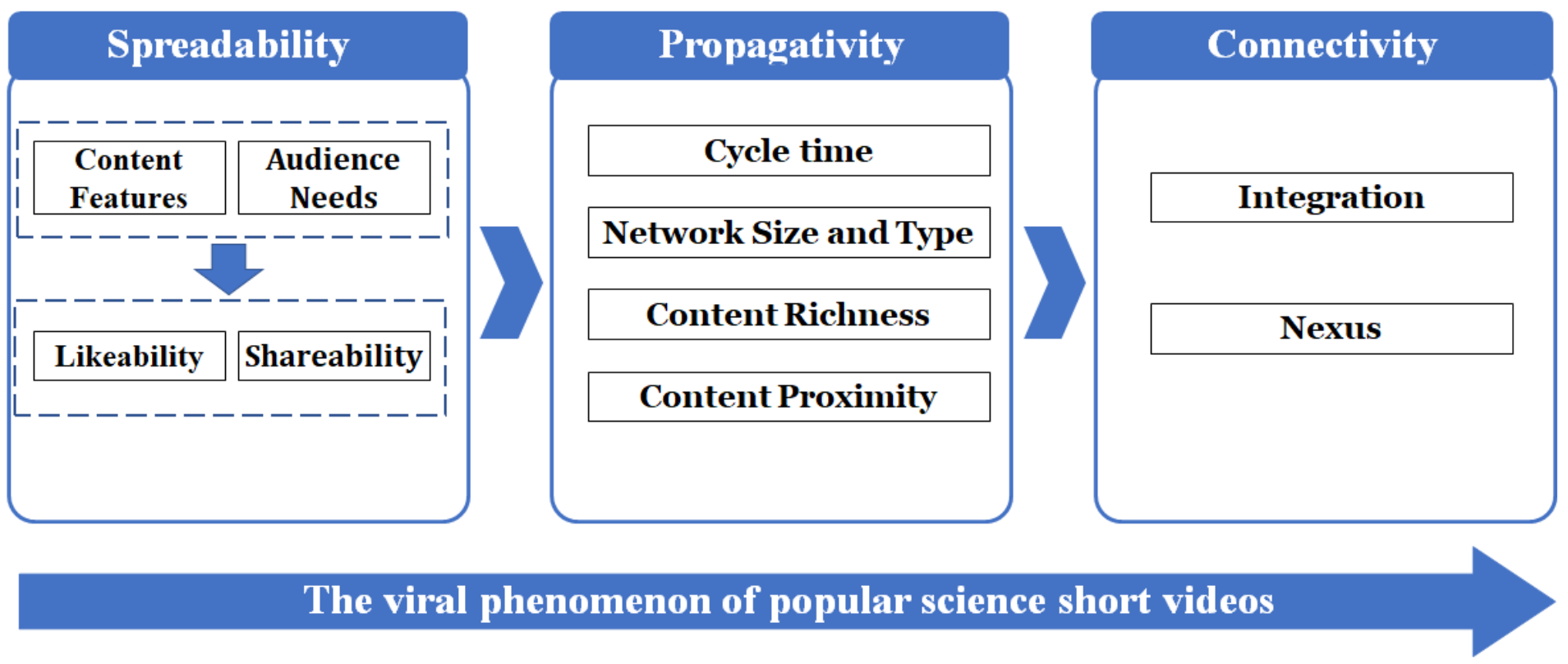
Spreadability captures the content’s inherent capacity to engage and motivate sharing. It integrates Content Features, Audience Needs, Likeability, and Shareability, while Audience Needs and Content Features both synergistically amplify Likeability and Shareability. Propagativity emphasizes the outward propagation dynamics of the video across networks, focusing on factors that accelerate diffusion, including Cycle Time, Network Size and Type, Content Richness, and Content Proximity. Connectivity ensures sustained propagation continuity across media ecosystems, including Integration and Nexus.
The model positions Spreadability as the content-centric trigger, Propagativity as the distribution-driven accelerator, and Connectivity as the environmental enabler. In summary, this model has elaborated the overall structure of virality. It points out the main drivers of viral phenomena on social media platforms, so it could be used as a guideline when exploring the communication strategies of short popular science videos on social media.
3.7 Theoretical saturation and validation
To ensure theoretical rigour, this study conducted additional validation by recruiting three new interview participants. The analysis revealed that the extracted concepts and categories remained consistent with prior findings and recurred throughout the validation process, with no changes to the core categories. This outcome confirms that the conceptual model constructed in this study achieves theoretical saturation, thereby demonstrating its robustness in explaining the mechanisms of viral propagation in popular science short videos.
4 Research findings
This section will analyze the viral communication of popular science short videos around the case company and its viral videos during the public health crisis according to the theoretical model (see Figure 1). This study provides producers’ understanding of target audiences, perceptions of platform communication logic, and the communication strategies to analyze the viral communication of popular science short videos during public health crises. The analysis will primarily rely on the interview for this study, to ensure findings are derived from first-hand empirical material, supplemented by secondary sources for validation.
4.1 Spreadability
Analysing the number of likes and shares could reflect the likeability and shareability of videos. A popular science editor explained, “Sharing is to let someone have a look at this important thing, and ‘point praise’ represents the affirmation of videos. For example, the number of shares may be higher on health topics, while the number of likes may be higher if the video is produced expertly. However, generally, these two metrics are positively correlated, both high and low.”
According to the user interaction data of a Chinese popular science video, which was posted on Weibo and Bilibili in January 2020, the video “Everything You Need to Know about the Epidemic” received the highest number of both likes and retweets from users compared to other videos. The video has been shared by 2.15 million people and watched over 1.3 billion times on Weibo. There are 610,000 Likes, 391,000 shares, and 5.393 million views on Bilibili. Furthermore, this video satisfies STR > 1% on Weibo, which means it is a viral video during that period.
Why has this video been able to spread so widely? A popular science editor in Nutshell emphasised two things behind the virality of the video “Everything You Need to Know about the Epidemic”. One is the high-quality content, and the other is understanding the audience’s needs. She said, “I think the content of this video challenges the conventional wisdom and concerns the self-interest of most people. Is there anyone who does not want to know how the epidemic got to be like this? Another reason is that the video producer chased the hot topic and continued to produce high-quality content. However, the foundation of all is understanding your audience’s needs.”
Meanwhile, a popular science editor gave a more detailed explanation for the idea that the high quality of the Chinese popular science media video leads to widespread video distribution. She pointed out in the interview that: “The visual effect of a video has the least impact. The content is much more important. The visual effects of the Chinese popular science video are technical barriers, but the manuscript is the real soul of a fantastic video. Although other media did the same kind of subject at that time, most of them were shallow and repetitive, while the popular science video content was studied deeply and analysed comprehensively.” Thus, it could be seen that the high spreadability of the video is due to the high quality of content produced with an understanding of the audience’s needs.
4.2 Propagativity
This section will study the propagation characteristics of social media platforms, which are commonly used by popular science short videos, to analyse the propagativity of Chinese popular science short videos. Aiming to understand the communication characteristics of short science videos on different social media platforms, this part will focus on the four influential factors of online video propagation, including cycle time, network size and type, content richness, and content proximity.
-
Cycle time. Under normal circumstances, the case company releases two videos per week, synchronously posting them on WeChat, Weibo, and Bilibili between 9:00 PM and 10:00 PM to maintain consistent exposure. As one editor explained,“The release time of a popular science video is based on the active period of your target audience. For example, if your target audience is office workers, perhaps the update time from Monday to Friday from 9:00 pm to 10:00 pm is a more reasonable period.”
However, during the public health crisis,the viral video “Everything You Need to Know about the Epidemic” was released at 9:00 a.m. The editor explained that this video was not part of their original plan, and they had decided to do it because of the outbreak of the epidemic, and posted it as soon as possible to take advantage of public attention on this sudden event. She added, “We did not expect that many people would watch this video. We just thought no one was comprehensively covering this topic, but we could do it.” Thus, it could suggest that timing is much more important than the frequency of release during public health crises. However, from another perspective, it can also be understood that the popularity of short videos has a certain degree of serendipity.
-
Network size and type. The network size of a viral video can be measured by the initial fan base of the video, while the network type can be shown by the social characteristics of the fans. The case company has accumulated substantial fan bases across multiple platforms. As one interviewee noted: “With more followers on each platform, those online videos are easier to see, because there is a large population base.” Specifically, the case company has 4.29 million followers on Weibo, 2.436 million on Bilibili, 96,000 followers on WeChat, 6.657 million on TikTok, 287,000 followers on Himalaya, and 195,000 followers on Zhihu. The entire network matrix has nearly 13 million fans in total.
In addition, the case company has high levels of user stickiness on social media platforms. An editor explained the strong alignment between content and audience: “Our fans are mostly 18 to 30-year-olds. People in this age group tend to be curious about new things, and the purpose of our company is to show people new knowledge, help them in life, or arouse their interests in some specific and interesting science topics, to make them think the world is not complicated. That purpose exactly meets those audience needs.” Through interactive behaviours of their loyal audience, videos achieve repeated transmission and “explosive” communication across platforms.
During public health crises, this existing network size becomes critical. In non-crisis contexts, a large fan base primarily serves routine content distribution; however, in crisis contexts, it functions as an instant activation channel for urgent information dissemination and significantly lowers the threshold for triggering viral communication. Meanwhile, the significance of user stickiness becomes amplified in public health crises. Highly engaged followers not only consume content themselves but also act as trusted information communicators. Their active participation in liking, commenting, and sharing serves as a form of social endorsement, enhancing the credibility of scientific information.
The viral communication of “Everything You Need to Know about the Epidemic” further demonstrates the importance of network size during the public health crisis. Within two days of its release, the case company experienced explosive follower growth across platforms: the WeChat Official Account gained 1.2 million new followers, Weibo gained 1.5 million, TikTok gained 1.6 million, and Bilibili gained 500,000, totaling nearly 5 million new followers across the entire network matrix. This data suggests that an existing large fan network provides the foundation for viral communication, while the success of viral videos in turn dramatically expands network size — creating a positive feedback loop.
-
Content richness. Content richness refers to the diversity of forms during the distribution process. As for the form of content, the Chinese popular science media mainly use short videos. Firstly, the content format of short videos adapts to user habits in today’s communication world. Nowadays, online information and people’s daily time are fragmented, and people’s reading habits have changed. “Compared to text, video is a quicker way to get information,” a popular science editor noted. “Short videos require less cognitive effort than text, making them more accessible.”
Secondly, compared to text or graphics, short videos have a low consumption threshold. Even people with a low level of education can watch short videos and meet their entertainment or learning needs. This also reflects the unique advantages of utilising short videos in science communication. On the one hand, content production and communication in a unique form of “scientific knowledge + short videos” reduces the knowledge consumption threshold and satisfies the needs of content consumers with different levels of education. On the other hand, short videos break the barriers that exist between the communication and reception of knowledge. They transform individual learning into public sharing to make scientific knowledge reach more audiences. In other words, it promotes the effective communication of scientific knowledge.
Importantly, during public health crises, the role and significance of content richness are amplified. In such high-risk scenarios, the audience’s demand for rapid and timely health information becomes particularly urgent. Short videos, with their intuitive presentation and efficient dissemination capabilities, emerge as powerful tools for conveying critical information. Compared to non-crisis scenarios, users’ tolerance for lengthy text has significantly decreased, while demand for short videos that combine visual appeal, credibility, and emotional appeal has surged dramatically. The prioritization of using short videos by popular science media in this context is not only a result of adapting to user habits but also an active response to the unique demands of crisis communication.
Although the video has been very consistent with the user’s content consumption habits during the public health crises, the Chinese popular science media still adopts different forms of content according to the characteristics of multiple social media platforms. In the Chinese popular science media’s distribution strategy, they give priority to utilising short videos and then consider using graphics and text. Their official WeChat platform has a complete embodiment of their distribution strategy: the finished content product has multiple media presentations, a short video version, and a text version, which has graphics and text in detail.
A popular science editor explained: “The reason why we also made a text version is that if you post a video directly on the WeChat official account, you could see the cover picture of the video directly in the video function, so that viewers could easily click and watch the video. Another reason is that some people may not watch the video, or the topic may not have enough traffic. The text could help the video catch more people’s eyes.”
Thus, it could be seen that content richness may have two main factors. One is the technical limitation of social media platforms. For example, the length of a video on TikTok is limited to 45 seconds. As a result, some long videos must be split into several parts. Another reason is that the form of content with text and graphics is still the primary way that many people receive information online. Therefore, for short videos, the choice of content forms needs to be considered from multiple perspectives, including the limitations of the platform and the consumer behaviour of users.
-
Content proximity. Content proximity refers to the technical barriers users face when forwarding content within or across social media platforms. The short video of the Chinese popular science media has been distributed throughout the network on various platforms, including WeChat, Weibo, Bilibili, and TikTok. However, the communication effectiveness of popular science short videos varies significantly across platforms in public health crises in China.
Compared with other social media platforms, WeChat is more straightforward for users to share content, as it has the WeChat Moments function, which connects each user with their friends and family. A popular science editor said, “The WeChat Moments function is very convenient for people to forward online content so that everyone can quickly swipe interesting content on WeChat.” WeChat is not only a subscription-based platform, but also an essential channel for one-to-one or one-to-many communication via strong-tie networks. This mechanism significantly enhances the credibility and acceptance of scientific information in public health crises.
Weibo is more like a media platform full of information flow, and is more suitable for some media organisations to release hot news. Due to the decline of social networking attributes, the media rely more on the one-time transmission of information on Weibo, and it is difficult to carry out the second or even multiple transmissions. However, the influence of this one-off transmission is widespread during the public health crises, as explained by an interviewee: “If a video posted on Weibo could attract some influencers to forward it, it could bring high volumes of traffic. For example, when the viral video ‘Everything You Need to Know about the Epidemic’ was forwarded by a famous young actor in China, he brought nearly 30,000 views in a short period.”
Bilibili may be the first choice for the young generation to search for related videos in professional fields. A popular science editor said, “Many people do not have the habit of watching videos on WeChat, but Bilibili, which is similar to YouTube, is great for watching videos.” Bilibili’s subculture atmosphere allows videos to go viral within niche groups, but its community boundaries limit broader reach. This makes it a double-edged sword for science communication during crises.
TikTok’s technical limitations hinder cross-platform sharing, and its entertainment-oriented style contrasts with the serious tone of science videos. However, as one editor noted, “I don’t think making the content more entertaining is bad. The key is whether you can ensure the quality of your popular science short video while making entertaining content.” This tension is especially acute in public health crises, where balancing entertainment value and scientific rigor becomes a central concern facing science communication content producers on TikTok.
In conclusion, within the specific context of public health crises, content proximity influences communication efficiency through the diversity of content platforms in China. WeChat is suitable for “explosive” distribution, and Weibo is more of a one-time propagation with significant influence. These two platforms are more likely to lead to a viral phenomenon on social media. However, Bilibili is suitable for creating hot topics in a niche group. As for TikTok, entertainment and science popularisation should be well combined, but its technical barriers make it unsuitable for cross-platform sharing and transmission. While these platform characteristics also manifest in non-crisis periods, their activation, amplification, or suppression under public health crises significantly impacts the viral communication of popular science short videos.
4.3 Connectivity
Connectivity refers to the capability of media content to establish and maintain synergistic linkages across platforms, systems, and applications within a digital ecosystem. During public health crises, connectivity specifically denotes the strategic capacity of popular science short videos to interoperate with complementary content, platforms, or user communities, thereby amplifying their reach and engagement. Within the proposed model, connectivity encompasses two interdependent dimensions: Integration and Nexus.
-
Integration. Integration emphasises the synchronized delivery of video content across multiple platforms to maximise communication effectiveness. The case company operates accounts not only on major video platforms but also on knowledge and audio platforms such as Zhihu and Himalaya. The popular science video editor explained: “Setting up official accounts on various media platforms could facilitate more traffic to some large social platforms, such as Weibo and WeChat. For example, people may follow our official WeChat or Weibo account because they have received some interesting text or audio content on Zhihu or Himalaya.” Therefore, the establishment of a social media matrix with the video platform as the central platform and other platforms as auxiliary platforms is an efficient communication strategy for popular science short videos to gain more market exposure.
During public health crises, the function of Integration transforms from routine channel management into a crisis communication operation. In crisis contexts, this media matrix serves not merely as a traffic distribution system but as a multi-layered crisis information network where platforms assume differentiated roles based on their communication characteristics: WeChat and Weibo facilitate rapid diffusion, Bilibili creates hot topics in niche groups, and Zhihu/Himalaya satisfy demands for different information access. This functional differentiation ensures that scientific information reaches diverse audiences through multiple formats during public health crises.
-
Nexus. Nexus refers to enhancing viral communication through consistent publication of relevant content, including not only text and audio but also related videos that form a series on leading platforms. Nexus operates as a secondary communication strategy: after the initial release of videos, subsequent related content could bring more traffic through the distribution of other related content.
However, in public health crises, Nexus may have a limited impact. Between 2019 and 2022, many popular science media produced epidemic-related series, yet none averaged over 100,000 views. In contrast, the case company made only two videos related to the epidemic. One is “Everything You Need to Know about the Epidemic”, which has caused a widespread viral phenomenon. Another related video is “Why can’t you buy a mask?”. As for why this Chinese popular science media did not make a series of videos like other popular science media, the video editor explained, “Because the first video was very comprehensive and the communication effect could not be better, there was nothing more that needed to be explained.”
Table 5: Comparing the viewing data of the Chinese popular science media videos related to the epidemic. Source: the data in the table were directly collected from Weibo and Bilibili platforms on 31st July 2020. VideosWeiboBilibiliLikes Shares Views STR Likes Shares Views STR (millions) (millions) (millions) (%) (millions) (millions) (millions) (%) Everything You Need to Know about the
Epidemic
0.62 2.15 130.000 1.65 0.61 0.391 5.393 7.25 Why can’t you buy a mask?
0.28 0.05 23.253 0.22 0.087 0.029 1.517 1.91 The comparison reveals that the communication effect of the first video far exceeds that of the second(see Table 5). Consequently, the information released by the first video may have a greater impact on people, and the communication effect of subsequent videos may gradually weaken. This pattern is particularly evident in crisis contexts where comprehensive content in the early stages of a crisis is more effective in shaping public perception than subsequent content.
5 Discussion
Based on the three-level coding process in grounded theory, this study constructed a theoretical framework from in-depth interview data with 16 professionals from China’s science communication media. The findings reveal that the viral communication of popular science short videos during public health crises results from the synergistic interaction of three core dimensions: Spreadability, Propagativity, and Connectivity.
5.1 Theoretical justification of the three dimensions
The “Spreadability-Propagativity-Connectivity” model proposed in this study aims to explain the factors influencing the viral communication of popular science short videos during public health crises. The three dimensions directly respond to specific communication demands that are amplified during crises, and form a sequential framework: Spreadability as the content-level trigger, Propagativity as the distribution-driven accelerator, and Connectivity as the environmental enabler.
Spreadability. This dimension focuses on the content’s inherent capacity to engage and motivate sharing [Mills, 2012]. During public health crises, the public experiences acute information anxiety and surges in demand for authoritative health information [Sudheendra et al., 2024; Terry et al., 2023]. Therefore, content must not only possess conventional appeal and emotional impact, but also fulfil the public’s urgent demand for high informational quality, practicality, credibility, and psychological reassurance [Chordaki & Zarifi, 2025]. This is the core driver that determines whether content can trigger viral communication.
Propagativity. This dimension emphasizes the outward propagation dynamics of the video across networks [Mills, 2012]. It examines how social platforms and user networks collectively influence the speed and scope of content communication. Public health crises require rapid information diffusion to support containment and stabilize social sentiment [Cui et al., 2008; Kim et al., 2019]. Within China’s diverse social media ecosystem, analysing how different platforms facilitate the viral communication of popular science short videos is key to understanding their propagation pathways in public health crises.
Connectivity. This dimension ensures sustained propagation continuity across media ecosystems. It is critically informed by crisis communication theory, emphasises building long-term impact through coordinated integration across social media networks and the consistent release of serialised content. Crisis communication theory highlights that effective crisis communication demands systematic coordination and information continuity to maintain public trust [Page et al., 2025; Seeger, 2006]. Connectivity operationalizes these requirements through Integration and Nexus. During the public health crisis, this connectivity is vital for sustaining public engagement, countering information fragmentation, and establishing enduring channels for information access.
During public health crises, the key factors influencing the viral communication of popular science videos exhibit distinct characteristics compared to general scenarios. These make audience demand, content quality, platform diversity, and media matrix integration become key factors in driving effective communication during public health crises. Therefore, this study constructs a theoretical framework for popular science short videos during public health crises. It provides a systematic and actionable theoretical model for understanding the complex dissemination mechanisms of popular science short videos in crisis scenarios, filling a gap in existing research on theoretical frameworks tailored to this specific context.
5.2 Dialogue with existing literature
The findings empirically support the SPIN framework [Mills, 2012], while revealing the complex dissemination mechanisms of popular science short videos in crisis scenarios. Interview data confirm that Content Features and Audience Needs amplify Likeability and Shareability, aligning with Welbourne and Grant’s [2016] findings on YouTube science communication. However, this study reveals a crisis-specific divergence regarding Nexus. Mills [2012] conceptualized Nexus as enhancing viral transmission through consistent publication of relevant content. Yet the findings indicate that during public health crises, timely and comprehensive one-off content may be more effective than serialized follow-ups. This challenges the universal applicability of Nexus and suggests communication strategies in crisis scenarios should prioritize initial comprehensiveness and timeliness.
By integrating crisis communication theory, this study extends viral communication research in two ways. Crisis communication theory highlights information continuity [Seeger, 2006]. The Connectivity dimension directly reflects this requirement. Crisis communication theory underscores systematic coordination [Coombs, 2012]. The findings show successful viral communication relies on a functionally differentiated media matrix, extending the SPIN framework’s conceptualization of integration.
5.3 Summary of theoretical contributions
This study makes three theoretical contributions. First, it empirically validates and refines the SPIN framework in China’s public health crisis context, revealing crisis-specific nuances. Second, it integrates crisis communication theory with viral communication theory and introduces the dimension “Connectivity” to address the unique demand for systemic coordination and continuity in crisis scenarios. Third, it provides a context-specific analytical framework explaining not only what factors drive viral communication but also how they interrelate, filling a gap in existing research on theoretical frameworks tailored to public health crisis scenarios.
6 Conclusions
With the continuous development of media technology, more and more social media platforms are emerging. Social networking has become an essential part of people’s lives. Under such a background, the virality of popular science short videos on social media is a new market phenomenon. Utilising this phenomenon, an effective communication strategy could bring benefits both to the public and to the media company itself. The primary purpose of this research is to study how to use virality on social media to form an effective communication strategy to make popular science short videos widely spread during the public health crisis.
Existing studies have largely focused on general models for the effective communication of popular science short videos, leaving a gap in systematic research on the factors influencing their viral communication within the specific context of public health crises in China. In crisis scenarios, the dynamic nature of viral communication intersects with the urgency and risk inherent in crisis communication, potentially giving rise to key factors and mechanisms distinct from those in general communication models. To address this gap, this study conducts an in-depth analysis of the viral phenomenon of popular science short videos on Chinese social media during the public health crisis by applying the theoretical model of factors influencing the virality of popular science short videos. Based on the case study of the Chinese popular science media and primary interview data, this study constructs and validates an integrated theoretical framework. This framework reveals that the viral transmission of popular science short videos arises from the synergistic interaction of three dimensions — spreadability, propagativity, and connectivity — during the public health crisis. The research findings were that:
- Two main factors are influencing the viral spread of popular science short videos in the Chinese market. One is the user demand, and the other is the quality of content. The study found that the user demand for content becomes even more significant during the public health crisis. This particularly highlights the unique social value of science communication content during such crises.
- This study analyses the synergistic mechanisms within China’s diverse social media ecosystem during the public health crisis and refines the impact of platform characteristics. Understanding the characteristics of different types of social media platforms in China, it is shown that some video platforms are more suitable for users to watch videos to gain knowledge. More interactive platforms, such as WeChat and Weibo, are suitable for sharing and spreading online content more widely.
- This study introduces connectivity as a core dimension, elucidating how viral communication evolves from a single event into sustained influence. Viral communication does not rely on a single platform, but is achieved through a functionally complementary “media matrix”. The establishment of a perfect social media matrix, with the video platform as the central platform and other platforms as auxiliary platforms, is the basis of the communication channel for popular science short videos to gain more market exposure.
During public health crises, the key factors influencing the viral communication of popular science videos exhibit distinct characteristics compared to general communication scenarios. This makes audience demand, content quality, platform diversity, and media matrix integration key variables driving effective communication during crises. This study employs grounded theory to inductively construct a comprehensive analytical framework. This framework provides a systematic and actionable model for understanding the complex communication mechanisms of popular science short videos in crisis scenarios, filling a gap in existing research regarding theoretical frameworks tailored to this specific context.
For science communication content creators and media operators, this study provides several practical guidelines: During the public health crisis, the focus should be on producing high-quality content that combines scientific information with user demand. Simultaneously, it is essential to leverage the distinct communication characteristics of various platforms to formulate a cross-platform distribution strategy and establish a sustainable media matrix, which could transform fragmented user attention into lasting influence.
While this study extends the understanding of viral communication on Chinese social media, several limitations should be acknowledged. First, the limited sample size and potential influences from contextual factors and temporal limitations may constrain the generalizability of the results. The theoretical framework constructed in this study is not a universally applicable model, but rather a context-specific version rooted in the Chinese social media ecosystem. Future research can further test the cross-cultural applicability of this framework through comparative analysis. Second, the study faces limitations by focusing solely on the producer perspective. As audiences are the drivers of viral communication, their reception behaviors, sharing motivations, and psychological mechanisms are critical. Future research integrating empirical data from the audience could provide more comprehensive validation and supplementation to the current findings.
The post-pandemic era has witnessed health communication emerge as a critical area of scholarly inquiry, with anticipated continued progression in research examining science communication through short video mediums. For example, the accuracy of health information on social media has always been questioned, and this will be a very important research direction in the future. Concurrently, the transformative potential of Artificial Intelligence Generated Content (AIGC) technology is redefining operational paradigms for video production. AIGC technology is rapidly changing China’s popular science video market, potentially reshaping content creation and communication mechanisms, and will further influence the global media market.
A Interview questions
Question 1: Why did your popular science short video suddenly go viral on social media during the public health crisis?
Question 2: Which type of content is more likely to be liked by the users? And what types of content do you think are more likely to be shared?
Question 3: Who is the target audience of popular science videos? What are their needs?
Question 4: What’s the difference between what audiences like and what they share?
Question 5: What’s the difference between text and video? Which is more effective? Why?
Question 6: Do the cycle time and frequency of updates affect the communication of the popular science short videos during the public health crisis?
Question 7: Will the number of followers affect the spread of the science video?
Question 8: Does your team post different forms of content on different platforms?
Question 9: Which social media platform do you think is more suitable for the viral communication of science short videos in China during the public health crisis?
Question 10: Your team has official accounts on different platforms. Why are these accounts set up, and what are they responsible for?
Question 11: What do you think is the most important thing in the spread of popular science short videos during the public health crisis?
References
-
Alhabash, S., Almutairi, N., Lou, C., & Kim, W. (2019). Pathways to virality: psychophysiological responses preceding likes, shares, comments and status updates on Facebook. Media Psychology, 22(2), 196–216. https://doi.org/10.1080/15213269.2017.1416296
-
Asamoah, J., Galpin, A., & Heinze, A. (2016). What is video virality? An introduction to virality metrics. U.K. Academy for Information Systems Conference Proceedings. https://aisel.aisnet.org/ukais2016/8
-
AuYong, H.-N., & Yeoh, G.-G. (2017). The emerging web 2.0 social media as a tool to develop engaged audiences for behaviour change in health promotion: an overview (B. Mohamad & H. Abu Bakar, Eds.). SHS Web of Conferences, 33, 00074. https://doi.org/10.1051/shsconf/20173300074
-
Blank, R., Burau, V., & Kuhlmann, E. (2015). Application of public health system in public health emergencies. China Health Industry. https://doi.org/10.16659/j.cnki.1672-5654.2015.24.174
-
Boppolige, A. A., & Gurtoo, A. (2017). What determines viral phenomenon? Views, comments and growth indicators of TED talk videos. International Journal of Trade, Economics and Finance, 8(2), 83–89. https://doi.org/10.18178/ijtef.2017.8.2.544
-
Broxton, T., Interian, Y., Vaver, J., & Wattenhofer, M. (2013). Catching a viral video. Journal of Intelligent Information Systems, 40(2), 241–259. https://doi.org/10.1007/s10844-011-0191-2
-
Cai, M., Luo, H., Meng, X., Cui, Y., & Wang, W. (2022). Influence of information attributes on information dissemination in public health emergencies. Humanities and Social Sciences Communications, 9(1), 257. https://doi.org/10.1057/s41599-022-01278-2
-
Chandralekha, J. S. (2024). Role of crisis communication in risk management. International Journal For Multidisciplinary Research, 6(3), 21962. https://doi.org/10.36948/ijfmr.2024.v06i03.21962
-
Chordaki, E., & Zarifi, M. (2025). Feeling uncertainty: power, knowledge and emotions in times of crisis. JCOM, 24(06), A05. https://doi.org/10.22323/157420251002190134
-
Coombs, W. T. (2012). Ongoing crisis communication: planning, managing and responding (4th ed.). SAGE Publications.
-
Corbin, J., & Strauss, A. (2008). Basics of qualitative research: techniques and procedures for developing grounded theory (3rd ed.). SAGE Publications. https://doi.org/10.4135/9781452230153
-
Cui, J., Sun, Y., & Zhu, H. (2008). The impact of media on the control of infectious diseases. Journal of Dynamics and Differential Equations, 20(1), 31–53. https://doi.org/10.1007/s10884-007-9075-0
-
Feroz Khan, G., & Vong, S. (2014). Virality over YouTube: an empirical analysis. Internet Research, 24(5), 629–647. https://doi.org/10.1108/intr-05-2013-0085
-
Fouad, N. (2017). Viral marketing effect on digital knowledge acquisition: WhatsApp as a model. Alexandria: The Journal of National and International Library and Information Issues, 27(1), 10–29. https://doi.org/10.1177/0955749017718705
-
Gee, E. (2014). Utilizing networks and digital distribution strateges to create spreadable video content for change [doctoral dissertation]. University of Southern California.
-
Grover, P., Kar, A. K., & Ilavarasan, P. V. (2017). Understanding nature of social media usage by mobile wallets service providers — an exploration through SPIN framework. Procedia Computer Science, 122, 292–299. https://doi.org/10.1016/j.procs.2017.11.372
-
Jiang, J., Wei, Y., Guo, D., He, W., & Xu, X. (2023). Research on the communication effect and improvement of popular science short videos by scientific institutions. Advances in Education, Humanities and Social Science Research, 8(1), 311. https://doi.org/10.56028/aehssr.8.1.311.2023
-
Kim, L., Fast, S. M., & Markuzon, N. (2019). Incorporating media data into a model of infectious disease transmission (J. Shaman, Ed.). PLOS ONE, 14(2), e0197646. https://doi.org/10.1371/journal.pone.0197646
-
Korda, H., & Itani, Z. (2013). Harnessing social media for health promotion and behavior change. Health Promotion Practice, 14(1), 15–23. https://doi.org/10.1177/1524839911405850
-
Li, S., Zhao, S., Wang, X., Huang, Z., & Liu, X. (2026). A study on the dissemination effectiveness and influencing factors of short videos in scientific journals: An empirical analysis based on the ELM model (Y. Chen, Ed.). PLOS One, 21(1), e0341716. https://doi.org/10.1371/journal.pone.0341716
-
Lin, Y., & Honglin, L. (2020). China: Science popularisation on the road forever. In P. Broks, T. Gascoigne, J. Leach, B. V. Lewenstein, L. Massarani, M. Riedlinger & B. Schiele (Eds.), Communicating science: a global perspective (pp. 205–226). ANU Press. https://doi.org/10.22459/cs.2020.09
-
Mills, A. J. (2012). Virality in social media: the SPIN framework. Journal of Public Affairs, 12(2), 162–169. https://doi.org/10.1002/pa.1418
-
Montes, M., Wargo, J., Jones-Jang, S. M., Quan, S., Lai, B., & Riobueno-Naylor, A. (2025). Evaluating video-based science communications practices: a systematic review. JCOM, 24(3), V01. https://doi.org/10.22323/2.24030901
-
Munoz Morcillo, J., Czurda, K., & Robertson-von Trotha, C. Y. (2016). Typologies of the popular science web video. JCOM, 15(04), A02. https://doi.org/10.22323/2.15040202
-
Page, T. G., Liu, B. F., & Seate, A. A. (2025). The twin pillars of crisis communication: protecting safety and building healthy relationships. Journal of Public Relations Research, 37(4), 412–421. https://doi.org/10.1080/1062726x.2025.2513803
-
Seeger, M. W. (2006). Best practices in crisis communication: an expert panel process. Journal of Applied Communication Research, 34(3), 232–244. https://doi.org/10.1080/00909880600769944
-
Sudheendra, S. M., Xu, H., Huh, J., & Srivastava, J. (2024). Impact of emotions on information seeking and sharing behaviors during pandemic. 10th International Conference on Computational Social Science (IC2S2 2024). https://doi.org/10.48550/ARXIV.2409.10754
-
Swigart, T., Hollowell, J., Remes, P., Lavoie, M., Murray, J., Belem, M., Lamoukri, R., Salouka, S., Lamahewa, K., & Head, R. (2019). Can health promotion videos ‘go viral’? A non-randomised, controlled, before-and-after pilot study to measure the spread and impact of local language mobile videos in Burkina Faso. Global Health Action, 12(1), 1600858. https://doi.org/10.1080/16549716.2019.1600858
-
Terry, K., Yang, F., Yao, Q., & Liu, C. (2023). The role of social media in public health crises caused by infectious disease: a scoping review. BMJ Global Health, 8(12), e013515. https://doi.org/10.1136/bmjgh-2023-013515
-
Wang, A. M. (2014). Lifecycle of viral YouTube videos [doctoral dissertation]. Massachusetts Institute of Technology. http://hdl.handle.net/1721.1/97377
-
Wang, X., & Yue, X. (2022). A study on the mechanism of the influence of short science video features on people’s environmental willingness in social media — based on the SOR model. Frontiers in Environmental Science, 10. https://doi.org/10.3389/fenvs.2022.990709
-
Wang, Z., Zhou, J., Ma, J., Li, J., Ai, J., & Yang, Y. (2020). Discovering attractive segments in the user-generated video streams. Information Processing & Management, 57(1), 102130. https://doi.org/10.1016/j.ipm.2019.102130
-
Welbourne, D. J., & Grant, W. J. (2016). Science communication on YouTube: factors that affect channel and video popularity. Public Understanding of Science, 25(6), 706–718. https://doi.org/10.1177/0963662515572068
About the author
Qingyang Chen is a Research Secretary at the Faculty of Information and Communication Engineering, Communication University of China. She holds an M.A. from the University of Westminster and a B.Eng. from the Communication University of China. Her research interests include science communication, health communication, and social media.
E-mail: chenqingyang@cuc.edu.cn