
1 Introduction
Leveraging quantum physics, mathematics, engineering, computing and other disciplines to study properties at extremely small scales, the emerging quantum technology is at its nascent phase of development when its long-term societal ramifications are still uncertain [Purohit et al., 2023; Roberson, 2021]. Despite a decent level of awareness, most of the public does not know much about quantum science [Ten Holter et al., 2023]. A survey of UK residents showed that 92% of respondents had heard of quantum physics [Williams et al., 2024]. Another survey conducted in France and Germany indicated that 49% of respondents were aware of quantum science but did not understand it; only a third had a decent level of understanding of the topic [World Quantum Day, 2025]. The state of development in quantum science exemplifies the Collingridge dilemma: a technological innovation’s long-term societal benefits and risks are largely unknown at the nascent stage of development, but when the technology matures and becomes integrated in our daily lives it will be too late to change its development trajectory [Roberson, 2023]. One of the strategies to tackle this dilemma is to engage a wide group of stakeholders in responsible innovation at the nascent phase [Genus & Stirling, 2018].
It is a worthy effort to study media’s role in quantum literacy and public support because mass media channels are major sources for the public to learn about quantum science [van de Merbel et al., 2024], shape how salient the topic of quantum science is in the public’s mind through the agenda-setting function [Bromley-Trujillo & Karch, 2021], influence how the public makes sense of quantum science via framing [Gustafson, 2025], and make responsible innovation a mainstream topic to escape the Collingridge dilemma [Li et al., 2023]. However, there has been scant research so far on the nexus of mass media and public attitudes toward quantum science. Some recent studies have analysed quantum science coverage in newspapers [Meinsma et al., 2026] and on social media [Meinsma et al., 2023], but we still do not know from which mass media the public learns about quantum science and technology, let alone the intricate relationships between media consumption and quantum attitudes.
This study is novel in addressing this critical gap in the literature by investigating the relationships between different information sources, quantum interest, knowledge, benefit-risk perceptions, and support for quantum science. Extant research has analysed quantum science content from a single media type [Meinsma et al., 2023, 2026] and measured media exposure to quantum science information with broad and limited source categories in a local sample [van de Merbel et al., 2024]. This study furthers this line of research by examining a list of 22 potential communication sources to get quantum science information in a national representative sample in the United States. In addition, drawing upon insights from the Orientation-Stimulus-Reasoning-Orientation-Response (O-S-R-O-R) model [Cho et al., 2009], the deficit model [Scheufele, 2022] and dual information processing models [Chaiken, 1980; Petty & Cacioppo, 1986], this study tests a serial mediation mechanism where media use is expected to be indirectly associated with support for quantum science via its relationships with interest, knowledge, benefit perception, and risk perception. This approach identifies not only direct correlates of public support for quantum science but also media use’s multiple indirect associations. Moreover, building upon the insight that interest is the most significant immediate goal of communicating basic science [Besley et al., 2024], this study conceptualizes interest as a motivational factor that mediates the relationships between media use and knowledge/attitudes. By analysing data from a national cross-sectional survey of quantum science aware publics in the United States (n = 919), this study provides some tentative evidence to advance our understanding of the intricate relationships between media use and support for quantum science.
2 Literature review
2.1 Mass media as an information source for science and technology
The public gets a substantial amount of science news from the mass media. Data from the 2018 US General Social Survey indicated that the Internet was the top source for the public to receive information about science and technology (55% of the respondents), followed by TV (25%) and newspapers/magazines (8%). This finding reflects the trend in news consumption over the past decades: reliance on legacy news media (e.g., newspapers and magazines) has been on the decline and the consumption of digital media content, particularly social media, has been on the rise.
As readership of print media keeps dwindling, traditional media organizations have to adapt to the evolving news ecosystem. Under financial pressure, news organizations have been laying off science and technology beat reporters, relying more on press releases and general beat reporters to cover science news [Ashwell, 2016; Menezes, 2018]. This provides an opportunity for scientists to play a more powerful role in shaping science news [Brüggemann et al., 2020]. In the meantime, to meet the needs of online news consumers, legacy media organizations turn to websites and social media to publish news stories. News organizations remediate science stories posted on their websites for social media platforms [Verstappen & Opgenhaffen, 2024]. Some news organizations are even adopting a social first strategy now [Verstappen & Opgenhaffen, 2024]. In the current media environment, online news media still drive the agenda of social media discussions about science, but certain social media platforms, such as X, have increased their prowess in setting the science news agenda [Jones-Jang et al., 2020].
2.2 Communication mediation processes
Grounded in the communication mediation paradigm, the O-S-R-O-R model [Cho et al., 2009] is one popular framework that explicates the cognitive mediation process of media effects. This model posits that individual dispositions and sociodemographic variables (first Orientation) influence media use (Stimulus), whose effects on outcome variables (Response) are presumed to be mediated via mental elaboration and collective consideration (Reasoning) as well as any subsequent cognitive or attitudinal variables that relate to how individuals process information gained from media exposure (second Orientation). This model assumes strong media effects but contends they are largely channelled through mediators. Cho et al. [2009] suggested that the O-S-R-O-R model, albeit developed in the political communication domain, could also be applied to science communication, but much fewer studies have employed this theoretical framework in science communication research [for some recent applications see Fung et al., 2025; Zhang, 2025]. Thus, although multiple studies have already examined media effects on public attitudes toward emerging technologies, this paper contributes to the empirical evidence studying these relationships through the lens of the O-S-R-O-R framework.
Unlike applied science research, the most important behavioural goal for basic science, such as quantum science, is to secure funding from relevant stakeholders to support research [Besley et al., 2024]. Hence, this study focuses on support for quantum science as the outcome variable. In science communication, two theoretical models, the knowledge deficit model and the heuristics dominance model, offer competing perspectives in explaining how mass media may be related to public support for science. The earlier knowledge deficit model attributes low public support for a scientific topic to the public’s lack of knowledge; it follows that once science communicators have educated the public, individuals will form positive attitudes toward the topic [Scheufele, 2022]. According to this framework, a key variable connecting media use and public support is science knowledge. As a matter of fact, knowledge is a key determinant of public support for emerging technologies [Chen et al., 2025; Tan et al., 2024]. But informing the public about scientific issues may not be the immediate goal for communicating basic science research. A survey of scientists working in basic science disciplines revealed that enhancing public interest in science was instead their most important focus when communicating their research to the public [Besley et al., 2024]. Hence, interest in quantum science may be a motivational factor. Indeed, scholars have investigated interest [Kim et al., 2020] and knowledge [Chen, 2021] as orientation variables directly impacting communication response.
By contrast, a different perspective argues that heuristics, such as values and deference to scientific authority, play a more powerful, at times overpowering, role in influencing public support for science despite not having sufficient factual knowledge of the topic [Akin et al., 2021; Ho et al., 2021]. Heuristics, cues that provide diagnostic information for the judgement and evaluations individuals make, are central to dual processing theories. For instance, according to the Elaboration Likelihood Model (ELM), individuals, depending on their ability and motivation, can process information via the central route using more cognitive effort by critically analysing message content itself or the peripheral route using less cognitive energy by relying on such cues as source credibility [Petty & Cacioppo, 1986]. Another popular dual processing model, the Heuristic-Systematic Model (HSM) similarly argues that people process information via either heuristic processing using mental shortcuts or systematic processing engaging in more careful evaluation of message content [Chaiken, 1980]. Systematic processing via the central route often leads to more stable attitudes while heuristic processing via the peripheral route can result in malleable attitudes.
Benefits and risks are common cues that the public uses to assess the impact of emerging technologies, particularly when motivation to process information is low [Ho et al., 2021; Popa et al., 2021]. This has been referred to as the benefit-risk heuristic in the literature [Beyer et al., 2015; Slovic et al., 2004]. Perceived benefits concern public evaluations of the likelihood of positive consequences and personal gains from technological development whereas perceived risks reflect public evaluations of both the likelihood and severity of negative consequences of a technology [Featherman et al., 2021]. Benefit perception tends to be positively associated with support for emerging technologies while risk perception tends to be negatively correlated [Featherman et al., 2021; Gupta et al., 2023; Siegrist, 2000].
In dual processing models, central/systematic and peripheral/heuristic processing can co-occur [Chaiken, 1980; Petty & Cacioppo, 1986]. Relying on knowledge to form support attitudes toward quantum science can be an indication of central/systematic processing while using benefit-risk perceptions can suggest peripheral/heuristic processing. It should be noted that which processing route to adopt depends on an individual’s ability and motivation. Given that quantum science is a basic science field, it may be challenging for most individuals to process the scientific information with ease. Hence, the benefit-risk heuristic route may play a more powerful role here.
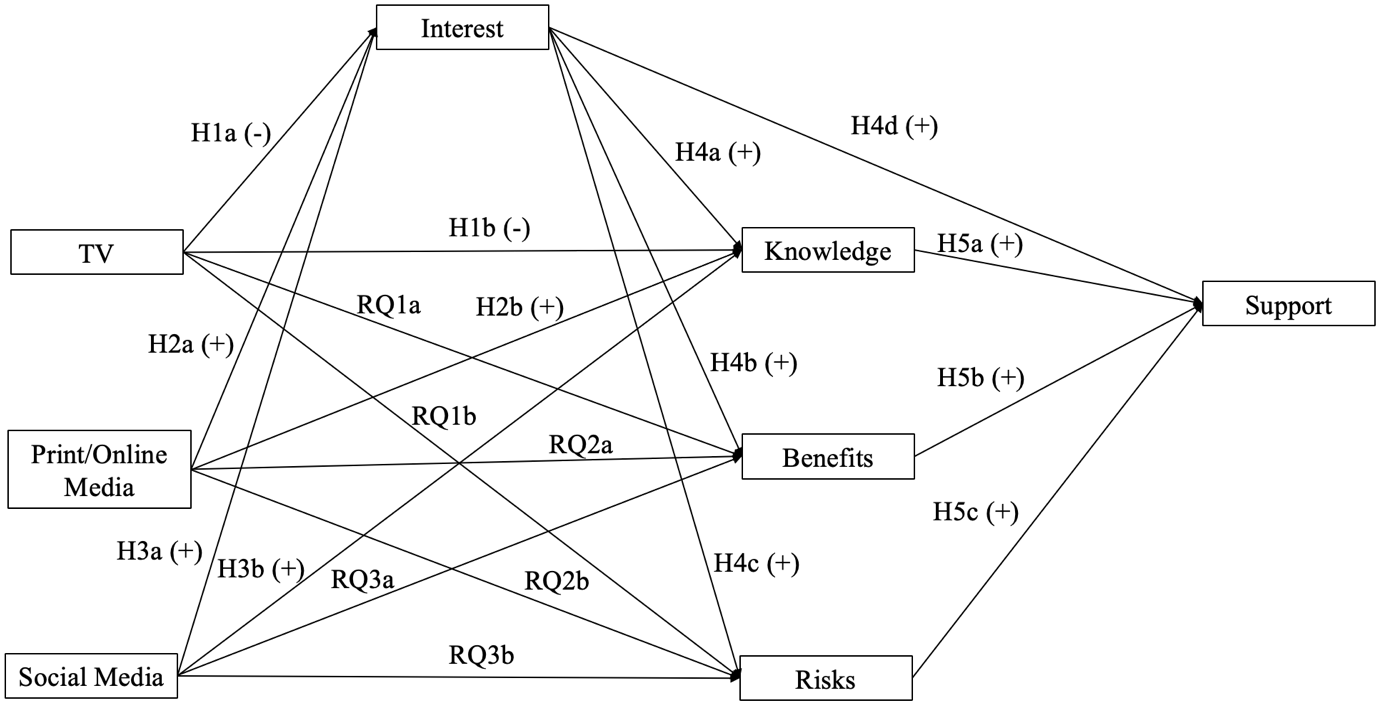
Integration of the O-S-R-O-R, knowledge deficit, and heuristics dominance perspectives suggests that orientational variables can mediate the relationship between media use and response and that interest and cognitive variables (such as knowledge, perceived benefits and risks) may be important mediators. These theoretical frameworks are particularly relevant to study attitudes toward quantum science because we currently do not know how different media use is related to public support or if knowledge or heuristic cues are related to public support in the context of quantum science research. Informed by these perspectives, a serial mediation model is proposed here. First, interest in quantum science is expected to be closely related to media use and to mediate the relationships between media use and cognitive variables as well as support for quantum science. Furthermore, these cognitive variables are expected to mediate the relationships between media use/interest and support for quantum science. These expectations lay the foundation for the theoretical model in Figure 1.
2.3 How media use is related to quantum interest, knowledge, benefit-risk perceptions, and public support
2.3.1 TV news use
TV news has some advantages in communicating science: it focuses on audio and visual presentations, thereby making news stories more vivid than plain text; the language used in broadcast news is also simpler, making news stories more comprehensible to the lay public [Bahrani & Sim, 2011]. But science and technology news on TV tends to be very brief [Verhoeven, 2010], largely fails to provide explanations to scientific concepts [León, 2008], and features a limited presence of experts [Morani et al., 2022]. In sum, although TV makes news more comprehensible to the public, it does not do a decent job of providing in-depth coverage of science.
Consequently, TV news may not be significantly related to science interest. For instance, Chen et al. [2023] found that watching STEM-related TV programs during high school did not have a direct impact on college freshmen’s interest in a STEM career. Notably, Takahashi and Tandoc [2016] even reported a negative relationship between using TV as a main source of science and technology information and science interest.
There is mixed evidence about how TV news use is related to science knowledge. While some scholars have reported a null relationship [Brossard & Nisbet, 2007] or a positive relationship [Su et al., 2015], others have found a negative association [Besley & Shanahan, 2005]. One explanation is informed by the cultivation theory, which argues that TV portrays a distorted reality and displaces other opportunities for more engaged science learning. As a result, heavy TV viewers become less knowledgeable about science [Shanahan et al., 1997]. The political communication literature has similarly shown that voters gain less information from watching TV news than from reading newspapers [Eveland & Scheufele, 2000]. Even quality science content on TV may not lead to more knowledge gain [Miller et al., 2006]. Since quantum knowledge is operationalized as public understanding of key principles and concepts in the current study, TV news will likely not be an adequate source.
There is tentative evidence that TV news may be associated with both more benefit and more risk perceptions of emerging technologies. Liu and Priest [2009] examined seven media sources and only found national TV news to be related to perceived benefits of stem cell research. Brossard and Shanahan [2003] reported that attention to TV news about biotechnology increased concerns over its social implications. But the effects of media use on benefit-risk perceptions may vary by how a specific scientific topic is portrayed on a particular media source. Hence, a research question is proposed below.
- H1:
-
Getting quantum science and technology information from TV news is negatively associated with (a) quantum interest and (b) quantum knowledge.
- RQ1:
-
Is there a relationship between getting quantum science and technology information from TV news and (a) benefit or (b) risk perceptions?
2.3.2 Print and online media use
Print newspapers and online news sites are high in textuality with most of the content taken up by words and at times complemented by visuals. Science bloggers also complement science journalists in providing science news. Compared to TV, print and online media stories are better at providing more in-depth information on complicated scientific topics to stimulate interest and facilitate science learning. Empirical studies have shown that consuming print media is indeed positively associated with both generic science knowledge [Nisbet et al., 2002] and context-specific knowledge [Brossard & Nisbet, 2007; Lee & Scheufele, 2006]. As a matter of fact, getting science and technology information from print and the Internet was found to be the strongest predictor of self-reported science knowledge [Falk & Needham, 2013; Su et al., 2015].
Exploring the coverage of quantum benefits and risks, one study found benefits were not a big part of newspaper coverage of quantum science and risks were an even more obscure focus in Dutch newspapers [Meinsma et al., 2026]. No published research on US print media coverage of quantum science is available.
- H2:
-
Getting quantum science and technology information from print and online media is positively associated with (a) quantum interest and (b) quantum knowledge.
- RQ2:
-
Is there a relationship between getting quantum science and technology information from print and online media and (a) benefit or (b) risk perceptions?
2.3.3 Social media use
Social media provide an alternative avenue for individuals to learn about science and have become significant venues for raising awareness about emerging technologies [Metag, 2020; Mueller-Herbst et al., 2020]. First, social media provide the public with a wide spectrum and large volume of science information, making information seeking more convenient. Second, social media facilitate incidental exposure to science news [Scharkow et al., 2020], which contributes to science knowledge [Anderson et al., 2021]. In addition, information encountered on social media is typically shaped by one’s trusted sources at a level accessible to social media users, making science information more comprehensible and trusted [Huber et al., 2019]. For those who are interested in learning about a specific scientific topic, social media provide both direct access to authoritative sources from scientists and to communities where users engage with others to deepen understanding of science [Martin & MacDonald, 2020]. The empirical evidence strongly supports the conclusion that social media use boosts science interest and knowledge [Jiang, 2024; Li et al., 2024].
Given the lack of analysis of quantum science benefit and risk discussions on social media, a research question is proposed.
- H3:
-
Getting quantum science and technology information from social media is positively associated with (a) quantum interest and (b) quantum knowledge.
- RQ3:
-
Is there a relationship between getting quantum science and technology information from social media and (a) benefit or (b) risk perceptions?
2.3.4 Support for quantum science
Science interest is an important motivational variable that stimulates more science learning. Analysis of data from 12 European countries reveals a moderate positive relationship between interest in science and factual science knowledge [Bauer et al., 1994]. It is fair to anticipate that interest in science will motivate individuals to learn more about potential benefits and risks of a scientific topic and to support scientific research in that area.
- H4:
-
Quantum interest is positively associated with (a) quantum knowledge, (b) benefit perception (c) risk perception, and (d) support for quantum science.
Perceptions of risks and benefits are key attitudes that shape support for emerging technologies [Bao et al., 2022; Howell et al., 2022]. Knowledge and benefit perception are related with strong support for emerging technologies, such as nanotechnology [Lee & Scheufele, 2006] and artificial intelligence [Yang et al., 2025], while risk perception can curtail support for emerging technologies [Featherman et al., 2021; Gupta et al., 2023; Siegrist, 2000]. Quantum science tends to be framed more positively in the mass media: 33.2% benefit mentions versus 5.5% risk mentions in Dutch newspapers [Meinsma et al., 2026] and 34% benefit mentions versus 5% risk mentions in TEDx talks on YouTube [Meinsma et al., 2023]. The benefits mentioned revolved around life sciences, health, energy, and climate issues while the risks tended to focus on security and privacy concerns [Meinsma et al., 2023]. Hence, it is expected that:
- H5:
-
(a) Quantum knowledge and (b) benefit perception are positively associated with support for quantum science while (c) risk perception is negatively associated with support for quantum science.
3 Method
3.1 Data
An online survey was conducted with a quota-based representative sample of US adults on CloudResearch Connect, a reputable market research and online survey platform. The Census-based quota included gender, age, ethnicity, and race. In total, 1,204 respondents completed the survey on Oct. 2 and Oct. 3, 2024. Each participant was paid $3 for completing the survey. The completion rate, the percentage of participants who completed the survey amongst all who accepted the survey task, was 91.81%. Those who failed the attention check question (n = 46) and another respondent who completed the survey in less than one-third of the median response time (n = 1, Mdn = 733 seconds) were removed. After applying these quality control measures, the valid sample included 1,157 respondents.
The consent form stated that the study would ask about knowledge and attitudes toward an emerging technology and that participants did not need to know anything about this topic to complete the study. The survey started with a screening question asking respondents how much they had ever heard, read, or seen quantum science and technology on a 5-point scale: “None at all” (n = 238), “A little” (n = 587), “A moderate amount” (n = 241), “A lot” (n = 71) and “A great deal” (n = 20). Those who answered “None at all” were removed and the remaining data contained only quantum aware publics (n = 919). Data and statistical analysis codes are available on OSF (https://osf.io/bdyrq/?view_only=37ef6f9511fb44869f252bffe0cf964b).
3.2 Sample characteristics
The quantum aware publics in the sample tended to be older (Mdn = 45–54 years old), male (55.82%), White or Caucasian (77.48%), with a bachelor’s degree (41.83%), with a median household income of $50,000–$74,999, never married (42.27%), Independent (26.97%), and politically moderate (20.02%). For those who at least attended some college, 29.73% majored in the science, technology, engineering, and math (STEM) field. More detailed sample characteristics are reported in the Supplementary material.
3.3 Measures
Bivariate correlations between information sources and knowledge/attitudes about quantum science are reported in the Supplementary material; so are specific question wordings.
Information sources. Respondents were asked to indicate, on a 5-point scale from “Never” to “Very frequently”, how often they had heard, read, or seen quantum science and technology information from each of the following sources or places: (1) books (M = 2.12, SD = 1.02), (2) documentaries or films (M = 2.60, SD = 1.01), (3) TV series (M = 2.48, SD = 1.07), (4) games (M = 1.81, SD = 1.04), (5) science blogs or websites (M = 2.60, SD = 1.11), (6) podcasts (M = 1.94, SD = 1.05), (7) local TV (M = 1.60, SD = 0.89), (8) national network TV (e.g., ABC, CBS, NBC) (M = 1.92, SD = 0.94), (9) CNN (M = 1.64, SD = 0.91), (10) MSNBC (M = 1.54, SD = 0.89), (11) FOX News (M = 1.44, SD = 0.85), (12) print or online newspapers (M = 1.94, SD = 0.99), (13) print or online magazines (M = 2.08, SD = 1.03), (14) public radio (e.g., NPR) (M = 1.73, SD = 0.93), (15) Facebook (M = 1.77, SD = 1.01), (16) Instagram (M = 1.65, SD = 1.01), (17) X (formerly Twitter) (M = 1.92, SD = 1.17), (18) YouTube (M = 2.52, SD = 1.20), (19) TikTok (M = 1.59, SD = 1.01), (20) interpersonal discussions with family members (M = 1.82, SD = 1.00), (21) interpersonal discussions with friends (M = 2.03, SD = 1.03), and (22) interpersonal discussions with coworkers (M = 1.67, SD = 0.98). Information source distribution and descriptive statistics are reported in the Supplementary material.
An exploratory factor analysis (EFA) was conducted on these 22 items. The Kaiser rule, the parallel analysis, and the optimal coordinates index all suggested a three-factor solution. A promax rotation and maximum likelihood method revealed a three-factor solution with quite a few cross-loading variables. Items with loadings above .55 on one factor and no more than .32 on another factor were retained [Comrey & Lee, 1992; Tabachnick & Fidell, 2013]. The results, shown in Supplementary material, indicated a clear three-factor interpretation. First, the five social media sites (Facebook, Instagram, X, YouTube, and TikTok) loaded onto one factor, which explained 24% of the total variance. These items were averaged to create a social media use index (α = .88, M = 1.89, SD = 0.89). Next, the five TV news sources (local TV, national network TV, CNN, MSNBC, and FOX News) loaded onto the second factor, which explained 17% of the total variance. These items were averaged to create a TV news use index (α = .92, M = 1.63, SD = 0.78). Last, science blogs or websites, print or online newspapers, and print or online magazines loaded onto the third factor, which explained 16% of the total variance. These items were also averaged to create a print and online media use index (α = .79, M = 2.21, SD = 0.87).
Interest in quantum science and technology. Respondents were asked, on a 7-point scale from “Strongly disagree” to “Strongly agree”, the extent to which they agreed with five statements (e.g., “I am interested in learning about quantum science and technology.”). These items, adapted from Meinsma et al. [2024], were averaged to create an index (α = .93, M = 5.31, SD = 1.16).
Quantum knowledge. Respondents were asked two True/False and four multiple-choice questions to test their objective factual knowledge of quantum science and technology. Some questions were self-developed after reviewing relevant domain literature and some were adapted from prior research [van de Merbel et al., 2024]; all questions were reviewed by two quantum scientists. Correct answers were coded as 1 and incorrect or “Don’t Know” answers were coded as 0. Correct answers were summed up to create an index (M = 3.03, SD = 1.67).
Benefit perception. Respondents were asked to indicate, on a 5-point scale from “Not beneficial at all” to “Extremely beneficial”, how beneficial they thought quantum science and technology would be for (1) society as a whole and (2) them personally. These items, adapted from Choi [2024], were averaged to create an index (r = .67, p < .001, M = 3.43, SD = 0.94).
Risk perception. Respondents were asked to indicate, on a 5-point scale from “Not serious at all” to “Extremely serious”, how serious of a threat they thought quantum science and technology would be for (1) society as a whole and (2) them personally. These items, adapted from Choi [2024], were averaged to create an index (r = .79, p < .001, M = 1.96, SD = 0.93).
Support for quantum science. Respondents were asked, on a 7-point scale from “Strongly disagree” to “Strongly agree”, the extent to which they agreed with four statements (e.g., “I support federal funding for basic quantum science and technology research). These items, adapted from previous research [Boudet et al., 2014; Choi, 2024], were averaged to create an index (α = .93, M = 5.64, SD = 1.07).
Predispositional controls. Following prior research [Akin et al., 2021], data analysis also controlled for party identification, political ideology, religiosity, and deference to scientific authority. Party identification was recoded into a 5-point scale from “Strong Democrat” to “Strong Republican” (M = 2.62, SD = 1.32). Political ideology was measured by a 7-point scale from “Very liberal” to “Very conservative” (M = 3.47, SD = 1.78). Religiosity was measured by asking respondents to indicate, on a 7-point scale from “No guidance at all” to “A great deal of guidance”, how much guidance religion provided in their everyday life (M = 3.50, SD = 2.29). Adapted from Howell et al. [2020], deference to scientific authority was measured by asking respondents, on a 7-point Likert scale, their agreement with four statements (e.g., “Scientists know best what is good for the public.”) (α = .83, M = 4.74, SD = 1.16).
Demographic controls. Age was measured by a 6-point scale (Mdn = 45–54 years old, M = 3.51, SD = 1.57). Gender was binary coded so that male was coded as 1 and the other options were coded as 0 (M = 0.56, SD = 0.50). Race was binary coded so that “White or Caucasian” was coded as 1 and all other racial categories were coded as 0 (M = 0.77, SD = 0.42). Education was measured by a 6-point scale (M = 4.38, SD = 1.21). For those who have at least “some college, but no degree”, they were also asked if their majors in college were in the STEM field or not. STEM major was coded as 1 and the other options were coded as 0 (M = 0.27, SD = 0.20). Household income was measured by a 6-point scale (Mdn = $50,000–$74,999, M = 3.36, SD = 1.52). Marital status was measured by coding “Married” as 1 and all other categories as 0 (M = 0.39, SD = 0.49).
3.4 Analytical strategy
Path analysis was run with the lavaan package in R to test the theoretical model in Figure 1. In addition to the three exogenous media use variables, all endogenous variables were also regressed on the predispositional and demographic controls, including age, gender, race, education, STEM major, household income, marital status, party identification, political ideology, religiosity, and deference to scientific authority. The model was estimated with maximum likelihood with robust standard errors (MLR). Model fit was judged based on a variety of fit indices. Since the χ2 fit statistic is more likely to be statistically significant when the sample size gets bigger [Byrne, 2012], other alternative fit indices were also consulted. The following cutoff thresholds for some commonly reported fit indices were adopted for this study: Root Mean Square Error of Approximation (RMSEA) < .06, Comparative Fit Index (CFI) > .95, Tucker-Lewis Index (TLI) > .95, and Standardized Root Mean Square Residual (SRMR) < .08 [Hair et al., 2010; Hu & Bentler, 1999].
4 Results
4.1 Model fit
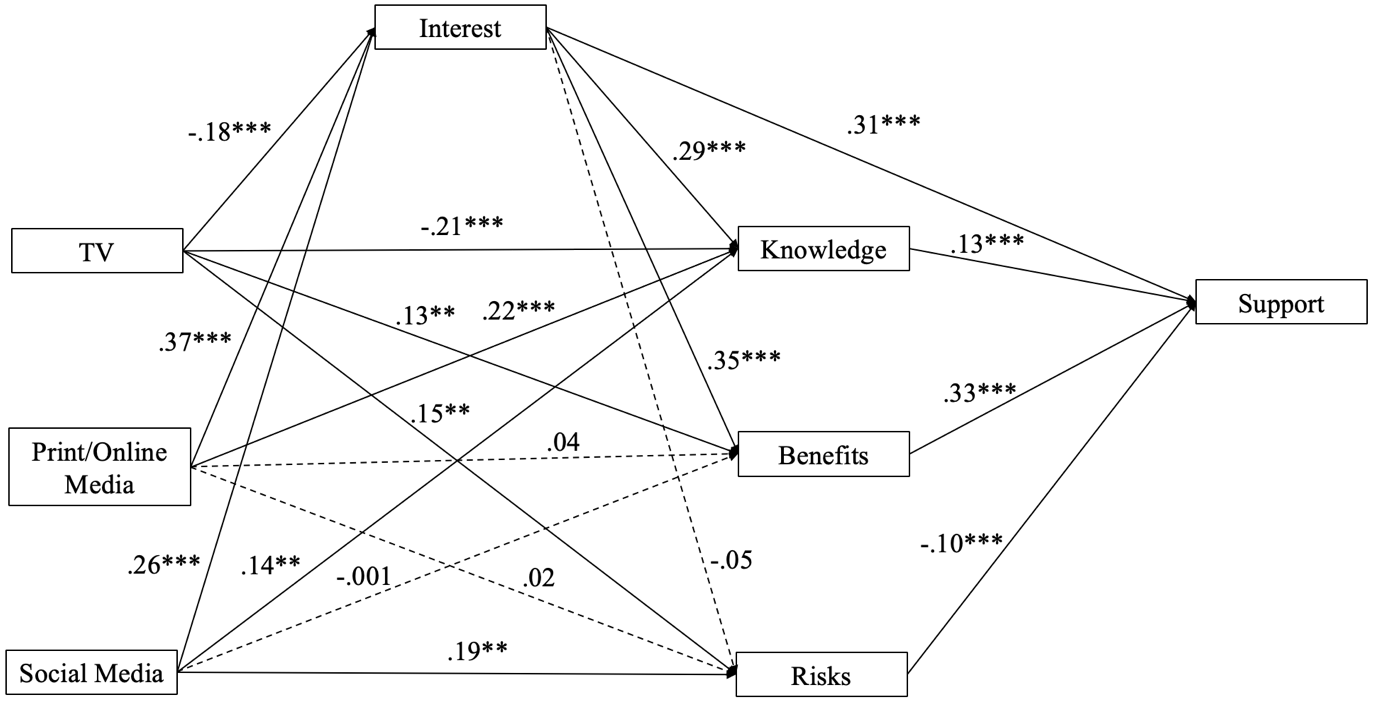
The χ2 test of the model fit was statistically significant (robust χ2(6,N = 919) = 15.37, p = .02). An examination of the alternative fit indices indicated a good model fit: robust RMSEA = .04, robust CFI = .99, robust TLI = .93, and SRMR = .006. Although robust TLI was slightly below the preferred cutoff criterion of .95, Bentler and Bonett [1980] suggested that TLI > .90 was also acceptable. Hence, the theoretical model fit the data well. The final model with standardized path coefficients is shown in Figure 2.
4.2 Hypothesis testing
First, H1 and RQ1 focused on TV news use. Results show that getting quantum science and technology information from TV news channels was negatively associated with both quantum interest (B = -0.27, SE = 0.06, β = -.18, p < .001) and quantum knowledge (B = -0.44, SE = 0.09, β = -.21, p < .001), lending support to H1a and H1b. In response to RQ1, TV news use was positively associated with both perceived benefits (B = 0.16, SE = 0.05, β = 0.13, p = .002) and perceived risks (B = 0.18, SE = 0.07, β = .15, p = .007).
H2 and RQ2 focused on print and online media use. Results show that using print and online media to get information about quantum science and technology was positively associated with both quantum interest (B = 0.48, SE = 0.06, β = .37, p < .001) and quantum knowledge (B = 0.41, SE = 0.08, β = .22, p < .001), lending support to H2a and H2b. In response to RQ2, print and online media use was not associated with either perceived benefits (B = 0.04, SE = 0.05, β = .04, p = .41) or perceived risks (B = 0.02, SE = 0.05, β = .02, p = .72).
Next, H3 and RQ3 focused on social media use. Results show that using social media to get information about quantum science and technology was positively associated with quantum interest (B = 0.33, SE = 0.06, β = .26, p < .001) and quantum knowledge (B = 0.26, SE = 0.09, β = .14, p = .005), lending support to H3a and H3b. In response to RQ3, social media use was not related to perceived benefits (B = -0.001, SE = 0.05, β = -.001, p = .99) but was positively associated with perceived risks (B = 0.19, SE = 0.06, β = .19, p = .001).
In terms of mediators, interest in quantum science and technology was positively associated with knowledge (B = 0.41, SE = 0.05, β = .29, p < .001), perceived benefits (B = 0.28, SE = 0.03, β = .35, p < .001) and support for quantum science (B = 0.28, SE = 0.03, β = .31, p < .001), but was not related to perceived risks (B = -0.04, SE = 0.03, β = -.05, p = .24). Hence, H4a, H4b and H4d were supported, but H4c was not.
Last, in addition to its positive relationship with quantum interest, support for quantum science was also positively associated with factual quantum science knowledge (B = 0.08, SE = 0.02, β = .13, p < .001) and perceived benefits (B = 0.37, SE = 0.04, β = .33, p < .001), but was negatively associated with perceived risks (B = -0.12, SE = 0.03, β = -.10, p < .001). These finding supported H5a, H5b, and H5c.
4.3 Additional analysis: indirect and total effects
All the indirect and total effects in the serial mediation model were also estimated. Complete results are reported in the Supplementary material.
Findings reveal that, when all indirect relationships are considered, relying on TV news for quantum science and technology information was negatively correlated with quantum science knowledge (B = -0.55, SE = 0.09, β = -.26, p < .001), positively associated with perceived risks (B = 0.19, SE = 0.07, β = .16, p = .004), and not related to perceived benefits (B = 0.08, SE = 0.06, β = .07, p = .13). For total effects, TV news use was negatively associated with support for quantum science (B = -0.11, SE = 0.04, β = -.08, p = .004).
Next, relying on print and online media for quantum science and technology information was positively associated with knowledge (B = 0.61, SE = 0.08, β = .32, p < .001) and perceived benefits (B = 0.18, SE = 0.05, β = .16, p < .001), but not related to perceived risks (B = 0.001, SE = 0.05, β = .001, p = .99). For total effects, print and online media use was positively associated with support for quantum science (B = 0.25, SE = 0.03, β = .21, p < .001).
Turning to social media use, results show that getting quantum science and technology from social media was positively associated with knowledge (B = 0.39, SE = 0.09, β = .21, p < .001) and perceived risks (B = 0.18, SE = 0.06, β = .18, p = .002), but not related to perceived benefits (B = 0.09, SE = 0.05, β = .09, p = .082). For total effects, social media use was positively associated with support for quantum science (B = 0.14, SE = 0.04, β = .12, p < .001).
Last, when all indirect relationships are combined, quantum interest was positively associated with support for quantum science (B = 0.43, SE = 0.03, β = .46, p < .001).
4.4 Additional analysis: alternative models
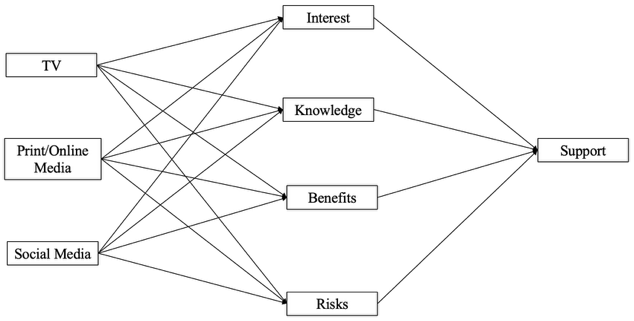
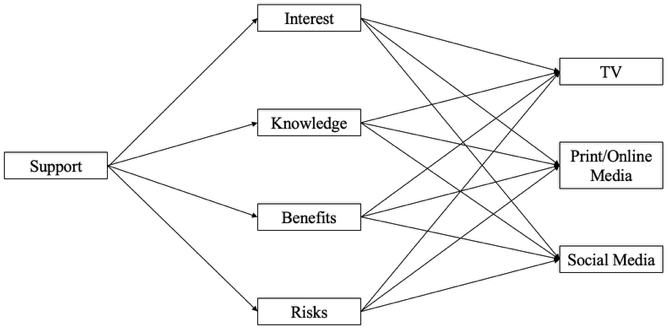
Path models estimated with cross-sectional data do not lend support to causal inferences. For instance, it is possible that knowledge of quantum science or attitudes drive individuals to different media channels. Hence, four plausible alternative models were estimated. In Alternative Model 1, a one-step mediation model was estimated instead of a serial mediation process. In Alternative Model 2, the directions of all paths in Alternative Model 1 were reversed. In Alternative Model 3, the directions of all paths in Figure 2 were reversed. Last, in Alternative Model 4, interest was designated the primary motivational variable that affected media use, knowledge, benefit/risk perceptions, and support. These model diagrams are depicted in Figure 3.
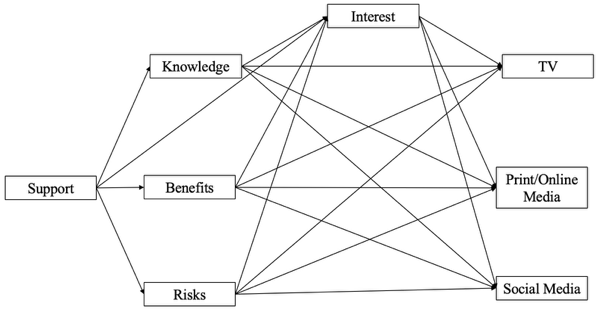
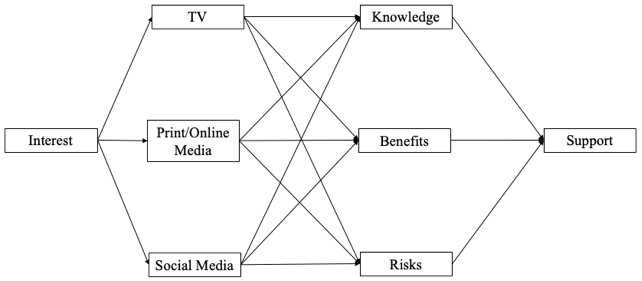
The Akaike Information Criterion (AIC), Bayesian Information Criterion (BIC), and other fit indices of the final model and four alternative models are reported in Table 1. A lower AIC or BIC value indicates a better fitting model [Byrne, 2012]. The results show that the AIC and BIC values of the four alternative models were all larger than those of the final model specified in Figure 2. In addition, the robust RMSEA values of Alternative Models 1, 2, and 4 failed to meet the cutoff threshold and the robust CFI values of Alternative Models 1 and 4 were also not satisfactory. None of the robust TLI values met the threshold, but the value in the Alternative Model 3 was close to that in the final model. Taken together, the final model specified in this paper fit the data much better than these alternative models.
| Models | AIC | BIC | RMSEA | CFI | TLI | SRMR | χ2 |
| Final Model | 11670.597 | 12047.217 | .044 | .994 | .926 | .006 | 15.367∗ |
| Alt Model 1 | 11843.369 | 12205.687 | .154 | .896 | .072 | .030 | 177.603∗∗∗ |
| Alt Model 2 | 14507.241 | 14998.277 | .108 | .970 | .648 | .019 | 93.745∗∗∗ |
| Alt Model 3 | 14432.529 | 14937.867 | .051 | .995 | .920 | .008 | 19.163∗∗ |
| Alt Model 4 | 15120.895 | 15592.862 | .303 | .677 | -1.608 | .064 | 890.080∗∗∗ |
5 Discussion
The current study aims to examine how different information sources are related to public attitudes toward quantum science. Consistent with the O-S-R-O-R framework [Cho et al., 2009], the relationships between mass media (Stimulus) and support for quantum science (Response) were mediated through motivational and cognitive variables, including interest, knowledge, benefit perception, and risk perception (Second Orientation). Besley et al. [2024] reported that interest was the most important immediate goal for communicating basic science. Findings from this study showed that interest indeed mediated the relationships between media use and quantum science knowledge and attitudes.
The fact that quantum science knowledge and benefit-risk perceptions were related to support for quantum science also suggests that both the deficit model and the heuristic dominance model might be at work and that central/systematic and peripheral/heuristic processing indeed co-occurred. Even after controlling for value variables, such as deference to scientific authority, objective factual knowledge was still a positive correlate of support for quantum science. This is consistent with earlier work that showed similar results with nuclear energy, nanotechnology [Akin et al., 2021] and autonomous vehicles [Tan et al., 2024]. Notably, benefit and risk perceptions were important heuristics. Comparison of standardized coefficients showed that the benefit heuristic was more strongly associated with support for quantum science than factual knowledge (and deference to scientific authority), upholding the heuristics dominance framework. Although risk perception was a negative correlate of support for quantum science, it played a less important role compared to the benefit heuristic and factual knowledge. These findings are consistent with earlier work on the relationship between benefit-risk heuristic and support for emerging technologies [Featherman et al., 2021; Gupta et al., 2023; Siegrist, 2000]. Taken together, the co-occurrence of both the knowledge deficit and heuristic dominance models suggests that these are not competing models per se, but complementary ones. For science communicators working to engage the public on quantum science, the best practice is not either/or but both. To a certain extent, benefit heuristics may make up for the lack of factual knowledge on quantum science. Indeed, a seminal article studying the power of heuristics showed that information shortcuts, such as knowing the official position of the insurance industry on insurance reforms, enabled ill-informed publics to make decisions similar to well-informed ones in voting on insurance reform propositions [Lupia, 1994].
The study results also provide tentative evidence for the public’s critical or reflexive engagement with quantum science. The finding that social media use was positively associated with both factual knowledge and perceived risks about quantum science suggests that the public could become more informed and more concerned about quantum science at the same time. However, the total effects of social media use on support for quantum science were still positive, suggesting that awareness of scientific uncertainties did not necessarily dampen endorsement of scientific advancement. This public reflexivity is not unique to quantum science; it has been observed in public understanding of other scientific issues, such as nanotechnology [Doubleday, 2007].
Getting quantum science and technology information from TV had some negative correlates. It was negatively associated with quantum interest and knowledge while print/online media use and social media use were both positively correlated. When all indirect relationships were combined with regard to support for quantum science, the same pattern emerged: TV news use was negatively associated with support while the other two media types were both positively correlated. These results confirmed prior research that highlighted the limits of TV news for science learning [Besley & Shanahan, 2005; Takahashi & Tandoc, 2016] and the benefits of print/online media and social media [Jiang, 2024; Li et al., 2024; Su et al., 2015]. This study revealed that the top three information sources for quantum science information were documentaries, science blogs or websites, and YouTube.
It is also important to point out that different types of media use associated with benefit-risk perceptions differently. Benefit and risk perceptions are two concepts often researched in the context of emerging technologies but not in prior applications of the O-S-R-O-R model. TV news was the only source related to benefit perception of quantum science and technology, while neither print/online media or social media use was a significant correlate, confirming Liu and Priest [2009] who found only exposure to national TV news predicted perceived benefits of stem cell research. In addition, both TV news and social media use were related to risk perception of quantum science and technology. The results about TV news echoed findings from Brossard and Shanahan [2003] while social media’s relationship with risk perception about quantum science was a novel finding. Given the dearth of research examining benefit and risk discussions of quantum science on different social media platforms, researchers are encouraged to conduct more media content analysis studies to help the quantum science community better understand what kind of benefits and risks are discussed there.
The findings reported in this study should be interpreted with several limitations in mind. First, even though the theoretical model in this paper specified a process-based mediation mechanism, the nature of the cross-sectional survey design reported in this study is insufficient to support any causal inferences. Hence, readers should be careful not to infer causal claims from the correlational findings. For instance, instead of TV use predicting low interest in quantum science, the reverse causation may also be plausible that individuals with preexisting low interest in quantum science are more likely to get quantum science information from TV. In a similar vein, a large portion of respondents had never or rarely been exposed to quantum science information from mass media channels, including some social media platforms. Hence, those who do get quantum science information from social media may be highly interested in or knowledgeable about the topic to begin with. In other words, it is the interest and knowledge that drove people to consume social media rather than social media use enhancing interest or knowledge. Future research can measure active information seeking behaviour, which may help shed more light on these relationships. Admittedly, these relationships may also be reciprocal. The Reinforcing Spirals Model [Slater, 2007, 2015] and the Differential Susceptibility to Media Effects Model [Valkenburg & Peter, 2013] both suggest spiral, dynamic effects between media use and attitudes. This study did not build upon these frameworks because the cross-sectional nature of the data was not suited for testing these models. Future research can take advantage of a panel survey design or an experimental design to provide a causal test of the relationships in the model specified in this paper or these alternative spiral, dynamic models.
Second, this study did not delve into the individual dispositions or sociodemographic variables that predicted information seeking from different channels or the mental elaboration and collective consideration involved in processing quantum science information. Future research can identify and test relevant orientation and reasoning variables for quantum science communication in the O-S-R-O-R framework. A useful addition can be the role of expectation disconfirmation in reasoning. Scholars have posited that trust and support may suffer when hyped expectations about emerging technologies are not met, but little empirical evidence is available to support this claim [Chakraborty & Zhang, 2025].
Third, the current research zeroed in on cognitive variables. Prior research demonstrated that affect could impact media message processing in profound ways [Adegbola & Zhang, 2023]. Future research can expand the O-S-R-O-R model to incorporate affective mechanisms.
Fourth, this study measured information seeking from multiple information sources but did not specify the type of content sought (e.g., hard news vs. soft news, news vs. documentaries). Using science-focused channels, such as the Discovery Channel or Public Broadcasting Service, or seeing science documentaries versus news on YouTube, may be positively related to science interest and knowledge. By contrast, consuming entertainment content from TV may not be related to science learning. Future research can investigate effects of different content genres on science knowledge and attitudes.
Last, party identification, political ideology, religiosity, and deference to scientific authority were treated as control variables in this study. Prior research suggested that these personal values could interact with media use in shaping public attitudes toward emerging technologies [Akin et al., 2021]. Future research can test moderated mediation mechanisms that may be at play when individuals process quantum science information from mass media.
Overall, the results from this study have significant theoretical and practical implications. Theoretically, it applied the O-S-R-O-R framework, developed in political communication, to science communication and integrated the deficit and heuristic dominance perspectives to advance our understanding of how individuals processed science and technology information from mass media. Practically, it revealed top mass media sources for the public to get information about quantum science, which may help science communicators better reach interested publics on quantum science. The tentative findings reported in this exploratory study can be useful for future research to further explicate the intricate relationships between media use and public support for emerging technologies.
Acknowledgments
This study is supported by the University of Nebraska-Lincoln’s Grand Challenges catalyst award entitled “Quantum Approaches Addressing Global Threats”.
References
-
Adegbola, O., & Zhang, W. (2023). An angry, hopeful, or efficacious citizen: information, emotion, and participation in an emerging democracy. Social Media + Society, 9(4). https://doi.org/10.1177/20563051231213560
-
Akin, H., Cacciatore, M. A., Yeo, S. K., Brossard, D., Scheufele, D. A., & Xenos, M. A. (2021). Publics’ support for novel and established science issues linked to perceived knowledge and deference to science. International Journal of Public Opinion Research, 33(2), 422–431. https://doi.org/10.1093/ijpor/edaa010
-
Anderson, J. T. L., Howell, E. L., Xenos, M. A., Scheufele, D. A., & Brossard, D. (2021). Learning without seeking?: Incidental exposure to science news on social media & knowledge of gene editing. JCOM, 20(04), A01. https://doi.org/10.22323/2.20040201
-
Ashwell, D. J. (2016). The challenges of science journalism: the perspectives of scientists, science communication advisors and journalists from New Zealand. Public Understanding of Science, 25(3), 379–393. https://doi.org/10.1177/0963662514556144
-
Bahrani, T., & Sim, T. S. (2011). The role of audiovisual mass media news in language learning. English Language Teaching, 4(2), 260–266. https://doi.org/10.5539/elt.v4n2p260
-
Bao, L., Krause, N. M., Calice, M. N., Scheufele, D. A., Wirz, C. D., Brossard, D., Newman, T. P., & Xenos, M. A. (2022). Whose AI? How different publics think about AI and its social impacts. Computers in Human Behavior, 130, 107182. https://doi.org/10.1016/j.chb.2022.107182
-
Bauer, M., Durant, J., & Evans, G. (1994). European public perceptions of science. International Journal of Public Opinion Research, 6(2), 163–186. https://doi.org/10.1093/ijpor/6.2.163
-
Bentler, P. M., & Bonett, D. G. (1980). Significance tests and goodness of fit in the analysis of covariance structures. Psychological Bulletin, 88(3), 588–606. https://doi.org/10.1037/0033-2909.88.3.588
-
Besley, J. C., & Shanahan, J. (2005). Media attention and exposure in relation to support for agricultural biotechnology. Science Communication, 26(4), 347–367. https://doi.org/10.1177/1075547005275443
-
Besley, J. C., Yeo, S. K., Newman, T. P., & Dudo, A. (2024). The challenge of identifying behavioral goals for communication in the context of basic science. JCOM, 23(07), Y02. https://doi.org/10.22323/2.23070402
-
Beyer, A. R., Fasolo, B., de Graeff, P. A., & Hillege, H. L. (2015). Risk attitudes and personality traits predict perceptions of benefits and risks for medicinal products: a field study of European medical assessors. Value in Health, 18(1), 91–99. https://doi.org/10.1016/j.jval.2014.10.011
-
Boudet, H., Clarke, C., Bugden, D., Maibach, E., Roser-Renouf, C., & Leiserowitz, A. (2014). “Fracking” controversy and communication: using national survey data to understand public perceptions of hydraulic fracturing. Energy Policy, 65, 57–67. https://doi.org/10.1016/j.enpol.2013.10.017
-
Bromley-Trujillo, R., & Karch, A. (2021). Salience, scientific uncertainty, and the agenda-setting power of science. Policy Studies Journal, 49(4), 992–1018. https://doi.org/10.1111/psj.12373
-
Brossard, D., & Nisbet, M. C. (2007). Deference to scientific authority among a low information public: understanding U.S. opinion on agricultural biotechnology. International Journal of Public Opinion Research, 19(1), 24–52. https://doi.org/10.1093/ijpor/edl003
-
Brossard, D., & Shanahan, J. (2003). Do citizens want to have their say? Media, agricultural biotechnology, and authoritarian views of democratic processes in science. Mass Communication and Society, 6(3), 291–312. https://doi.org/10.1207/s15327825mcs0603_4
-
Brüggemann, M., Lörcher, I., & Walter, S. (2020). Post-normal science communication: exploring the blurring boundaries of science and journalism. JCOM, 19(03), A02. https://doi.org/10.22323/2.19030202
-
Byrne, B. M. (2012). Structural equation modeling with Mplus: basic concepts, applications, and programming. Routledge. https://doi.org/10.4324/9780203807644
-
Chaiken, S. (1980). Heuristic versus systematic information processing and the use of source versus message cues in persuasion. Journal of Personality and Social Psychology, 39(5), 752–766. https://doi.org/10.1037/0022-3514.39.5.752
-
Chakraborty, D., & Zhang, J. Z. (2025). When hope matters: moderating effects on expectation disconfirmation, trust, and continuance usage in AR fashion apps. Electronic Commerce Research. https://doi.org/10.1007/s10660-025-10023-1
-
Chen, A., Zhang, X., & Jin, J. (2025). Public opinion outweighs knowledge: a dual-process framework for understanding acceptance of genetic modification among scientists and laypeople. Risk Analysis, 45(7), 1850–1860. https://doi.org/10.1111/risa.17704
-
Chen, C., Hardjo, S., Sonnert, G., Hui, J., & Sadler, P. M. (2023). The role of media in influencing students’ STEM career interest. International Journal of STEM Education, 10(1), 56. https://doi.org/10.1186/s40594-023-00448-1
-
Chen, H.-T. (2021). Second screening and the engaged public: the role of second screening for news and political expression in an O-S-R-O-R model. Journalism & Mass Communication Quarterly, 98(2), 526–546. https://doi.org/10.1177/1077699019866432
-
Cho, J., Shah, D. V., McLeod, J. M., McLeod, D. M., Scholl, R. M., & Gotlieb, M. R. (2009). Campaigns, reflection, and deliberation: advancing an O-S-R-O-R model of communication effects. Communication Theory, 19(1), 66–88. https://doi.org/10.1111/j.1468-2885.2008.01333.x
-
Choi, S. (2024). Temporal framing in balanced news coverage of artificial intelligence and public attitudes. Mass Communication and Society, 27(2), 384–405. https://doi.org/10.1080/15205436.2023.2248974
-
Comrey, A. L., & Lee, H. B. (1992). A first course in factor analysis (2nd ed.). Lawrence Erlbaum Associates Publishers. https://doi.org/10.4324/9781315827506
-
Doubleday, R. (2007). Risk, public engagement and reflexivity: alternative framings of the public dimensions of nanotechnology. Health, Risk & Society, 9(2), 211–227. https://doi.org/10.1080/13698570701306930
-
Eveland, W. P., & Scheufele, D. A. (2000). Connecting news media use with gaps in knowledge and participation. Political Communication, 17(3), 215–237. https://doi.org/10.1080/105846000414250
-
Falk, J. H., & Needham, M. D. (2013). Factors contributing to adult knowledge of science and technology. Journal of Research in Science Teaching, 50(4), 431–452. https://doi.org/10.1002/tea.21080
-
Featherman, M., Jia, S., Califf, C. B., & Hajli, N. (2021). The impact of new technologies on consumers beliefs: reducing the perceived risks of electric vehicle adoption. Technological Forecasting and Social Change, 169, 120847. https://doi.org/10.1016/j.techfore.2021.120847
-
Fung, T. K. F., Leung, H. M., Zhou, X., & Zheng, S. (2025). “What might happen with generative AI?” Examining the role of prefactual thinking in the cognitive mediation model in the context of emerging technologies. Science Communication. https://doi.org/10.1177/10755470251362368
-
Genus, A., & Stirling, A. (2018). Collingridge and the dilemma of control: towards responsible and accountable innovation. Research Policy, 47(1), 61–69. https://doi.org/10.1016/j.respol.2017.09.012
-
Gupta, S., Pandey, D. K., El Ammari, A., & Sahu, G. P. (2023). Do perceived risks and benefits impact trust and willingness to adopt CBDCs? Research in International Business and Finance, 66, 101993. https://doi.org/10.1016/j.ribaf.2023.101993
-
Gustafson, E. (2025). Communicating the quantum world: a news framing analysis of recent developments in quantum technologies. Utah Journal of Communication, 3(1), 18–25. https://doi.org/10.5281/zenodo.15312243
-
Hair, J. F., Black, W. C., Babin, B. J., & Anderson, R. E. (2010). Multivariate data analysis (7th ed.). Prentice Hall.
-
Ho, S. S., Xiong, R., & Chuah, A. S. F. (2021). Heuristic cues as perceptual filters: factors influencing public support for nuclear research reactor in Singapore. Energy Policy, 150, 112111. https://doi.org/10.1016/j.enpol.2020.112111
-
Howell, E. L., Kohl, P., Scheufele, D. A., Clifford, S., Shao, A., Xenos, M. A., & Brossard, D. (2022). Enhanced threat or therapeutic benefit? Risk and benefit perceptions of human gene editing by purpose and heritability of edits. Journal of Risk Research, 25(2), 139–155. https://doi.org/10.1080/13669877.2020.1806911
-
Howell, E. L., Wirz, C. D., Scheufele, D. A., Brossard, D., & Xenos, M. A. (2020). Deference and decision-making in science and society: how deference to scientific authority goes beyond confidence in science and scientists to become authoritarianism. Public Understanding of Science, 29(8), 800–818. https://doi.org/10.1177/0963662520962741
-
Hu, L.-t., & Bentler, P. M. (1999). Cutoff criteria for fit indexes in covariance structure analysis: conventional criteria versus new alternatives. Structural Equation Modeling: a Multidisciplinary Journal, 6(1), 1–55. https://doi.org/10.1080/10705519909540118
-
Huber, B., Barnidge, M., Gil de Zúñiga, H., & Liu, J. (2019). Fostering public trust in science: the role of social media. Public Understanding of Science, 28(7), 759–777. https://doi.org/10.1177/0963662519869097
-
Jiang, S. (2024). Does social media promote or hinder health learning? The roles of media attention, information discussion, information elaboration, and information seeking experience. Mass Communication and Society, 27(4), 627–652. https://doi.org/10.1080/15205436.2022.2090961
-
Jones-Jang, S. M., Hart, P. S., Feldman, L., & Moon, W.-K. (2020). Diversifying or reinforcing science communication? Examining the flow of frame contagion across media platforms. Journalism & Mass Communication Quarterly, 97(1), 98–117. https://doi.org/10.1177/1077699019874731
-
Kim, B., Barnidge, M., & Kim, Y. (2020). The communicative processes of attempted political persuasion in social media environments: the mediating roles of cognitive elaboration and political orientations. Information Technology & People, 33(2), 813–828. https://doi.org/10.1108/itp-03-2018-0157
-
Lee, C.-J., & Scheufele, D. A. (2006). The influence of knowledge and deference toward scientific authority: a media effects model for public attitudes toward nanotechnology. Journalism & Mass Communication Quarterly, 83(4), 819–834. https://doi.org/10.1177/107769900608300406
-
León, B. (2008). Science related information in European television: a study of prime-time news. Public Understanding of Science, 17(4), 443–460. https://doi.org/10.1177/09636625056073089
-
Li, F., Owen, R., & Shaw, G. (2023). Framings of innovation, responsibility, and responsible innovation in China: insights from a case study undertaken with Chinese businesses. Journal of Responsible Innovation, 10(1), 2217594. https://doi.org/10.1080/23299460.2023.2217594
-
Li, W., Xu, S., Zheng, X., & Sun, R. (2024). Bridging the knowledge gap in artificial intelligence: the roles of social media exposure and information elaboration. Science Communication, 46(4), 399–430. https://doi.org/10.1177/10755470241232352
-
Liu, H., & Priest, S. (2009). Understanding public support for stem cell research: media communication, interpersonal communication and trust in key actors. Public Understanding of Science, 18(6), 704–718. https://doi.org/10.1177/0963662508097625
-
Lupia, A. (1994). Shortcuts versus encyclopedias: information and voting behavior in California insurance reform elections. American Political Science Review, 88(1), 63–76. https://doi.org/10.2307/2944882
-
Martin, C., & MacDonald, B. H. (2020). Using interpersonal communication strategies to encourage science conversations on social media. PLoS ONE, 15(11), e0241972. https://doi.org/10.1371/journal.pone.0241972
-
Meinsma, A. L., Albers, C. J., Vermaas, P., Smeets, I., & Cramer, J. (2024). The effect of frames on engagement with quantum technology. arXiv. https://doi.org/10.48550/arXiv.2404.14104
-
Meinsma, A. L., Kristensen, S. W., Reijnierse, W. G., Smeets, I., & Cramer, J. (2023). Is everything quantum ‘spooky and weird’? An exploration of popular communication about quantum science and technology in TEDx talks. Quantum Science and Technology, 8(3), 035004. https://doi.org/10.1088/2058-9565/acc968
-
Meinsma, A. L., Rothe, T., Reijnierse, W. G., Smeets, I., & Cramer, J. (2026). Quantum in the media: a content analysis of Dutch newspapers. Science Communication, 48(1), 128–147. https://doi.org/10.1177/10755470251318300
-
Menezes, S. (2018). Science training for journalists: an essential tool in the post-specialist era of journalism. Frontiers in Communication, 3, 4. https://doi.org/10.3389/fcomm.2018.00004
-
Metag, J. (2020). What drives science media use? Predictors of media use for information about science and research in digital information environments. Public Understanding of Science, 29(6), 561–578. https://doi.org/10.1177/0963662520935062
-
Miller, J. D., Augenbraun, E., Schulhof, J., & Kimmel, L. G. (2006). Adult science learning from local television newscasts. Science Communication, 28(2), 216–242. https://doi.org/10.1177/1075547006294461
-
Morani, M., Cushion, S., Kyriakidou, M., & Soo, N. (2022). Expert voices in the news reporting of the coronavirus pandemic: a study of UK television news bulletins and their audiences. Journalism, 23(12), 2513–2532. https://doi.org/10.1177/14648849221127629
-
Mueller-Herbst, J. M., Xenos, M. A., Scheufele, D. A., & Brossard, D. (2020). Saw it on Facebook: the role of social media in facilitating science issue awareness. Social Media + Society, 6(2). https://doi.org/10.1177/2056305120930412
-
Nisbet, M. C., Scheufele, D. A., Shanahan, J., Moy, P., Brossard, D., & Lewenstein, B. V. (2002). Knowledge, reservations, or promise?: A media effects model for public perceptions of science and technology. Communication Research, 29(5), 584–608. https://doi.org/10.1177/009365002236196
-
Petty, R. E., & Cacioppo, J. T. (1986). Communication and persuasion: central and peripheral routes to attitude change. Springer. https://doi.org/10.1007/978-1-4612-4964-1
-
Popa, E. O., van Hilten, M., Oosterkamp, E., & Bogaardt, M.-J. (2021). The use of digital twins in healthcare: socio-ethical benefits and socio-ethical risks. Life Sciences, Society and Policy, 17(1), 6. https://doi.org/10.1186/s40504-021-00113-x
-
Purohit, A., Kaur, M., Seskir, Z. C., Posner, M. T., & Venegas-Gomez, A. (2023). Building a quantum-ready ecosystem. IET Quantum Communication, 5(1), 1–18. https://doi.org/10.1049/qtc2.12072
-
Roberson, T. (2023). Talking about responsible quantum: “Awareness is the absolute minimum that… we need to do”. NanoEthics, 17(1), 2. https://doi.org/10.1007/s11569-023-00437-2
-
Roberson, T. M. (2021). On the social shaping of quantum technologies: an analysis of emerging expectations through grant proposals from 2002–2020. Minerva, 59(3), 379–397. https://doi.org/10.1007/s11024-021-09438-5
-
Scharkow, M., Mangold, F., Stier, S., & Breuer, J. (2020). How social network sites and other online intermediaries increase exposure to news. Proceedings of the National Academy of Sciences, 117(6), 2761–2763. https://doi.org/10.1073/pnas.1918279117
-
Scheufele, D. A. (2022). Thirty years of science-society interfaces: what’s next? Public Understanding of Science, 31(3), 297–304. https://doi.org/10.1177/09636625221075947
-
Shanahan, J., Morgan, M., & Stenbjerre, M. (1997). Green or brown? Television and the cultivation of environmental concern. Journal of Broadcasting & Electronic Media, 41(3), 305–323. https://doi.org/10.1080/08838159709364410
-
Siegrist, M. (2000). The influence of trust and perceptions of risks and benefits on the acceptance of gene technology. Risk Analysis, 20(2), 195–204. https://doi.org/10.1111/0272-4332.202020
-
Slater, M. D. (2007). Reinforcing spirals: the mutual influence of media selectivity and media effects and their impact on individual behavior and social identity. Communication Theory, 17(3), 281–303. https://doi.org/10.1111/j.1468-2885.2007.00296.x
-
Slater, M. D. (2015). Reinforcing spirals model: conceptualizing the relationship between media content exposure and the development and maintenance of attitudes. Media Psychology, 18(3), 370–395. https://doi.org/10.1080/15213269.2014.897236
-
Slovic, P., Finucane, M. L., Peters, E., & MacGregor, D. G. (2004). Risk as analysis and risk as feelings: some thoughts about affect, reason, risk, and rationality. Risk Analysis, 24(2), 311–322. https://doi.org/10.1111/j.0272-4332.2004.00433.x
-
Su, L. Y.-F., Akin, H., Brossard, D., Scheufele, D. A., & Xenos, M. A. (2015). Science news consumption patterns and their implications for public understanding of science. Journalism & Mass Communication Quarterly, 92(3), 597–616. https://doi.org/10.1177/1077699015586415
-
Tabachnick, B. G., & Fidell, L. S. (2013). Using multivariate statistics (6th ed.). Pearson.
-
Takahashi, B., & Tandoc, E. C. (2016). Media sources, credibility, and perceptions of science: learning about how people learn about science. Public Understanding of Science, 25(6), 674–690. https://doi.org/10.1177/0963662515574986
-
Tan, H., Liu, J., Chen, C., Zhao, X., Yang, J., & Tang, C. (2024). Knowledge as a key determinant of public support for autonomous vehicles. Scientific Reports, 14(1), 2156. https://doi.org/10.1038/s41598-024-52103-6
-
Ten Holter, C., Inglesant, P., & Jirotka, M. (2023). Reading the road: challenges and opportunities on the path to responsible innovation in quantum computing. Technology Analysis & Strategic Management, 35(7), 844–856. https://doi.org/10.1080/09537325.2021.1988070
-
Valkenburg, P. M., & Peter, J. (2013). The differential susceptibility to media effects model. Journal of Communication, 63(2), 221–243. https://doi.org/10.1111/jcom.12024
-
van de Merbel, A., Peer, J., Willems, S. J. W., & Cramer, J. (2024). ‘Quantum technology will change my life.’ Citizens’ attitudes and knowledge of quantum science and technology. Journal of Physics Communications, 8(7), 075005. https://doi.org/10.1088/2399-6528/ad48d3
-
Verhoeven, P. (2010). Sound-bite science: on the brevity of science and scientific experts in Western European television news. Science Communication, 32(3), 330–355. https://doi.org/10.1177/1075547010362709
-
Verstappen, M., & Opgenhaffen, M. (2024). Making it fit: how science news gets remediated for Facebook and Instagram. Journalism Studies, 25(9), 1010–1028. https://doi.org/10.1080/1461670x.2023.2263799
-
Williams, L., Busby, A., McGinigal, S., & Bradbury, H. (2024). Public dialogue on quantum computing. Verian. https://www.qcshub.org/sitefiles/public-dialogue-on-quantum-computing.pdf
-
World Quantum Day. (2025). New survey reveals public support for quantum science and technology. https://worldquantumday.org/news/new-survey-reveals-public-support-for-quantum-science-and-technology
-
Yang, S., Krause, N. M., Bao, L., Calice, M. N., Newman, T. P., Scheufele, D. A., Xenos, M. A., & Brossard, D. (2025). In AI we trust: the interplay of media use, political ideology, and trust in shaping emerging AI attitudes. Journalism & Mass Communication Quarterly, 102(2), 382–406. https://doi.org/10.1177/10776990231190868
-
Zhang, B. (2025). Climate information exposure on social media and climate-related political participation: the mediating roles of environmental discussion and risk perception. Environmental Communication, 19(7), 1311–1325. https://doi.org/10.1080/17524032.2025.2464150
About the author
Ming (Bryan) Wang, Ph.D., is an Associate Professor in the College of Journalism and Mass Communications at the University of Nebraska-Lincoln, USA. His research focuses on the impact of new communication technologies, particularly social media and artificial-intelligence-driven tools, on health and science communication.
E-mail: mwang10@unl.edu
Supplementary material
Available at https://doi.org/10.22323/149620260228102221