

1 Introduction
In this practice insight, we present the Science & Cinema (S&C) format for the first time — an innovative science communication format that uses the powerful visual language of movies to introduce audiences to popular conceptions of science and scientific topics. The screening of movie clips sets the stage for a scientist who then analyses the transported images and examines the ways that science is presented to identify conformities and divergences with established scientific facts and research. This S&C format aims: (1) to attract people’s attention to science, (2) to provide deeper insights into the respective scientific field, and (3) to engage audiences in critical reflection on the representation of science and scientific topics in movies. Here, we present the event Science & Cinema: Climate, Collapse, Catastrophes as an example of how the format has been implemented for the topic of climate change. We report on the results of the concept evaluation and conclude with practical recommendations for designing future science communication events.
1.1 The ‘science communication as culture’ framework
Recently, broader conceptions of science communication, beyond strict strategic and prescriptive notions, have been proposed: Bucchi and Trench [2021] define science communication as “the social conversation around science” (p. 6) and recognise the centrality of images and ideas related to science in popular culture. They acknowledge the diversity of formats and practices and suggest that science communicators think of science communication as “encouraging the public to think about, respond to, and discuss science and its role in society” [Bucchi & Trench, 2021, p. 5].
In a similar vein, Davies and colleagues [Davies et al., 2019; Trench, 2021] argue for conceptualising science communication as cultural in nature. They consider science communication as part of the public communication about science and propose that focusing on the meaning created by public stories can help guide science communication practice and research. This cultural approach seems to be particularly helpful when it comes to frequently debated topics in society, such as climate change.
It has been argued that climate change is an especially challenging topic for communication: it is abstract in nature, which facilitates psychological distance to the topic [Spence et al., 2011]; political polarisation and emotional debates raise scepticism [Hahnel et al., 2019]; misinformation strengthens existing misconceptions [Treen et al., 2020], and laypeople’s knowledge about the topic is often limited and characterised by multiple misunderstandings [Fischer et al., 2019; Thaller & Brudermann, 2020]. Considering these challenges, there is a clear need for more engaging communication formats that recognise the role of conversations around science in meaning-making.
Researchers argue that representations of scientific topics in popular culture influence our individual perceptions and shared conceptions about science [Bucchi & Trench, 2021; Davies et al., 2019]. Studies have shown that climate-fiction movies draw attention to climate change, shaping our understanding and emotional responses through dystopian visions [e.g. Hart & Leiserowitz, 2009; Lowe et al., 2006; Sakellari, 2014]. When developing a science communication strategy, it may be useful to actively account for these science-related cultural definitions, depictions, and stories that are present in society [Trench, 2021; Sakellari, 2014].
2 Science & Cinema (S&C)
We designed the S&C format to attract people’s attention to science using the engaging power of movies. In the landscape of science audio-visual engagement, formats differ in terms of film genres and the involvement of experts and audiences. Sci-fi nights are screenings of fictional mainstream movies focusing on entertainment, whereas cinema debates feature documentary films and include reflective discussions with experts and the audience. Science film festivals and sci-art exhibitions mostly show independent short films covering documentaries to artistic fiction. Film festivals are usually structured events with varying degrees of expert and audience involvement, while exhibitions are usually experienced on an individual basis.
S&C takes its own place within this landscape, by showing clips from multiple movies. S&C events last around 90 minutes and are organised into five narrative blocks. Each block consists of a screening of thematically curated and compiled movie clips followed by a moderated discussion. In our events, we invite a scientist from our university, but other experts in the respective field (scientists, science communicators, science journalists) could also take on the role of discussion participant. The alternation of screenings of 5–10 minutes with discussion not only provides clear structure, but it also aims to stimulate the audience’s attention. Clip selection allows a focused, yet emotional, exploration of the cinematic representation of the scientific topic and its evolution in movies over time. Whereas full-length movies may be stronger in mentally drawing the audience into the story (narrative transportation) and in identification with characters, they may distract the audience from the scientific topic(s) at hand [Griffin, 2017]. Documentaries better represent the nature of science, and independent films are characterised by realism and challenging classical cinematic tropes [Felgueiras & Ruão, 2025]. S&C, however, uses movies to integrate precisely these cultural images that they convey. The dialogue between moderator and scientist adds the scientific view on the topics and reflects how the images may support or distort our perception of science. The participating expert analyses the clips for their degree of realism, corrects factual misrepresentations, clarifies potential misunderstandings, and contextualises the information based on current scientific knowledge. In the end, the audience is invited to join the discussion. The S&C format is suitable for various disciplines. We have created various S&C events covering topics of natural sciences and humanities, e.g., for microbiology (‘Zombies, monsters, and mutants in science and film’) or medieval research (‘Mongols, monks, minstrelsy: What medieval movies like Robin Hood and Braveheart reveal’).
2.1 The S&C event ‘Climate, Collapse, Catastrophes’
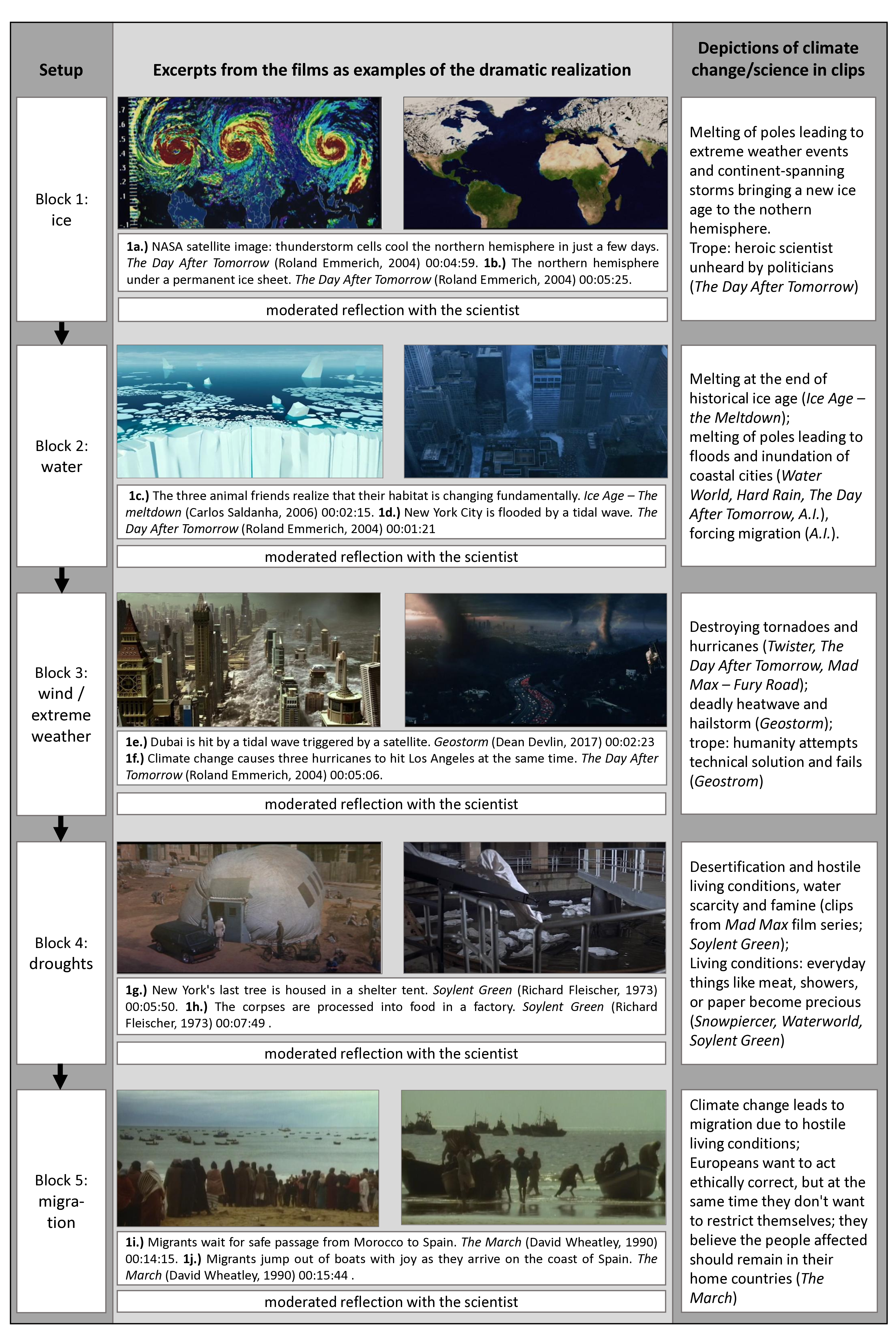
We implemented the S&C concept for the topic of climate change in the event ‘Climate, Collapse, Catastrophes’ (Figure 1). Prominent climate scenarios and their impacts form the five narrative blocks ice (into an ice age), water (melting poles, sea level rise, and floods), wind and extreme weather events, droughts, and migration; they cover five of seven main themes taken up in cli-fi films (Svoboda [2015]; excluding preclima(c)tic stress disorder and antagonists that do not focus on impacts). For detailed clip description and filmography see Supplementary File S1. The dense presentation in thematic blocks makes the narratives and the transported images explicit. During a moderated discussion, the scientist examines these images and resumes the scientific perspective:
Block 1 (ice). Clips show an ice age caused by the halt of the North Atlantic current due to global warming. The vice-president admits mistakes made in the CO2 reduction policy (The Day After Tomorrow, Emmerich [2004]). This is followed by scenes from Snowpiercer [Bong, 2013], showing an ice-covered city in the USA after a failed scientific Earth-cooling experiment.
After this screening, the moderator asks the scientist about the physical connection of global warming and ice ages in geological history, and the probability of them reoccurring in the (near) future.
Block 2 (water). The squirrel Scrat (Ice Age, Saldanha [2006]) causes a dam breach of a meltwater lake. Movie sequences from AI, The Day After Tomorrow, Waterworld [Reynolds, 1995], and Hard Rain [Salomon, 1998] alternate, dramatically showing the destructive power of water. A.I. [Spielberg, 2001] depicts coastal cities worldwide situated meters under water due to melted polar ice caps.
The scientist outlines the connection between CO2 emissions and the melting of polar ice, the possible extent of sea level rise, and its consequences.
Block 3 (wind/extreme weather). A tornado sucks a man out of his bunker (Twister, De Bont [1996]), followed by images of various extreme weather events (deadly heat waves, droughts, hurricanes and tornadoes, tsunamis) from The Day After Tomorrow, Geostorm [Devlin, 2017], and Mad Max — Fury Road [Miller, 2015].
The scientist explains the F-tornado scale and whether tornadoes can also occur locally. It is discussed how recently experienced severe storms and heavy rainfalls relate to climate change.
Block 4 (droughts). Starts with a narrative voiceover from Mad Max 2 [Miller, 1981], where the failure of politics led to a post-apocalyptic world, featuring water scarcity and deserts. Scenes from Soylent Green [Fleischer, 1973] show a world divided into rich and poor, where corpses are processed into food to overcome shortages.
The following discussion between moderator and scientist touches upon desertification and its consequences, food waste as source of CO2 emissions, and other lifestyle issues, such as excessive water consumption.
Block 5 (migration). In Sudan, a group of refugees start their journey to Europe due to shortages in fuels and crop failures. A young man shoots a pistol into the air out of joy after arriving on the Spanish coast and is then shot by soldiers (all clips from The March, Wheatley [1990]).
Considering that The March already highlighted several social challenges related to climate change in 1990, the scientist mentions that a lot of scientific knowledge about climate change and possible strategies for action were available at that time. He discusses the slow implementation of climate policy despite scientific progress. To avoid leaving the audience with feelings of helplessness, the scientist integrates messages in line with the concept of “constructive hope”. Examples include thinking about ways to reach a desired goal, such as pathway thinking and agency thinking [Ojala, 2023]. An example for a pathway mentioned by the scientist in the S&C is: “Transport costs can be adjusted so that the absurd back-and-forth transport of goods across Europe is no longer economically viable”. With agency thinking, participants are encouraged to strive towards goals, such as “As humanity, we have demonstrated that we can solve problems when we truly recognise them, such as the problem with the hole in the ozone layer.”
3 Objectives
The intended outcome of the event is to inspire critical reflection on scientific topics and their representations in movies. As an indicator for initiated reflection, we examine how the event influences the audience’s attitudes toward climate change regarding concern, risk perception, and motivation. We evaluate the S&C format by answering five questions: (1) What kind of audience participates? (2) What impact does the venue have on the composition of the audience? (3) What does the audience expect? (4) How does the audience perceive the event (entertainment, sparking interest) and scientific information? (5) What are the motivations and goals of the scientist engaged in the S&C?
4 Methods
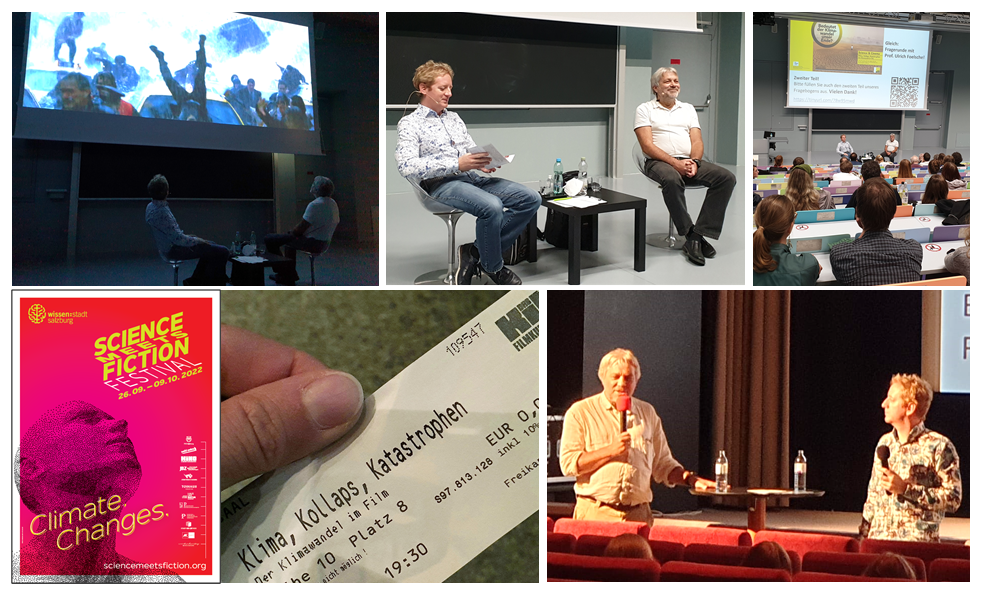
The S&C: Climate, Collapse, Catastrophes event was held twice: once in a university lecture hall that was open to the public and once in a cinema as part of a local film festival (see Figure 2).
We applied method triangulation when evaluating the S&C format by employing: (1) a quantitative evaluation using pre-/post-event online questionnaires with the audiences, (2) a qualitative evaluation through a focus group held after the event, and (3) a short, written interview with the participating scientist.
4.1 Pre-/post-event study
For data collection, participants completed the questionnaires online (Supplementary File S2). At both venues, around three quarters of the visitors completed the questionnaires (university: 62/79; cinema: 33/45). The pre-event questionnaire captured participation motives, expectations, current knowledge, and demographics. The post-event questionnaire gathered feedback on the event, including whether expectations were met in terms of entertainment, interest, and scientific information. To assess the format’s potential to initiate reflection, participants were asked to what degree they had changed their view on climate change in terms of understanding, knowledge, risk perception, concern, and intention to act. The questionnaires are partially based on van der Linden’s climate perception instrument [2015] and were adapted to our study’s queries. The descriptive and quantitative data analysis was carried out in R software.
4.2 Focus group session
To gain deeper insights and descriptive information about how the event was perceived, participants were invited to take part in a focus group, which was only held three days after the university event due to organisational constraints (see Supplementary File S3 for the interview guide). Five people participated, all between the ages of 24 and 34: four from a master’s program and one university graduate. Statements and conclusions are therefore based on a small and homogenous sample. The focus group session lasted 100 minutes. For qualitative content analysis, the interview was transcribed and coded in MAXQDA2022 (for the transcript and detailed results, see Supplementary Files S4 and S5).
4.2.1 Interview with the participating scientist
A short, written interview with the participating scientist was also included in the evaluation. The scientist was asked questions focused on his perception of the event, his personal motivation for participating in the S&C, and the goals he would like to achieve. The complete interview can be found in Supplementary File S6.
5 Results
The results section is divided into the three evaluative parts of the study: (1) the survey data of the S&C audiences, (2) the focus group discussion, and (3) the perspective of the participating scientist.
5.1 Survey data of the S&C audiences
5.1.1 Demographics
We observed differences between the two audiences. The questionnaire participants at the university (n=62) event were significantly younger than those at the cinema event (n=33): at the university, just under two third of participants (40/62) were aged between 18 and 27 years old, whereas about 3/5 of participants at the cinema (20/33) were aged between 28 and 45 (all data tables are available in Supplementary File S7). Questionnaire participants were balanced according to gender with slightly more female than male participants (university: 33 female, 27 male, 1 diverse; cinema: 17 female, 15 male, 1 diverse).
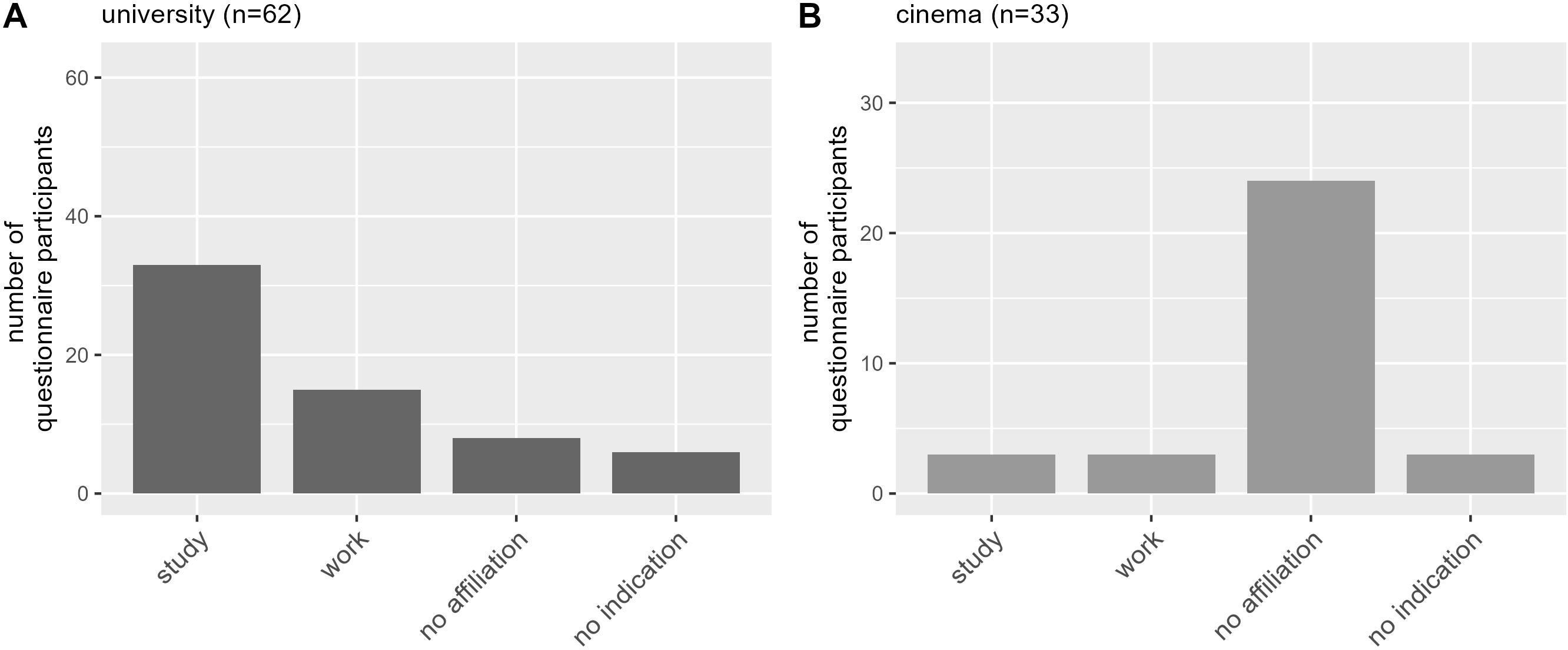
Regarding education level of questionnaire participants, both S&C events attracted mainly people holding at least an A-level degree (university 60/62; cinema 29/33). However, we see clear differences for the audiences’ affiliation with university (see Figure 3). Whereas only 6 of the 33 questionnaire participants at the cinema event indicated that they had an affiliation with the university, more than two thirds of the participants at university event (48/62) indicated that they had a close connection to the university via their study or work. These data suggest that the selection of the venue may have an impact on the audiences’ diversity.
5.1.2 Perception of the S&C event
Our results showed that over half of the questionnaire participants found out about the event via personal contacts (university 41/62; cinema 18/33). Social media advertising was relevant for the university event (10/62) but not for the cinema event (1/33). About one third of cinema event participants were attracted via poster advertising (9/33). Newsletters and websites played minor roles.
5.1.3 Entertainment, interest, and scientific information
The audiences of both venues generally liked the event (mean value for the university Muniv = 6.18 ± 0.95; mean value for the cinema Mcin = 5.70 ± 1.33; scale from 1 (‘not at all’) to 7 (‘enjoyed it a lot’)), were entertained (university 51/62; cinema 21/33; rating ≥5), and showed high interest (university 57/62; 27/33; rating ≥5). Most questionnaire participants at each venue felt informed (university 54/62; cinema 26/33) (Table 1).
|
Expectations met for … | Setting | Mean | Standard deviation | Min | Max |
|
entertainment | university | 5.81 | 1.3 | 2 | 7 |
| cinema | 5.00 | 1.46 | 1 | 7 | |
|
interest | university | 6.16 | 0.94 | 4 | 7 |
| cinema | 5.64 | 1.39 | 2 | 7 | |
|
scientific
information | university | 5.95 | 1.09 | 3 | 7 |
| cinema | 5.52 | 1.48 | 2 | 7 | |
5.1.4 Climate change perception, motivation and concern
The following results provide insight into S&C event attendees’ levels of the concern about, and engagement with, climate change issues. Questionnaire participants from both venues stated that they (very) often thought about climate change (university 53/62; cinema 25/33) and expressed high concern (university 57/62; cinema 29/33; rating ≥5 on a 7-point-Likert scale). However, for their motivation to personally engage in activities to address climate change, we see a difference between these audiences. While at the university event only 5 of 62 questionnaire participants indicated rather low motivation in the pre-test, the proportion at the cinema event was almost one third (10/33; rating ≤ 3 on a 7-point-Likert scale). These results show that preferentially our events appealed to people with higher concern in climate change.
Participants partially agreed that the scientist changed their view on climate change in terms of higher risk perception, more motivation, and greater sense of concern (mean values between 3.45 and 4.74; Table 2). Interestingly, in the pre-post comparison participants’ general concern for climate change (‘How concerned are you about climate change?’) did not increase; it was nearly at the same high level (item climate_worry_a, pre: M = 5.81 ± 1.29, post: M = 5.54 ± 1.28). Insights gained from the focus group session may provide support for interpretation. The new way of looking at climate change during joint reflection of movie clips may have provoked already existing attitudes, as suggested during the focus group discussion (see Results of the focus group discussion: Climate change perception and reflection).
|
View on climate change | Setting | Mean | Standard deviation | Min | Max |
|
better
insight
/
better
understanding | university | 4.02 | 1.61 | 1 | 7 |
| cinema | 4.58 | 1.73 | 1 | 7 | |
|
more
knowledge | university | 4.92 | 1.46 | 2 | 7 |
| cinema | 5.33 | 1.57 | 2 | 7 | |
|
higher
risk
perception | university | 3.82 | 1.63 | 1 | 7 |
| cinema | 3.85 | 1.70 | 1 | 7 | |
|
greater
sense
of
concern | university | 3.98 | 1.63 | 1 | 7 |
| cinema | 3.85 | 1.79 | 1 | 7 | |
|
more
worried | university | 3.47 | 1.67 | 1 | 7 |
| cinema | 3.45 | 1.60 | 1 | 7 | |
|
more
motivated | university | 4.74 | 1.41 | 1 | 7 |
| cinema | 4.27 | 1.51 | 1 | 7 | |
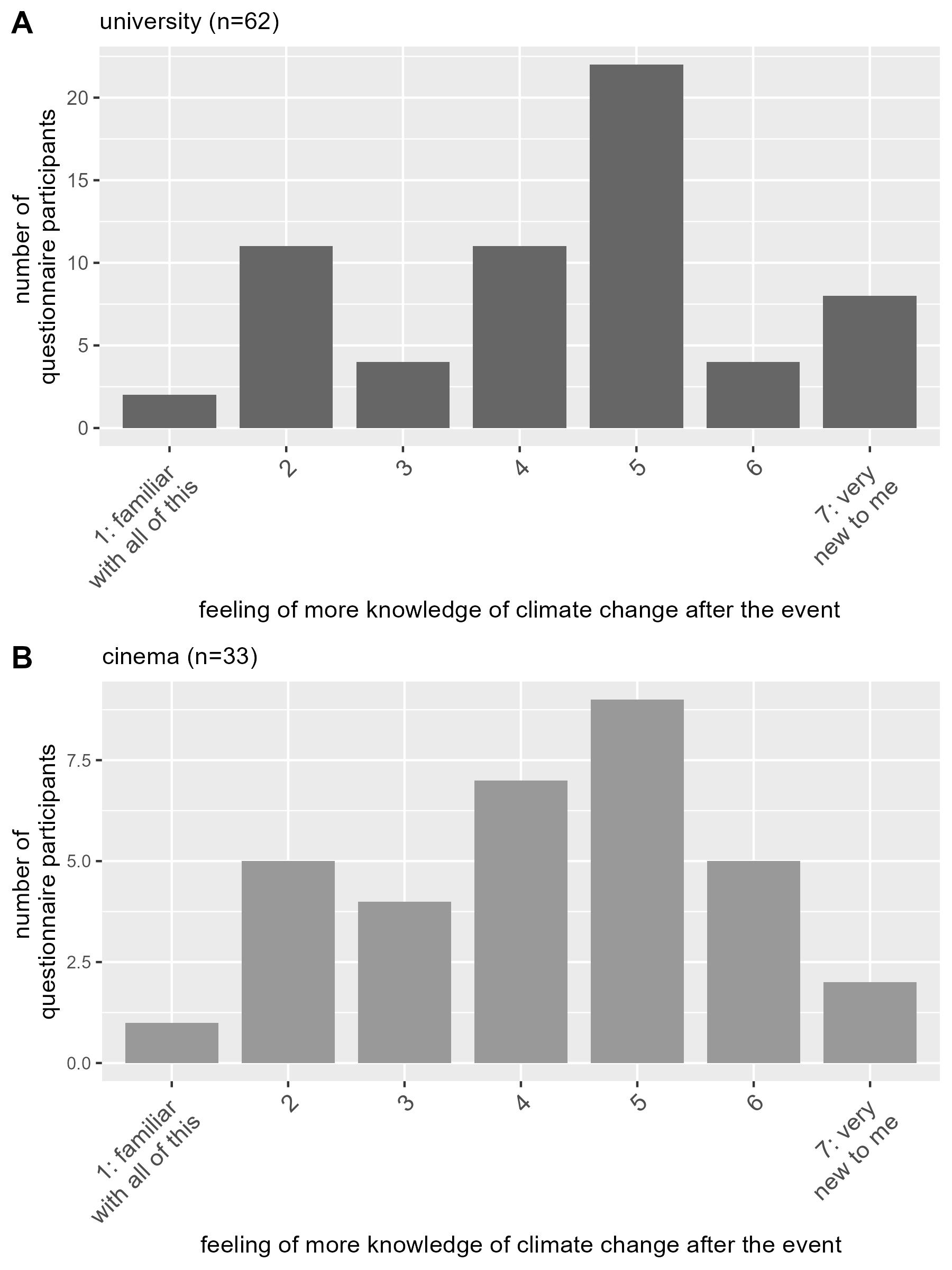
Regarding knowledge about climate change, in a self-referential question approximately half of the questionnaire participants at both venues felt that they knew more about climate change after the event than before, rating 5 or higher on a scale from 1 (‘familiar with all of this’) to 7 (‘very new to me’) (see Figure 4). When participants were asked if the scientist was able to contribute towards changing their attitudes regarding climate change (Table 2), participants partially agreed to gaining more knowledge (university 39/62; cinema 24/33; rating ≥5) and a better understanding (university 26/62; cinema 20/33; rating ≥5) with slightly higher ratings in the cinema setting. These results indicate that even for audience members at the university, who may have more prior knowledge on the subject (as also discussed in the focus group), the event provided new knowledge and insights on climate change.
5.2 Results of the focus group discussion
The focus group session provided details on how focus group members perceived the S&C event, how the event may have influenced their climate change perception and what aspects stimulated the reflection on representations of science and climate change (see transcript file S4). Since the focus group was only held after the university event, and only with five participants, all holding at least a bachelor’s degree, insights from this evaluation cannot be generalized.
5.2.1 Perception of the S&C event
All members of the focus group provided positive feedback on the S&C event. They felt entertained and interested, and especially mentioned the combination of emotional movie clips with scientific information. For example:
“And there I think S&C is actually quite brilliant. Because of the movies. Most people like movies at least a little or even a lot. And watching movies is something emotional that you associate with a lot, something exciting, something funny. And I think using that to communicate scientific content is basically very ingenious.”
This illustrative quote further suggests the importance to adapt the selection of movies according to the target audience. This was supported by the focus group members’ criticism that the event included too few new movies for a young audience.
The narrative arch of the event evoked various alternating emotions, from fun over surprise to despair, and thereby created moments of learning. For example:
“It was fun at first. With Ice Age and stuff: ‘Hey, I know that movie!’ And then: ‘Wow!’ Really surprised, and then: ‘Okay, that wall really existed. Exciting.’ […] I learned something! And that was a positive feeling for me. In between, it was a bit depressing again when you hear: ‘And here we are now. It doesn’t look good.’ And then you think to yourself: ‘We did well!’ [ironically]. And then The March was…You feel helpless.”
This quote emphasizes how communicators can use movie clips to create emotional flows, but also points out the need to be cautious when selecting movie sequences that may evoke negative emotions.
Focus group members expected the scientist to reflect on images transported in the movie clips and to provide scientific climate facts. Therefore, the dialogue of the moderator with the scientist was seen as central part. In the first blocks, the dialogue focused on a direct analysis of movie sequences. A member praised this “reality check” as a tool to link positive feelings with the acquisition of knowledge. In the later blocks, the scientist discussed the respective topics rather on a meta-level. One focus group member pointed out that he also here expected a more direct analysis of the clips, although he found the discussion interesting. For S&C design, it might be advisable to consistently refer directly to the selected clips before discussing the topic on a meta-level.
5.2.2 Climate change perception and reflection
Focus group members did not see the primary purpose of the format as being to motivate, but instead to gain insights from the expert, to stimulate reflection, and to refresh awareness for the topic. However, they reported that the event had strengthened their already climate-friendly attitude. Regarding the survey data showing moderate effects on their concern for climate change, risk perception, and worry, here, the focus group session provided additional insight. For example:
“Before the event, […] my general attitude toward climate change, was that it’s very serious, that we should be afraid, and that we absolutely must do something about it. And I expected the event to reinforce that view. But the reality today is a bit more nuanced. […] And in some respects, it has almost reassured me a little. Not in the sense that nothing needs to be done now, but rather in the sense that we can still achieve it.”
With regard to knowledge and understanding, members of the focus group stated that they have learnt scientific facts about climate change from the event. However, two members noted that they had gained only limited new knowledge, as they had attended relevant lectures during their studies. But they mentioned that the later blocks of the event on droughts leading to food scarcity and climate migration provided them with new perspectives on climate change, looking at it from different angles like social justice. For example:
“But the movie [The March] really addressed a completely different level, namely the refugee issue. And for me, it actually triggered a lot of memories of 2015. […] And I think that people in our age group are familiar with these photos and this issue, and maybe some people were motivated to look at it from a different perspective. That climate justice and social justice simply go hand in hand”.
By linking the event to his own real experiences of the wave of migration in 2015, this member demonstrated a well-founded reflection that went beyond the discussion at the event. Another member picked up the movie sequence on the last tree in New York from the movie Soylent Green from 1973. He reflected on the degree of this narrated future scenario having become a real threat today, thereby drawing connections to recent forest diebacks in Germany:
“Yes, the scene with those last trees in Manhattan, for example […]. That really upsets me because I thought to myself: The movie is, I don’t know, from the 80s or something. And back then, people still imagined that as a distant future, but nowadays in Germany we’re actually already facing the problem that certain tree species simply can’t survive anymore and fall down in rows.”
These examples demonstrate that sequences allowing to draw connections to real-world examples may be especially efficient to initiate reflection or start a joint meaning-making process during discussion on transported images in movies.
Regarding realism in movies, one member remembered his difficulty in judging the threat depicted in the The Day After Tomorrow when being a child and that he had been devastated by this possible future scenario. In order to be able to better distinguish between possible risks due to climate change and fictional stories in the movies’ narratives, members of the focus group emphasized the importance of the scientist providing scientific evidence. These aspects point toward the strength of the S&C format, that the event may contribute to meaning-making by scientific classification and reflection of transported images.
5.3 The scientist’s perspective
The scientist perceived the S&C format as a refreshingly new approach compared to talks and lectures. He sees this as an opportunity to reach people who may not feel addressed by traditional presentations. He pointed out:
“I actually only see advantages here. Entertaining movies are, of course, not documentaries, and the depictions are correspondingly dramatic — but the accompanying discussions offer precisely the opportunity to clear this up.”
This statement underscores that the scientist himself sees a high value in reflecting on the portrayal of science and scientific topics in movies.
His aim is to raise awareness of the urgency to take action against climate change. He considers this as crucial, but is aware of the difficulty of doing so without causing a feeling of hopelessness. His assessment indicates that, when developing the format, close attention should be paid for the selection of movie clips. They should both, increase the awareness of risks due to climate change, as well as serve as a starting point for demonstrating possible actions that can be taken.
The scientist was especially motivated due to his positive experiences of using references to movies in his lectures.
6 Discussion
In this practice insight we show how events, using the S&C format appeal to different audiences and might inspire them to critically reflect on scientific topics and their representations in movies.
This format has the flexibility and potential to reach different audiences depending on the screening venue. At the university event, the majority of the questionnaire participants were under 27 years old and affiliated with the university through their study or work. In contrast, at the cinema event about three fifths of participants were aged between 28 and 45 and most of them (24/33) had no affiliation with the university. However, at both events most participants had at least an A-level degree. The cinema may have felt more open, an aspect that could attract people who have no direct connection to university or science [Dawson et al., 2024; DeWitt & Archer, 2017]. Future S&C events could be integrated in public settings, like art festivals or open-air cinemas, providing the chance for unplanned encounters. This kind of “Guerilla Science” [Rosin et al., 2023] blending various elements of access has the potential to reach non-traditional audiences.
S&C events can be adapted in content and attractiveness to appeal to different target audiences by film choice (genre, age) and clip selection, e.g., adapting film choices to appeal to younger audience members or to highlight topics of special interest for particular communities. Collaborations with interest groups (e.g., cultural centres) may help adapt events to the needs of audiences, by engaging interpreters, providing subtitles, or inviting community discussants for joint reflection. Targeted collaboration with different communities and venue operators may also help inform advertising strategies to attract specialized audiences. As our results showed, over half of the questionnaire participants of both events found out about S&C via personal contacts. Other means of communication played only minor roles.
The audiences for both events found the event entertaining, interesting, and informative. About half of the questionnaire participants at both venues felt to know more about climate change than before the event. About half of the participants at the university event agreed that they gained more knowledge and a better understanding through the scientist’s explanation; at the cinema event it was about one third. This highlights the potential of these events to broaden knowledge and encourage reflection, particularly among non-university affiliates, further emphasizing the value of off-campus events. The findings also show that these events can provide new knowledge and insights for people with higher levels of prior knowledge on climate change, as several members of the focus group noted, e.g., reporting on new perspectives in connection with social justice.
The scientist associated with these S&C events pointed out his motivation to raise public awareness about the urgency of taking action against climate change. However, the quantitative analysis revealed only modest participant reported changes for risk perception and concern. Both events mainly attracted people who were already engaged in the topic of climate change. On the one hand, most of the questionnaire participants stated that they often think about climate change and expressed great concern. On the other hand, we found differences in their motivation to personally engage in activities to combat climate change. While only a small proportion of university participants reported low motivation, at the cinema it was almost one third. This suggests that these events have potential to appeal to people in early stages of behavioural change.
To explain this gap between the questionnaire participants who think about climate change and those who are motivated to take action, we could draw on insights from the Transtheoretical Model (TTM), a model for behavioural change [Prochaska & DiClemente, 1982]. In this model, behaviour change goes through several stages in an upward spiral of increasing awareness and contemplation of the problem. People in the precontemplation stage have no awareness of the problem and show no intention of changing their behaviour. In the contemplation phase, awareness has increased but there is no intention to take further action in the near future.
At our S&C event, respondents who reported neither concern about climate change nor motivation to act may be in the precontemplation stage. Respondents who are concerned about climate change but show no motivation to act may be in the contemplation phase of TTM. Whether S&C can animate participants to move on to further action, such as entering the preparation stage (willingness to take additional action) needs to be further investigated. This would be supported by the fact that in our study, two thirds of participants at the university and half of the participants at the cinema stated that the event motivated them to do more to combat climate change. Accordingly, focus group members saw the purpose of the event as providing insight, stimulating reflection, and raising general awareness of climate change.
The results of our study showed that the clips were able to elicit emotions and affect. Emotions are known to be intertwined with cognition and motivation. For information processing, emotional flow from fear to hope may be especially beneficial [Nabi et al., 2018]. Focus group members reported feeling helpless during the block on migration, which hints at ethical challenges and suggests a prudent use of clips that may foster hopelessness or anxiety. This could be investigated in further research.
Several studies have shown that viewers of cli-fi films are uncertain about how to distinguish factual science from imaginary fiction [Busselle & Bilandzic, 2008; Griffin, 2017; Lowe et al., 2006]. During the focus group, one member reported to have had this difficulty as a child while watching The Day After Tomorrow, thereby also pointing at the emotional stress that accompanied his uncertainty. In S&C, the scientist uses the emotional, but attentive state of the audience to expose misrepresentations and clarify scientific background information, which can help the audience to gain a more differentiated and accurate picture. The focus group members picked up on several images conveyed in the clips (such as the protection of the last tree in New York) and on information provided by the scientist (such as changes in regional precipitation patterns) and linked them to real events of their local environment (the forest dieback in Germany). This discussion demonstrates that carefully selected movie clips can engage audiences in critical reflection on the transported images and direct them to developments in their local environment.
Movies may distort scientific facts, and use problematic tropes or stereotypes, like climate dystopia or a hero scientist [Felgueiras & Ruão, 2025]. Communicators planning events of this kind should take this into account when selecting clips and ensure that these issues are addressed in the discussion between the moderator and the scientist. Future research could examine the effectiveness of the S&C format in challenging problematic tropes through explicit reflection or by showing them alongside clips from independent films that break with problematic stereotype representations.
6.1 Limitations
Insights from our practice report are limited due to the small and imbalanced quantitative data set, meaning that we can point out tendencies rather than present robust and generalizable results. Furthermore, some items of the questionnaire were leading instead of neutrally formulated, especially items in the post-test asking for (dis-)agreement on the positive impact on awareness, knowledge, and motivation with regard to climate change. These questions may have unintentionally signalled to participants what results the researchers expected to observe, creating what is known as demand characteristics. Previous research [Nichols & Maner, 2008] has shown that when participants infer the study’s purpose or underlying hypotheses, they may adjust their responses to align with what they believe the researchers expect, thereby influencing the results.2
Accuracy of the focus group data may also be limited by several factors. First, only a small and homogeneous sample was obtained (N=5, all young and highly educated), which limited the breadth of insights that could be drawn. Second, accuracy of retrospective data (the discussion took place three days after the event) may be distorted, e.g., due to omission (like forgetting), emotion in memory retrieval, or motivation-related bias by a need for self-enhancement or social desirability [Müggenburg, 2021]. Third, the focus group took place only after the university event, so comparison data from the cinema’s audience is missing.
The role of the scientist entails high thematic and interpretative power, which may limit the range of reflective insights available to audiences and provide opportunities for scientist-presenters to pursue their own agendas. The S&C has elements of a rather closed model for science communication, using terminology from the framework for social conversations around science proposed by Bucchi and Trench [2021]. Together with the S&C team, the scientist decides on the main scientific aspects and the movie clips to be included and enacts a rather authoritative role while interpreting and correcting the conveyed images and imparting scientific knowledge. However, there are also elements of dialogue and participation. The movie clips themselves provide a cultural perspective on the topic that may resonate with audiences. Furthermore, the moderator represents the audience in the discussion, asks critical questions and contributes popular viewpoints on the topics. In this way, he acts as a representative of the audience and simulates an audience dialogue that can lead to interpretation and (re-)construction of knowledge. At the end of our S&C events, audiences are encouraged to join the discussion by sharing their thoughts, asking questions, and expressing concerns, thereby starting a process of joint meaning-making. Measures to balance the authority of the scientist could be taken to further develop the S&C format, for example by including another expert in the selection of clips and reflecting on the content or by increasing the audience discussion time.
6.2 Recommendations
Based on our evaluations of these events, we make the following recommendations. Firstly, maintain a balance between entertaining stories and scientific insights, and correct misrepresentations. Given that S&C audiences expected scientific insights and entertainment rather than detailed research results, we recommend focusing on a general understanding of scientific concepts. Secondly, incorporate references to local environments to enhance the connection of scientific topics to individuals and community, which showed high resonance in our focus group discussion (e.g., forest dieback). Thirdly, utilise the movies’ narratives to establish a connection with the audience and evoke an emotional response. When utilising emotion-based messaging, make prudent use of clips eliciting negative emotions like fear and combine them with messages of hope and solutions to promote emotional flow and mitigate maladaptive effects [Dennison, 2023; Nabi et al., 2018]. Finally, plan for, and further develop methods for, evaluating these events, e.g., by revising the pre-/post-questionnaire design and taking care to avoid demand characteristics (see Limitations). To encourage more people to participate, the focus groups could be held directly after the events in a nice atmosphere serving refreshments.
Based on the lessons we have learned from implementing S&C activities, we also make the following practical recommendations: 1) Select event venues and frameworks to attract the desired target audiences. Our results underline the importance of off-campus events to facilitate access for people from diverse backgrounds. 2) Reach out to facilitators within the community of your target audience and ask for assistance with advertising the event or invite them to participate as discussants. Our results showed that most people found out about the event through personal contacts. 3) Apply for screening licenses of the movies while preparing for your event. 4) Integrate a short training session for the scientist involved in the S&C event early in the preparation phase. When reflecting on the format of the event during this writing process, we realised how important it is to ensure that the participating scientist understands their role, authority, and responsibility. Clarify the goals and objectives of the S&C format for the participating scientist and ensure that the expected standards for science communication are clear, such as distinguishing between scientific findings and their interpretation, and being transparent when expressing personal opinions.
7 Conclusions
Community perceptions of science and scientific topics are shaped by various forms of institutionalized science education and communication, delivered through schools and media, for example, and by cultural conversations around science. Taking these perceptions into account may guide new approaches in science communication practice which seems especially relevant in times of information overload and increasing presence of false or misleading statements. In S&C, we make cultural images explicit by using movie clips, examine them, and encourage critical reflection. The findings from our evaluation suggest that the S&C events presented here can support audiences in questioning the images they see and clarifying scientific perspectives on the topics covered. Furthermore, these events can attract interest from people with higher and lower formal affinity levels to science. We argue that especially for scientific topics that are strongly present in societal discourses, S&C events can contribute to better understanding, more reflection, and development of scientifically informed cultural conceptions of science.
Open Science and Ethics Statement
This study was approved by the Ethics Committee of the University of Graz (No. 2022/23/56). Informed consent to participate was obtained from all participants.
Data and materials are available at the Open Science Framework repository ( https://osf.io/ahytv/?view_only=aab00304f900477cae9c3ce0b667ab3d).
Acknowledgments
We would like to sincerely thank all participants in this study. We also thank Michael Kirchmeyr for his support in event organisation at the University of Graz and and Elmar Schüll and the organisational team of the Science Meets Fiction Festival for hosting the event at the cinema Das Kino in Salzburg. We further thank the reviewers and the editor for constructive suggestions to improve our manuscript.
Conflict of Interest Statement
The authors declare no conflict of interest.
References
-
Bong, J.-H. (Director). (2013). Snowpiercer (Seolgugyeolcha) [Film]. CJ Entertainment.
-
Bucchi, M., & Trench, B. (2021). Rethinking science communication as the social conversation around science. JCOM, 20(03), Y01. https://doi.org/10.22323/2.20030401
-
Busselle, R., & Bilandzic, H. (2008). Fictionality and Perceived Realism in Experiencing Stories: A Model of Narrative Comprehension and Engagement. Communication Theory, 18(2), 255–280. https://doi.org/10.1111/j.1468-2885.2008.00322.x
-
Davies, S. R., Halpern, M., Horst, M., Kirby, D., & Lewenstein, B. (2019). Science stories as culture: experience, identity, narrative and emotion in public communication of science. JCOM, 18(05), A01. https://doi.org/10.22323/2.18050201
-
Dawson, E., Iqani, M., & Lock, S. (2024). Why should we think about social justice in science communication? JCOM, 23(04). https://doi.org/10.22323/2.23040501
-
De Bont, J. (Director). (1996). Twister [Film]. Universal Pictures.
-
Dennison, J. (2023). Emotions: functions and significance for attitudes, behaviour, and communication. Migration Studies, 12(1), 1–20. https://doi.org/10.1093/migration/mnad018
-
Devlin, D. (Director). (2017). Geostorm [Film]. Skydance Media; Warner Bros. Pictures.
-
DeWitt, J., & Archer, L. (2017). Participation in informal science learning experiences: the rich get richer? International Journal of Science Education, Part B, 7(4), 356–373. https://doi.org/10.1080/21548455.2017.1360531
-
Emmerich, R. (Director). (2004). The Day After Tomorrow [Film]. 20th Century Studios.
-
Felgueiras, E., & Ruão, T. (2025). Science on screen: the representation of science in independent films. JCOM, 24(03). https://doi.org/10.22323/2.24030202
-
Fischer, H., Amelung, D., & Said, N. (2019). The accuracy of German citizens’ confidence in their climate change knowledge. Nature Climate Change, 9(10), 776–780. https://doi.org/10.1038/s41558-019-0563-0
-
Fleischer, R. (Director). (1973). Soylent Green [Film]. MGM.
-
Griffin, L. N. (2017). Audience Reactions to Climate Change and Science in Disaster Cli-fi Films: A Qualitative Analysis. The Journal of Public Interest Communications, 1(2), 133. https://doi.org/10.32473/jpic.v1.i2.p133
-
Hahnel, U. J. J., Mumenthaler, C., & Brosch, T. (2019). Emotional foundations of the public climate change divide. Climatic Change, 161(1), 9–19. https://doi.org/10.1007/s10584-019-02552-0
-
Hart, P. S., & Leiserowitz, A. A. (2009). Finding the Teachable Moment: An Analysis of Information-Seeking Behavior on Global Warming Related Websites during the Release ofThe Day After Tomorrow. Environmental Communication, 3(3), 355–366. https://doi.org/10.1080/17524030903265823
-
Lowe, T., Brown, K., Dessai, S., de França Doria, M., Haynes, K., & Vincent, K. (2006). Does tomorrow ever come? Disaster narrative and public perceptions of climate change. Public Understanding of Science, 15(4), 435–457. https://doi.org/10.1177/0963662506063796
-
Miller, G. (Director). (1981). Mad Max 2 — The Road Warrior [Film]. Kennedy Miller Productions.
-
Miller, G. (Director). (2015). Mad Max — Fury Road [Film]. Warner Bros.
-
Müggenburg, H. (2021). Beyond the limits of memory? The reliability of retrospective data in travel research. Transportation Research Part A: Policy and Practice, 145, 302–318. https://doi.org/10.1016/j.tra.2021.01.010
-
Nabi, R. L., Gustafson, A., & Jensen, R. (2018). Framing Climate Change: Exploring the Role of Emotion in Generating Advocacy Behavior. Science Communication, 40(4), 442–468. https://doi.org/10.1177/1075547018776019
-
Nichols, A. L., & Maner, J. K. (2008). The Good-Subject Effect: Investigating Participant Demand Characteristics. The Journal of General Psychology, 135(2), 151–166. https://doi.org/10.3200/genp.135.2.151-166
-
Ojala, M. (2023). Hope and climate-change engagement from a psychological perspective. Current Opinion in Psychology, 49, 101514. https://doi.org/10.1016/j.copsyc.2022.101514
-
Priest, S. (2019). Theme Issue: Communication and Persuasion on Energy, Environment, and Climate. Science Communication, 41(4), 391–393. https://doi.org/10.1177/1075547019864178
-
Prochaska, J. O., & DiClemente, C. C. (1982). Transtheoretical therapy: Toward a more integrative model of change. Psychotherapy: Theory, Research & Practice, 19(3), 276–288. https://doi.org/10.1037/h0088437
-
Reynolds, K. (Director). (1995). Waterworld [Film]. Universal Pictures.
-
Rosin, M. S., Storksdieck, M., O’Connell, K., Keys, B., Hoke, K., & Lewenstein, B. V. (2023). Broadening participation in science through arts-facilitated experiences at a cultural festival (M. Bathgate, Ed.). PLOS ONE, 18(5), e0284432. https://doi.org/10.1371/journal.pone.0284432
-
Sakellari, M. (2014). Cinematic climate change, a promising perspective on climate change communication. Public Understanding of Science, 24(7), 827–841. https://doi.org/10.1177/0963662514537028
-
Saldanha, C. (Director). (2006). Ice Age — The Meltdown [Film]. 20th Century Studios.
-
Salomon, M. (Director). (1998). Hard Rain [Film]. BBC.
-
Spence, A., Poortinga, W., & Pidgeon, N. (2011). The Psychological Distance of Climate Change. Risk Analysis, 32(6), 957–972. https://doi.org/10.1111/j.1539-6924.2011.01695.x
-
Spielberg, S. (Director). (2001). A.I. Artificial Intelligence [Film]. Amblin Entertainment.
-
Svoboda, M. (2015). Cli-fi on the screen(s): patterns in the representations of climate change in fictional films. WIREs Climate Change, 7(1), 43–64. https://doi.org/10.1002/wcc.381
-
Thaller, A., & Brudermann, T. (2020). “You know nothing, John Doe” – Judgmental overconfidence in lay climate knowledge. Journal of Environmental Psychology, 69, 101427. https://doi.org/10.1016/j.jenvp.2020.101427
-
Treen, K. M. d., Williams, H. T. P., & O’Neill, S. J. (2020). Online misinformation about climate change. WIREs Climate Change, 11(5). https://doi.org/10.1002/wcc.665
-
Trench, B. (2021). Routledge Handbook of Public Communication of Science and Technology: Third Edition (M. Bucchi, Ed.). Routledge. https://doi.org/10.4324/9781003039242
-
van der Linden, S. (2015). The social-psychological determinants of climate change risk perceptions: Towards a comprehensive model. Journal of Environmental Psychology, 41, 112–124. https://doi.org/10.1016/j.jenvp.2014.11.012
-
Wheatley, D. (Director). (1990). The March [Film]. BBC.
Notes
1. These authors have contributed equally to this work.
2. Unlike in research, however, these leading questions themselves could serve as part of the intervention during the S&C event. Priest [2019, p. 391] claims that science communicators should not just educate, but also engage in persuasion, since “climate change is an unprecedented emergency proceeding at an accelerating pace”. In that way, the questions themselves posed at the beginning and end of the event may serve as persuasive element by providing individual feedback on the participants’ progress in attitudinal change during the event and thereby serve as a motivating “take-away”.
About the authors
Hildrun Walter has been a research fellow in science communication at the Center for Society, Science and Communication (‘die 7. Fakultät’) at the University of Graz since 2019. Her research focuses on the evaluation of science communication strategies and formats. She studied plant sciences at the Universities of BOKU Vienna and Graz, worked as a research associate at the Technical University of Munich and finished her doctorate in 2016. She is eager to share scientific insights with audiences outside academia.
E-mail: hildrun.walter@uni-graz.at
Fritz Treiber, PhD, is a molecular biologist, and also an expert in science communication and specializes in the topic of nutrition. He gives scientific cooking courses for interested people in the taste lab at the University of Graz. He developed the format “Science & Cinema” where researchers from the University of Graz discuss films about their field of research in a critical, educational, and entertaining way.
E-mail: fritz.treiber@uni-graz.at
Hilmar Brohmer studied social and political sciences, as well as social psychology, at the Universities of Halle (Saale), Frankfurt (Main), Oslo, and Tilburg in the Netherlands, and earned his PhD in psychology at the University of Graz between 2016 and 2020. In addition to research in the fields of environmental psychology and science communication, his expertise lies primarily in the area of Open Science. He is co-founder of the Graz Open Science Initiative and serves as an Arqus Open Science Ambassador.
E-mail: hilmar.brohmer@uni-graz.at
Thomas Brudermann is Associate Professor at the Department of Environmental Systems Sciences at the University of Graz, Austria. He has a background in psychology and works in the interdisciplinary field of sustainability and innovation research. He also is active in the field of climate change communication (co-creating info-charts, social media public events, and media appearances).
E-mail: thomas.brudermann@uni-graz.at
Ulrich Foelsche is Associate Professor for Meteorology and Geophysics at the University of Graz, Austria. He has more than 25 years of research experience in fields like global climate monitoring based on radio occultation data, analysis of extreme precipitation, and historic climate variability. He also has a strong interest in science communication – as a university teacher but also for public audiences.
E-mail: ulrich.foelsche@uni-graz.at
Heide Beranek-Knauer, PhD, is the scientific head of the “Offenes Labor Graz” (OLG) at the Center for Society, Science and Communication (‘die 7. Fakultät’) at the University of Graz. She holds a doctorate in microbiology and has many years of experience in the field of science communication. The main focus of her research is on hands-on experiments as a communication tool for the target group of children and young people.
E-mail: heide.knauer@uni-graz.at
Lucas Eder, MSc, is a research fellow at the “Offenes Labor Graz” (OLG) at the Center for Society, Science and Communication (‘die 7. Fakultät’) at the University of Graz. During his master’s program in molecular microbiology, he developed interest in science communication and teaching. Now, after several years of experience in organizing and holding hands-on science courses, he has become deeply involved in the project design and research at the OLG.
E-mail: lucas.eder@uni-graz.at
Christina Maier, BA, completed her bachelor’s degree in sociology in Graz, Austria. As part of her studies, she conducted a research study on opinions and behaviors during the COVID-19 pandemic. She worked as a student project assistant at the Center for Society, Science and Communication (‘die 7. Fakultät’) at the University of Graz.
E-mail: maiertina.tm@gmail.com
Helmut Jungwirth was appointed Austria’s first university professor for science communication at the University of Graz in 2016. His research focuses on science communication on social media. Since 2015, he has been a member of the multi-award-winning science cabaret ‘Science Busters’. Helmut Jungwirth completed his PhD in microbiology at the University of Graz. After research stays at the University of Tübingen (Erwin Schrödinger Fellowships abroad) and the Medical University of Vienna, he habilitated in molecular biology in 2009.
E-mail: helmut.jungwirth@uni-graz.at