
1 Introduction
The Philippine Department of Science and Technology (DOST) is composed of 18 agencies and 17 regional offices distributed across the country’s 7,500 islands with diverse ethnical and language/dialect backgrounds. The agencies and offices under the Department are clustered science and technology (S&T) services institutes, research and development (R&D) institutes, and regional offices. With such diversity within the Department, as well as its audiences, science communicators within DOST face difficulties in informing the public about the Department and its various services, such as R&D, scholarship, facilities, and expertise. To somehow drive unity in such a diversity, the DOST led by its head, came up with a hashtag that attempts to assert the oneness in the Department. In their various campaigns and information materials and activities, the communication officers used the hashtag #OneDOST4U. Generally, audiences feel intimidation with the very notion of “science and technology” — that has been apparent in the many responses from our research as validated by the extensive work on “technophobia” [Brosnan, 2002]. However, beyond the typical impression of intimidation, individuals and the social groups where technology revolves in, have deeper and alternative ways of making sense of science, technology, and innovations — hence, a social negotiation and construction process.
1.1 Science communicative context: #OneDOST4U as the agency’s message
#OneDOST4U is an institutional communication handle used to unify messaging across DOST’s diverse agencies and regional offices. It is used in official events and appears in communication materials and collaterals. The core communicative aims are: (i) to make the Department’s multi-sector work legible through a single, recognisable identity; (ii) to foreground practical relevance (“for you/for us”) that invites stakeholders to interpret, apply, and co-shape messages; and (iii) to surface feedback loops from field projects back into institutional communication. Target audiences include R&D collaborators (academe, industry, local government units), media partners, educators and learners, technology adopters/beneficiaries, and the general public reached via regional outreach. Stakeholders encountered #OneDOST4U either directly (campaign materials, social posts, televised segments) or indirectly through project-level engagements with DOST staff and partner institutions.
The constructs science, technology and innovation (STI) in social perspectives provide insights on how STI are shaped by societal factors — cultural norms, societal institutions, and citizens’ value systems. We establish that STI is not purely technical but a social negotiation with complex layers of knowledge management and co-creation. Prior work has cited this perspective on the agency of the society and culture as negotiators of STI constructs [Callon, 1999; Nowotny et al., 2001]. Cognitive and social interpretations of the hashtag as a scientific agency’s identity vary depending on the audiences’ motivations and social involvement with the DOST. These variations, in turn, shape the way the role and messages of scientific knowledge and technological services are translated into values-in-use in the co-creative process of the hashtag as a popular media identity. Variations in the form of being ‘holistic’, ‘one-stop-shop’, ‘united in service’, ‘community-based’, and synergistic process, are the formulations of message understanding given towards the agency. These are contingent upon the stakeholders’ core values and intrinsic motivations that could be individuated or communal.
By examining #OneDOST4U, we explore how a unifying digital handle functions as both a communicative artifact and a platform for co-creation. Our paper was guided by the following questions: (1) How do diverse stakeholders interpret the #OneDOST4U campaign and its relevance to their engagements with DOST? (2) How do these interpretations reflect processes of co-creation, trust-building, and value-in-use in science communication? In linking theory to practice, we situate this paper within debates on dialogic engagement, symbolic mediation, and the role of institutional identity in fostering trust and legitimacy in science, particularly in Global South contexts.
2 Literature review
2.1 Science communication as participatory and institutional practice
Functional literature in science communication increasingly emphasises dialogic and participatory approaches to public engagement with science [Irwin & Wynne, 1996; Stilgoe et al., 2013]. As institutions attempt to reconfigure their relationships with publics, communication is no longer about correcting knowledge deficits but about fostering shared meaning-making and responsiveness. Within this context, institutional branding and digital handles such as hashtags are emerging as key artifacts in shaping public trust and identity in science [Bruns et al., 2016; Deng, 2024]. Yet, empirical studies remain limited on how audiences themselves interpret these symbolic tools and how such interpretations affect institutional legitimacy.
2.2 Social construction of science and technology
The discourse on the social construction of reality began with Berger and Luckmann [1966], who argued that knowledge, including scientific knowledge, is created through social interactions. This premise underpins the social construction of technology (SCOT), which frames science, technology, and innovation as products of negotiation and stabilization among social groups. Seminal works by Pinch and Bijker [1984], and Bijker [1995] highlighted how technologies evolve through iterative negotiation, while Latour and Woolgar [1979] demonstrated that even scientific “facts” emerge from discursive and social processes.
2.3 Stakeholder perspectives
Stakeholder theory asserts that decision-making and outcomes are shaped by multiple perspectives, each with different stakes in the process [Freeman, 2010; Freeman et al., 2018]. In STI contexts, this means scientists, policymakers, and publics all negotiate boundaries of knowledge and governance [Jasanoff, 2003; Fischer, 2000]. Empirical work shows that such multi-stakeholder exchanges can enhance legitimacy and trust when inclusive [Edelenbos & Klijn, 2006]. Responsible research and innovation [Stilgoe et al., 2013] and open innovation models [Chesbrough, 2003] reinforce this principle by embedding societal values into scientific and technological development. For example, Skouloudis et al. [2025] demonstrated that stakeholder participation is central to the acceptance of smart city technologies. These perspectives highlight the necessity of understanding how institutional campaigns like #OneDOST4U resonate with or exclude stakeholder voices, as trust in STI depends on perceived inclusivity and alignment with communal priorities.
2.4 Co-creation of value
Participation is increasingly recognised as a process of co-creating value, where stakeholders do not simply receive innovations but shape their meaning and utility [von Hippel, 2009; Prahalad & Ramaswamy, 2004]. Their DART framework (dialogue, access, risk assessment, and transparency) illustrates how stakeholder engagement can improve innovation quality and legitimacy. Likewise, interdisciplinarity and collaboration are key to generating multi-faceted solutions in STI [Klein, 2004]. Within science communication, this perspective suggests that publics co-create not only technological solutions but also the communicative value of institutional efforts.
2.5 Synthesis and relevance
Taken together, the literature converges on a crucial insight: science communication is not a matter of transmission but of negotiation, co-creation, and value alignment. Yet, empirical evidence remains scarce on how institutional branding devices such as key brand essence (e.g., taglines, hashtags) function within this participatory paradigm. By examining #OneDOST4U, this practice insight bridges theoretical discussions on participatory science communication, SCOT, stakeholder theory, and value co-creation. It shows how an institutional campaign can operate simultaneously as a branding strategy and as a boundary object through which publics negotiate meanings, build trust, and co-create the legitimacy of science.
2.6 Interpretive spine (theory-data link)
Across focus groups, stakeholders consistently framed #OneDOST4U through the lens of what they need and do (motivations), how they can use it (value-in-use), who they must coordinate with (synergy), and what they collectively stand for (communal values). Audience motivation, value-in-use, and synergy were identified inductively and validated through iterative comparison of coded segments across transcripts. For example, the theme “value-in-use” was defined as the perceived utility of STI in addressing personal, community, or national needs, and was supported by quotes from both industry partners and education-sector stakeholders.
These four themes specified a priori by theory and elaborated inductively through coding, structuring our findings, functioning as both conceptual anchors and empirical summaries. The themes also show how a unifying handle operates as a site of co-created meaning rather than a mere tag. To enhance transparency, the analysis process was supported by a codebook that mapped each emergent theme to operational definitions and illustrative excerpts. Tables 2 and 3 in the Supplementary material showcase the thematic analysis process and sample protocols.
3 Methodology
3.1 Design and data sources
This practice insight forms part of the project “Audience Analysis of Research and Development Stakeholders in the Philippines towards the Development of Strategic Communication Plan”,1 which aimed to inform the DOST communication strategy through systematic stakeholder engagement. A qualitative design was adopted, using focus group discussions as the primary data source. FGD participants were recruited through a purposive, project-exemplar approach: eleven (11) DOST research and development agencies each nominated one high-impact project and six to eleven stakeholders drawn from their project networks: target beneficiaries, media partners, regional information officer, and project researchers or leader. This resulted in eleven focus groups with a total of 88 FGD participants. Focus groups were conducted per project and per agency; participants were not mixed across agencies in order to anchor discussions in shared, concrete experiences with specific initiatives. Representativeness was operationalised through systematic inclusion of key stakeholder roles along the communication flow (knowledge producers, intermediaries, and end users), rather than through statistical sampling. FGDs were conducted between July and August 2023, either online or onsite at regional venues and project locations across the country. Sessions lasted approximately 60–120 minutes and were audio-recorded with informed consent, then transcribed verbatim.
The FGDs followed a semi-structured guide covering: (1) R&D information-seeking practices, (2) clarity and accessibility of communication, (3) perceived usefulness and value of DOST initiatives, and (4) interpretations of institutional messaging, including the hashtag #OneDOST4U, which was in the early phase of implementation at the time of the study. Example prompts included: “How useful for you the research information you often hear or read about DOST?”, “What are common issues you encounter when reading or understanding a research information coming from DOST?”, “How do you think DOST R&D can deliver useful science and technology research to address your needs?”, “What does #OneDOST4U communication to about how science and technology works for you and your community?”. The complete list of questions is found in the Supplementary material. Facilitators prioritised open-ended questioning, explicitly invited both positive and critical reflections, used round-robin techniques to promote participation equity, and applied neutral probes to encourage elaboration.
Data were analysed using qualitative content analysis and thematic coding (open-axial-selective). Transcripts were first read for familiarisation, then coded inductively line-by-line. Codes were iteratively grouped into categories and refined into higher-order themes through constant comparison across stakeholder groups. Reflexive analytic notes were maintained throughout the process.
3.2 Researcher positionality
The first author, a university academic, led the facilitations of the FGDs. The second author was affiliated with a DOST agency during the project and supported facilitation. Participants were assured of confidentiality, and facilitators emphasised the value of critical as well as positive perspectives on the agency and the #OneDOST4U campaign, and analysis was conducted reflexively with attention to how researcher roles could shape interpretation. The first author’s institutional independence from DOST further supported open discussion, including the expression of negative or ambivalent views.
4 Findings
Across the focus groups, stakeholders’ accounts revealed that DOST’s science, technology, and innovation communication operates primarily as a process of collective sensemaking, through which participants interpret the agency’s role, offerings, and identity in relation to their own social positions and practical goals. Satisfaction emerged when communication enabled value co-creation, particularly through the mentions of translating technical knowledge into usable resources (e.g., scholarships, laboratory access, micro-small-medium enterprises (MSME) support, and technology transfer) and by symbolically articulating a shared public-service orientation through the #OneDOST4U narrative. These communicative practices, according to the participants, contributed to the formation of institutional trust, as stakeholders recurrently framed DOST as a reliable, integrative “one-stop shop” and a coordinating backbone of national development. At the same time, participants’ sensemaking processes also surfaced communicative frictions in their sentiments, such as the high technicality of the information, procedural complexity in cross-sector collaboration, which occasionally posed perceived accessibility, despite broadly positive evaluations of the agency’s mission. Communication co-creation was enacted, according to the FGD participants, through consultations, project implementation, technology diffusion, and informal peer-to-peer sharing, positioning stakeholders not merely as message recipients but as active participants of the institution. Taken together, the findings suggest that DOST’s branding and STI communication effectiveness depends on its capacity to support inclusive sensemaking, sustained value co-creation, and trust-building across heterogeneous stakeholder networks.
In the focus groups that were carried out, representatives of stakeholders in a focal project (“project exemplar”) were conceptually composing the network of value-creators in different motivations and utility. The motivational nature of the respondents’ answers highlights the individual motivations and social networks that highly contribute to innovation adoption such as how Heinze and Bauer [2014] emphasised this entry point of social meanings towards STI. Meanwhile, Dietrich et al. [2016] call these types of social adoption factors as instrumental (practical) and non-instrumental (emotional) for innovation acceptance. Findings of the thematic analysis generally describe (1) involvement and communication — that took place with the stakeholders represented in the discussions. It narrates the first-hand experience of the participants in the overall process of STI as a member of the represented stakeholders; (2) value communication — how the message and its content satisfies the motivations, goals, and aspirations of each of the stakeholders; (3) communication processes — that could create friction in the delivery of value in the STI from the government down to a networked approach; and (4) communication co-creation towards institutional image and new branding of the agency on #OneDOST4U.
4.1 Audience motivations affect social meanings of STI
Participants articulated need-fulfillment in concrete and everyday terms, most prominently in relation to livelihood security, educational mobility, and access to technical resources. MSME owners and local government unit (LGU) representatives described STI support as fulfilling economic needs by improving production efficiency, product quality, and market competitiveness through laboratory testing, equipment access, and process training. Students and educators framed DOST primarily as a pathway to social mobility via scholarships and research funding, while community stakeholders associated the agency with problem-solving capacity in agriculture, nutrition, and disaster preparedness. These accounts indicate that DOST is socially appreciated not merely as a scientific authority but as a practical enabler of opportunity, stability, and community advancement. Motivations were typically defined as the internal processes that initiate, guide, sustain, and terminate goal-directed behaviour, encompassing the biological, emotional, social, and cognitive forces that drive individuals to act, i.e., “what’s in it for me?” schema. These need fulfillment factors reflected how STI and DOST are socially understood and appreciated.
How STI helps livelihood and makes more profitability was another strong motivational theme in the FGDs, particularly among stakeholders from the business sector such as the MSMEs and the LGUs:
(1) We mention that we have developed technologies that are being used as tools. The Mayor usually uses technologies for food processing, and there are technologies that he has already availed of. The Mayor has also been informed that the DOST funds livelihood projects. DOST and DTI (Department of Trade and Industry) are partners of this state university and the facilities that these agencies have provided are being used well.
The nexus of motivations wherein stakeholders were exposed to are leaning towards multiplicity of purpose as well as the well-definition of how each sector could benefit from STI and DOST, thus an overall theme of “improving lives”:
(2) If only all people are aware of DOST services, programmes, and projects, their lives will change. Lives will improve. Technology transfer, if you are a student, there is scholarship for you. If you are a businessman, there is a support service for you. Lives will truly change. We are exposed to the projects and programmes of DOST. There are testimonies that their lives improved and their businesses truly grew. (3) We don’t usually receive timely information as others; deadlines are already past.
Stakeholders’ interpretations of STI and DOST varied according to the needs the agency fulfills, which can be distinguished as instrumental (practical) and non-instrumental (emotional and symbolic) motivations. Quotes (1) and (3) reflected instrumental value, emphasizing access to technologies, facilities, and livelihood support, as well as unequal access to timely information, where delayed communication constrained participation in available opportunities (“deadlines are already past”). This therefore indicated informational asymmetry rather than multiplicity of purpose. By contrast, quote (2) reflected non-instrumental motivations, framing DOST as a source of hope, social mobility, and collective uplift. Together, these findings show that STI is socially understood through both practical opportunity structures and affective evaluations, shaping how #OneDOST4U is interpreted and trusted across sectors. Here, the respondent highlighted informational asymmetry, illustrating that motivations are not only about personal or institutional interests but also about timely access to opportunities, which significantly influenced perceptions of relevance.
4.2 Value-in-use are inputs to social negotiations and co-creation
Value-in-use is a concept used in marketing, economics, and service-dominant logic referring to the value that customers derive from the actual use or consumption of a product or service, rather than from its ownership or purchase. For instance, STI was seen by respondents as an empowering social agency especially among youth and households who have the notion that DOST means science scholarship, providing a deeper input wherein DOST is seen as a social endowment enabling young bright minds to prosper:
(4) I consider myself and our institution as a DOST beneficiary because we directly benefit from DOST being a recipient of their endowment for our research. Most of all, at the community level, many scholars of the Bicol Region associate themselves with DOST and they’re so proud. These DOST scholars, like my older brother and niece who are from the Philippine Science High School, are considered elite. When they reach college, they are still DOST scholars. So, DOST is very important in our daily lives.
The value-in-use in the knowledge development domain seeks validation of how new solutions guided practical results, according to the participants. For example, in the entrepreneurship of stakeholders, innovation was seen as a key knowledge to create a competitive advantage:
(5) The DOST always supports us Micro-Small-Medium Enterprises. They help us grow our businesses not only financially. Through the SETUP, they help us through laboratory tests and seminars which enhance our knowledge. They help not only us employees but also those who learn about DOST through word of mouth.
The STI concept itself is often tied to national development even in pronouncements of international quality vision. The perception is that it always turns attention back to what benefits the people:
(6) It’s my first time to hear about #OneDOST4U but I assume that it means that all the forces that DOST has, and all the resources too, will be for the purpose of serving the Filipino people.)
However, a recurring theme in the focus groups was that technical complexity can alienate non-expert audiences. While DOST’s STI products may be robust, its real-world value depends on how accessible the supporting communication materials are. Here, there are stakeholder perceptions that value-in-use is constrained by a communication gap:
(7) The manuals are too technical, difficult for ordinary citizens to follow.
This reflects a recurring theme that technical complexity can alienate non-expert audiences. While the STI product may be robust, its real-world value depends on how accessible the supporting communication materials are. Here, value-in-use is constrained by a communication gap.
4.3 STI is seen as a synergistic social process
Formulations of message understanding given towards the agency varied from being a ‘holistic’, ‘one-stop-shop’, ‘united in service’, to ‘community-based’, including synergistic process. STI as a multi-stakeholder, multi-function, and multi-disciplinary as highlighted in the hashtag communication handle, was the common view of the stakeholders on DOST as an agency.
Metaphors and visual imageries such as: “umbrella”, “spokes and hub”, “nervous system”, “family membership”, “cellular composition” and “organism” were used by focus group participants to express their view of DOST as one agency:
(8) Since the #OneDOST4U campaign started, I have been thinking about the cooperation and partnership of DOST as a whole. I’ve been working at the DOST for many years, and it has not faltered in terms of international, national, and local partnerships and cooperation. If we need something from the DOST agencies, we are confident that it will support and guide us. I am aware that DOST agencies are very different from each other, we are different institutes, and we have different products and services. DOST agencies don’t hesitate to render support to one another, especially to those in need.
“One-stop-shop” was also a commonly used metaphor, setting expectations of efficiency and effectiveness as an organisational purpose. Stakeholders shared anecdotes that captured their personal experiences of going to DOST and getting what they needed — information, solution, network, and basically answers to their questions. Focus group participants generally saw DOST as being a backbone to all other government agencies — such as those in trade, environment, transportation, information technology, even social welfare (for public goods development) among others:
(9) Regarding #OneDOST4U, it means that the DOST is a one stop-shop. It can address all the needs of citizens, whether education, scholarship, livelihood, technologies. It also has financial assistance, new technologies. For those who need industry assistance, DOST can help.
Thus, focus groups participants emphasized that synergy was part of the social collective meaning-making and stakeholder imaginaries of DOST and the STI-related agencies and sub-agencies in the country — including those in the private and non-governmental organisations:
(10) More on the technical aspect, like science and technology, and research and development. For me, all of us are united, geared towards helping everyone relying on science and technology.
However, an industry partner reflected on the barriers in public-private collaboration. Instead of synergy, they reported that stakeholders can experience complexity and exclusion. This underscores that synergy is not automatic:
(11) Collaboration with private industry might be generally complicated, making projects seemingly underscored.
4.4 Communicating stakeholders’ core values and motivations are seen communally
Focus group participants indicated that social negotiation and construction happen directly and indirectly in a communal setup such as consultations, validations, and distribution of innovations that require inter-agencies and multiple stakeholder involvement. Through these interactions, the social nodes that connect with each other were described by participants as contributing to the general construction of STI as whole.
As a communal effect, DOST and STI were seen by focus group participants as communally motivated. The expressions of social value of DOST in the development of communities were apparent especially in the culture of sharing and enabling:
(12) Just as Forest Product Research and Development Institute pertains to the forest, #OneDOST4U is like a way of living. It is communal. It is the bottom line of things. In macro perspective, community and culture are all related, everything is being shared. So that’s it, it is a way of living for the DOST.
Trust and satisfaction towards the agency could be considered high because the focus group participant responses reflected DOST’s positive public image of being purpose-driven: serving the Filipino people. This is evident as one participant said emphasizing the role of one council in the agency:
(13) Science and technology initiatives in the country. So, it includes supporting researchers, creating an enabling environment for research and development, and to ensure that our research initiatives are eventually translated to outputs that are actually useful for our target beneficiaries. In PCHRD (Philippine Council for Health Research and Development), that our mission is to make lives better for the Filipino people. We emphasise that our goal is actually to serve the Filipino people, not just to lead initiatives, but to actually generate tangible outputs that will serve their needs.
For participants, communal sharing and their willingness to amplify DOST messages depended on whether the values embedded in the messages resonated with them. They indicated that when the benefits of sharing DOST messages aligned with community priorities, then messages spread organically; when they did not, then participation dropped. This shows that embedding communal values in DOST messages are a critical gateway for collective engagement.
(14) We share only when we understand the benefit — otherwise, we don’t bother. — Small business owner
5 Discussion and conclusion
The findings suggest that #OneDOST4U has been effective in communicating a coherent institutional identity centered on unity, public service, and integrated delivery of science and technology initiatives. Stakeholders commonly interpreted the campaign as signaling organizational synergy and accessibility, frequently describing DOST as a “one-stop shop” supporting education, livelihood, research, and community development. This aligns with science communication research showing that public engagement depends not only on information provision but also on how institutions symbolically connect science to everyday social needs [Davies & Horst, 2016]. By linking diverse programs under a shared narrative of service, the campaign appears to facilitate sensemaking, value co-creation, and institutional trust through tangible benefits such as scholarships, technology transfer, and business support [Besley et al., 2018], functioning as a communicative infrastructure rather than merely a promotional label.
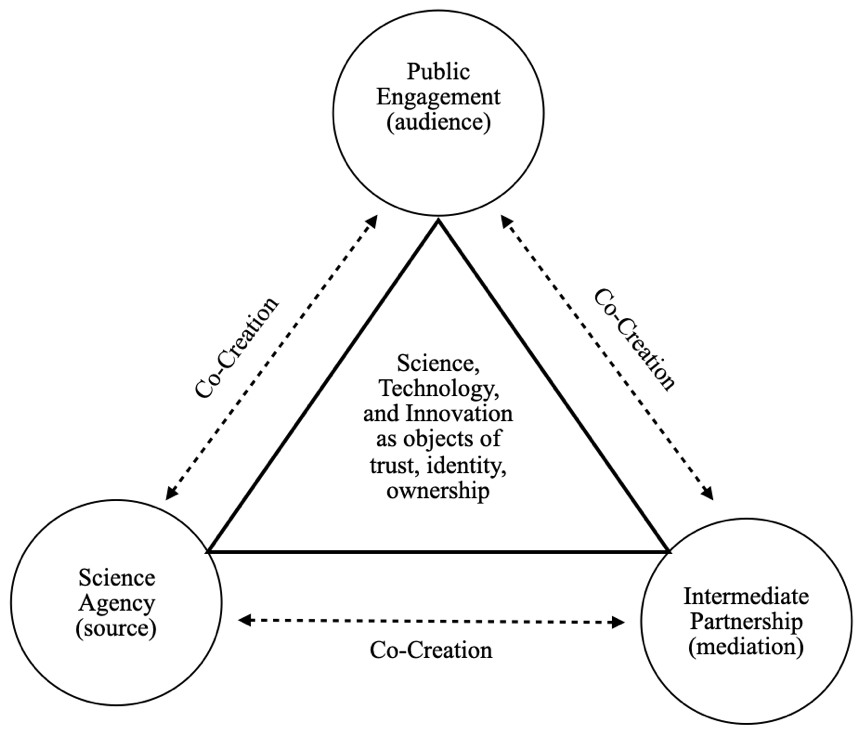
The analysis of #OneDOST4U illustrates how science communication, when framed as a co-creative and participatory practice, can foster not only awareness but also public trust, identity, and ownership of science. This aligns with the growing body of literature emphasizing dialogic models of science communication, where publics are not passive recipients of information but active participants in constructing scientific meaning [Irwin & Wynne, 1996; Bucchi & Trench, 2021]. The findings demonstrate that communicative identity building, through symbolic tools like hashtags, inclusive branding, and localized storytelling, serves as a bridge between technical institutions and lay publics. In particular, these symbolic artifacts act as “boundary objects” [Star & Griesemer, 1989] that mediate understanding across diverse stakeholder groups, such as the illustrated STI co-creative process in Figure 1.
This practice insight reinforces the idea that effective science communication must be grounded in local cultural contexts, stakeholder motivations, and everyday experiences, especially in Global South settings where institutional trust and accessibility vary [Guenther & Joubert, 2017]. Through reception analysis, we show that stakeholder interpretations can form essential feedback loops, helping institutions like DOST align their messaging with public values, expectations, and lived realities, an idea echoed in participatory evaluation models [Rowe & Frewer, 2005]. While the findings highlight the strengths of #OneDOST4U as a unifying and trust-building narrative, they also point to areas where communication practices could be further strengthened, including the timeliness of information, the technical density of some materials, and the procedural complexity of certain public-private collaborations. Messages not clearly linked to concrete community benefit were also less likely to be shared. From a science communication perspective, these issues relate mainly to challenges in one-way information provision associated with the deficit model, where clarity and accessibility are critical [Bucchi & Trench, 2021; Davies & Horst, 2016]. At the same time, the positive reception of #OneDOST4U reflects elements of the dialogue and participation models, supported by consultations and co-creative project activities. Together, the findings suggest that participatory engagement should be complemented by continuous refinement of informational outputs to ensure accessibility and relevance to stakeholder and community needs.
This framework positions #OneDOST4U not just as a branding tool but as a boundary object, a communicative construct that different stakeholder groups can interpret according to their own contexts while still recognizing it as a shared point of reference. Our findings advance science communication theory and practice in three ways:
- Empirical grounding of co-creation mechanisms: while co-creation is widely endorsed in theory, few studies detail the specific audience processes that transform a unifying institutional handle into a platform for collaborative meaning-making. We show that motivations, value-in-use, synergy, and communal values operate as linked mechanisms, each reinforcing the other in iterative cycles of message adaptation and stakeholder feedback.
- Bridging institutional communication and grassroots adaptation: the study demonstrates how an institutional campaign like #OneDOST4U can function as a shared symbolic resource that accommodates both top-down strategic objectives and bottom-up reinterpretations. This dual movement expands participatory models by showing that centralized communication can coexist with, and even benefit from, localized customization.
- Operationalising value-based science communication: by mapping the theoretical constructs onto concrete focus groups findings, we offer a methodological pathway for others to audit their own science communication efforts: identify audience motivations, document real-world applications (value-in-use), map collaboration points (synergy), and surface shared values.
In sum, this paper shows that a unifying campaign handle can be operationalized as a platform for value co-creation [Vargo & Lusch, 2016]. Through routine practices such as stakeholder consultations, project implementation, technology transfer, and cross-agency coordination, the campaign becomes a living site where meanings are continually negotiated, sustaining institutional coherence while allowing stakeholders to interpret and adapt the message to their own contexts.
This practice insight capturing findings from an evaluation of stakeholder perspectives focused on #OneDOST4U must be interpreted with several limitations. First, the composition of participants, many of whom were predisposed to view DOST as a single, coordinated entity, may have inclined them to interpret #OneDOST4U more positively than stakeholders with narrower, project-specific experiences. Future research should purposively examine discrete project-level stakeholders whose exposure is limited to a single agency or programme and compare their perceptions with those who hold broad portfolio views, to assess whether the sense of synergy and unity persists across audience types. Second, issues of researcher positionality warrant careful reflection. The author team consisted of one member affiliated with DOST and another from an independent academic institution, allowing for a balance of insider familiarity and external perspective in interpreting the findings. Nonetheless, social desirability bias may have influenced participant responses, and we sought to mitigate this by assuring confidentiality, using open-ended questioning, and documenting reflexive notes during analysis. Finally, it is important to recognise that some of the themes that emerged, such as synergy and communal values, closely align with the intended aims of the #OneDOST4U campaign.
References
-
Berger, P. L., & Luckmann, T. (1966). The social construction of reality: a treatise in the sociology of knowledge. Anchor Books.
-
Besley, J. C., Dudo, A., Yuan, S., & Lawrence, F. (2018). Understanding scientists’ willingness to engage. Science Communication, 40(5), 559–590. https://doi.org/10.1177/1075547018786561
-
Bijker, W. E. (1995). Of bicycles, bakelites, and bulbs: toward a theory of sociotechnical change. The MIT Press.
-
Brosnan, M. J. (2002). Technophobia: the psychological impact of information technology. Routledge. https://doi.org/10.4324/9780203436707
-
Bruns, A., Moon, B., Paul, A., & Münch, F. (2016). Towards a typology of hashtag publics: a large-scale comparative study of user engagement across trending topics. Communication Research and Practice, 2(1), 20–46. https://doi.org/10.1080/22041451.2016.1155328
-
Bucchi, M., & Trench, B. (2021). Introduction: science communication as the social conversation around science. In M. Bucchi & B. Trench (Eds.), Routledge handbook of public communication of science and technology (3rd ed., pp. 1–13). Routledge. https://doi.org/10.4324/9781003039242
-
Callon, M. (1999). The role of lay people in the production and dissemination of scientific knowledge. Science, Technology and Society, 4(1), 81–94. https://doi.org/10.1177/097172189900400106
-
Chesbrough, H. W. (2003). Open innovation: the new imperative for creating and profiting from technology. Harvard Business School Press.
-
Davies, S. R., & Horst, M. (2016). Science communication: culture, identity and citizenship. Palgrave Macmillan. https://doi.org/10.1057/978-1-137-50366-4
-
Deng, Q. (2024). Who are the science audiences? A typology study on digital scientific audiences: persona, performance, and public. Science Communication, 46(6), 687–724. https://doi.org/10.1177/10755470241252160
-
Dietrich, M., Znotka, M., Guthor, H., & Hilfinger, F. (2016). Instrumental and non-instrumental factors of social innovation adoption. Voluntas: International Journal of Voluntary and Nonprofit Organizations, 27(4), 1950–1978. https://doi.org/10.1007/s11266-015-9639-2
-
Edelenbos, J., & Klijn, E.-H. (2006). Managing stakeholder involvement in decision making: a comparative analysis of six interactive processes in the Netherlands. Journal of Public Administration Research and Theory, 16(3), 417–446. https://doi.org/10.1093/jopart/mui049
-
Fischer, F. (2000). Citizens, experts, and the environment: the politics of local knowledge. Duke University Press. https://doi.org/10.1215/9780822380283
-
Freeman, R. E. (2010). Strategic management: a stakeholder approach. Cambridge University Press. https://doi.org/10.1017/CBO9781139192675
-
Freeman, R. E., Harrison, J. S., & Zyglidopoulos, S. (2018). Stakeholder theory: concepts and strategies. Cambridge University Press. https://doi.org/10.1017/9781108539500
-
Guenther, L., & Joubert, M. (2017). Science communication as a field of research: identifying trends, challenges and gaps by analysing research papers. JCOM, 16(02), A02. https://doi.org/10.22323/2.16020202
-
Heinze, T., & Bauer, G. (2014). Exploring creative research in emerging research domains. Worldwide longitudinal evidence for nanoscale science and technology. Annals of Economics and Statistics, (115/116), 107–124. https://doi.org/10.15609/annaeconstat2009.115-116.107
-
Irwin, A., & Wynne, B. (Eds.). (1996). Misunderstanding science? The public reconstruction of science and technology. Cambridge University Press. https://doi.org/10.1017/CBO9780511563737
-
Jasanoff, S. (2003). Technologies of humility: citizen participation in governing science. Minerva, 41(3), 223–244. https://doi.org/10.1023/a:1025557512320
-
Klein, J. T. (2004). Interdisciplinarity and complexity: an evolving relationship. Emergence: Complexity & Organization, 6(1–2), 2–10.
-
Latour, B., & Woolgar, S. (1979). Laboratory life: the social construction of scientific facts. SAGE Publications.
-
Nowotny, H., Scott, P. B., & Gibbons, M. T. (2001). Re-thinking science: knowledge and the public in an age of uncertainty. Polity Press.
-
Pinch, T. J., & Bijker, W. E. (1984). The social construction of facts and artefacts: or how the sociology of science and the sociology of technology might benefit each other. Social Studies of Science, 14(3), 399–441. https://doi.org/10.1177/030631284014003004
-
Prahalad, C. K., & Ramaswamy, V. (2004). Co-creation experiences: the next practice in value creation. Journal of Interactive Marketing, 18(3), 5–14. https://doi.org/10.1002/dir.20015
-
Rowe, G., & Frewer, L. J. (2005). A typology of public engagement mechanisms. Science, Technology, & Human Values, 30(2), 251–290. https://doi.org/10.1177/0162243904271724
-
Skouloudis, A., Botetzagias, I., Malesios, C., & Koutroumpinis, P. (2025). Acceptance of smart-city technologies: some evidence on the role of perceptions and demographics from a municipality of Athens, Greece. Smart Cities, 8(5), 177. https://doi.org/10.3390/smartcities8050177
-
Star, S. L., & Griesemer, J. R. (1989). Institutional ecology, ‘translations’ and boundary objects: amateurs and professionals in Berkeley’s Museum of Vertebrate Zoology, 1907–39. Social Studies of Science, 19(3), 387–420. https://doi.org/10.1177/030631289019003001
-
Stilgoe, J., Owen, R., & Macnaghten, P. (2013). Developing a framework for responsible innovation. Research Policy, 42(9), 1568–1580. https://doi.org/10.1016/j.respol.2013.05.008
-
Vargo, S. L., & Lusch, R. F. (2016). Institutions and axioms: an extension and update of service-dominant logic. Journal of the Academy of Marketing Science, 44(1), 5–23. https://doi.org/10.1007/s11747-015-0456-3
-
von Hippel, E. (2009). Democratizing innovation: the evolving phenomenon of user innovation. International Journal of Innovation Science, 1(1), 29–40. https://doi.org/10.1260/175722209787951224
Notes
1. Implemented by the DOST-Philippine Nuclear Research Institute, funded by the DOST-Philippine Council for Agriculture, Aquatic, and Natural Resources Research and Development; in collaboration with DOST R&D Communications Team.
About the authors
Dr. Dave D. Centeno is a full professor of marketing at the UP Cesar E.A. Virata School of Business, University of the Philippines, Diliman, Quezon City, Metro Manila, Philippines. He is a well-published scholar and practitioner of marketing and communication; obtained his Ph.D. from the City University of Hong Kong.
E-mail: ddcenteno@up.edu.ph
Ms. Framelia Viernes Anonas heads the communication section of the Philippine Nuclear Research Institute, an agency under the Republic of the Philippines’ Department of Science and Technology. She obtained her Master of Development Communication from the University of the Philippines Open University.
E-mail: fvanonas@pnri.dost.gov.ph
Supplementary material
Available at https://doi.org/10.22323/159120260131095647
Table 1. List of the focus group discussion conducted with participant profiles
Focus group discussion guide questions
Table 2. Thematic analysis: major themes, definitions, and representative quotes
Table 3. Sample coding protocol