

1 Introduction
The media are critical to shaping who and what is deemed important within society, prioritising which topics receive attention and which individuals are featured or given visibility [Lang, 2013]. However, decisions about what constitutes news are typically made by dominant groups represented in newsrooms, resulting in coverage that often fails to reflect the diversity of the audience or their interests and needs [Cukier et al., 2019; Mulupi & Zirugo, 2023]. Every five years since 1995, the Global Media Monitoring Project (GMMP) has analysed gender in news, including the presence of women as journalists and sources compared to men. The most recent report published in 2020 found that women appear as experts in 24% of media coverage, an increase from the 19% found in 2015 [Global Media Monitoring Project, 2020]. In newspapers and digital news, about 40% of stories are reported by women, compared to 37% since 2005 [Global Media Monitoring Project, 2020]. However, women and minoritised groups are historically mis- or underrepresented in media, both as journalists and expert sources [Cukier et al., 2019; Global Media Monitoring Project, 2020]. This underrepresentation can have flow on effects as to who society associates with being competent and qualified in various topics, “…who ‘counts’ in society, whose voices have legitimacy and status” [Ross, 2007, p. 454]. This is particularly the case in science.
For many people, mainstream media is their primary source of scientific information [Schäfer, 2016]. Journalistic representations of scientists can influence cultural perceptions of “who speaks for science” [LaFollette, 1988, p. 262], and exposure to science and role models can therefore shape public perceptions of both science [Noy & O’Brien, 2019] and scientists. However, news coverage of scientific topics tends to be dominated by white males as expert sources [Global Media Monitoring Project, 2020], even in progressive countries with strong commitment to gender equality [Niemi & Pitkänen, 2017]. Despite advances in gender equality and workforce participation in most countries, including in journalism and in science, “there has been little progress in terms of the inclusion and portrayal of women in the news” [Shine et al., 2024, p. 2]. Australia is no exception.
Despite decades of effort to increase the participation of women in science [McKinnon, 2022] and media [Carson et al., 2024], gaps remain. In Australian science, technology, engineering and mathematics (STEM) industries, women comprise 29% of the workforce [Australian Government, 2024]. While this increases to 78% in health industries, women are still outnumbered by men at all senior levels [Australian Government, 2024]. Within Australian journalism, near gender parity in workforce numbers has not translated to equal visibility. Women are less likely to author news stories — reflected in bylines and appearances on the front page — and are underrepresented as quoted expert sources [Carson et al., 2024]. Women are also more likely to write about health rather than issues like energy [Women in Media, 2023]. These trends raise the question: does media coverage of Australian science reflect the combination of these inequities? Price and Payne [2019] conducted a review of gender roles in online news media from 15 Australian news sites. Based on a sample of 19 stories on science topics, they found that 59% of science stories were written by women and 33% of direct quotes were from women [Price & Payne, 2019]. The small sample of science news articles provides some insight, but further investigation is required to draw more definitive conclusions. This study examines who writes and speaks about which scientific issues in Australian print and online media. It seeks to provide a picture of how science news is presented in mainstream media and specialised popular science outlets in Australia, and how this changes over a five-year period.
2 Literature review
2.1 Women in the media
The news media play an important role in reinforcing societal norms and values [Santoniccolo et al., 2023]. Within the context of media, editorial decisions such as what to publish and where, are typically made by men [Ross, 2001] meaning that the news is filtered according to male values [North, 2015]. Consequently, issues and topics of most salience and importance to women “tend to be pushed to the margins of the news” reinforcing the privilege of men’s views and opinions over women’s and “contributing to the ongoing secondary status of women’s participation as citizens” [Ross & Carter, 2011, p. 1148]. This is not only limited to women but extends to all minoritised groups. The voices and perspectives of these groups are often presented relying on stereotypes which treat them as ‘other’ [Phillips & Tapsall, 2007] and without context [LaPoe et al., 2022], if their voices and perspectives are presented at all [Clark, 2017; Peng et al., 2024; Zabaleta et al., 2013]. For decades, researchers have asserted the seeming truism that more diverse representation of journalists and editors will ensure better representation of topics [and sources] that are relevant to diverse audiences [Gallagher & von Euler, 1995]. Yet despite the apparent ‘simplicity’ of the solution, the inequities persist, indicating the larger systemic issues remain unaddressed.
Early studies by Cottle [1997] raised issues of exclusion, racism and sexism which remain pertinent today as, despite organisational commitments to increase diversity in newsrooms, these commitments are often at odds with the experiences of the minoritised groups they are meant to include [Douglas, 2022]. Although gains have been made in the proportion of female journalists, global progress to parity is only halfway with notable variations between regions with only North America and the Pacific showing overall presence of women above 30% [Global Media Monitoring Project, 2020]. This proportion is reflected in the sources used by journalists. The GMMP [2020] found women appear as expert sources in about 24% of their global sample. Similarly, findings from a recent Women in Media report in Australia found women account for 30% of quoted sources overall, and as expert sources in 34% of stories [Women in Media, 2023].
These findings are not new. In the United States, Desmond and Danilewicz [2010] found male reporters were more likely to present stories related to politics, whereas female reporters produced stories on human interest and health topics. Again, regardless of topic, men were more likely to be used as sources [Desmond & Danilewicz, 2010]. During COVID 19, news coverage in Kenya and Zimbabwe was dominated by the male elite, with women absent in 72% of all news stories collected in the sample [Mulupi & Zirugo, 2023]. The authors note that these patterns were consistent in both countries, despite different media and political systems, suggesting the patriarchal culture of these countries could be related. Recent data from Australia reveals similar patterns, as the next section describes.
2.1.1 The Australian media
Journalism in Australia does not appear to have a ‘pipeline’ problem with women long dominating media-related courses in Australian universities. As early as 1992, almost 60% of students in journalism and mass communication were female [Gallagher & von Euler, 1995]. By 2006, Australia appeared to have achieved a near gender balance in journalism, based on data from the Australian Bureau of Statistics 2006 census [Josephi & Richards, 2012]. Less than 10 years later, about half of the 15 most influential news sites in Australia had achieved gender parity in their journalists [Price & Payne, 2019]. Nevertheless, since the call for gender parity in the media emerged, the news industry in Australia has remained immersed in a ‘blokey’ culture, hindering female participation [North, 2016b]. In the most recent Industry Insight Report, 57% of women working in media roles were dissatisfied or unsure about how to advance in their career. The top three reasons for career stagnation were a lack of opportunities for progression and development, lack of managerial support and limitations created by caregiving and household responsibilities [Women in Media, 2024].
For the first time ever since the GMMP began in 1995, women outnumbered men when the percentages of reporters and presenters in Australia were combined [Romano, 2020]. Yet despite this parity in the number of male and female reporters, similar patterns in source and topic selection have persisted over the last three decades. No matter the gender of the journalist or the topic, men were predominantly the expert sources used [Cann & Mohr, 2001]. The more recent national report by the GMMP found women comprised only 32% of the 1,706 news sources identified in all media stories studied, despite representing just over half of the national population [Romano, 2020]. In their study of Australian television news, Cann and Mohr [2001] also found female reporters were disproportionately represented in stories on ‘lower ranked’ subjects — those appearing towards the end of a television newscast such as health and arts. In contrast, men were more likely to report on the leading news program stories on topics such as disasters, politics and crime. This was echoed in a study almost 20 years later with women most likely to cover ‘soft news’ areas of features, arts, education and health, despite an increase in their coverage of politics and business [North, 2016a].
A more recent examination of the gender of journalists covering particular ‘beats’ or topics, calculated by byline share of total coverage, shows a highly variable picture [Women in Media, 2023]. In coverage of science topics, the gender split is even, with men and women each accounting for 50% coverage. Environmental stories show a similar distribution, with men accounting for 51% of reporting and women 49%. Greater disparities are seen in more niche topics such as energy and resources, where men account for 74% of reporting compared to 26% by women. In comparison, coverage of health topics is dominated by female journalists (64%) [Women in Media, 2023]. This scorecard examined media coverage broadly, not coverage from science-specific outlets. This study conducts a similar examination of mainstream media coverage of scientific news but will also include science-focused news outlets to gain a more holistic picture.
2.2 Media representations of women in science
Throughout history there has been an emphasis on a female scientist’s role as a mother, wife, or feminine ‘token’ [Chimba & Kitzinger, 2010]. Early 20th century portrayals of female scientists focused more on the unusualness of being a scientist and a woman, and prioritised female scientists’ domestic abilities over their scientific ones [Steinke, 2012]. Portrayals of women in science were skewed to character stereotypes and subtle undermining of their ability to comprehend science. This is echoed within STEM disciplines themselves, where women can be stereotypically perceived as less capable and effective than their male counterparts, even if they have equal levels of achievement [Knobloch-Westerwick et al., 2013; Moss-Racusin et al., 2012]. Part of this could be attributed to the so-called Matilda Effect [Rossiter, 1993] which describes the “systematic under-recognition of female scientists” with work quality and potential collaborative ‘worth’ of male scientists perceived to be much higher than that of women’s [Knobloch-Westerwick et al., 2013, p. 694].
In magazine media, an accomplished female scientist was an exception rather than the rule [LaFollette, 1988]. When female scientists were covered they tended to be presented either as ‘super-scientists’ [Nelkin, 1995], or as subordinate assistants to male scientists: “another pair of hands for the professional man” [LaFollette, 1988, p. 269]. There was also some tendency to portray female scientists as women “with unusual interests, who are also scientists” [Shachar, 2000, p. 356].
Both journalistic practices and audience responses pose a risk to women who publicly communicate their work. If a journalist includes a woman in a story about science, their gender and professional performance should not be the story [Shachar, 2000]. This reverts to tokenism, and it occurs in media around the world. In Brazil, a study of television news programs found that although women scientists were represented, the journalists used language which reinforced perceptions and stereotypes of science as a male domain [Massarani et al., 2019]. Similarly, an earlier study of news coverage of genetically modified organisms in Uganda found women were more likely to be portrayed as associates of men, if they were represented in the news coverage at all [Lukanda, 2021]. Their chances of being included as sources were improved only if they collaborated with a male colleague [Lukanda, 2021].
Audiences also provide challenges for women appearing in the media. Women who do communicate their scientific work are more likely to be evaluated on appearance and personality [Mitchell & Martin, 2018], subject to harassment and abusive comments on social media [Amarasekara & Grant, 2019; Veletsianos, 2012] and have additional negative stereotypes applied to them such as bitchy, bossy and emotional [McKinnon & O’Connell, 2020]. This creates a precarious situation for women who do step forward to act as role models for their discipline, where in attempting to overcome one layer of stereotypes they are covered with another [McKinnon & O’Connell, 2020]. These overlapping challenges, from audiences and media outlets, may contribute to a reticence to participate in media coverage.
In a study with people who had experience as a news source in Australia, fear of online harassment and negative evaluations based on appearance were two key factors identified as deterrents to agreeing to interview requests [Shine et al., 2024]. These concerns were raised exclusively by female respondents and were not shared by male respondents. Despite acknowledging these concerns, they typically were not enough to deter respondents from giving interviews. Irrespective of gender, willingness to engage with media remained high, with over 80% of respondents reporting positive media interactions [Shine et al., 2024]. This study was not specific to those within the sciences, although earlier studies with researchers from science and health disciplines show similar sentiments in Australia [McKinnon et al., 2019] and overseas [Ashwell, 2016; Peters et al., 2008]. If women are prepared to engage with media, despite the additional challenges outlined in this section, then where do they appear in Australian media and what are they speaking about?
2.3 Research aims
This article explores the coverage of STEM topics in the Australian print and online media to better understand:
- Who reports on STEM news
- Who is quoted in STEM news (directly or indirectly)
- What STEM topics have the greatest number of female journalists and sources.
3 Methods
3.1 Data collection
The media outlets selected for data collection included the 15 original sources analysed in the 2019 Women for Media Report [Price & Payne, 2019]. Media outlets in the Women for Media Report were selected to cover a breadth of Australian geographies and demographics. The outlets included seven of the top 10 online-access news sources in Australia, according to a Neilsen poll [Price & Payne, 2019]. In addition to these 15 sources, the present study included three additional science-based media outlets: New Scientist, The Conversation and Cosmos. It is important to note that the articles written in The Conversation are by researchers, rather than professional journalists. However, as these articles are often picked up and presented by other media outlets verbatim, including providing the authors with a byline, they are included in this sample as ‘defacto’ journalists given the average media consumer is likely to be unaware of the distinction between the publishing model of The Conversation and other outlets. The media outlets included in the final dataset are outlined in Table 1, which also shows their distribution format and ownership.
| Outlet | Format | Owner |
| 9News | Online | Nine Entertainment Co |
| ABC | Online | Public Broadcaster |
| BuzzFeed | Online | BuzzFeed Inc. |
| Cosmos | Online | CSIRO Publishing |
| Daily Mail Australia | Online | Daily Mail and General Trust |
| Daily Telegraph | Print/Online | News Corp Australia |
| Financial Review | Print/Online | Nine Entertainment Co |
| Herald Sun | Print/Online | News Corp Australia |
| New Scientist | Online | Daily Mail and General Trust |
| news.com.au | Online | News Corp Australia |
| The Age | Print/Online | Nine Entertainment Co |
| The Australian | Print/Online | News Corp Australia |
| The Conversation | Online | The Conversation Media Group |
| The Courier Mail | News Corp Australia | |
| The Guardian | Print/Online | Guardian Media Group |
| The Sydney Morning Herald | Print/Online | Nine Entertainment Co |
| The West Australian | Seven West Media | |
| Yahoo 7 | Online | Verizon |
3.1.1 Sampling
News articles were collected through online repositories of print media using the ‘constructed week method’ — a sampling technique that provides an overview of the content of media outlets [Jones & Carter, 1959]. Here, a six-day constructed week from Monday to Saturday is used. Six days are used instead of a seven-day week as the content in Sunday newspapers usually varies significantly from the content published Monday to Saturday [Bell, 1991]. A random sample of 12 days was taken from each year (2018–2022) to construct the equivalent of two six-day weeks as described by Riffe and colleagues [1993]. Although Luke et al. [2011] suggested sampling at least six constructed weeks to estimate textual data in a one-year population accurately, other studies showed that two constructed weeks allow reliable estimates of one year’s content to be made [Riffe et al., 2019; Stempel, 1952]. Thus, two randomly constructed weeks per year were created using an online random date generator. The dates for this study are provided in Table 2.
| Day | Week | 2018 | 2019 | 2020 | 2021 | 2022 |
| Monday | A | 26 March | 25 November | 13 April | 22 March | 3 January |
| B | 1 October | 2 September | 31 August | 20 December | 21 February | |
| Tuesday | A | 8 May | 29 January | 4 February | 13 April | 5 April |
| B | 12 June | 5 November | 16 June | 17 August | 18 October | |
| Wednesday | A | 4 April | 13 November | 13 May | 8 September | 19 January |
| B | 26 September | 18 September | 5 August | 3 November | 5 October | |
| Thursday | A | 7 June | 25 July | 5 March | 11 March | 5 May |
| B | 13 September | 24 October | 16 April | 9 September | 7 July | |
| Friday | A | 15 June | 5 July | 22 May | 15 January | 18 March |
| B | 30 March | 1 March | 13 November | 26 March | 4 November | |
| Saturday | A | 1 September | 6 April | 22 February | 16 January | 26 February |
| B | 22 December | 5 January | 3 October | 2 October | 28 May | |
All articles published on the selected day were scanned and those relating to any aspect of science were retained for analysis. Inclusion criteria were any articles:
- in the ‘Science’ section of a publication (e.g., all articles in the ‘Science and Technology’ section of The Conversation)
- that mentioned the word science, scientist/s or researcher/s, or referred to a scientific study (e.g., quoting a relevant scientist or a scientific study on flooding in an article about local floods)
- that contained an explanation of a scientific phenomenon (e.g., the biology of whales in an article about beaching whales)
- that contained a reference to scientifically gathered data on a topic (e.g., an explanation of what historical climate data can tell us about where people lived over time)
To ensure consistency of comparison between all five years, articles pertaining to COVID-19 were omitted from the 2020–2022 samples.
All articles published between 12:01 am and 11:59 pm Australian Eastern Standard Time per day constituted the sample. As time zones vary across the continent, whatever timestamp was published with the article in the specific outlet was used as a guide. Articles were accessed from the Australian website of the chosen outlet, and Google News, news site archives, and Factiva (a global news database) were used to search for articles and crosscheck publication dates. For traditionally print-based sources, PressReader and the Global Newsbank were used to access articles behind paywalls. Where the same article was published across two different news sources on the same day, both articles were retained and analysed, recognising individuals may not read every possible news source. Articles which required a subscription were not analysed where the article was not accessible through alternative channels, as they would not have been widely accessible to Australian viewers. Where an outlet’s Australian website contained international news or articles published overseas and reuploaded on the Australian site, these were included on the basis that they were accessible to an Australian audience.
3.1.2 Data analysis
We replicated the analysis methodology of the 2019 Women for Media Report, recording the gender of journalists as well as individuals quoted directly and indirectly. To limit bias in sampling, gender was only recorded if the subject’s name was gender specific, or where additional verification was possible. This included searching for the individual on external sources (i.e. organisational or personal web page, LinkedIn) and checking for binary and non-binary personal pronoun use in external sources or in the article itself. Where phrases such as ‘the researchers’ or an organisation name (e.g. ‘according to NASA’) were used, this was recorded in a separate ‘unspecified’ group. If a wire service such as Reuters or AAP was listed as the author instead of a journalist, this was also classified as ‘unspecified’.
Direct quotes are those attributed to the speaker using “quotation marks”, whereas indirect quotes do not use quotation marks, only indicate the comment came from the person interviewed with phrases like ‘Dr. Singh said’. As this study is exclusively focused on science and health news, in most articles the sources quoted are the researchers conducting the study or other researchers within the same field. Where non-expert sources are quoted, they tend to be eyewitnesses or people with firsthand experience of the issue being presented. As the focus of this paper is on who is given a voice in scientific issues, and the predominance of experts being cited due to the subject focus, this distinction between expert and source was not made in the analysis, consistent with earlier studies [e.g. Women in Media, 2023].
Data collection and coding of journalist and source gender was undertaken by different researchers each year, with the lead author contributing to each iteration. To ensure consistency, data was coded using the same process each year. Each group of researchers conducted a check for internal consistency by using a subsample of 20–40 articles. These were individually coded and then discussed by the group with any discrepancies or inconsistencies resolved. Given the data being coded was both limited in classification (male, female, unspecified), external verifications were used, and coder agreement was consistent in each sample, further calculation of coder reliability was not calculated. Coding of the article topic was done for all five years of articles by the lead author only. Each year, the researchers collecting the articles provided a short description of the article topic. These were used, in conjunction with the articles themselves, to develop thematic categories. The primary author developed the original list of categories from the first year of articles collected. The primary and a second author applied these categories to a different year of collected articles to confirm the appropriateness of the themes and refine them as required. Any discrepancies (of which there were few) were discussed and the resolved thematic schema used by the lead author for the rest of the data collected. The topics allocated to the different code categories are shown in Table 3. All data collection and coding was completed using manual human verification and no automation, consistent with the Women in Media [2023] study. Quantitative analysis was completed in Microsoft Excel, using sum and count functions, pivot tables and graphs. Additional statistical analysis using a Chi Square test of independence to examine the relationship between different variables was conducted using IBM SPSS Statistics (Version 28).
| Topic |
Examples of articles |
| Agriculture, aquaculture & food |
Weight gain in cattle, chillis, fish farming, rapeseed for vegan food |
| Animals, insects & birds |
Bee size in urban areas, fat pigeons are more aggressive, fruit fly behaviour |
| Antarctica/Arctic |
Hidden lake in Antarctica, meteorite found in Antarctica, Arctic research, Arctic weather |
| Archaeology |
Salamander fossil, remote sensing used in archaeology discovery, drought forced Vikings out of an area |
| Art & Science |
Exhibition with real bodies, blending art theory and cognitive science |
| Chemistry |
Bone repair materials, graffiti removal fluid |
| Climate |
Tourism carbon, climate change, bushfires, daffodils flowering early |
| Dinosaurs |
Egg laying dinosaur, monkeydactyl, dinosaur fossils |
| Energy |
Wind power, fracking, power station demolition, fossil fuels |
| Engineering |
Aerofoil design, hybrid plane, inflatable prosthetic |
| Environment |
Weedkiller, conservation biology, impact of oil drilling in Guyana |
| Evolution |
Neanderthals, beginning of life in the deep sea |
| Genetics |
Cell evolution, stem cell database, trauma affects DNA |
| Geology |
New volcanic island off Japan, plate tectonics, planetary geology, sink holes |
| Health & Medicine |
Pain killer from sea snails, nutrition, why you should shut toilet lid, antimicrobial resistance |
| Marine science |
Angler fish footage, cooling the Great Barrier Reef, zooplankton fish oil |
| Mathematics |
Calculating pi, mathematical proofs |
| Physics |
Nuclear, static electricity, smallest gravitational field |
| Psychology |
Ability to spot fakes, influence of perception of quality on preference |
| Social |
Social media filters, birthrate linked to housing security, t-shirts against facial recognition |
| Space |
Stars going supernova, SpaceX control simulation, James Webb space telescope |
| STEM Education |
Early childhood, science exhibition, mathematics education, |
| Technology |
Robotic dog, AI, Google quantum computer, microwaves detect nutritional value in food |
| Weather |
Green skies, history of weather forecasting, microbursts, typhoons |
4 Results
4.1 Who reports on, and is quoted in, STEM news?
A total of 2,551 articles were collected over the five-year period (Figure 1). There were lower numbers of articles in 2020–2022, which can likely be attributed to the exclusion of any COVID-19 related items. Many articles were attributed to more than one journalist, meaning the number of journalists shown will exceed 2,551. Figure 1 shows a higher number of male journalists reporting on science in 2018–2020, but from 2021 onwards there were more female journalists. Collectively, there were slightly more (n = 22) STEM articles written by male journalists across the sample period. There was a spike in the proportion of journalists of unspecified gender in 2020 however this also decreased from 2021. The unspecified journalist category did not contain any non-binary gender authors in this sample; all unspecified journalists in this sample refer to individuals whose gender identity could not be ascertained or, more commonly, news wires such as AAP and Reuters.
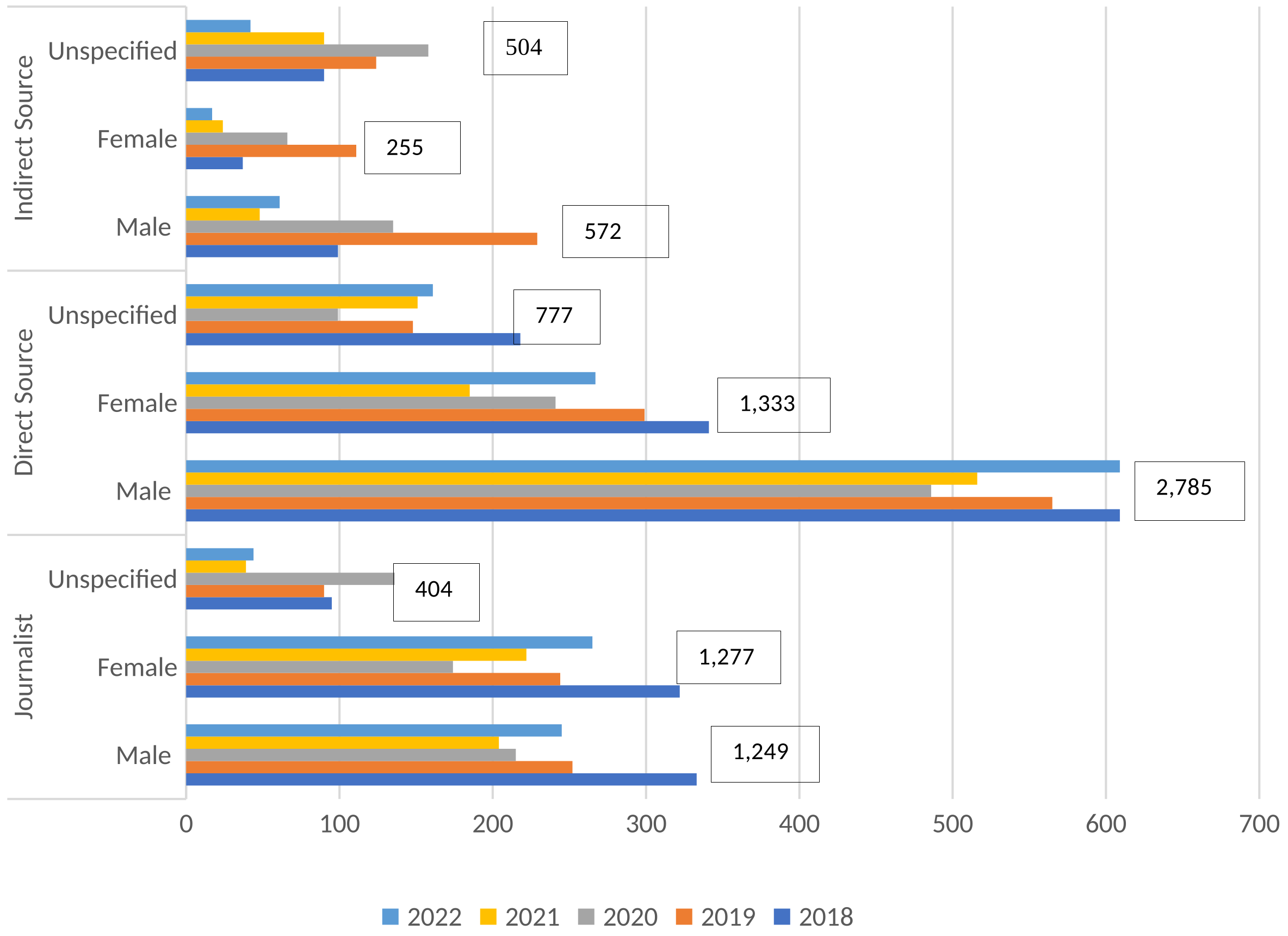
Of the 2,551 articles in the sample, 2,146 used direct or indirect quotes (or a combination of both). Across all outlets in each year, men were the most frequently directly quoted sources by some magnitude (Figure 1), with 75.5% of articles using direct quotes and 20.2% using indirect quotes. This proportion was fairly consistent over the five years with each year showing 72–80% of articles using men as sources directly or 16–35% indirectly (Table 4). Women were directly quoted in 44.9% of articles in the whole sample, a number that was fairly consistent over the five-year period (range of 41–48%). Women were quoted indirectly less frequently (9.7%) in the whole sample, with the range for each year of the sample period quite variable at 4–18%. The number of unspecified gender sources that were quoted directly or indirectly showed variation over the years, ranging from 23–32% of direct sources and 9–31% of indirect sources. The full five-year sample showed 29% of direct quotes came from unspecified sources and 18.7% indirect quotes from a source with unspecified gender. Similar to the unspecified journalist category, this sample did not include any non-binary gender sources, only those whose gender identity could not be reliably identified or reference to groups such as ‘the researchers’. Chi square analysis showed a significant relationship between journalist and source gender. Male journalists were significantly more likely to use male sources X2 (35, N = 2,551) = 906.935; p < .001) and unspecified sources X2 (30, N = 2,551) = 409.988; p < .001) whereas female journalists were more likely to use female sources X2 (24, N = 2,551) = 63.72; p < .001).
| Year |
Male direct |
Male indirect |
Female direct |
Female indirect |
Unspecified direct |
Unspecified indirect |
| 2018 |
72.75 |
16.08 |
44.51 |
5.88 |
32.94 |
14.71 |
| 2019 |
73.64 |
35.51 |
44.01 |
17.86 |
27.67 |
21.79 |
| 2020 |
73.03 |
25.95 |
47.84 |
14.76 |
23.16 |
31.30 |
| 2021 |
80.32 |
9.97 |
40.97 |
5.66 |
31.27 |
17.52 |
| 2022 |
79.18 |
11.86 |
46.97 |
4.12 |
29.06 |
9.20 |
Five outlets comprised most of the articles across all five years sampled. Collectively they provided 66% (1,686 articles) of the total dataset, specifically: Australian Broadcasting Corporation (ABC — 221 articles), The Conversation (264 articles), Cosmos (249 articles), Daily Mail (659 articles) and the Guardian (293 articles). Two of these outlets have a specific science focus in either the whole publication (Cosmos) or in a dedicated section (The Conversation). The remaining three are mainstream news outlets that cover all topics. Examination of gender composition of journalists within these five outlets provides a more nuanced picture over time (Figure 2).
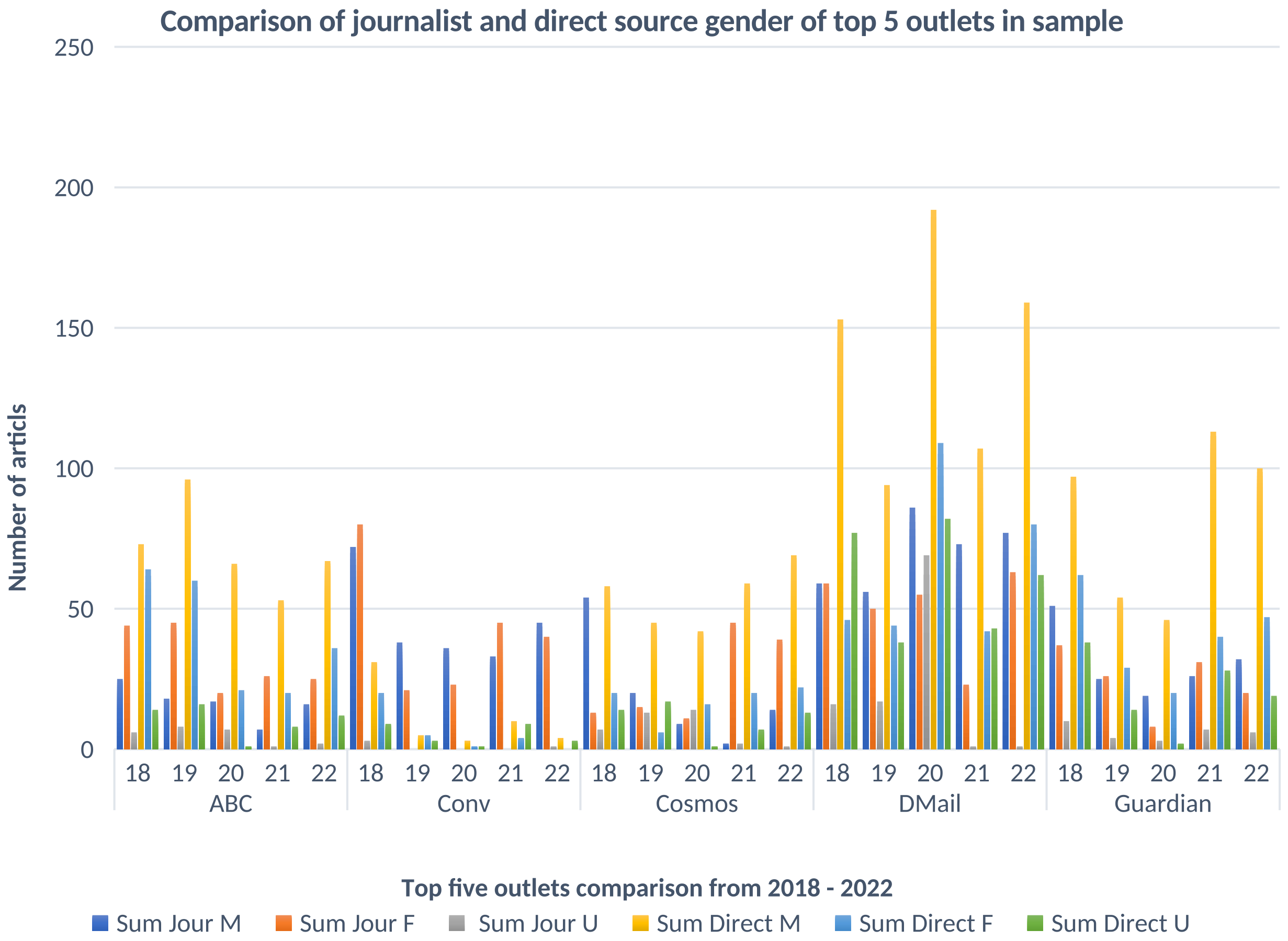
In the first year of the sample, there were higher numbers of stories written by women than men in the ABC and The Conversation. The ABC maintained this in 2019 while the number of women writing in The Conversation decreased. The higher number of male journalists persisted across other outlets. Cosmos exhibited a distinct shift in the gender profile of their journalists in 2021, showing predominantly female journalists in stark contrast to previous years. All outlets show variability over the sample period. For example, the Daily Mail shows the greatest difference between male and female journalists in 2021 while the other years in the sample show ratios closer to parity. The Guardian fluctuates each year, with between 11 and 14 more stories written by either male or female journalists, with only 2019 showing near parity.
Across all five sources in every year, men were the primary source of direct quotes (Figure 2). In 2018, the ABC came close to parity in gender of directly quoted sources, but not in other years. The Daily Mail relied on male sources far more than any other publication. The Guardian showed an increase in the number of direct quotes used overall, after a reduction in 2019 and 2020, however the ratio of male to female sources remains skewed towards the use of males. Although the increase in female journalists writing for Cosmos also saw an increase in the number of females directly quoted, male sources were still used more frequently.
4.2 What STEM topics have the greatest number of female journalists and sources?
Health and medicine-related topics were the most popular across the five-year sample (Figure 3). Articles pertaining to space were the next most common, closely followed by those focussing on animals, insects and birds. Environmental issues in general were popular, reflected by the consistent inclusion of stories pertaining to environment, climate and marine science topics. Weather-related topics were also regularly included, peaking in 2020. Technology news and surprisingly, archaeology-related topics were frequent inclusions too. As described in the method, archaeology was ultimately included in the sample because the stories all detailed the scientific processes used to locate and examine the artefacts found, as well as how the findings contributed to our current understanding of ecological systems, the evolution of human practices pertaining to tools, navigation and diet, and geological events.
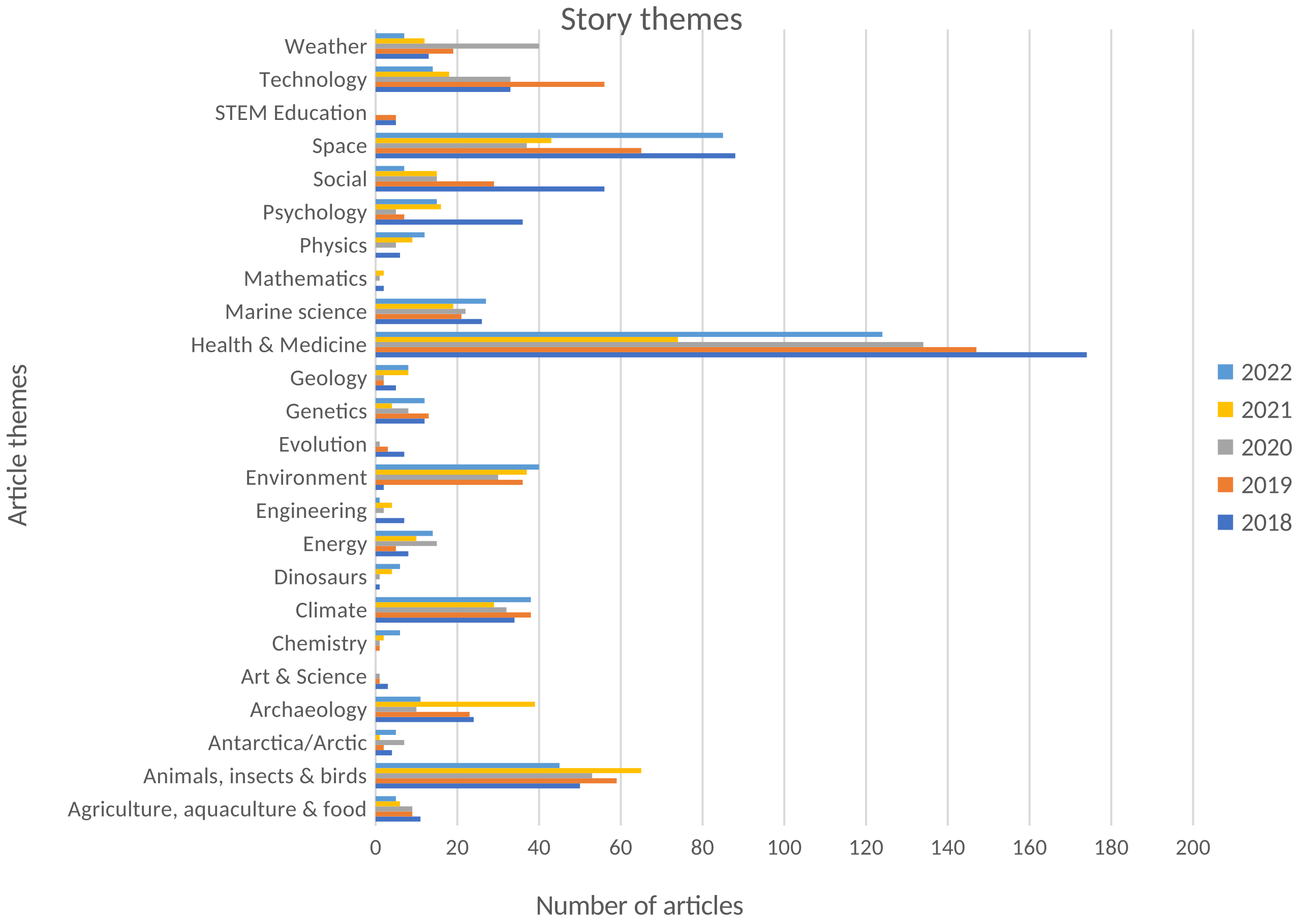
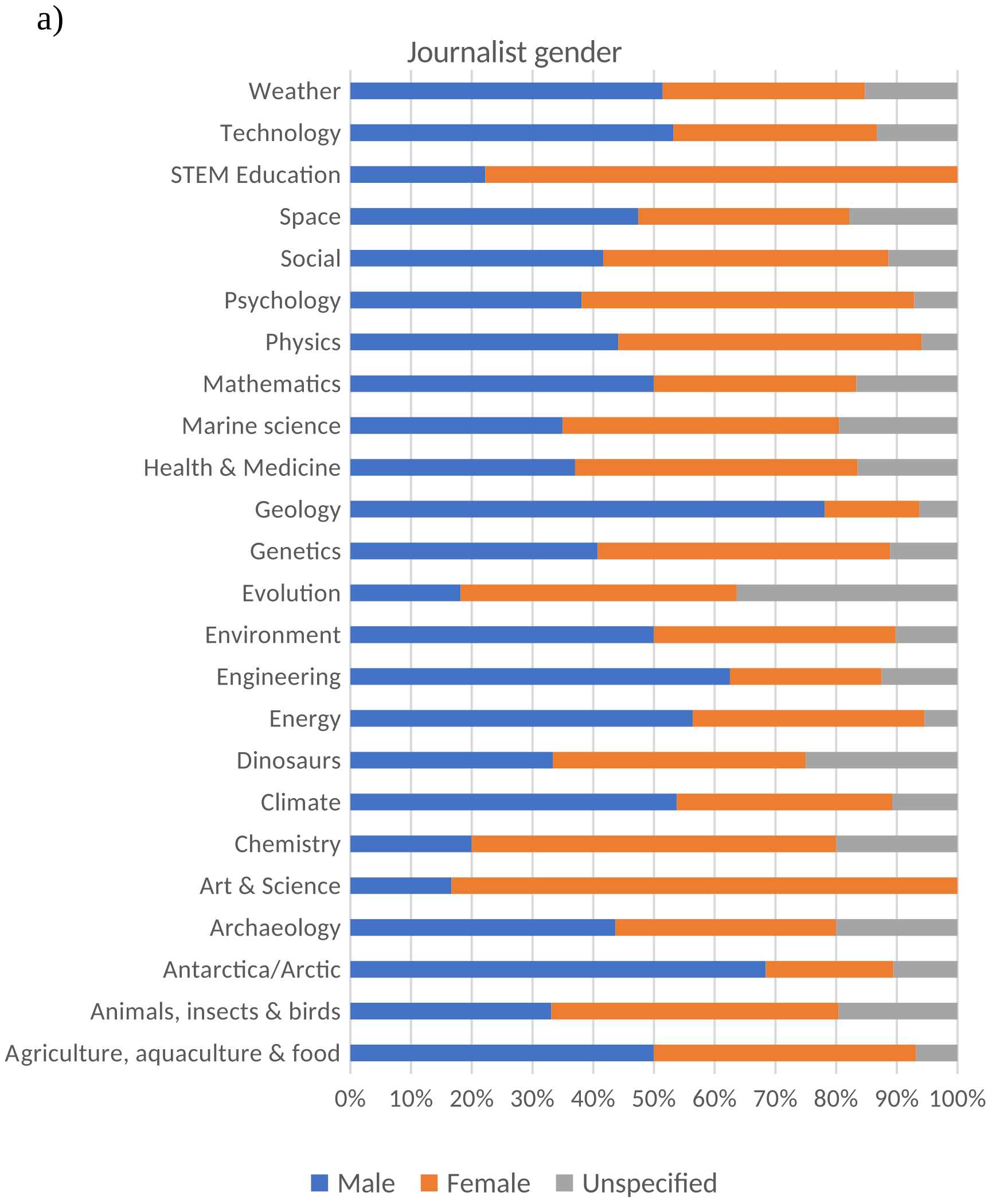
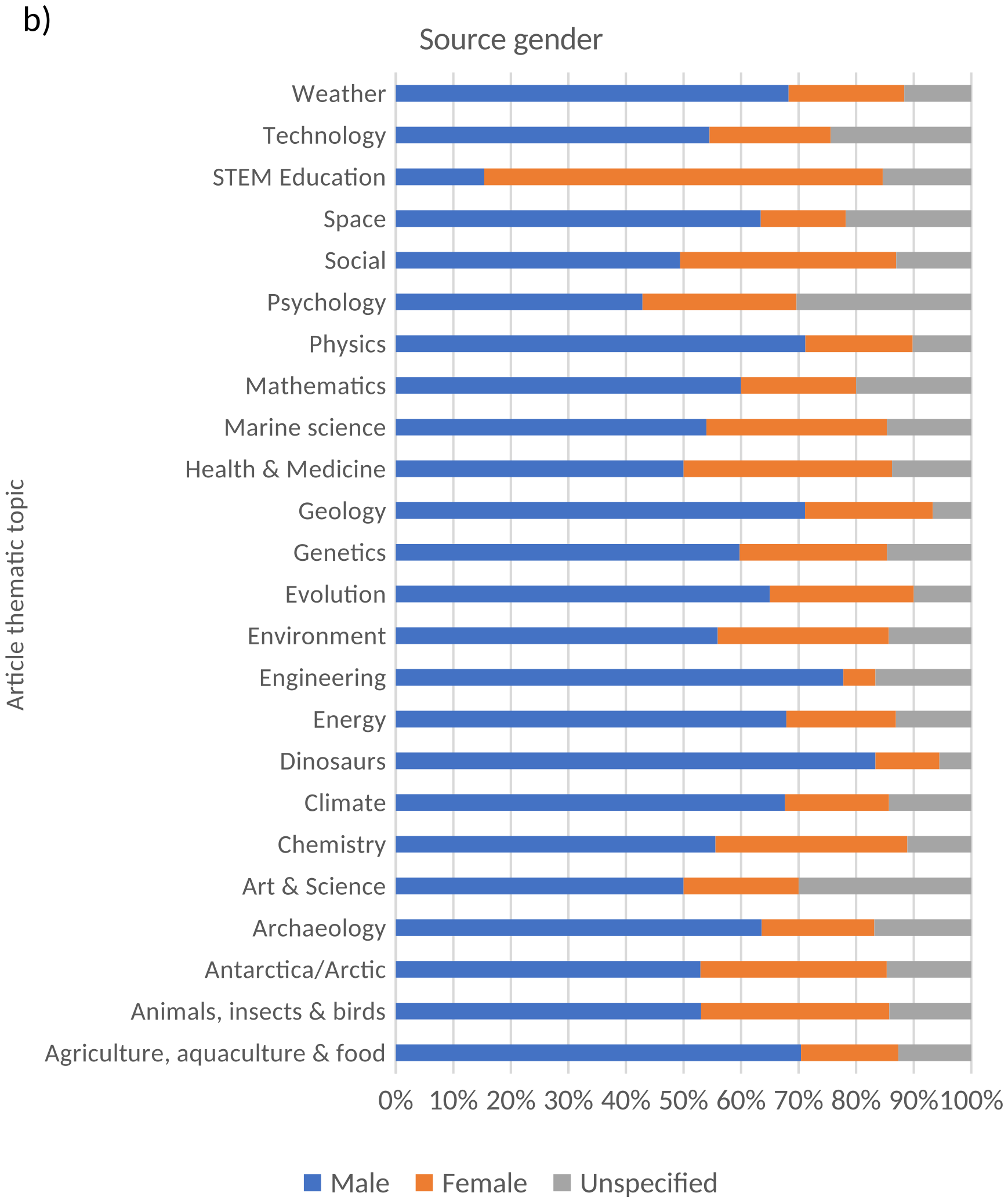
Figure 4 presents journalist and source gender for each theme as a percentage of the entire sample (whether the sample was 2 or 200 articles), enabling a visual guide as to which gender is most likely to write or speak about particular themes. Female journalists were more likely to write about health and medicine topics, along with animals, insects and birds, marine science, psychology, physics and social themes. Men were more likely to write about weather, technology, space, the environment and climate (Figure 4(a)). Figure 4(b) illustrates that women were less likely to be used as direct sources in every theme except for STEM education. In psychology and technology, unspecified sources (generic ‘researchers’) were more frequently used as direct sources than women.
5 Discussion
Across the five years of this study, the number of STEM stories written by women increased, particularly from 2020–2022, with only 22 more stories written by male journalists in the sample overall. This adds more nuance to earlier findings. The results presented here echo earlier studies, which show that women and men tend to work in similar numbers, however there are differences in topics covered, with men seeming to dominate coverage of science and technology [Carson et al., 2024; Global Media Monitoring Project, 2020]. The study by Price and Payne [2019] found 59% of science stories were written by women, but this was based on a sample of 19 articles. Here we show that within science and technology coverage, an almost equal number of articles were written by male and female journalists across the five-year period. Collectively, this is a positive step although there are differences between each outlet. Cosmos for example transitioned from predominantly male to predominantly female journalists over the five years. All other outlets had fluctuating proportions of journalist gender, with some years showing parity and others favouring one gender over another. It is also worth noting that most of the articles in our sample came from five outlets which included two sources with a specific science and technology focus either in sum or part. Our study then indicates that overall, female journalists are equitably represented in science and technology article bylines, across both mainstream and specialised science and technology news-focused outlets. However, it is important to note that these bylines may be shared with male colleagues or news wires.
Gender differences are more pronounced in the use of sources. This study found that males appear as directly quoted sources in 76% of articles, whereas women were quoted in 45% of articles. Although this is an improvement on the 32% reported in the Australian GMMP results [Romano, 2020] and the 33% found by Price and Payne [2019], these percentages remained relatively stable over the full five years of the sample. It is possible that the inclusion of science specific publications in the data set may have helped to increase the proportion, but differences remain.
There is still a noticeable and disproportionate representation of males in both direct and indirect source use. This does vary between outlets. The Conversation for example tends not to cite sources very frequently in its articles, instead linking to published research. Although it is interesting to note that even in the years with a greater number of female writers (2018 and 2021), and in the very rare instances where direct quotes were used, articles in The Conversation were more likely to cite male sources. Despite the increase in female journalists, Cosmos was more likely to cite male sources. The Daily Mail and the Guardian both cite male sources far more frequently than female. Chi square analysis shows that male journalists are significantly more likely to cite male and unidentified sources, whereas female journalists are more likely to cite female sources. This suggests that increasing proportions of women writing STEM stories will lead to an increase in the number of female sources used, however male journalists also have a role to play, as do news, scientific and research organisations. This is discussed later in this section.
This study finds articles on health and medicine, space, and animals, insects and birds are most likely to receive coverage in Australian media. The reasons for the popularity of these topics can likely be gleaned from the application of news values including timeliness, prominence, impact and novelty [Bednarek & Caple, 2014]. Space news stories were amongst the top five or ten news stories of the year in various international outlets in 2020 and 2021, perhaps echoing the popularity of space-themed movies and television shows [Kelley & Schwalbe, 2024]. Health and medicine are arguably relevant to everyone, particularly in an era of increasing threat from pandemics. The most prominent topics themselves are not necessarily surprising. The gender of journalists and sources in stories about these topics presents some interesting patterns.
The 2024 Women for Media report found men were more likely to report on science, technology, energy and environment stories, whereas women are more likely to write about health, wellbeing and lifestyle [Carson et al., 2024]. This is consistent with earlier studies which found sports, science, technology, foreign affairs and business are beats more likely to be covered by men while women were more likely to cover health [North, 2016a]. Although similar patterns are seen in these results, the use of finer grained themes instead of the broader ‘catch all’ of ‘science and technology’ allows more insight. Women are more likely than men to write about health and medicine-related topics. However, the difference in gender representation for each topic was not as large. For example, the 2023 Women in Media report found male journalists were almost three times as likely to write about topics such as energy. This same pattern is not reflected in this sample, with the number of articles written by males and females much closer to parity.
The disproportionate use of male sources is reflected in the different article themes, even in those fields typically dominated by women such as health and environmental studies [SAGE, 2025]. Since 2003, women have comprised 75% of people working in health related occupations, which includes those in universities [Australian Bureau of Statistics, 2025]. However, in this data set men are quoted in 50% of health and medicine related articles, with women quoted 36%. Similar patterns are seen in the environmental theme, with male journalists and sources comprising the ‘lion’s share’. These are not new patterns. Men have dominated pages and screens as expert sources in Australia for decades [Cann & Mohr, 2001] with common reasoning being that women are less likely to be willing to be interviewed, a rationale that is not supported by a 2023 survey of Australian researchers [Shine et al., 2024] or the number of participants involved in media related initiatives described in the next section. This male dominance could potentially be attributed to the stereotypical (and erroneous) perceptions of STEM disciplines being male-oriented [Garriott et al., 2017] and perceptions of what it means to be a ‘successful’ scientist do not overlap with stereotypes about women [Carli et al., 2016]. The consequence of these stereotypical perceptions tends to be a dominance of ‘men as expert’ in science and technology coverage [Price & Payne, 2019], which in turn reinforces the stereotype of STEM disciplines being male-dominated. This study indicates that the status of science reporting in Australia may have greater representation of women than first thought, although there is more to be done to increase the diversity of sources quoted in science news, noting gender is only part of the story.
6 Limitations and recommendations
Achieving equity in the representation of journalists, science and scientists in the media is important in helping to shape societal perceptions of what science is, who ‘does’ it and who is a trusted messenger for information. A recent study of Australian television found presenters and reporters of non-European background were severely under-represented, particularly on commercial networks, while coverage with Indigenous reporters and presenters was inconsistent across the networks [Groutsis et al., 2022]. This same study found non-European audiences were more likely to want to see greater cultural diversity and were more likely to distrust some Australian news and current affairs media as they felt it was biased. Journalists participating in the study were also more likely to feel that Indigenous and culturally diverse presenters and reporters faced greater barriers to representation and progression in front of and behind the camera, with female respondents holding more negative perceptions of the barriers to career progression than their male counterparts [Groutsis et al., 2022]. Future studies may wish to explicitly explore other identity characteristics of journalists, their sources and the topics of stories covered to better understand the influence, if any, of these factors on news coverage.
The greatest limitation of this study is that it only focuses on gender. The barriers to participation and representation in journalism and STEM disciplines (and society generally) are intersectional, hence focusing only on one aspect of identity will only provide part of the picture. When this study began in 2019, initial collection and coding aimed to determine whether other issues of identity were reflected in the articles however little was captured. Attempting to attribute any other identity characteristics based on names of people or organisations was not practical nor possible so a singular focus on gender was retained. Optimistically, the absence of any other identity characteristic information could be interpreted as a positive step. Within this sample, none of the articles collected spoke about a source solely in terms of their gender or any other identity characteristic. This is in contrast to earlier studies which found stories about female scientists tended to focus on their family or domestic abilities [Steinke, 2012] or as anomalies with super-powers [Nelkin, 1995] or unusual interests [Shachar, 2000]. Not reporting on a researcher as an expert who also happens to belong to a certain gender or cultural group may be a means of mainstreaming who ‘does’ science and is qualified to speak about it. However, it could also contribute to the perpetuation of minoritised groups being ‘hidden’ and not visible experts and contributors. Future research on representations in media should explore questions through an intersectional lens.
Renewed attention to gender equity in STEM in Australia may have helped to increase the proportion of women writing and being quoted in STEM news articles. We could speculate that gender equity initiatives aimed at increasing the visibility of women in STEM disciplines may be having an impact. This includes tools to help journalists identify female experts such as the STEM Women database which launched in 2019 and yielded over 2,600 profiles in its first year [Australian Academy of Science, 2020]. Another example is Superstars of STEM which, since it began in 2017, has had 210 participants collectively generate over 8,800 media mentions, reaching over 38 million people in a six month period [Science & Technology Australia, 2024]. This study did not seek to identify or confirm causative relationships, indeed, to do so would be quite difficult, but future research may wish to explore potential links more closely.
Diversification of sources in the media requires journalists to be intentional in trying to find diverse sources. Searchable databases like STEM Women can help in this regard. Equally, organisations also have a responsibility to support a diverse range of staff with opportunities to engage with the media. There is a tendency for journalists to repeatedly return to trusted sources, which includes both researchers and science communicators [McKinnon et al., 2019], particularly due to time pressures [Ashwell, 2016]. This reinforces the prevalence of the same, notably male, voices in STEM topics. There is a role here for organisational press officers and science communicators whose duties include connecting scientists with journalists. Rather than returning to the experienced media contributor each time, they could provide opportunities for less experienced and/or more diverse representatives. This also requires an awareness of the barriers that exist within organisations, particularly those working within academic institutions. Academia has entrenched systemic inequities which perpetuate the under-representation of minoritised groups, including women [O’Connell & McKinnon, 2021], and women typically have fewer opportunities to present as an expert in both media and in professional colloquia and scientific meetings [Nittrouer et al., 2018]. Organisations can help to address some of these systemic barriers by investing time and energy in specific ways, summarised by the mnemonic START:
- Support: more experienced commentators can invite those less experienced to shadow them at an interview or studio; this specifically helps to provide insight, support and mentoring given the historical mis- and under-representation of minoritised groups [Cukier et al., 2019] and the increased potential for abusive comments on online platforms [Amarasekara & Grant, 2019].
- Train: provide media training to staff, including an understanding of how media works and the deadlines journalists work to. Researchers can take weeks, months or years to publish a work, journalists often work on timeframes of hours. There is a cultural divide that can exist between STEM researchers and journalists, particularly in Australia, where scientists seem to want journalists to know more about science but do not seem to recognise the need for scientists to know more about media [McKinnon et al., 2019]. This could help better share the responsibility for accurate science reporting between researchers and journalists, while also supporting more diverse representation of scientific experts.
- Advocate: researchers who already have a high media profile nominate a less experienced colleague, instead of taking the opportunity themselves, and support them through it. Alternatively, science communicators and press officers can invite less experienced researchers to do an interview (providing training and support). This helps diversify the pool of experts, moving away from the preference for middle-class, middle-aged white males as news sources [Ross & Carter, 2011]. Advocacy can also help articulate the value of public communication of work, as recommended in the next dot point.
- Reinforce: organisations recognise and reward staff who do interviews and public engagement, including this in assessments of job performance and career development. There is a cultural perception within science that communication is a ‘soft’ task and, as such, delegated to women where it is inferred that it is less valuable and can limit career progression [Johnson et al., 2014]. AbiGhannam [2016] argues that this portrayal of communication as a feminine soft skill also reinforces the perception that women go to science communication because they cannot “keep up with the technical aspect of science” whereas in reality it is the “hostility of the scientific environments [that] contributes to their decisions to build a career away from bench science where they can practice science more freely” [p. 487]. Reinforcing the value of communication via professional recognition such as promotion counteracts these stereotypical assumptions and associated barriers.
- Track: organisations monitor their media coverage to see who their ‘public faces’ are and work to ensure equity and diversity. Tracking and dashboards are useful tools to help organisations monitor progress towards equity goals. It is only by setting meaningful targets and reporting performance against them — as many of the reports cited in this paper have done [e.g. Global Media Monitoring Project, 2020; Women in Media, 2023, 2024] — that gaps and barriers can be identified and addressed.
7 Conclusion
There is evidence, in Australia at least, that gains have been made in equity and diversity of representation of science in the media, at least at the level of gender. There is still some way to go to ensure the people writing and speaking about science reflect the identities of the communities they serve. The data presented in this paper shows that gains have been made in the diversity of people writing and speaking about science in the Australian print and online media, however this is largely despite the systemic barriers that exist and persist in media and academic organisations. Media outlets, scientific and research organisations, as well as science communicators all have an important role to play. This paper puts forward a suggested place to START and encourages future work to adopt more intersectional explorations of media representation.
References
-
AbiGhannam, N. (2016). Madam science communicator: a typology of women’s experiences in online science communication. Science Communication, 38(4), 468–494. https://doi.org/10.1177/1075547016655545
-
Amarasekara, I., & Grant, W. J. (2019). Exploring the YouTube science communication gender gap: a sentiment analysis. Public Understanding of Science, 28(1), 68–84. https://doi.org/10.1177/0963662518786654
-
Ashwell, D. J. (2016). The challenges of science journalism: the perspectives of scientists, science communication advisors and journalists from New Zealand. Public Understanding of Science, 25(3), 379–393. https://doi.org/10.1177/0963662514556144
-
Australian Academy of Science. (2020). STEM Women: one year of impacts and learnings. August 2019–August 2020. https://www.stemwomen.org.au/sites/default/files/inline-files/STEM-Women-Impact-Report-2020.pdf
-
Australian Bureau of Statistics. (2025). STEM-qualified occupations. https://www.industry.gov.au/publications/stem-equity-monitor/workforce-data/stem-qualified-occupations
-
Australian Government. (2024). STEM Equity Monitor. Data report 2024. Australian Government Department of Industry, Science and Resources. Commonwealth of Australia. https://www.industry.gov.au/sites/default/files/2024-07/STEM-Equity-Monitor-data-summary-report-2024.pdf
-
Bednarek, M., & Caple, H. (2014). Why do news values matter? Towards a new methodological framework for analysing news discourse in Critical Discourse Analysis and beyond. Discourse & Society, 25(2), 135–158. https://doi.org/10.1177/0957926513516041
-
Bell, A. (1991). The language of news media. Blackwell Publishers.
-
Cann, D. J., & Mohr, P. B. (2001). Journalist and source gender in Australian television news. Journal of Broadcasting & Electronic Media, 45(1), 162–174. https://doi.org/10.1207/s15506878jobem4501_10
-
Carli, L. L., Alawa, L., Lee, Y., Zhao, B., & Kim, E. (2016). Stereotypes about gender and science: women ≠ scientists. Psychology of Women Quarterly, 40(2), 244–260. https://doi.org/10.1177/0361684315622645
-
Carson, A., Jackman, S., Hayman, P., & Bossio, D. (2024). Women for Media Report 2024. An unfinished story: understanding gender bias in Australian newsrooms. Women’s Leadership Institute Australia. https://wlia.org.au/2024-women-for-media-report
-
Chimba, M., & Kitzinger, J. (2010). Bimbo or boffin? Women in science: an analysis of media representations and how female scientists negotiate cultural contradictions. Public Understanding of Science, 19(5), 609–624. https://doi.org/10.1177/0963662508098580
-
Clark, B. (2017). Applied diversity: a normative approach to improving news representations of ethno-cultural minorities based on the Canadian experience. Journal of Applied Journalism & Media Studies, 6(2), 245–267. https://doi.org/10.1386/ajms.6.2.245_1
-
Cottle, S. (1997). Television and ethnic minorities: producers’ perspectives. A study of BBC in-house, independent, and cable TV producers. Avebury.
-
Cukier, W., Jackson, S., & Gagnon, S. (2019). The representation of women and racialized minorities as expert sources on-air in Canadian public affairs television. Canadian Journal of Communication, 44(1), 25–47. https://doi.org/10.22230/cjc.2019v44n1a3321
-
Desmond, R., & Danilewicz, A. (2010). Women are on, but not in, the news: gender roles in local television news. Sex Roles, 62(11), 822–829. https://doi.org/10.1007/s11199-009-9686-5
-
Douglas, O. (2022). The media diversity and inclusion paradox: experiences of black and brown journalists in mainstream British news institutions. Journalism, 23(10), 2096–2113. https://doi.org/10.1177/14648849211001778
-
Gallagher, M., & von Euler, M. (1995). An unfinished story: gender patterns in media employment. UNESCO.
-
Garriott, P. O., Hultgren, K. M., & Frazier, J. (2017). STEM stereotypes and high school students’ math/science career goals. Journal of Career Assessment, 25(4), 585–600. https://doi.org/10.1177/1069072716665825
-
Global Media Monitoring Project. (2020). 6th Global Media Monitoring Project. Who makes the news? World Association of Christian Communication (WACC).
-
Groutsis, D., Martin, L., Lattouf, A., Soutphommasane, T., Lumby, C., Young, N., Crawford, J., & Robertson, A. (2022). Who gets to tell Australian stories? 2.0. Media Diversity Australia.
-
Johnson, D. R., Ecklund, E. H., & Lincoln, A. E. (2014). Narratives of science outreach in elite contexts of academic science. Science Communication, 36(1), 81–105. https://doi.org/10.1177/1075547013499142
-
Jones, R. L., & Carter, R. E. (1959). Some procedures for estimating “news hole” in content analysis. Public Opinion Quarterly, 23(3), 399–403. https://doi.org/10.1086/266892
-
Josephi, B., & Richards, I. (2012). The Australian journalist in the 21st century. In D. H. Weaver & L. Willnat (Eds.), The global journalist in the 21st century (pp. 115–125). Routledge. https://doi.org/10.4324/9781003070740
-
Kelley, M. M., & Schwalbe, C. B. (2024). Media coverage of space science and exploration. In K. Walsh-Childers & M. McKinnon (Eds.), Palgrave handbook of science and health journalism (pp. 295–317). Palgrave Macmillan. https://doi.org/10.1007/978-3-031-49084-2_15
-
Knobloch-Westerwick, S., Glynn, C. J., & Huge, M. (2013). The Matilda Effect in science communication: an experiment on gender bias in publication quality perceptions and collaboration interest. Science Communication, 35(5), 603–625. https://doi.org/10.1177/1075547012472684
-
LaFollette, M. C. (1988). Eyes on the stars: images of women scientists in popular magazines. Science, Technology, & Human Values, 13(3–4), 262–275. https://doi.org/10.1177/016224398801303-407
-
Lang, A. (2013). Discipline in crisis? The shifting paradigm of mass communication research. Communication Theory, 23(1), 10–24. https://doi.org/10.1111/comt.12000
-
LaPoe, V. L., Carter Olson, C. S., Azocar, C. L., LaPoe, B. R., Hazarika, B., & Jain, P. (2022). A comparative analysis of health news in indigenous and mainstream media. Health Communication, 37(9), 1192–1203. https://doi.org/10.1080/10410236.2021.1945179
-
Lukanda, I. N. (2021). Female voices marginalised in media coverage of science in Uganda, both as authors and sources. JCOM, 20(02), A11. https://doi.org/10.22323/2.20020211
-
Luke, D. A., Caburnay, C. A., & Cohen, E. L. (2011). How much is enough? New recommendations for using constructed week sampling in newspaper content analysis of health stories. Communication Methods and Measures, 5(1), 76–91. https://doi.org/10.1080/19312458.2010.547823
-
Massarani, L., Castelfranchi, Y., & Pedreira, A. E. (2019). Cientistas na TV: como homens e mulheres da ciência são representados no Jornal Nacional e no Fantástico. Cadernos Pagu, 56, e195615. https://doi.org/10.1590/18094449201900560015
-
McKinnon, M. (2022). The absence of evidence of the effectiveness of Australian gender equity in STEM initiatives. Australian Journal of Social Issues, 57(1), 202–214. https://doi.org/10.1002/ajs4.142
-
McKinnon, M., Black, B., Bobillier, S., Hood, K., & Parker, M. (2019). Stakeholder relations in Australian science journalism. Public Understanding of Science, 28(5), 554–571. https://doi.org/10.1177/0963662519835745
-
McKinnon, M., & O’Connell, C. (2020). Perceptions of stereotypes applied to women who publicly communicate their STEM work. Humanities and Social Sciences Communications, 7, 160. https://doi.org/10.1057/s41599-020-00654-0
-
Mitchell, K. M. W., & Martin, J. (2018). Gender bias in student evaluations. PS: Political Science & Politics, 51(3), 648–652. https://doi.org/10.1017/s104909651800001x
-
Moss-Racusin, C. A., Dovidio, J. F., Brescoll, V. L., Graham, M. J., & Handelsman, J. (2012). Science faculty’s subtle gender biases favor male students. Proceedings of the National Academy of Sciences, 109(41), 16474–16479. https://doi.org/10.1073/pnas.1211286109
-
Mulupi, D., & Zirugo, D. (2023). Who gets to speak? Sources in Covid-19 news coverage by Kenyan and Zimbabwean press. Feminist Media Studies, 23(7), 3157–3174. https://doi.org/10.1080/14680777.2022.2099927
-
Nelkin, D. (1995). Selling science: how the press covers science and technology. W.H. Freeman.
-
Niemi, M. K., & Pitkänen, V. (2017). Gendered use of experts in the media: analysis of the gender gap in Finnish news journalism. Public Understanding of Science, 26(3), 355–368. https://doi.org/10.1177/0963662515621470
-
Nittrouer, C. L., Hebl, M. R., Ashburn-Nardo, L., Trump-Steele, R. C. E., Lane, D. M., & Valian, V. (2018). Gender disparities in colloquium speakers at top universities. Proceedings of the National Academy of Sciences, 115(1), 104–108. https://doi.org/10.1073/pnas.1708414115
-
North, L. (2015). The currency of gender: student and institutional responses to the first gender unit in an Australian journalism program. Journalism & Mass Communication Educator, 70(2), 174–186. https://doi.org/10.1177/1077695814558144
-
North, L. (2016a). The gender of “soft” and “hard” news: female journalists’ views on gendered story allocations. Journalism Studies, 17(3), 356–373. https://doi.org/10.1080/1461670x.2014.987551
-
North, L. (2016b). Still a ‘blokes club’: the motherhood dilemma in journalism. Journalism, 17(3), 315–330. https://doi.org/10.1177/1464884914560306
-
Noy, S., & O’Brien, T. L. (2019). Science for good? The effects of education and national context on perceptions of science. Public Understanding of Science, 28(8), 897–916. https://doi.org/10.1177/0963662519863575
-
O’Connell, C., & McKinnon, M. (2021). Perceptions of barriers to career progression for academic women in STEM. Societies, 11(2), 27. https://doi.org/10.3390/soc11020027
-
Peng, H., Teplitskiy, M., & Jurgens, D. (2024). Author mentions in science news reveal widespread disparities across name-inferred ethnicities. Quantitative Science Studies, 5(2), 351–365. https://doi.org/10.1162/qss_a_00297
-
Peters, H. P., Brossard, D., de Cheveigné, S., Dunwoody, S., Kallfass, M., Miller, S., & Tsuchida, S. (2008). Interactions with the mass media. Science, 321(5886), 204–205. https://doi.org/10.1126/science.1157780
-
Phillips, G., & Tapsall, S. (2007). Ethnic diversity in television news: an Australian case study. Australian Journalism Review, 29(2), 15–33.
-
Price, J., & Payne, A. M. (2019). 2019 Women for Media Report: ‘You can’t be what you can’t see’. Women’s Leadership Institute Australia. https://wlia.org.au/resources/2019-women-for-media-report/
-
Riffe, D., Aust, C. F., & Lacy, S. R. (1993). The effectiveness of random, consecutive day and constructed week sampling in newspaper content analysis. Journalism Quarterly, 70(1), 133–139. https://doi.org/10.1177/107769909307000115
-
Riffe, D., Lacy, S., Fico, F., & Watson, B. (2019). Analyzing media messages: using quantitative content analysis in research. Routledge. https://doi.org/10.4324/9780429464287
-
Romano, A. (2020). Global Media Monitoring Project 2020. Who makes the news? Australia National Report. World Association of Christian Communication (WACC).
-
Ross, K. (2001). Women at work: journalism as en-gendered practice. Journalism Studies, 2(4), 531–544. https://doi.org/10.1080/14616700120086404
-
Ross, K. (2007). The journalist, the housewife, the citizen and the press: women and men as sources in local news narratives. Journalism, 8(4), 449–473. https://doi.org/10.1177/1464884907078659
-
Ross, K., & Carter, C. (2011). Women and news: a long and winding road. Media, Culture & Society, 33(8), 1148–1165. https://doi.org/10.1177/0163443711418272
-
Rossiter, M. W. (1993). The Matthew Matilda Effect in science. Social Studies of Science, 23(2), 325–341. https://doi.org/10.1177/030631293023002004
-
SAGE. (2025, May 1). Gender equity in higher education. Science in Australia Gender Equity. https://sciencegenderequity.org.au/about/gender-equity-in-higher-education/
-
Santoniccolo, F., Trombetta, T., Paradiso, M. N., & Rollè, L. (2023). Gender and media representations: a review of the literature on gender stereotypes, objectification and sexualization. International Journal of Environmental Research and Public Health, 20(10), 5770. https://doi.org/10.3390/ijerph20105770
-
Schäfer, M. S. (2016). Mediated trust in science: concept, measurement and perspectives for the ‘science of science communication’. JCOM, 15(05), C02. https://doi.org/10.22323/2.15050302
-
Science & Technology Australia. (2024). Superstars of STEM. https://scienceandtechnologyaustralia.org.au/what-we-do/superstars-of-stem/
-
Shachar, O. (2000). Spotlighting women scientists in the press: tokenism in science journalism. Public Understanding of Science, 9(4), 347–358. https://doi.org/10.1088/0963-6625/9/4/301
-
Shine, K., Fisher, A. N., Mikołajczak, G., Ryan, M. K., & Monteith, E. A. (2024). Does gender influence media engagement? Attitudes and experiences of Australian media sources. Journalism Practice. https://doi.org/10.1080/17512786.2024.2441283
-
Steinke, J. (2012). Portrayals of female scientists in the mass media. In The international encyclopedia of media studies. John Wiley & Sons. https://doi.org/10.1002/9781444361506.wbiems070
-
Stempel, G. H. (1952). Research in brief. Journalism Quarterly, 29(3), 333–334. https://doi.org/10.1177/107769905202900312
-
Veletsianos, G. (2012). Higher education scholars’ participation and practices on Twitter. Journal of Computer Assisted Learning, 28(4), 336–349. https://doi.org/10.1111/j.1365-2729.2011.00449.x
-
Women in Media. (2023). Women in Media Gender Scorecard: how women are portrayed in media, featured in the news, and included as experts in their fields. https://www.womeninmedia.com.au/_files/ugd/86bada_1824e1f0389c44248155ba91b0a50720.pdf
-
Women in Media. (2024). Women in Media Industry Insight Report 2024. https://www.womeninmedia.com.au/about-us/insights/insights-report-2024
-
Zabaleta, I., Fernandez, I., Ferré-Pavia, C., Gutierrez, A., Xamardo, N., & Urrutia, S. (2013). Newsgathering and language: concerns and strategies among European minority language journalists. Journal of Applied Journalism & Media Studies, 2(1), 77–97. https://doi.org/10.1386/ajms.2.1.77_1
About the authors
Merryn McKinnon is a Professor at the Centre for the Public Awareness of Science at the Australian National University. Merryn draws from her background in science, science communication and journalism to develop research which contributes to a better understanding of the relationship between science, media and publics. She explores the influence of equity, inclusion and intersectionality in science, especially in its communication.
E-mail: merryn.mckinnon@anu.edu.au
Tegan Clark is a Ph.D. candidate at the Fenner School of Environment and Society at the Australian National University. She takes an interdisciplinary approach to research, intersecting environmental and climate science, policy and gender equity. Tegan also works as a research assistant at the Global Institute for Women’s Leadership.
E-mail: tegan.clark@anu.edu.au
Abby Hodges is a Masters Graduate of the Australian National University. They hold degrees in Biological Anthropology, Science Communication and Health Promotion. They draw on this understanding of human nature, education and health in their current work supporting the delivery of public health programs for marginalised communities in rural Australia.
E-mail: abby.hodges1@gmail.com
Alex Horvat is a science communications specialist working across research and healthcare. Her work focuses on strategic communications, media engagement and campaign development to support researchers and clinicians and strengthen the public communication of their science. With experience in government and research organisations, she specialises in translating complex scientific and health information for public, professional and policy audiences.
E-mail: alex.horvat@ckccwa.org.au
Tianle Huang is a science communicator with experience in science journalism, public engagement and research storytelling.
E-mail: calo.huang@anu.edu.au
Melissa Larkins works in cyber security. She applies her science communication background to translating complex technical concepts into strategy and educational tools to help clients secure their futures.
E-mail: mellarkins93@gmail.com
Annaclaire McDonald is an environmental scientist and science communicator. She currently draws from her Ph.D. in environmental remediation and her Master of Science Communication Outreach to respond to environmental incidents and emergencies.
E-mail: animcd13@gmail.com
Caitlin McLeod is a science communicator and freelance science writer. She currently works in community engagement for the Menzies Institute for Medical Research at the University of Tasmania.
E-mail: mcleod.caitlin@proton.me Bluesky: @caitlinmcleod
Timothy Newport is an editor at Cambridge University Press and Assessment in Melbourne, where they work on science resources for secondary teachers and students across Australia. A former science writer, editor, presenter and tragic, they graduated from ANU’s Questacon Science Circus in 2019, and previously worked for the Australian Academy of Science in Canberra.
E-mail: timothydotnewport@gmail.com
Amelia Pearson is a science communicator and Operations Manager at the Monash Climate Change Communication Research Hub. She leads programs across Australia and Southeast Asia, using social science research to understand climate and energy transition challenges and to connect communities with reliable information through media, schools and at international forums. Her work has taken her from classrooms and newsrooms to the wild Southern Ocean.
E-mail: amelia.pearson@monash.edu
Sumita Thiagarajan is a science communications specialist based in Singapore, with experience across non-profits, research institutions, and digital media. Her work focuses on translating complex climate science, conservation, and environmental research into accessible narratives for diverse audiences.
E-mail: sumitathiagarajan@gmail.com