

1 Introduction: the artist vs. the designer in science communication
“Wonder is the source for our desire for knowledge.”
— Carlo Rovelli, after Aristotle, Metaphysics I.2
Science communication has traditionally positioned art and artists in largely instrumental roles. The first is didactic explanation within a ‘deficit model’, which assumes publics lack knowledge and deploys art to inform them [Wynne, 1995]. The second is promotional illustration, in which artists are tasked with visualising research for broader audiences. Both framings have been critiqued in favour of a third mode: aesthetic intervention, in which art operates as an equal partner to science, opening up its cultural, ethical and poetic dimensions rather than simplifying or decorating established findings [Wilson, 2002].
In this paper the term ‘poetics’ is used in its classical Aristotelian sense — from poiesis, ‘to make’ — to refer to the principles of making and the affective, lived experience of phenomena. A poetic understanding of science is therefore concerned with embodied feeling, metaphor and sensory engagement rather than with the validation of facts alone.
This essay offers a practitioner reflection on one such aesthetic intervention: an art-science installation created for a non-commercial curated project at Art Central Hong Kong in 2021. The work places visitors physically between two records of path-taking — a handmade carpet derived from the firing patterns of neuronal grid cells, and a suspended mobile of pre-1500 AD mtDNA haplogroup maps tracing deep-time human migrations. Its central operation is the juxtaposition of these two scales: the momentary, individual paths recorded by the brain’s internal mapping system, and the deep-time, collective paths of human dispersal out of Africa.
This approach belongs to a longer practice of treating scientific diagrams and data visualisations not as material to be illustrated or simplified from the outside, but as sites in which scientific precision and poetic force can be held in tension — an approach I have termed romantic objectivism [Whittle, 2021]. The 2021 installation tested that approach under real constraints of access, copyright, institutional ownership of scientific imagery, and enforced confinement, and then presented it in a high-traffic public setting. The installation was developed through consultation with the relevant scientists and the institute’s head of communications, who acted as expert advisors, granted permissions, and supplied source materials rather than through extended co-production of the artistic interpretation.
Recent scholarship shows that practitioners of art–science work rarely adhere to a single justification; they fluidly combine goals of accessibility, reach to non-self-selecting audiences, and the generation of interpretive knowledge [Achiam et al., 2026; Fleerackers et al., 2022]. This project draws primarily on the first two. While informed by calls for more dialogue-oriented and participatory models of science communication [Trench, 2008; Stilgoe et al., 2014] and by the value of affective and embodied engagement [Davies & Horst, 2016; Zaelzer, 2020], the work functions in practice as a sophisticated form of embodied aesthetic explanation. It uses sensory and material means to render abstract concepts tangible and to create conditions of curiosity, rather than constituting extended public co-production of meaning.
The art-fair setting — a free-choice learning environment [Falk & Dierking, 2010] — required a pragmatic balance between aesthetic ambiguity and modest didactic scaffolding through short facilitated talks and an accompanying brochure. This essay therefore reflects on both the conceptual operation of the installation and the practical realities of presenting such work in a busy, non-science public context. It draws on direct observations of visitor interactions, including the questions visitors asked, to examine what becomes possible when an artist works inside high-profile scientific visual languages rather than alongside them.
2 Origin of the work
The initial concept for the installation took shape during a 21-day quarantine in a hotel room in 2021, a period of intense spatial confinement that brought movement, location and tracking into sharp personal focus. On arrival I was required to wear a position-locating wristband. After activation I had to walk the perimeter of the room three times so that my location could be registered. For the next three weeks the wristband remained a constant reminder that my movement was being tracked and confined to a single small room.
During that period I undertook extensive research into the scientific understanding of movement, location, mapping and memory. Two very different scales of path-taking stood out from my survey of the literature. One was the momentary, individual paths recorded by neuronal grid cells, the brain’s internal mapping of an organism’s movement through its immediate environment. The other was the deep-time, collective paths of human migration traced through genetic haplogroup maps. The work that emerged places the visitor physically between these two records: one underfoot, one overhead. This spatial and temporal juxtaposition — the proximate and the ancestral, the cognitive and the genetic — formed the central operation of the installation and the conceptual seed of its poetics of place. The irony was not lost on me: the work was conceived in the immediate aftermath of my own migration from Japan to Hong Kong, only for me to then spend three weeks confined to a hotel room with my every movement tracked — the very themes the mobile and the carpet were designed to explore.
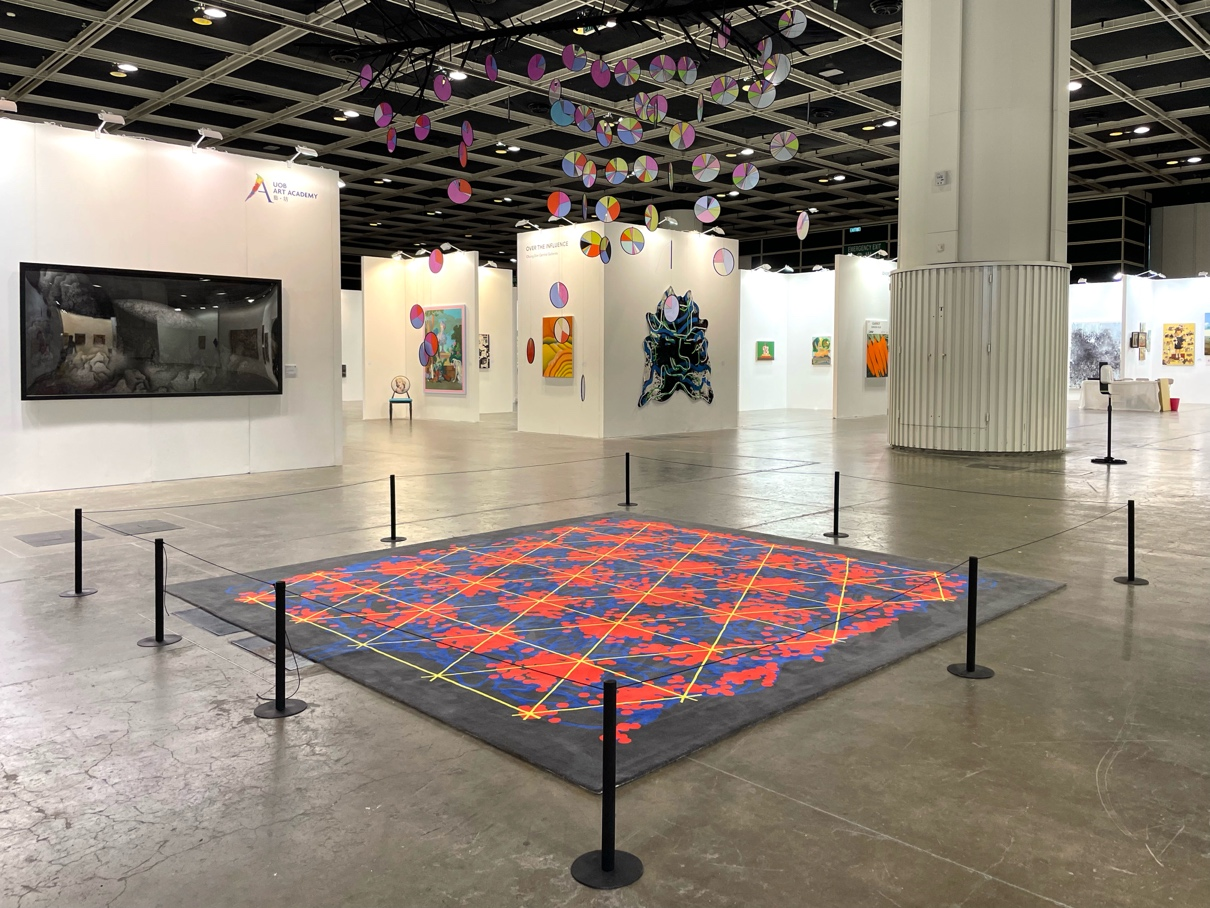
The finished installation, Perpetual Motion (shown in Figure 1), was presented as part of a non-commercial curated project at Art Central Hong Kong in 2021. It comprises two components of equal conceptual weight.
2.1 Component 1: the map below (individual & cognitive movement)
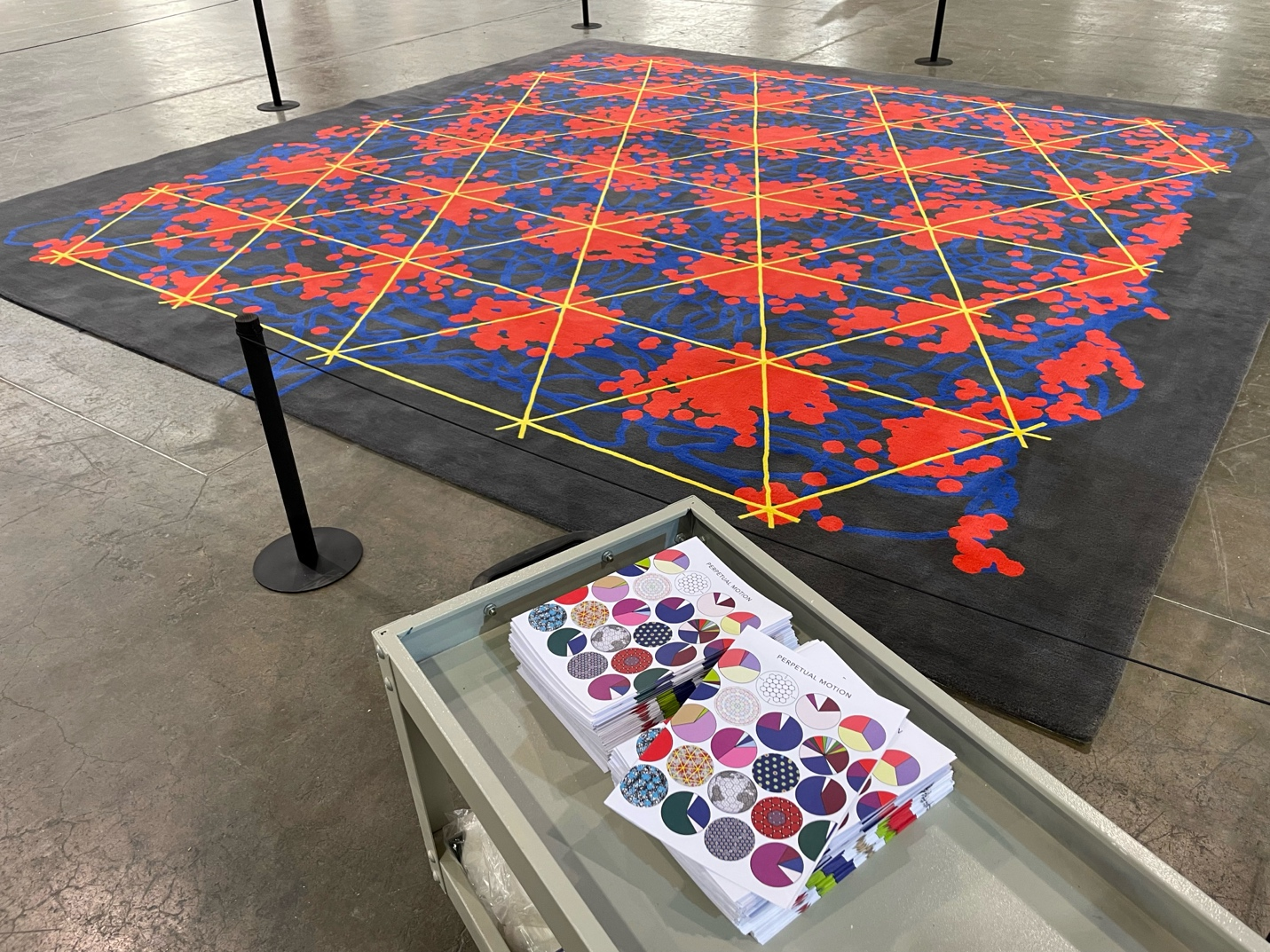
The lower component is a 3.5 m2 handmade carpet that visitors are invited to walk upon. Its pattern is derived directly from the firing data of grid cells recorded in the original experiments that identified these neurons in the entorhinal cortex [Hafting et al., 2005]. Grid cells form part of an internal positioning system, often described as an ‘inner GPS’, that enables the brain to construct cognitive maps of an animal’s or person’s location and movement through space, even in the absence of visual landmarks [Moser et al., 2014]. The 2014 Nobel Prize in Physiology or Medicine was awarded jointly to John O’Keefe for the discovery of place cells and to May-Britt and Edvard Moser for the discovery of grid cells.
At the outset of the project I contacted the Nobel laureates and the Kavli Institute for Systems Neuroscience. My main point of contact throughout the project was Rita Elmkvist Nilsen, Head of Communications at the Institute and advisor to Professors May-Britt and Edvard Moser. Holding an MA in Visual Culture and a Ph.D. in interdisciplinary studies and aesthetics, she was unusually well placed to engage with an artistic reinterpretation of the research. She responded with genuine interest, supplied papers and images.
Permission to adapt the published figures was granted; however, rights in the specific iconic versions of the images were controlled in such a way that I could not simply reproduce them. I therefore recreated the diagrams from the original published data. A point worth recording for others planning comparable work is that rights in landmark scientific images often sit with a publisher or an institution rather than with the researchers who produced them; permission from the scientists is therefore not always sufficient. Far from being merely an extra layer of labour, this restriction proved productive. Having to reconstruct the diagram forced a much closer engagement with the experimental record than simply reproducing a published image would have required. I had to trace the entire path the rat took through the test arena and accurately position each point at which a single grid cell fired.
The process of close reading and careful redrawing transformed what might have been experienced as an institutional constraint into a deeper, more intimate encounter with the scientific data itself. After the installation was completed I sent documentation to the scientists involved. Beyond initial encouragement from May-Britt Moser (“Fantastic, good luck with the project!”), no further responses were received. I did not receive a response from Nilsen on the finished artistic interpretation itself. This pattern — constructive cooperation at the stage of access and permission, followed by limited dialogue once the work moved into artistic reinterpretation — illustrates both the possibilities and the practical limits of exchange between artistic and scientific practices. The limited dialogue after permission had been granted is also a reminder that a ‘Third Space’ between artistic and scientific practices [Groves et al., 2025] is not an automatic outcome of contact. In this case the space opened at the point of access and closed again once the work moved into artistic reinterpretation.
The decision to realise the data as a large, handmade carpet was deliberate. A carpet is a familiar, domestic and tactile object that invites touch and a change in posture from conventional art-viewing. Visitors are asked to remove their shoes before stepping onto it, marking a physical transition into a more sensory mode of engagement. By placing the scientific visualisation underfoot rather than on a wall or screen, the installation grounds abstract neuroscience in an everyday, embodied encounter [Dudley, 2010]. The didactic brochure designed to accompany the carpet is shown in Figure 2.
2.2 Component 2: the map above (species & ancestral movement)
Suspended directly above the carpet is a large-scale mobile sculpture representing a different map of human movement: the deep-time dispersal of our species as traced through mitochondrial DNA (mtDNA) haplogroups. MtDNA is inherited almost exclusively through the maternal line; its relatively constant mutation rate has allowed researchers to reconstruct the major migrations of human populations out of Africa, beginning approximately 65,000 years ago [Mellars, 2006]. The mtDNA maps used pre-1500 AD data to represent genetic distributions prior to the major population movements associated with European colonial expansion.
I also consulted J. D. McDonald [2005], who had compiled accessible visual summaries of worldwide mtDNA haplogroup distributions. After explaining the artistic context, McDonald granted permission to adapt the diagrams. The exchange remained largely at the level of access and practical advice rather than extended dialogue about the interpretation itself. The mobile is hung from a horizontal wooden beam that has been burnt and painted with black ink to evoke excavated roots or an ancient tree, suggesting archaeological time. From this structure hang circular discs printed with the pie-chart data from the genetic maps, as shown in Figure 3.
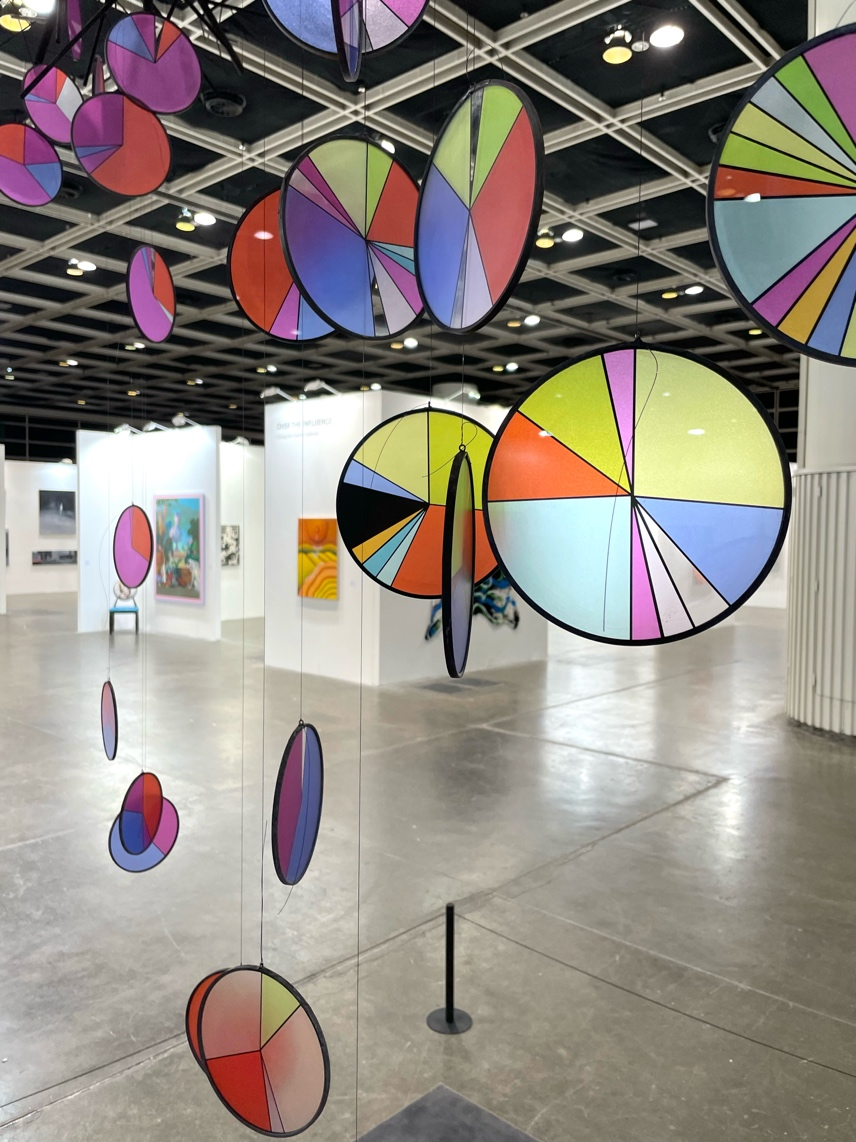
The original proposal had been to use stained glass so that light would create shifting colour combinations as the discs moved; however, the venue’s health-and-safety requirements would have prohibited visitors from walking beneath glass elements. Acrylic was therefore substituted. The discs rotate gently in air currents, occasionally aligning to suggest the faint outline of a world map.
As with the carpet, material choices for this component were made with both practical and symbolic intent. The mobile’s lightness and constant, gentle motion evoke a constellation or ongoing movement, deliberately contrasted with the heavy, burnt-wood structure. In this way the ‘sky’ component (the mobile) and ‘earth’ component (the carpet) work in material opposition. The two components are linked by a shared focus on path-taking. The carpet visualises the momentary, embodied paths recorded by grid cells as an organism moves through its immediate environment; the mobile suspends the deep-time migratory paths of human populations traced through maternal lineages.
Placing the visitor physically between these two records — one underfoot, one overhead — creates a spatial and temporal pairing of the proximate and the ancestral, the individual and the collective. It is this relationship, rather than either map in isolation, that constitutes the work’s central poetic operation — a poetics of place in which a visitor may experience, however briefly, the almost vertiginous holding of two scales at once: the deep-time migratory paths of their ancestors overhead, and the microscopic geometric firing of grid cells orienting them underfoot.
3 Reflective framework and approach
This essay is a practitioner reflection grounded in contemporaneous observations, informal field notes, and a record of visitor questions written down during the five-day presentation. No structured observation protocol was followed, no visitor interviews or surveys were conducted, and there was no post-event follow-up with participants. It does not claim systematic evaluation or generalisable findings. Its value lies in the situated insights that can be drawn from direct experience of presenting the work in a high-traffic, non-science public setting.
4 Facilitated encounters and the questions they surfaced
The installation was presented at Art Central Hong Kong (19–23 May 2021) in a free-choice setting with competing sensory stimuli.
The setting should not be treated as interchangeable with a science centre or museum. Art Central 2021 was a commercial fair: visitors had self-selected for contemporary art, and the works surrounding the installation were for sale. What they had not self-selected for was science. The 2021 edition, moreover, ran under pandemic restrictions. Travel limits and a 21-day inbound quarantine had reduced the fair in scale and made the audience substantially more local, even as organiser figures still recorded approximately 25,000 visitors over five days [Fitzpatrick, 2022]. The free-choice literature remains useful for describing a high-stimulus environment in which no one is obliged to stop. It does not describe an audience that arrived already oriented toward science.
As the commissioned artist I managed access in small groups of up to eight visitors, giving each group a short introductory talk before inviting them to remove their shoes and step onto the carpet. The talk briefly explained the neuroscience behind the carpet pattern and the genetic basis of the mobile, using accessible language and a simple narrative device for children: a mouse searching for chocolate in the dark, whose path and the moments when particular brain cells fired were mapped onto the carpet. A brochure provided further details about the project and the underlying scientific research. I printed and distributed approximately 2,000 of these pamphlets; this figure remains only an indicator of initial reach.
The questions visitors asked reveal both the reach and the limits of the format. On the mobile, the most frequent and pointed questions concerned the temporal and methodological framing of the data: “Why does the Map use DNA from before 1500 AD? How do you get dead people’s DNA from before 1500?”; “What does the Map look like now? Why didn’t you use that newest one?”; and direct requests for explanation of European colonial expansion. Visitors also asked why the mobile showed only female lineages and what the corresponding Y-chromosome map looked like, and why certain discs (notably the Eskimo region) appeared almost uniform while Europe was highly mixed.
These last questions open onto a deeper issue of sampling and representation. Haplogroup frequency maps record not only human migration but also where, and how thoroughly, geneticists have collected data. Collection has been concentrated in Europe and North America even though Africa is the most genetically diverse continent. McDonald himself noted that the maps aimed to show the situation before the European expansion beginning around 1500 AD, that reconstruction in some regions involved guesswork, and that certain categories functioned as “catchall” groups because of limited markers [McDonald, 2005]. The visual contrast visitors noticed is therefore shaped by both demographic history and the uneven distribution of scientific attention. Using the pre-1500 AD framing made this unevenness legible and gave the colonial dimension of the work a concrete presence in the data itself.
On the carpet the questions were more immediately embodied: whether human brains contain grid cells, whether “there is a GPS inside my head”, how a single cell can be measured, and, from children, “Are there triangles in my head?” and “Why are there no red spots here?” Many children traced the blue lines with their feet or hands while standing beneath the mobile, physically enacting the narrative of a mouse’s path. During one session a group of girls aged approximately five or six, in party dresses, spontaneously joined hands and danced in a circle under the ancestral map, singing “Ring a Ring o’ Roses” before falling down together — an act made more resonant by the fact that the work was shown during the Covid-19 pandemic.
Only rarely did visitors spontaneously ask the question that goes to the centre of the work: “What’s the connection between the carpet and the circles?” Most interactions remained brief and directed at the facilitator. Some visitors engaged only with surface aesthetics. A recurring observation was the visible shift that occurred when people who had first approached the work as “a pretty carpet with spinning circles” were told they were standing on Nobel-winning neuroscience beneath maps of deep human ancestry.
That shift from visual attraction to curiosity demonstrated the power of the aesthetic hook, yet it also underlined the format’s dependence on facilitation. Without the short talk the deeper layers of the double mapping — the two records of path-taking, one momentary and cognitive, the other deep-time and collective — remained largely inaccessible.
The questions and actions recorded here show that working directly inside scientific data and imagery, and placing the body between two scales of path-taking, can open a space for recognition. They also show the practical limits of that opening: most exchanges remained brief, facilitator-dependent, and one-directional.
5 Reflection and conclusion
This practitioner reflection has examined an art–science installation that worked directly with scientific data and imagery under the practical constraints of access, copyright, institutional ownership, and enforced confinement. Its central operation was the physical and conceptual juxtaposition of two scales of path-taking. Presented in a busy commercial art fair, the work was tested through facilitated public engagement; the observations recorded here document both what that central operation made possible and the practical limits of the format.
This installation belongs to the same ongoing practice of romantic objectivism outlined at the beginning of this essay. Across projects I have treated these austere forms — laboratory images, published figures, technical maps — not as material to be illustrated or simplified from the outside, but as sites in which scientific precision and poetic force can be held in tension. The 2021 work developed that approach in a public, embodied setting: translating two scientific maps of path-taking into a spatial experience that visitors could inhabit. The same inquiry continues in subsequent versions of the work, including a more tactile carpet with raised fibres that mark the rat’s path, the grid, and the points of cell firing, and new mobile sculptures that return to the original stained-glass concept. The consistent aim is to work inside the languages of science rather than alongside them, recovering forms of resonance and connection that specialisation often leaves behind.
The central practitioner insight is that an aesthetic and embodied approach can serve as an effective entry point for complex scientific ideas in non-science public settings. The carpet’s domestic materiality and the mouse narrative enabled children in particular to engage physically with the neuroscience, while the mobile prompted recurring questions about human migration, genetic mapping methods, and the existence of parallel Y-chromosome data. These interactions were typically brief and facilitator-directed rather than extended dialogue among visitors, yet they demonstrate that the combination of aesthetic hook and light facilitation can surface curiosity that might not arise from more conventional formats.
The quality of engagement depended heavily on the presence of a knowledgeable facilitator. Without this, many visitors engaged only with the surface of the work. The short duration of most interactions further limited depth. The model is therefore resource-intensive and not easily scalable to unstaffed exhibitions. Digital alternatives (audio guides or QR codes) could reduce reliance on a facilitator but risk pulling attention away from the physical, embodied experience at the centre of the design.
Despite these constraints, elements of the approach appear transferable. The use of familiar, tactile materials to ground abstract data, the pairing of an aesthetic object with a concise narrative scaffold, and the deliberate sequencing of aesthetic encounter followed by facilitated explanation offer practical strategies for science centres, festivals and outreach programmes. A minimal narrative toolkit for similar work could include three elements: (i) a simple, relatable protagonist (the “little mouse”), (ii) a clear, consistent mapping of visual features to scientific concepts (blue lines = path taken, red spots = moments of cell firing), and (iii) an explicit bridge to the visitor’s own embodied experience (“this is your own GPS system”). Effective facilitators in hybrid art–science settings typically combine scientific literacy with comfort in open-ended, aesthetic contexts; they read audience cues in real time and move fluidly between evoking wonder and offering clarification. Other practitioners could therefore adapt the material and narrative choices while investing in facilitation capacity among museum educators or explainers rather than relying on the originating artist.
In conclusion, this installation provides a documented example of what becomes possible when an artist engages directly with established scientific visual languages rather than illustrating them from the outside, and then tests that approach in a high-traffic public setting. It shows both the potential of embodied aesthetic approaches and the practical requirements, particularly facilitation, needed to move beyond surface encounter. By recording the questions visitors asked and the patterns of interaction observed, this reflection contributes to the growing body of practitioner accounts that examine how art–science work actually operates in real-world settings.
Acknowledgments
The artwork discussed in this essay was supported by a Hong Kong Baptist University Start-up Grant (RC-STARTUP/20-21/07), which funded the purchase of materials.
References
-
Achiam, M., Vitting-Seerup, S., Hurley, M., Micallef Grimaud, C., Chanay, R., Eric, D. L., Laursen, S., Dunets, V., & Russo, P. (2026). Practical rationales for art-science in science communication. International Journal of Science Education, Part B, 16(1), 57–70. https://doi.org/10.1080/21548455.2025.2523572
-
Davies, S. R., & Horst, M. (2016). Science communication: culture, identity and citizenship. Palgrave Macmillan. https://doi.org/10.1057/978-1-137-50366-4
-
Dudley, S. H. (2010). Museum materialities: objects, sense and feeling. In S. H. Dudley (Ed.), Museum materialities: objects, engagements, interpretations (pp. 1–18). Routledge. https://doi.org/10.4324/9780203523018
-
Falk, J. H., & Dierking, L. D. (2010). The 95 percent solution: school is not where most Americans learn most of their science. American Scientist, 98(6), 486–493. https://doi.org/10.1511/2010.87.486
-
Fitzpatrick, M. (2022, June 6). A bigger splash. China Daily Hong Kong. https://www.chinadailyhk.com/hk/article/274323
-
Fleerackers, A., Brown Jarreau, P., & Krolik, J. (2022). Why create SciArt? An investigation into science artists’ goals and professional journeys. JCOM, 21(06), A05. https://doi.org/10.22323/2.21060205
-
Groves, K., Muindi, F. J., & Zuanazzi, A. (2025). Examining science and art collaborations through a social psychology lens reveals the need for Third Spaces. JCOM, 24(05), Y01. https://doi.org/10.22323/145620250815082846
-
Hafting, T., Fyhn, M., Molden, S., Moser, M.-B., & Moser, E. I. (2005). Microstructure of a spatial map in the entorhinal cortex. Nature, 436(7052), 801–806. https://doi.org/10.1038/nature03721
-
McDonald, J. D. (2005). World haplogroups maps [Y-chromosome and mtDNA frequency maps with accompanying notes]. https://web.archive.org/web/20180124193433/http://faculty.scs.illinois.edu/~mcdonald/WorldHaplogroupsMaps.pdf
-
Mellars, P. (2006). Why did modern human populations disperse from Africa ca. 60,000 years ago? A new model. Proceedings of the National Academy of Sciences, 103(25), 9381–9386. https://doi.org/10.1073/pnas.0510792103
-
Moser, E. I., Roudi, Y., Witter, M. P., Kentros, C., Bonhoeffer, T., & Moser, M.-B. (2014). Grid cells and cortical representation. Nature Reviews Neuroscience, 15(7), 466–481. https://doi.org/10.1038/nrn3766
-
Rovelli, C. (2018). The order of time (E. Segre & S. Carnell, Trans.). Penguin.
-
Stilgoe, J., Lock, S. J., & Wilsdon, J. (2014). Why should we promote public engagement with science? Public Understanding of Science, 23(1), 4–15. https://doi.org/10.1177/0963662513518154
-
Trench, B. (2008). Towards an analytical framework of science communication models. In D. Cheng, M. Claessens, T. Gascoigne, J. Metcalfe, B. Schiele & S. Shi (Eds.), Communicating science in social contexts: new models, new practices (pp. 119–135). Springer. https://doi.org/10.1007/978-1-4020-8598-7_7
-
Whittle, M. (2021). Romantic-objectivism: developing a diagrammatic poetics of science. Journal of Visual Art Practice, 20(3), 283–298. https://doi.org/10.1080/14702029.2021.1951584
-
Wilson, S. (2002). Information arts: intersections of art, science, and technology. MIT Press.
-
Wynne, B. (1995). Public understanding of science. In S. Jasanoff, G. E. Markle, J. C. Peterson & T. Pinch (Eds.), Handbook of science and technology studies (pp. 361–388). SAGE Publications. https://doi.org/10.4135/9781412990127.n17
-
Zaelzer, C. (2020). The value in science-art partnerships for science education and science communication. eNeuro, 7(4), ENEURO.0238-20.2020. https://doi.org/10.1523/eneuro.0238-20.2020
About the author
Michael Whittle is an artist and researcher with a background in biochemistry. His practice explores the intersections of art, science, and public engagement, primarily through large-scale installations that translate complex scientific concepts — particularly from neuroscience and human genetics — into embodied, sensory experiences. He investigates how aesthetic and material interventions can foster new forms of public understanding and personal connection to scientific knowledge. His work has been exhibited internationally.
E-mail: mwhittle@um.edu.mo Bluesky: @michael-whittle