
1 Context
Historically, much science communication circulated through specialised channels and among peers, limiting its incorporation into practices such as science education and often preserving transmissive relations between science and society [Freire, 1996; Santos, 2010; Santos & Meneses, 2009]. School structures, educational policies, and teachers’ working conditions can further restrict critical dialogue [Freire, 1996; Santos & Meneses, 2009]. Web 2.0 and social media have widened opportunities to produce, circulate, and appropriate scientific knowledge through networked communication. In Lévy’s account, cooperative learning refers to knowledge-building through interaction and shared exchange, while collective intelligence concerns the distributed mobilisation and coordination of knowledge across a network [Bembem & Santos, 2013; Lévy, 1999, 2007]. These concepts provide a conceptual basis for examining how networked environments may broaden participation in the circulation and educational appropriation of scientific knowledge, rather than evidence that social media automatically overcome the gap between science and education.
In this study, science communication denotes heterogeneous processes through which scientific knowledge is selected, recontextualised, circulated, discussed, and sometimes produced with different publics. These processes range from one-way dissemination to dialogic and participatory arrangements involving questioning, interpretation, feedback, authorship, and collaboration. They form a continuum rather than mutually exclusive models, since one initiative may combine information provision with interaction or participant production [Bucchi & Trench, 2021; Bueno, 2018; Freire, 1996]. In educational contexts, participants may therefore act as recipients, interlocutors, or producers of science-related meanings and content.
Digital social media intensify these opportunities and tensions. YouTube, Instagram, TikTok, Twitter/X, and Facebook serve as science-communication channels, environments of sociability, and arenas of narrative dispute, while misinformation, entertainment logics, algorithmic opacity, information bubbles, and echo chambers shape content visibility and interpretation [Ahmmad et al., 2025; Bucchi & Trench, 2021; Bueno, 2018; Menezes et al., 2023; Portman et al., 2025; Souza & Dale, 2024]. Scientific and media literacy is therefore central: it entails evaluating science-related information, recognising uncertainty and controversy, understanding platform-mediated circulation, and producing content responsibly [Belova & Eilks, 2016; Reid & Norris, 2016; UNESCO, 2024].
Schools, universities, and non-formal initiatives increasingly use social media as pedagogical tools, communication channels, and spaces for experimentation in science teaching and learning [Berruezo et al., 2025; Reid & Norris, 2016]. Here, educational contexts encompass formal school and university settings and non-formal or hybrid initiatives explicitly connected to learning, training, participation, outreach, or scientific and media literacy. They are treated not merely as destinations for scientific information, but as settings in which content is pedagogically mediated, questioned, evaluated, and produced. Persistent challenges include teacher education, limited curricular guidance for critical platform use, and insufficient evidence of effects on scientific knowledge and skills [Belova & Eilks, 2016].
Despite growing activity, the literature remains dispersed across objectives, designs, platforms, publics, and educational levels. Recent reviews address the public circulation of science, visual platforms, sustainability literacy, or effects on young audiences [Aung et al., 2025; Berruezo et al., 2025; Bucchi & Trench, 2021; Portman et al., 2025], but formal, non-formal, and hybrid educational contexts are not consistently central or systematically linked to scientific and media literacy. A mapping synthesis is therefore needed to identify platforms, purposes, publics, settings, and reported evidence of engagement and learning, together with challenges, contributions, and research gaps [Reid & Norris, 2016].
Accordingly, the review focuses on articles published from January 2022 to September 2025, a recent timeframe selected to capture contemporary platform dynamics and intensified digitally mediated science circulation. It foregrounds how scientific content is disseminated, interpreted, pedagogically mediated, critically evaluated, and produced in educational settings. The capacities to assess epistemic quality, understand platform-mediated circulation, and recontextualise or create scientific content provide the conceptual basis for the framework developed in the Discussion [Bucchi & Trench, 2021; Reid & Norris, 2016; UNESCO, 2024].
This scoping review maps studies of social media as mediators of science communication in formal, non-formal, and hybrid educational contexts. It aims to: (a) characterise the publics, data settings, educational contexts, scientific topics, platforms, formats, and study designs represented; (b) describe how social media are used to disseminate, discuss, critically analyse, and produce science-related content, including reported engagement and learning; and (c) synthesise challenges, contributions, and research gaps as a basis for an interpretative framework for scientific and media literacy in educational digital-platform environments.
2 Methodology
2.1 Review design and protocol
This scoping review was guided by the Joanna Briggs Institute (JBI) recommendations and reported in accordance with PRISMA-ScR [Aromataris et al., 2024; Munn et al., 2018; Peters et al., 2015; Tricco et al., 2018].
The approach was selected to organise a heterogeneous corpus, map concepts, and identify evidence gaps. The review protocol is available on the Open Science Framework (OSF) at https://osf.io/jbt3k/overview?view_only=f61f834e3bc7406e95b4d8bd53bc2219, providing a public record of the methodological procedures. During revision, the manuscript’s adapted CoCoPop formulation was re-expressed as PCC to distinguish participants, concept, and context more clearly. This reporting amendment itself did not alter the databases, search dates, search strings, or screening procedures. A separate final consistency audit resulted in the two full-text exclusions described in Section 2.4.
The January 2022–September 2025 window was intentionally selected to examine recent educational uses of social media amid intensified digital circulation of science; it is not intended to represent the field’s full historical development.
2.2 PCC framework and review questions
The review question and eligibility criteria were organised using the PCC framework (Participants, Concept, and Context), recommended by JBI for scoping reviews. PCC was selected because the review maps heterogeneous forms of social-media-mediated science communication across diverse publics and educational settings while identifying evidence gaps. Unlike intervention-oriented frameworks such as PICO, PCC does not require a comparator or predefined outcome and therefore fits the review’s exploratory purpose [Stern et al., 2014].
The Participants component encompassed students, teachers, researchers, science communicators, and non-specialist publics involved in, targeted by, or represented in educational science-communication practices. No single group was prescribed because the publics addressed were a mapped variable. Content, platform, and communication-practice analyses without recruited participants remained eligible when an intended educational public was identifiable.
The Concept was social media as mediators of science communication, including their use for the dissemination, discussion, critical analysis, production, and circulation of science-related content, as well as for dialogic or participatory engagement. Generalist, video-based, academic, and professional platforms were eligible when explicitly connected to science communication.
The Context comprised formal, non-formal, and hybrid educational settings in which social media were intentionally linked to teaching, learning, training, outreach, or scientific and media literacy. Formal contexts included primary, secondary, and higher education; non-formal contexts included extension, outreach, science-communication initiatives, and professional-learning networks. Hybrid practices circulated beyond institutions while retaining an identifiable educational purpose. Institutional marketing, administrative communication, or general public engagement without such a purpose was excluded.
Based on the PCC framework, the following review question was formulated: “How has the literature published between January 2022 and September 2025 characterised the use of social media as mediators of science communication in formal, non-formal, and hybrid educational contexts?”
Three subsidiary questions guided the mapping and synthesis: (i) Which publics, educational contexts, scientific topics, platforms, communication formats, and study designs are represented in the included literature? (ii) How are social media used to disseminate, discuss, critically analyse, or produce science-related content in educational contexts? (iii) What evidence of engagement and learning, challenges, contributions, and research gaps is reported by the included studies?
2.3 Search strategy and eligibility criteria
Systematic searches covered Scopus, Web of Science, and ERIC for publications from January 2022 to 29 September 2025 in English, Portuguese, or Spanish. The strategy combined science communication, social media, and education.
Controlled and uncontrolled terms represented each axis, including science communication, scientific dissemination, science outreach, public engagement with science, science literacy, social media, digital platforms, education, learning, and teaching. Strings were adapted to each database’s syntax and indexing fields. Table 1 reports the final strings; publication-year and language limits were applied in the database interfaces where they are not encoded in the displayed string.
| Database |
Search string | Query language |
| Scopus |
(TITLE-ABS-KEY (“social media” OR “social network*” OR “online platform*” OR “web 2.0” OR facebook OR twitter OR instagram OR tiktok OR youtube OR linkedin) AND TITLE-ABS-KEY (“science communication” OR “scientific dissemination” OR “science popularization” OR “science outreach” OR “public engagement with science” OR “science literacy”) AND TITLE-ABS-KEY (“pedagogical instrument*” OR “teaching tool*” OR “learning tool*” OR “science education” OR “didactic” OR “learning”)) AND PUBYEAR > 2021 AND PUBYEAR < 2026 AND (LIMIT-TO (LANGUAGE, “English”) OR LIMIT-TO (LANGUAGE, “Spanish”) OR LIMIT-TO (LANGUAGE, “Portuguese”)) AND (LIMIT-TO (PUBSTAGE, “final”)) AND NOT DOCTYPE (“scoping review”) | English |
| Web of Science |
TS=(“social media” OR “social network*” OR “online platform*” OR “web 2.0” OR facebook OR twitter OR instagram OR tiktok OR youtube OR linkedin) AND TS=(“science communication” OR “scientific dissemination” OR “science popularization” OR “science outreach” OR “public engagement with science” OR “science literacy”) AND TS=(“pedagogical instrument*” OR “teaching tool*” OR “learning tool*” OR “science education” OR didactic OR teaching OR learning) NOT DT=“Scoping Review” NOT TS=(“scoping review” OR “scoping studies” OR “scoping literature” OR “PRISMA-ScR”) | English |
| ERIC |
(“social media” OR “social network*” OR “online platform*” OR “web 2.0” OR facebook OR twitter OR instagram OR tiktok OR youtube OR linkedin) AND (“science communication” OR “scientific dissemination” OR “science popularization” OR “science outreach” OR “public engagement with science” OR “science literacy”) AND (“pedagogical instrument*” OR “teaching tool*” OR “learning tool*” OR “science education” OR didactic OR teaching OR learning) | English |
| Note.
Query
language
refers
to
the
language
in
which
the
search
terms
were
entered.
Publication-year
and
publication-language
limits
are
described
in
Section 2.3.
Source:
the
authors. | ||
Professional platforms were eligible when linked to science communication, and LinkedIn appeared in all three search strings. No LinkedIn-focused study met the eligibility criteria; its absence therefore resulted from screening rather than prior exclusion.
Scopus and Web of Science records were exported in RIS format. ERIC records were exported in BibTeX, converted to RIS in Zotero, and imported into Rayyan.
Scopus, Web of Science, and ERIC were selected for their multidisciplinary coverage and relevance to education, technology, and science. This choice nevertheless favours internationally visible, English-dominant indexing and may underrepresent Global South research published in regional databases, local journals, or repositories. The geographical distribution therefore reflects the search strategy rather than the field in full. This limitation is considered in the Discussion and Conclusion.
Studies were included if they: (i) were original empirical studies or documented experience reports; (ii) involved or represented an identifiable educational public (Participants); (iii) examined social media as mediators of science-related dissemination, discussion, critical analysis, production, or circulation (Concept); (iv) occurred in formal, non-formal, or hybrid settings explicitly connected to teaching, learning, training, outreach, or scientific and media literacy (Context); and (v) were published from January 2022 to 29 September 2025 in English, Portuguese, or Spanish.
Reviews were excluded because the synthesis focused on original empirical research and documented experiences. Studies limited to institutional marketing, administrative communication, or public engagement without an explicit educational purpose were also excluded.
2.4 Study selection
Selection occurred in two phases in Rayyan. Two reviewers independently and blindly screened titles and abstracts against the predefined criteria. Cohen’s kappa was 0.85, indicating strong agreement; disagreements were resolved by consensus. The same reviewers then assessed full texts and discussed borderline cases to consensus. No second kappa was calculated because full-text disagreements were resolved in consensus meetings.
Searches yielded 121 records. After removing 35 duplicates, 86 records were screened and 68 excluded, chiefly because they did not address science communication, social-media mediation, an educational context, or original empirical/experience evidence. Eighteen reports were assessed in full text. Two were excluded: one did not address science communication or an identifiable educational purpose, and one was a theoretical paper without original empirical evidence or a documented experience report. Sixteen studies remained in the synthesis. Figure 1 presents identification, screening, eligibility, and inclusion.
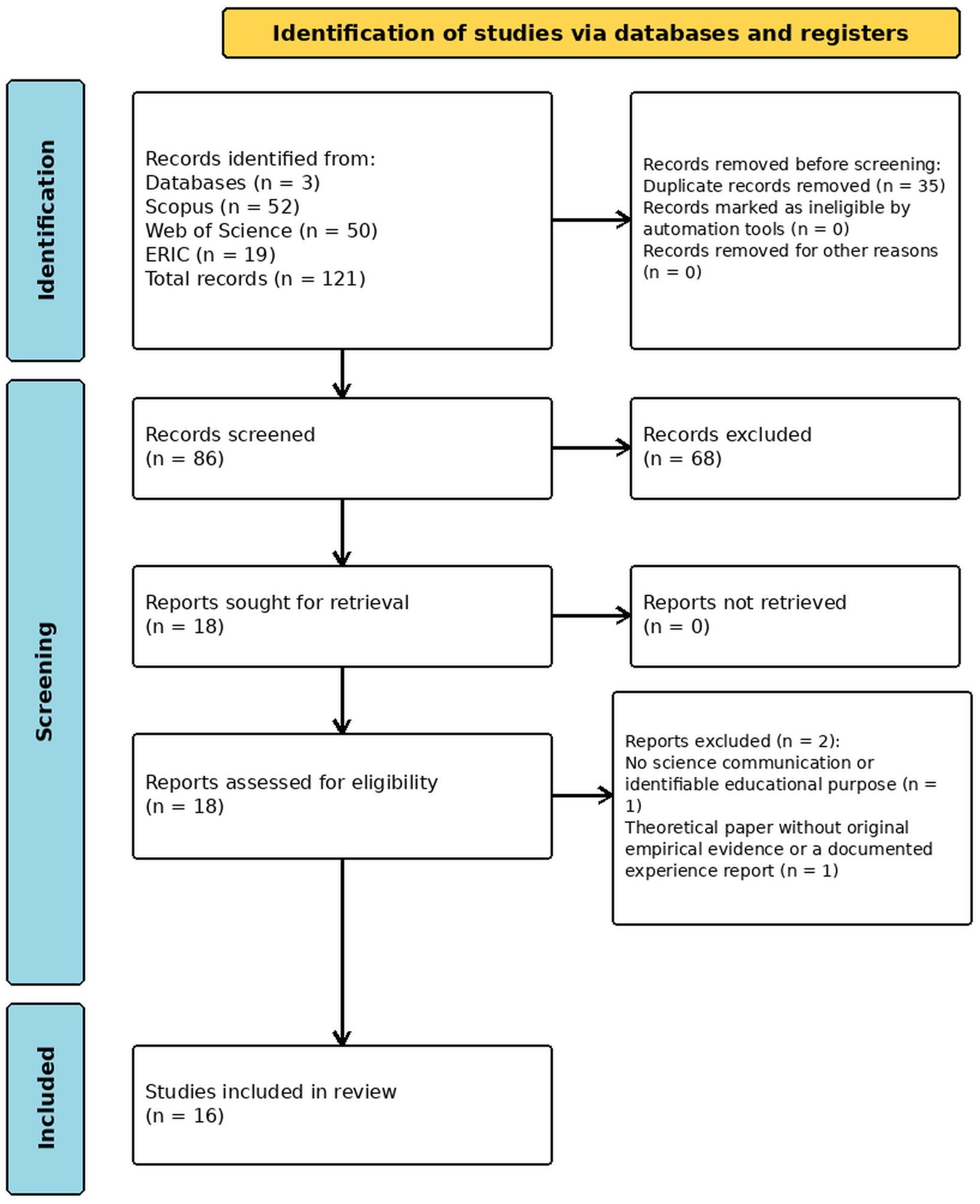
Of the 16 included publications, 14 were in English, one in Portuguese, and one in Spanish. This language distribution is reported here alongside the PRISMA flow diagram and is also summarised in Table 3.
2.5 Data extraction
An extraction spreadsheet was piloted on three randomly selected studies to align completion criteria and clarify categories. The 16 studies were then divided between reviewers for extraction and cross-checked through discussion and verification; coding, classification, and interpretation queries were resolved by consensus.
Full texts were charted in a pre-developed Microsoft Excel extraction matrix. Fields covered bibliographic data; data setting and public; design and data collection; educational level and formality; scientific topic; platform and format; communication mode; objectives; engagement or learning measures; and reported results, challenges, contributions, and gaps.
2.6 Data synthesis
Data synthesis combined descriptive statistics and inductive thematic analysis. Frequencies described publication year, data setting, design, educational context, and platform (Section 3.2). For the qualitative synthesis, two reviewers repeatedly read each study’s Results and Discussion, identified meaning units, and assigned descriptive codes in a shared spreadsheet. Codes were compared and grouped by semantic similarity into intermediate categories. Platform-function categories informed the modes in Section 3.3; barriers, benefits, and underexplored issues informed the challenges, contributions, and gaps in Section 3.4. For example, limited teacher preparation, absent institutional guidance, and source-evaluation difficulties were grouped as “implementation and institutional conditions” and then incorporated into the challenge axis. Disagreements were resolved by consensus. Coding was conducted manually in Excel without specialised qualitative-analysis software or AI.
2.7 Use of generative artificial intelligence
Generative AI was used only as an auxiliary writing and editing tool during manuscript revision. ChatGPT (GPT-5.5; OpenAI; web interface) supported Portuguese-to-English translation, linguistic refinement in British English, and presentation of author-supplied Boolean search strings in database-specific notation. Prompts asked the tool to translate faithfully, improve clarity without changing meaning, and check the presentation of search terms without adding substantive concepts. Grammarly (Grammarly, Inc.; web interface) was used only for basic grammar and spelling checks. The authors critically reviewed and revised all outputs. Neither tool ran database searches, made eligibility decisions, conducted coding, generated analytical categories, interpreted studies, or performed the synthesis. These decisions were made exclusively by the researchers, who take full responsibility for the manuscript’s accuracy, integrity, originality, and final content.
2.8 Methodological appraisal
No formal methodological-quality or risk-of-bias appraisal was conducted, consistent with the mapping purpose of a scoping review [Munn et al., 2018; Peters et al., 2015; Tricco et al., 2018]. Consequently, the synthesis describes the extent and nature of the evidence but does not support conclusive claims about intervention effectiveness; this limitation is addressed in the Discussion and Conclusion.
3 Results
3.1 Included studies
The 16 included studies are summarised in Table 2, which distinguishes data setting from author affiliation and reports target public, educational setting, topic, platform/format, study design, and primary communication mode. The table provides the evidence base for the synthesis.
3.2 General characterisation of the included studies
The corpus was concentrated in 2024–2025 and predominantly English-language. Data settings were mainly in the Global North, although Brazil and Chile were represented. Non-formal/hybrid and higher-education settings were most frequent, followed by basic education. Publics included school students and young people, teachers, researchers, professional groups, non-specialists, and university or MOOC learners. Video-based environments predominated; Facebook, blogs, and academic/professional platforms were occasional. Quantitative studies were most frequent, followed by qualitative/practice-based studies and mixed methods. Table 3 presents the full distribution.
3.3 Modes of use of social media in science communication in educational contexts
Across the 16 studies, three non-mutually exclusive modes were identified. Nine studies used social media for dissemination, outreach, or resource circulation; seven integrated platform content into teaching, learning, or professional development; and five examined platforms critically and/or involved participants in authorship. Because studies could combine functions, the 21 mode occurrences exceed the 16-study corpus.
|
Author/year |
Data setting |
Target public |
Setting/formality |
Topic |
Platform/format |
Study design |
Primary mode |
|
Engberg & Maier [2025] |
Germany, United States and Denmark |
Non-specialist audiences |
Non-formal science events |
Science-slam performance |
YouTube; recorded science-slam videos |
Qualitative multimodal analysis (9 videos) |
Dissemination / outreach |
|
Marx & König [2025] |
Germany |
Non-specialist adults |
Non-formal / public communication |
Public health and nutrition |
Online video; animated and talking-head formats |
Randomised 2Õ3 experiment (N = 358) |
Dissemination / outreach |
|
Núñez-Cook & Lizana [2024] |
Chile (Viña del Mar) |
Secondary-school community and wider audiences |
Basic education / hybrid |
Health sciences and anatomical terminology |
TikTok; short educational videos |
Descriptive cross-sectional survey + platform metrics |
Dissemination + didactic resource |
|
Steinbeck et al. [2024] |
Global online sample |
MOOC learners |
Higher education / online learning |
Data science |
MOOC video platform; four video styles |
Between-subjects experiment (n≈980) |
Didactic resource |
|
Déchène et al. [2024] |
Germany |
Teachers and education professionals |
Non-formal professional learning |
Evidence-based teaching and education research |
Twitter/X; network posts and resource sharing |
Mixed methods: survey + network / content analysis |
Professional dialogue + resource sharing |
|
Cosmo et al. [2024] |
Brazil |
University students and extension publics |
Higher education / hybrid |
Soil science and erosion |
Instagram; educational posts and videos |
Descriptive applied study + platform metrics |
Didactic resource + outreach |
|
Prindle et al. [2024] |
United States |
Non-specialist STEM audiences |
Non-formal outreach |
STEM |
YouTube Shorts; short-form videos |
Experience report / case study + metrics |
Dissemination / outreach |
|
Anderson [2024] |
United Kingdom |
Secondary-school students (14–18) |
Basic education / formal |
Climate change and sustainability |
YouTube and TikTok; viewed / used content |
Sequential mixed methods: survey + workshops |
Critical analysis |
|
Abreu-Tardelli & Oliveira [2024] |
Brazil (São Paulo) |
Primary-school students and school community |
Basic education / hybrid |
COVID-19 and health prevention |
YouTube; puppet videos |
Experience report + textual / multimodal analysis |
Didactic resource + authorship |
|
Frauhammer & Dreston [2025] |
Germany |
Adult / non-specialist followers |
Non-formal outreach |
Deep-sea science |
Instagram; outreach posts under three design conditions |
Field experiment |
Dissemination / outreach |
|
Brown [2023] |
United States |
University students |
Higher education / formal |
Virology and scientific claims |
TikTok; student-created short videos |
Pedagogical practice report |
Critical analysis + authorship |
|
Said-Hung, Arce-García & Mottareale-Calvanese [2024] |
Spain and Latin America |
Education researchers and platform audiences |
Higher education / research communication |
Education research |
Twitter/X; posts |
Quantitative text mining and engagement analysis |
Professional dissemination + outreach |
|
Pérez-Llantada [2024] |
Spain |
STEM researchers |
Non-formal professional development |
Digital science communication and genre composing |
Blogs and Twitter/X; authored texts and posts |
Exploratory qualitative case study |
Professional learning + authorship |
|
Said-Hung, Martín-Gutiérrez & Marcano [2024] |
Spain and Latin America |
Education researchers |
Higher education / research communication |
Education-research communication |
ResearchGate, Academia.edu and generalist platforms |
Mixed methods: survey + interviews |
Professional dissemination + networking |
|
Kresin et al. [2025] |
Germany |
School students (14–16) |
Basic education / formal |
Science-related communication mechanisms |
Instagram, TikTok and YouTube; self-reported use |
Qualitative focus groups |
Critical analysis |
|
Lesiak et al. [2024] |
United States |
Educators and extension audiences |
Non-formal extension |
STEM curriculum dissemination |
Facebook; curriculum-sharing posts |
Descriptive case study + platform metrics |
Resource sharing + outreach |
Note. Data setting refers to the location or reach of the analysed data rather than the authors’ institutional affiliations. The modes indicate the predominant communicative function identified in each study and are used descriptively; some studies combined more than one function. Source: the authors, based on the extraction matrix.
| Dimension | Category | n | % of studies |
| Publication year | 2023 | 1 | 6.3% |
| Publication year | 2024 | 11 | 68.8% |
| Publication year | 2025 | 4 | 25.0% |
| Language | English | 14 | 87.5% |
| Language | Portuguese | 1 | 6.3% |
| Language | Spanish | 1 | 6.3% |
| Primary data setting | Germany | 4 | 25.0% |
| Primary data setting | United States | 3 | 18.8% |
| Primary data setting | Brazil | 2 | 12.5% |
| Primary data setting | Spain | 1 | 6.3% |
| Primary data setting | United Kingdom | 1 | 6.3% |
| Primary data setting | Chile | 1 | 6.3% |
| Primary data setting | Multinational/multiregional | 3 | 18.8% |
| Primary data setting | Global online sample | 1 | 6.3% |
| Educational setting | Higher education/research/professional education | 6 | 37.5% |
| Educational setting | Basic education | 4 | 25.0% |
| Educational setting | Non-formal/hybrid education | 6 | 37.5% |
| Primary target public | School students/young people | 4 | 25.0% |
| Primary target public | Teachers/researchers/professional groups | 5 | 31.3% |
| Primary target public | Non-specialist/general publics | 4 | 25.0% |
| Primary target public | University/MOOC learners | 3 | 18.8% |
| Study design | Qualitative/practice-based | 6 | 37.5% |
| Study design | Quantitative | 7 | 43.8% |
| Study design | Mixed methods | 3 | 18.8% |
| Platform occurrence∗ | YouTube/online or MOOC video | 7 | 43.8% |
| Platform occurrence∗ | 3 | 18.8% | |
| Platform occurrence∗ | TikTok | 4 | 25.0% |
| Platform occurrence∗ | Twitter/X | 3 | 18.8% |
| Platform occurrence∗ | 1 | 6.3% | |
| Platform occurrence∗ | Blogs | 1 | 6.3% |
| Platform occurrence∗ | Academic/professional platforms | 1 | 6.3% |
| ∗Platform
categories
are
non-mutually
exclusive.
The
16 studies
generated
20 platform
occurrences;
percentages
use
the
16 included
studies
as
the
denominator. Note. Primary data setting was used instead of author affiliation. Multinational/multiregional and global online samples were retained as separate categories to avoid assigning them to a single country. Source: the authors, based on the extraction matrix. | |||
3.3.1 Social media as channels for dissemination and outreach
Nine studies used social media to translate, circulate, or extend the reach of science-related content to non-specialist audiences, school or extension communities, and professional publics [Cosmo et al., 2024; Engberg & Maier, 2025; Frauhammer & Dreston, 2025; Lesiak et al., 2024; Marx & König, 2025; Núñez-Cook & Lizana, 2024; Prindle et al., 2024; Said-Hung, Arce-García & Mottareale-Calvanese, 2024; Said-Hung, Martín-Gutiérrez & Marcano, 2024]. The scientific topics addressed ranged from science-slam performances, public-health and nutrition communication, and anatomical terminology to soil science, STEM, deep-sea research, education research, and curriculum dissemination.
The communication formats reflected different platform logics. Recorded science-slam performances and animated or talking-head videos supported more extended explanation [Engberg & Maier, 2025; Marx & König, 2025], whereas TikTok and YouTube Shorts favoured compressed, short-form communication [Núñez-Cook & Lizana, 2024; Prindle et al., 2024]. Instagram posts and videos were used for educational outreach and field experiments [Cosmo et al., 2024; Frauhammer & Dreston, 2025], while Twitter/X, academic platforms, and Facebook supported the circulation of research, professional networking, and resource sharing [Lesiak et al., 2024; Said-Hung, Arce-García & Mottareale-Calvanese, 2024; Said-Hung, Martín-Gutiérrez & Marcano, 2024]. In this mode, evidence was frequently based on reach, viewing, and interaction indicators, although some studies also examined knowledge acquisition or the effects of content design [Frauhammer & Dreston, 2025; Marx & König, 2025].
3.3.2 Social media integrated into educational and professional-learning activities
Seven studies incorporated social media or platform-derived content into formal, hybrid, or professional-learning activities [Abreu-Tardelli & Oliveira, 2024; Brown, 2023; Cosmo et al., 2024; Déchène et al., 2024; Núñez-Cook & Lizana, 2024; Pérez-Llantada, 2024; Steinbeck et al., 2024]. These uses included correcting anatomical terminology for a school community, comparing video-production styles in a data-science MOOC, connecting teachers with education research, supporting soil-science extension, producing health-prevention videos, analysing scientific claims through TikTok assignments, and developing researchers’ digital genre-composing practices.
The educational function of the platforms varied accordingly. Video-based environments were used to explain concepts, compare instructional designs, and support student production [Abreu-Tardelli & Oliveira, 2024; Brown, 2023; Núñez-Cook & Lizana, 2024; Steinbeck et al., 2024]. Instagram connected extension activities with the public circulation of content [Cosmo et al., 2024], whereas Twitter/X and blogs supported professional dialogue, resource sharing, and reflective writing [Déchène et al., 2024; Pérez-Llantada, 2024]. Evidence in this mode ranged from quizzes, examinations, surveys, and platform metrics to classroom records, textual analysis, participant reflections, and network analysis. Social media therefore operated not only as repositories of materials, but as components of pedagogically organised activities.
3.3.3 Social media as objects of critical analysis and spaces for authorship
Five studies treated social media as objects of critical scrutiny and/or spaces for student, teacher, or researcher authorship [Abreu-Tardelli & Oliveira, 2024; Anderson, 2024; Brown, 2023; Kresin et al., 2025; Pérez-Llantada, 2024]. They examined scientific claims, source reliability, recommendation mechanisms, information circulation, and links between social media, climate, sustainability, and media literacy [Anderson, 2024; Brown, 2023; Kresin et al., 2025].
Authorship was developed through puppet videos, student-created TikTok content, and blogs or Twitter/X posts produced by researchers [Abreu-Tardelli & Oliveira, 2024; Brown, 2023; Pérez-Llantada, 2024]. These practices most clearly approached dialogic and participatory orientations because participants interpreted, recontextualised, and circulated scientific meanings rather than merely receiving information. Nevertheless, participation remained concentrated in critical reading, curation, and media production; the corpus provided little evidence of sustained co-creation of research questions, scientific procedures, or scientific knowledge.
Across the three modes, science communication was mediated through linguistic, narrative, and multimodal strategies intended to make scientific content understandable or pedagogically usable. Everyday examples, analogies, humour, storytelling, captions, illustrations, animations, graphs, and on-screen text were especially visible in video-based studies, while short-form videos prioritised compression and rapid sequencing [Abreu-Tardelli & Oliveira, 2024; Engberg & Maier, 2025; Marx & König, 2025; Núñez-Cook & Lizana, 2024; Prindle et al., 2024]. Text-based and professional platforms more often supported extended commentary, reflective writing, networking, and resource sharing [Déchène et al., 2024; Lesiak et al., 2024; Pérez-Llantada, 2024; Said-Hung, Arce-García & Mottareale-Calvanese, 2024; Said-Hung, Martín-Gutiérrez & Marcano, 2024].
Evidence of engagement and learning was heterogeneous. Native platform metrics such as views, likes, comments, shares, and viewing time were useful for describing reach and interaction, but did not by themselves demonstrate conceptual change [Cosmo et al., 2024; Lesiak et al., 2024; Prindle et al., 2024; Said-Hung, Arce-García & Mottareale-Calvanese, 2024]. Experimental studies used knowledge measures, behavioural indicators, or comparisons between content designs [Frauhammer & Dreston, 2025; Marx & König, 2025; Steinbeck et al., 2024], while qualitative and mixed-methods studies drew on interviews, workshops, focus groups, classroom records, and participant reflections [Anderson, 2024; Brown, 2023; Déchène et al., 2024; Kresin et al., 2025]. The corpus therefore extends from dissemination-oriented uses to more dialogic and participatory practices, but robust evidence of sustained learning remains limited.
3.4 Challenges, contributions, and gaps in the literature
The thematic synthesis grouped findings into challenges, contributions, and gaps. Statements are linked to the included studies from which they were derived. Because no formal methodological-quality appraisal was conducted, the results describe the mapped corpus rather than pooled estimates of effectiveness.
3.4.1 Challenges identified in the studies
The first challenge concerns the relationship between platform-native design, audience attention, and epistemic accuracy. Science-slam performances deliberately combine knowledge transfer with entertainment and humour, illustrating that accessibility is achieved through recontextualisation rather than through the simple reduction of content [Engberg & Maier, 2025]. In the TikTok study on anatomical terminology, students received the video positively but identified visual editing and explanatory fluency as aspects requiring improvement [Núñez-Cook & Lizana, 2024]. Experimental comparisons also caution against assuming that a specific visual format is inherently more educational: animated and talking-head videos produced comparable knowledge-transfer and sharing outcomes, while four popular science-communication video styles showed no overall differences in learning success [Marx & König, 2025; Steinbeck et al., 2024]. A field experiment further showed that participants exposed to social-media posts learned less than those receiving the same information through an email newsletter when the posts did not prompt elaboration; this difference disappeared when elaboration questions were added, and multitasking was associated with poorer knowledge acquisition [Frauhammer & Dreston, 2025].
Implementation conditions constituted a second challenge. The Facebook curriculum-dissemination case documented that a small outreach group lacked the specialised knowledge and staff capacity required to maintain a consistent social-media presence; it also showed that digital dissemination required time, coordination, and resources for content production, audience interaction, and evaluation [Lesiak et al., 2024]. Among Spanish education researchers, the use of non-academic social media remained limited, and perceived training needs and patterns of platform use influenced assessments of usefulness; the authors consequently argued for institutional training and dissemination policies [Said-Hung, Martín-Gutiérrez & Marcano, 2024]. In secondary education, climate-related teaching was constrained by examination specifications and disciplinary silos, while media literacy and critical thinking were not systematically integrated into the curriculum despite students’ reliance on social media for information [Anderson, 2024].
The third challenge concerns the opacity of platform mechanisms and the interpretation of digital indicators. Students demonstrated awareness of filter bubbles, echo chambers, bots, microtargeting, and algorithms, but their explanations ranged from relatively simple to more elaborate conceptions, indicating uneven preparedness to understand how scientific information and misinformation are selected and amplified [Kresin et al., 2025]. At the same time, views, likes, shares, website visits, and other native metrics primarily described exposure or interaction. In the curriculum-dissemination case, increased website traffic could not be attributed exclusively to Facebook posts and did not demonstrate that teachers had adopted the materials [Lesiak et al., 2024]. Similar platform metrics in outreach-oriented studies documented visibility and audience response but did not, by themselves, establish conceptual learning or sustained educational use [Cosmo et al., 2024; Prindle et al., 2024; Said-Hung, Arce-García & Mottareale-Calvanese, 2024].
3.4.2 Contributions to educational practice and science communication
The included studies nevertheless provide analytical and practical contributions. At the analytical level, they describe how expert knowledge is recontextualised through multimodal genre moves and humour, compare common video formats and production styles, and demonstrate the role of cognitive elaboration in knowledge acquisition [Engberg & Maier, 2025; Frauhammer & Dreston, 2025; Marx & König, 2025; Steinbeck et al., 2024]. Taken together, these studies do not identify a universally superior format; rather, they show that the educational value of social-media content depends on the alignment among communicative purpose, multimodal design, processing demands, and the measures used to assess outcomes.
At the level of educational practice, the corpus documents several reproducible forms of intervention: using TikTok to address anatomical terminology in a school community [Núñez-Cook & Lizana, 2024]; creating Instagram and video materials for soil education [Cosmo et al., 2024]; producing YouTube videos on COVID-19 for primary-school audiences [Abreu-Tardelli & Oliveira, 2024]; using YouTube Shorts for STEM edutainment [Prindle et al., 2024]; and asking university students to compare scientific claims on social media with the findings of the cited research articles [Brown, 2023]. Professional and researcher-development studies also show that Twitter/X communities can circulate evidence and teaching resources, that reflective work with blogs and social-media posts can develop digital genre awareness, and that communication partnerships can extend the reach of educational materials [Déchène et al., 2024; Lesiak et al., 2024; Pérez-Llantada, 2024].
A further contribution lies in treating platforms as objects of learning rather than only as channels. Studies of climate education and science-related communication mechanisms make visible the need to address source evaluation, algorithmic selection, filter bubbles, and misinformation in educational activities [Anderson, 2024; Kresin et al., 2025]. Classroom and professional-development studies add a productive dimension by involving participants in critical comparison, multimodal composition, and the public circulation of science-related content [Abreu-Tardelli & Oliveira, 2024; Brown, 2023; Pérez-Llantada, 2024]. These findings provide concrete pedagogical directions for integrating scientific and media literacy, although they should not be read as evidence of long-term effectiveness.
3.4.3 Gaps and directions for future research
The first gap concerns the depth and duration of outcome assessment. Several outreach studies relied primarily on platform or website metrics, which documented reach but could not determine whether audiences understood, retained, transferred, or used the scientific content [Cosmo et al., 2024; Lesiak et al., 2024; Prindle et al., 2024; Said-Hung, Arce-García & Mottareale-Calvanese, 2024]. Experimental evidence was more directly connected to learning, but it also showed that outcomes cannot be inferred from format alone: two video formats produced comparable results, four production styles showed no overall advantage, and learning on social media depended on conditions that promoted cognitive elaboration [Frauhammer & Dreston, 2025; Marx & König, 2025; Steinbeck et al., 2024]. The corpus therefore lacks longitudinal evidence concerning retention, transfer, behavioural change, and the sustained development of scientific and media literacy.
The second gap concerns the breadth and transferability of the evidence. As shown in Table 3, the corpus was concentrated in a small number of countries and included only limited representation from the Global South. Several studies also involved context-specific or small samples, including 17 secondary-school students in the TikTok perception study, 12 STEM researchers in a professional-development workshop, and 26 students distributed across seven focus groups [Kresin et al., 2025; Núñez-Cook & Lizana, 2024; Pérez-Llantada, 2024]. These designs are appropriate for exploratory or qualitative purposes, but they limit the extent to which findings can be generalised across educational systems, age groups, scientific topics, and levels of digital access.
The third gap involves training and measurement. One study identified the absence of media literacy and critical thinking from the curriculum examined, while another found that researchers’ use of generalist platforms remained low and was associated with perceived training needs [Anderson, 2024; Said-Hung, Martín-Gutiérrez & Marcano, 2024]. Studies of student conceptions and classroom interventions offer useful starting points for teaching about algorithms, misinformation, and evidential support, but the corpus contains few validated instruments that can compare scientific, media, and algorithmic literacy across settings or follow their development over time [Brown, 2023; Kresin et al., 2025]. Future research should therefore combine pedagogical interventions with transparent, validated measures and longer follow-up periods.
Overall, the reviewed studies show that social media can extend the circulation of scientific content and support critical, dialogic, and productive educational practices. Their contribution is strongest at the level of design principles, documented experiences, and exploratory evidence. The main limitations concern causal attribution, long-term learning, transferability across contexts, and the availability of validated measures. These findings inform the interpretative framework developed in the Discussion without establishing a definitive model of pedagogical effectiveness.
4 Discussion
Taken together, the mapped evidence indicates that social media in educational science communication operate across a continuum from dissemination and outreach to critical analysis and authorship, while the corpus provides limited evidence of sustained learning or co-creation. The distinctive contribution of this review lies in connecting these communicative functions to educational contexts and to the epistemic, critical-algorithmic, and productive demands of scientific and media literacy. This integration provides the basis for comparison with adjacent reviews and for the interpretative framework proposed below.
This contribution is complementary to, but distinct from, recent syntheses. Aung et al. [2025] examine digital science communication for sustainability literacy within Education for Sustainable Development and the Sustainable Development Goals, organised around knowledge, values, and action. The present review spans multiple scientific topics and focuses on educational settings, publics, formats, and pedagogical uses. Portman et al. [2025] focus on effects on young audiences rather than formal, non-formal, and hybrid educational contexts more broadly. These reviews are complementary.
Transferability must be considered against rapidly changing platforms. Interfaces, recommendation systems, moderation, metrics, and names may change between data collection and educational use. Short-form vertical video now spans TikTok, Instagram Reels, and YouTube Shorts [Guerra, 2026], while Twitter’s transition to X illustrates platform instability. Interface-specific findings may date quickly, whereas multimodal compression, algorithmic recommendation, interaction metrics, resource sharing, and participant authorship may remain analytically transferable.
Because the corpus shows that educational value depends not only on content dissemination but also on epistemic quality, platform-mediated circulation, and opportunities for authorship, we propose a provisional interpretative framework for researchers, educators, teacher educators, and science-communication practitioners working in formal, non-formal, and hybrid educational contexts. The framework is intended as a heuristic for analysing, planning, and reflecting on social-media-mediated science-communication activities by bringing epistemic, critical-algorithmic, and productive dimensions into relation. It is not a validated assessment instrument or causal model.
- Epistemic dimension (rigour and engagement): the capacity to recontextualise scientific knowledge for networked communication while preserving accuracy, uncertainty, evidential support, and the distinction between scientific claims, opinion, and entertainment.
- Critical-algorithmic dimension (infrastructure and circulation): the capacity to recognise that scientific content is selected, ranked, recommended, and made visible through platform infrastructures, and to evaluate sources, metrics, recommendation mechanisms, information bubbles, and the conditions under which content circulates.
- Productive dimension (recontextualisation and authorship): the capacity to curate, adapt, and create science-related content in platform-specific languages while retaining educational purpose, ethical responsibility, and epistemic coherence.
The dimensions are interdependent and grounded in different evidence. The epistemic dimension draws on studies of video formats, recontextualisation, cognitive elaboration, and learning [Engberg & Maier, 2025; Frauhammer & Dreston, 2025; Marx & König, 2025; Steinbeck et al., 2024]. The critical-algorithmic dimension draws on source reliability, recommendation systems, filter bubbles, and students’ conceptions of science-related communication [Anderson, 2024; Kresin et al., 2025]. The productive dimension draws on activities in which participants analysed, adapted, or produced science-related media [Abreu-Tardelli & Oliveira, 2024; Brown, 2023; Pérez-Llantada, 2024]. Their separation is analytical; in practice, evaluating knowledge, understanding circulation, and producing content are interdependent.
The challenges show why integration is necessary. Platform-native formats may support access and attention, but no visual or production style consistently guarantees learning [Marx & König, 2025; Steinbeck et al., 2024]. Learning also depends on processing conditions, including elaboration prompts and multitasking [Frauhammer & Dreston, 2025]. Limited staff capacity, training, curricular constraints, and weak media-literacy integration can restrict continuity and pedagogical depth [Anderson, 2024; Lesiak et al., 2024; Said-Hung, Martín-Gutiérrez & Marcano, 2024].
The contributions extend beyond distributing materials. The corpus documents terminology explanation, comparisons of video design, student production, circulation of evidence and teaching resources through professional networks, and reflective work with digital genres [Brown, 2023; Déchène et al., 2024; Núñez-Cook & Lizana, 2024; Pérez-Llantada, 2024; Steinbeck et al., 2024]. Pedagogical value emerged when platform use was tied to an explicit communicative objective, an organised learning activity, and appropriate assessment.
The evidence nevertheless limits claims about effectiveness. Reach, interaction, short-term response, and context-specific samples predominated; longitudinal measures of retention, transfer, behaviour, and sustained literacy development were scarce [Cosmo et al., 2024; Lesiak et al., 2024; Prindle et al., 2024]. Experimental studies also showed that format alone was insufficient [Frauhammer & Dreston, 2025; Marx & König, 2025; Steinbeck et al., 2024]. Future work should use transparent intervention descriptions, validated measures, longer follow-up, and greater geographical, sociocultural, and infrastructural diversity.
For teacher education and policy, the findings support neither unrestricted adoption nor rejection of social media. Programmes should integrate source evaluation, algorithmic awareness, multimodal design, ethical authorship, and interpretation of platform metrics. This would help teachers and learners distinguish visibility from learning, align content with pedagogical purposes, and examine the infrastructures through which science becomes visible [Anderson, 2024; Brown, 2023; Kresin et al., 2025; Said-Hung, Martín-Gutiérrez & Marcano, 2024].
Overall, social media are contested educational environments in which science communication is expanded, reformatted, and subjected to platform logics. Their value lies not in the platforms themselves but in the pedagogical and communicative arrangements through which content is selected, evaluated, discussed, and produced. The framework organises these arrangements cautiously; corpus limitations and platform instability require continued testing and periodic evidence updates.
5 Conclusion
This scoping review mapped 16 studies published from January 2022 to September 2025 and retrieved from Scopus, Web of Science, and ERIC. Social media served three overlapping functions: dissemination and outreach; educational and professional-learning activities; and critical analysis and authorship. Video-based environments were prominent, but educational evidence was heterogeneous and often limited to reach, interaction, participant perceptions, or short-term measures.
Educational value did not follow from platform use alone. It depended on how scientific content was recontextualised, how infrastructures shaped circulation, and whether activities had explicit pedagogical purposes, opportunities for interpretation or production, and appropriate assessment. For science-communication and education practitioners, this means defining a communicative purpose, incorporating source and algorithmic evaluation, creating opportunities for interpretation or production, and using measures that distinguish visibility from learning. The corpus also documented tensions involving epistemic accuracy, entertainment, algorithmic opacity, institutional capacity, training, and platform metrics.
The review therefore proposes a provisional interpretative framework comprising epistemic, critical-algorithmic, and productive dimensions of scientific and media literacy. It can guide analysis and reflection on platform-mediated science-communication activities while remaining a heuristic rather than a validated measurement model or tested intervention.
Conclusions are bounded by the short temporal window, database and language coverage, absence of formal methodological-quality appraisal, and limited Global South representation. Future research should combine transparent descriptions of platform-based practices with validated measures, longitudinal follow-up, and greater geographical, sociocultural, and infrastructural diversity. Evidence updates will be necessary as platform features and communication practices change.
References
References marked with an asterisk (*) were included in the scoping review corpus.
-
*Abreu-Tardelli, L. S., & Oliveira, G. A. (2024). Description and analysis of an interdisciplinary project on Covid-19: a scientific dissemination proposal from the 3MT genre. Linha D’Água, 37(2), 161–183. https://doi.org/10.11606/issn.2236-4242.v37i2p161-183
-
Ahmmad, M., Shahzad, K., Iqbal, A., & Latif, M. (2025). Trap of social media algorithms: a systematic review of research on filter bubbles, echo chambers, and their impact on youth. Societies, 15(11), 301. https://doi.org/10.3390/soc15110301
-
*Anderson, A. (2024). Climate change and sustainability literacy: a mixed-methods study of attitudes to climate education in secondary schools. Climatic Change, 177(12), 169. https://doi.org/10.1007/s10584-024-03815-1
-
Aromataris, E., Lockwood, C., Porritt, K., Pilla, B., & Jordan, Z. (Eds.). (2024). JBI manual for evidence synthesis. JBI. https://doi.org/10.46658/JBIMES-24-01
-
Aung, T. S., Faria, C., Sousa, J., & Mendes, M. (2025). Digital science communication for sustainability literacy: a scoping review. Open Research Europe, 239. https://doi.org/10.12688/openreseurope.20966.1
-
Belova, N., & Eilks, I. (2016). German teachers’ views on promoting scientific media literacy using advertising in the science classroom. International Journal of Science and Mathematics Education, 14(7), 1233–1254. https://doi.org/10.1007/s10763-015-9650-5
-
Bembem, A. H. C., & Santos, P. L. V. A. C. (2013). Inteligência coletiva: um olhar sobre a produção de Pierre Lévy. Perspectivas em Ciência da Informação, 18(4), 139–151. https://doi.org/10.1590/s1413-99362013000400010
-
Berruezo, L. G., Santos, R. F., Brito, S. R., & Giannella, T. R. (2025). Open schooling in times of pandemic: mobilizing media scientific literacy practices on the topic of COVID-19. Sisyphus — Journal of Education, 13, 93–116. https://doi.org/10.25749/sis.41865
-
*Brown, J. J. (2023). Social media reflection assignment: a simple classroom intervention to help students examine scientific claims in social media. Journal of Microbiology & Biology Education, 24(1), e00155-22. https://doi.org/10.1128/jmbe.00155-22
-
Bucchi, M., & Trench, B. (Eds.). (2021). Routledge handbook of public communication of science and technology (3rd ed.). Routledge. https://doi.org/10.4324/9781003039242
-
Bueno, W. C. (2018). A divulgação científica no universo digital: o protagonismo dos portais, blogs e mídias sociais. In C. Porto, K. E. Oliveira & F. Rosa (Eds.), Produção e difusão de ciência na cibercultura: narrativas em múltiplos olhares (pp. 55–67). Editus. https://doi.org/10.7476/9788574555249.0005
-
*Cosmo, C. F. A., Jesus, A. S., Sales, M. M., Luz, M. P., & Mascarenha, M. M. A. (2024). Educational videos on erosion disseminated through social media for soil education. Revista Brasileira de Ciência do Solo, 48, e0230166. https://doi.org/10.36783/18069657rbcs20230166
-
*Déchène, M., Lesperance, K., Ziernwald, L., & Holzberger, D. (2024). From research to retweets — exploring the role of educational Twitter (X) communities in promoting science communication and evidence-based teaching. Education Sciences, 14(2), 196. https://doi.org/10.3390/educsci14020196
-
*Engberg, J., & Maier, C. D. (2025). Understanding multimodal science slam performances: how expert knowledge is built and transferred through digital ludic recontextualization. Discourse, Context & Media, 66, 100918. https://doi.org/10.1016/j.dcm.2025.100918
-
*Frauhammer, L. T., & Dreston, J. H. (2025). How cognitive elaboration fosters knowledge acquisition on social media — a field experiment. Journal of Computer-Mediated Communication, 30(5), zmaf014. https://doi.org/10.1093/jcmc/zmaf014
-
Freire, P. (1996). Pedagogia da autonomia: saberes necessários à prática educativa. Paz & Terra.
-
Guerra, G. I. (2026). The short video format: conceptualizing a ubiquitous artifact of visual platforms. International Journal of Communication, 20, 792–816. https://doi.org/10.65476/rdgsy150
-
*Kresin, S., Kremer, K., Nehring, A., & Büssing, A. G. (2025). Students’ awareness and conceptions of science-related communication mechanisms on social media. Journal of Research in Science Teaching, 62(3), 756–791. https://doi.org/10.1002/tea.21973
-
*Lesiak, A. J., Malik, N., & Griswold, J. C. (2024). A creative communication partnership to promote curricula dissemination on social media. Journal of STEM Outreach, 7(1), 1–10. https://doi.org/10.15695/jstem/v7i1.02
-
Lévy, P. (1999). Cibercultura. Editora 34.
-
Lévy, P. (2007). A inteligência coletiva: por uma antropologia do ciberespaço. Edições Loyola.
-
*Marx, C. L., & König, L. M. (2025). Comparing the effectiveness of animated videos and talking-head videos in science communication. British Journal of Health Psychology, 30(1), e12786. https://doi.org/10.1111/bjhp.12786
-
Menezes, V. L. M. A., Araújo Júnior, J. S., & Santos, L. K. P. M. (2023). Câmaras de eco e filtros-bolha no contexto da gestão algorítimica da atenção: refletindo sobre os desafios contemporâneos do letramento digital à luz da BNCCEM. Littera: Revista de Estudos Linguísticos e Literários, 14(28), 65–83. https://doi.org/10.18764/2177-8868v14n28.2023.18
-
Munn, Z., Peters, M. D. J., Stern, C., Tufanaru, C., McArthur, A., & Aromataris, E. (2018). Systematic review or scoping review? Guidance for authors when choosing between a systematic or scoping review approach. BMC Medical Research Methodology, 18, 143. https://doi.org/10.1186/s12874-018-0611-x
-
*Núñez-Cook, S., & Lizana, P. A. (2024). ¿Cúbito o ulna?: divulgación de la correcta terminología a la comunidad escolar por medio del uso de la plataforma TikTok. International Journal of Morphology, 42(5), 1222–1232. https://doi.org/10.4067/s0717-95022024000501222
-
Page, M. J., McKenzie, J. E., Bossuyt, P. M., Boutron, I., Hoffmann, T. C., Mulrow, C. D., Shamseer, L., Tetzlaff, J. M., Akl, E. A., Brennan, S. E., Chou, R., Glanville, J., Grimshaw, J. M., Hróbjartsson, A., Lalu, M. M., Li, T., Loder, E. W., Mayo-Wilson, E., McDonald, S., … Moher, D. (2021). The PRISMA 2020 statement: an updated guideline for reporting systematic reviews. BMJ, 372, n71. https://doi.org/10.1136/bmj.n71
-
*Pérez-Llantada, C. (2024). Approaching digital genre composing through reflective pedagogical praxis. Journal of English for Academic Purposes, 68, 101349. https://doi.org/10.1016/j.jeap.2024.101349
-
Peters, M. D. J., Godfrey, C. M., Khalil, H., McInerney, P., Parker, D., & Soares, C. B. (2015). Guidance for conducting systematic scoping reviews. International Journal of Evidence-Based Healthcare, 13(3), 141–146. https://doi.org/10.1097/xeb.0000000000000050
-
Portman, J., Miara, V. Y., & Baram-Tsabari, A. (2025). How does social-media-based science communication affect young audiences? A scoping review of impact making. JCOM, 24(05), V02. https://doi.org/10.22323/145420250918092124
-
*Prindle, C. R., Orchanian, N. M., Venkataraman, L., & Nuckolls, C. (2024). Short-form videos as an emerging social media tool for STEM edutainment. Journal of Chemical Education, 101(3), 1319–1324. https://doi.org/10.1021/acs.jchemed.3c01185
-
Reid, G., & Norris, S. P. (2016). Scientific media education in the classroom and beyond: a research agenda for the next decade. Cultural Studies of Science Education, 11(1), 147–166. https://doi.org/10.1007/s11422-015-9709-1
-
*Said-Hung, E., Arce-García, S., & Mottareale-Calvanese, D. (2024). How Spanish educational researchers used Twitter/X as a platform to promote the dissemination of scientific knowledge: a descriptive study. Science Editing, 11(2), 123–133. https://doi.org/10.6087/kcse.336
-
*Said-Hung, E., Martín-Gutiérrez, Á., & Marcano, B. (2024). A study of social media use for scientific communication and dissemination among Spanish education researchers. Knowledge Management & E-Learning, 16(2), 237–258. https://doi.org/10.34105/j.kmel.2024.16.012
-
Santos, B. S. (2010). Um discurso sobre as ciências (16th ed.). Edições Afrontamento.
-
Santos, B. S., & Meneses, M. P. (Eds.). (2009). Epistemologias do Sul. Almedina.
-
Souza, J. B., & Dale, C. S. (2024). Science communication on social media — challenges and opportunities. Brazilian Journal of Pain, 7, e20240035. https://doi.org/10.5935/2595-0118.20240035-en
-
*Steinbeck, H., Elhayany, M., & Meinel, C. (2024). Millions of views, but does it promote learning? Analyzing popular SciComm production styles regarding learning success, user behavior and perception. In LAK ’24: Proceedings of the 14th Learning Analytics and Knowledge Conference (pp. 134–144). Association for Computing Machinery. https://doi.org/10.1145/3636555.3636861
-
Stern, C., Jordan, Z., & McArthur, A. (2014). Developing the review question and inclusion criteria. AJN, American Journal of Nursing, 114(4), 53–56. https://doi.org/10.1097/01.naj.0000445689.67800.86
-
Tricco, A. C., Lillie, E., Zarin, W., O’Brien, K. K., Colquhoun, H., Levac, D., Moher, D., Peters, M. D. J., Horsley, T., Weeks, L., Hempel, S., Akl, E. A., Chang, C., McGowan, J., Stewart, L., Hartling, L., Aldcroft, A., Wilson, M. G., Garritty, C., … Straus, S. E. (2018). PRISMA extension for scoping reviews (PRISMA-ScR): checklist and explanation. Annals of Internal Medicine, 169(7), 467–473. https://doi.org/10.7326/m18-0850
-
UNESCO. (2024). Media and information literacy. Retrieved December 9, 2025, from https://www.unesco.org/en/media-information-literacy
About the authors
Ramon Scheifer is a Ph.D. student in Science and Technology Education at the Universidade Tecnológica Federal do Paraná (UTFPR), Brazil. His research examines how science is communicated through social media in educational contexts, with a focus on multiliteracies and multimodality.
E-mail: scheiferr@gmail.com Bluesky: @scheiferr
Graziela Borsato holds a specialization in Portuguese Language and Literature, a degree in Portuguese and Spanish Languages and Literature, and is a master’s student in the Graduate Program in Science and Technology Teaching at the Universidade Tecnológica Federal do Paraná (UTFPR), Brazil. Her research interests include didactic transposition, the use of artificial intelligence in education, digital literacy, and science communication.
E-mail: graziborsato@gmail.com
Fabiana F. P. S. Pinheiro is a Ph.D. student in Science and Technology Education at the Universidade Tecnológica Federal do Paraná (UTFPR), Brazil. She holds a degree in History. Her research focuses on the history of science, particularly the barriers women face in producing scientific knowledge and gaining recognition for their contributions.
E-mail: profhistoria300@gmail.com Bluesky: @profabi
Luiz Alberto Pilatti is a Full Professor at the Universidade Tecnológica Federal do Paraná (UTFPR), Brazil, where he coordinates the Graduate Program in Science and Technology Education. He served as Rector of UTFPR from 2016 to 2020. He holds a Ph.D. in Physical Education from the University of Campinas (UNICAMP). His research interests include science and technology education, graduate education, and educational research.
E-mail: lapilatti@utfpr.edu.br
João Paulo Aires holds a Ph.D. in Science and Technology Education and is a professor and researcher at the Universidade Tecnológica Federal do Paraná (UTFPR), Brazil. His research interests include active learning methodologies, computational thinking in education, academic integrity, and the use of artificial intelligence in teaching and learning.
E-mail: joao@utfpr.edu.br
Marizete Righi Cechin is a professor at the Universidade Tecnológica Federal do Paraná (UTFPR), Brazil. She teaches courses on scientific communication within undergraduate engineering programs. At the graduate level, she supervises research in the field of education.
E-mail: mrcechin@utfpr.edu.br
Supplementary material
Available at https://doi.org/10.22323/404220260915075151
PRISMA-ScR checklist