

1 The practice problem: making microbial loss matter
How publics come to care about distant or abstract environmental harms is a long-standing question in science communication [Moser, 2010; O’Neill & Nicholson-Cole, 2009]. One biodiversity crisis remains under-communicated within this field: the silent loss of human gut microbiota that has accompanied industrialised lifestyles [Sonnenburg & Sonnenburg, 2019].
The empirical case is established. Comparative studies of hunter-gatherer populations such as the Hadza of Tanzania document gut microbial diversity far exceeding urban populations, including such as Treponema and other spirochaetes essentially absent from industrialised cohorts [Carter et al., 2023; Sanders et al., 2023]. The biodiversity hypothesis links this depletion to rising immune and metabolic disorders through under-exposure to the diversity our immune systems co-evolved with [Rook, 2013]. Reversing the trend requires interventions from dietary change to urban green infrastructure [Wastyk et al., 2021; Watkins et al., 2020], and people who care.
That last condition is where conventional science communication runs into trouble. Microbes lack the attractions conservation communication depends on: they are invisible, occupy a domain associated with disease and disgust [Yeo et al., 2019], and the species at risk have no common names, field guides, or Latin binomials lay audiences recognise. The charismatic minifauna problem [Lorimer, 2020; Paxson, 2008] is pronounced: a polar bear on melting ice mobilises emotion in a way that a vanishing spirochaete cannot, even when the implications for human health may be more direct.
A second difficulty is emotional. Microbial communication needs to produce not only understanding but awe at how ancient, vast, and intimate the microbial world is: microbes have been on Earth for 3.5 billion years, and our bodies harbour as many microbial as human cells [Sender et al., 2016]. Such figures are easy to state but hard to absorb. Communicating microbial loss requires formats that hold attention long enough for the significance to sink in.
These difficulties have been met, in adjacent areas of science communication, by a body of practice that Symbiosis draws on and departs from. Planetariums and full-dome theatres are established immersive instruments whose wide field of view and enveloping projection have been shown to improve attention and retention relative to flat-screen delivery [Yu et al., 2016], yet this capacity has been applied almost entirely to astronomical and earth-system content rather than to the microbial world. Arts-science performance has a longer history of treating scientific knowledge as something to be experienced rather than explained, moving from public understanding toward public experiment [Born & Barry, 2010; Lesen et al., 2016]. And a growing literature on ecological grief argues that the loss of species and ecosystems is a legitimate object of mourning, and that collective, ritualised acknowledgement of that loss can motivate care in ways information alone does not [Cunsolo & Ellis, 2018]. In Symbiosis these three lines of practice meet and extend each to a subject none has yet addressed at scale: the invisible, disease-associated, uncharismatic microbial commons of the human body.
Symbiosis was developed in 2023 as a sixty-minute performance for the ARTIS Planetarium in Amsterdam, by a microbiologist (RK), composer (GTD), cellist (MF), videomicrographer (WvE), and the planetarium’s head (MG). We set out to use the full dome, the planetarium’s spatialised audio, the live human voice and instrument, and the dramaturgy of a concert to reach ends a lecture, exhibition text, or documentary could not reach alone.
This Practice Insight reflects on five iterations of the work. We outline the performance design, the adaptations made for different venues and audiences, three transferable communicative strategies (inverting the planetarium toward microbial scale, the Requiem for a Microbe as public mourning ritual, and an embodied imaginative transformation), and what evaluation is feasible for work of this kind. The first of these strategies is the contribution we want to foreground: turning the planetarium dome inward, away from the stars and onto the microbial world, so that the choice of venue itself helps make the scientific point.
2 The Symbiosis performance
Symbiosis is six acts of continuous performance lasting approximately 60 minutes. Although staged in a concert-like setting with a single cellist live alongside a recorded electronic composition, it is more accurately an immersive performance in which spoken text, live cello, electronic composition, and full-dome video function as co-equal communicative media [Born & Barry, 2010].
The opening act, Origin, condenses the history of life into a twenty-four-hour day [Kort, 2017]. The narrator begins at midnight; bacteria appear at 5:30, cyanobacterial photosynthesis at 8:00, the eukaryotic cell at 1:30 in the afternoon, vertebrates at 9:30 in the evening, and modern humans in the final four seconds before the next midnight. The dome shows microbial mats, cyanobacterial colonies, single-celled algae, photosynthetic protists carrying chloroplasts as endosymbionts, and microbial consortia at scales beyond microscope reach, tracing the transition from single-celled to multicellular life. The music alternates contemplative cello and electronic soundscapes.
The second act, Symbiosis, journeys through ARTIS-Park, the zoological garden in which the Planetarium is located, to inspect symbioses already surrounding the audience: mycorrhizal networks beneath a 250-year-old oak, nitrogen-fixing Rhizobium in nodules on the roots of nearby Golden Rain trees, algae colouring the fur of the sloths in the walkthrough monkey house, time-lapse footage of Chlorella algae living inside ciliate hosts, and a soil sample magnified to dome scale.
The third act, The Holobiont, moves inside the human body. Time-lapse dome footage of gut lactic acid bacteria dividing, and of colonies forming biofilms, accompanies a narration repositioning the human as a holobiont: a composite of host and microbial communities, understood as a single evolutionary unit [Zilber-Rosenberg & Rosenberg, 2008]. The gut-brain axis is treated as one mechanism of host-microbe crosstalk.
The fourth act, The Broken Pact, turns from celebration to loss. It traces routes by which the microbiota that once colonised humans have been cut off: overuse of antibiotics, indoor living, reduced contact with soil, and dietary shifts toward lower fibre and ultra-processed foods.
The fifth act, Requiem for a Microbe, is the affective heart of the performance. The cellist plays a slow lament; the narrator names Treponema succinifaciens, a spirochaete lost from the industrialised gut; the dome fills with its spiralling form and the audience is invited into a moment of silence. The act treats depletion of microbial diversity, in other words ‘the emptiness in our gut’, as a loss to be publicly acknowledged, a mourning ritual that scholarship on ecological grief and environmental mourning considers essential for ecological loss to be processed [Cunsolo & Ellis, 2018; Rose, 2011; van Dooren, 2014].
The sixth act, Rewilding, offers an action perspective. This act introduces dietary diversification to rewild the gut microbiome from within, with fibre and fermented foods as the two practical actions, and frames microbiome-inspired green infrastructure and the symbiotic city as complementary routes to environmental microbial exposure. The dietary route bridges to the Feed Your Microbes campaign (section 3.5): rewilding the gut is, in everyday practice, eating fibre and ferments.
The 2023 staging closed with The Transformation, in which the audience is asked to shrink to bacterial scale, to feel the kinetic violence of water molecules at micrometre dimensions, and to surrender to Brownian motion as a force of nature [Kort, 2017]. The act is purely textual: the dome goes dark, the cello settles into a low drone, and the audience closes its eyes.
The collaboration model: text was written first, in dialogue with composer and videomicrographer, so musical and visual material developed alongside the conceptual structure rather than as illustration. GTD composed the electronic music to WvE’s videomicrographic footage, with gestures matched to microbial motion. The live cello, the only sustained acoustic element, was routed through the planetarium’s spatialised audio together with the electronic composition; dome projections combined microbial and astronomical material, allowing transitions between cosmic and microbial scales. The work was built over several months of iterative exchange rather than a single hand-off. The microbiologist (RK) wrote the scientific narrative and selected the living microbes together with the videomicrographer (WvE); the composer (GTD) wrote to that footage so that sound followed microbial movement; the cellist (MF) shaped the live line in rehearsal under the dome; and the planetarium’s head (MG) assembled the acts for the dome and provided the footage for the act Broken Pact. Working this way asked each contributor to translate their own discipline for the others. Accordingly, microbial biodiversity loss was understood by the team as something that could be scored, filmed, and mourned, rather than only explained.
3 Five iterations
Symbiosis has been staged five times in substantially different configurations. Each iteration was an opportunity to reflect on which elements of the original 2023 design are essential to the communicative goal and which can be adapted to context. We treat the five stagings as a small but informative action-research sequence [Bradbury, 2015] and summarise what we learned at each in Table 1.
|
Iteration (date) |
Venue |
Audience |
Format configuration |
What we learned |
|
1 (6 Jul 2023) |
ARTIS Planetarium |
Academic; First European Planetary Health Congress |
Dome; live cello; full narration; all six acts |
Requiem and Transformation most affecting; the content-rich acts read closest to a lecture; visual density sometimes outran the narration. |
|
2 (14 Nov 2023) |
ARTIS Planetarium (IDFA DocLab R&D Summit, Amsterdam) |
Documentary and immersive-media practitioners |
Dome; no live cello; minimal narration; electronic score only |
Well received as immersive-media, but the microbial-loss message was largely lost without a narrative thread. |
|
3 (15 Jun 2024) |
TivoliVredenburg, Utrecht (SNAAR festival) |
Contemporary-music festival public |
No dome (flat screen); live cello; narration replaced by captions |
Music and image foregrounded; the Transformation broke without the dome; audience interest lay in image and music over science. |
|
4 (22 Jun 2024) |
ARTIS Planetarium (Earthlings festival) |
General festival-going public |
Dome; live cello; full narration; all six acts |
Landed close to the premiere; Requiem and Transformation again the most discussed. |
|
5 (18 May 2026) |
ARTIS Planetarium (Feed Your Microbes launch) |
Alumni from the Vrije Universiteit, self-selected into a campaign launch |
Dome; live cello; narration; 40 min; Broken Pact and Requiem merged; Transformation cut; Rewilding rewritten as the campaign |
Structured evaluation: familiarity rose; the action act was most memorable; the Requiem was only moderately affecting; attention shifted from affect to action. |
3.1 ARTIS Planetarium, full premiere as part of the First European Planetary Health Congress (Iteration 1, 6 July 2023)
The premiere was a sixty-minute performance for approximately 120 attendees from the academic network of the First European Planetary Health Congress [Kort et al., 2023]. All six acts were performed in full. Post-performance conversation suggested the Requiem and the Transformation were the most affecting and memorable acts, and the 24-hour evolutionary metaphor the most cognitively useful. Acts 2 and 3 (richest in scientific content) read closest to a conventional planetarium lecture, where attention sometimes drifted. Several audience members described the work as a ‘Gesamtkunstwerk’. Some reported difficulty relating every microbial image to its moment in the spoken narrative; the density of the visual material occasionally exceeded what the text could explain.
3.2 IDFA DocLab R&D Summit, compressed version without live cello (Iteration 2, 14 November 2023)
At the International Documentary Film Festival Amsterdam DocLab R&D Summit [IDFA DocLab, 2023], we presented a heavily compressed version within a programme of immersive and experimental documentary works. The live cello was absent; narration was reduced to a brief introduction by RK, after which the audience watched dome projections accompanied only by the electronic composition. The audience were documentary-makers and immersive-media practitioners who had not opted in to a science context. The response was warmer than anticipated as immersive-media work, but the central scientific message, microbial biodiversity loss, was largely lost: without the narrative thread, the videomicrography read as abstract material rather than evidence of vanishing diversity.
3.3 SNAAR festival, TivoliVredenburg in Utrecht, version without narrator, outside the planetarium (Iteration 3, 15 June 2024)
The SNAAR contemporary music festival staged Symbiosis at TivoliVredenburg, outside a planetarium environment for the first time. Without a dome, the videomicrography was projected on a flat screen behind the cellist, and the spoken narration was removed entirely; the explanatory text appeared instead as on-screen captions during the performance, while Maya Fridman performed the cello score live. This iteration prioritised the music and the videomicrographic image over the immersive spatial experience that the dome had previously provided, and over the spoken-word framing that had previously carried the science. The conceptual structure was compressed while trying to maintain the overall narrative, including the Requiem and all significant musical and story-building elements. After the performance a short Q&A was held; the main interest from the audience was in the video images and the music, less in the science.
3.4 Earthlings festival, ARTIS Planetarium, full version with live cello and narrator (Iteration 4, 22 June 2024)
The fourth iteration restored Symbiosis to the ARTIS Planetarium with live cello, narrator, and full-dome projection, as part of the inaugural Earthlings planetary-health public festival (15 to 23 June 2024). The audience differed from the 2023 premiere: drawn from the festival-going public, with no expectation of a science performance. The work landed close to its original form: the elements reported as most affecting in 2023 (Requiem and Transformation) were the most discussed afterwards. Read alongside the 2023 premiere, this suggests the affective strategies do not depend on prior academic commitment; because both iterations were observed informally rather than evaluated, we hold this as a reflective observation rather than a measured result.
3.5 ARTIS Planetarium, Feed Your Microbes citizen science campaign launch (Iteration 5, 18 May 2026)
The fifth iteration was a forty-minute version of Symbiosis at the ARTIS Planetarium, embedded within a Vrije Universiteit Amsterdam campaign for the ‘Feed Your Microbes’ citizen science project, a light version of the GEEF study [van den Belt et al., 2025; van de Put et al., 2024]. Structural changes were substantive: the Broken Pact and Requiem were merged, the closing Transformation was omitted to make room for enrolment, and Rewilding was rewritten to introduce Feed Your Microbes from within the performance, framing the campaign as the dietary expression of microbial rewilding. Audience members heard, while still under the dome, that fibre and fermented foods are the practical route to recovering a depleted gut ecosystem, and were invited to follow that route for four weeks alongside thousands of others. Such interventions have been shown to shift gut microbial composition and function in controlled nutritional trials [van den Belt et al., 2025; Wastyk et al., 2021]. This was the first iteration to couple an affective communicative experience to a behaviour-change intervention, and to invite the audience, before the performance, to co-produce the evidence reported in section 5. The pre-survey fibre baseline placed a large majority of respondents (N = 90) well below the Dutch Health Council recommendation of 30 g per day for women and 40 g per day for men (Table 2). Full evaluation results are reported in section 5.
3.6 What the five iterations revealed
Three observations recur. First, the Requiem has survived every adaptation in close to its original form (although in iteration 5 it was merged with the Broken Pact, and the audience evaluation named the action-oriented Rewilding act as most memorable; section 5). Second, the Transformation is the most fragile element; it depends on the dome, broke without it (iteration 3), and was the first act we were prepared to cut (iteration 2). Third, the cello is the only live, acoustic element in the performance, and it matters more than that single role suggests: removing it (iteration 2) weakened the work; restoring it (iterations 4 and 5) returned it close to the 2023 resonance. The choice of live performance and immersive venue is not decoration but a core part of how the science communicates. The work also proved robust over different audience types, provided essential elements remained intact. One caution applies to how these lessons are read: only iterations 1 and 4 form a like-for-like comparison, since they used the same venue and the same full staging for two different audiences (the 2023 academic congress and the 2024 general public). In iterations 2, 3, and 5 the format and the audience changed together, so the lessons drawn there, that the science was lost without narration or that attention moved to the action act, cannot be attributed to the audience alone.
4 Three communicative strategies
Beyond the specific acts, we want to draw out three communicative strategies used in Symbiosis that we believe have transferable value for science communication practice. We discuss each in turn and locate it in the existing science communication and environmental-humanities literature.
4.1 Inverting the planetarium
Planetariums are conventionally instruments of cosmic outreach: full-dome systems dwarf the audience under a sky of stars, making astronomical concepts perceptually available, with measurable gains in attention and retention over flat-screen delivery [Yu et al., 2016]. Symbiosis inverts this capability. The dome enlarges a droplet of pondwater to building scale, a single bacterial cell to several metres wide, a biofilm to cathedral scale. The move is not metaphorical: it uses the dome’s optical properties to make the microbial perceptually available at scales no microscope eyepiece, screen, or printed image can match.
The inversion yields a conceptual claim as well as a perceptual one. Using the same instrument and idiom for cosmic and microbial scales enacts a non-trivial scientific argument: that biology and cosmology are continuous, that life on Earth is a planetary phenomenon, that the microbial cell is part of the same physical universe as the galaxy, and that planetary health depends on attention to both ends of the scale [Whitmee et al., 2015]. Audiences leave with the dome having held both in their visual memory. We present this inversion as the principal innovation of Symbiosis.
4.2 Mourning rituals for invisible loss
The Requiem was the most controversial act during development. To name a bacterial species, ask the audience to fall silent, and treat that silence as public mourning is a heavy gesture. Two considerations led us to keep it. First, a body of scholarship on ecological grief and on environmental mourning argues that the absence of acknowledged grief for ecological loss is itself part of why such loss fails to mobilise action, and that collective, ritualised mourning can do affective work that statistics cannot [Cunsolo & Ellis, 2018; Rose, 2011; van Dooren, 2014]. We were also mindful that grief and fear do not always mobilise: a body of work on climate emotion finds that they can produce anxiety or paralysis rather than engagement [Hickman et al., 2021; Ojala, 2012; Wray, 2022]. Indeed, our own data show only a moderate emotional response and audiences moving toward the action act. For this reason we designed a deliberate exit from grief into constructive hope and action rather than leaving the audience in mourning [Ojala, 2012; Wray, 2022]. Second, in a microbial context the gesture is doubly novel: few publics have been asked to mourn a bacterium, and the unfamiliarity interrupts the disgust that ordinarily forecloses microbial empathy [Yeo et al., 2019].
Our reading of the first four iterations is that this strategy did important affective work. The structured evaluation of iteration 5 qualifies this: with the Broken Pact and Requiem merged and an action act at the end, audiences more often named the action act as memorable, and the Requiem itself produced only a moderate emotional response. The affective and action work compete for the same attention; the Requiem does not fail on its own. The strategy also transfers easily: a requiem can be staged in a lecture hall, museum gallery, concert programme, or podcast, without a dome.
4.3 Embodied transformation
The Transformation, in which the audience imagines being shrunk to bacterial scale and feels the kinetic violence of water molecules at that scale, is a deliberate departure from cognitive science communication. It does not aim to convey information; it aims to produce a brief somatic experience of a physical regime impossible to inhabit otherwise. Awe, defined in psychological research as the response to a perceived vastness that requires accommodation of one’s mental structures, has been theorised to promote prosocial orientation and openness to new information [Keltner & Haidt, 2003]. The dome’s enclosure, the cellist’s sustained low notes, and the textual invitation to surrender to Brownian motion are all tuned to that response. Immersive media have been shown to elicit awe and, through it, to raise connectedness to nature and pro-environmental intention [Chirico et al., 2023], and the dome is an unusually strong instrument for the effect. We did not, however, measure awe or the Transformation directly in any iteration, so its contribution remains a practitioner reflection rather than an evaluated outcome.
The three strategies, the inverted dome, the public requiem, and the embodied transformation, illustrate a principle we propose for microbial science communication more broadly: in the absence of charismatic visibility and conventional conservation framings, communicators must work on perception, ritual, and embodiment not as supplements to scientific content but as its primary carriers.
5 Evidence and evaluation
The evidence base for the first four iterations of Symbiosis is reflective rather than systematic. We collected anecdotal feedback in person, monitored social-media response after each staging, and recorded our own observations as creators. None of this constitutes the kind of structured audience evaluation that science communication research rightly calls for, and we present the reflections in sections 3 and 4 in that spirit.
The 2026 staging was designed to change this with a two-component embedded evaluation (supplementary file 1). First, a paired pre/post Qualtrics questionnaire delivered via QR codes on the dome before and after the performance, capturing familiarity with the gut microbiome and agreement that microbial diversity matters for health (five-point Likert), plus habitual fibre intake in four categories. The post-survey added the Requiem’s emotional impact, the most memorable act, intention to enrol in Feed Your Microbes, agreement that increasing fibre is beneficial for health, and a one-word takeaway. Likert items were analysed with the Wilcoxon signed-rank test on paired differences (N ≥ 50 pre-specified). The second component was Feed Your Microbes enrolment data, a behavioural endpoint. Audience members were told that by participating they contributed data to the very research the performance discusses.
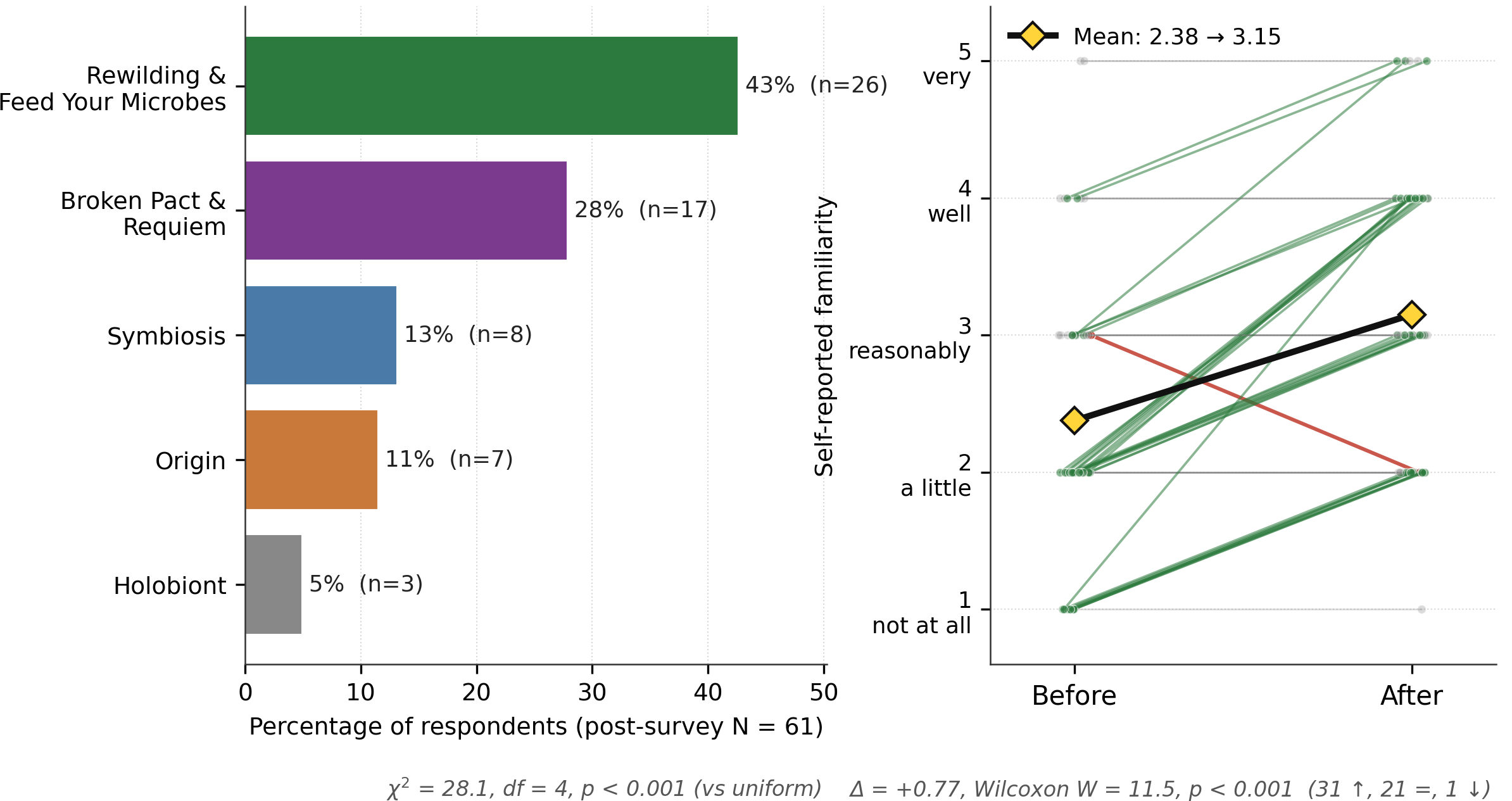
Of approximately 120 audience members, 92 completed the pre-survey and 65 the post-survey; 53 formed strict paired records and were analysed as such (Table 2; full data and analyses in supplementary file 2). Post-survey single-item analyses use all available post-survey responses varies slightly from item to item because of item-level missingness, respondents being free to skip individual questions: 64 answered the Likert items (63 for intention to enrol), 61 named a most memorable act, and 59 gave a one-word takeaway. Each item’s N is reported with its result and in Table 2. Self-reported familiarity with the gut microbiome increased from a paired mean of 2.38 (median 2) to 3.15 (median 3), a shift of +0.77 (W = 11.5, p < 0.001; 31 up, 1 down, 21 unchanged; Figure 1B). Agreement that microbial diversity matters for human health was already high at baseline (mean 4.53, median 5) and shifted modestly upward (mean 4.72, median 5; W = 25.5, p = 0.012), consistent with a ceiling effect.
Of the post-only items, the strongest signals were on the action side. Sixty-two per cent of respondents reported being likely or very likely to enrol in Feed Your Microbes (mean 3.73, median 4); 86% agreed or strongly agreed that increasing dietary fibre is beneficial for health (mean 4.25, median 4.5), the cognitive-uptake measure. Both signals are stronger than the affective one: the Requiem’s emotional impact was moderate (mean 2.70, median 2.5), with 34% reporting a strong or very strong response and 50% only a little or none.
|
Item | Pre M (Med) | Post M (Med) | Δ (post – pre) |
Test statistic, p-value |
| Paired analyses (N = 53)
| ||||
|
Familiarity with the gut microbiome (1-5) | 2.38 (2) | 3.15 (3) | + 0.77 |
W = 11.5,p< 0.001 |
|
Importance of microbial diversity for health (1-5) | 4.53 (5) | 4.72 (5) | + 0.19 |
W = 25.5,p= 0.012 |
| Post-survey single items (N = 61–64; item N given per row)
| ||||
|
Requiem for a Microbe: emotional impact (1–5) | 2.70 (2.5) |
34% strong / very strong |
||
|
Intention to enrol in Feed Your Microbes (1–5; N = 63) | 3.73 (4) |
62% likely / very likely |
||
|
Fibre-health insight (1–5) | 4.25 (4.5) |
86% agree / strongly agree |
||
| Most memorable act (N = 61)
| ||||
| Rewilding & Feed Your Microbes 43% (N= 26); Broken Pact & Requiem 28% (N= 17);
Symbiosis 13% (N= 8); Origin 11% (N= 7); Holobiont 5% (N= 3).
| ||||
| Chi-square vs. uniform: χ2= 28.1, df = 4, p < 0.001.
| ||||
| Pre-survey fibre baseline (N = 90)
| ||||
| 0% at < 6 g/day (0–1 portion); 37% at 6–12 g (2–3 portions); 42% at 12 to <20 g (4–5
portions); 21% at ≥20 g (≥6 portions).
| ||||
The most memorable act was the rewritten Rewilding tied to the Feed Your Microbes launch (43%), followed by the merged Broken Pact and Requiem (28%), Symbiosis (13%), Origin (11%), and Holobiont (5%; Figure 1A; χ2= 28.1, df = 4, p < 0.001). This contradicts iterations 1 and 4, in which the Requiem was most often cited in informal conversation. Two structural changes plausibly explain the shift: merging Broken Pact and Requiem may have diluted the Requiem as a standalone affective event; and rewriting Rewilding as the in-dome introduction to Feed Your Microbes made it both the last content the audience heard and the cue to action. A third explanation is the audience itself: iteration 5 was the launch event for the Feed Your Microbes campaign, so those present may have arrived already disposed toward action, and that disposition alone could account for the action act outscoring the emotional one, independent of the running order. Our data cannot separate the two, since every respondent saw the same order at the same event; telling them apart would require staging the same version for a non-campaign audience. Iteration 5 provides preliminary evidence that linking affective communication to a behavioural pathway (section 6) succeeds at the cost of redistributing attention from the affective to the action act.
The one-word open responses (59 of 65 post-survey respondents wrote one) clustered around three themes: dietary action (vezels [fibre], vezelrijk [high in fibre], fermenteer [ferment], gezond eten [eating healthily], plantaardig eten [eating plant-based], appearing at least 10 times); engagement and curiosity (interessant [interesting], indrukwekkend [impressive], fascinerend [fascinating], nieuwsgierigheid [curiosity], at least 12 times); and microbial concepts (holobiont [holobiont], biodiversiteit [biodiversity], oerbacterie [ancestral bacterium]). No respondent’s one-word takeaway pointed to mourning or grief, which is consistent with the moderate Requiem-emotion rating.
Limitations. This evaluation covers a single event at a single venue with no control or comparison group, so it cannot separate the effect of the performance from that of the setting or the occasion. The audience self-selected into a campaign launch and was therefore already disposed toward the message, which limits how far the results generalise and, as noted above, confounds the memorability result. The measures themselves are modest. The self-reported gain in familiarity functions close to a manipulation check, since almost any forty-minute performance on the topic would raise it, and it is open to priming and demand effects, the more so because the audience was told the study’s purpose. The single-item Likert change scores are coarse, and the importance-of-diversity item was already near the top of its scale before the performance, leaving little room to move. Intention to enrol is a stated-intention proxy rather than behaviour; the actual Feed Your Microbes enrolment figures would be the stronger endpoint, and pre-post questionnaires in general capture stated rather than enacted change. The instrument was built around the cognitive and attitudinal content of the performance and did not measure its aesthetic and affective reception, such as immersion, awe, or aesthetic appreciation, beyond a single Requiem-emotion item and the one-word takeaways, while the embodied Transformation was not measured at all. We also collected little demographic information, so we cannot examine how reception varied with age, background, or prior interest. Finally, whether any of these gains persist beyond a single evening remains an open question, while the microbial biodiversity crisis unfolds over centuries.
6 Lessons for practice and transferability
We close with five lessons. We mark each according to what supports it: the structured evaluation of iteration 5 (section 5), which measured a defined set of audience outcomes; the reflective observations gathered over iterations 1 to 4, and our judgement as creators.
First, consider venue properties as potential content, not only as backdrop. We argue that staging a microbial performance in a planetarium was not just an aesthetic choice but a way of making the scientific point visually: the dome usually shows the cosmos, and using it for microbes places them on the same scale. This is the work’s principal proposed innovation, and it remains an argument from design. Offered in that spirit, the practitioner question is what scientific claim each available venue (planetariums, immersive cinemas, vivariums, churches, disused industrial buildings) might make that no other medium can.
Second, design for adaptation. Each iteration taught us something the original alone could not: which acts can be cut for a non-science audience (IDFA DocLab), which strategies depend on the dome (SNAAR), that the work survives an academic-to-public shift (Earthlings), and how affective communication couples to behaviour-change recruitment (Feed Your Microbes). Modularity in the original design made each adaptation possible without rewriting. These are reflective observations from the staging sequence rather than controlled comparisons, since iterations 1 to 4 were not formally evaluated.
Third, we hypothesise that mourning rituals can help communicate ecological loss. The ecological-grief and environmental-mourning literature supports the idea [Cunsolo & Ellis, 2018], and our reading of the first four stagings was that the Requiem did important affective work. We hold this loosely. In iteration 5 the Requiem, merged with the Broken Pact, produced only a moderate emotional response (section 5), and no audience member offered a one-word takeaway pointing to grief. The climate-emotion literature also cautions that grief and fear can tip into anxiety or paralysis as readily as into engagement [Hickman et al., 2021; Ojala, 2012; Wray, 2022], so we treated designing an exit from mourning toward hope and action as a deliberate choice rather than only dramaturgy. Whether structured public mourning communicates better than lecture or exhibition is therefore an open question we put to practitioners working on declining bee populations, lost songbirds, retreating glaciers, or vanishing soil microbes, not a result we can assert.
Fourth, we suggest retaining a human element, while noting that this rests on creator judgement rather than audience data. In our reading, the iterations without the live cellist (notably iteration 2) were the thinnest, and restoring the cello (iterations 4 and 5) returned the work close to its original resonance. For practitioners without a live musician, a live narrator or present scientist may offer another route to real-time co-presence with the audience.
Fifth, we explored linking affect to action. The 2026 staging was the first to integrate a clear behavioural pathway, Feed Your Microbes enrolment through dietary fibre and fermented foods, as the practical form of the rewilding the performance argues for. Our starting hypothesis, drawn from the planetary health literature, is that despair without an action perspective is demobilising [O’Neill & Nicholson-Cole, 2009]. What the iteration 5 evaluation does show is that coupling the affective performance to an enrolment step did not weaken the cognitive or attitudinal gains reported in section 5. What it also shows is a redistribution of attention toward the closing action act (section 5). What it does not show is that emotional resonance caused the action intention: the survey did not ask audiences to connect the two, and the strongest signals were cognitive and behavioural rather than affective. We therefore read the coupling as a defensible design trade rather than a demonstrated mechanism, an emotional space that opens onto action seeming to us more useful than one that closes on grief alone. Transferability is conditional. The full-dome strategy in its strongest form requires a planetarium and a budget for full-dome video, whereas the Requiem, the human element, and the affect-to-action principle do not, and could in principle be staged in museums, school auditoriums, and outdoor events.
7 Conclusion
The microbial biodiversity crisis will not mobilise public concern through statistics alone. Communicating it requires forms that hold open the scales of time, space, and intimacy in which microbial life takes place, and that interrupt the disgust through which microbes are conventionally encountered. Symbiosis was our attempt, turning a planetarium dome inward toward the microbial world. Five iterations between July 2023 and May 2026 showed us which elements survive adaptation and where structured evaluation can strengthen the practice; the inversion of the planetarium, which we offer as the central innovation, is for now an idea argued from the design, and one we put to the field to test directly with audiences. The fifth iteration emphasised the central message: rewilding the microbial world is a daily, edible practice, and adding fibre and fermented foods is the form that rewilding takes inside a human body.
Acknowledgments
We thank the ARTIS-Planetarium team for hosting the 2023 premiere, the 2024 Earthlings staging, and the 2026 restaging; the IDFA DocLab team for iteration 2; SNAAR and TivoliVredenburg for iteration 3; the VU fonds and the MDL fonds (Dutch Digestive Health fund) for the 2026 ‘Feed your Microbes’ campaign; audiences at all five stagings for the conversations that shaped this reflection; and in particular the audience members at the 18 May 2026 staging who completed the pre- and post-performance questionnaires reported in section 5.
Author contributions (Contributor Roles Taxonomy, CRediT). RK: conceptualisation, writing of original concept and text, narration, project administration, writing of original draft, writing review and editing. GTD: conceptualisation, composition, writing review and editing. MF: cello performance, conceptualisation, writing review and editing. WvE: videomicrography, visualisation, writing review and editing. MG: full-dome projection design, visualisation, writing review and editing.
Funding. This work was accomplished with institutional funding of the Vrije Universiteit Amsterdam and ARTIS, Amsterdam. The 2023 production was sponsored by Yakult. The 2026 ‘Feed Your Microbes’ campaign, including the staging reported as iteration 5, was supported by the VU fonds and the MDL fonds (Dutch Digestive Health fund).
Conflicts of interest. The authors declare no competing interests.
Ethics statement. The evaluation used a voluntary questionnaire completed by adult audience members, collecting no sensitive personal data and performing no medical procedures. All participants gave informed consent to take part and to publish the anonymised results, and were informed of the purpose of the study and that data were de-identified before analysis. Under Dutch law (WMO), ethics review is only required for research aimed at generating medical knowledge where participants undergo procedures or follow imposed rules of behaviour. This study meets neither criterion: it measures science communication outcomes, not health or disease, and participation was limited to filling in a questionnaire. It is therefore non-WMO research, exempt from METC review, in line with both national law [CCMO, 2025] and VU Amsterdam institutional policy [VU Amsterdam, 2025]. The research was evaluated using the evaluation tool of the Research Ethics Review Committee of the Faculty of Science (BETHCIE) of the Vrije Universiteit, which confirmed this non-WMO status.
Use of AI. This manuscript was prepared with editorial assistance from a large language model (Claude, Anthropic) used by RK to organise and revise text drafted by the authors. All scientific claims, references, and reflective judgements are the authors’ own.
Data availability. Two supplementary files accompany this submission. Supplementary file 1 contains the pre- and post-performance Qualtrics questionnaire (Dutch original) deployed at the 18 May 2026 staging. Supplementary file 2 contains the de-identified paired dataset and the full statistical analyses underlying section 5, Table 2, and Figure 1.
References
-
Born, G., & Barry, A. (2010). ART-SCIENCE: From public understanding to public experiment. Journal of Cultural Economy, 3(1), 103–119. https://doi.org/10.1080/17530351003617610
-
Bradbury, H. (Ed.). (2015). The SAGE Handbook of Action Research (3rd ed.). SAGE Publications Ltd. https://doi.org/10.4135/9781473921290
-
Carter, M. M., Olm, M. R., Merrill, B. D., Dahan, D., Tripathi, S., Spencer, S. P., Yu, F. B., Jain, S., Neff, N., Jha, A. R., Sonnenburg, E. D., & Sonnenburg, J. L. (2023). Ultra-deep sequencing of Hadza hunter-gatherers recovers vanishing gut microbes. Cell, 186(14), 3111–3124.e13. https://doi.org/10.1016/j.cell.2023.05.046
-
CCMO. (2025). Your research: is it subject to the WMO or not? Central Committee on Research Involving Human Subjects. https://english.ccmo.nl/investigators/legal-framework-for-medical-scientific-research/your-research-is-it-subject-to-the-wmo-or-not
-
Chirico, A., Pizzolante, M., Borghesi, F., Bartolotta, S., Sarcinella, E. D., Cipresso, P., & Gaggioli, A. (2023). “Standing Up for Earth Rights”: Awe-Inspiring Virtual Nature for Promoting Pro-Environmental Behaviors. Cyberpsychology, Behavior, and Social Networking, 26(4), 300–308. https://doi.org/10.1089/cyber.2022.0260
-
Cunsolo, A., & Ellis, N. R. (2018). Ecological grief as a mental health response to climate change-related loss. Nature Climate Change, 8(4), 275–281. https://doi.org/10.1038/s41558-018-0092-2
-
Hickman, C., Marks, E., Pihkala, P., Clayton, S., Lewandowski, R. E., Mayall, E. E., Wray, B., Mellor, C., & van Susteren, L. (2021). Climate anxiety in children and young people and their beliefs about government responses to climate change: a global survey. The Lancet Planetary Health, 5(12), e863–e873. https://doi.org/10.1016/s2542-5196(21)00278-3
-
IDFA DocLab. (2023). Takeaways from the IDFA DocLab R&D Summit 2023. IDFA. https://professionals.idfa.nl/en/stories/idfa-doclab-rd-summit-2023-report/
-
Keltner, D., & Haidt, J. (2003). Approaching awe, a moral, spiritual, and aesthetic emotion. Cognition and Emotion, 17(2), 297–314. https://doi.org/10.1080/02699930302297
-
Kort, R. (2017). De microbemens: het belang van het onzichtbare leven. Athenaeum, Polak & Van Gennep.
-
Kort, R., Arts, K., Antó, J. M., Berg, M. P., Cepella, G., Cole, J., van Doorn, A., van Gorp, T., Grootjen, M., Gupta, J., Hill, C., van der Heide, E., Huisman, J., Janmaat, J., O’Callaghan-Gordo, C., Mattijsen, J., Modi, T., Nowak, E., Ossebaard, H. C., … Martens, P. (2023). Outcomes from the First European Planetary Health Congress at ARTIS in Amsterdam. Challenges, 14(4), 49. https://doi.org/10.3390/challe14040049
-
Lesen, A. E., Rogan, A., & Blum, M. J. (2016). Science Communication Through Art: Objectives, Challenges, and Outcomes. Trends in Ecology & Evolution, 31(9), 657–660. https://doi.org/10.1016/j.tree.2016.06.004
-
Lorimer, J. (2020). The Probiotic Planet: Using Life to Manage Life. University of Minnesota Press. https://doi.org/10.5749/j.ctv19cw9vg
-
Moser, S. C. (2010). Communicating climate change: history, challenges, process and future directions. WIREs Climate Change, 1(1), 31–53. https://doi.org/10.1002/wcc.11
-
Ojala, M. (2012). Hope and climate change: the importance of hope for environmental engagement among young people. Environmental Education Research, 18(5), 625–642. https://doi.org/10.1080/13504622.2011.637157
-
O’Neill, S., & Nicholson-Cole, S. (2009). “Fear Won’t Do It”: Promoting Positive Engagement With Climate Change Through Visual and Iconic Representations. Science Communication, 30(3), 355–379. https://doi.org/10.1177/1075547008329201
-
Paxson, H. (2008). Post-Pasteurian cultures: The Microbiopolitics of Raw-Milk Cheese in the United States. Cultural Anthropology, 23(1), 15–47. https://doi.org/10.1111/j.1548-1360.2008.00002.x
-
Rook, G. A. (2013). Regulation of the immune system by biodiversity from the natural environment: An ecosystem service essential to health. Proceedings of the National Academy of Sciences, 110(46), 18360–18367. https://doi.org/10.1073/pnas.1313731110
-
Rose, D. B. (2011). Wild dog dreaming: love and extinction. University of Virginia Press. https://www.upress.virginia.edu/title/4294/
-
Sanders, J. G., Sprockett, D. D., Li, Y., Mjungu, D., Lonsdorf, E. V., Ndjango, J.-B. N., Georgiev, A. V., Hart, J. A., Sanz, C. M., Morgan, D. B., Peeters, M., Hahn, B. H., & Moeller, A. H. (2023). Widespread extinctions of co-diversified primate gut bacterial symbionts from humans. Nature Microbiology, 8(6), 1039–1050. https://doi.org/10.1038/s41564-023-01388-w
-
Sender, R., Fuchs, S., & Milo, R. (2016). Revised Estimates for the Number of Human and Bacteria Cells in the Body. PLOS Biology, 14(8), e1002533. https://doi.org/10.1371/journal.pbio.1002533
-
Sonnenburg, E. D., & Sonnenburg, J. L. (2019). The ancestral and industrialized gut microbiota and implications for human health. Nature Reviews Microbiology, 17(6), 383–390. https://doi.org/10.1038/s41579-019-0191-8
-
van de Put, M., van den Belt, M., de Wit, N., & Kort, R. (2024). Rationale and design of a randomized placebo-controlled nutritional trial embracing a citizen science approach. Nutrition Research, 131, 96–110. https://doi.org/10.1016/j.nutres.2024.07.008
-
van den Belt, M., van de Put, M., Yüksel, E., Lee, D., van Eeden, F., van Straaten, J. P., Pintar, N., Balen, B., Andelic, M., Rijnaarts, I., Besseling-van der Vaart, I., Rook, M., Molenaar, D., Levin, E., de Vos, W. M., de Wit, N. J. W., & Kort, R. (2025). Distinct modulatory effects of high-fiber and fermented-food diets on gut microbiota, immune function, transit time, and sleep quality in a citizen science randomized controlled trial. https://doi.org/10.1101/2025.08.05.25332853
-
van Dooren, T. (2014). Flight Ways: Life and Loss at the Edge of Extinction. Columbia University Press. https://doi.org/10.7312/columbia/9780231166188.001.0001
-
VU Amsterdam. (2025). Frequently asked questions on research ethics review. Vrije Universiteit Amsterdam. https://vu.nl/en/employee/social-sciences-getting-started/frequently-asked-questions-on-research-ethics-review
-
Wastyk, H. C., Fragiadakis, G. K., Perelman, D., Dahan, D., Merrill, B. D., Yu, F. B., Topf, M., Gonzalez, C. G., Van Treuren, W., Han, S., Robinson, J. L., Elias, J. E., Sonnenburg, E. D., Gardner, C. D., & Sonnenburg, J. L. (2021). Gut-microbiota-targeted diets modulate human immune status. Cell, 184(16), 4137–4153.e14. https://doi.org/10.1016/j.cell.2021.06.019
-
Watkins, H., Robinson, J. M., Breed, M. F., Parker, B., & Weinstein, P. (2020). Microbiome-Inspired Green Infrastructure: A Toolkit for Multidisciplinary Landscape Design. Trends in Biotechnology, 38(12), 1305–1308. https://doi.org/10.1016/j.tibtech.2020.04.009
-
Whitmee, S., Haines, A., Beyrer, C., Boltz, F., Capon, A. G., de Souza Dias, B. F., Ezeh, A., Frumkin, H., Gong, P., Head, P., Horton, R., Mace, G. M., Marten, R., Myers, S. S., Nishtar, S., Osofsky, S. A., Pattanayak, S. K., Pongsiri, M. J., Romanelli, C., … Yach, D. (2015). Safeguarding human health in the Anthropocene epoch: report of The Rockefeller Foundation–Lancet Commission on planetary health. The Lancet, 386(10007), 1973–2028. https://doi.org/10.1016/s0140-6736(15)60901-1
-
Wray, B. (2022). Generation dread: finding purpose in an age of climate crisis. Alfred A. Knopf.
-
Yeo, S. K., Sun, Y., McKasy, M., & Shugart, E. C. (2019). Disgusting microbes: The effect of disgust on perceptions of risks related to modifying microbiomes. Public Understanding of Science, 28(4), 433–448. https://doi.org/10.1177/0963662519832200
-
Yu, K. C., Sahami, K., Denn, G., Sahami, V., & Sessions, L. C. (2016). Immersive Planetarium Visualizations For Teaching Solar System Moon Concepts To Undergraduates. Journal of Astronomy & Earth Sciences Education (JAESE), 3(2), 93. https://doi.org/10.19030/jaese.v3i2.9843
-
Zilber-Rosenberg, I., & Rosenberg, E. (2008). Role of microorganisms in the evolution of animals and plants: the hologenome theory of evolution. FEMS Microbiology Reviews, 32(5), 723–735. https://doi.org/10.1111/j.1574-6976.2008.00123.x
About the authors
Remco Kort is Professor of Host-Microbe Interactions at Vrije Universiteit Amsterdam, where he holds the ARTIS-Micropia chair. His research covers the gut microbiome, the gut-brain axis, and citizen-science approaches to microbial biodiversity, including the Feed Your Microbes campaign and the GEEF and FOOD4MOOD nutritional intervention trials. He co-developed ARTIS-Micropia, the world’s first microbe museum, wrote the popular science book De Microbemens, writes the column "Het Verborgen Leven" for ARTIS Magazine, and co-founded the Yoba for Life Foundation. https://www.linkedin.com/in/remco-kort-40354714.
E-mail: r.kort@vu.nl
Gustavo Trujillo Delgado (La Orotava, Tenerife, 1972) is a composer and music theorist based in Amsterdam. He studied clarinet in Tenerife and composition and music theory at the conservatoires of Amsterdam and Rotterdam, and teaches music theory at the Conservatorium van Amsterdam. He is artistic adviser to the PA’dam Chamber Choir and associated composer at the Festival de Música de Cámara Villa de La Orotava. His work moves between concert music, electronics and interdisciplinary projects.
E-mail: gustavoatrujillo@hotmail.com
Maya Fridman (Moscow, 1989) is a cellist and singer based in the Netherlands. She graduated cum laude from the Conservatorium van Amsterdam and won the Dutch Classical Talent Award in 2019, followed by residencies at Gaudeamus and TivoliVredenburg. She records for the Dutch label TRPTK and works between contemporary classical, improvised and popular idioms. Her doctoral research concerns the ritualisation of concert practice, a theme central to her collaboration on Symbiosis.
E-mail: maya@trptk.com
Wim van Egmond (The Hague, 1966) is an artist and microphotographer who studied painting and photography in Rotterdam and specialised in imaging through the microscope. He curates the online Micropolitan Museum, has been awarded in the Nikon Small World competition, and contributed imagery to ARTIS-Micropia. His recent work uses time-lapse and focus stacking to film micro-organisms, fungi and soil life, and he researches Antoni van Leeuwenhoek’s first observations of microbes.
E-mail: t936927@telfort.nl
Milo Grootjen is an astronomer and head of the ARTIS-Planetarium in Amsterdam, where he is responsible for the programme of full-dome productions and live shows. He presents public programmes on astronomy and space exploration, appears regularly in Dutch media, and develops collaborations that bring scientific and artistic work to the dome. For Symbiosis he designed and assembled the full-dome projection.
E-mail: m.grootjen@artis.nl