

1 Introduction
Science communication always takes place in site-specific, situated spaces — whether in physical spaces such as city streets and festival tents, in museums, libraries or cafes, or in digital spaces such as social media platforms. In this practice insight, we focus on how these spaces are not merely neutral or passive backdrops [Crang & Thrift, 2000; Warf & Arias, 2009]; rather, space needs “to be recognised as a central component in [ …] communication” [Shome, 2003, p. 40]. Despite the proliferation of science communication across diverse venues [Ayure & Triana, 2022; Bell et al., 2009; Ribeiro et al., 2026], relatively little attention has been paid to how spatial conditions shape, constrain, or enable science communication practices. Our analysis centres on physical spaces, acknowledging that digital spaces warrant separate, dedicated investigation.
The term space is used frequently yet uncritically in the literature [see, e.g., Ribeiro et al., 2026] — probably due to its ambiguity [Ingold, 2009]. But space should not be limited to experts in math, geography or architecture; it is equally important to science communication, as all practice unfolds within, and is shaped by, spatial arrangements.
This practice insight examines how attending to spatial dimensions can deepen our understanding of science communication. It is guided by the question: How do spatial configurations and science communication practices shape and co-construct one another? We aim to broaden the epistemic horizons of science communication, and to demonstrate how reflective spatial practice can be productively integrated into the field. The insights developed through this cross-disciplinary work are relevant to both researchers and practitioners seeking to design, facilitate and interpret science communication.
2 Uses and conceptualisations of space in science communication
Space is often invoked implicitly in science communication literature or used interchangeably with terms such as place, environment, or setting. A common application concerns public space, which refers to accessible physical sites where public life unfolds [Conforti et al., 2018; Davies et al., 2019; Orthia et al., 2021; Thompson et al., 2023]. Elsewhere, public space is used metaphorically to refer to arenas of public debate rather than specific physical locations [Elsdon-Baker, 2015]. Relatedly, the concept of social space appears in discussions of citizen science [Hecker & Taddicken, 2022; Wagenknecht et al., 2021].
The varied venues in which science communication unfolds are sometimes described as physical spaces. These include institutions such as science centres, museums, observatories, zoos, aquariums, and botanical gardens, as well as living labs, science cafés, maker spaces, and less traditional settings like community centres, libraries, cultural institutions, theme parks or holiday resorts [Ayure & Triana, 2022; Bucchi & Trench, 2025; Martin, 2019; Merzagora, 2017; Rader & Gibbs, 2024]. Across these studies, space describes a location or setting. A growing body of work emphasises the creation of new spaces for participation, dialogue, and co-creation, including spaces for collective storytelling [Roig, 2025], hybrid spaces designed to enable encounters between different knowledge systems [Roberts et al., 2022], and purpose-built participatory spaces such as “cardboard laundromats” [Bailey et al., 2022].
Beyond physicality, space is used metaphorically to describe science communication as a cultural space. Silva Luna and Bering [2021, 2022] conceptualise science communication as comprising multiple cultural subspaces with distinct norms and identities. Others employ spatial metaphors to foreground geopolitical divides [Raman, 2023; Sesan & Ibiyemi, 2023] or identify overlooked areas within the discipline [Wilkinson, 2021]. Sometimes, science communication itself is explicitly described as a space [Davies et al., 2019; Hetland, 2019]. Space is also occasionally discussed alongside time [Phillips, 2014], though the two are most often treated as parallel rather than analytically integrated.
In summary, space is a recurrent reference point in science communication research, used to describe settings, institutions, participatory formats, and the field itself. These uses remain diverse and loosely connected, with space most often functioning as a descriptive or metaphorical term rather than as an explicit analytical category. We turn now to spatial theory to develop a conceptual framework for analysing space not merely as a setting for science communication, but as a constitutive element of communicative practice itself.
3 Theory: towards a spatial framework for science communication
Space and place are often described as the “building blocks” of geographical thinking [Gilmartin et al., 2024, p. 2; see also Tuan, 1977]. Their relative meanings and analytical roles have long been debated [Agnew, 2011; Coleman & Agnew, 2018]. While space and place are interrelated, spatial theory emphasises how space foregrounds relations, configurations, and processes, rather than bounded locations alone. Focusing on space as distinct from place thus allows us to attend to the conditions through which social practices unfold without presuming fixed meanings or stable settings.
3.1 Is space dead or alive?
The spatial turn of the 1970s and 1980s marked an increasing scholarly engagement with space [Arias, 2010; Finnegan, 2008; May & Thrift, 2003]. This work employed geographical concepts to analyse an increasingly complex and differentiated social world [Crang & Thrift, 2000]. Here, space was understood as produced through interactions and relations, and as implicated in social organisation and power [Warf & Arias, 2009]. Thus, space had no independent existence outside the practices and relations through which it was constituted.
This approach repositions space as an active analytical concern rather than a container for social action. Relational approaches to space emphasise how spatial configurations are produced through ongoing interactions, how multiple trajectories coexist, and how space is implicated in social and political processes [see, e.g., Lefebvre, 1991]. These insights form the conceptual foundation for contemporary spatial theory and inform how space can be approached analytically.
3.2 Space as interrelational, heterogeneous, and continually under construction
Among spatial theorists, Doreen Massey has been particularly influential in articulating a relational understanding of space that foregrounds its social and political dimensions [Massey, 1984, 1994, 2005, 2006]. In For Space [2005], she challenges static or surface-like conceptions of space and formulates three propositions that conceptualise space as interrelational, heterogeneous, and continually under construction. Together, these propositions suggest a coherent framework for understanding space as dynamic, contested, and socially and materially produced.
Massey’s [2005] first proposition conceptualises space as constituted through interrelations across multiple scales. Here, space is not an inert surface but an effect of social and material relations that extend across and beyond specific sites. This understanding foregrounds how spaces are shaped through connections between actors, objects, practices, and histories rather than existing as bounded containers.
The second proposition conceptualises space as the sphere of coexisting heterogeneity [Massey, 2005]. Space is thus defined by the simultaneous presence of multiple trajectories, perspectives, and forms of difference. Rather than assuming coherence or consensus, this view emphasises plurality, contestation, and the negotiation of difference as constitutive features of spatial configurations.
The third proposition holds that space is always under construction [Massey, 2005]. Because space is produced through ongoing practices and interactions, it is never complete or final. This emphasis on becoming foregrounds temporality, contingency, and process, highlighting how spatial configurations are continually made and remade rather than given in advance.
Taken together, Massey’s relational conceptions of space point out what it means to examine space not as a neutral setting but as a dynamic configuration produced through relations, differences, and ongoing practices. The following sections apply this perspective directly to demonstrate how spatial arrangements actively shape communicative encounters, rather than merely containing them. By adopting this framework, we analyse space as a relational, polyphonic, and emergent force that co-constitutes science communication practices.
4 Method
To attend to the multiple modes — relational, polyphonic and emergent — through which meaning is produced in a science communication workshop, we employ a qualitative approach informed by multimodal critical discourse analysis (MCDA) [Machin & Mayr, 2012]. The workshop in question, What a Wonderful World?, was developed within the research program Addressing Sustainability with Arts-based Science Communication. It was co-created by artist Maj Horn, geologist Kasia Śliwińska, curator and philosopher Mads Kring, and the first author. It took place in an eponymous exhibition which explored the human relationship to landscape and climate change.
The workshop took about 90 minutes and was conducted three times in June and July 2025 at the Danish Museum of Science and Technology (DMST). It aimed to communicate climate change and changing landscapes through performative artistic approaches, scientific knowledge, and the objects and gallery spaces within the museum. The common pigeon (Columba livia) played a central role as a species with a 20-million-year evolutionary history and a long-standing co-existence with humans.
Here, we focus on a single workshop to prioritise a micro-spatial investigation of a science communication event, rather than examining all three workshops. Given the exploratory nature of this article and its aim to develop a practical understanding of space in science communication, a single-case study provides a productive starting point [Flyvbjerg, 2006; Schwandt & Gates, 2018]. We employ multimodal critical discourse analysis (MCDA) to examine how spatial configurations shape and co-construct science communication practices.
4.1 Multimodal critical discourse analysis (MCDA)
MCDA builds on critical discourse analysis (CDA) and multimodal analysis (MA). We use CDA [Machin & Mayr, 2012; van Leeuwen, 2008] to attend to how language contributes to shaping and co-constructing the relational space of the performance workshop. Because language cannot account for the full complexity of spatial meaning-making, we use MA [Kress & van Leeuwen, 1996, 2001] to investigate how communication is realised through multiple semiotic modes, including images, material arrangements and architectural forms [Machin & Mayr, 2012]. These modes are central to understanding how meaning is constructed [Diamantopoulou et al., 2024] and are therefore particularly relevant when analysing spatiality in museum settings, where diverse communicative forms coexist, and museums may be understood as multimodal environments at their core [Ravelli, 2024]. MCDA thereby provides a deeper understanding of communication activities [Machin, 2013], including those unfolding in science museums and science centres [Katz-Kimchi & Atkinson, 2014], and enables us to move beyond methods that privilege either human movement [Hillier & Hanson, 1984] or architectural representation [Ravelli & McMurtrie, 2016].
4.2 Data
We draw on empirical material generated during the first of three workshops conducted at the DMST. The dataset comprises observations, post-workshop interviews (two individual and one group interview with two participants), and follow-up interviews (one individual and one group interview with two participants) conducted approximately two months later. In total, 11 adult participants took part in the workshop analysed here, representing a range of ages and genders. Participants were recruited through the museum’s social media channels and word of mouth. Interviews were audio-recorded, transcribed, and translated from Danish into English. Informed consent was obtained from all participants. In addition to these data, the analytical corpus includes the objects used during the workshop. Together, these materials form the empirical basis for analysing how the workshop was constituted through interactions among participants, materials, and spatial arrangements in the museum.
4.3 Analysis
We attend to how participants acted within the science museum setting; how displayed objects and materials participated in constructing the spatial dynamics; and how participants reflected on their experiences of the space both immediately after the workshop and in the follow-up interviews. This multimodal approach enables us to deductively examine how space was continually made and remade through linguistic, bodily, and material interactions. We use vignettes [Bloom-Christen & Grunow, 2024] based on the observation data to demonstrate how the space was relational, polyphonic and emergent.
5 Findings
The findings from the workshop are structured around its four parts: performance lecture, collective chanting, conversing with objects, and collective reflections.
5.1 Part one: performance lecture
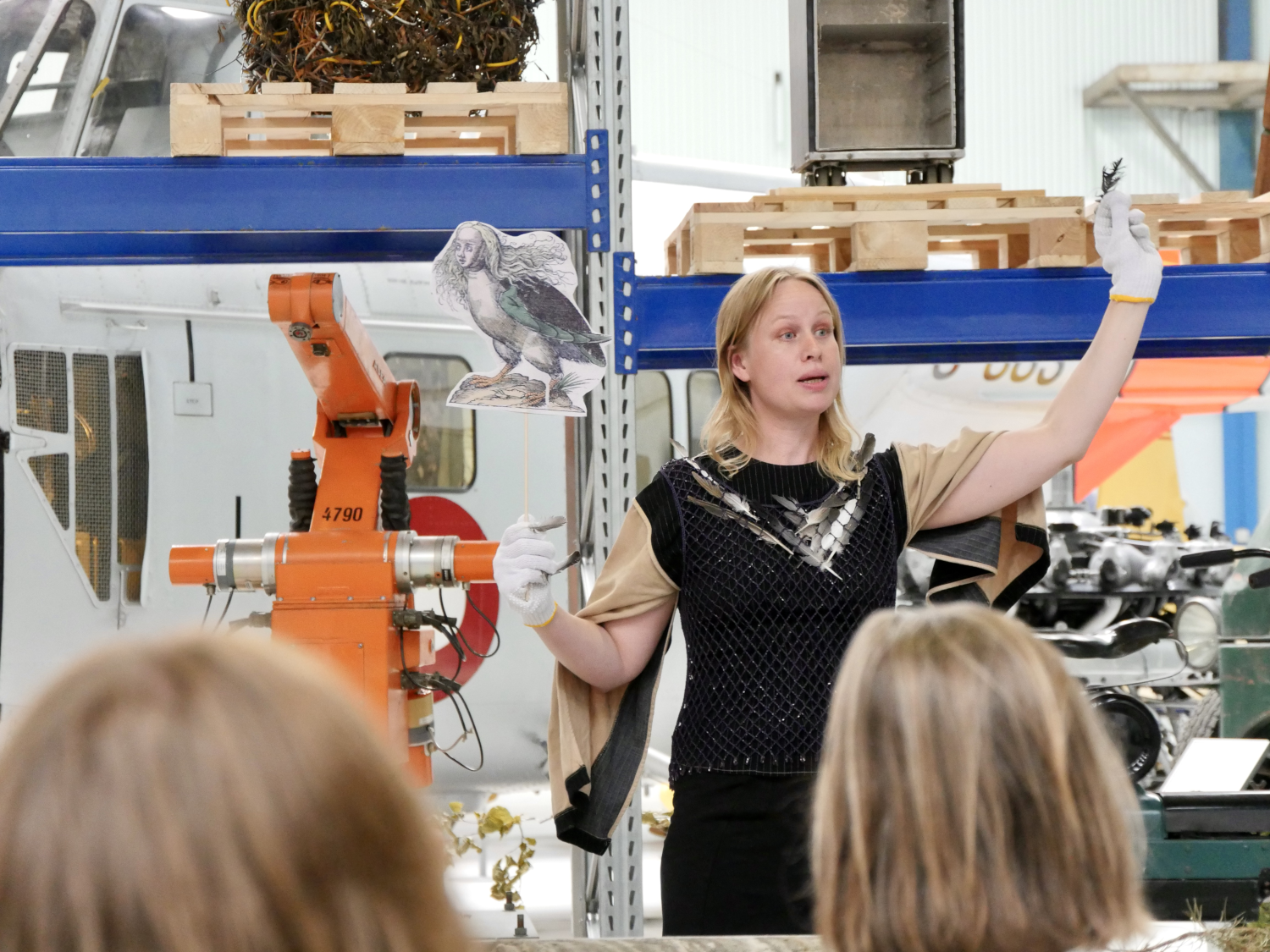
The exhibition What a Wonderful World?, where the first part of the workshop took place (Figures 1 and 2), was delineated from the wider museum galleries by a large shelving unit displaying objects and a delicate string fence. Thus, the objects in the surrounding area remained visually dominant: a passenger aircraft, a helicopter, and a space capsule asserted themselves within the dynamics of the performance lecture.
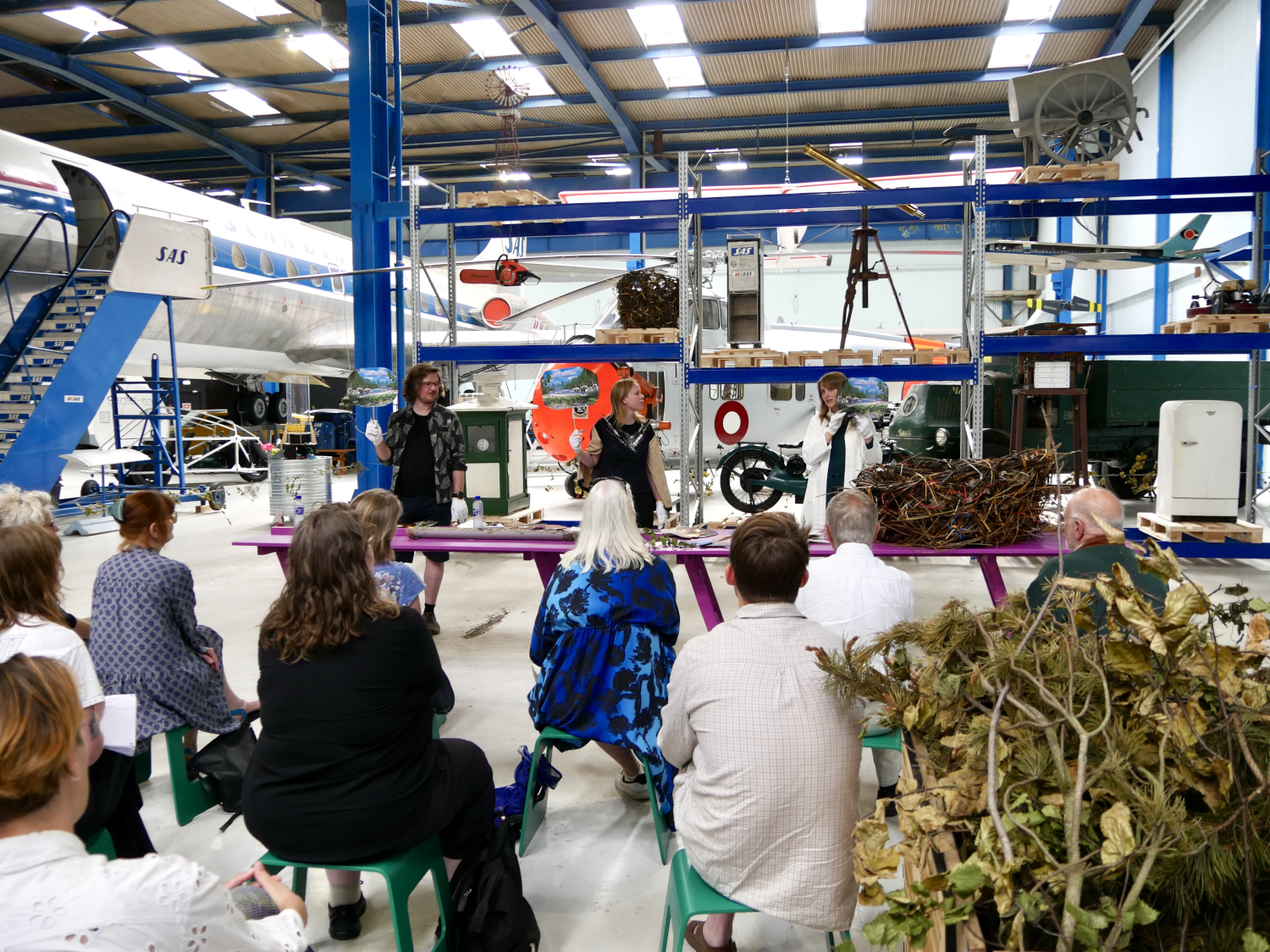
Participants commented on the influence of the setting. One remarked on its scale and materiality: “It’s the atmosphere as a whole because the architecture is crazy big and, yeah, it’s not something I see every day.” (Interviewee 4, post-workshop). Another emphasised the affective pull of being surrounded by machines: “The museum is one thing with everything that’s in there — I’m completely childishly excited about it. I’ve loved cars my whole life, and also planes.” (Interviewee 1, post-workshop). This sense of childlike excitement persisted; when reflecting on the workshop two months later, the same participant noted: “I’m thinking, ‘Wow! All those machines — can I play with them?’ I’m a big kid at heart.” (Interviewee 1, follow-up). These accounts highlight how the industrial scale and material presence of the surrounding objects were not merely a backdrop but an active spatial force shaping participants’ affective, sensory and interpretive engagements during the workshop.
Participants sat on stools facing the three performers (Figure 1) — the artist, the geologist and the curator — who began with a dialogue-style performance lecture. The echoing acoustics, amplified by the metal structure of the building and periodically interrupted by seagulls or the movements of other visitors, required some participants to lean forward and one to adjust a hearing aid. These subtle bodily adjustments illustrate how the material affordances of the space directly shaped communicative possibilities.
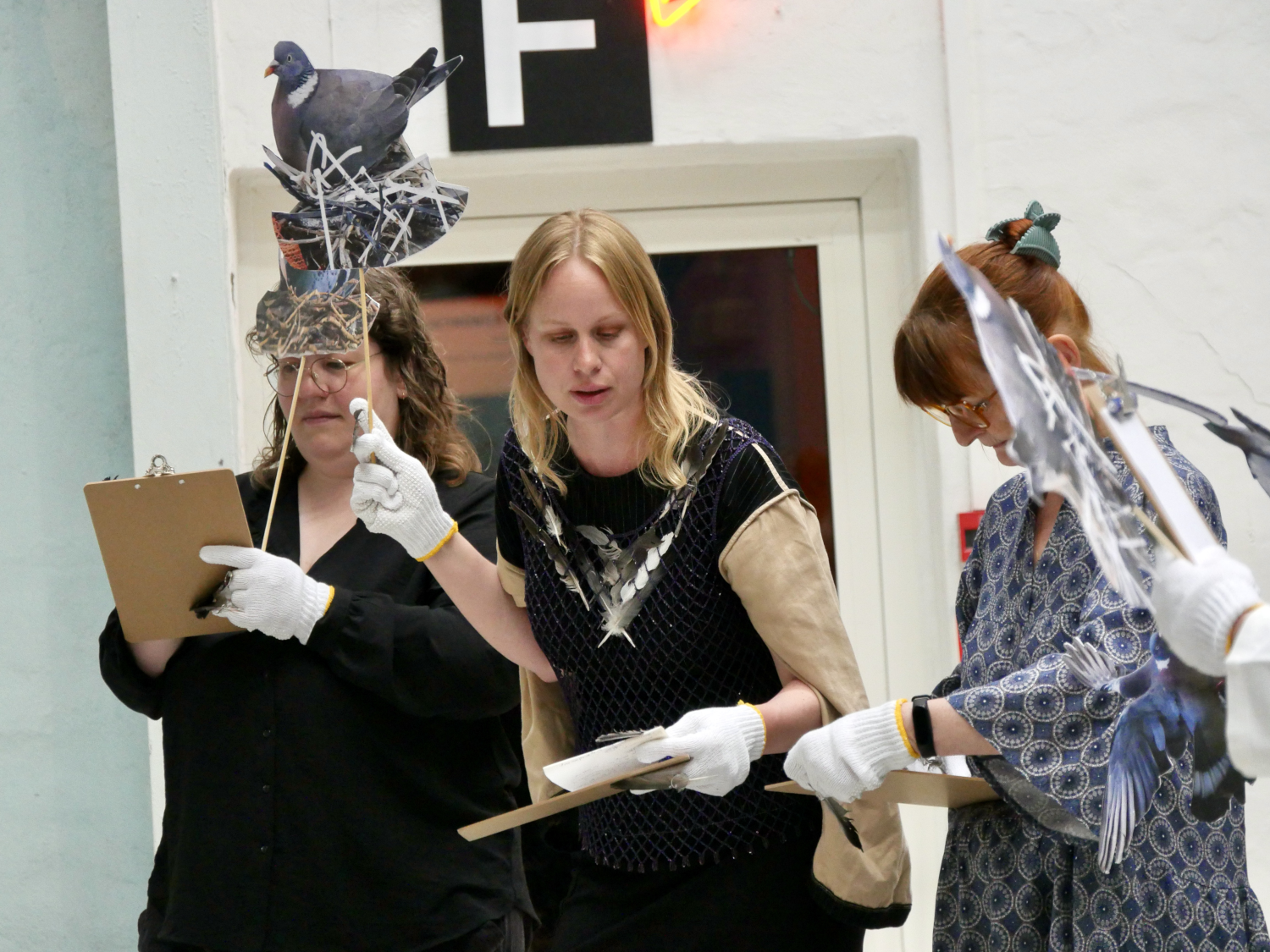
The performers’ embodied presence further configured spatial relations. The artist’s pigeon-feathered clothing signalled a mode of engagement; the geologist’s lab coat invoked scientific authority; and the curator’s everyday attire positioned him as an institutional mediator. This made a notable impression on participants, as reflected in one interviewee’s recollection of the artist’s outfit as one of the first things that came to mind when reflecting on the workshop: “now I can’t remember her name, the one who organised it all… but also with the gloves, and she had feathers on her shoes and feathers on…” (Interviewee 2). Participants appeared engaged, smiling and occasionally laughing, though some periodically glanced towards the larger machines in the gallery, momentarily shifting their attention beyond the performance area.
The performers used props to accompany their presentations; for example, the geologist introduced a lignite sample to illustrate how such material can reveal past climatic conditions. This intervention made a strong impression. As one participant explained: “I thought a lot about the climate and the scientist’s fascination with lignite. I can see the interest in all those layers over time, where she can measure how much it rained and which plants grew in the different time periods.” (Interviewee 2, post-workshop). The lignite sample also resurfaced prominently in the follow-up interviews: “I keep coming back to the lignite… I really had to go and read more about it.” (Interviewee 1, follow-up). The sample thus became a central material element in the participant’s memory two months after the workshop.
In the first phase of the workshop, space was thus constituted as relational, polyphonic, and emergent. Relationally, it was produced through interactions among architecture, objects, bodies, performances, and environmental conditions. Polyphonically, multiple acoustic, visual, and material voices intersected within the gallery. Emergently, space was continuously reconfigured through ongoing actions and interruptions, actively co-constituting the workshop rather than serving as a neutral container.
5.2 Part two: collective chanting
After the performance lecture, participants were equipped with gloves adorned with pigeon feathers and signs bearing images of pigeons. Together, they moved through the museum gallery, stopping at three selected objects — a mini submarine, a space capsule and a cement mixer truck (Figures 3 and 4) — to collectively read aloud stories written by the three performers and the first author of this article, addressing the objects in second person (“you”) about their role in the changes of landscapes. The objects were thus animated as agents with perspectives on the worlds they had helped shape.
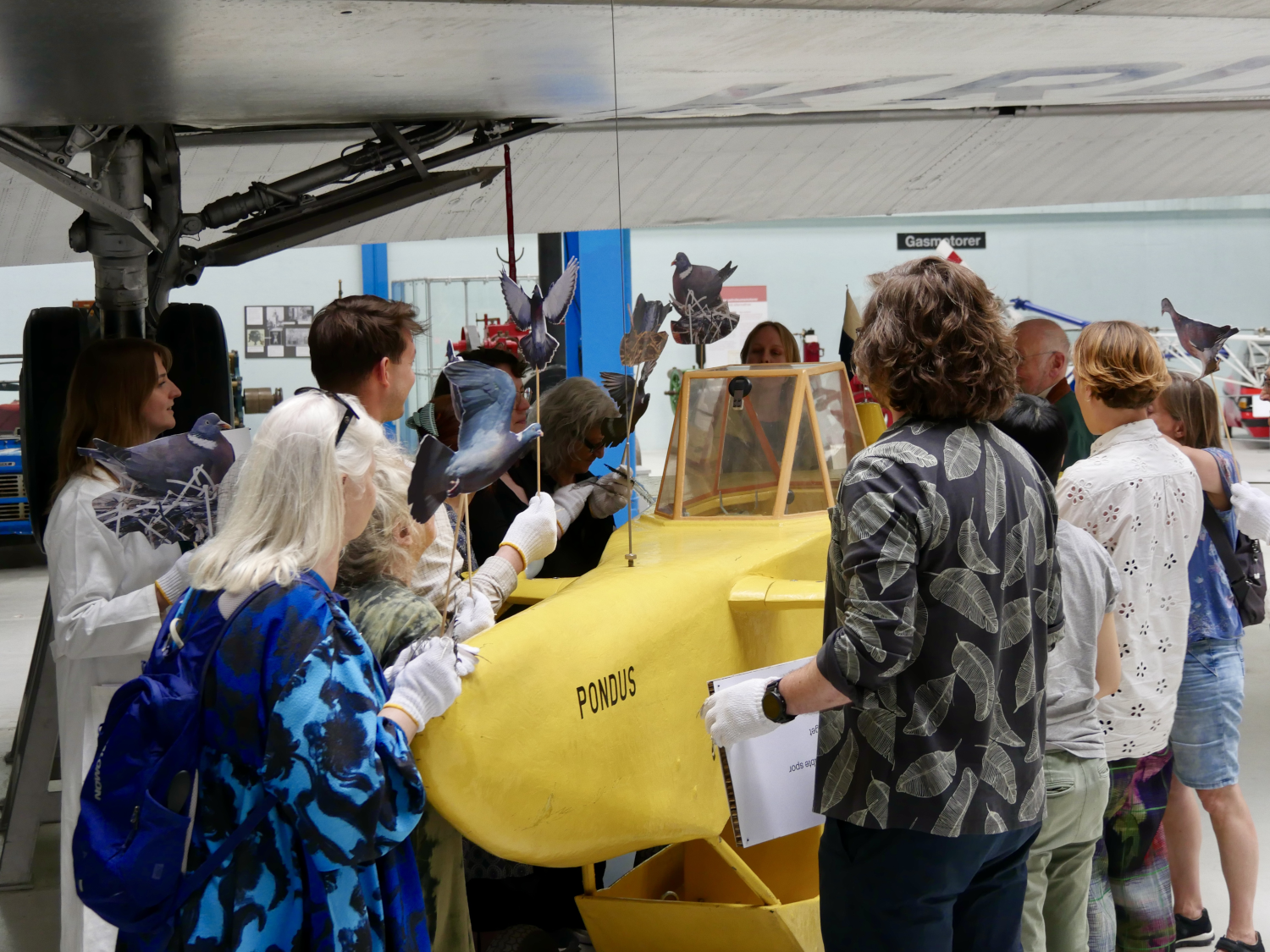
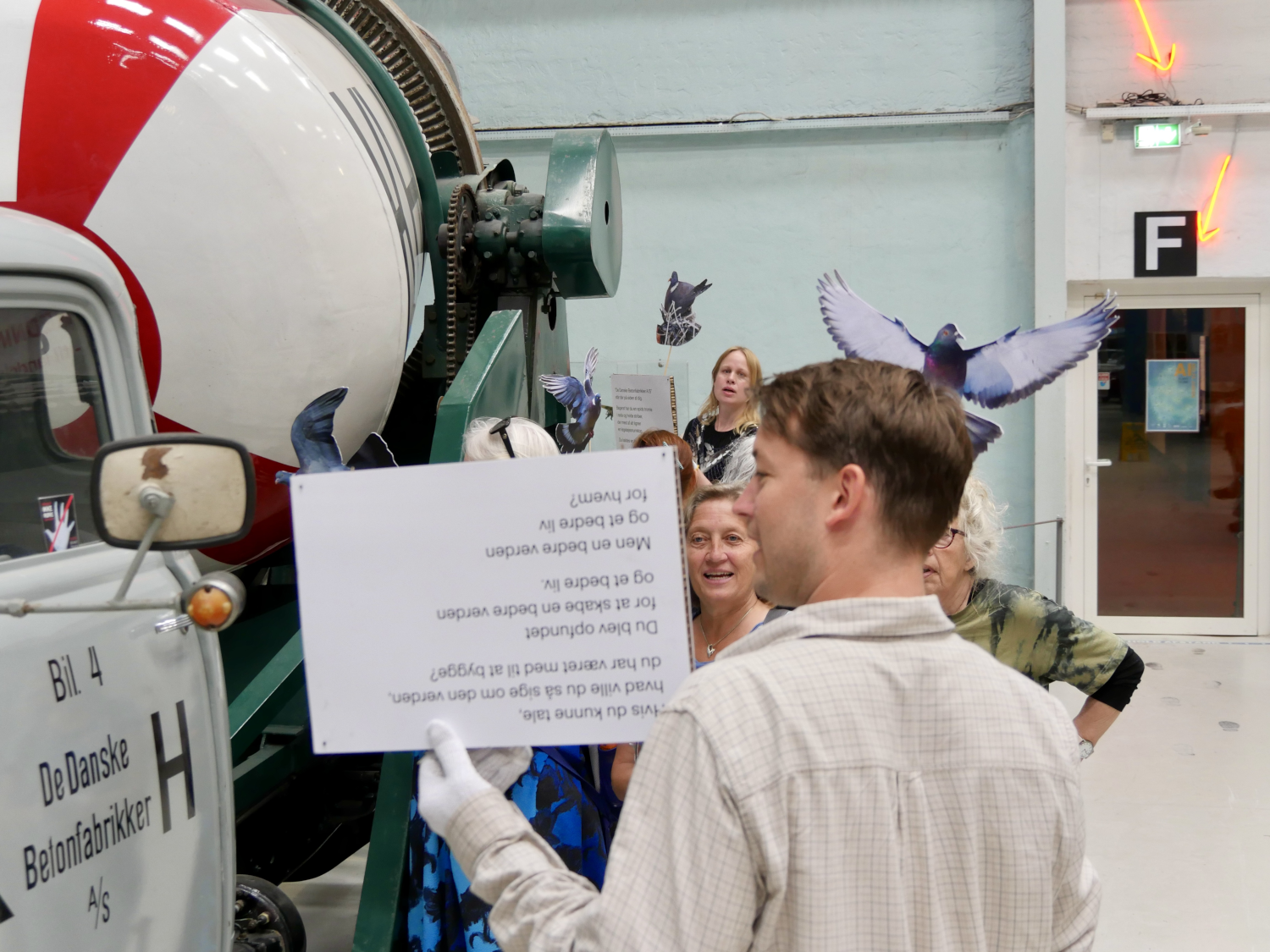
Reading aloud from the signs created moments of shared vocalisation that temporarily equalised participants’ positions within the space. One participant described this as producing a sense of co-presence: “I thought it was a nice aesthetic experience walking around and reading aloud together. I really liked that. I had some kind of… a little bit of a community kind of vibe with that.” (Interviewee 4, post-workshop). Standing in a circle around the objects intensified this atmosphere, creating an elevated and almost ritual quality. As another participant reflected: “When we stood and read the text aloud, it was almost a little religious in a way. You stand there chanting in unison — like the Lord’s Prayer.” (Interviewee 2, post-workshop). This practice of reading aloud also featured prominently in participants’ later recollections. For example, in a follow-up interview, one participant explained: “The physical side of it — standing there saying something together, choir-like. I don’t do that kind of thing every day… so I thought it was funny.” (Interviewee 4, follow-up).
Relationally, addressing objects and using props brought participants, materials, and museum objects into new constellations. Polyphonically, collective readings layered scripted object voices, shared human vocalisation, and ambient gallery sounds. Emergently, movement, repetition, and affective responses transformed the gallery into a temporarily intensified communicative space.
5.3 Part three: conversing with objects
Next, the participants were invited to make self-formed small groups of two or three, ideally with people they did not know beforehand, and were tasked with selecting an object in the museum galleries (Figure 5). They were asked to write a short text or produce a drawing reflecting on the object’s role in past, present and future landscapes from the imagined viewpoint of a pigeon. The groups selected a range of objects, including a rescue helicopter and a postman’s bicycle. As participants discussed their chosen objects, the objects themselves acquired a kind of voice: their age, design, function and historical significance became grounds for speculation and imaginative reframing. One participant expressed how the setting shaped their reflections: “And also, I think there’s something about the museum [ …] it’s a very special, slightly strange place. It’s an experience just going there, because it’s a bit outside my usual surroundings.” (Interviewee 4, follow-up).
For some groups, object selection emerged through shared negotiation; for others, certain voices were dominant. This dynamic was evident in one participant’s reflection: “Maybe I was a bit manipulative by saying that I thought we should try to look at some of the things that were least represented here, but which, in terms of impact and effect, have had the greatest influence. And then we stopped at the DR [Danish National Broadcasting] equipment [ …]” (Interviewee 3, post-workshop). A similar pattern appeared in another group, where one participant explained: “If I had to choose, it would have been the cement mixer truck. I was completely obsessed with that truck.” (Interviewee 1, post-workshop).
Within the groups, participants shared diverse forms of knowledge — some drawing on technical expertise, others approaching the task through the imagined perspective of the pigeon, or through personal associations and memories. The artist finally gathered the participants by sounding a whistle that mimicked a pigeon’s call (Figure 6).
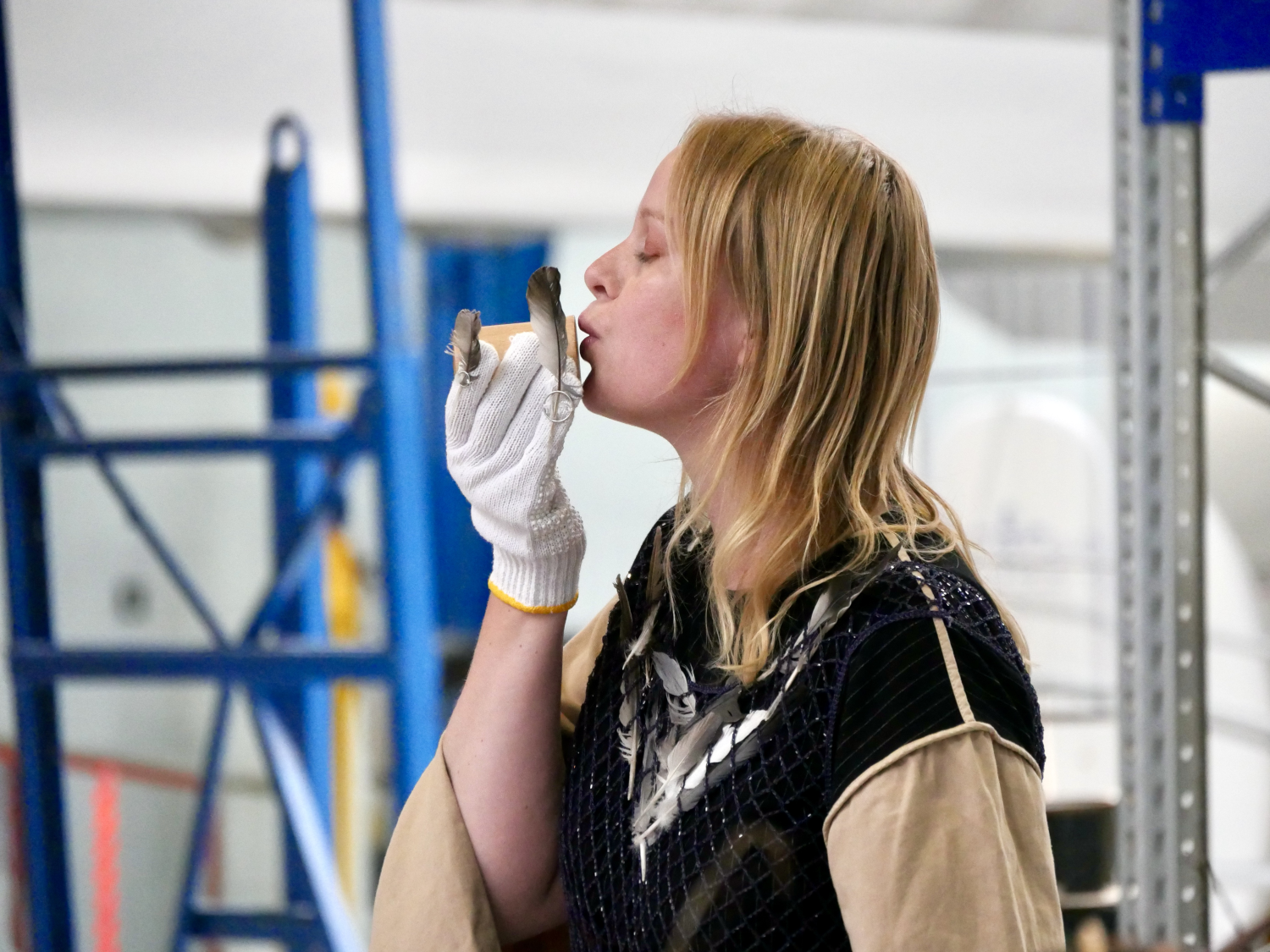
Relationally, participants dispersed across the gallery, forming new constellations with museum objects through acts of selection and interpretation. Polyphonically, imagined, technical, and material voices overlapped as groups constructed their narratives. Emergently, movement, debate, and improvisation transformed the gallery into a temporary field of inquiry.
5.4 Part four: collective reflections
Finally, the groups reconvened in the What a Wonderful World? exhibition to share their reflections (Figures 7 and 8). The groups took turns sharing their conversations and presenting the objects they had chosen. Their exchanges touched on the multiple uses and meanings of the selected objects, frequently moving between themes of technological progress, human control, vulnerability, and ecological transformation. They drew on a wide range of experiences: some participants shared personal or professional memories connected to the objects; others speculated about how pigeons might interpret these technologies or their future implications; and still others contributed knowledge about technological development and the environmental changes driven by climate change.
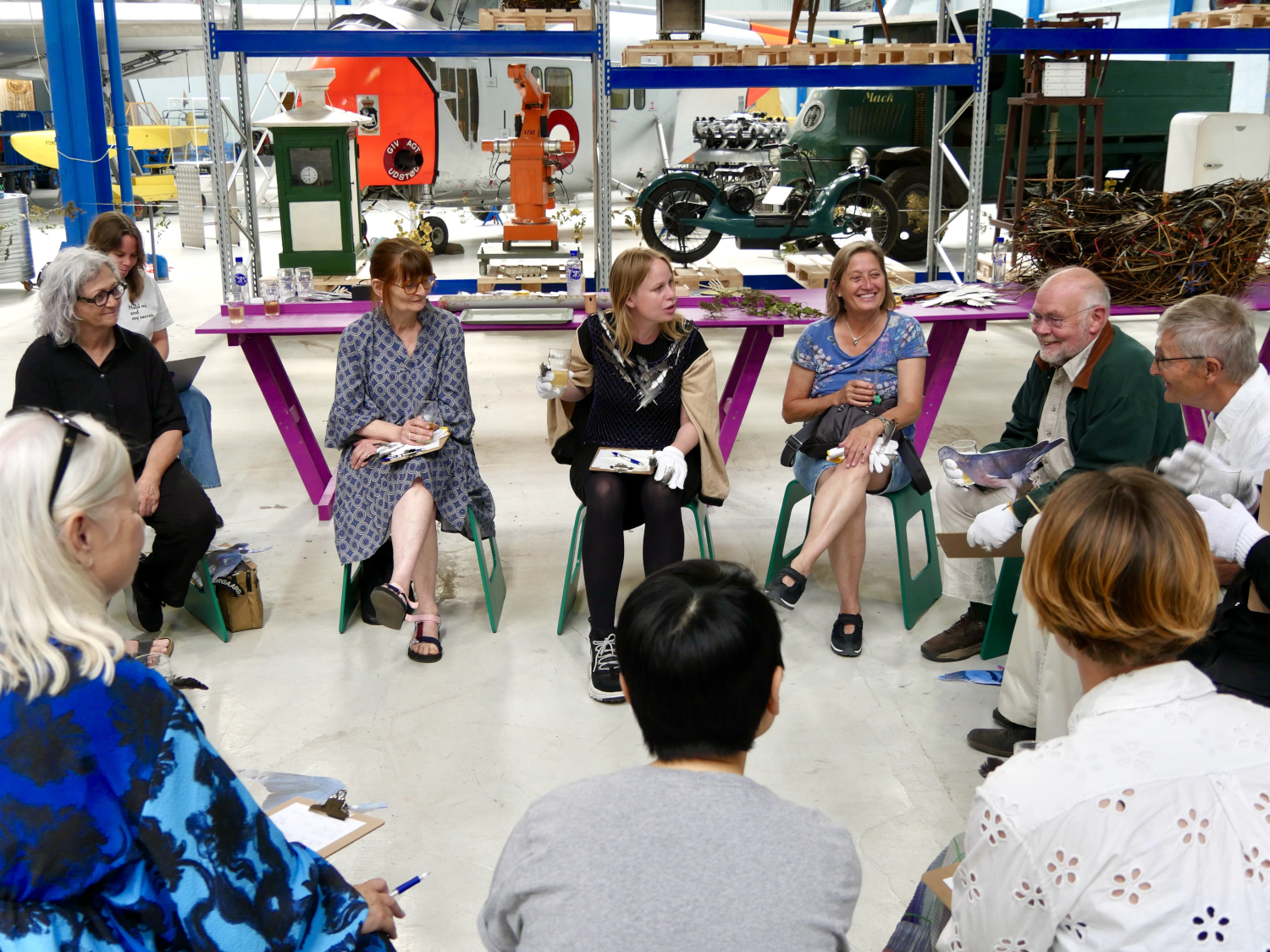
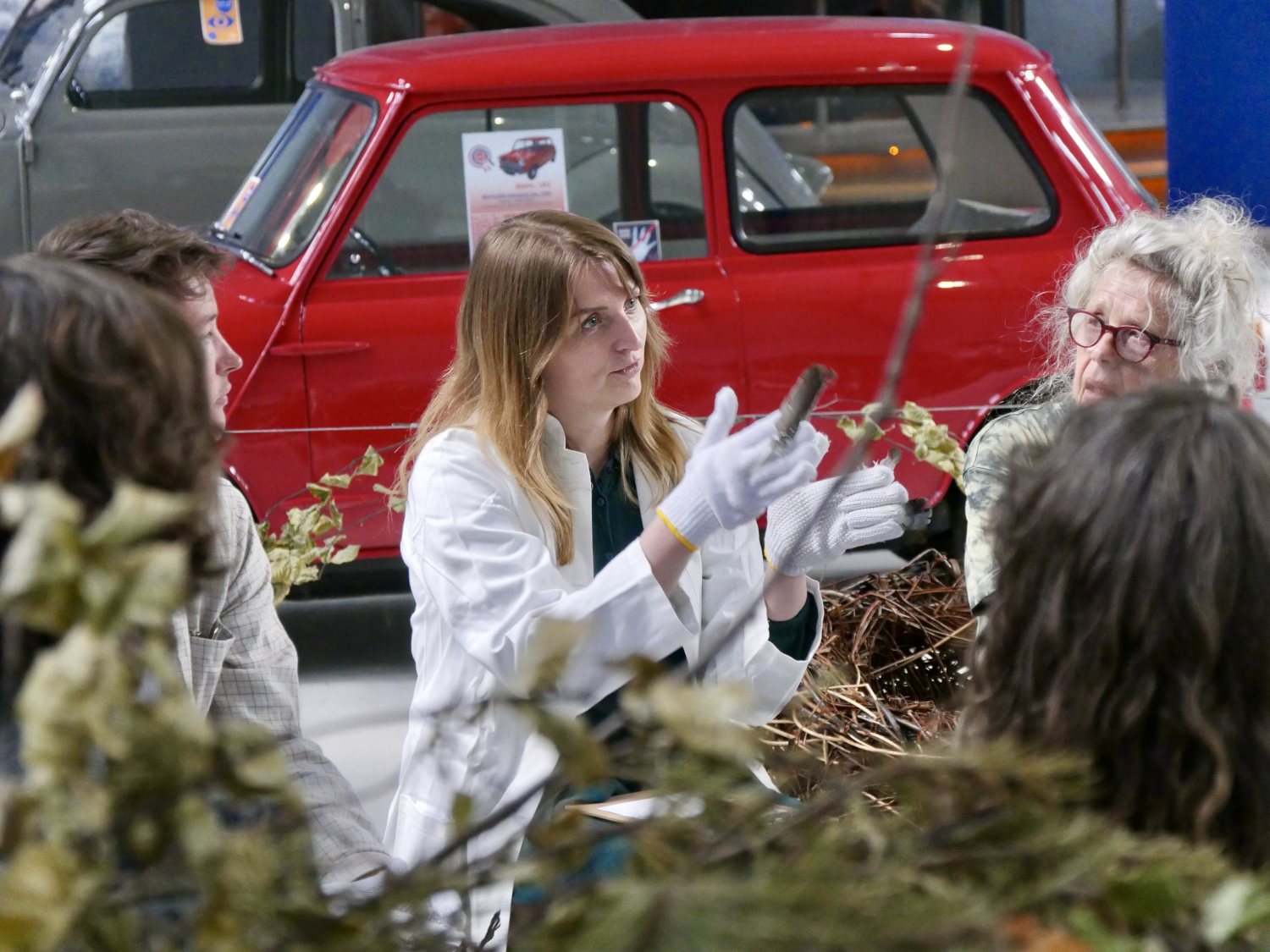
When the conversation became technically specialised or conceptually demanding, some participants became more dominating while others withdrew. The workshop space was therefore not simply multi-vocal but characterised by shifting hierarchies, uneven participation and ongoing negotiations of expertise. Yet participants consistently framed the experience as collective. One explained: “It’s not like everyone could contribute in the same way, and you had to work out what to say, but you could still participate, you know?” (Interviewee 4, post-workshop). Another, in a follow-up interview, similarly emphasised the communal aspect: “Well, I actually thought the atmosphere was good… That’s what I remember.” (Interviewee 2, follow-up).
This final phase of the workshop further illustrates how the space was produced through relational, polyphonic and emergent dynamics. Relationally, reconvening in a circle and sharing objects and reflections brought participants, materials, and ideas into new configurations. Polyphonically, diverse voices coexisted — personal, technical and environmental — revealing uneven circulations of authority. Emergently, responses and shifting emphases produced a dynamic and evolving communicative space.
Taken together, the four parts of the performance workshop demonstrate how science communication unfolds through complex spatial entanglements in which objects, bodies, materials, sounds, atmospheres and stories dynamically co-constitute one another. Rather than serving as a neutral backdrop, the museum space continuously actively shaped — and was shaped by — the interactions, narratives, and affective responses that emerged across the workshop. These findings invite us to reconsider how science communication operates when space is a central, generative force in meaning-making.
6 Discussion
To our knowledge, this practice insight is the first science communication study to analyse a public event through an explicitly spatial framework. In doing so, we make three contributions to the field. First, we demonstrate empirically that space plays an active and constitutive role in shaping and co-constructing science communication. Our findings show that space is not simply a passive container as it is often treated in science communication literature [see, e.g., Conforti et al., 2018; Orthia et al., 2021; Thompson et al., 2023]. Recognising both space and science communication as co-constructed underscores their deep interconnection and complexity.
Second, we offer an analytical framework that enables researchers and practitioners to attune to the spatial dynamics of science communication, thereby extending existing work on meaning-making within the field [see, e.g., Davies et al., 2019; Halpern & Elliott, 2022; Smith & Garramon Merkle, 2021]. By conducting our spatial analysis through MCDA, we were able to examine a wide range of elements — such as bodies, objects, materials, sounds, and movements — that together shaped and co-constructed the space of the science communication event. This approach afforded a level of granularity and relational sensitivity that would have been difficult with other spatial methods, such as space syntax [Hillier & Hanson, 1984] or spatial discourse analysis [Ravelli & McMurtrie, 2016].
Third, we propose a methodological orientation that foregrounds spatiality as an integral component of science communication research, demonstrating how careful attention to spatial elements can illuminate otherwise invisible processes that constitute science communication. In the present study, these include tacit interactions between participants and the objects on display in the museum, as well as the atmospheres of the galleries, shaped, for instance, by sound and temperature. As a way forward, we suggest building on Davies and Horst’s [2016] notion of science communication as an ecosystem composed of multiple niches. While their metaphor primarily describes the broader landscape of science communication, we propose extending it to focus more closely on individual communication events [see also Achiam et al., 2025; Horst & Michael, 2011]. By shifting attention from the macro-level ecosystem to the micro-level event, it becomes clear how the specificities of space actively shape and co-construct science communication as it unfolds.
7 Conclusion
This practice insight advances a conceptual argument for taking space seriously as a constitutive dimension of science communication. It demonstrates how spatial relations actively shape — and are reshaped by — communicative practices within a science museum setting. Our findings show that space is neither neutral nor passive: it structures possibilities for participation while simultaneously being reconfigured through interaction.
By foregrounding space as relational, polyphonic, and emergent, this study highlights how physical environments participate in the production, performance, and interpretation of scientific knowledge. Space can thus function as a communicative medium in its own right, inviting embodied, affective, and imaginative forms of engagement. Attending more carefully to spatial dynamics opens new avenues for both research and practice in science communication, encouraging more deliberate and creative uses of space to support participation and reimagine communicative hierarchies.
Acknowledgments
We are grateful to Elin Ferm and Marine Duthil-McArthur for their contributions to data collection, and to Christine Delcomyn Dohn for assisting with transcribing and proofreading the interviews. We also wish to thank the anonymous reviewers for their constructive comments, which helped improve the manuscript.
Declaration of interest
This research was made possible by funding from the Novo Nordisk Foundation, grant
number NNF220C0078707. The funders had no involvement in the study design, data collection
and analysis, decision to publish, or preparation of the manuscript. The authors report there are no
competing interests to declare. The study was carried out in accordance with the code of conduct
for responsible research at the University of Copenhagen.
References
-
Achiam, M., Grünfeld, M., Vitting-Seerup, S., Jensen, J. T., & Whiteley, L. (2025). Towards a terroir approach to science communication and its evidencing. JCOM, 24(07), Y01. https://doi.org/10.22323/161120251104104659
-
Agnew, J. A. (2011). Space and place. In J. Agnew & D. N. Livingstone (Eds.), The SAGE handbook of geographical knowledge (pp. 316–330). SAGE Publications. https://doi.org/10.4135/9781446201091.n24
-
Arias, S. (2010). Rethinking space: an outsider’s view of the spatial turn. GeoJournal, 75(1), 29–41. https://doi.org/10.1007/s10708-010-9339-9
-
Ayure, M., & Triana, R. (2022). Participatory science communication for transformation in Colombia. JCOM, 21(02), Y03. https://doi.org/10.22323/2.21020403
-
Bailey, J., Salmon, R., & Horst, M. (2022). The ‘Engagement Incubator’: using design to stimulate reflexivity about public engagement with science. JCOM, 21(04), A01. https://doi.org/10.22323/2.21040201
-
Bell, P., Lewenstein, B., Shouse, A. W., & Feder, M. A. (Eds.). (2009). Learning science in informal environments: people, places, and pursuits. The National Academies Press. https://doi.org/10.17226/12190
-
Bloom-Christen, A., & Grunow, H. (2024). What’s (in) a vignette? History, functions, and development of an elusive ethnographic sub-genre. Ethnos, 89(5), 786–804. https://doi.org/10.1080/00141844.2022.2052927
-
Bucchi, M., & Trench, B. (2025). Science communication: the basics. Routledge. https://doi.org/10.4324/9781032646749
-
Coleman, M., & Agnew, J. (Eds.). (2018). Handbook on the geographies of power. Edward Elgar Publishing. https://doi.org/10.4337/9781785365645
-
Conforti, M. E., Chaparro, M. G., Degele, P., & Díez Fernández Lomana, J. C. (2018). Visitor profiling at the Museum of Human Evolution of Burgos (Spain). JCOM, 17(04), A03. https://doi.org/10.22323/2.17040203
-
Crang, M., & Thrift, N. (2000). Introduction. In M. Crang & N. Thrift (Eds.), Thinking space (pp. 1–30). Routledge. https://doi.org/10.4324/9780203411148
-
Davies, S. R., Halpern, M., Horst, M., Kirby, D., & Lewenstein, B. (2019). Science stories as culture: experience, identity, narrative and emotion in public communication of science. JCOM, 18(05), A01. https://doi.org/10.22323/2.18050201
-
Davies, S. R., & Horst, M. (2016). Science communication: culture, identity and citizenship. Palgrave Macmillan. https://doi.org/10.1057/978-1-137-50366-4
-
Diamantopoulou, S., Christidou, D., & Blunden, J. (2024). Multimodality and museums: innovative research methods and interpretive frameworks. Multimodality & Society, 4(3), 249–258. https://doi.org/10.1177/26349795241270436
-
Elsdon-Baker, F. (2015). Creating creationists: the influence of ‘issues framing’ on our understanding of public perceptions of clash narratives between evolutionary science and belief. Public Understanding of Science, 24(4), 422–439. https://doi.org/10.1177/0963662514563015
-
Finnegan, D. A. (2008). The spatial turn: geographical approaches in the history of science. Journal of the History of Biology, 41(2), 369–388. https://doi.org/10.1007/s10739-007-9136-6
-
Flyvbjerg, B. (2006). Five misunderstandings about case-study research. Qualitative Inquiry, 12(2), 219–245. https://doi.org/10.1177/1077800405284363
-
Gilmartin, M., Hubbard, P., Kitchin, R., & Roberts, S. M. (Eds.). (2024). Key thinkers on space and place (3rd ed.). SAGE Publications. https://doi.org/10.4135/9781036231323
-
Halpern, M. K., & Elliott, K. C. (2022). Science as experience: a Deweyan model of science communication. Perspectives on Science, 30(4), 621–656. https://doi.org/10.1162/posc_a_00398
-
Hecker, S., & Taddicken, M. (2022). Deconstructing citizen science: a framework on communication and interaction using the concept of roles. JCOM, 21(01), A07. https://doi.org/10.22323/2.21010207
-
Hetland, P. (2019). Constructing publics in museums’ science communication. Public Understanding of Science, 28(8), 958–972. https://doi.org/10.1177/0963662519870692
-
Hillier, B., & Hanson, J. (1984). The social logic of space. Cambridge University Press. https://doi.org/10.1017/CBO9780511597237
-
Horst, M., & Michael, M. (2011). On the shoulders of idiots: re-thinking science communication as ‘event’. Science as Culture, 20(3), 283–306. https://doi.org/10.1080/09505431.2010.524199
-
Ingold, T. (2009). Against space: place, movement, knowledge. In P. W. Kirby (Ed.), Boundless worlds: an anthropological approach to movement (pp. 29–43). Berghahn Books. https://doi.org/10.3167/9781845455385
-
Katz-Kimchi, M., & Atkinson, L. (2014). Popular climate science and painless consumer choices: communicating climate change in the Hot Pink Flamingos exhibit, Monterey Bay Aquarium, California. Science Communication, 36(6), 754–777. https://doi.org/10.1177/1075547014555998
-
Kress, G., & van Leeuwen, T. (1996). Reading images: the grammar of visual design. Routledge. https://doi.org/10.4324/9781003099857
-
Kress, G., & van Leeuwen, T. (2001). Multimodal discourse: the modes and media of contemporary communication. Arnold.
-
Lefebvre, H. (1991). The production of space (D. Nicholson-Smith, Trans.). Blackwell Publishing.
-
Machin, D. (2013). What is multimodal critical discourse studies? Critical Discourse Studies, 10(4), 347–355. https://doi.org/10.1080/17405904.2013.813770
-
Machin, D., & Mayr, A. (2012). How to do critical discourse analysis: a multimodal introduction. SAGE Publications. https://doi.org/10.4135/9781036212933
-
Martin, D. (2019). EPCOT theme park as a science communication space: the Test Track case. JCOM, 18(04), A09. https://doi.org/10.22323/2.18040209
-
Massey, D. (1984). Spatial divisions of labour: social structures and the geography of production. Macmillan. https://doi.org/10.1007/978-1-349-24059-3
-
Massey, D. (1994). Space, place, and gender. Polity Press.
-
Massey, D. (2005). For space. SAGE Publications.
-
Massey, D. (2006). Space, time and political responsibility in the midst of global inequality. Erdkunde, 60(2), 89–95. https://doi.org/10.3112/erdkunde.2006.02.01
-
May, J., & Thrift, N. (2003). Foreword: Timespace. In J. May & N. Thrift (Eds.), Timespace: geographies of temporality (p. i). Routledge. https://doi.org/10.4324/9780203360675
-
Merzagora, M. (2017). Science centres and science engagement activities as research facilities: blurring the frontiers between knowledge production and knowledge sharing. JCOM, 16(02), E. https://doi.org/10.22323/2.16020501
-
Orthia, L. A., McKinnon, M., Viana, J. N., & Walker, G. (2021). Reorienting science communication towards communities. JCOM, 20(03), A12. https://doi.org/10.22323/2.20030212
-
Phillips, A. T. (2014). Eliding extraction, embracing novelty: the spatio-temporal configuration of natural history. Environmental Communication, 8(4), 452–467. https://doi.org/10.1080/17524032.2014.919331
-
Rader, K. A., & Gibbs, C. (2024). Broadening adult engagement and education in science cafés: lessons from an STS — science communication boundary spanning experiment. JCOM, 23(02), Y02. https://doi.org/10.22323/2.23020402
-
Raman, S. (2023). Response to: “Looking back to launch forward: a self-reflexive approach to decolonising science education and communication in Africa”. Decoloniality opens up new epistemic vistas for science communication. JCOM, 22(04), Y02. https://doi.org/10.22323/2.22040402
-
Ravelli, L. (2024). Centering multimodality: a personal and disciplinary journey. Multimodality & Society, 4(3), 259–274. https://doi.org/10.1177/26349795241265262
-
Ravelli, L. J., & McMurtrie, R. J. (2016). Multimodality in the built environment: spatial discourse analysis. Routledge. https://doi.org/10.4324/9781315880037
-
Ribeiro, F., Silva, S., & Oliveira, T. (2026). Science communication pursing the “unexpected places”. JCOM, 25(02), E. https://doi.org/10.22323/378920260129130837
-
Roberts, J., Milne, R., Middleton, A., Patch, C., & Morley, K. (2022). Opportunities for poaching: using the public’s enjoyment of popular culture to foster dialogues around genetics. JCOM, 21(06), Y01. https://doi.org/10.22323/2.21060401
-
Roig, A. (2025). Our future stories: approaches to collective storytelling for climate futures and action through an integrative review. Environmental Communication, 19(2), 337–350. https://doi.org/10.1080/17524032.2024.2393776
-
Schwandt, T., & Gates, E. F. (2018). Case study methodology. In N. K. Denzin & Y. S. Lincoln (Eds.), The SAGE handbook of qualitative research (5th ed., pp. 341–358). SAGE Publications.
-
Sesan, T., & Ibiyemi, A. (2023). Looking back to launch forward: a self-reflexive approach to decolonising science education and communication in Africa. JCOM, 22(04), Y01. https://doi.org/10.22323/2.22040401
-
Shome, R. (2003). Space matters: the power and practice of space. Communication Theory, 13(1), 39–56. https://doi.org/10.1111/j.1468-2885.2003.tb00281.x
-
Silva Luna, D., & Bering, J. M. (2021). The construction of awe in science communication. Public Understanding of Science, 30(1), 2–15. https://doi.org/10.1177/0963662520963256
-
Silva Luna, D., & Bering, J. M. (2022). Varieties of awe in science communication: reflexive thematic analysis of practitioners’ experiences and uses of this emotion. Science Communication, 44(3), 347–374. https://doi.org/10.1177/10755470221098100
-
Smith, A. N. B., & Garramon Merkle, B. (2021). Meaning-making in science communication: a case for precision in word choice. The Bulletin of the Ecological Society of America, 102(1), e01794. https://doi.org/10.1002/bes2.1794
-
Thompson, B., Jürgens, A.-S., BOHIE & Lamberts, R. (2023). Street art as a vehicle for environmental science communication. JCOM, 22(04), A01. https://doi.org/10.22323/2.22040201
-
Tuan, Y.-F. (1977). Space and place: the perspective of experience. University of Minnesota Press.
-
van Leeuwen, T. (2008). Discourse and practice: new tools for critical analysis. Oxford University Press. https://doi.org/10.1093/acprof:oso/9780195323306.001.0001
-
Wagenknecht, K., Woods, T., Nold, C., Rüfenacht, S., Voigt-Heucke, S., Caplan, A., Hecker, S., & Vohland, K. (2021). A question of dialogue? Reflections on how citizen science can enhance communication between science and society. JCOM, 20(03), A13. https://doi.org/10.22323/2.20030213
-
Warf, B., & Arias, S. (2009). Introduction: the reinsertion of space in the humanities and social sciences. In B. Warf & S. Arias (Eds.), The spatial turn: interdisciplinary perspectives (pp. 1–10). Routledge. https://doi.org/10.4324/9780203891308
-
Wilkinson, C. (2021). Neglected spaces in science communication. JCOM, 20(01), C01. https://doi.org/10.22323/2.20010301
About the authors
Jacob Thorek Jensen is a Ph.D. Fellow at the University of Copenhagen with extensive experience
in science communication, developed through his work as a museum curator since 2015. His
research and practice focus on inclusion within cultural institutions and the potential of museums
as spaces for co-creation and public engagement. Building on his curatorial background, his
doctoral project investigates how science museums can create spaces and practices that foster
collective imagination around sustainable futures. Combining a deep understanding of
institutional structures with insights into visitor engagement, he works at the intersection of
theory and practice to reimagine the role of science museums in an era of social and
environmental transformation.
Besides pursuing his Ph.D., he has worked as a museum curator at the Danish Museum of Science
and Technology since 2016 and has served on the board of CIMUSET (International Committee for
Museums and Collections of Science and Technology), where he has been vice-chair since
2022.
E-mail: jtj@tekniskmuseum.dk
Marianne Achiam (Associate Professor, University of Copenhagen) leads a research group on science communication. Her research and teaching focus on using interdisciplinary methods to create effective science communication for sustainability. She has published research in international, peer reviewed journals in the fields of museology, science education and science communication, has authored a number of chapters for peer-reviewed anthologies, and has co-edited books published by Springer and Routledge.
E-mail: achiam@ind.ku.dk