1 Introduction
The construction of the Square Kilometre Array (SKA) in South Africa presented not only an engineering challenge but also a science communication challenge. As part of the project’s environmental authorisation, the National Research Foundation, through the South African Radio Astronomy Observatory (NRF|SARAO), was required to engage with the Indigenous Knowledge Systems (IKS), cultural heritage, and local communities of the Central Karoo. Science communication, therefore, became part of the project’s regulatory implementation rather than an optional public engagement activity.
The SKA is being developed in the Central Karoo, where NRF|SARAO previously constructed the MeerKAT radio telescope, now forming part of the SKA-Mid instrument (Figure 1). Environmental approval required a Strategic Environmental Impact Assessment (SEIA) and an Integrated Environmental Management Plan (IEMP), which included studies of Indigenous Knowledge Systems and cultural heritage [National Research Foundation, & South African Radio Astronomy Observatory, 2018].

A practical challenge emerged early in the project. While the Bleek and Lloyd archive documents nineteenth-century |Xam cosmology, there was little accessible information on contemporary Indigenous astronomical knowledge in the communities surrounding the telescope site. Consultations with representative Khoi-San organisations similarly identified limited region-specific documentation of astronomy, medicinal plants, and local cultural heritage.
To address this gap, two complementary studies were undertaken: an ethnobotanical survey of medicinal plant knowledge and an ethnoastronomical study of local astronomical traditions. Rather than treating archival records as definitive accounts of living Indigenous knowledge, the engagement explored how historical narratives were recognised, interpreted, adapted, or transformed within contemporary communities.
Indigenous astronomy has long provided communities across Africa with knowledge for navigation, seasonal observation, environmental interpretation and storytelling [Koitsiwe, 2019]. Using the SKA as a case study, this practice insight examines what science communication practitioners can learn from engaging Indigenous Knowledge Systems within a large scientific infrastructure. It argues that engagement is most effective when Indigenous cosmologies are approached as living knowledge traditions and then presents the Dialogical Knowledge Renewal Model, developed and refined over a decade of practice, as a framework for facilitating dialogue between historical archives, community knowledge, and contemporary science.
2 Critical scholarship on the SKA and the Karoo: Reassessing the narrative
The development of the Square Kilometre Array (SKA) has prompted considerable scholarship examining the relationships between large-scale scientific infrastructure, land, governance, and local communities in the Karoo [Twidle, 2019; Walker, 2019; Chinigò & Walker, 2020]. Collectively, this work argues that internationally significant scientific projects may generate tensions where scientific development intersects with local identities, cultural heritage, and Indigenous Knowledge Systems.
For science communication, these studies raise an important practical question: how can scientific institutions engage meaningfully with Indigenous communities while operating within institutional and regulatory constraints? Although existing scholarship has provided valuable analyses of governance, development, and representation, less attention has been given to the practical realities of designing and implementing such engagement.
This practice insight addresses that gap by offering a practitioner perspective based on ten years of engagement with San descendant communities during the implementation of the SKA’s Indigenous Knowledge Systems programme. Rather than revisiting broader debates about the SKA itself, it focuses on what science communication practitioners can learn from engaging Indigenous Knowledge Systems within a large scientific infrastructure.
3 Historical context: Using the Bleek and Lloyd archive in the SKA landscape
The Square Kilometre Array (SKA) is located within a landscape historically associated with |Xam communities whose cosmological traditions were closely connected to observations of the night sky. Contemporary radio astronomy, therefore, occupies the same landscape as historically documented Indigenous cosmologies, creating a distinctive context for science communication.
A central resource informing the engagement was the Bleek and Lloyd archive [Bleek & Lloyd, 1911], compiled from |Xam oral narratives recorded between 1870 and 1884 and later published as Specimens of Bushman Folklore. It remains one of the most important documentary records of |Xam language, cosmology, and oral traditions. At the same time, scholars have shown that the archive reflects the colonial conditions, translation practices, and systems of classification through which this knowledge was recorded [Deacon, 1996; J. Holbrook & de Prada-Samper, 2016; Mignolo, 2011; Skotnes, 1996].
Within the SKA engagement programme, the archive was used as a historical point of departure rather than as a definitive account of contemporary Indigenous knowledge. During the workshops, archival narratives were presented alongside images of celestial objects to stimulate discussion and comparison with participants’ own memories and experiences.
This approach allowed the engagement to explore how historical records, community memory, and contemporary experience intersect within the SKA landscape. For science communication practitioners, the value of historical archives lies not in establishing authoritative accounts of Indigenous knowledge but in creating opportunities for dialogue between historical records and contemporary community experience.
4 Theoretical and conceptual framework: Decoloniality, Indigenous knowledge, and cultural astronomy
This practice insight draws on decolonial scholarship to recognise Indigenous Knowledge Systems (IKS) as legitimate knowledge traditions rather than symbolic additions to scientific discourse [Mignolo, 2011; Ndlovu-Gatsheni, 2018; Santos, 2014]. Within the context of the Square Kilometre Array (SKA), this perspective provides a conceptual basis for examining how science communication can engage different ways of knowing while operating within institutional and scientific contexts.
Indigenous Knowledge Systems are widely understood as relational forms of knowledge that develop through long-term interactions between communities, their environments, and the cosmos [Battiste, 2013; Chilisa, 2019; Odora Hoppers & Richards, 2011]. Ethnoastronomy similarly examines how societies observe, interpret, and assign meaning to celestial phenomena [J. C. Holbrook et al., 2008; Ruggles, 2015].
The analysis is further informed by Jasanoff’s [2004] concept of co-production, which emphasises that scientific knowledge and social meaning develop together, and by theories of cultural memory [Connerton, 1989; Ricoeur, 2004], which explain how knowledge is remembered, adapted, and reinterpreted over time. These perspectives provide a conceptual lens for interpreting the workshop findings and the evolution of the engagement approach described in this practice insight.
Together, these perspectives frame science communication as a process of dialogue.
5 Methodology and methods
5.1 Research design
This practice insight employed a qualitative research design informed by ethnoastronomy, narrative inquiry, and community engagement. The study formed part of NRF|SARAO’s implementation of the Strategic Environmental Impact Assessment (SEIA) and Integrated Environmental Management Plan (IEMP), meaning that the objectives, scope, and timelines were established within the project’s environmental compliance framework.
The research examined how Indigenous astronomical knowledge was discussed, used and interpreted during science communication activities involving historical archives, community memory, and observations of the night sky.
5.2 Data collection
Participants were identified through purposive and snowball sampling. Initial knowledge holders were recommended by community leaders and previous studies [J. Holbrook & de Prada-Samper, 2016], while workshop participants identified additional individuals recognised within their communities for their knowledge of Indigenous traditions, astronomy, and oral history.
In several communities, particularly in Williston, older knowledge holders were unable to attend formal workshops due to age and mobility constraints. Home visits and informal interviews were therefore undertaken to ensure broader participation and to facilitate more detailed discussions within familiar community settings.
Workshops were conducted in seven towns surrounding the SKA core site, including Carnarvon, Williston, Van Wyksvlei, Brandvlei, and neighbouring communities, involving approximately 52 recognised knowledge holders and elders. Each workshop combined images of celestial objects with selected narratives from the Bleek and Lloyd archive. Participants were invited to discuss these narratives in relation to their own knowledge, memories, and experiences. Evening stargazing sessions complemented the workshops by allowing discussions to take place while observing the night sky.
5.3 Narrative analysis
Data generated through workshops, interviews, field observations, and researcher field notes were analysed using qualitative narrative analysis. This approach was appropriate because the primary data consisted of oral narratives, personal recollections, and community interpretations of celestial phenomena.
The Bleek and Lloyd archive [Bleek & Lloyd, 1911] served as the principal historical reference against which contemporary narratives were examined. c motifs, and patterns of continuity, reinterpretation, and transformation.
The analysis proceeded in three stages. First, workshop discussions and interviews were coded for recurring celestial narratives and environmental interpretations. Second, these narratives were compared with related themes documented in the Bleek and Lloyd corpus to identify areas of convergence and divergence. Finally, the narratives were interpreted within their contemporary social and cultural contexts, with particular attention to how participants connected historical stories to present-day environmental knowledge, religious beliefs, cultural identity, and everyday experience.
The analytical emphasis was therefore not on determining the historical accuracy of individual narratives, but on understanding how Indigenous astronomical knowledge is interpreted, negotiated, and communicated within contemporary community settings.
5.4 Reflexivity
Ethical clearance was obtained through informed verbal consent procedures appropriate to the community context. Participants were informed of the purpose of the study and how their contributions would be used and shared.
The engagement formed part of NRF|SARAO’s environmental compliance programme, and the authors participated as science communication practitioners responsible for implementing aspects of the Indigenous Knowledge Systems programme. This insider position shaped both access to communities and the interpretation of engagement, forming an important element of the practitioner perspective presented in this paper.
While earlier work [Binneman & Davis, 2020] documented many of the constellation names and ethnoastronomical narratives discussed during these engagements, the present practice insight focuses on how participants engaged with historical material during the workshops. Table 1 summarises selected |Xam astronomical narratives from the Bleek and Lloyd corpus that were used as discussion prompts. The table is included to illustrate the historical material that informed the engagement rather than as a comprehensive account of |Xam astronomy.
| Achernar |
Digging stick star |
| Aldebaran |
The male Hartebeest |
| Alpha Orionis (Betelgeuse) |
The female Hartebeest |
| Aquila |
The great star |
| Canopus |
The Ant egg star |
| Castor and Pollux |
The Eland’s wife |
| Cetus |
The Orphan |
| Corona Australis |
The bush, hut, branch house, nest |
| Magellanic Clouds |
A family of steenbok |
| Milky Way |
Created by one of the earliest Bushmen girls, who threw ashes into the sky and commanded them to become the “Milky Way”. She wanted a little light to be made so that the Bushmen could return home at night; for the earth then could not give even a little light were it not for the Milky Way and the stars. This same girl also thought that she would throw a specific root (which the Bushmen eat) into the sky so that it would become a star. |
| Momo |
“A constellation round the moon (a lunar rainbow) is the dust made by a dancing party that ascends and surrounds the moon.” |
| Moon |
The moon was created by a being called Kaggen, who, once inconvenienced by darkness, threw one of his shoes into the sky to become the moon and make light for him. The moon is red because the shoe was dusty with red dust, and cold because it is only skin (or leather). The moon is also looked upon as a male being, with whom the sun becomes angry (on account of his going out before him). The sun then stabs and cuts him with its knife, i.e. its rays. These attacks continue until the moon is reduced to a mere backbone, which he entreats the sun to spare so that he may live to return home and see his children. The sun has mercy and spares the little piece, which goes home and grows again to a full moon, when the stabbing and cutting process recommences. The wife and children of the moon are in his house. |
| Orion |
Three female tortoises on a stick |
| Pleiades |
“They are like Ostrich eggs; therefore, the Bushmen seek Ostrich eggs when they come out.” |
| Regulus (Alpha Leonis) |
“Day’s Heart’s Child” |
| Sirius |
“To sing” and “honey” |
| Southern Cross |
“Male Lions”. The lions themselves are Alpha and Beta Centauri, also known as the Pointers. From this, one can deduce that the |Xam saw in the Southern Cross, or at least part of it, a pride of lions. |
| Sun |
“The Sun was a man, but not one of the early races of people […] He only gave forth brightness for a space around his dwelling. Before the children threw him up, he had not been in the sky, but had lived at his own house on earth. As his shining had been confined to a certain space round his dwelling, the rest of the country seemed as if the sky were very cloudy, as it looks now when the Sun is behind thick clouds. […] The shining came from one of the Sun’s armpits, as he lay with one arm lifted. When he put down his arm, darkness fell everywhere; when he lifted it, it was as if day came. […] When the Sun was thrown up into the sky, it became round, and never was a man afterwards.” Before being thrown into the sky, the Sun was called “Sun-armpit”. |
| Venus |
“The Day-break’s Great Star” |
6 Findings
6.1 Fragmentation, transformation and selective continuity
Workshop discussions indicated considerable variation in how Indigenous astronomical knowledge was remembered across participating communities. While many constellation names and cosmological narratives documented in the Bleek and Lloyd corpus [Bleek & Lloyd, 1911] were no longer widely recognised, participants continued to describe celestial phenomena through local stories, environmental observations, and everyday practice.
Knowledge associated with seasonal change, rainfall prediction, and daily activities was recalled more consistently than elaborate cosmological narratives. Where older stories were remembered, they frequently appeared in modified forms that reflected contemporary religious beliefs, Afrikaans linguistic traditions, or locally developed interpretations.
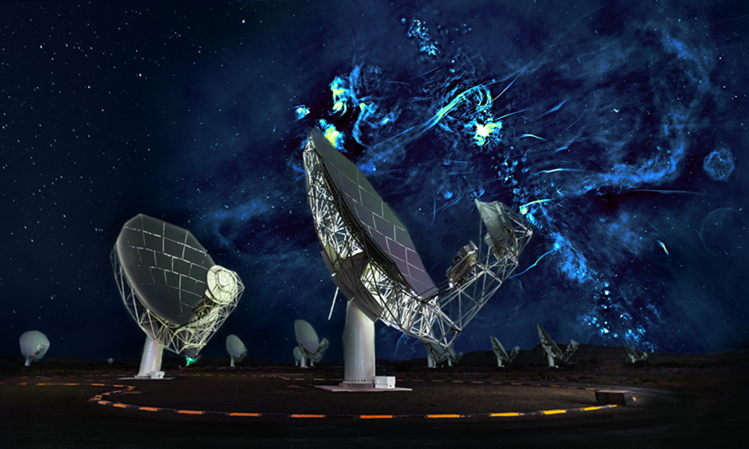
One example concerned the |Xam account of a young girl creating the Milky Way by throwing ashes into the sky. During the workshops, several participants recognised the Afrikaans expression die Hemelstraat ("the heavenly road"), but few associated it with its earlier Indigenous cosmological narrative. The expression appeared to have persisted while its original narrative context was no longer widely remembered. Figure 2 presents MeerKAT’s radio image of the Galactic Centre, revealing a region of the same night sky that San communities observed, interpreted and incorporated into their astronomical knowledge and cultural narratives over generations.
Workshop discussions also indicated that Christian beliefs influenced the interpretation of celestial phenomena. Participants frequently described traditional stories as "old beliefs" or explained them through biblical frameworks. Rather than entirely replacing earlier narratives, these interpretations often coexisted with older environmental observations and local storytelling traditions.
7 Contemporary Narratives
7.1 The Moon as Story and Environmental Knowledge
The Moon featured prominently in workshop discussions as both a storytelling motif and an environmental indicator. In Brandvlei, participants described a narrative in which a vulture collided with the Moon, explaining the markings visible on its surface. More consistently across communities, participants associated lunar halos ("moonbows") and the orientation of the waxing crescent with approaching rainfall and seasonal change. These accounts indicate that celestial observation continues to function as practical environmental knowledge rather than solely as cosmological narrative.
7.2 Venus as an Environmental Timekeeper
Narratives concerning the Morning and Evening Star showed the greatest continuity across communities. Participants consistently identified Venus as signalling the beginning and end of daily activities, recalling how parents and grandparents used its appearance to wake children and organise work. Frequently referred to as the boer se horlosie ("the farmer’s clock"), Venus continues to function as a practical timekeeper within everyday community life, closely resembling descriptions recorded by Bleek and Lloyd [1911].
7.3 Zodiacal Light and the Waterslang
Participants identified the zodiacal light, locally known as Invaltyd ("time to get started"), as another environmental indicator signalling the appropriate time to begin daily activities.
Alongside these practical interpretations, the Waterslang (Water Snake) emerged as the most widely shared narrative across all workshop locations. Although local versions differed, participants consistently described a dangerous being associated with glowing light, water, and moral caution. In Carnarvon, the story centred on a water source near the SKA, while in Brandvlei, participants instead described the Ogvoet, an ape-like being that similarly used a glowing stone to lure people into caves. Many participants related these narratives to contemporary Christian beliefs, illustrating how older Indigenous motifs continue to coexist with newer religious frameworks.
8 Discussion
The findings suggest that the transformation of San cosmological narratives is better understood as a process of cultural adaptation than one of simple cultural loss. Rather than disappearing entirely, many narratives have been reshaped through historical disruption, Christianisation, changing livelihoods, and contemporary environmental experience. This interpretation aligns with theories of cultural hybridity [Bhabha, 1994], collective memory [Connerton, 1989], and Hall’s [1990] understanding of identity as an ongoing process of negotiation. The workshops demonstrated that surviving celestial narratives are not unchanged remnants of earlier cosmologies but evolving expressions that combine older Indigenous understandings with newer religious, linguistic, and cultural influences.
For science communication, these findings reinforce a growing body of Indigenous and decolonial scholarship that understands Indigenous Knowledge Systems as living, relational, and continually evolving [Kimmerer, 2013; Langton et al., 2024; Smith, 2012; Wilson, 2008]. Rather than seeking to recover or present an "authentic" body of Indigenous knowledge, engagement is better understood as creating opportunities for communities to interpret historical narratives in relation to contemporary experience.
The workshops also illustrate the practical value of historical archives within science communication. The Bleek and Lloyd was a relevant reference point for participants to compare their own memories, experiences, and interpretations with. The limited recognition of many archival narratives demonstrates that engagement with Indigenous Knowledge Systems is less about validating historical accounts than about understanding how knowledge is retained, adapted, and reinterpreted over time.
The engagement further provides a practical illustration of Jasanoff’s [2004] concept of co-production. Scientific infrastructure, community knowledge, and local interpretation shaped one another throughout the programme. At the same time, the workshops highlighted the practical limits of co-production. Engagement remained constrained by institutional mandates, environmental legislation, funding requirements, and predefined project objectives, illustrating that recognising multiple knowledge traditions requires continual negotiation more than just simple inclusion [Mavhunga, 2017; Mignolo, 2011; Santos, 2014].
Finally, the findings demonstrate that Indigenous narratives can provide meaningful entry points for astronomy communication. Participants consistently linked celestial observation to environmental knowledge, seasonal change, daily routines, and moral storytelling, illustrating how Indigenous cosmologies can enrich public engagement with astronomy while remaining distinct from scientific explanation.
Taken together, these lessons informed the gradual refinement of the engagement approach over the course of the programme. The Dialogical Knowledge Renewal Model presented in the following section synthesises these practical lessons into a framework for engaging Indigenous Knowledge Systems within large scientific infrastructures.
9 Implications for science communication practice
The engagement programme demonstrates that science communication can extend beyond communicating scientific knowledge to creating opportunities for communities, researchers, and scientific institutions to interpret heritage, place, and science together. Within the SKA, engagement shifted the focus from documenting Indigenous knowledge to creating conditions in which historical archives, community knowledge, and contemporary astronomy could be explored collectively.
Several practical lessons emerged. First, Indigenous Knowledge Systems proved most valuable when approached as resources for shared interpretation rather than as historical artefacts or alternative scientific explanations. Second, the programme showed that large scientific infrastructures can be situated within much longer histories of human engagement with the night sky. For many participants, the SKA became part of an existing astronomical landscape rather than the beginning of astronomy in the Karoo. Third, Indigenous narratives, environmental knowledge, and cultural memory provided culturally meaningful entry points for astronomy communication, particularly when combined with direct observation of the night sky.
The programme also generated tangible outcomes beyond the workshops. It contributed to the development of astro-tourism initiatives, the training of local astro-guides, educational resources, heritage publications, Indigenous Knowledge initiatives, and broader science communication programmes undertaken by SARAO and its partners. Equally important, it encouraged renewed discussion of Indigenous stories within communities, supported intergenerational knowledge exchange, and reinforced the importance of returning research findings through accessible publications, community workshops, and ongoing engagement.
Comparison with the ethnobotanical study of Van Wyk and De Beer [2022] further suggests that the persistence of Indigenous Knowledge Systems is closely linked to their continued social relevance. Whereas medicinal plant knowledge remained widely practised because of its direct everyday value, many cosmological narratives had become fragmented or transformed. For science communication practitioners, this highlights the importance of understanding the social and cultural contexts within which knowledge is maintained, adapted, and communicated.
These practical experiences progressively shaped the engagement approach over the course of the programme and informed the development of the Dialogical Knowledge Renewal Model presented in the following section.
10 A Dialogical Knowledge Renewal Model for Science Communication
The engagement programme demonstrated that Indigenous astronomical knowledge in the Central Karoo has not disappeared but persists in fragmented, transformed, and contextually embedded forms among descendants of San communities. Describing science communication as the "reintroduction" or "recovery" of Indigenous astronomy, therefore, misrepresents the nature of the engagement. Rather than restoring a lost body of knowledge, the programme showed that Indigenous astronomy continues to evolve through contemporary cultural, social, and environmental contexts.
Over approximately a decade of engagement, a set of recurring practice principles emerged and was progressively refined through successive workshops, community interactions, and science communication activities. Collectively, these principles form what is conceptualised here as the Dialogical Knowledge Renewal Model (Figure 3). More than representing a methodology developed after the project, the model synthesises the practical lessons that guided and evolved throughout the engagement programme.
The model conceptualises science communication as an iterative process in which historical archives, community knowledge, and contemporary science continually inform one another through dialogue, reciprocity, shared interpretation, and the return of knowledge to communities. Although developed within the context of the Square Kilometre Array, the model may provide a transferable framework for engaging Indigenous Knowledge Systems within other large scientific infrastructures.
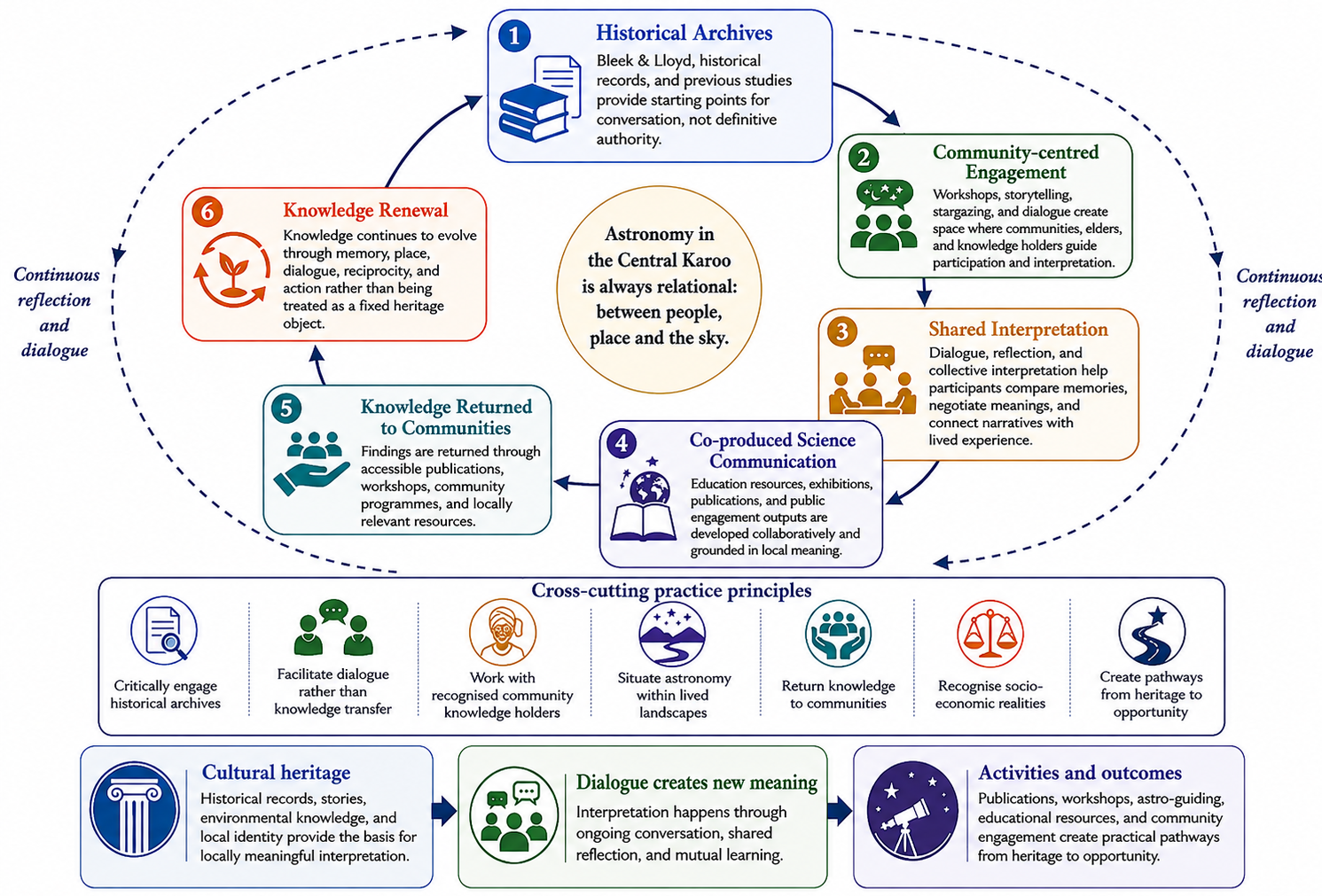
The model is operationalised through seven interconnected practice principles.
-
Critically engage historical archives
Historical archives such as the Bleek and Lloyd collection should be approached as historically situated resources rather than definitive accounts of living Indigenous knowledge. Their value lies in providing points of departure for community interpretation and discussion.
-
Facilitate dialogue rather than knowledge transfer
Science communication should prioritise shared interpretation over one-way dissemination. Combining archival narratives, storytelling, visual prompts, and shared observation creates opportunities for communities to compare memories, negotiate meanings, and interpret astronomical knowledge together.
-
Work with recognised community knowledge holders
Meaningful engagement depends upon recognising the authority of community-identified knowledge holders. Engagement methods should create space for elders and local practitioners to guide discussions through their own experiences, interpretations, and cultural perspectives.
-
Situate astronomy within lived landscapes
Astronomy is most meaningful when experienced within the landscape itself. Stargazing, storytelling, and environmental observation allow communities to connect celestial phenomena with place, memory, and everyday life.
-
Return knowledge to communities
Engagement should extend beyond academic publication. Returning knowledge through accessible publications, educational resources, exhibitions, workshops, and community programmes strengthens reciprocity, accessibility, and long-term relationships.
-
Recognise socio-economic realities
The persistence of Indigenous Knowledge Systems is influenced by their contemporary social relevance. Science communication should therefore engage with communities’ educational, cultural, and economic priorities rather than treating Indigenous knowledge solely as historical heritage.
-
Create pathways from heritage to opportunity
Engagement should create opportunities for communities to participate in science. Within the SKA programme, this included astro-tourism, astro-guide training, educational resources, Indigenous Knowledge publications, and broader community participation in astronomy, demonstrating how cultural heritage can contribute to education, employment, and public engagement.
Collectively, these principles position science communication as a process of knowledge renewal, and not of knowledge recovery. They recognise historical archives, community knowledge, and contemporary science as complementary resources that acquire meaning through ongoing engagement. Within the SKA area, this reframed astronomy not as something introduced to the Karoo, but as the latest chapter in a much longer tradition of observing, interpreting, and finding meaning in the night sky.
11 Conclusion
This practice insight demonstrates how engagement with Indigenous Knowledge Systems can unfold within a large international scientific infrastructure. Rather than revealing Indigenous astronomy as a body of knowledge to be recovered, the study shows how historical archives, community memory, and contemporary scientific practice can be brought into dialogue through sustained science communication.
Working within the regulatory and institutional context of the Square Kilometre Array highlighted both the opportunities and the constraints of engaging Indigenous Knowledge Systems in practice. Over approximately a decade of implementation, the engagement approach evolved through ongoing interaction with communities, ultimately informing the Dialogical Knowledge Renewal Model presented in this paper. Although developed within the SKA, the model may provide a practical framework for science communication initiatives involving Indigenous Knowledge Systems in other scientific and cultural settings.
More broadly, the study reinforces that engagement should not end with documentation or publication. Returning knowledge to communities, recognising local authority, and sustaining dialogue are essential components of ethical science communication.
Ultimately, the contribution of this practice insight lies in demonstrating that science communication is not simply about communicating scientific knowledge, but about creating conditions in which different knowledge traditions can be interpreted together while respecting the integrity of each. Within the Karoo, this meant recognising that the SKA did not bring astronomy to the landscape, but became part of a much longer human tradition of observing, interpreting, and finding meaning in the night sky.
References
-
Battiste, M. (2013). Decolonising education: Nourishing the learning spirit. UBC Press. https://www.ubcpress.ca/decolonizing-education
-
Bhabha, H. K. (1994). The location of culture. Routledge. https://www.routledge.com/The-Location-of-Culture/Bhabha/p/book/9780415336390
-
Binneman, A., & Davis, C. (2020). Star stories: using indigenous knowledge for stakeholder engagement. Communitas, 25, 1–17. https://doi.org/10.38140/com.v25i.5047
-
Binneman, A., & Davis, C. (2021). From Management to Engagement: How South Africa’s Square Kilometer Array Project Transformed Its Interactions With Stakeholder Groups. In Space Science and Public Engagement (pp. 221–243). Elsevier. https://doi.org/10.1016/b978-0-12-817390-9.00006-3
-
Bleek, W. H. I., & Lloyd, L. C. (1911). Specimens of Bushman folklore. George Allen.
-
Chilisa, B. (2019). Indigenous research methodologies (2nd ed.). SAGE Publications. https://uk.sagepub.com/en-gb/eur/indigenous-research-methodologies/book241776
-
Chinigò, D., & Walker, C. (2020). Science, astronomy, and sacrifice zones: development trade-offs, and the Square Kilometre Array (SKA) radio telescope project in South Africa. Social Dynamics, 46(3), 391–413. https://doi.org/10.1080/02533952.2020.1850626
-
Connerton, P. (1989). How Societies Remember. Cambridge University Press. https://doi.org/10.1017/cbo9780511628061
-
Deacon, J. (1996). A tale of two families: The Wilmans of the Northern Cape and the Bleek and Lloyd collection. In P. Skotnes (Ed.), Miscast: Negotiating the presence of the Bushmen. University of Cape Town Press.
-
Hall, S. (1990). Cultural identity and diaspora. Framework, 36, 222–237.
-
Holbrook, J., & de Prada-Samper, J. M. (2016). Xam skylore of the Karoo Desert, South Africa. Mediterranean Archaeology and Archaeometry, 16, 81–86. https://www.maajournal.com/index.php/maa/article/view/618
-
Holbrook, J. C., Medupe, R., & Urama, J. O. (Eds.). (2008). African Cultural Astronomy: Current Archaeoastronomy and Ethnoastronomy research in Africa. Springer Netherlands. https://doi.org/10.1007/978-1-4020-6639-9
-
Jasanoff, S. (Ed.). (2004). States of knowledge: The co-production of science and the social order. Routledge.
-
Kimmerer, R. W. (2013). Braiding sweetgrass: Indigenous wisdom, scientific knowledge and the teachings of plants. Milkweed Editions.
-
Koitsiwe, M. (2019). African Indigenous astronomy of Batswana in Botswana and South Africa [Doctoral dissertation]. University of South Africa. UNISA Institutional Repository. http://hdl.handle.net/10394/37013
-
Langton, M., Corn, A., & Curkpatrick, S. (Eds.). (2024). Indigenous knowledge: Australian perspectives. Melbourne University Press.
-
Mavhunga, C. C. (Ed.). (2017). What do science, technology, and innovation mean from Africa? https://mitpress.mit.edu/9780262533904/what-do-science-technology-and-innovation-mean-from-africa/
-
Mignolo, W. D. (2011). The Darker Side of Western Modernity: Global Futures, Decolonial Options. Duke University Press. https://doi.org/10.1215/9780822394501
-
National Research Foundation, & South African Radio Astronomy Observatory. (2018). Strategic environmental impact assessment for the SKA Phase 1 in South Africa. National Research Foundation.
-
Ndlovu-Gatsheni, S. J. (2018). Epistemic freedom in Africa: Deprovincialization and decolonization. Routledge. https://www.routledge.com/Epistemic-Freedom-in-Africa-Deprovincialization-and-Decolonization/Ndlovu-Gatsheni/p/book/9781138588592
-
Odora Hoppers, C. A., & Richards, H. (2011). Rethinking thinking: Modernity’s “other” and the transformation of the university. UNISA Press.
-
Ricoeur, P. (2004). Memory, history, forgetting. University of Chicago Press.
-
Ruggles, C. L. N. (Ed.). (2015). Handbook of Archaeoastronomy and Ethnoastronomy. Springer New York. https://doi.org/10.1007/978-1-4614-6141-8
-
Santos, B. (2014). Epistemologies of the South: Justice against epistemicide. Routledge. https://www.routledge.com/Epistemologies-of-the-South-Justice-Against-Epistemicide/Santos/p/book/9781612055459
-
Skotnes, P. (Ed.). (1996). Miscast: Negotiating the presence of the Bushmen. University of Cape Town Press.
-
Smith, L. T. (2012). Decolonizing methodologies: Research and indigenous peoples (2nd ed.). Zed Books.
-
Twidle, H. (2019). Impossible Images: Radio Astronomy, the Square Kilometre Array and the Art of Seeing. Journal of Southern African Studies, 45(4), 767–790. https://doi.org/10.1080/03057070.2019.1632052
-
Van Wyk, B.-E., & De Beer, J. (2022). Medicinal and edible plants of the Bushmenland. Briza Publications.
-
Walker, C. (2019). Cosmopolitan Karoo: Land, Space and Place in the Shadow of the Square Kilometre Array. Journal of Southern African Studies, 45(4), 641–662. https://doi.org/10.1080/03057070.2019.1645493
-
Wilson, S. (2008). Research is ceremony: Indigenous research methods. Fernwood Publishing. https://fernwoodpublishing.ca/books/research-is-ceremony-shawn-wilson
About the author
Dr Anton Binneman is a Research Associate for the UJ Department of Strategic Communication. By profession, Anton is the Science Communication and Engaged Research Manager at the South African Agency for Science and Technology Advancement. Before that, he was the Acting Head of Communication at SARAO whilst being the Communication and Science Engagement Manager for the South African Radio Astronomy Observatory (NRF|SARAO). Currently, Anton specialises in strategic stakeholder engagement in science and science infrastructure projects; however, he has over 10 years’ experience in strategic stakeholder communication and engagement, communication research, and public relations management. Some of his other strengths and interests are rooted in business awareness, design thinking, media management, Science Engagement, IKS, and communications, which enable him to effectively promote a positive organisational brand whilst remaining sensitive to both stakeholders and the broader society.
E-mail: drbinneman@gmail.com