
1 Introduction
Effective communication between university-based researchers and broader audiences is crucial for fostering public understanding of science, promoting public engagement with academic research, and countering negative perceptions of researchers [Trench & Miller, 2012; Weingart & Guenther, 2016]. In terms of fostering public understanding, such communication provides a potential means for bridging divides between researchers and the public on topics ranging from climate change to vaccines [Kahan, 2013; Nisbet & Scheufele, 2009]. In regard to promoting engagement, two-way exchanges between researchers and laypeople offer avenues for wider participation as well as improved research [Besley & Dudo, 2022b]. In terms of challenging negative perceptions, efforts by diverse communicators to share their research with broader audiences can help to counter stereotypes of scientists and encourage greater inclusion within scientific communities [Jarreau et al., 2019; Steinke & Duncan, 2023].
At the same time, university-based researchers confront an array of challenges in communicating with broader audiences. At the societal level, developments in many nations — including the United States — have amplified financial and political pressures on researchers [Calo & Starbird, 2024]. At the institutional level, researchers may face a lack of support and infrastructure for broader engagement [Besley & Dudo, 2022a]. In addition, they may face individual-level obstacles [Dudo et al., 2021], including low communication self-efficacy [Besley, Dudo & Yuan, 2018; Copple et al., 2020; Fähnrich et al., 2021; Rodgers et al., 2020; Stylinski et al., 2018; Swords et al., 2023], negative beliefs about engagement [Besley et al., 2015; Copple et al., 2020], and unwillingness to engage with broader audiences [Copple et al., 2020; Stylinski et al., 2018].
To address the communication needs of researchers across a range of settings, scholars and practitioners have developed a host of training programs for fostering beliefs, skills, and intentions that can facilitate engagement with broader audiences [Baram-Tsabari & Lewenstein, 2017; Besley & Dudo, 2022b; Clarkson et al., 2018; Fähnrich et al., 2021; Rodgers et al., 2018]. Though such programs often rely on anecdotal evidence to assess outcomes [Dudo et al., 2021; Vickery et al., 2023], a growing body of research has tested the effects of specific programs. In particular, previous studies suggest that participation in communication training programs can be associated with key beliefs about science communication [Clarkson et al., 2018; Copple et al., 2020; Fick et al., 2025; Rodgers et al., 2020; Silva & Bultitude, 2009; Stylinski et al., 2018; Swords et al., 2023].
The present study builds on and extends this research by using data from a pretest-posttest intervention study to analyze how participants’ beliefs and intentions shifted from the start to the end of a university-based communication training program for graduate students, postdoctoral researchers, and faculty (including, but not limited to, scientists). Specifically, the study provides new tests of how such programs can foster communication self-efficacy, positive beliefs about engagement, and willingness to communicate about one’s research. In doing so, it draws on theories of communicative behavior [Ajzen, 1991; Montaño & Kasprzyk, 2015]. The results highlight potential benefits of and next steps in developing communication training programs for university-based researchers.
2 Self-efficacy, beliefs about engagement, and willingness to communicate research
Following previous research on science communication training programs [Akin et al., 2021; Besley et al., 2019; Copple et al., 2020; Parrella et al., 2022; Poliakoff & Webb, 2007], the present study draws on the Theory of Planned Behavior [TPB; Ajzen, 1991] and the Integrated Behavioral Model [IBM; Montaño & Kasprzyk, 2015] to conceptualize the potential outcomes of such programs. In particular, these frameworks highlight the roles of personal agency (including self-efficacy beliefs), beliefs about benefits and risks, and perceived norms as foundations for behavioral intentions and, ultimately, future behavior. Given the design of the program examined here, the present study focuses on self-efficacy, beliefs about engagement, and willingness to communicate about one’s research as outcomes while acknowledging that other outcomes, such as norms and goal-centered communication [Besley et al., 2019; Lewenstein & Baram-Tsabari, 2022] can also play key roles in research communication.
2.1 Fostering communication self-efficacy
The TPB and IBM point to self-efficacy as a key factor shaping communication motivations and behaviors [Ajzen, 1991; Akin et al., 2021; Besley et al., 2019; Copple et al., 2020; Poliakoff & Webb, 2007]. Looking specifically at science communication, low self-efficacy remains a persistent barrier for scientists [Stylinski et al., 2018] whereas greater self-efficacy may bolster intentions to communicate along with effectiveness at doing so [Clarkson et al., 2018; Murphy & Kelp, 2023; Rodgers et al., 2020]. Self-confidence in using specific tools such as public presentations, press releases, media interviews, podcasts, and social media [see Autzen, 2014; Brewer & Ley, 2017; Brossard & Scheufele, 2022; Jarreau et al., 2019; Yuan et al., 2022] can also help researchers effectively select and use tools that meet their communication goals [Clarkson et al., 2018; Silva & Bultitude, 2009; Swords et al., 2023].
Previous studies suggest that training programs can bolster communication self-efficacy among researchers [Copple et al., 2020; Fick et al., 2025; Rodgers et al., 2020; Stylinski et al., 2018]. In addition, studies have found that training programs can bolster self-confidence in using specific communication tools such as public presentations [Clarkson et al., 2018; Silva & Bultitude, 2009; Swords et al., 2023]. Building on these findings, the present study tests the following hypothesis:
- H1:
-
Participants in a university-based research communication training program will report greater communication self-efficacy after completing the program.
2.2 Fostering positive beliefs about engagement
The IBM also emphasizes how risk and benefit beliefs can shape behavioral intentions [Montaño & Kasprzyk, 2015]. Given that many scientists express concerns about the effectiveness of engagement with broader audiences, positive beliefs about engagement may strengthen scientists’ intentions to communicate [Besley et al., 2015, 2019]. However, Copple et al. [2020] found that participation in a communication training program was not significantly associated with such beliefs among university-based scientists. In light of this finding, the present study asks:
- RQ1:
-
Will participants in a university-based research communication training program report more positive beliefs about engagement after completing the program?
2.3 Bolstering willingness to communicate about research
Consistent with accounts of science communication rooted in the TPB and IBM [Akin et al., 2021; Besley et al., 2019; Copple et al., 2020], studies have found that both self-efficacy [Besley et al., 2013; Poliakoff & Webb, 2007] and beliefs about risks and benefits of communication [Besley, Dudo, Yuan & Lawrence, 2018] can predict willingness to communicate. Furthermore, previous assessments of science communication training programs have found that participation in such programs can increase researchers’ intentions to engage with broader publics [Stylinski et al., 2018; Copple et al., 2020; Swords et al., 2023]. Building on these findings, the current study tests the following hypothesis:
- H2:
-
Participants in a research communication training program will report greater willingness to communicate after completing the program.
3 The training program
The program examined in this study was designed by communications and marketing staff at a public research university in the United States, with the assistance of the present study’s authors, academic technology services staff, and faculty from a center for science, ethics, and public policy. To assess the communication goals of potential participants, the authors conducted an online interest survey from 28 September to 16 October 2023 (for details, see the online supplementary appendix). The university’s research office recruited respondents by sending emails to all graduate students, postdoctoral researchers, and faculty at the institution. Participation was voluntary, and no incentives were offered. The training development team used the results from the completed surveys (N = 186) to help select topics for the program.
In late 2023 and early 2024, the development team designed a program consisting of an optional in-person introductory event, a series of online modules, and a capstone project (Figure 1). Participation in the program was voluntary. To complete the training, participants were required to finish seven modules. Each module was designed to take one to two hours. All but one were offered through an online learning management system and featured videos with accompanying text notes.
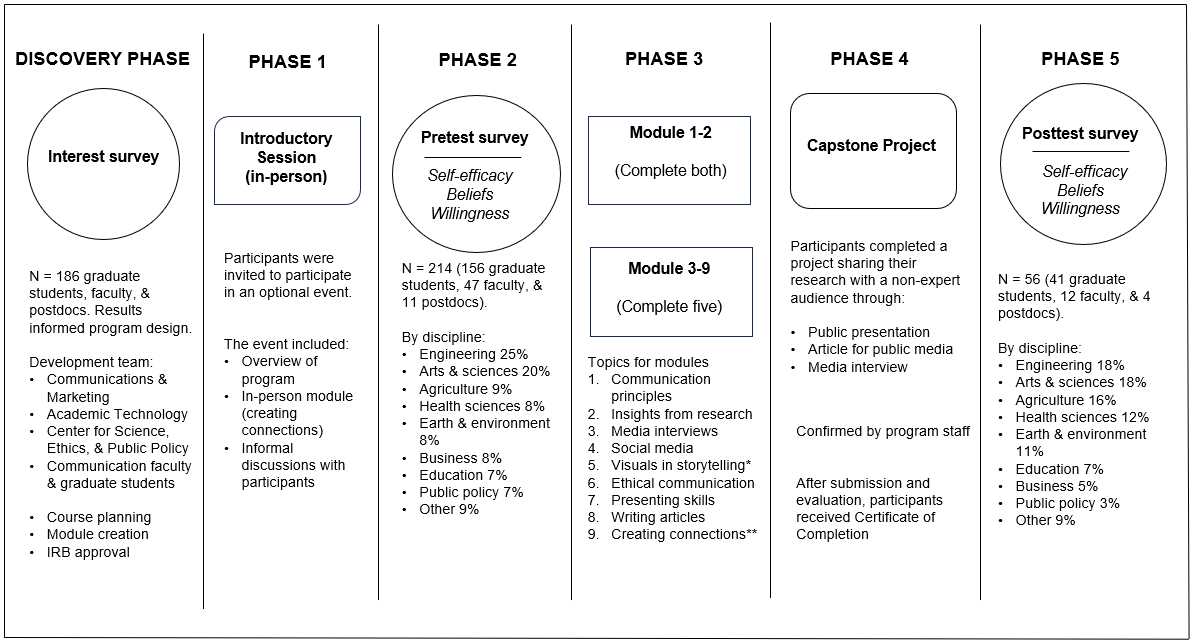
∗ Available only for the second cohort.
∗∗ In-person module; available only for the first cohort.
The first module, which was developed and presented by members of the university’s communications and marketing staff, provided an overview of research communication principles and was required. The second module, which the authors developed and presented, discussed insights from research on science communication and was also required. Additional modules addressed media interviews, social media, the use of visuals in storytelling, principles of ethical communication, presentation and speaking skills, writing media articles, and creating connections with audiences. Topic selection reflected the expertise of the program’s instructors along with the interest survey results.
Once participants completed seven modules, they were required to finish a capstone project in which they used skills developed through the program to share their research in a public forum with a non-expert audience. This could take the form of a public presentation, an article for public media, or a published media interview. On fulfilling the capstone requirement, participants received a certification of completion.
4 Methods
Given that all participants were invited to complete the program rather than being randomly assigned to conditions, the study used a pretest-posttest quasi-experimental design rather than a true experimental design. The study’s design limits the extent to which one can draw causal inferences from the results — a point the conclusion revisits.
4.1 Pretest survey
The university’s research office advertised the program through emails to all graduate students, postdoctoral researchers, and faculty at the institution. Participants were told they would receive a certificate of completion upon finishing the program; beyond this, no incentives were offered. Each participant completed a pretest at the beginning of the program. Between 5 April and 17 April 2024, 134 participants in the program’s first cohort completed this pretest. Another 80 participants in the program’s second cohort completed the pretest between 23 September and 10 October 2024. Of the 214 total pretest participants, 73% were graduate students, 22% were faculty members, and 5% were postdocs.
The pretest survey included two Likert items measuring communication self-efficacy beliefs [“I am skilled at discussing my research with broader audiences”, “I have a hard time talking about my research”; strongly disagree = 1, strongly agree = 5; adapted from Besley et al., 2015; Copple et al., 2020] along with a set of items measuring self-confidence in using seven communication tools “to convey information about research” [not confident at all = 1, very confident = 5; adapted from Rodgers et al., 2020]: visuals such as infographics and charts; videos or podcasts; press releases; articles for magazines or websites; media interviews; public presentations such as TED talks; and social media such as Instagram, Facebook, and YouTube. The survey also included two Likert items measuring beliefs about engagement [“I think public engagement by researchers can make a difference in society”, “I think public engagement activity is probably a waste of researchers’ time”; adapted from Besley et al., 2015; Copple et al., 2020] and one Likert item measuring willingness to communicate with broader audiences [“I would be willing to discuss my research with broader audiences”; adapted from Copple et al., 2020].
4.2 Posttest survey
All participants who finished the program also completed a posttest. Between 28 May and 1 July 2024, 37 participants (28% of the initial first cohort) completed the training and posttest. Between 8 January and 17 March 2025, an additional 19 participants completed the training and posttest (24% of the initial second cohort). In all, 56 participants completed both the pretest and posttest whereas 158 completed the pretest but not the posttest, for an overall attrition rate of 74%. Of the pretest-posttest participants, 73% were graduate students, 21% were faculty members, and 5% were postdocs (results do not sum to 100% due to rounding). The median time between completing the pretest at the start of the program and the posttest at its conclusion was 60 days. Attrition did not significantly vary across roles (student, faculty, or postdoc) or disciplines. Given that the results for the study’s hypotheses and research question were largely similar across cohorts, the analyses below used the pooled sample of first and second cohort responses.
5 Results
A series of independent samples t-tests tested for attrition bias. As Table 1 shows, participants who did not complete the training (first column of results) and those who did complete it (second column) varied little in terms of their pretest responses to the five Likert items. Compared to “pretest without posttest” participants, “pretest with posttest” participants reported significantly lower pretest self-confidence for using visuals and articles (p ≤ .05 for each) but not for using the other five communication tools.
|
Pretest w/out posttest (1) |
Pretest with posttest (2) |
Posttest (3) |
t (1 vs. 2) [Cohen’s d] |
t (2 vs. 3) [Cohen’s d] |
|
| Self-efficacy
| |||||
|
Skilled at discussing my research |
3.12 (0.90) |
3.09 (0.75) |
4.13 (0.63) |
-0.23 [-0.04] |
9.33∗∗[1.25] |
|
Hard time talking about my research |
3.10 (1.09) |
3.07 (0.99) |
2.27 (1.07) |
-0.18 [-0.03] |
-4.36∗∗[-0.58] |
|
Confidence in using visuals |
3.75 (0.99) |
3.34 (1.00) |
4.43 (0.68) |
-2.69∗[-0.42] |
8.19∗∗[1.09] |
|
Confidence in using videos or podcasts |
2.70 (1.14) |
2.34 (0.96) |
3.50 (0.83) |
-2.09 [-0.33] |
9.05∗∗[1.21] |
|
Confidence in using press releases |
2.54 (1.14) |
2.23 (1.03) |
3.52 (1.01) |
-1.77 [-0.27] |
8.35∗∗[1.12] |
|
Confidence in using articles |
3.11 (1.08) |
2.64 (1.05) |
3.88 (0.83) |
-2.82∗[-0.44] |
8.29∗∗[1.11] |
|
Confidence in using media interviews |
2.44 (1.20) |
2.29 (1.11) |
3.54 (0.97) |
-0.83 [-0.13] |
7.73∗∗[1.03] |
|
Confidence in using public presentations |
2.73 (1.23) |
2.52 (1.11) |
3.77 (0.97) |
-1.16 [-0.18] |
7.50∗∗[1.00] |
|
Confidence in using social media |
2.94 (1.29) |
2.73 (1.02) |
3.84 (1.09) |
-1.08 [-0.17] |
6.90∗∗[0.92] |
| Beliefs about engagement
| |||||
|
Engagement can make a difference |
4.60 (0.66) |
4.79 (0.49) |
4.91 (0.29) |
1.92 [0.30] |
1.85 [0.25] |
|
Engagement is probably a waste of time |
1.48 (0.85) |
1.36 (0.82) |
1.25 (0.82) |
-0.95 [-0.15] |
-0.93 [-0.12] |
| Behavioral intentions
| |||||
|
Willing to discuss my research |
4.49 (0.82) |
4.59 (0.78) |
4.84 (0.42) |
0.81 [0.13] |
2.70∗∗[0.36] |
|
N |
158 |
56 |
56 |
214 |
56 |
| Notes:
table
entries
are
means
with
standard
deviations
in
parentheses.
Pretest
without
posttest
vs. pretest
with
posttest
results
are
based
on
independent
samples
t-tests
(df = 212).
Pretest
vs. posttest
results
are
based
on
paired
samples
t-tests
(df = 55).
∗p ≤.05;
∗∗p ≤.01
(with
Benjamini-Hochberg
corrections). | |||||
The main analysis used a series of paired samples t-tests to examine whether pretest and posttest scores differed among participants who completed the training. As Table 1 reports, the analysis found significant differences between pretest scores (second column of results) and posttest scores (third column) on both Likert measures for communication self-efficacy. When asked whether they were skilled at discussing their research with broader audiences, participants reported greater agreement in the posttest than in the pretest (p ≤ .01). When asked whether they had a hard time talking about their research, they reported greater disagreement in the posttest than in the pretest (p ≤ .01). Both results are consistent with H1, which posited that self-efficacy would be greater after the training than before. The difference on the first item was large by conventional standards [d = 1.25; Cohen, 1992], whereas the difference on the second item fell between medium and large (d = -0.58)
Providing further support for H1, the pretest-posttest comparisons yielded consistent results across all seven items measuring self-confidence in using specific tools to convey information about research. For each comparison, posttest scores were significantly greater than pretest scores (p ≤ .01). Furthermore, these shifts were substantively large, with effect sizes ranging from 0.92 to 1.21. In short, participants came away from the training program more self-confident than when they entered it.
By contrast, beliefs about engagement shifted little from the pretest to the posttest (RQ1). Agreement that public engagement by researchers can make a difference in society did not differ significantly from the pretest to the posttest; neither did agreement that public engagement is probably a waste of researchers’ time. However, it is possible that ceiling and floor effects [Wang et al., 2008] masked potential differences here. The pretest mean for the first item was 4.79 on a scale where 5 was the maximum, leaving relatively little room for an increase. The pretest mean on the second item was 1.36, where 1 was the minimum; here, then, there was relatively little room for a decrease.
Turning to behavioral intentions, participants’ willingness to discuss their research was significantly greater after the training than before (p ≤ .01) — a pattern consistent with H2. In terms of magnitude, the difference between pretest and posttest scores fell between conventional thresholds for small and medium effect sizes (d = 0.36). However, this shift may have been attenuated by a ceiling effect: among “pretest with posttest” participants, pretest willingness was 4.59 on a scale where 5 was the maximum.
6 Discussion
The results from this pretest-posttest intervention study show that participants in a university-based research communication training program reported greater communication self-efficacy and willingness to communicate about their research after completing the program. As such, the study’s findings dovetail with previous arguments, rooted in the Theory of Planned Behavior and the Integrated Behavioral Model [Akin et al., 2021; Besley et al., 2019; Copple et al., 2020; Parrella et al., 2022; Poliakoff & Webb, 2007], regarding how communication training can foster individual-level foundations for effective engagement with broader audiences on the part of researchers [Clarkson et al., 2018; Copple et al., 2020; Fick et al., 2025; Rodgers et al., 2020; Silva & Bultitude, 2009; Stylinski et al., 2018; Swords et al., 2023]. On the other hand, the study yielded little evidence that the training program bolstered positive beliefs about engagement. Though the results for such beliefs may partly reflect floor and ceiling effects, they also parallel the findings of a previous study [Copple et al., 2020].
In weighing this study’s findings, it is important to consider several potential limitations of its methods. One such limitation is its use of a quasi-experimental design that precludes strong causal inferences. Accordingly, future studies could conduct more rigorous tests of training effects. One approach here would be to incorporate controls for additional exogenous factors; another would be to conduct randomized experiments.
A related limitation revolves around the potential for attrition bias in the study’s results, particularly given the substantial attrition rate. Though comparisons between the pretest scores of “pretest with posttest” participants and “pretest without posttest” participants revealed only two significant differences across twelve measures, future research could explore the causes and consequences of attrition in research communication training programs. Furthermore, future training efforts could seek to reduce attrition and broaden participation through incentives such as financial compensation at multiple phases of the program (interest survey, pretest, and posttest) as well as course credit for graduate student participants.
In terms of sampling, one key limitation involves the small sample size, which limited the power of the statistical tests. Many of the shifts observed in this study were sizable enough to detect even with limited power, but additional studies with larger samples might also capture subtler effects. Moreover, the sample consisted of self-selected participants in one training program at one university in the United States. With this in mind, future research could test whether the present study’s findings generalize to other programs, institutions, and populations.
A final limitation of the present study revolves around its focus on three self-reported outcomes: self-efficacy, beliefs about engagement, and willingness to communicate. Previous research indicates that these outcomes can play important roles in research communication [Besley et al., 2013], but other outcomes such as norms and goal-centered communication can do so as well [Besley et al., 2019; Lewenstein & Baram-Tsabari, 2022]. Thus, future studies could explore the effects of university-based research communication training programs on a broader range of outcomes, including independently-assessed communication skills [Rubega et al., 2021]. In addition, such research could examine how the outcomes examined here predict actual behaviors and use qualitative approaches to reveal richer insights.
More broadly, it is important to consider the roles of individual-level factors in the context of institutional and infrastructural challenges confronting university-based researchers. In the face of increasing financial pressures and growing threats to academic freedom, many researchers may be wary of engaging with broader audiences. Thus, facilitating public engagement by university researchers may require institutions to provide greater support in terms of both resources for communication and protection from potential costs of communication (such as doxxing, harassment, and threats to funding or employment status).
Within these caveats, the present study’s findings contribute new evidence that training programs can help to foster beliefs and intentions facilitating effective communication by university-based researchers across a range of disciplines and roles. By bolstering self-efficacy and willingness to communicate among graduate students, faculty, and postdocs, such programs may enhance researchers’ efforts at promoting public understanding of, engagement with, and support for research in an increasingly fraught social and political environment. Given how participants in the program described here entered it with largely positive beliefs about engagement, one next step in terms of program development could involve outreach to researchers with less positive beliefs about engagement. Building on the TPB and IBM, another potential step could be to expand this program to foster other beliefs, norms, attitudes, and behaviors that facilitate effective research communication.
References
-
Ajzen, I. (1991). The theory of planned behavior. Organizational Behavior and Human Decision Processes, 50(2), 179–211. https://doi.org/10.1016/0749-5978(91)90020-t
-
Akin, H., Rodgers, S., & Schultz, J. (2021). Science communication training as information seeking and processing: a theoretical approach to training early-career scientists. JCOM, 20(05), A06. https://doi.org/10.22323/2.20050206
-
Autzen, C. (2014). Press releases — the new trend in science communication. JCOM, 13(03), C02. https://doi.org/10.22323/2.13030302
-
Baram-Tsabari, A., & Lewenstein, B. V. (2017). Science communication training: what are we trying to teach? International Journal of Science Education, Part B, 7(3), 285–300. https://doi.org/10.1080/21548455.2017.1303756
-
Besley, J. C., & Dudo, A. (2022a). Perceived successfulness of public engagement at research institutes. In M. Entradas & M. W. Bauer (Eds.), Public communication of research universities: ‘arms race’ for visibility or science substance? (pp. 79–96). Routledge. https://doi.org/10.4324/9781003027133-7
-
Besley, J. C., & Dudo, A. (2022b). Strategic science communication: a guide to setting the right objectives for more effective public engagement. Johns Hopkins University Press. https://doi.org/10.56021/9781421444215
-
Besley, J. C., Dudo, A., & Storksdieck, M. (2015). Scientists’ views about communication training. Journal of Research in Science Teaching, 52(2), 199–220. https://doi.org/10.1002/tea.21186
-
Besley, J. C., Dudo, A., & Yuan, S. (2018). Scientists’ views about communication objectives. Public Understanding of Science, 27(6), 708–730. https://doi.org/10.1177/0963662517728478
-
Besley, J. C., Dudo, A., Yuan, S., & Lawrence, F. (2018). Understanding scientists’ willingness to engage. Science Communication, 40(5), 559–590. https://doi.org/10.1177/1075547018786561
-
Besley, J. C., Oh, S. H., & Nisbet, M. (2013). Predicting scientists’ participation in public life. Public Understanding of Science, 22(8), 971–987. https://doi.org/10.1177/0963662512459315
-
Besley, J. C., O’Hara, K., & Dudo, A. (2019). Strategic science communication as planned behavior: understanding scientists’ willingness to choose specific tactics. PLoS ONE, 14(10), e0224039. https://doi.org/10.1371/journal.pone.0224039
-
Brewer, P. R., & Ley, B. L. (2017). “Where my ladies at?”: online videos, gender, and science attitudes among university students. International Journal of Gender, Science and Technology, 9(3), 278–297. https://web.archive.org/web/20180420232201id_/http://genderandset.open.ac.uk/index.php/genderandset/article/viewFile/518/881
-
Brossard, D., & Scheufele, D. A. (2022). The chronic growing pains of communicating science online. Science, 375(6581), 613–614. https://doi.org/10.1126/science.abo0668
-
Calo, R., & Starbird, K. (2024). American academic freedom is in peril. Science, 385(6704), 7. https://doi.org/10.1126/science.adr3820
-
Clarkson, M. D., Houghton, J., Chen, W., & Rohde, J. (2018). Speaking about science: a student-led training program improves graduate students’ skills in public communication. JCOM, 17(02), A05. https://doi.org/10.22323/2.17020205
-
Cohen, J. (1992). A power primer. Psychological Bulletin, 112(1), 155–159. https://doi.org/10.1037/0033-2909.112.1.155
-
Copple, J., Bennett, N., Dudo, A., Moon, W.-K., Newman, T. P., Besley, J., Leavey, N., Lindenfeld, L., & Volpe, C. (2020). Contribution of training to scientists’ public engagement intentions: a test of indirect relationships using parallel multiple mediation. Science Communication, 42(4), 508–537. https://doi.org/10.1177/1075547020943594
-
Dudo, A., Besley, J. C., & Yuan, S. (2021). Science communication training in North America: preparing whom to do what with what effect? Science Communication, 43(1), 33–63. https://doi.org/10.1177/1075547020960138
-
Fähnrich, B., Wilkinson, C., Weitkamp, E., Heintz, L., Ridgway, A., & Milani, E. (2021). Rethinking science communication education and training: towards a competence model for science communication. Frontiers in Communication, 6, 795198. https://doi.org/10.3389/fcomm.2021.795198
-
Fick, J., Hendriks, F., & Thies, B. (2025). How to talk about science in ways that are comprehensible and interesting? Evaluation of an evidence-based science communication training program for graduate students. Frontiers in Education, 10, 1558203. https://doi.org/10.3389/feduc.2025.1558203
-
Jarreau, P. B., Cancellare, I. A., Carmichael, B. J., Porter, L., Toker, D., & Yammine, S. Z. (2019). Using selfies to challenge public stereotypes of scientists. PLoS ONE, 14(5), e0216625. https://doi.org/10.1371/journal.pone.0216625
-
Kahan, D. M. (2013). A risky science communication environment for vaccines. Science, 342(6154), 53–54. https://doi.org/10.1126/science.1245724
-
Lewenstein, B. V., & Baram-Tsabari, A. (2022). How should we organize science communication trainings to achieve competencies? International Journal of Science Education, Part B, 12(4), 289–308. https://doi.org/10.1080/21548455.2022.2136985
-
Montaño, D. E., & Kasprzyk, D. (2015). Theory of reasoned action, theory of planned behavior, and the integrated behavioral model. In K. Glanz, B. K. Rimer & K. Viswanath (Eds.), Health behavior: theory, research, and practice (5th ed., pp. 95–124). Jossey-Bass.
-
Murphy, K. M., & Kelp, N. C. (2023). Undergraduate STEM students’ science communication skills, science identity, and science self-efficacy influence their motivations and behaviors in STEM community engagement. Journal of Microbiology & Biology Education, 24(1), e00182-22. https://doi.org/10.1128/jmbe.00182-22
-
Nisbet, M. C., & Scheufele, D. A. (2009). What’s next for science communication? Promising directions and lingering distractions. American Journal of Botany, 96(10), 1767–1778. https://doi.org/10.3732/ajb.0900041
-
Parrella, J. A., Koswatta, T. J., Leggette, H. R., Ramasubramanian, S., & Rutherford, T. (2022). Teaching scientists to communicate: developing science communication training based on scientists’ knowledge and self-reflectiveness. International Journal of Science Education, Part B, 12(3), 235–253. https://doi.org/10.1080/21548455.2022.2068809
-
Poliakoff, E., & Webb, T. L. (2007). What factors predict scientists’ intentions to participate in public engagement of science activities? Science Communication, 29(2), 242–263. https://doi.org/10.1177/1075547007308009
-
Rodgers, S., Wang, Z., Maras, M. A., Burgoyne, S., Balakrishnan, B., Stemmle, J., & Schultz, J. C. (2018). Decoding science: development and evaluation of a science communication training program using a triangulated framework. Science Communication, 40(1), 3–32. https://doi.org/10.1177/1075547017747285
-
Rodgers, S., Wang, Z., & Schultz, J. C. (2020). A scale to measure science communication training effectiveness. Science Communication, 42(1), 90–111. https://doi.org/10.1177/1075547020903057
-
Rubega, M. A., Burgio, K. R., MacDonald, A. A. M., Oeldorf-Hirsch, A., Capers, R. S., & Wyss, R. (2021). Assessment by audiences shows little effect of science communication training. Science Communication, 43(2), 139–169. https://doi.org/10.1177/1075547020971639
-
Silva, J., & Bultitude, K. (2009). Best practice in communications training for public engagement with science, technology, engineering and mathematics. JCOM, 08(02), A03. https://doi.org/10.22323/2.08020203
-
Steinke, J., & Duncan, T. (2023). Challenging media stereotypes of STEM: examining an intervention to change adolescent girls’ gender stereotypes of STEM professionals. International Journal of Gender, Science and Technology, 15(2), 136–165. https://www.researchgate.net/publication/380357853_Challenging_Media_Stereotypes_of_STEM_Examining_an_Intervention_to_Change_Adolescent_Girls’_Gender_Stereotypes_of_STEM_Professionals
-
Stylinski, C., Storksdieck, M., Canzoneri, N., Klein, E., & Johnson, A. (2018). Impacts of a comprehensive public engagement training and support program on scientists’ outreach attitudes and practices. International Journal of Science Education, Part B, 8(4), 340–354. https://doi.org/10.1080/21548455.2018.1506188
-
Swords, C. M., Porter, J. S., Hawkins, A. J., Li, E., Rowland-Goldsmith, M., Koci, M. D., Tansey, J. T., & Woitowich, N. C. (2023). Science communication training imparts confidence and influences public engagement activity. Journal of Microbiology & Biology Education, 24(2), e00037-23. https://doi.org/10.1128/jmbe.00037-23
-
Trench, B., & Miller, S. (2012). Policies and practices in supporting scientists’ public communication through training. Science and Public Policy, 39(6), 722–731. https://doi.org/10.1093/scipol/scs090
-
Vickery, R., Murphy, K., McMillan, R., Alderfer, S., Donkoh, J., & Kelp, N. (2023). Analysis of inclusivity of published science communication curricula for scientists and STEM students. CBE — Life Sciences Education, 22(1), ar8. https://doi.org/10.1187/cbe.22-03-0040
-
Wang, L., Zhang, Z., McArdle, J. J., & Salthouse, T. A. (2008). Investigating ceiling effects in longitudinal data analysis. Multivariate Behavioral Research, 43(3), 476–496. https://doi.org/10.1080/00273170802285941
-
Weingart, P., & Guenther, L. (2016). Science communication and the issue of trust. JCOM, 15(05), C01. https://doi.org/10.22323/2.15050301
-
Yuan, S., Kanthawala, S., & Ott-Fulmore, T. (2022). “Listening” to science: science podcasters’ view and practice in strategic science communication. Science Communication, 44(2), 200–222. https://doi.org/10.1177/10755470211065068
About the authors
Paul R. Brewer is a professor of Communication at the University of Delaware. His interests include science communication and public opinion. His research has appeared in Science Communication, Public Opinion Quarterly, and Public Understanding of Science.
E-mail: prbrewer@udel.edu Bluesky: @prbrewer
Erin Oittinen is a Ph.D. candidate in communication at the University of Delaware. Erin’s research focuses on the intersection of identity, politics, science, and online (mis)information.
E-mail: oittinen@udel.edu
Wyatt Dawson is an assistant professor of Media and Communication at Muhlenberg College. His primary research is focused on emerging technologies and public opinion. His work has been featured in AI & Society and Science Communication.
E-mail: wyattdawson@muhlenberg.edu
Barbara L. Ley is an associate professor of Women & Gender Studies at the University of Delaware. She is the author of From Pink to Green: Disease Prevention and the Environmental Breast Cancer Movement (2009) and co-author of Science in the Media: Popular Images and Public Perceptions (2021). Her research has also appeared in journals such as Social Media + Society, Science Communication, Public Understanding of Science, and International Journal of Gender, Science & Technology.
E-mail: bley@udel.edu
Supplementary material
Available at https://doi.org/10.22323/379620260720204802
Interest survey sample characteristics
Interest survey questionnaire
Pretest survey questionnaire
Posttest survey questionnaire