

1 Introduction
In an era marked by complex global crises, the relationship between science and politics is increasingly crucial yet remains contentious. While research in political science has explored the influence of scientific knowledge on policy-making [Boswell & Smith, 2017], the relationship between science and politics is not always straightforward, leaving several aspects of these interactions open for further analysis. For instance, political actors may selectively interpret or even contest scientific knowledge to align with ideological agendas or strengthen their arguments [Druckman, 2017; Oreskes, 2019]. This is evident in climate policy discussions where some politicians seek to politicise science by reframing evidence or presenting unscientific counterclaims to undermine established scientific consensus [Roper et al., 2016]. Such phenomena demonstrate the limitations of established analyses of science representations in policy-making, such as cross-reference analyses of scientific citations in policy documents [Bornmann et al., 2016], which capture only direct uptake and miss the contested, selective ways in which science is represented in argumentation. This highlights the need to address how and when political actors invoke representations of science, as this is crucial for comprehending how science is communicated and politicised [Jasanoff, 2014].
An equally essential yet underexplored arena for examining the role of science in politics is parliamentary debates [Qadir & Syväterä, 2021]. Unlike policy documents, which primarily present finalised positions, or media coverage, which already journalistically (re-)interprets party communication and political events for public consumption, parliamentary debates provide real-time insights into how politicians negotiate, challenge, and justify their positions by relying on science. In this setting, representations of science are not only invoked as a basis for decision-making but also portrayed and reframed to align with party ideologies and rhetorical strategies. Thus, parliamentary debates offer a unique window into the science-policy interface in which representations of science are actively constructed, contested, and communicated, highlighting a dual role in shaping policy directions and influencing public perceptions [Proksch & Slapin, 2014]. Furthermore, they offer an arena governed by a stable set of norms and rules, enabling meaningful comparisons over time. While large parts of the existing literature analyse specific cases to identify such aspects, a broad analysis over an extensive period enables us to track such phenomena more systematically.
Against this backdrop, this study advances the understanding of science’s role in political discourse by examining how different Austrian political parties have represented scientific knowledge over nearly three decades. Through a systematic, large-scale mixed-methods analysis, we reveal patterns that highlight the broader dynamics of science in political discourse and the ways political actors’ strategic interests shape representations of science. Our findings provide insights into the science-policy interface, underscoring both the stability and selectivity in the representation of science.
2 The science-policy interface
The scientific and political spheres are deeply interconnected. Following the distinction between politics as the contestation of public issues and policy as the substantive content of governmental action [Hay, 2007; Palonen, 2003], this relationship operates on multiple levels. Policies shape research through legal boundaries, funding, and agenda-setting [Brown, 2009], while politics affects science through the politicisation of research and the interpretation of findings [Pielke, 2004; Weingart, 1999]. Conversely, science informs policy-making by providing the evidential basis for governmental decisions [Cairney, 2016], while political actors invoke science to justify their own positions and challenge those of others in politics [Sarewitz, 2004]. This broader relationship is commonly described as the science-policy interface, which captures the multiple sites and practices through which science and policy meet [Jasanoff & Wynne, 1998; Pielke, 2004].
The question of the degree to which policy-making is based on scientific knowledge has fostered a substantial research field in political science. Boswell and Smith [2017] theorise four different models of the science-policy interface. Models suggesting a unidirectional relationship from science to policy or vice versa oversimplify these interactions [Rueschemeyer & Skocpol, 1995]. Furthermore, as shown in cross-reference analyses, only a small fraction of scientific papers, primarily from prestigious journals such as Nature and Science, are cited in policy documents [Bornmann et al., 2016]. Therefore, more nuanced models try to capture more than just the direct implementations of science and view science and policy as mutually constitutive [Jasanoff, 2004]. Consequently, the science-policy interface is widely characterised as a contested terrain rather than a smooth pipeline from science to policy. Several reasons for this recur in the literature. First, science rarely speaks with one voice on policy-relevant questions [Lavazza & Farina, 2020]. Sarewitz [2004, p. 388] describes an “excess of objectivity” in which complex issues generate enough credible evidence to support various, sometimes even opposing, political positions. Second, science cannot fully resolve disputes that are, at their core, about values, priorities, and the distribution of risk [Hempel, 1960; Pielke, 2004]. Third, the boundary between science and politics is itself politically negotiated, and attempts to depoliticise issues by appealing to scientific authority can have the opposite effect of politicising science [Bogner, 2021; Partheymüller et al., 2025].
Some models, therefore, reject a fixed causal relationship between science and policy and instead emphasise the selective use of scientific knowledge by politicians. This selective engagement reflects how each system interprets and responds to the other, often influenced by party affiliation, political ideology, and strategic goals [Boswell, 2009; Stevens, 2007]. Politicians frequently deploy science strategically, either to reinforce pre-existing policy decisions (political model) or to create doubt and delay action on otherwise pressing issues (tactical model), as seen in discussions around the climate crisis [Roper et al., 2016].
2.1 Science in political discourse
While the current science-policy interface literature on which we build describes the broader institutional and practical relationship between science and policy-making, the present paper focuses on one specific facet of this interface: science in political discourse. Rather than examining the integration of science into policy outputs, we analyse how political actors invoke, present, and mobilise science as part of their communication. Through argumentation in parliaments, party communications, media appearances and public debate, political actors decide which research to cite, which experts to refer to and what evidence to use to inform their argumentative positions. If the relationships in the science-policy interface are selective, contested, and shaped by strategic interests, then political discourse is the empirical site where these dynamics can be observed directly.
What circulates as “science” in political discourse is also not always aligned with established scientific standards. Oreskes [2019] describes the phenomenon of facsimile science, which mimics scientific credibility without aligning with scientific standards. This phenomenon, increasingly evident in political discourse, is often perceived as legitimate by audiences, potentially influencing public understanding of science [Oreskes & Conway, 2010]. A study of how politicians represent science, therefore, needs to capture not only references to peer-reviewed research but also broader invocations of science as a concept and the use of science-like wording to lend authority to political claims. Several studies focus specifically on the political discourse about science. For instance, Boecher et al. [2022] investigated the knowledge strategies of the German populist right-wing party AfD, revealing its selective and arbitrary use of expertise to align with political interests. Other studies examined incivility towards scientists in online discussions [Peters, 2024] or rhetorical attacks by politicians on scientists and the effects of such attacks [Egelhofer et al., 2024].
Furthermore, science scepticism is a widespread phenomenon across several social groups, with ideology, spirituality, and populism being consistent predictors [Zapp, 2022]. Especially scientific fields that are perceived as controversial exhibit lower levels of public trust in science [Schug et al., 2024]. Such science-sceptic sentiments have been documented across several countries [Rutjens et al., 2022], and political parties can reflect these sentiments in their argumentation [Rekker, 2025].
To understand the salience and structure of these phenomena, comprehensive analyses of science representations across large-scale databases are essential. Such analyses offer comparable data on representations of science in political discourse, moving beyond the limitations of case studies focused on specific policy issues. This broader approach addresses the outlined research gap by reconstructing the degree to which and how science is represented in political discourse.
2.2 Science in parliamentary debates
Within the broader space of political discourse, parliamentary debates occupy a distinctive position. They are the setting in which bills are introduced, justified, contested, and voted upon. They are also one of the few sites where political actors from across the party spectrum address each other and the public on the same issue, on the record, and under procedural conditions that produce a comparable textual record over time, which makes them a productive source for systematic, comparative analysis [Proksch & Slapin, 2014]. Furthermore, parliamentary debates are not merely self-referential but are also deeply interconnected with other arenas, such as the news media. Through agenda-setting and the provision of structured statements on current policy issues, these debates both influence and are influenced by media narratives [Vliegenthart et al., 2016].
Additionally, the dynamic nature of parliamentary discourse is a relevant aspect that is often obscured when we examine only the final policy outcomes. By analysing representations of science in parliamentary debates, we gain insights into how science is used to support specific arguments, legitimise certain viewpoints, or appeal to different interest groups. Recent studies have looked at parliamentary debates on specific science-related issues, such as those on sustainable energy [Brondi et al., 2016] and genetically modified food policies [Lassen, 2018]. While such topic-focused studies deliver valuable insight into specific argumentative patterns and policy fields, a broader research focus that includes the overall role of science and scientific arguments and their use in political debates across different policy fields is still missing.
Tracing this over time further allows us to capture whether and how the salience of science in parliamentary debate has shifted. Recent scholarship suggests a broader shift from evidence-based toward more intuition-based language in parliamentary speeches [Aroyehun et al., 2025]. Whether this trend is reflected specifically in representations of science remains an open question that our study is positioned to address. In short, examining representations of science in parliamentary debates over time illuminates the dynamic and potentially shifting relationship between science and political discourse. Therefore, our first research question is:
- RQ1:
-
To what extent do politicians use representations of science in parliamentary debates over time?
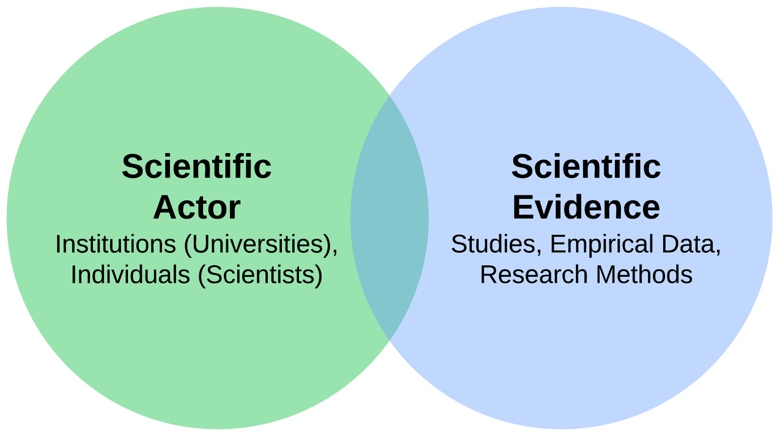
Answering this question can provide meaningful insight into politicians’ use of science and the importance they attribute to science. To structure potential representations, we define two relevant types of science representations in political discourse (Figure 1). Such statements can point to (1) any kind of scientific evidence, like studies, empirical data, or established research methods, (2) scientific actors, like individual scientists or research institutions (e.g., universities), or both.
While the idea of evidence-based policy-making is not new [Cairney, 2016], especially in times of crisis, such as public health emergencies, environmental disasters, or economic recessions, various actors call for greater use of scientific evidence to address pressing challenges [Cairney, 2021]. Yet references to science can be selective. Stevens [2007] describes a “survival of the ideas that fit” pattern, in which evidence circulates through policy networks in ways that favour ideas compatible with prevailing political positions. This selectivity is enabled by the structural features of scientific knowledge itself: because empirical findings on contested issues are rarely univocal, the resulting inherent uncertainty leaves room for value-driven interpretation and the strategic mobilisation of supportive evidence [Lavazza & Farina, 2020; Sarewitz, 2004].
Beyond examining the prominence of science in parliamentary debates and the frequency and types of references politicians make, it is important to consider how science is framed and contextualised in these discussions [Boswell & Smith, 2017]. This includes analysing the contextual factors and evaluative cues in science-related political speeches. How such selective uses unfold along party lines remains underexplored. Existing work shows that partisan actors hold differing views on what constitutes reliable and actionable evidence [Senninger & Hansen, 2026], assign different weights to scientific evidence in their argumentation [Rekker, 2025], pursue distinct knowledge strategies [Boecher et al., 2022], and rely on different scientific sources when they do cite research [Furnas et al., 2025]. What this body of work has not yet established is how parties qualitatively present science in political debates at scale. Most existing studies focus on salience [Qadir & Syväterä, 2021], source selection [Furnas et al., 2025], or long-term rhetorical shifts [Aroyehun et al., 2025] rather than on the discursive contextualisation of science across large corpora.
To better understand how parties differ in their use of science, we have to analyse the specific language and narratives each party uses. This will help reveal the distinct ways in which science is portrayed in parliamentary debates. Therefore, our second research question is:
- RQ2:
-
How do these representations of science in parliamentary debates differ between political parties?
3 Methods
3.1 Data
We used the ParlSpeech V2 data [Rauh & Schwalbach, 2020], which covers speeches in the Austrian Nationalrat between 1996 and 2018, and data from the ParlaMint 4.1 project [Erjavec et al., 2024] for speeches between 2018 and 2022. We excluded all speeches by the chair, resulting in 104,088 speeches by individual MPs with a median length of 479 words. All of these speeches were considered for the overall analysis over time.
To analyse party differences, we considered the parties represented in the Nationalrat at the time the manuscript was written,1 as presented in Table 1. The remaining speeches were delivered by parties no longer represented in parliament, by MPs without party affiliation, or by guest speakers.
| Party | Name | Political orientation | Speeches (N) |
| ÖVP | People’s Party | Conservative | 28,172 |
| SPÖ | Social Democrats | Social Democratic | 27,925 |
| FPÖ | Freedom Party | Right-wing Populist | 19,787 |
| Grüne | The Greens | Green | 14,422 |
| NEOS | NEOS | Liberal | 3,510 |
3.2 Coding process
Based on this data, we identified science-related sequences through a two-step procedure. The first step used a keyword-based pre-filter to compile a broad subcorpus of potentially science-related sequences. The employed keyword dictionary contained 29 stemmed search strings,2 which identified 80,226 sequences that contained at least one keyword. The recall of the dictionary-based approach was validated using two randomly selected, unfiltered subsamples of full speeches. In the first validation subsample, a single human coder classified 200 speeches using the categories defined above. Of these, 41 speeches (20.5%) were identified as science-related, with a recall of 0.95 (Wilson 95% CI [0.84, 0.99]). In the second validation subsample, the OpenAI GPT-4o model classified 2,000 speeches using the same categories. Of these, 435 speeches (21.8%) were identified as science-related, with a recall of 0.87 (Wilson 95% CI [0.83, 0.90]).3
The second step of the coding procedure refined this subcorpus using GPT-4o, which assessed whether the 160-word text window surrounding each keyword referred to scientific evidence (e.g., studies or empirical data), scientific actors (e.g., universities or individual scientists), or both. Validation against a human-coded subset (n = 400) showed satisfactory Krippendorff’s Alpha values of α = 0.89 for overall science mentions, α = 0.91 for Scientific Actors, and α = 0.84 for Scientific Evidence. After cleaning the initial subcorpus of science-related sequences identified by the dictionary approach (n = 80,226) for false positives4 (n = 15,572) and duplicates5 (n = 32,335), our final subcorpus consisted of 32,319 science-related sequences.
3.3 Analysis
To analyse the salience of different representations of science (RQ1), we measured the proportion of all speeches that included at least one reference to scientific actors or scientific evidence. Differences between parties in the salience of science representations were analysed using a chi-square test of independence, followed by pairwise z-tests to identify which parties differed significantly from one another.
To investigate how different parties discuss scientific evidence (RQ2), we analysed the 160-word text window surrounding a keyword in which scientific evidence was specifically mentioned (n = 11,439).6 Using R, we calculated log-odds ratios with Laplace smoothing for each word to identify terms predominantly used by each party. The log-odds ratio compares a word’s frequency in one party’s speeches to its frequency in speeches from all other parties. Words with high ratios are considered “typical” for a party, those with low ratios are “atypical”. Because words used at similar rates across all parties receive low scores by design, the measure is largely self-correcting, and pre-filtering can be kept minimal: we excluded all words that appeared fewer than 30 times in the overall database across all parties since these were found to overshadow the results in the pre-testing process without representing relevant discussion points (due to their rare occurrence).7 After converting to lowercase, removing numbers, symbols, and standard German stopwords, as well as excluding single- and double-character tokens, we obtained interpretable results. Furthermore, we deliberately chose not to apply stemming or lemmatisation in order to preserve morphological variation. In German, different inflected word forms can carry distinct meanings. Retaining these forms allows us, for example, to identify whether a party uses particularly gendered or gender-inclusive language. For the same reason, we retained personal names, party self-designations, and stylistically marked or idiomatic expressions, since their differential use across parties can itself constitute a substantive finding.
Building on the log-odds ratio results, we conducted an exploratory qualitative analysis of the typical and atypical words identified for each party. For each term, we examined the surrounding sequences to better understand the argumentative contexts and rhetorical strategies in which it appeared. This step allowed us to interpret why specific words were distinctive for a party, for example, by revealing underlying policy positions, issue ownership, party-specific language use, or recurring argumentative patterns. The qualitative inspection thus complemented the quantitative findings by situating the distinctive vocabulary within its discursive context.
4 Results
We initially analysed the salience of different types of science representations in parliamentary speeches (RQ1), focusing on overall salience, temporal patterns, and party differences without yet examining how science is discussed within these speeches. Subsequently, we focused on specific sequences in which scientific evidence is discussed to analyse how different parties talk about scientific evidence (RQ2). For this step, we focused on the immediate context of representations of scientific evidence, excluding references to scientific actors, as our aim was to understand how evidence is discussed and utilised in political communication.
4.1 Salience of science in political debates
Results show that 18.9% of all parliamentary speeches by individual MPs contained representations of science. Scientific actors are the most common reference points (16.3% of all speeches) in science-related speeches, whereas references to scientific evidence are less frequent (9.5% of all speeches). These subcategories are not mutually exclusive, as references to scientific actors and scientific evidence can appear within the same speech. The results provide an initial glimpse into what politicians reference when they want to bring science into their argumentation. The validation process for the two subcategories revealed that the scientific actor category is heavily influenced by higher-education policy debates, often prompted by terms like university.
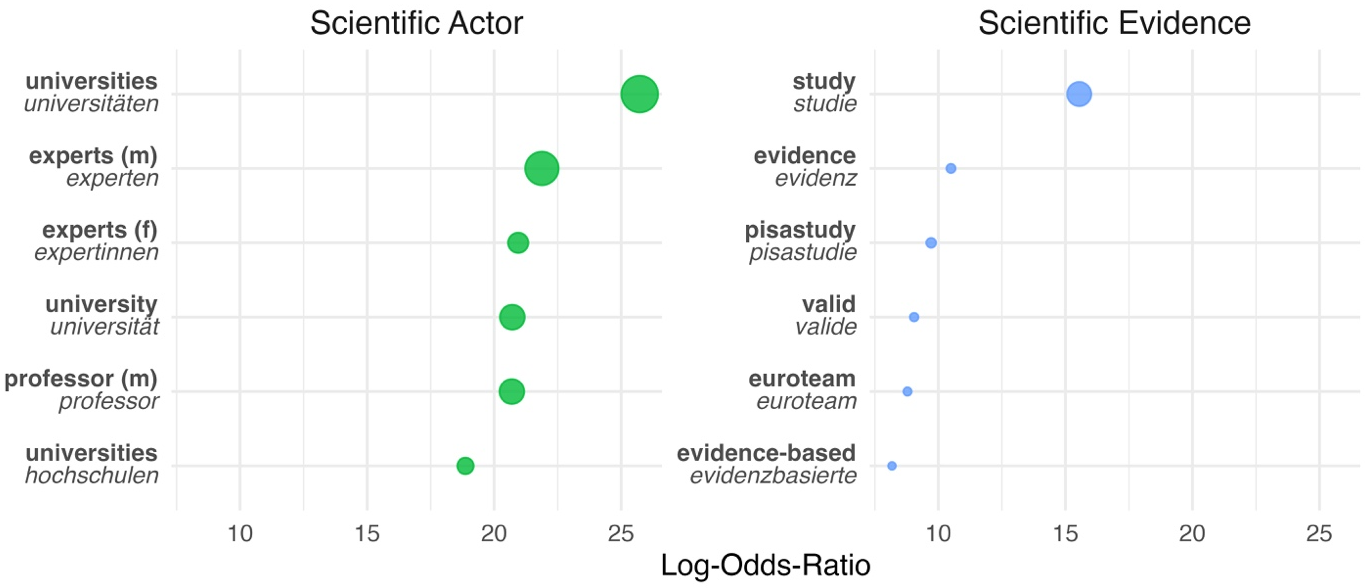
To understand and validate the model’s classifications, we calculated log-odds ratios to identify the most typical words for each type of science representation (see Figure 2). The typical words identified suggest that the model successfully captured the essence of the sequences, as most of the words show a plausible connection to the measured concept. The most typical words for the scientific actor category are universities, experts, and professor, whereas words like study, evidence, or valid are typical for the scientific evidence category. While the scientific actor category is designed to measure any (manifest) reference to scientific institutions or individuals, the scientific evidence category has a more specific and latent nature since it is designed to capture the actual intention of representing scientific evidence. Both the manual validation process and the log-odds calculation confirm the validity of our methodological pipeline.
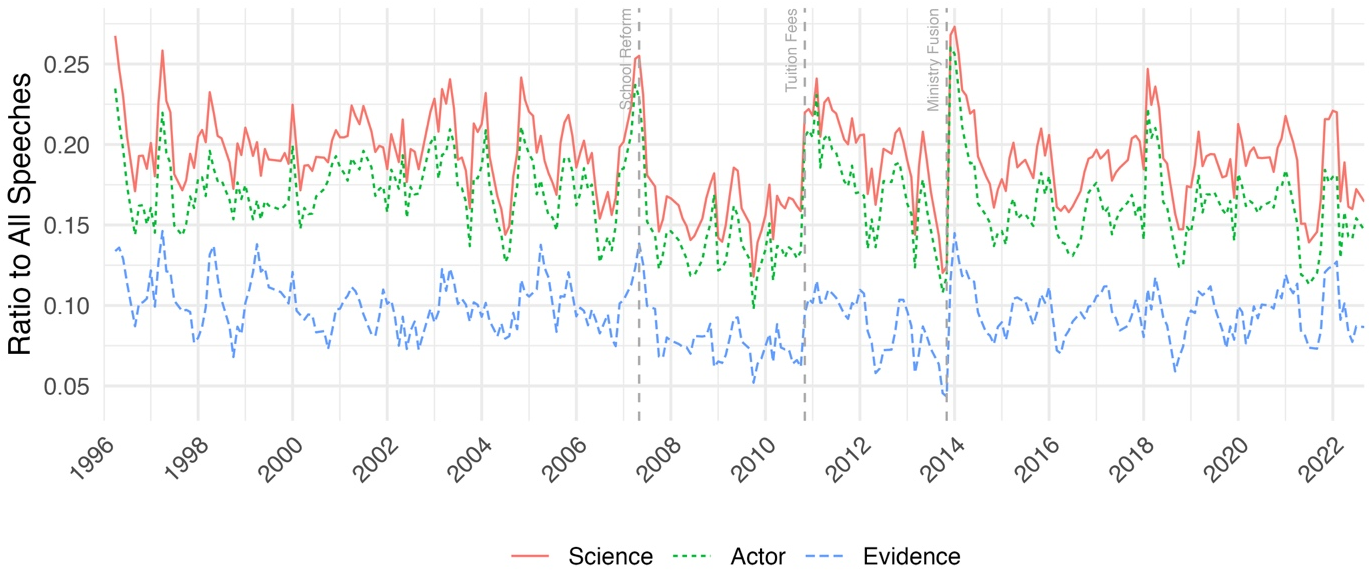
Next, we analysed the ratios of different types of science representations over time, revealing that while there are short-term fluctuations, the proportion of speeches containing representations of science remains relatively stable, with only a noticeable drop between 2008 and 2011 (see Figure 3). Since representations of scientific actors are the most prevalent, fluctuations in this category influence the overall science values. Representations of scientific evidence show only minor variations in the overall parliamentary discourse, indicating that the parliamentary science-related discourse mainly follows an entrenched style. However, several spikes indicate the relevance of specific short-term developments and discussions, suggesting promising avenues for future research.
4.2 How political parties talk about science
Next, we considered potential differences among parties in the representation of science (Figure 4). The analysis revealed that scientific evidence is most frequently mentioned in speeches by the Green Party (Grüne, 11.5%), followed by the Liberal Party (NEOS, 11.3%), while it appears least often in speeches by the populist right-wing Freedom Party (FPÖ, 8.1%). The same pattern applies to the overall ratio of speeches mentioning any aspect of science. References to scientific actors are much more prevalent than references to scientific evidence across all parties.8
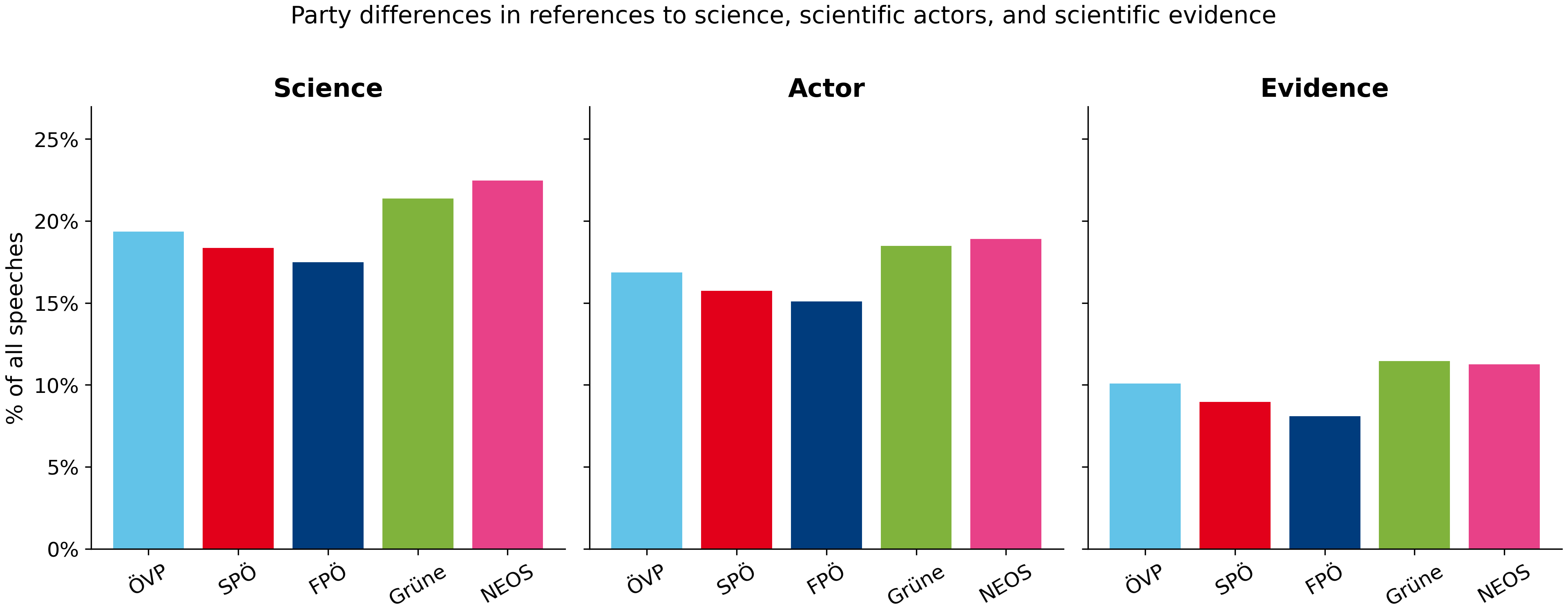
To assess whether these between-party differences are systematic, we ran chi-square tests of independence on the cross-tabulation of party and science-reference (any science, scientific actor, scientific evidence). All three tests were significant at p < .001 (Table 4 in Appendix C). However, given the corpus size (N = 93,816 speeches), p-values offer little diagnostic value, as even trivial differences will reach significance. We therefore base our substantive interpretation on effect sizes. Cramér’s V was 0.036 for any science reference, 0.033 for scientific actors, and 0.039 for scientific evidence. By conventional benchmarks, these are small effects, indicating that party affiliation accounts for only a modest share of the variation in whether a given speech invokes science.
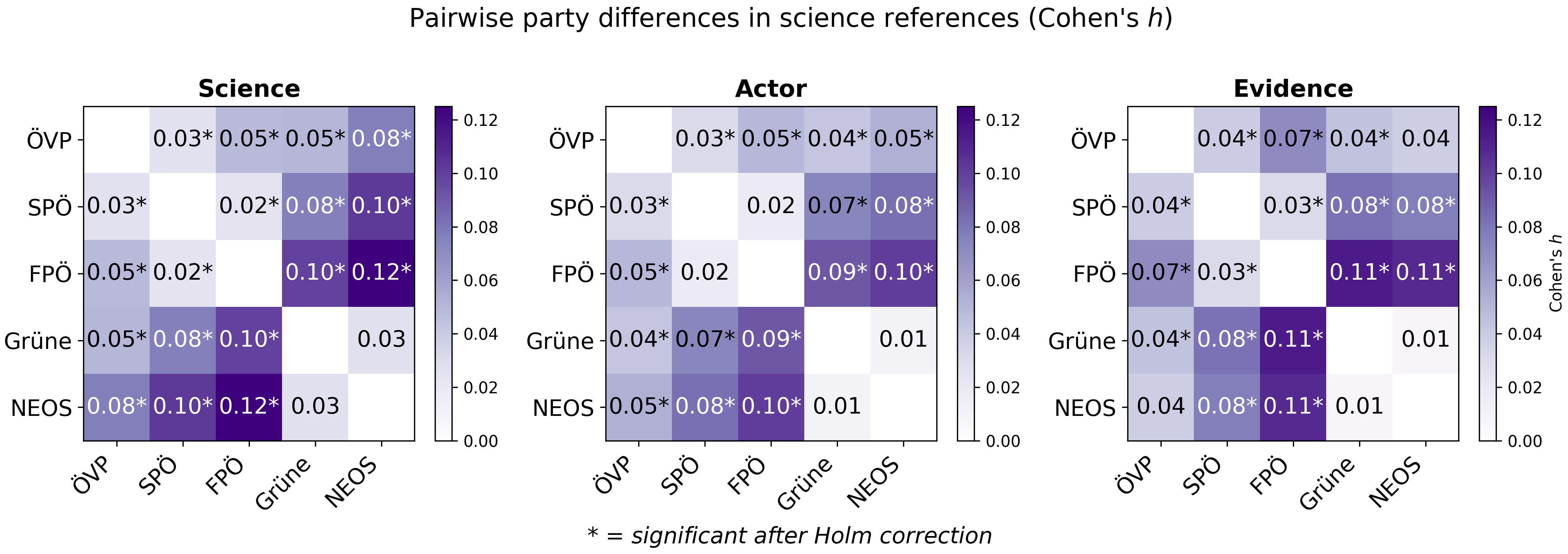
Pairwise z-tests of proportions with Bonferroni and Holm corrections (see Figure 5 and Table 5 in Appendix C), interpreted via Cohen’s h, reveal three notable patterns. First, the cluster with the most frequent references to science contains the liberal NEOS and the Greens. The two parties are statistically indistinguishable across all three indicators (h between -0.026 and 0.006; Holm-corrected p > .1), yet both show significantly higher proportions than nearly every other party. Second, at the opposite end, the populist right-wing FPÖ shows the lowest proportions and differs significantly from NEOS and the Greens, with the largest pairwise effects in the matrix (FPÖ vs NEOS: h = -0.125 for any science, -0.101 for actors, -0.108 for evidence; FPÖ vs Grüne: h = -0.099, -0.091, -0.114). Third, the two mainstream parties, ÖVP and SPÖ, show distinct patterns. The ÖVP shows slightly higher proportions of science references than the SPÖ across all three indicators, although the differences are substantively small (any science: h = 0.025, Holm-corrected p = .008; scientific actors: h = 0.031, p = .001; scientific evidence: h = 0.039, p < .001). The ÖVP differs significantly from both the top cluster (NEOS: h = -0.077, -0.053, -0.038; Grüne: h = -0.050, -0.042, -0.044) and the FPÖ (h = 0.048, 0.049, 0.070), placing it in an intermediate position. The SPÖ, by contrast, differs significantly from the top cluster across all three indicators (Grüne: h = -0.076, -0.073, -0.082; NEOS: h = -0.102, -0.083, -0.077) but only marginally from the FPÖ (h = 0.023, 0.018, 0.031), with differences remaining significant after Holm correction only for any science and evidence, not for actors.
Beyond statistical measures of science references in parliamentary debates, we calculated log-odds ratios for a more nuanced understanding of how different parties refer to scientific evidence. We focused on representations of scientific evidence (n = 11,439) because the scientific actors category included many higher education policy discussions, which were not central to our research focus regarding RQ2. Accordingly, only sequences coded by the LLM as containing references to scientific evidence were retained. The mere presence of keywords such as “university” was not sufficient. Additionally, we qualitatively examined the sequences surrounding typical and atypical words to gain deeper insights into their argumentative representation.
When examining typical words, it is noticeable that specific policy positions, issue ownership, and party language often overshadow science-related speeches. Different policy positions are, for instance, visible in the term tuition fees, which is typical for the conservative ÖVP (see Table 2) but atypical for the social democratic SPÖ (see Table 3). This reflects a long-standing discussion between the two parties, in which the ÖVP favours introducing general tuition fees, whereas the SPÖ strongly opposes this idea. For example, conservative politicians frequently argue that recent studies found no negative effect of tuition fees on the accessibility of Higher Education for students from disadvantaged socio-economic backgrounds, or that tuition fees are fair in comparison with other forms of education, such as vocational training courses, which are also not free of charge:
In this context, there is a very recent study by the Stifterverband für die Deutsche Wissenschaft, which compared German federal states that charge tuition fees with those that do not. This study clearly shows that the question of whether or not tuition fees are charged has no bearing on social mobility. Even in states where tuition fees are charged, the social mix is no worse (ÖVP, 129016, 2010-11-18).1
Tuition fees are also socially equitable because, as already mentioned, many other training courses — such as master craftsman examinations — are often very expensive, and it is unreasonable for some to study for free while others have to finance their education with very high sums of money. They are also socially equitable because it has been proven that moderate tuition fees do not deter students from studying. The latest study, conducted in Berlin in 2011 with 40,000 cases, proves exactly that (ÖVP, 148702, 2012-12-06).
1The original German version of all cited text passages can be found in Appendix D.
| Party | Word (translated) | Original (German) | Log-odds | Total count |
| ÖVP | tuition fees | studienbeiträge | 2.68 | 46 |
| SPÖ | employees (f) | arbeitnehmerinnen | 1.28 | 78 |
| SPÖ | educators (f) | pädagoginnen | 1.71 | 48 |
| SPÖ | educators (m) | pädagogen | 1.31 | 44 |
| Grüne | ecological | ökologisch | 1.99 | 52 |
| Grüne | true-cost pricing | kostenwahrheit | 1.87 | 32 |
| Grüne | cut | kürzen | 1.54 | 35 |
| FPÖ | [self-designation] | freiheitliche | 3.30 | 92 |
| FPÖ | [self-designation] | freiheitlichen | 1.96 | 214 |
| FPÖ | foreigner(s) | ausländer | 2.30 | 32 |
| FPÖ | leftists | linken | 1.77 | 34 |
| FPÖ | guilty | schuldig | 1.61 | 33 |
| NEOS | evidence | evidenz | 2.71 | 72 |
| NEOS | evidence-based | evidenzbasierte | 2.16 | 39 |
| NEOS | passive smoking | passivrauchen | 2.40 | 30 |
| Note.
Higher
log-odds
indicate
terms
more
typical
for
a
given
party;
total
count
reflects
salience
across
all
parties.
Only
theoretically
meaningful
terms
are
shown;
names
and
procedural
language
were
excluded.
Full
results
in
Appendix C. | ||||
| Party | Word (translated) | Original (German) | Log-odds | Total count |
| SPÖ | tuition | studienbeiträge | -2.82 | 46 |
| ÖVP | true-cost pricing | kostenwahrheit | -1.92 | 32 |
| ÖVP | scientists (f) | wissenschafterinnen | -1.66 | 64 |
| FPÖ | researchers (f) | forscherinnen | -3.22 | 114 |
| FPÖ | scientists (f) | wissenschafterinnen | -2.65 | 64 |
| FPÖ | teachers (f) | lehrerinnen | -2.55 | 117 |
| FPÖ | educators (f) | pädagoginnen | -2.36 | 48 |
| FPÖ | climate protection | klimaschutz | -2.35 | 145 |
| FPÖ | energy fund | energiefonds | -2.28 | 44 |
| FPÖ | environmental policy | umweltpolitik | -2.25 | 43 |
| Note.
Lower
log-odds
indicate
terms
more
atypical
for
a
given
party;
total
count
reflects
salience
across
all
parties.
Only
theoretically
meaningful
terms
are
shown;
names
and
procedural
language
were
excluded.
Full
results
in
Appendix C. | ||||
The same holds for the Social Democrats, with their typical use of the words employees [f] and educators [f/m], indicating their prioritisation of employment and education policy discussions.
There are also other studies; the IHS, for example, examined 30 collective agreements to investigate whether the seniority principle has a positive effect on older employees [f] and employees [m]. The researchers [m] and researchers [f] concluded that specific measures for older employees [f] and employees [m] are needed above all else (SPÖ, 172884, 2015-10-14).
Finally, I appeal to the scientist in you, Federal Minister Faßmann: please do not abandon scientific integrity! Please base your policies on facts and educational science findings and principles, and please do not stir up fears among parents and educators [f] and educators [m] by making populist statements (SPÖ, 190865, 2017-12-21).
Notably, the use of gender-inclusive language by the SPÖ is visible, as multiple terms are represented in their feminine forms (see Table 2), whereas the Freedom Party avoids gender-inclusive language as the female versions of educators, teachers, researchers, and scientists are atypical for the FPÖ (see Table 3).
The effect of issue ownership is clearly visible for several parties. The Greens typically use the terms ecological and true-cost pricing (a term associated with ecological policies) when representing scientific evidence.
We are talking about true-cost pricing. I remember that ten years ago, the Green Party pushed hard for true costs to be determined, particularly in the transport and energy sectors, and your predecessor, colleague Streicher, also commissioned a study at that time and had very important data calculated in connection with energy and transport infrastructure (Grüne, 46958, 1996-10-02).
In contrast, the terms environmental policy, energy fund, and climate protection are atypical for the right-wing FPÖ, showing that the party avoids explicitly environmental topics when talking about science (see Table 3). Instead, the FPÖ often discusses migration, even in sequences representing scientific evidence, underscoring how parties maintain ideological positions by incorporating their preferred partisan language.
Party- and role-specific language is visible through self-designations for several parties like the Liberal Party (NEOS) and the FPÖ, which frequently and characteristically use the terms freiheitliche and freiheitlichen (their self-designation, loosely translated as libertarian(s)). Conversely, such self-designations of parties unsurprisingly appear as atypical terms for other parties (see Table 3). Furthermore, parties differ in sentiment when representing scientific evidence, with predominantly opposition parties like the FPÖ and the Greens often using negative terms like guilty and cut, reflecting their critical stance.
A specific pattern at the intersection of issue ownership and ideology is visible for the populist FPÖ, which frequently uses the term foreigner(s) in speeches involving scientific evidence. Qualitative analysis shows that the term is often used pejoratively to construct an excluded outgroup that is blamed for supposedly negative developments, especially in social and employment policy discussions, where foreigners are portrayed as taking resources meant for Austrians.
It is evident that foreigners take more out of the social welfare pot than they pay in. [ …] There is a study by Julia Bock-Schappelwein’s Economic Research Institute, which reported on this negative foreigner balance as early as 2004 (FPÖ, 32698, 2007-03-30).
A study shall be conducted to determine how much foreigners really cost the social welfare system. All four political parties represented here — red, black, green and orange — voted against this. You are not interested in how much foreigners cost the social welfare system. You don’t care at all, because it is the small pensioners who have to pay for it (FPÖ, 38844, 2007-12-05).
[ …] indeed foreigners take far more out of the social welfare system than they pay into it, as many international studies have shown (FPÖ, 151017, 2013-03-21).
Similar tactics are visible in sequences containing the FPÖ-typical term leftists, with which the party attempts to brand political opponents as incompetent or crooked.
All the leftist pro-migration fetishists bear a considerable share of the blame for this epidemic of violence against women in Europe. [ …] In your ideological blindness, you are not even capable of acknowledging numbers, data and facts (FPÖ, 213790, 2020-12-10).
This study on political behaviour was commissioned not only by President Prammer, but also by the Federal Minister of Education, among others — and now, of course, there is immediate backtracking. Where were the efforts when, during demonstrations by the leftists, the real perpetrators of violence in this republic injured innocent people and political opponents? — Silence. The entire media community showed no reaction whatsoever (FPÖ, 113939, 2009-05-19).
This finding, based on qualitative inspection, demonstrates how the FPÖ constructs dichotomous, populist categories to reinforce a clear “us” versus “them” division — even in science-related speeches.
In contrast, the Liberal Party strongly emphasises the role of scientific evidence, as shown by the frequent use of terms like evidence and evidence-based, which are notably more typical for NEOS than for any other party. Qualitative inspection of these sequences confirms that the party uses these terms to highlight and introduce scientific evidence for its claims. The party commonly highlights the epistemic authority of science through calls to follow scientific evidence. This pattern is also observable in topic-specific discussions, such as the frequently debated issue of smoking policy.9
In the future — and that is unfortunately something that has not always been the case in this House, as in all parliaments — scientific evidence should serve as the factual basis for climate policy. It is no longer about the gut feeling you have when you leave the discussion, it is not about stories you may have heard somewhere, but it is actually about examining scientific knowledge and asking what this means for our country (NEOS, 204566, 2019-09-25).
That is the scientific evidence [ …] Once again: there are two to three deaths per day in Austria due to passive smoking; that has been scientifically proven. [ …] You are choosing death and your party’s tactical line. In my opinion, that is not right (NEOS, 191376, 2018-02-28).
5 Discussion
This study aimed to contribute to a deeper understanding of how science is represented in political discourse, particularly in parliamentary debates. Building on current literature on science references in parliamentary debates [Qadir & Syväterä, 2021], we find largely stable patterns in the degree to which politicians engage with science over time, but clear party differences in the representation of science that can be tied to issue ownership and populist rhetorical styles. These findings contribute to the literature on science and political communication in at least three ways.
First, the largely stable pattern in how politicians engage with science over time suggests that parliamentary discourse tends to adhere to entrenched rhetorical styles and procedural norms rather than adapting dynamically to evolving scientific contexts, which is in line with research on the role of parliamentary debates [Proksch & Slapin, 2014]. This also means that politicians find a way to limit their use of science, even in times when crises and external stakeholders demand an increased reliance on scientific evidence. The question of why we do not see a more substantial influence of real-world developments here remains open for further investigation. Interviews with politicians could deliver deeper insights into their reasoning and motivations for incorporating varying levels of science into their communication.
Second, the substantial party differences in the salience of science indicate the weight that different parties place on science in their political argumentation. Yet these differences may partly reflect issue ownership and the policy domains parties typically prioritise [Petrocik, 1996]. Centre-left parties such as the SPÖ tend to be associated with social justice, labour rights, and welfare, domains in which arguments commonly rest on normative concepts such as fairness, equality, and solidarity [Esmark & Schoop, 2017]. The FPÖ, by contrast, is more strongly associated with immigration, national identity, and law and order, consistent with the broader literature on populist radical right parties and their emphasis on nativism and authoritarianism [Ennser-Jedenastik, 2020]. Such issue agendas may constrain the salience of science, since parties invoke scientific arguments within policy domains that vary in how strongly they are treated as technocratic and evidence-based rather than moral or identity-based. The observed party differences may equally reflect differences in the policy contexts in which science becomes rhetorically relevant in the first place.
Third, the findings suggest differences in how science is incorporated into political argumentation once it is invoked. Parties such as NEOS and the Greens appear more likely to invoke science in ways that correspond to scientific logic, whereas the FPÖ more frequently discusses science through political logic by linking it to ideological positions and conflictual claims. These argumentative patterns are consistent with populist communication styles and are visible in ideologically driven language, as the refusal to use gender-inclusive language by the far right indicates, and in the exclusionary rhetoric used by populists when referring to outgroups such as foreigners or political opponents [Nai, 2021]. Whether such selective and symbolic uses of science erode public trust in science and democratic institutions remains an open question for future research.
This study comes with some limitations. First, due to the long time span investigated, our approach only allowed for identifying long-term patterns rather than shorter-term debates. Applying the methodology to specific temporal or policy contexts, such as the onset of the COVID-19 pandemic or climate policy debates, would be a promising way to analyse contemporary discourse on science more precisely. Second, subtle nuances in parliamentary rhetoric are inevitably obscured when analysing large volumes of data. For instance, we focus on mentions of scientific evidence rather than the actual sources of that evidence. As a result, we cannot conclude that certain parties adhere more rigorously to scientific evidence, only that some assign greater importance to it in their argumentation.
Despite these limitations, this study advances previous research in two main ways. First, it analyses all parliamentary debates over a 26-year period using advanced text-analysis methods. Second, by focusing on debates rather than finalised policy documents, it captures how politicians actively justify positions and construct epistemic authority in real time, offering a more precise measurement of their genuine stance on science. The findings reveal that the main differences in the representation of science lie between parties rather than over time, and that ideology and issue stance are relevant factors that influence how different political actors talk about science. Future research could extend this approach to specific policy fields such as climate, health, or technology. If we consider parliaments not only as legislative bodies but as performative stages where science is used rhetorically and communicated to the public, the challenges associated with these dynamics become even more pressing, especially given that communication about science can influence crucial aspects like public trust [Guenther et al., 2024]. Consequently, preventing the politicisation and polarisation of science remains a critical challenge of our time.
References
-
Aroyehun, S. T., Simchon, A., Carrella, F., Lasser, J., Lewandowsky, S., & Garcia, D. (2025). Computational analysis of US congressional speeches reveals a shift from evidence to intuition. Nature Human Behaviour, 9(6), 1122–1133. https://doi.org/10.1038/s41562-025-02136-2
-
Boecher, M., Zeigermann, U., Berker, L. E., & Jabra, D. (2022). Climate policy expertise in times of populism — knowledge strategies of the AfD regarding Germany’s climate package. Environmental Politics, 31(5), 820–840. https://doi.org/10.1080/09644016.2022.2090537
-
Bogner, A. (2021). Die Epistemisierung des Politischen. Wie die Macht des Wissens die Demokratie gefährdet. Reclam.
-
Bornmann, L., Haunschild, R., & Marx, W. (2016). Policy documents as sources for measuring societal impact: how often is climate change research mentioned in policy-related documents? Scientometrics, 109(3), 1477–1495. https://doi.org/10.1007/s11192-016-2115-y
-
Boswell, C. (2009). Knowledge, legitimation and the politics of risk: the functions of research in public debates on migration. Political Studies, 57(1), 165–186. https://doi.org/10.1111/j.1467-9248.2008.00729.x
-
Boswell, C., & Smith, K. (2017). Rethinking policy ‘impact’: four models of research-policy relations. Palgrave Communications, 3(1), 44. https://doi.org/10.1057/s41599-017-0042-z
-
Brondi, S., Sarrica, M., Caramis, A., Piccolo, C., & Mazzara, B. M. (2016). Italian parliamentary debates on energy sustainability: how argumentative ‘short-circuits’ affect public engagement. Public Understanding of Science, 25(6), 737–753. https://doi.org/10.1177/0963662515580067
-
Brown, M. B. (2009). Science in democracy: expertise, institutions, and representation. MIT Press. https://doi.org/10.7551/mitpress/9780262013246.001.0001
-
Cairney, P. (2016). The politics of evidence-based policy making. Palgrave Macmillan. https://doi.org/10.1057/978-1-137-51781-4
-
Cairney, P. (2021). The UK government’s COVID-19 policy: assessing evidence-informed policy analysis in real time. British Politics, 16(1), 90–116. https://doi.org/10.1057/s41293-020-00150-8
-
Druckman, J. N. (2017). The crisis of politicization within and beyond science. Nature Human Behaviour, 1(9), 615–617. https://doi.org/10.1038/s41562-017-0183-5
-
Egelhofer, J. L., Seeger, C., & Binder, A. (2024). The effects of witnessing harassment of scientists on public perceptions of science. JCOM, 23(09), A01. https://doi.org/10.22323/2.23090201
-
Ennser-Jedenastik, L. (2020). The FPÖ’s welfare chauvinism. Österreichische Zeitschrift für Politikwissenschaft, 49(1), 1–13. https://doi.org/10.15203/ozp.3102.vol49iss1
-
Erjavec, T., Kopp, M., Ogrodniczuk, M., Osenova, P., Agirrezabal, M., Agnoloni, T., Aires, J., Albini, M., Alkorta, J., Antiba-Cartazo, I., Arrieta, E., Barcala, M., Bardanca, D., Barkarson, S., Bartolini, R., Battistoni, R., Bel, N., Bonet Ramos, M. M., Calzada Pérez, M., … Fišer, D. (2024). Multilingual comparable corpora of parliamentary debates ParlaMint 4.1 [Data set]. CLARIN ERIC. http://hdl.handle.net/11356/1912
-
Esmark, A., & Schoop, S. R. (2017). Deserving social benefits? Political framing and media framing of ‘deservingness’ in two welfare reforms in Denmark. Journal of European Social Policy, 27(5), 417–432. https://doi.org/10.1177/0958928716688262
-
Furnas, A. C., LaPira, T. M., & Wang, D. (2025). Partisan disparities in the use of science in policy. Science, 388(6745), 362–367. https://doi.org/10.1126/science.adt9895
-
Guenther, L., Schröder, J. T., Reif, A., Brück, J., Taddicken, M., Weingart, P., & Jonas, E. (2024). Intermediaries in the limelight: how exposure to trust cues in content about science affects public trust in science. JCOM, 23(09), A06. https://doi.org/10.22323/2.23090206
-
Hay, C. (2007). Why we hate politics. Polity Press.
-
Hempel, C. G. (1960). Science and human values. In R. E. Spiller (Ed.), Social control in a free society (pp. 39–64). University of Pennsylvania Press. https://doi.org/10.9783/9781512807424-003
-
Jasanoff, S. (2004). The idiom of co-production. In S. Jasanoff (Ed.), States of knowledge: the co-production of science and the social order (pp. 1–12). Routledge. https://doi.org/10.4324/9780203413845
-
Jasanoff, S. (2014). A mirror for science. Public Understanding of Science, 23(1), 21–26. https://doi.org/10.1177/0963662513505509
-
Jasanoff, S., & Wynne, B. (1998). Science and decisionmaking. In S. Rayner & E. L. Malone (Eds.), Human choice and climate change (pp. 1–87). Battelle Press.
-
Lassen, J. (2018). Listened to, but not heard! The failure to represent the public in genetically modified food policies. Public Understanding of Science, 27(8), 923–936. https://doi.org/10.1177/0963662518766286
-
Lavazza, A., & Farina, M. (2020). The role of experts in the Covid-19 pandemic and the limits of their epistemic authority in democracy. Frontiers in Public Health, 8, 356. https://doi.org/10.3389/fpubh.2020.00356
-
Nai, A. (2021). Fear and loathing in populist campaigns? Comparing the communication style of populists and non-populists in elections worldwide. Journal of Political Marketing, 20(2), 219–250. https://doi.org/10.1080/15377857.2018.1491439
-
Oreskes, N. (2019). Systematicity is necessary but not sufficient: on the problem of facsimile science. Synthese, 196(3), 881–905. https://doi.org/10.1007/s11229-017-1481-1
-
Oreskes, N., & Conway, E. M. (2010). Merchants of doubt: how a handful of scientists obscured the truth on issues from tobacco smoke to global warming. Bloomsbury Press.
-
Palonen, K. (2003). Four times of politics: policy, polity, politicking, and politicization. Alternatives: Global, Local, Political, 28(2), 171–186. https://doi.org/10.1177/030437540302800202
-
Partheymüller, J., Eberl, J.-M., & Bogner, A. (2025). Perceptions of science and politics during the COVID-19 pandemic in Austria: technocratic overreach or blame deflection? Österreichische Zeitschrift für Soziologie, 50(1), 33. https://doi.org/10.1007/s11614-025-00619-0
-
Peters, N. (2024). Uncivil communication and epistemic trustworthiness concerns in public online discussions in response to scientists during the Covid-19 pandemic. JCOM, 23(06), A03. https://doi.org/10.22323/2.23060203
-
Petrocik, J. R. (1996). Issue ownership in presidential elections, with a 1980 case study. American Journal of Political Science, 40(3), 825–850. https://doi.org/10.2307/2111797
-
Pielke, R. A. (2004). When scientists politicize science: making sense of controversy over The Skeptical Environmentalist. Environmental Science & Policy, 7(5), 405–417. https://doi.org/10.1016/j.envsci.2004.06.004
-
Proksch, S.-O., & Slapin, J. B. (2014). The politics of parliamentary debate: parties, rebels and representation. Cambridge University Press. https://doi.org/10.1017/cbo9781139680752
-
Qadir, A., & Syväterä, J. (2021). The moral authority of science: evidence from parliamentary debates in seven countries. European Journal of Cultural and Political Sociology, 8(3), 265–293. https://doi.org/10.1080/23254823.2021.1885461
-
Rauh, C., & Schwalbach, J. (2020). The ParlSpeech V2 data set: full-text corpora of 6.3 million parliamentary speeches in the key legislative chambers of nine representative democracies [Data set]. Harvard Dataverse. https://doi.org/10.7910/DVN/L4OAKN
-
Rekker, R. (2025). A four-level model of political polarization over science: evidence from 10 European countries. Public Understanding of Science, 34(4), 424–445. https://doi.org/10.1177/09636625241306352
-
Roper, J., Ganesh, S., & Zorn, T. E. (2016). Doubt, delay, and discourse: skeptics’ strategies to politicize climate change. Science Communication, 38(6), 776–799. https://doi.org/10.1177/1075547016677043
-
Rueschemeyer, D., & Skocpol, T. (Eds.). (1995). States, social knowledge, and the origins of modern social policies. Princeton University Press. https://doi.org/10.1515/9781400887408
-
Rutjens, B. T., Sengupta, N., van der Lee, R., van Koningsbruggen, G. M., Martens, J. P., Rabelo, A., & Sutton, R. M. (2022). Science skepticism across 24 countries. Social Psychological and Personality Science, 13(1), 102–117. https://doi.org/10.1177/19485506211001329
-
Sarewitz, D. (2004). How science makes environmental controversies worse. Environmental Science & Policy, 7(5), 385–403. https://doi.org/10.1016/j.envsci.2004.06.001
-
Schug, M., Bilandzic, H., & Kinnebrock, S. (2024). Public perceptions of trustworthiness and authenticity towards scientists in controversial scientific fields. JCOM, 23(09), A03. https://doi.org/10.22323/2.23090203
-
Senninger, R., & Hansen, J. A. (2026). The politics of evidence selection. SocArXiv. https://doi.org/10.31235/osf.io/8zv9s_v3
-
Stevens, A. (2007). Survival of the ideas that fit: an evolutionary analogy for the use of evidence in policy. Social Policy and Society, 6(1), 25–35. https://doi.org/10.1017/s1474746406003319
-
Vliegenthart, R., Walgrave, S., Baumgartner, F. R., Bevan, S., Breunig, C., Brouard, S., Bonafont, L. C., Grossman, E., Jennings, W., Mortensen, P. B., Palau, A. M., Sciarini, P., & Tresch, A. (2016). Do the media set the parliamentary agenda? A comparative study in seven countries. European Journal of Political Research, 55(2), 283–301. https://doi.org/10.1111/1475-6765.12134
-
Weingart, P. (1999). Scientific expertise and political accountability: paradoxes of science in politics. Science and Public Policy, 26(3), 151–161. https://doi.org/10.3152/147154399781782437
-
Zapp, M. (2022). The legitimacy of science and the populist backlash: cross-national and longitudinal trends and determinants of attitudes toward science. Public Understanding of Science, 31(7), 885–902. https://doi.org/10.1177/09636625221093897
Notes
1. A detailed overview can be found in Appendix A.
2. The list of search strings can be found in Appendix B.
3. Further information on false negatives can be found in Appendix B.
4. Identified as not science-related in step two of the coding procedure using LLMs.
5. The keyword-based selection process produces duplicates if multiple keywords appear close to each other. Further information on the deduplication process can be found in Appendix B.
6. The full number of sequences for each party and year can be found in Appendix C.
7. Details on the pre-testing process can be found in Appendix B.
8. Detailed results can be found in Appendix C.
9. In 2019, stricter rules about smoking in restaurants were enacted.
About the authors
Daniel Wiesner is a Research Associate (Pre-Doc) at the Department of Communication at the University of Vienna. His research focuses on the role of science in political processes and on public trust in science and democratic institutions.
E-mail: daniel.wiesner@univie.ac.at Bluesky: @danielwiesner
Jakob-Moritz Eberl is a Senior Scientist at the Department of Communication at the University of Vienna. He studies how information environments shape citizens’ attitudes and perceptions, and how norms and trust surrounding media, science, and democratic institutions are formed and contested.
E-mail: jakob-moritz.eberl@univie.ac.at Bluesky: @jamoeberl
Sophie Lecheler is a Professor of Political Communication at the Department of Communication at the University of Vienna and the current speaker of the Research Platform “Trustworthy Science Communication”. Her research focuses on digital politics, the politics of science communication, political journalism, emotions, and experimental methods.
E-mail: sophie.lecheler@univie.ac.at Bluesky: @solecheler
Supplementary material
Available at https://doi.org/10.22323/385320260718153107