
1 Introduction
Improvisation in the theatre involves spontaneously co-creating a scene, monologue, or song in collaboration with other performers and the audience [Spolin, 1999]. Methods from improvised theatre (or improv) have been used in science communication training for many years [Fessell et al., 2019]. However, improv as a mode of science communication is relatively underutilised, where instead of being used as a skill-building tool, improvised theatre is the means of engagement itself. This transition offers many potential advantages for practitioners: adaptation of content to each audience, portable shows with minimal staging, and incorporation of dramaturgical methods such as narrative, humour, and pathos. Improv as science communication could be especially powerful for two-way engagement with societal challenges like climate change, a wicked problem defying simple solutions where people often experience a lack of agency [Hulme, 2009].
In Ireland 95% of people surveyed think climate change is happening and 81% are at least “somewhat worried” about it [O’Mahony et al., 2024]. In the same survey, about half of the people in Ireland had engaged in consumer actions to reduce climate change. Creative approaches to climate engagement are one method of increasing these actions, and already have a successful precedent in Ireland, with creative and cultural climate initiatives led by artists and practitioners engaging participants across cognitive, emotional, and practical dimensions [Mac Mahon et al., 2025].
Climate change engagement and action can be driven by a complex variety of factors including hope [Ojala, 2023], social norms and contexts [Van der Linden et al., 2015], and connection to place [Nicolosi & Corbett, 2018]. To understand an individual’s current and future climate actions and pro-environmental behaviour, the concept of environmental science agency is helpful. This was originally proposed by Ballard et al. [2017] drawing on Basu and Calabrese Barton’s [2009; 2010] concept of critical science agency. Through the development of these agencies, individuals rely on scientific expertise to inform their decisions, and to empower them to act based on their own scientific knowledge “to reflect and act on injustice in their lives” [Basu & Barton, 2010, p. 75]. Environmental science agency consists of three central components: (a) Understanding environmental science content (b) Identifying areas of their own expertise associated with environmental science and (c) Using environmental science expertise as a foundation for change [Ballard et al., 2017]. However, the impetus to induce or create change often depends on an individual’s motivations behind climate action, which are often linked to the values they hold, with biospheric, altruistic, egoistic and hedonic values being most relevant [Bouman et al., 2021]. Strong endorsement of biospheric values, which reflect goals to care for nature and the environment, increase the likelihood that an individual will support or engage in climate action. Hence, science communicators can combat climate anxiety and burnout by adopting practices that enhance environmental science agency.
The climate change improv show ‘We Built This City on Rock and Coal’, adapted to and delivered in rural and remote locations across Ireland, has previously demonstrated an increase in performer perceptions of their ability to discuss climate change with family and friends, as well as to take action [Murray et al., 2026]. Performer interviews, analysed through the framework of environmental science agency, demonstrate the importance and diversity of rural communities and the two-way flow of both fact and feeling for practitioners. This practice insight focuses on the impact of participation in these shows on performers, examining whether place-based co-creation changed their knowledge about environmental science, and if that led to climate action or pro-environmental behaviours.
2 Co-creating theatre
Theatre about science has been shown to evoke both critical thinking and mutual understanding [Dowell & Weitkamp, 2011], reaching new and underserved audiences [Weitkamp & Almeida, 2022] while acknowledging emotional challenges alongside technical ones [Bentz et al., 2022]. Participatory theatre, in the tradition of Augusto Boal’s Theatre of the Oppressed [Boal, 2000], can enhance audience agency to explore scientific challenges [Keith & Griffiths, 2020] while challenging traditional hierarchies of knowledge [Enria, 2016]. Given improvisation as a training tool for science communicators has been shown to enhance introspective communication [Preis et al., 2021], empathy and self-efficacy [O’Connell et al., 2020], it stands to reason that a fully improvised theatrical show could create a space for co-created, affective science communication that in turn drives climate action. This approach also has the potential to demonstrate symbiotic ties between individual climate action and structural change [Brownstein et al., 2021], driving agency by avoiding oppositional thinking.
Previous work has shown that play and light-heartedness are a key part of the value of improv for science communication [Watson, 2011], and comedy is valuable in communicating complex scientific topics [Roche et al., 2020]. Responding to existential threats like climate change, improv offers practitioners and publics a means of rehearsing the future, collectively imagining and exploring societal transformations and what consequences they might have [Tyszczuk, 2021]. Transitioning improv from a training tool to mode of engagement enables collective storytelling with embodied and affective dimensions [Bennett et al., 2024], demonstrating the impact that a truly co-creative approach can have when artistic and scientific approaches are partnered in exploration, meaning-making, and critique of the climate crisis [Bevan et al., 2021]. Hence, improvised theatre is a promising methodology to enhance agency and potentially support climate action.
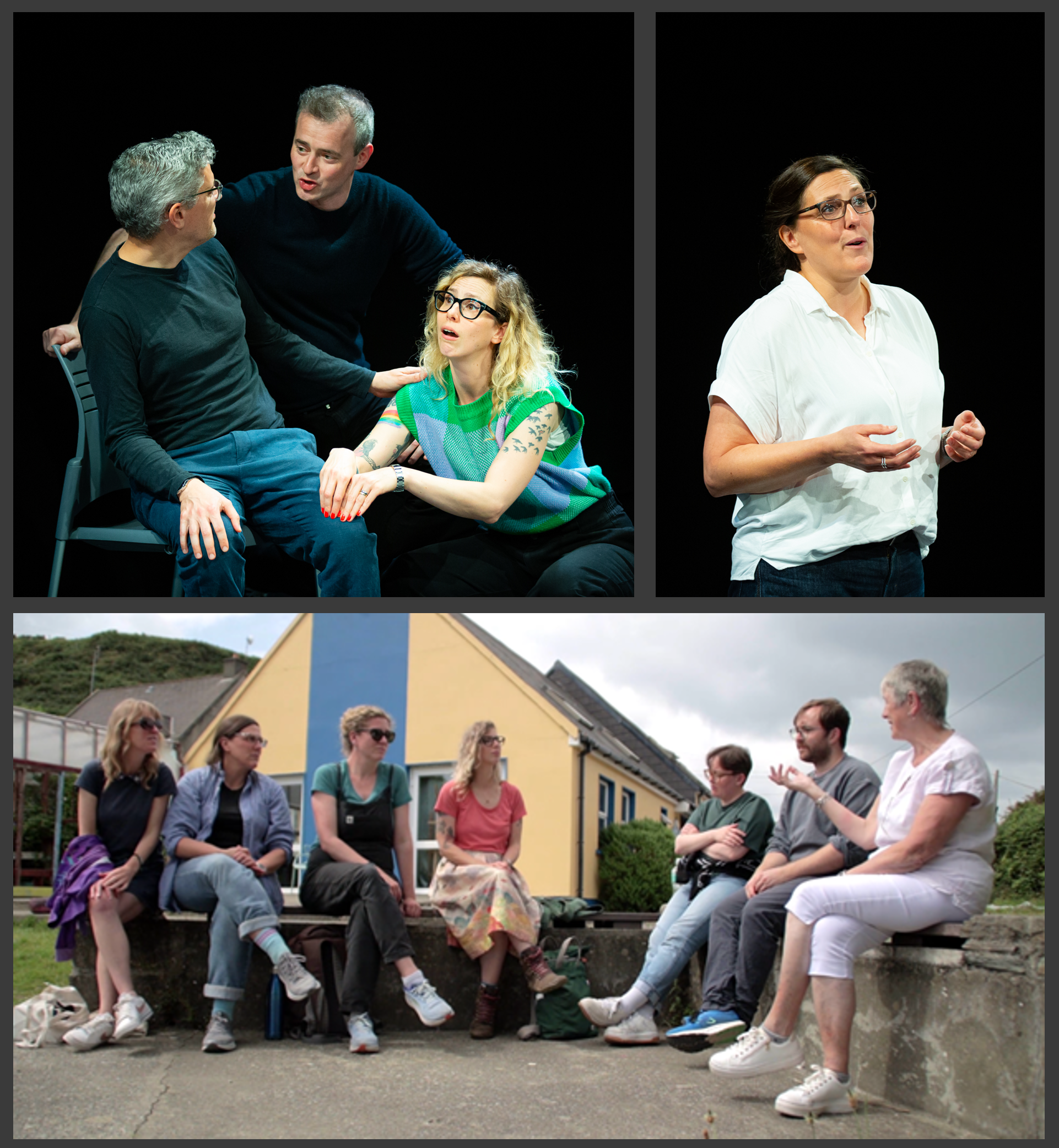
A cast of improvisers and scientists co-created shows about the climate crisis with rural Irish audiences, called ‘We Built This City on Rock and Coal’ (Figure 1). In each show, audiences provided written answers to prompts about nature, climate change, and their emotional responses to both that were the basis for scientists to improvise scientific monologues (2–3 minutes in length) or improvisers to create comedic and dramatic scenes. No material was written in advance, and each show was specific to the audience present and their concerns. Thirty shows were performed in 2023–2025, including two summer tours. Development and mixed methods evaluation of the 2024 summer tour is detailed in [Murray et al., 2026], demonstrating increased self-efficacy around the climate crisis in both audiences and performers. Locations visited were predominantly small and coastal, including eight offshore islands; these communities are on the front lines of sea level rise and increasingly extreme weather events. Venues ranged from arts and community centres to pubs, picnic tables, and parks, recognising that diverse contexts attract diverse audiences and the settings for science communication are not neutral [Philip & Azevedo, 2017]. Locations and local stories influenced the scenes played, referencing the particular problems the community faced, and the worries they had. Creating the show was therefore a process done both with and for the audience [Orthia et al., 2021].
3 Methodology
This paper explores interview responses from improv performers relating to environmental science agency after both tours (mainly collected from responses to the questions in Table 1). Eight performers participated in the interviews in 2024 and six performers participated in the interviews in 2025. Results presented here come from both years. One of the performers interviewed in 2025 was completely new to the project, whilst the remaining five performers interviewed in 2025 had previously taken part in the 2024 tour. Participation in the qualitative interviews was voluntary, and performers could opt out without repercussions at any point. This work was ethically approved by the University of Galway Research Ethics Committee (project number 2024.05.007).
Performers’ answers during the interviews comprised both examples of concrete actions and of previous involvement in the topic. These personal actions around climate change were then coded according to the six domains of choice for climate action published by Hampton and Whitmarsh [2023] (Table 2). The first sorting was made by P.S., triangulated with analysis by C.M. to find consensus for the final coding as well as additional codes needed.
|
Food
|
Energy in the home |
Transport |
Shopping |
Influence |
Citizenship |
|
Low/no meat diet |
Thermostat settings |
Telecommuting |
Sustainable materials |
Talking |
Investing |
|
Seasonal |
Time-shifting electricity usage |
Avoid flying |
Local |
Community involvement |
Voting |
|
Reduce waste |
Micro- generation |
Public transport |
Renting and borrowing |
Volunteering |
Activism |
|
Efficiency measures |
Walking and cycling |
Second hand |
Career choices | ||
|
Switch to EV (electric vehicle) |
Efficient appliances | ||||
|
Repair and reuse | |||||
Each example was further coded under subdomains (Table 2) and examined. Some actions were assigned to multiple subdomains, for example attending a swap shop to exchange clothes with other people was coded both as ‘Second hand’ and ‘Local’ within the ‘Shopping’ domain. However, multiple mentions of the same action by the same performer were only counted once. To capture the full range of climate actions shared by the performers, additional subdomains were added, and some others were repositioned in the model developed by Hampton and Whitmarsh [2023]: reducing waste not (necessarily) related to food consumption, recycling behaviours, and a commitment to educating themselves.
3.1 Limitations
A clear limitation is that performers willing to engage with this project are probably more comfortable talking about climate change than those who didn’t. They may already be taking action or thinking about the climate crisis. They were aware of the central theme of the tour before agreeing to take part, so this may have affected their decision to participate.
Climate actions were not the main focus of the interviews, and performers were only asked a limited number of questions relating to this. It is therefore very likely that they are also taking other actions that they did not mention. Despite this limitation, these data provide insights into the type of actions that the performers were reflecting on and taking after their tour, so are included here.
The number of performers involved in the two tours is also relatively small, which limits the statistical significance of some of the results. All authors are involved in the project but were not interviewed for this project.
4 Environmental science agency
Environmental science agency as reported by the performers was captured in terms of their individual actions, affective impact of the project, and the communities they visited and created over the course of the tour(s).
In the interviews, the diversity of the 84 individual climate actions reported covered all of the six domains of choice (Figure 2). The most popular subdomain by far was ‘Reduce Waste’, but it included both food and not food related waste; to better reflect this, the action was placed between the ‘Food’ and ‘Shopping’ domains. Similarly, to best represent the interview responses, subdomains ‘Recycling’ and ‘Education (self)’ were added. ‘Energy in the home’ was the least popular domain, whereas ‘Food’ was the only domain where all subdomains were mentioned. ‘Shopping’ was the domain with the most overall actions, even before adding the ‘Recycling’ action, followed by ‘Food’. The new action, ‘Education (self)’, contributed to ‘Citizenship’ being the third most popular domain for actions, though some of the performers were also very active in other actions from that domain.
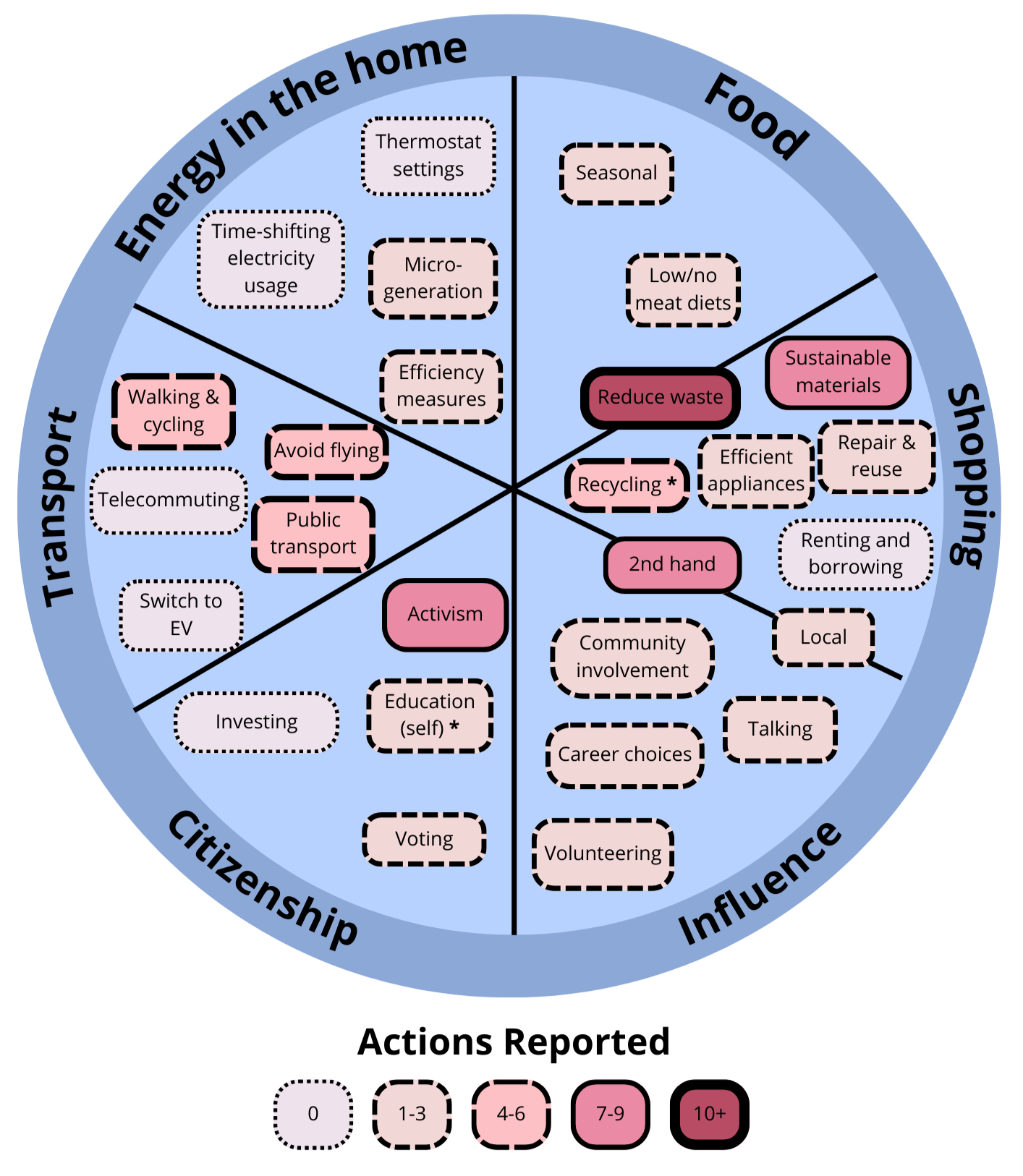
Education was a recurring topic, whereby performers specifically mentioned pursuing opportunities to learn about climate change and climate actions for themselves. Recycling was also very popular, with performers citing it as one of the most straightforward individual actions to take. Most performers focused on actions that were free from financial constraints, with expensive actions such as switching to EV or investing not being reported. Telecommuting was also not mentioned, which is unsurprising giving the need for physical presence for performances.
4.1 Individual actions
Many performers reported changes in individual climate actions based on participation in the show, such as mindful buying, using reusable cups, thrifting to source clothes as necessary, reducing plastic consumption and travel.
“I’m definitely looking at my plastic much more since doing the show… [I]t’s more at the front of my choices. Know about my purchases, I suppose? Things like liquids and shampoo bars, also thinking about travel a bit more, because I do travel for work a fair bit, and [something I have been] thinking about is slow travel… looking at it a bit more like, could I combine 2 things rather than taking 3 flights.”
Recycling was a major topic for all performers (Figure 2), even before starting the shows. This likely reflects implementation of European (e.g. 1999/31/EC, 2008/98/EC, 2019/904/EC) and Irish legislation and policies such as the 2004 Irish National Waste Prevention Programme and the ‘Race for Waste’ Campaign [Byrne & O’Regan, 2014], which have influenced waste management behaviours and people’s willingness to recycle in Ireland. The 2024 Deposit Return Scheme for bottles and cans has enhanced public conversation around recycling and increased access to facilities, coupled with financial incentives. The pro-environmental attitudes of performers mean they were already more likely to recycle [e.g. Corrado et al., 2022], enhanced by improved convenience and cost, as well as increased environmental science agency from participation in the show.
“Recycle everything possible, even preaching at other people to recycle things they didn’t know were recyclable.”
Other actions were limited by factors such as the cost associated with sustainable and ethically produced materials, compared to other mass-produced options. The cost of more sustainable solutions such as EVs prevented performers from engaging with them, reflecting a barrier impacting the wider Irish public [Department of Climate, Energy and the Environment, 2024].
“I’m currently switching over to a sustainable wardrobe, not shopping at [multinational low-cost fashion store] and I already shopped second hand shops. So I’m doing that, but also not trying to buy blended clothes, trying to buy cotton and linen as much as my budget allows. You know, it’s expensive, very expensive.”
The inherently political nature of the climate crisis means that public engagement on climate change topics necessitates political engagement to drive action [Carvalho et al., 2017]. Some performers were already active in the political realm and local community, routinely writing to local representatives about climate issues. For some, the act of performing in the show created connections for future citizenship actions they could take.
“When I’m voting, when somebody comes to my door, I make sure that they know [climate] is one of my top three priorities.”“Now I know more about groups, have contacts with people who know more about this than I do (…) Action groups, protest groups that I can get involved with, to have our concerns more heard.”
Some performers shared experiences of more critical engagement with environmental messaging after the shows, such as looking for greenwashing. These practices demonstrate using newly acquired environmental science expertise as a foundation for change [Ballard et al., 2017].
“And I think I probably spent a lot more time in the shop than I would have before, had I not done the show and thought about it, I was like, oh, what does this really mean? Is it just trying to sell me something, you know?”
Increased engagement with nature after the shows was also highlighted by some performers, which has been shown to support mental and physical health as well as pro-environmental action [Carlin et al., 2020].
“There was no purpose behind it, it wasn’t purposefully trying to spend more time in nature, I just found myself spending… more time in nature. At the beginning of 2025, I just find myself outdoors. A lot.”
4.2 The importance of affect
Modes of science communication that include more personal elements like affect and creative self-expression have previously been shown to increase self-determination in researchers [Gallagher et al., 2024]. A previous study of several Creative Climate Action projects (the programme which funded this project) demonstrated strong emotional engagement with the climate crisis when using creative approaches, leading to impacts on empathy and solidarity with affected groups [Mac Mahon et al., 2025].
Some, but not all performers felt that their attitude towards the climate crisis had changed after doing the tour(s). Given some of the performers informally shared that they signed up to the tour due to their pre-existing values and concerns relating to climate, participation would not necessarily challenge these values and concerns. As Bouman et al. [2021] highlight, the more individuals worry about the climate, the more likely they are to take and support climate action, such as performing in an improv show about climate change.
“I suppose it’s the same as it always was. I mean, I’m a little bit hopeful. But also fairly pessimistic. I’m pessimistic with a tiny layer of hope.”“I think it’s the same as it was before. It’s something that I tried to put every effort I can… not to worsen the environment.”
However, even though some performers reported no major changes in their climate actions, they reported changes in their emotional responses to the climate crisis. The perception of risk arising from climate change is often interpreted through cognitive lenses, but as Leiserowitz [2006] discusses, affect and emotion often arise before cognition, playing an important role in subsequent risk processing and decision making. The positivity or negativity of affective impressions, as well as how easily and precisely they are defined, can substantially impact judgements [Slovic et al., 2007].
“But one thing that has changed is, like, the optimism involved (…) I’m not doing much more, but I am much more optimistic about the work that I am doing. Which, it certainly has a big personal impact.”“It’s a bit less of a scary elephant in the room. I think having done the show, I think initially there was a feeling of, ‘Oh, how are we going to do comedy by climate change?’ But then you’re like ‘Oh, climate change affects everything.”’
There are notes of optimism throughout the shows and interviews, where the performers positively assert their environmental science agency through seeking to educate and inform themselves.
“I think I’m a little bit more hopeful about our ability to have an impact on it. I think prior to doing the show, I was absorbing a huge amount via the Internet and the news and it can be quite a huge topic to get your head around. There’s a feeling of inertia, and inability to have an impact on it. So, post doing the show and seeing how people are taking little steps in the right way, I was involved, and, I think inspired to take a little bit more ownership about my role in it.”
The spaces opened for the audience as part of co-creation (both via suggestions in the shows and in the post-show discussions) contributed directly to a dialogue that enhanced environmental science agency in the performers, not only by sharing information but by honouring affective responses that were often shared between performers and audiences [Murray et al., 2026].
“I am very optimistic about things. [This] was a really, potentially, emancipatory and transformative type of project within its own confines, because it’s small, and localized.”
Affective change supports the IPCC recommendation for all individuals to educate themselves through knowledge transfer, enabling them to act in different roles to contribute to limiting global warming to 1.5∘C [Creutzig et al., 2023]. During shows, performers started to communicate some climate science through improv, asserting their environmental science agency by transitioning their role from pure improvisers to science communicators. In the interviews, performers related knowledge they have learned through the act of participating in the shows, especially through interactions (both on- and off-stage) with the scientists.
“I certainly called back things in one of the shows that a scientist had related to me the night before. As they were talking about the natural environment and I recalled some of the things in the show and improvised in the moment, I was like, you know what, I have this fact that I learned yesterday, which I think would be really apt to use now.”
4.3 Communities
Hampton and Whitmarsh [2023] identified four diverse sources of influence on climate choice capabilities: individual, social, physical and political. These influences do not work in isolation and their combination results in complex effects on individuals and their behaviour(s). For the performers, these influences are a unique mix including: community engagement (prompts and discussions), engagement with the scientists (show content and social contexts), place-based activities, sustainability workshops and discussions between the performers. All these influences could have contributed to the performers’ changing perceptions of their own capabilities. In interviews and informal discussions, performers often reflected on their learnings from communities they had engaged with and the diversity of challenges faced. Performers noted the contrast between one location where community members were actively using a food waste decomposer and another location nearby where community members highlighted issues relating to inappropriate waste disposal. This highlighted the complexity and diversity of local challenges, and community adaptability and resilience. These experiences emphasize the benefit of situating the show within the communities’ geographic space and the mutual benefit of responding to the communities’ interest and priorities through the show [Orthia et al., 2021].
“I would say that it’s not binary, it’s not. There’s not one way of sorting it out, one way of making it. It’s quite nuanced, and we have to think about the individuals as well as the larger thing… So thinking about all the different angles, and again, trying to not be judgy, just trying to listen to people’s perspectives, and see possible outcomes or improvements.”
The new subdomain ‘Education (self)’ (Figure 2) arose due to repeated mentions of learning and seeking information by the performers. An important aspect of this format of improvised science theatre is that the local contexts provided unique opportunities for both the performers and the scientists to learn from the communities’ expertise. Performers valued this opportunity to learn about local approaches to climate action through the audience prompts and pre-/post-show discussions, perceiving themselves as being in dialogue with community members.
“One thing I learned was that like in this project that people are, we were learning a lot from how people were doing things in their communities.”“And I think it is… I think what is happening in the islands is almost…catching on in a way. I mean that’s entirely anecdotal, but it does seem… It does seem like people are more engaged with climate and with the natural world.”
Performers worried about the impact of the actions they or the communities could undertake, since spheres of action like economy and government can feel out of reach [Crandon et al., 2022]. Exchanges with rural and remote communities brought forward the importance of place, considering elements of infrastructure and transit, as well as the importance of collective and political action. Attachment to place can motivate people to get involved in climate issues, due to the interweaving of individuals’ identities with specific places and their importance for meaning, satisfaction, and fulfilment [Nicolosi & Corbett, 2018]. Island-dwellers have especially distinctive sets of needs, considering the difficulty of obtaining goods and disposing of waste, and the importance of energy independence. Performers often reflected on the communities’ different approaches to environmental science agency and their methods to live more locally and sustainably.
“But in terms of relating to [the audience]. I think, like, you do see these landscapes, there is a kind of feeling of, it isn’t a feeling of come in, do the show, leave. There is a feeling of, these people are really trying to make a go of living sustainably, and are in some ways vulnerable, you know, so there is… there is that persistent feeling. I guess a kind of solidarity there.”
The nature of touring means that performers spend a lot of time together in a very short period, and in this show, they focus intensely on the specific topic of climate change. It is therefore unsurprising that a sense of community is created between the performers. One performer explicitly noted this as a form of community work, and this climate community work is grounded in principles of collective psychosocial resilience [Ntontis et al., 2020]. Performers share an identity as part of the tour group that enables them to share support and resources to deal with the climate crisis, as well as mutually providing solidarity.
“Back home… I suppose my main engagement with climate has been, like, as a passive observer of the horrors, just seeing the news and tipping points… The engaging with the climate science on these tours very quickly builds you up and then slowly, being absent from that kind of climate community work, it very slowly kind of weighs you down, just, like, article by article, you know?”
The community of practice created by the performers continually exchanged knowledge with and beyond rural communities visited. The diversity of these exchanges created a foundation for change for the performers, enabled by the co-creative nature of the show, which increased their environmental science agency.
“The audiences that we met brought their own local knowledge and expertise about climate change and about how their locality and the people in the community are interacting with nature and climate change. So learning from them about how they’re tackling smaller projects within their communities that are specific to what’s happening, whether it’s to do with like an invasive species, or whether it’s to do with like, a part of their diversity that’s retreating or disappearing.”
5 Conclusion
Improvised theatre as an open dialogue between artists, scientists and audiences is a powerful methodology for communicating the climate crisis and other wicked problems in a way that centres communities, increases agency, and co-creates solutions for the challenges it presents. In this Practice Insight, mixed methods were used to evaluate the impact on performers in ‘We Built This City on Rock and Coal’, an improvised show about the climate crisis that toured rural Irish communities in 2024–2025, through the framework of environmental science agency. In interviews, performers in these shows reported new opportunities for climate action, informed by their affective experiences and learnings from scientists, communities visited, and communities formed on the tour. These actions were a basis for change, demonstrating the value of co-created storytelling in climate engagement for both communities and practitioners. The increased environmental science agency reported could be an antidote to the climate anxiety and burnout that can affect science communicators focused on the climate crisis.
This work shows the value of improvisation as a full partner with and not just a tool for science communication (including appropriate financial compensation for performers). While this project focused on the climate crisis, it is likely that the methodology would work well with many other societal challenges involving scientific research. However, from our experience the audience must remain meaningfully involved, as a partner in the events alongside improvisers and scientists. Co-created storytelling, with science and the arts as equal partners, offers a path toward meaningful and equitable engagement between practitioners and rural communities, toward creative and urgently needed climate action.
Acknowledgments
The authors would like to thank all ‘We Built This City on Rock and Coal’ performers and audience members, as well as producers Elaine Donovan and Gwen Spencer Jones without whom the tour would not have been possible. This work was supported by the Research Ireland Discover programme (Award 24/DP/13040), Creative Ireland through their Creative Climate Action programme, as well as the iCRAG Research Ireland Centre in Applied Geosciences, the BiOrbic Research Ireland Centre for Bioeconomy, and the University of Galway. The project was approved by the University of Galway Research Ethics Committee, with project number 2024.05.007.
References
-
Ballard, H. L., Dixon, C. G. H., & Harris, E. M. (2017). Youth-focused citizen science: examining the role of environmental science learning and agency for conservation. Biological Conservation, 208, 65–75. https://doi.org/10.1016/j.biocon.2016.05.024
-
Basu, S. J., & Barton, A. C. (2010). A researcher-student-teacher model for democratic science pedagogy: connections to community, shared authority and critical science agency. Equity & Excellence in Education, 43(1), 72–87. https://doi.org/10.1080/10665680903489379
-
Basu, S. J., Barton, A. C., Clairmont, N., & Locke, D. (2009). Developing a framework for critical science agency through case study in a conceptual physics context. Cultural Studies of Science Education, 4(2), 345–371. https://doi.org/10.1007/s11422-008-9135-8
-
Bennett, N., Alcantar, V., Ravindran, T., Chen, V., Terrell, R., & Dawson, K. (2024). A green moment to share: a theatrical laboratory to explore climate crisis possibilities within single moments. Arts, 13(4), 120. https://doi.org/10.3390/arts13040120
-
Bentz, J., do Carmo, L., Schafenacker, N., Schirok, J., & Dal Corso, S. (2022). Creative, embodied practices and the potentialities for sustainability transformations. Sustainability Science, 17(2), 687–699. https://doi.org/10.1007/s11625-021-01000-2
-
Bevan, B., Mejias, S., Rosin, M., & Wong, J. (2021). The main course was mealworms: the epistemics of art and science in public engagement. Leonardo, 54(4), 456–461. https://doi.org/10.1162/leon_a_01835
-
Boal, A. (2000). Theater of the oppressed. Pluto Press.
-
Bouman, T., Steg, L., & Perlaviciute, G. (2021). From values to climate action. Current Opinion in Psychology, 42, 102–107. https://doi.org/10.1016/j.copsyc.2021.04.010
-
Brownstein, M., Kelly, D., & Madva, A. (2021). Individualism, structuralism and climate change. Environmental Communication, 16(2), 269–288. https://doi.org/10.1080/17524032.2021.1982745
-
Byrne, S., & O’Regan, B. (2014). Attitudes and actions towards recycling behaviours in the Limerick, Ireland region. Resources, Conservation and Recycling, 87, 89–96. https://doi.org/10.1016/j.resconrec.2014.03.001
-
Carlin, C., Kindermann, G., Britton, E., Cormican, M., Domegan, C., Gormally, M., & O’Donovan, D. (2020). Nature and Environment to Attain and Restore Health (NEAR Health) [No. 348]. Environmental Protection Agency. https://www.epa.ie/publications/research/environment--health/research-348-nature-and-environment-to-attain-and-restore-health-near-health.php
-
Carvalho, A., van Wessel, M., & Maeseele, P. (2017). Communication practices and political engagement with climate change: a research agenda. Environmental Communication, 11(1), 122–135. https://doi.org/10.1080/17524032.2016.1241815
-
Corrado, L., Fazio, A., & Pelloni, A. (2022). Pro-environmental attitudes, local environmental conditions and recycling behavior. Journal of Cleaner Production, 362, 132399. https://doi.org/10.1016/j.jclepro.2022.132399
-
Crandon, T. J., Scott, J. G., Charlson, F. J., & Thomas, H. J. (2022). A social-ecological perspective on climate anxiety in children and adolescents. Nature Climate Change, 12(2), 123–131. https://doi.org/10.1038/s41558-021-01251-y
-
Creutzig, F., Roy, J., Devine-Wright, P., Diaz-José, J., Geels, F., Grubler, A., Maïzi, N., Masanet, E., Mulugetta, Y., & Onyige-Ebeniro, C. (2023). Demand, services and social aspects of mitigation. In Climate change 2022: mitigation of climate change. Contribution of working group III to the sixth assessment report of the Intergovernmental Panel on Climate Change (pp. 503–612). Cambridge University Press. https://doi.org/10.1017/9781009157926.007
-
Department of Climate, Energy and the Environment. (2024). Climate conversations 2023 report. Government of Ireland. https://www.gov.ie/en/department-of-climate-energy-and-the-environment/publications/climate-conversations-2023-report/
-
Dowell, E., & Weitkamp, E. (2011). An exploration of the collaborative processes of making theatre inspired by science. Public Understanding of Science, 21(7), 891–901. https://doi.org/10.1177/0963662510394278
-
Enria, L. (2016). Co-producing knowledge through participatory theatre: reflections on ethnography, empathy and power. Qualitative Research, 16(3), 319–329. https://doi.org/10.1177/1468794115615387
-
Fessell, D., McKean, E., Wagenschutz, H., Cole, M., Santen, S. A., Cermak, R., Zurales, K., Kukora, S., Lantz-Gefroh, V., Kaplan-Liss, E., & Alda, A. (2019). Medical improvisation training for all medical students: 3-year experience. Medical Science Educator, 30(1), 87–90. https://doi.org/10.1007/s40670-019-00885-0
-
Gallagher, Á., Fracchiolla, C., & Fairfield, J. A. (2024). Motivation, self-determination and reflexivity of researchers in comedic public engagement. Public Understanding of Science, 34(5), 628–645. https://doi.org/10.1177/09636625241291464
-
Hampton, S., & Whitmarsh, L. (2023). Choices for climate action: a review of the multiple roles individuals play. One Earth, 6(9), 1157–1172. https://doi.org/10.1016/j.oneear.2023.08.006
-
Hulme, M. (2009). Why we disagree about climate change: understanding controversy, inaction and opportunity. Cambridge University Press. https://doi.org/10.1017/cbo9780511841200
-
Keith, L., & Griffiths, W. (2020). “Space plague”: an investigation into immersive theatre and narrative transportation effects in informal pandemic science education. JCOM, 19(07), N01. https://doi.org/10.22323/2.19070801
-
Leiserowitz, A. (2006). Climate change risk perception and policy preferences: the role of affect, imagery and values. Climatic Change, 77(1-2), 45–72. https://doi.org/10.1007/s10584-006-9059-9
-
Mac Mahon, J., Revez, A., Burke, M., Hogan, P., & Nyhan, M. M. (2025). Arts, creative & cultural initiatives for citizen engagement on climate action: insights from Ireland’s creative climate action fund. Current Research in Environmental Sustainability, 9, 100274. https://doi.org/10.1016/j.crsust.2024.100274
-
Murray, C. A., Kindermann, G., Serrano Bravo, P., Schutte, K., McAuliffe, F., Mathieson, A. J., Graham, R., & Fairfield, J. A. (2026). Improvised theatre for public engagement with the climate crisis in rural Irish communities. JCOM, 25(2), A02. https://doi.org/10.22323/157920260105151910
-
Nicolosi, E., & Corbett, J. B. (2018). Engagement with climate change and the environment: a review of the role of relationships to place. Local Environment, 23(1), 77–99. https://doi.org/10.1080/13549839.2017.1385002
-
Ntontis, E., Drury, J., Amlôt, R., Rubin, G. J., & Williams, R. (2020). What lies beyond social capital? The role of social psychology in building community resilience to climate change. Traumatology, 26(3), 253–265. https://doi.org/10.1037/trm0000221
-
O’Connell, C., McKinnon, M., & LaBouff, J. (2020). One size does not fit all: gender implications for the design of outcomes, evaluation and assessment of science communication programs. JCOM, 19(01), A06. https://doi.org/10.22323/2.19010206
-
Ojala, M. (2023). Hope and climate-change engagement from a psychological perspective. Current Opinion in Psychology, 49, 101514. https://doi.org/10.1016/j.copsyc.2022.101514
-
O’Mahony, D., Quinlan, C., Cotter, D., Rochford, M. F., Leiserowitz, A., Regan, A., Carman, J., & Rosenthal, S. (2024). Climate change in the Irish mind: wave 2, report 1. Environmental Protection Agency. https://www.epa.ie/publications/monitoring--assessment/climate-change/climate-change-in-the-irish-mind-wave-2-report-1.php
-
Orthia, L. A., McKinnon, M., Viana, J. N., & Walker, G. (2021). Reorienting science communication towards communities. JCOM, 20(03), A12. https://doi.org/10.22323/2.20030212
-
Philip, T. M., & Azevedo, F. S. (2017). Everyday science learning and equity: mapping the contested terrain. Science Education, 101(4), 526–532. https://doi.org/10.1002/sce.21286
-
Preis, H., Bojsza, E., Lindenfeld, L., & Pati, S. (2021). Medical improvisation improves communication skills among healthcare professionals. Communication Center Journal, 7(1), 95–107.
-
Roche, J., Fairfield, J. A., Gallagher, Á., & Bell, L. (2020). Bright club: establishing a science comedy variety night in Ireland. Science Communication, 42(1), 130–140. https://doi.org/10.1177/1075547019890347
-
Slovic, P., Finucane, M. L., Peters, E., & MacGregor, D. G. (2007). The affect heuristic. European Journal of Operational Research, 177(3), 1333–1352. https://doi.org/10.1016/j.ejor.2005.04.006
-
Spolin, V. (1999). Improvisation for the theater: a handbook of teaching and directing techniques. Northwestern University Press.
-
Tyszczuk, R. (2021). Collective scenarios: speculative improvisations for the Anthropocene. Futures, 134, 102854. https://doi.org/10.1016/j.futures.2021.102854
-
Van der Linden, S., Maibach, E., & Leiserowitz, A. (2015). Improving public engagement with climate change: five “best practice” insights from psychological science. Perspectives on Psychological Science, 10(6), 758–763. https://doi.org/10.1177/1745691615598516
-
Watson, K. (2011). Perspective: serious play: teaching medical skills with improvisational theater techniques. Academic Medicine, 86(10), 1260–1265. https://doi.org/10.1097/acm.0b013e31822cf858
-
Weitkamp, E., & Almeida, C. (2022). Science & theatre: communicating science and technology with performing arts. Emerald Publishing Limited. https://doi.org/10.1108/9781800436404
About the authors
Claire Murray is an independent researcher based in Berlin, Germany, with extensive experience in the theory and practice of public engagement. Her research interests include informal learning, science communication, citizen science and participatory methods, evaluation and impact measurement, chemistry, social justice and social inclusion. She centres playful and inclusive design, building creative collaborations between communities, scientists, artists, policy makers and others. Claire has a PhD in Supramolecular Chemistry (University of Reading and Diamond Light Source).
E-mail: drclairemurray@gmail.com Bluesky: @drclairemurray.com
Paola Serrano Bravo is currently finishing a PhD in sustainability, public engagement and advocacy within cell and tissue engineering at University of Galway. She integrates her experience with science fairs and community outreach in her science communication work. She led the design of a card game around sustainable practices in the lab and has a weekly radio show on the intersection between art and STEM.
E-mail: P.SerranoBravo1@universityofgalway.ie
Gesche Kindermann is an Environmental Science lecturer and her work is focussed on the interactions between humans and the environment, in areas such as climate change, health and recreation management. She led stakeholder engagement on the NEAR Health project, which aimed to connect people with nature to assist communities in valuing a healthy environment and maintaining healthy lifestyles. She continued this work in the Sheer Wellbeing project exploring access to blue/green spaces in Ireland, in the TIDAL-GES project investigating affordable and clean energy that also enhances the resilience of communities and nature and in the Caomhnú citizen science storytelling project sharing rural communities lived experiences and expertise of climate change and climate action.
E-mail: gesche.kindermann@universityofgalway.ie
Jessamyn Fairfield is a lecturer in the School of Natural Sciences and School of English, Media & Creative Arts at the University of Galway leading research and practice on the intersection between science and the performing arts. She founded Bright Club Ireland, a research comedy variety night which has run 116 events across Ireland and trained hundreds of academics in standup comedy. She believes in democratising knowledge, and has co-created improvised and dance theatre pieces to explore nanoscience, neuroscience, and climate action with communities around the world.
E-mail: jessamyn.fairfield@universityofgalway.ieBluesky: @jessamynfairfield.bsky.social