

1 Introduction
News media are a powerful conduit for conveying information about agricultural biotechnology tools such as genetically modified organisms (GMOs) and gene-edited crops, significantly shaping public understanding and response to these technologies [DeRosier et al., 2015; Marks et al., 2007; McCluskey et al., 2016; Mwale, 2011; Sohi et al., 2023]. News media reporting provides clarity on the scientific aspects of these technologies that may be difficult for a broad audience to understand [Farid et al., 2020] and remain crucial for communicating the current state of knowledge on these innovations, highlighting both potential risks and benefits, while also dispelling misinformation and demystifying complex aspects of the technologies [Outram, 2010]. Through news stories, opinion pieces, and digital content, the media frames the benefits, risks, and ethical considerations associated with biotechnology, which in turn shapes individual attitudes, levels of acceptance, as well as public discourse and regulatory policies [Galata Bickell, 2019; Gustafson & Rice, 2019; Lynas et al., 2022; Vilella-Vila & Costa-Font, 2008].
There is no single, universally effective approach to reporting on agricultural biotechnology and other emerging innovations. Both promotional and critical forms of coverage offer important benefits while also presenting notable limitations. Reporting that privileges compelling narratives and foregrounds expert and elite perspectives can help inform the public and support decision-making; however, such coverage may also contribute to perceptions of elite manipulative intent (PEMI), thereby encouraging mistrust, skepticism, and resistance [Caulfield & Condit, 2012; Dempster et al., 2022; Stubenvoll et al., 2025]. Such promotional framing could oversell scientific advances, obscure risks and uncertainties, neglect alternative viewpoints, and limit public understanding of technological complexity [Cook et al., 2004; Conrad, 1999; Dunwoody, 2008; Stubenvoll et al., 2025]. Conversely, critical or negative reporting that focuses primarily on potential risks and unintended consequences may also hinder the broader uptake and potential benefits of these technologies [Clancy & Clancy, 2016; Faehnrich et al., 2020; Galata Bickell, 2019; S. Jiang & Fang, 2019; Lynas et al., 2022; Vilella-Vila & Costa-Font, 2008]. A good balance is thus needed to help the public make informed decisions on such innovations in their food.
Although GMOs and gene-edited crops have been touted as important technologies that could enhance Africa’s food security by improving pest and disease resistance, drought tolerance, yield, and shelf life, their adoption across the African continent has been slow [Gbadegesin et al., 2022; Sadikiel Mmbando, 2024]. The limited adoption of GMOs in agriculture across Africa is frequently connected to the campaigning efforts of opposing groups and the negative framing they employ when describing the technology [Clancy & Clancy, 2016; Lynas et al., 2022]. As Faehnrich et al. [2020] observe, non-governmental organisations and social movements have long operated as parallel channels of science communication, deliberately leveraging scientific claims to reinforce their viewpoints, steer policy or economic choices, and mobilise public engagement. Groups opposing GMOs have emerged as highly influential social movements that, through carefully crafted messaging and criticism, have significantly hindered the broader global adoption of GMOs [Clancy & Clancy, 2016; Lynas et al., 2022; Gakpo et al., 2025].
Since the start of the 21st Century, a coordinated consumer movement has emerged, built around a consistent set of arguments challenging the use of GMOs, with narratives typically revolving around concerns about sustainability, and the possible environmental harms of GMO products [Gauthier & Kappen, 2017]. For decades, groups critical of GM technology have characterised it as a danger to established models of organic and sustainable farming, with their public campaigns and outreach consistently arguing the adoption of GM technology cannot coexist with the values of environmental care and a natural approach to agriculture [Levidow & Boschert, 2008].
Meanwhile, an extensive study by the U.S. National Academies of Sciences, Engineering, and Medicine, which analysed nearly 900 research publications, concluded that existing GMOs have not reduced overall plant or insect biodiversity on farms and, in some cases, insect-resistant GMOs were associated with increased insect diversity [National Academies of Sciences, Engineering, and Medicine, 2016]. Overall, the report found no definitive cause-and-effect links between GMOs and environmental harm. The report further stated that available epidemiological evidence shows no links between the consumption of GMOs and human diseases or chronic health conditions and noted that GM insect-resistant crops may offer human health benefits by reducing cases of insecticide-related poisoning.
It is worthy to noted that GMOs are often framed as a single thing, when they are actually many different technologies with very varying risks and benefits. This framing problem fuels polarisation such as “GMOs will save the world” versus “GMOs are dangerous”, and “science” versus “anti-science”. In reality, the debate is as much about power, trust, governance, and values as about biology. Public perceptions of emerging technologies are shaped not only by technical characteristics, but also by the broader social and ethical considerations [Bubela et al., 2009].
2 Gene editing in agriculture
GMOs, also referred to as transgenics are crops developed through the introduction of specific gene(s) or DNA from another organism to confer desirable traits such as pest resistance, disease tolerance, improved nutritional quality, or enhanced adaptability to environmental stresses [Prakash et al., 2011; EPA, 2024; Gyau et al., 2009]. For example, GM cowpea, also known as Bt cowpea, was developed by introducing genes from a naturally occurring bacteria to make it inherently resistant to the maruca pod borer pest [Kumar et al., 2021]. On the other hand, gene editing, an advanced form of genetic engineering, is used to improve crops by making specific genetic changes in an organism, without necessarily introducing external genes [Ahmad et al., 2023; W. Jiang & Marraffini, 2015; Mao et al., 2019; Molla & Yang, 2019; Shew et al., 2018; Zaidi et al., 2019]. CRISPR (Clustered Regularly Interspaced Short Palindromic Repeats) is the most popular gene editing system [Grieger et al., 2024; Lawson et al., 2024; Xu & Li, 2020]. It is an immune system found in bacteria and archaea which acts like a pair of molecular scissors that can be used to precisely cut organisms’ DNA and either delete a piece of DNA or insert a new sequence of DNA, as a way of conferring desired traits [Chen et al., 2019; Grieger et al., 2024; Prillaman, 2024; Lawson et al., 2024; Smith, 2025].
Gene editing technologies have surpassed initial expectations in plant science and breeding, rapidly becoming the method of choice in many research studies and widely adopted in life-science laboratories for their precision and efficiency in crop improvement [Ricroch et al., 2024; Wang et al., 2020]. Agricultural stakeholders consider gene editing as among the most promising tools for sustained agricultural productivity amidst increasing biotic and abiotic stresses such as pests and drought [Shilomboleni & Ismail, 2023]. It is a flexible, precise, controllable, cheaper, faster, and efficient technique for enhancing plant traits, boosting yields, improving crop resilience, and elevating the nutritional quality of foods [Gaj et al., 2013; Gao, 2021; Hussain et al., 2018; Kamburova et al., 2017; Schleissing et al., 2019; Wolter et al., 2019].
Compared to GMO technologies, gene editing is expected to be more accessible to smaller laboratories and scientists in developing countries largely due to its relatively lower costs [Karavolias et al., 2021]. It is rapidly gaining traction as an emerging biotech tool (including in Africa), and there are strong expectations of more favourable public acceptance than GMOs, because currently developed gene-edited crops do not introduce foreign DNA [Halterman et al., 2015; Muringai et al., 2020; Qaim, 2020; Tripathi et al., 2022; Zaidi et al., 2019]. At least 12 different gene editing research projects have been launched in/for Africa [Rock et al., 2023]. They include the development of improved varieties of banana that is resistant to bacterial and viral diseases, sorghum that is resistant to the parasitic plant Striga, as well as maize that is drought tolerant, and cacao that is resistant to swollen shoot disease, among others [Rock et al., 2023; Sampedro, 2024; Tripathi et al., 2022]. None of these research projects have reached commercialisation stages yet.
In Ghana, researchers have previously explored CRISPR gene editing to develop a sweet potato variety with enhanced Vitamin A content [Gakpo, 2021]. In 2023, the country’s National Biosafety Authority released guidelines outlining procedures researchers must follow when working on gene-edited crops, making Ghana the fourth country (after Nigeria, Kenya, and Malawi) to establish validated regulations for gene editing in Africa [Dionglay, 2024]. Various organisations including Ghana’s National Biosafety Authority, Open Forum on Agricultural Biotechnology, African Agricultural Technology Foundation, Biotechnology and Nuclear Agricultural Research Institute, Alliance for Science, and Council for Scientific and Industrial Research, have rolled out various campaigns using mainstream media platforms to raise public awareness about gene editing and other biotechnology tools used in agriculture [Gakpo et al., 2025; IITA, 2020; Reuben, 2022; Kenu, 2024; Nkechi, 2022]. This has refocused attention on the media’s role in shaping reader and viewer perceptions of biotechnology tools like gene editing and GMOs in agriculture in Ghana.
3 Media framing of GMOs
Some researchers have reported media coverage across the globe has often framed GMO technology negatively [Esquivel et al., 2023; Galata Bickell, 2019; Levidow & Boschert, 2008; Vigani, 2017]. Some civil society groups consistently frame GM crops as undermining the core principles of sustainable and organic farming, using various advocacy channels including mainstream media to emphasise perceived risks associated with the technology [Levidow & Boschert, 2008]. Through frightening images, narratives have depicted the technology as unnatural, dangerous, and potentially harmful to both human health and the environment [Clancy & Clancy, 2016]. Furthermore, GMOs have been framed as mainly serving the interests of a handful of multinational corporations taking advantage of farmers, undermining food sovereignty by limiting farmers’ choices, and increasing dependency on external inputs like seeds and agrochemicals [Esquivel et al., 2023; Vercillo et al., 2015]. Media framing idealising non-GMOs as “natural” and “pure,” often appeals to emotions, encouraging negative sentiments toward biotechnology [Vigani, 2017].
In Africa, negative portrayals of GMOs in media reports have generally outweighed positive ones. In Uganda, Lukanda et al. [2023] found that media coverage of GMOs increased uncertainty about the science and products of genetic modification. In Kenya, a study analysing GMO media publications in 2022 and 2023 found that 40% of the articles spread misinformation about the technology, including unproven claims that they are harmful to human health, which went unchallenged [Alliance for Science, 2023]. In Nigeria, Omeje [2019] found that the majority of GMO articles emphasised the perceived risks associated with the technology. In Ghana, Kangmennaang et al. [2016] analysed public policy debates on GMOs in the media and found that the discourse is largely shaped by themes of entitlement, loss, and endangerment, and GMOs were often portrayed as risky to both environmental and human health. More recently however, Gakpo and Baffour-Awuah [2024] found that coverage of GMOs in the Ghanaian media often presented it as a key solution to the country’s food security challenges, indicating a divergence from the norm in Africa worthy of further investigation.
4 Media framing of gene editing
While historically and globally, GMOs have often been framed negatively in the media, gene editing, although less studied, has generally been portrayed more positively. The Annenberg Policy Center [2018] analysed headlines of 857 articles that discussed CRISPR gene editing and ethics, published in the USA between 2012 and 2017. They found that coverage was frequently positive (38%) or balanced (43%), with only 19% presenting it negatively. Marcon et al. [2019] examined 228 articles on CRISPR gene editing published in the USA and Canada between 2012 and 2017. They found that 66% of the articles framed CRISPR positively, 28% were neutral, and 6% framed it negatively. The German mass media’s depiction of New Genomic Technologies (NGTs), notably CRISPR/Cas9, was the subject of a frame analysis by Kossmann et al. [2025], spanning the years 2012 to 2023. The study found that narratives emphasising progress and farm productivity were more frequent than dissenting viewpoints (like those focussed on environmental risks or societal rejection). Siebert et al. [2021] also assessed the strategic narratives used in agricultural gene editing discourse in Germany and found that proponents of the technology framed it as an essential technology for scientific progress that warranted greater public faith, rendering new regulations redundant. Furthermore, they positioned gene editing as a solution for food security and hunger, describing it as a natural process, and promoting it as a path toward democratised science. These findings imply a media transition toward a gentler view of gene editing, especially in agriculture, contrasting with the more critical historical coverage of traditional genetic modification.
In June 2022, Ghana’s National Biosafety Authority approved the country’s first GMO, igniting media conversations around GMOs and gene-edited crops [Gakpo & Baffour-Awuah, 2024]. To gain in-depth understanding of how the media in Ghana is covering this emerging technology, our study assessed the framing of gene-edited crops by selected online news platforms. Guided by Media Framing Theory, the objectives of this study were to:
- Describe the characteristics of articles focussed on gene-edited crops published in the Ghanaian news media
- Analyse the sentiments expressed by the headlines, text of main articles and photographs
- Identify the prominently quoted sources and themes that dominated in the coverage of gene-edited crops
5 Media Framing Theory
Media Framing Theory posits that communicators influence public perception by selectively highlighting aspects of issues, emphasising specific facts or angles, omitting details that could alter understanding, and providing contextual depth to reinforce a particular viewpoint [Entman, 1993; Goffman, 1974; Kaplan, 2008; van der Pas, 2013; Velardi & Selfa, 2020]. A frame refers to packaging information in ways that promote a particular interpretation while discouraging alternative perspectives [van der Pas, 2013]. It is a “central organising idea or story line that provides meaning to an unfolding strip of events, weaving a connection among them” [Gamson & Modigliani, 1989, p. 143]. To frame is to “select some aspects of a perceived reality and make them more salient” [Entman, 1993, p. 52]. Through framing, journalists— consciously or otherwise— influence public interpretation by prioritising certain perspectives and emphasising them in news coverage [DeRosier et al., 2015]. This framing effect indicates the mass media’s ability to shape or reshape individuals’ viewpoints, influencing them to adopt either positive or negative perceptions of specific issues [Chong & Druckman, 2007; Druckman, 2001; Kaplan, 2008].
Framing according to Entman [1993], shapes understanding by identifying problems, attributing causes, making moral evaluations, and proposing solutions. Through this process, communicators shape how messages are received and understood because the way information is presented influences audience interpretation and response [Entman, 1993; Goffman, 1974; Kaplan, 2008; van der Pas, 2013; Velardi & Selfa, 2020]. By the logic of this theory, highlighting the risks of a technology more than its benefits fuels negative public attitudes toward that technology [Lore et al., 2013; Marks et al., 2007; Vilella-Vila & Costa-Font, 2008]. The media reflects and shapes public opinion, as reporters integrate their own frames into public discourse, influencing thoughts and how issues are perceived [Gamson & Modigliani, 1989]. Whether conveyed through headlines, written articles, or broadcast narratives, the intentional choice of language by news outlets can elicit specific emotions, spotlight particular elements of a story, and steer the narrative in a way that ultimately shapes audience opinions, attitudes, and perceptions [Mayor et al., 2022; Rodrigo-Ginés et al., 2024].
6 Methodology
This study analysed stories collected from six purposively selected Ghanaian online news platforms, comprising the three most read private news portals, and all three of the state-owned online news websites. The Multimedia Group Limited’s www.myjoyonline.com, Africaweb Holding Group’s www.ghanaweb.com and Modern Ghana Media Communication Limited’s www.modernghana.com were the three most visited Ghanaian private news portals as of December 2024, with a combined traffic of 1.3 million [Ahrefs, 2026], in a country with a population of 30 million [Ghana Statistical Service, 2021]. Ghana has only three state-owned online news portals: the Ghana News Agency’s www.gna.org.gh, the Graphic Communications Group’s www.graphic.com.gh, and Ghana Broadcasting Corporation’s www.gbcghanaonline.com [BBC, 2023; Stanford University Libraries, n.d.]. We used 11 keywords to search for articles published on these online news portals about gene-edited crops over the four-year period between January 2021 and December 2024:
“Gene editing”, “Genome editing”, “Gene-editing”, “Genome-editing”, “CRISPR”, “CRISPR gene editing”, “CRISPR genome editing”, “Gene-edited food”, “Gene-edited crops”, “Genome-edited foods”, and “Genome-edited crops”.
The January 2021 to December 2024 period was chosen for this study because it represented two-and-half years before the approval, and one-and-half years after the approval of the country’s first GMO (Bt cowpea), and there were heightened media publications on agricultural biotechnologies. This intensified conversations about agricultural biotechnologies were also spurred on by discussions on alternatives to ensure food security, post-Covid-19. Our early searches revealed that prior to this period, there was minimal reporting about gene editing and Ghana’s agriculture.
We searched for articles specifically on CRISPR / gene / genome editing in food and agriculture. If an article covered gene editing in agriculture, alongside other areas such as health, such stories were included, even if gene editing in agriculture was mentioned minimally. Articles that mentioned both gene editing and GMOs were included, even if gene editing was mentioned minimally. Articles that mentioned gene editing in agriculture, even in passing were included.
Articles on gene/genome editing in health and other areas alone, without the mention of the technology in agriculture, were excluded. Articles on GMOs or genetically engineered crops or biotechnology crops that do not mention gene/ genome editing/ CRISPR, were excluded.
This study employed a mixed-methods research design, integrating quantitative content analysis and qualitative thematic analysis to examine the media framing, frequency, and tone of coverage of gene editing in Ghana between 2021 and 2024. Quantitative research helps establish relationships, test hypotheses, and assess attitudes, while qualitative research helps develop hypotheses, as well as explore complex processes such as communication and decision making [Verhoef & Casebeer, 1997]. Employing both methods of analysis provided a complete and well-rounded understanding of the research problems. While the quantitative aspect generated factual, reliable and generalisable data, the qualitative analysis provided rich, detailed, valid and data grounded insights [Verhoef & Casebeer, 1997].
We adapted our quantitative coding variables from Ruan et al. [2019] and Wandati [2024] to assess how the media framed the headlines, main articles and photos accompanying the publications. Articles were coded as portraying positive sentiment if they emphasised benefits, successes, opportunities, or favourable outcomes of gene editing; negative sentiment stresses risks, harms, failures, or controversy; and neutral coverage presents information in a descriptive manner without clear approval or disapproval. Descriptive statistics (frequency analysis) were used to summarise the characteristics of the data and draw conclusions about differences across the media reports [Ott & Longnecker, 2015; Privitera, 2014]. Two researchers independently coded 11 articles, representing 20% of the total sample, and intercoder reliability was calculated using Holsti’s [1969] formula. Reliability scores ranged from 91% to 97%. See Appendix A for coding book. The degree of agreement between the coders for all 56 articles was also evaluated using Krippendorff’s alpha (α). The Krippendorff’s alpha for the various variables ranged from 0.782 to 1. Appendix B reports Krippendorff’s alpha for each code.
Additionally, we undertook inductive qualitative analysis of the full textual content of the articles, to identify and interpret patterns of meaning, as well as uncover underlying themes that provide deeper insights into how media articles framed gene-edited crops [Boyatzis, 1998; Elliott, 2018; Naeem et al., 2023; Thomas, 2006]. The general inductive approach offers a straightforward and systematic framework for analysing qualitative data, enabling the generation of reliable and valid findings [Thomas, 2006]. It involves condensing raw textual data into concise formats, linking the findings directly to the research objectives, and constructing a framework that reveals the underlying structure of the data [Thomas, 2006]. While the quantitative analysis offered measurable insights into patterns of coverage and descriptive profiles of the media content, the qualitative analysis provided interpretive depth into how gene-edited crops were constructed by the media.
7 Results
Fifty-six (56) published articles were identified following the search. Table 1 provides a breakdown of the number of stories obtainable within the period the search was conducted, using the keywords listed above in the methods section.
| Media house | Type of news portal | No of publications |
| Gna.org.gh | Public | 18 |
| Graphic.com.gh | Public | 6 |
| Gbcghanaonline.com | Public | 4 |
| Myjoyonline.com | Private | 13 |
| Ghanaweb.com | Private | 6 |
| Modernghana.com | Private | 9 |
| Total | 56 | |
The result of our quantitative analysis shows that half of the articles (n = 28) were published on public media platforms and the remaining half appeared on private media platforms, indicating a coincidentally equal split. Also, more than half of the 56 articles identified, were published in 2023 (n = 33). This is likely the result of the approval of the country’s first GMO in 2022, which encouraged increased media conversation about agricultural biotechnology throughout the rest of 2022 and 2023 [Gakpo & Baffour-Awuah, 2024]. Figure 1 shows the distribution of articles by year (2021–2024).
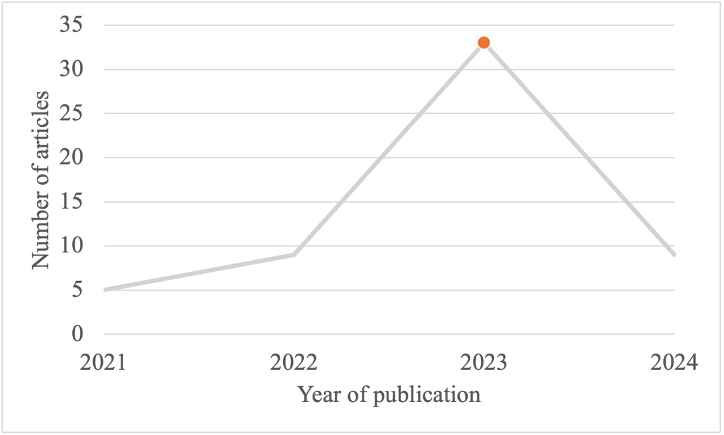
The Ghana News Agency had the highest number of identified articles (nearly one third, n = 18), with Gbcghanaonline.com recording the lowest (4 articles). Named journalists were listed as authors of 32 of the articles, with the rest listing names of the media organisation or other media houses, and non-journalists as authors. Scientists / academics (including plant breeders, crop scientists, plant biotechnologists, and other natural science researchers) and government officials who are not politicians (including officials of regulatory authorities and agricultural officers), were quoted most prominently in the majority of articles, with both sources being quoted in half (n =28) and nearly one third (n = 17) of articles respectively (see Table 2). Notably, none of the articles quoted an anti-biotechnology activist. Three quarters of the articles (n = 42) were event based, where journalists mainly reported what transpired at press briefings, conferences, training programs and meetings.
|
Characteristics of articles | Count |
|
Number of publications | |
|
2021 | 5 |
|
2022 | 9 |
|
2023 | 33 |
|
2024 | 9 |
|
Total | 56 |
|
Listed author | |
|
Named journalist | 32 |
|
Named non-journalist | 13 |
|
Name of news organisation | 9 |
|
Another media house | 2 |
|
Total | 56 |
|
Most prominently quoted sources | |
|
Politician | 2 |
|
Non-political government official (e.g., regulator) | 17 |
|
Scientist or academic | 28 |
|
Pro-biotechnology civil society activist | 4 |
|
Other pro-biotechnology officials (e.g. farmer, seed company official) | 4 |
|
No quoted individual | 1 |
|
Anti-biotechnology activist | 0 |
|
Total | 56 |
|
Kind of article | |
|
Event based | 42 |
|
Self-commissioned article | 14 |
|
Total | 56 |
Analysis of the headlines shows that the majority of them expressed positive sentiments about gene editing (see Table 3). Examples include Ghana News Agency’s article from January 2024, “Genome editing— a potential panacea to Africa’s food insecurity”, a December 2022 Graphic.com.gh article headlined “Genome editing technology key to protecting Africa’s ecosystem”, and a June 2023 Gbcghanaonline.com article headlined, “Benefits of Genome Editing to Africa.” None of the headlines expressed negative sentiments. Also, the majority of the article headlines stated definitive positions on gene editing, with only one headline ending with a question mark.
| Characteristics of article headlines | Count |
| Sentiments | |
| Positive | 38 |
| Negative | 0 |
| Neutral | 7 |
| Does not reference gene editing | 11 |
| Total | 56 |
| Nature of headline | |
| States definitive implications of gene editing | 44 |
| Does not reference gene editing | 11 |
| Raises questions about gene editing | 1 |
| Total | 56 |
The majority of articles provided some explanation of what gene editing is (see Table 4). Most articles expressed positive sentiments about gene editing, with three quarters of those articles claiming that gene editing would improve food security. Few articles (n = 2) discussed ethical, legal and social implications of the technology. The majority of articles quoted Ghanaian and African experts on the potential benefits and necessity of gene editing, as compared to international experts.
|
Characteristics of main content of articles | Count |
|
Provides background about gene-editing? | |
|
Yes (Substantial background) | 24 |
|
No | 5 |
|
Little background | 27 |
|
Total | 56 |
|
Sentiment about gene editing | |
|
Positive | 55 |
|
Neutral | 1 |
|
Negative | 0 |
|
Total | 56 |
|
Benefits or negative implications of gene editing | |
|
Food security | 40 |
|
Economic | 8 |
|
Health | 5 |
|
Sociocultural | 2 |
|
Environmental | 1 |
|
Total | 56 |
|
Any ethical, legal and social concerns? | |
|
Yes | 2 |
|
No | 54 |
|
Total | 56 |
|
Does the article quote data from international institutions such as WHO, EU, FAO, African Union, USAID, USDA, etc? | |
|
Yes | 34 |
|
No | 22 |
|
Total | 56 |
|
Institutional affiliation of dominantly quoted expert sources | |
|
International organisations such as African Union, WHO | 20 |
|
Ghanaian scientists and academics | 19 |
|
Ghanaian non-academic experts | 14 |
|
None | 3 |
|
Total | 56 |
Photographs accompanying the articles were also analysed to identify their nature and the sentiments they communicate. The majority of the photographs used in the articles (n = 45) can be described as neutral, with human beings (often those quoted) dominating. Table 5 presents a descriptive analysis of the photos that accompanied the articles.
| Characteristics of photos | Count |
| Sentiments about gene editing | |
| Positive | 9 |
| Negative | 2 |
| Neutral | 45 |
| Total | 56 |
| Animate and inanimate objects in the photos | |
| Human beings | 30 |
| Crops | 8 |
| Friendly inanimate object | 5 |
| Fearful inanimate object | 1 |
| Humans & non-animate object | 8 |
| No image | 4 |
| Total | 56 |
In summary, half of the 56 articles analysed were published on public media platforms and the other half on private platforms, with most articles published in 2023. The coverage was largely event-based and most articles expressed positive sentiments about gene editing. These findings suggest a strongly pro-biotechnology media environment in Ghana, which may shape public perception and policy discourse around gene editing, with limited exposure to critical or alternative viewpoints. The implications of these findings will be discussed further below.
Our qualitative analysis revealed that gene editing was mainly framed in the media articles as a high-end technological advancement, a nationally beneficial and a universally accepted technology.
7.1 Gene editing as a high-end technological advancement
The media articles predominantly framed gene editing as an efficient, high-end technological innovation that is distinct from GMOs, with gene-editing positioned at the apex of scientific advancement in agriculture. The technology was presented as the most advanced, sophisticated, and cutting-edge tool in agricultural production that surpasses other innovations currently available in the sector. In these portrayals, gene editing was touted as a transformative technological breakthrough, and a modern, viable alternative to existing agricultural innovations with unlimited potential. The term “tech”, for example, was mentioned at least 598 times across the 56 publications reviewed, appearing in various forms such as “technology,” “biotech,” or “biotechnology,” highlighting the centrality of the rhetoric of technological advancement as a frame of news reporting about gene editing. The media articles often re- emphasised scientists’ perspectives that gene editing allows for precision in agriculture, where traits can be enhanced without worrying about the characteristic unpredictability of traditional breeding methods and other genetic modification methods. For example:
Genome editing changes the DNA of animals, plants and microorganisms with high precision. The technology has a wide range of applications…(Article GNA2309 on Gna.org.gh)
About a decade ago, a more advanced form of genetic engineering technology called gene editing or genome editing was discovered. This technology allows scientists to break, insert or delete DNA strands of an organism, as a way of improving upon it to create beneficial traits.
(Article MYJ2204 on Myjoyonline.com)
Genome editing is not a classical way where the gene is transferred from donor to the recipient through the gene gun or the agrobacterium. It is the same organism, and the gene is edited in the organism.
(Article MODGH2302 on Modernghana.com)
Gene Editing is a tool with unlimited potential to reduce malnutrition… The potentials seem limitless in terms of what can be done with gene editing and CRISPR.
(Article MODGH2103 on Modernghana.com)
7.2 Gene editing as a nationally beneficial technology
Across the reviewed publications, gene editing was consistently framed as a beneficial and transformative technology, offering a wide range of advantages for Ghana’s environment, economy, and food security systems. The media reports framed gene editing as a scientific breakthrough capable of addressing entrenched agricultural and developmental challenges. This aligns with the quantitative analysis, which showed nearly three quarters of the articles (n = 40) indicated gene editing could benefit Ghana’s food security, with 8 articles highlighting its potential economic benefits for the country. The technology was portrayed as a safe, efficient, and forward-looking solution that could drive national progress while mitigating environmental degradation and food insecurity. For example:
Scientists have found a new technology to extend shelf life and improve storage in food crops, especially perishable vegetables like tomatoes, cabbage, carrot, and peppers. It will reduce pre-and post-harvest losses while conveying crops from farm to storage and market. The technology, called Genome Editing (GEd) when embraced, will also reduce incidence of traces of pesticide on vegetables and farmers’ cost of buying agro chemicals.(Article GHWEB2303 on Ghanaweb.com)
There is an urgent need for more food to be produced on less land with less chemicals… The development of improved varieties of our staple crops with high yields and resistance to the physical and biological stresses (through gene editing) is absolutely necessary for a green revolution and food self-sufficiency in Ghana.
(Article GNA2304 on Gna.org.gh)
The technology is to aid farmers to produce crops according to their desires and market suitability, rather than doing it by chance. Genome editing / gene editing, is a group of technologies that give scientists the ability to change an organism’s DNA or genes.
(Article GRAPH2401 on Graphic.com.gh)
In nearly all the articles, gene editing was associated with increased productivity through the development of crops with enhanced traits such as drought tolerance, pest resistance, and improved nutritional content. These benefits were often linked to broader national and continental aspirations, with the technology being described as a scientific answer to pressing agricultural problems. The framing was optimistic, emphasising how genome editing could lead to environmental sustainability by reducing the need for chemical pesticides and fertilisers, thereby lessening agriculture’s ecological footprint. For example:
GEd has the greatest potential of addressing pest and disease infestation of crops in the midst of climate change issues to increase food production… It is an emerging and affordable biotechnology tool that has great promise to deliver high-yielding crop varieties, able to withstand various stresses such as droughts, floods, insect pests, or diseases and possesses quality traits for use as food, feed, or for processing(Article GNA2310 on Gna.org.gh)
Additionally, the media articles highlighted the economic potential of gene editing, not only for individual farmers through improved yields and reduced input costs, but also for Ghana’s broader agricultural economy. The technology was positioned as a means of strengthening food systems, reducing hunger, and creating new opportunities for agro-industrial development. Farmers, consumers, and the nation were all described as potential beneficiaries of this innovation. In this way, the technology was linked to increased production, national economic growth, improved livelihoods, and public health gains. For example:
A Cellular and Molecular Neuroscientist, who made the call, said developing countries, particularly those in Africa, must embrace biotechnology to help in transforming the agricultural sector for increased food production and growth.(Article GNA2402 on Gna.org.gh)
Safety was another central narrative. Media articles emphasising the benefits of gene editing were quick to add that the technology is non-harmful and ethically sound. For example:
He allayed public fears regarding biotechnology (gene editing), adding that the precision science goes through vigorous safety checks at all points of its development.(Article GBC2301 on Gbcghanaonline.com)
7.3 Gene editing as a universally accepted technology
The media articles also largely portrayed gene editing as a universally accepted technology, particularly emphasising its growing recognition and endorsement by the African Union and other countries. The coverage framed it as a mainstream scientific advancement that enjoys broad-based support from governments, scientific communities, and global institutions. For example:
The technology (gene editing) has so far received a lot of buy-ins from many advanced and developing countries alike. Countries such as the USA, Argentina, Spain, Canada, Australia, India, Pakistan, Romania, Poland, Czech Republic, Paraguay, Uruguay, Slovakia, South Africa, and Nigeria are all making giant strides from the technology.(Article GRAPH2301 on Graphic.com.gh)
The technology was also depicted as an acceptable and strategically aligned tool that fits seamlessly into both global and African developmental agendas. Media publications frequently referenced the technology’s alignment with continental aspirations, notably the African Union’s vision for achieving food security. Gene editing is situated within the broader narrative of Africa-led innovation, suggesting that the continent is not merely a recipient of foreign technologies, but an active driver of biotechnological solutions tailored to its unique challenges. The media also tied gene editing to global development frameworks, most prominently the United Nations Sustainable Development Goals (SDGs). For example:
The application of genome editing is consistent with the African Union Agenda 2063 and the Sustainable Development Goals, and it is for this reason that the AUDA-NEPAD project on genome editing must be seen as a forwarding-looking project that must enjoy the support of all African governments.(Article GNA2404 on Gna.org.gh)
The UN SDGs, among other things, enjoin signatory countries to end poverty in all its forms everywhere and achieve zero hunger for their citizens by 2030…Farmers’ adoption of improved varieties birthed from gene editing would lead to sustainable, nutrient — efficient food production, resulting in food security in Ghana.
(Article GNA2403 on Gna.org.gh)
Employing language suggesting that gene editing is universally beneficial and widely accepted contributes to building global legitimacy and credibility for the technology.
8 Discussions
In this study, we set out to describe the characteristics of articles focussed on gene-edited crops published in the Ghanaian news media, analyse the sentiments expressed by the headlines, text of main articles and photographs, and identify the prominently quoted sources and themes that dominated the coverage of gene edited crops. Our analyses reveal that Ghanaian online media predominantly engaged in pro-innovation framing of gene editing, portraying it in an overwhelmingly positive light as a highly efficient scientific solution to food systems challenges facing Ghana and Africa. All but 1 of the articles framed gene editing in crops positively, with the remaining article content demonstrating neutral sentiments. This overwhelmingly positive framing of gene editing technology in Ghana aligns with findings from previous studies in other parts of the world, including the USA (between 81 and 91% of media reports portray gene editing as positive or neutral [Annenberg Policy Center, 2018; Marcon et al., 2019] ) and Germany (narratives emphasising progress and farm productivity were more frequently used to discuss gene editing [Kossmann et al., 2025] ). Although the contexts differ, our findings show strikingly similar patterns, which suggests the need for further research into reporting in other national contexts.
The predominantly favourable depiction of gene editing technology in Ghana’s online news outlets, however, stands in stark contrast to the way GMOs have been historically framed in the media across the rest of Africa. Existing literature shows that media reports on GMOs intensified ambiguity regarding the underlying science and resulting products of genetic modification in Uganda; they contained unverified and unchallenged claims of human endangerment in Kenya; and GMO-related articles highlighted the potential hazards associated with the technology in Nigeria [Alliance for Science, 2023; Lukanda et al., 2023; Omeje, 2019]. Nonetheless, Ghana’s positive media coverage of gene editing is consistent with the findings of Gakpo and Baffour-Awuah [2024], who reported that the Ghanaian media frequently presented GMOs as a critical remedy for the nation’s food security issues.
The largely pro-innovation and overwhelmingly positive framing of gene editing in the Ghanaian media may be attributed to three key factors. First, our analysis shows that approximately three out of every four articles were event-driven, with coverage centred around training workshops, press briefings, and conferences organised by local and international institutions that are actively promoting gene-editing technology. As such, journalists’ engagement with the subject may be shaped by the agendas and narratives presented at these events. The news media’s heavy reliance on events as primary sources for reporting limits the scope of journalistic inquiry, reducing the likelihood of in-depth, independent investigation. This finding resonates with previous studies in the UK that revealed journalists covering GMOs prioritised ‘good stories’ over nuanced or critical perspectives, thus limiting exposure to dissenting views [Cook et al., 2004]. News frames have the potential to significantly influence readers’ beliefs, attitudes, and behaviours [DeRosier et al., 2015; Druckman, 2001; Entman, 1993; Mayor et al., 2022; Oliver et al., 2019; Rodrigo-Ginés et al., 2024; Velardi & Selfa, 2020] and journalists have a responsibility to ensure the public is exposed to a broad range of perspectives so that they can make informed decisions on gene-edited foods.
Additionally, the news articles analysed in this study rarely engaged with the potential legal, ethical, and social implications of gene editing, focusing predominantly instead on the technology’s promise to improve food security in Ghana. This shows narrow reporting that contrasts discourse of gene editing in the Western world. In the West, the advancement and application of genetic modification have raised a host of ethical and societal concerns, including the potential unintended consequences, transparency and credibility of biotechnology institutions [Bubela et al., 2009; Grieger et al., 2024; Lawson et al., 2024]. Lay audiences not only seek to understand the technical aspects of emerging biotechnologies in food and biomedical research but are also interested in their social and ethical dimensions [Bubela et al., 2009]. The Ghanaian online media outlets’ inability to reflect these broader ethical, legal and social concerns in its reporting deprives the public of the critical context needed to make informed judgments about gene editing. Without balanced coverage that includes both promises and potential pitfalls, as well as both lay and expert voices, the media risks limiting meaningful dialogue on the responsible governance of emerging biotechnologies. Because scientific expertise does not encompass all relevant forms of knowledge, technological development requires engagement with diverse perspectives, especially those that contest prevailing scientific values, interpretations, or expectations [Davies & Horst, 2016]. Diverse forms of expertise in science engagement should be understood as assets rather than obstacles [Stilgoe et al., 2006].
Furthermore, the news articles overwhelmingly quoted government regulatory officials, scientists, and academic experts who are generally supportive of biotechnology. No anti-biotechnology activists or sceptical voices were cited in any of the media articles, creating a lack of balance and diversity in perspectives. Public perceptions and attitudes toward emerging technologies like biotechnology often reflect how these topics are represented in the media, largely because publics have limited direct experience with such innovations [Marks et al., 2007; McCluskey et al., 2016], and balanced media coverage is essential for individuals to make informed decisions. Inadequate and inaccurate media reports or those driven by misinformation and rumours can distort public understanding, create controversy and impede access to scientific innovations [Galata Bickell, 2019; S. Jiang & Fang, 2019; Vilella-Vila & Costa-Font, 2008]. Conversely, overly promotional reporting that prioritises the views of elite proponents, such as in the case of gene-editing coverage in the Ghanaian media, can also be problematic. Such one-sided narratives may prevent the public from engaging with the full complexity of the technology and this lack of nuance can encourage public mistrust, scepticism, and resistance.
Stubenvoll et al. [2025] draws on persuasion research by Friestad and Wright [1994] to propose the concept of perceptions of elite manipulative intent (PEMI) which describes situations in which individuals believe that powerful actors such as politicians, scientists, and mainstream media are attempting to influence public behavior in ways viewed as inappropriate or self-serving. When messages from elites are interpreted as manipulative, audiences tend to engage in heightened scrutiny [Fein & Hilton, 1994; Fransen et al., 2015; Sagarin & Cialdini, 2004], which can ultimately lead to resistance against the persuasive message [Stubenvoll et al., 2025]. PEMI causes audiences to suspect elites of hidden motivations and to doubt their ability, integrity, and benevolence, which in turn erodes trust [Mayer et al., 1995; Stubenvoll et al., 2025]. Stubenvoll et al. [2025, p. 1] found that “citizens’ perceptions of elite manipulative intent drove resistance against legacy media reporting on COVID-19 and COVID-19 misperceptions” and “citizens’ suspicion that elites have ulterior motives helps explain individuals resisting reported facts on COVID-19 and adopting alternative narratives.” Despite strong evidence of harm, people often disregard health warnings from credible authorities, reflecting misplaced skepticism, while at the same time accepting advice from sources who lack relevant expertise, a tendency described as maladaptive gullibility [Sagarin & Cialdini, 2004].
Notably, Ghanaian journalists have made deliberate efforts to ground their reporting on gene editing in local scientific expertise, instead of relying on experts from the Western world who have traditionally worked on biotechnology innovations. While a significant number of articles referenced reputable international organisations for background data, the majority prominently featured quotes and insights from Ghanaian scientists and experts, who brought local perspectives to bear on the subject. Democratising science and aligning it with cultural and institutional contexts strengthens public engagement and policy relevance [Chtena et al., 2025; Jasanoff, 2005]. This approach reinforces the credibility of the coverage and ensures that the discourse reflects local realities, which is essential for building public trust in emerging technologies. Beyond elevating local scientific voices, this pattern of coverage also reflects broader shifts in how science is understood and practiced in public life [Chtena et al., 2025]. Contemporary scholarship increasingly frames science not only as an enterprise inclusive of diverse researchers and knowledge systems, but also as one that recognizes the public’s right to access scientific knowledge, shape research priorities and contribute to innovation processes [Hoy, 2018; Prior, 2003; Wehn et al., 2024]. This approach supports a vision of science that is accessible, socially responsive, open to public involvement and informs policy while remaining attentive to the needs, values, and lived realities of the communities it serves [Riesch et al., 2016; Weingart & Meyer, 2021].
In conclusion, our study provides unique perspectives on how news media are covering gene editing in Ghana. Overall, the coverage of gene editing leaned strongly toward pro-innovation narratives, consistently presenting gene editing as an effective, science-driven solution to agricultural problems. Scientists, academics, and government representatives were the most frequently cited voices championing the technology, whereas consumers and dissenting perspectives were largely missing. We caution that an overreliance on elite voices sidelines grassroots insights and critical viewpoints. This imbalance may entrench dominant narratives and risk fuelling public mistrust or resistance [Sagarin & Cialdini, 2004; Stubenvoll et al., 2025; Williams & Gajevic, 2013]. Also, although GMOs have received unfavourable reporting over the years [Alliance for Science, 2023; Lukanda et al., 2023; Kangmennaang et al., 2016; Omeje, 2019], there appears to be largely positive framing of gene editing in Ghanaian online media and elsewhere in the world [Annenberg Policy Center, 2018; Kossmann et al., 2025; Marcon et al., 2019]. But caution is needed in how the media covers the technology to ensure that the public is presented with balanced perspectives to allow them to make informed decisions on gene editing.
9 Recommendations
Based on the analysis, we offer some recommendations to improve media reporting on gene editing technology in Ghana. First, media managers should prioritise investment in science coverage. Enhanced resource support for science reporting could provide journalists who report on biotechnology with the time and tools needed to pursue more in-depth and balanced coverage. Creating journalistic consortia could allow media houses to pool resources, share expertise, and conduct in-depth investigations, enabling cross-newsroom verification and sustained coverage beyond episodic reporting. Also, media training on biotechnology reporting should be redesigned to equip journalists not only with technical knowledge, but also with critical analytical tools that enable them to interrogate scientific claims and explore diverse viewpoints. Additionally, media outlets could also experiment with participatory reporting models, involving farmers, extension agents, and community groups as co-contributors or advisors in story development. This would help ensure that coverage reflects lived realities and local concerns, while also countering perceptions of elite-driven narratives. Newsrooms could additionally partner with universities, agricultural research centers, and farmer organizations to create short-term field immersion programs where journalists spend time observing research trials, regulatory processes, and farming practices firsthand. This experiential exposure can deepen understanding beyond press releases and interviews.
10 Limitations of study and future research
There is limited coverage of gene editing in the Ghanaian media, therefore, our study identified and analysed only 56 articles. While some may consider this to be a relatively small collection, they represent the total number of obtainable news articles published over four years in the three most read online news platforms, and three state-owned news portals in Ghana. However, these six online news platforms may not fully represent news reporting on the issue, given the broader media landscape in Ghana that includes print newspapers, radio, and television. Without interviewing journalists or media producers, the study cannot fully explain why certain frames were used or underlying factors influencing the editorial decisions.
Future research could adopt a phenomenological approach, conducting in-depth interviews with journalists in Ghana and other African countries to explore their lived experiences covering gene-edited crops. Also, expanding the scope of the current research to include TV, radio and social media platforms could reveal deeper insights on how Ghanaian journalists are covering gene editing and the audience reception of such reports. Additionally, expanding content analyses to include media platforms across other African countries could provide broader insights into how the technology is being reported across the continent. Such studies could prioritise how the media reports the perspectives of grassroots groups, such as farmers and consumers. Also, analyses of science cafes, citizen juries where laypeople deliberate on and recommend actions on controversial science issues, workshops, and other campaigns could help researchers gain a better in-depth understanding of how scientists and scientific institutions are communicating about the technology.
A Quantitative Codebook with Variable Definitions
| Variable Name |
Definition |
Code / Values |
| Publication year |
The year the article was published. |
1 = 2021, 2 = 2022, 3 = 2023, 4 = 2024 |
| Media house |
The media outlet that published the article. |
1 = GNA (Public), 2 = MyJoyOnline (Private), 3 = ModernGhana (Private), 4 = Graphic (Public), 5 = GhanaWeb (Private), 6 = GBC (Public) |
| Listed author type |
The listed author or source of the article. |
1 = Named journalist, 2 = Named non-journalist, 3 = News organisation, 4 = Another media house |
| Quoted source |
The most prominently quoted source in the article. |
1 = Politician, 2 = Non-political government official, 3 = Scientist or academic, 4 = Pro-biotech CSO activist, 5 = Other pro-biotech official (e.g., farmer, seed firm official), 6 = No quoted individual, 7 = Anti-biotech activist |
| Kind of article |
The nature of the article’s origin. |
1 = Event-based, 2 = Self-commissioned article |
| Variable Name |
Definition |
Code / Values |
| Headline sentiment |
The tone or sentiment conveyed in the headline. |
1 = Positive, 2 = Negative, 3 = Neutral, 4 = Does not reference genome editing |
| Nature of headline |
Whether the headline raises questions or states a definitive view. |
1 = Raises questions, 2 = States definitive implications, 3 = Does not reference genome editing |
|
Variable Name |
Definition |
Code / Values |
|
Offers background |
Indicates whether the article offers background information about genome editing. |
1 = Yes (Substantial), 2 = No, 3 = Little |
|
Content sentiment |
The general sentiment of the article’s main content. |
1 = Positive, 2 = Mostly positive, 3 = Neutral, 4 = Mostly negative, 5 = Negative |
|
Benefit or negative implications type |
The type of benefits or negative implications dominantly discussed in the article. |
1 = Food security, 2 = Economic, 3 = Health, 4 = Sociocultural, 5 = Environmental |
|
Ethical concerns |
Whether the article discusses ethical, legal, or social concerns. |
0 = No, 1 = Yes |
|
Data source |
Indicates whether data from international institutions are quoted. |
0 = No, 1 = Yes |
|
Interviewee affiliation |
The affiliation of major interviewees |
1 = International firm or institution (e.g., WHO, AU), 2 = Ghanaian source (e.g., CSIR), 3 = Ghanaian scientist, 4 = None |
| Variable Name |
Definition |
Code / Values |
| Photo sentiment |
The sentiment conveyed by the accompanying photo. |
1 = Positive, 2 = Negative, 3 = Neutral |
| Photo content |
The animate or inanimate subjects featured in the photo. |
1 = Human beings, 2 = Crops, 3 = Friendly inanimate object, 4 = Fearful inanimate object, 5 = Humans & non-animate object, 6 = No image |
B Krippendorff’s alpha for each code
| Code Variable | Krippendorff’s Alpha (Nominal) |
| Descriptive profiles | |
| Media house | 1 |
| Year of publication | 1 |
| Listed author type | 1 |
| Most prominently quoted sources | 0.965 |
| Kind of article | 1 |
| Article headlines | |
| Headline sentiment | 0.965 |
| Nature of headline | 1 |
| Main content | |
| Provides background? | 0.826 |
| Content sentiment | 0.782 |
| Benefit or negative implications type | 0.837 |
| Ethical, legal or social concerns? | 1 |
| Data source | 1 |
| Interviewee affiliation | 1 |
| Photo accompanying articles | |
| Photo sentiment | 0.844 |
| Photo content | 1 |
References
-
Ahmad, A., Jamil, A., & Munawar, N. (2023). GMOs or non-GMOs? The CRISPR Conundrum. Frontiers in Plant Science, 14. https://doi.org/10.3389/fpls.2023.1232938
-
Ahrefs. (2026). Top news websites in Ghana [Ahrefs Market Intelligence Tool]. https://ahrefs.com/websites/ghana/news
-
Alliance for Science. (2023). GMO misinformation in the Kenyan media. https://allianceforscience.org/wp-content/uploads/2023/02/GMO-misinformation-in-the-Kenyan-media-1.pdf
-
Annenberg Policy Center. (2018). Media framing of news stories about the ethics, benefits, and risks of CRISPR. University of Pennsylvania. https://www.annenbergpublicpolicycenter.org/feature/science-media-monitor-report-2/
-
BBC. (2023). Ghana media guide. British Broadcasting Corporation. https://www.bbc.com/news/world-africa-13433793
-
Boyatzis, R. E. (1998). Transforming qualitative information: Thematic analysis and code development. Sage. https://us.sagepub.com/en-us/nam/transforming-qualitative-information/book7714
-
Bubela, T., Nisbet, M. C., Borchelt, R., Brunger, F., Critchley, C., Einsiedel, E., Geller, G., Gupta, A., Hampel, J., Hyde-Lay, R., Jandciu, E. W., Jones, S. A., Kolopack, P., Lane, S., Lougheed, T., Nerlich, B., Ogbogu, U., O’Riordan, K., Ouellette, C., … Caulfield, T. (2009). Science communication reconsidered. Nature Biotechnology, 27(6), 514–518. https://doi.org/10.1038/nbt0609-514
-
Caulfield, T., & Condit, C. (2012). Science and the Sources of Hype. Public Health Genomics, 15(3–4), 209–217. https://doi.org/10.1159/000336533
-
Chen, K., Wang, Y., Zhang, R., Zhang, H., & Gao, C. (2019). CRISPR/Cas Genome Editing and Precision Plant Breeding in Agriculture. Annual Review of Plant Biology, 70(1), 667–697. https://doi.org/10.1146/annurev-arplant-050718-100049
-
Chong, D., & Druckman, J. N. (2007). A Theory of Framing and Opinion Formation in Competitive Elite Environments. Journal of Communication, 57(1), 99–118. https://doi.org/10.1111/j.1460-2466.2006.00331.x
-
Chtena, N., Alperin, J. P., Morales, E., Fleerackers, A., Dorsch, I., Pinfield, S., & Simard, M.-A. (2025). Towards an inclusive Open Science: examining EDI and public participation in policy documents across Europe and the Americas. Royal Society Open Science, 12(4). https://doi.org/10.1098/rsos.240857
-
Clancy, K. A., & Clancy, B. (2016). Growing monstrous organisms: the construction of anti-GMO visual rhetoric through digital media. Critical Studies in Media Communication, 33(3), 279–292. https://doi.org/10.1080/15295036.2016.1193670
-
Conrad, P. (1999). Uses of expertise: sources, quotes, and voice in the reporting of genetics in the news. Public Understanding of Science, 8(4), 285–302. https://doi.org/10.1088/0963-6625/8/4/302
-
Cook, G., Pieri, E., & Robbins, P. T. (2004). ‘The Scientists Think and the Public Feels’: Expert Perceptions of the Discourse of GM Food. Discourse & Society, 15(4), 433–449. https://doi.org/10.1177/0957926504043708
-
Davies, S. R., & Horst, M. (2016). Science Communication. Palgrave Macmillan UK. https://doi.org/10.1057/978-1-137-50366-4
-
Dempster, G., Sutherland, G., & Keogh, L. (2022). Scientific research in news media: a case study of misrepresentation, sensationalism and harmful recommendations. JCOM, 21(01), A06. https://doi.org/10.22323/2.21010206
-
DeRosier, C., Sulemana, I., James, H. S., Valdivia, C., Folk, W., & Smith, R. D. (2015). A comparative analysis of media reporting of perceived risks and benefits of genetically modified crops and foods in Kenyan and international newspapers. Public Understanding of Science, 24(5), 563–581. https://doi.org/10.1177/0963662514568061
-
Dionglay, C. (2024). Updates on global regulatory landscape for gene-edited crops. International Service for the Acquisition of Agri-biotech Applications. https://www.isaaa.org/blog/entry/default.asp?BlogDate=1/24/2024
-
Druckman, J. N. (2001). The Implications of Framing Effects for Citizen Competence. Political Behavior, 23(3), 225–256. https://doi.org/10.1023/a:1015006907312
-
Dunwoody, S. (2008). Science journalism: Prospects in the Digital Age. In M. Bucchi & B. Trench (Eds.), Handbook of Public Communication of Science and Technology (pp. 15–26). Routledge.
-
Elliott, V. (2018). Thinking about the Coding Process in Qualitative Data Analysis. The Qualitative Report. https://doi.org/10.46743/2160-3715/2018.3560
-
Entman, R. M. (1993). Framing: Toward Clarification of a Fractured Paradigm. Journal of Communication, 43(4), 51–58. https://doi.org/10.1111/j.1460-2466.1993.tb01304.x
-
EPA. (2024). Genetically Modified Organisms. https://www.epa.gov/regulation-biotechnology-under-tsca-and-fifra/genetically-modified-organisms
-
Esquivel, M. M., Aboobucker, S. I., & Suza, W. P. (2023). The impact of ‘framing’ in the adoption of GM crops. GM Crops & Food, 14(1), 1–11. https://doi.org/10.1080/21645698.2023.2275723
-
Faehnrich, B., Riedlinger, M., & Weitkamp, E. (2020). Activists as “alternative” science communicators — Exploring the facets of science communication in societal contexts. JCOM, 19(06), C01. https://doi.org/10.22323/2.19060301
-
Farid, M., Cao, J., Lim, Y., Arato, T., & Kodama, K. (2020). Exploring Factors Affecting the Acceptance of Genetically Edited Food Among Youth in Japan. International Journal of Environmental Research and Public Health, 17(8), 2935. https://doi.org/10.3390/ijerph17082935
-
Fein, S., & Hilton, J. L. (1994). Judging others in the shadow of suspicion. Motivation and Emotion, 18(2), 167–198. https://doi.org/10.1007/bf02249398
-
Fransen, M. L., Smit, E. G., & Verlegh, P. W. J. (2015). Strategies and motives for resistance to persuasion: an integrative framework. Frontiers in Psychology, 6. https://doi.org/10.3389/fpsyg.2015.01201
-
Friestad, M., & Wright, P. (1994). The Persuasion Knowledge Model: How People Cope with Persuasion Attempts. Journal of Consumer Research, 21(1), 1–31. https://doi.org/10.1086/209380
-
Gaj, T., Gersbach, C. A., & Barbas, C. F. (2013). ZFN, TALEN, and CRISPR/Cas-based methods for genome engineering. Trends in Biotechnology, 31(7), 397–405. https://doi.org/10.1016/j.tibtech.2013.04.004
-
Gakpo, J. O. (2021). Ghana scientist turns to gene editing to improve sweet potato crop. Alliance for Science. https://allianceforscience.org/blog/2021/02/ghana-scientist-turns-to-gene-editing-to-improve-sweet-potato-crop/
-
Gakpo, J. O., & Baffour-Awuah, D. (2024). The evolution of media reportage on GMOs in Ghana following approval of first GM crop. GM Crops & Food, 15(1), 200–211. https://doi.org/10.1080/21645698.2024.2365481
-
Gakpo, J. O., Baffour-Awuah, D., & Agyei, D. M. A. (2025). How hunger drives conversations on agricultural technologies: an analysis of the rhetoric of pro-GMO advocates on selected Ghanaian media platforms. JCOM, 24(03). https://doi.org/10.22323/146420250604091500
-
Galata Bickell, E. (2019). The framing effect of the media in the regulation of GMOs: a case study of Russia. Russian Journal of Communication, 11(3), 240–252. https://doi.org/10.1080/19409419.2019.1678348
-
Gamson, W. A., & Modigliani, A. (1989). Media Discourse and Public Opinion on Nuclear Power: A Constructionist Approach. American Journal of Sociology, 95(1), 1–37. https://doi.org/10.1086/229213
-
Gao, C. (2021). Genome engineering for crop improvement and future agriculture. Cell, 184(6), 1621–1635. https://doi.org/10.1016/j.cell.2021.01.005
-
Gauthier, J., & Kappen, J. A. (2017). Corporate rhetorical strategies in the legitimation of genetically modified foods. Journal of Communication Management, 21(3), 218–235. https://doi.org/10.1108/jcom-10-2016-0081
-
Gbadegesin, L. A., Ayeni, E. A., Tettey, C. K., Uyanga, V. A., Aluko, O. O., Ahiakpa, J. K., Okoye, C. O., Mbadianya, J. I., Adekoya, M. A., Aminu, R. O., Oyawole, F. P., & Odufuwa, P. (2022). GMOs in Africa: Status, adoption and public acceptance. Food Control, 141, 109193. https://doi.org/10.1016/j.foodcont.2022.109193
-
Ghana Statistical Service. (2021). Population and Housing Census. https://census2021.statsghana.gov.gh/
-
Goffman, E. (1974). Frame analysis: an essay on the organization of experience. Harvard University Press.
-
Grieger, K., Loschin, N., Barnhill, K., & Gould, F. (2024). Let’s talk about genetic engineering: A guide to understanding genetic engineering and its applications in food, agriculture, and the environment. https://content.ces.ncsu.edu/lets-talk-about-genetic-engineering
-
Gustafson, A., & Rice, R. E. (2019). The Effects of Uncertainty Frames in Three Science Communication Topics. Science Communication, 41(6), 679–706. https://doi.org/10.1177/1075547019870811
-
Gyau, A., Voss, J., Spiller, A., & Enneking, U. (2009). Farmer acceptance of genetically modified seeds in Germany: Results of a cluster analysis. International Food and Agribusiness Management Review, 12. https://doi.org/10.22004/ag.econ.92552
-
Halterman, D., Guenthner, J., Collinge, S., Butler, N., & Douches, D. (2015). Biotech Potatoes in the 21st Century: 20 Years Since the First Biotech Potato. American Journal of Potato Research, 93(1), 1–20. https://doi.org/10.1007/s12230-015-9485-1
-
Hoy, A. Q. (2018). AAAS advances its efforts to define, implement the right to science. American Association for the Advancement of Science. https://www.aaas.org/news/aaas-advances-its-efforts-define-implement-right-science
-
Hussain, B., Lucas, S. J., & Budak, H. (2018). CRISPR/Cas9 in plants: at play in the genome and at work for crop improvement. Briefings in Functional Genomics. https://doi.org/10.1093/bfgp/ely016
-
IITA. (2020). IITA partners with Cornell University and University of Ghana to train on genome editing. International Institute for Tropical Agriculture. https://www.iita.org/news-item/iita-partners-with-cornell-university-and-university-of-ghana-to-train-on-genome-editing/
-
Jasanoff, S. (2005). Designs on nature: Science and democracy in Europe and the United States. Princeton University Press.
-
Jiang, S., & Fang, W. (2019). Misinformation and disinformation in science: Examining the social diffusion of rumours about GMOs. Cultures of Science, 2(4), 327–340. https://doi.org/10.1177/209660831900200407
-
Jiang, W., & Marraffini, L. A. (2015). CRISPR-Cas: New Tools for Genetic Manipulations from Bacterial Immunity Systems. Annual Review of Microbiology, 69(1), 209–228. https://doi.org/10.1146/annurev-micro-091014-104441
-
Kamburova, V. S., Nikitina, E. V., Shermatov, S. E., Buriev, Z. T., Kumpatla, S. P., Emani, C., & Abdurakhmonov, I. Y. (2017). Genome Editing in Plants: An Overview of Tools and Applications. International Journal of Agronomy, 2017, 1–15. https://doi.org/10.1155/2017/7315351
-
Kangmennaang, J., Osei, L., Armah, F. A., & Luginaah, I. (2016). Genetically modified organisms and the age of (Un) reason? A critical examination of the rhetoric in the GMO public policy debates in Ghana. Futures, 83, 37–49. https://doi.org/10.1016/j.futures.2016.03.002
-
Kaplan, S. (2008). Framing Contests: Strategy Making Under Uncertainty. Organization Science, 19(5), 729–752. https://doi.org/10.1287/orsc.1070.0340
-
Karavolias, N. G., Horner, W., Abugu, M. N., & Evanega, S. N. (2021). Application of Gene Editing for Climate Change in Agriculture. Frontiers in Sustainable Food Systems, 5. https://doi.org/10.3389/fsufs.2021.685801
-
Kenu, D. (2024). GAEC rolls out new technology to transform agriculture. Daily Graphic. https://www.graphic.com.gh/news/general-news/ghana-news-gaec-rolls-out-new-technology-to-transform-agriculture.html
-
Kossmann, H., Engeler, H. L., Breunig, P., & Barkhausen, D. (2025). New Genetic Technologies (NGTs) as Mirrored by Mass Media - Topics and Frames of Genetic Editing in German Press. Food Ethics, 10(2). https://doi.org/10.1007/s41055-025-00175-z
-
Kumar, A., Jaiwal, R., Sreevathsa, R., Chaudhary, D., & Jaiwal, P. K. (2021). Transgenic cowpea plants expressing Bacillus thuringiensis Cry2Aa insecticidal protein imparts resistance to Maruca vitrata legume pod borer. Plant Cell Reports, 40(3), 583–594. https://doi.org/10.1007/s00299-020-02657-2
-
Lawson, M., Gakpo, J. O., & Sanders, C. E. (2024). Best Practices for Communicating Genetic Engineering & Biotechnology in Food. NC State Extension, North Carolina State University, USA. https://content.ces.ncsu.edu/best-practices-for-communicating-genetic-engineering-biotechnology-in-food?x=89610
-
Levidow, L., & Boschert, K. (2008). Coexistence or contradiction? GM crops versus alternative agricultures in Europe. Geoforum, 39(1), 174–190. https://doi.org/10.1016/j.geoforum.2007.01.001
-
Lore, T. A., Imungi, J. K., & Mubuu, K. (2013). A Framing Analysis of Newspaper Coverage of Genetically Modified Crops in Kenya. Journal of Agricultural & Food Information, 14(2), 132–150. https://doi.org/10.1080/10496505.2013.774277
-
Lukanda, I. N., Namusoga-Kaale, S., & Claassen, G. (2023). Media as mediators in a science-based issue: politics, foreign influence and implications on adoption of Genetically Modified Organisms in food production in Uganda. JCOM, 22(01), A03. https://doi.org/10.22323/2.22010203
-
Lynas, M., Adams, J., & Conrow, J. (2022). Misinformation in the media: global coverage of GMOs 2019-2021. GM Crops & Food, 16(1), 18–27. https://doi.org/10.1080/21645698.2022.2140568
-
Mao, Y., Botella, J. R., Liu, Y., & Zhu, J.-K. (2019). Gene editing in plants: progress and challenges. National Science Review, 6(3), 421–437. https://doi.org/10.1093/nsr/nwz005
-
Marcon, A., Master, Z., Ravitsky, V., & Caulfield, T. (2019). CRISPR in the North American popular press. Genetics in Medicine, 21(10), 2184–2189. https://doi.org/10.1038/s41436-019-0482-5
-
Marks, L. A., Kalaitzandonakes, N., Wilkins, L., & Zakharova, L. (2007). Mass media framing of biotechnology news. Public Understanding of Science, 16(2), 183–203. https://doi.org/10.1177/0963662506065054
-
Mayer, R. C., Davis, J. H., & Schoorman, F. D. (1995). An integrative model of organizational trust. Academy of Management Review, 20, 709–734. https://doi.org/10.5465/amr.1995.9508080335
-
Mayor, E., Miché, M., & Lieb, R. (2022). Associations between emotions expressed in internet news and subsequent emotional content on twitter. Heliyon, 8(12), e12133. https://doi.org/10.1016/j.heliyon.2022.e12133
-
McCluskey, J. J., Kalaitzandonakes, N., & Swinnen, J. (2016). Media Coverage, Public Perceptions, and Consumer Behavior: Insights from New Food Technologies. Annual Review of Resource Economics, 8(1), 467–486. https://doi.org/10.1146/annurev-resource-100913-012630
-
Molla, K. A., & Yang, Y. (2019). CRISPR/Cas-Mediated Base Editing: Technical Considerations and Practical Applications. Trends in Biotechnology, 37(10), 1121–1142. https://doi.org/10.1016/j.tibtech.2019.03.008
-
Muringai, V., Fan, X., & Goddard, E. (2020). Canadian consumer acceptance of gene-edited versus genetically modified potatoes: A choice experiment approach. Canadian Journal of Agricultural Economics/Revue canadienne d’agroeconomie, 68(1), 47–63. https://doi.org/10.1111/cjag.12221
-
Mwale, P. N. (2011). The media and genetically modified organisms (GMOs): ‘Talking past each other’ in science debate in public: The case of Zambia. Journal of Media and Communication Studies, 3, 302–314. https://doi.org/10.5897/JMCS11.059
-
Naeem, M., Ozuem, W., Howell, K., & Ranfagni, S. (2023). A Step-by-Step Process of Thematic Analysis to Develop a Conceptual Model in Qualitative Research. International Journal of Qualitative Methods, 22. https://doi.org/10.1177/16094069231205789
-
National Academies of Sciences, Engineering, and Medicine. (2016). Genetically engineered crops: Experiences and prospects. The National Academies Press. https://www.nationalacademies.org/news/genetically-engineered-crops-experiences-and-prospects-new-report
-
Nkechi, I. (2022). Gene editing: WACCI Seeks AATF partnership on crop improvements. Science Nigeria. https://sciencenigeria.com/gene-editing-wacci-seeks-aatf-partnership-on-crop-improvements/
-
Oliver, M. B., Raney, A. A., & Bryant, J. (Eds.). (2019). Media Effects: Advances in Theory and Research (4th ed.). Routledge. https://doi.org/10.4324/9780429491146
-
Omeje, C. H. (2019). Media coverage and framing of genetically modified crops: A case study of science journalism in Nigeria [Master’s thesis]. Stellenbosch University, Sudafrica. http://hdl.handle.net/10019.1/105750
-
Ott, R. L., & Longnecker, M. (2015). An introduction to statistical methods and data analysis. Cengage Learning.
-
Outram, S. M. (2010). Science communication in Sub-Saharan AFrica: The case of GMOs. Journal of International Development, 22(3), 341–351. https://doi.org/10.1002/jid.1692
-
Prakash, D., Verma, S., Bhatia, R., & Tiwary, B. N. (2011). Risks and Precautions of Genetically Modified Organisms. ISRN Ecology, 2011, 1–13. https://doi.org/10.5402/2011/369573
-
Prillaman, M. (2024). What is CRISPR? A bioengineer explains. https://news.stanford.edu/stories/2024/06/stanford-explainer-crispr-gene-editing-and-beyond
-
Prior, L. (2003). Using documents in social research. Sage Publications.
-
Privitera, G. (2014). Research methods for the behavioral sciences. Sage Publications.
-
Qaim, M. (2020). Role of New Plant Breeding Technologies for Food Security and Sustainable Agricultural Development. Applied Economic Perspectives and Policy, 42(2), 129–150. https://doi.org/10.1002/aepp.13044
-
R., H. O. (1969). Content analysis for the social sciences and humanities. Addison-Wesley.
-
Reuben, N. Y. (2022). Genetically Modified crops will reduce cost of production. Council for Scientific and Industrial Research. https://www.csir.org.gh/multimedia/news/genetically-modified-crops-will-reduce-the-cost-of-production-scientist
-
Ricroch, A., Eriksson, D., Miladinović, D., Sweet, J., Van Laere, K., & Woźniak-Gientka, E. (2024). A Roadmap for Plant Genome Editing. Springer Nature Switzerland. https://doi.org/10.1007/978-3-031-46150-7
-
Riesch, H., Potter, C., & Davies, L. (2016). What Is Public Engagement, and What Is It for? A Study of Scientists’ and Science Communicators’ Views. Bulletin of Science, Technology & Society, 36(3), 179–189. https://doi.org/10.1177/0270467617690057
-
Rock, J. S., Schnurr, M. A., Kingiri, A., Ely, A., Glover, D., Stone, G. D., & Fischer, K. (2023). The knowledge politics of genome editing in Africa. Elem Sci Anth, 11(1). https://doi.org/10.1525/elementa.2022.00143
-
Rodrigo-Ginés, F.-J., Carrillo-de-Albornoz, J., & Plaza, L. (2024). A systematic review on media bias detection: What is media bias, how it is expressed, and how to detect it. Expert Systems with Applications, 237, 121641. https://doi.org/10.1016/j.eswa.2023.121641
-
Ruan, Y., Yang, J., & Jin, J. (2019). One issue, different stories: The construction of GMO issues on Chinese, American and British mainstream media portals. Cultures of Science, 2(4), 255–275. https://doi.org/10.1177/209660831900200403
-
Sadikiel Mmbando, G. (2024). The Adoption of Genetically Modified Crops in Africa: the Public’s Current Perception, the Regulatory Obstacles, and Ethical Challenges. GM Crops & Food, 15(1), 185–199. https://doi.org/10.1080/21645698.2024.2345401
-
Sagarin, B. J., & Cialdini, R. (2004). Creating critical consumers: Motivating receptivity by teaching resistance. In E. S. Knowles & J. A. Linn (Eds.), Resistance and persuasion (pp. 259–282). Lawrence Erlbaum Associates. https://doi.org/10.4324/9781410609816
-
Sampedro, J. (2024). In Kenya, Nigeria and Malawi, gene-editing is saving crops. El País España, Science. https://english.elpais.com/science-tech/2024-02-03/in-kenya-nigeria-and-malawi-gene-editing-is-saving-crops.html
-
Schleissing, S., Pfeilmeier, S., & Dürnberger, C. (2019). Genome Editing in Agriculture: Between Precaution and Responsibility. An Introduction. In Genome Editing in Agriculture (pp. 9–22). Nomos Verlagsgesellschaft mbH & Co. KG. https://doi.org/10.5771/9783845296432-9
-
Shew, A. M., Nalley, L. L., Snell, H. A., Nayga, R. M., & Dixon, B. L. (2018). CRISPR versus GMOs: Public acceptance and valuation. Global Food Security, 19, 71–80. https://doi.org/10.1016/j.gfs.2018.10.005
-
Shilomboleni, H., & Ismail, A. M. (2023). Gene-editing technologies for developing climate resilient rice crops in sub-Saharan Africa: Political priorities and space for responsible innovation. Elem Sci Anth, 11(1). https://doi.org/10.1525/elementa.2022.00145
-
Siebert, R., Herzig, C., & Birringer, M. (2021). Strategic framing of genome editing in agriculture: an analysis of the debate in Germany in the run-up to the European Court of Justice ruling. Agriculture and Human Values, 39(2), 617–632. https://doi.org/10.1007/s10460-021-10274-2
-
Smith, M. (2025). CRISPR. National Human Genome Research Institute. https://www.genome.gov/genetics-glossary/CRISPR
-
Sohi, M., Pitesky, M., & Gendreau, J. (2023). Analyzing public sentiment toward GMOs via social media between 2019-2021. GM Crops & Food, 14(1), 1–9. https://doi.org/10.1080/21645698.2023.2190294
-
Stanford University Libraries. (n.d.). Ghana news and newspapers online. https://guides.library.stanford.edu/ghananews-newspapers
-
Stilgoe, J., Irwin, A., & Jones, K. (2006). The received wisdom — Opening up expert advice. Demos.
-
Stubenvoll, M., Freiling, I., & Matthes, J. (2025). Resistant and Misinformed: Understanding the Role of Elite Perceptions and Resistance Strategies Against COVID-19 Reporting in Legacy Media in Adopting COVID-19 Misperceptions. Digital Journalism, 1–23. https://doi.org/10.1080/21670811.2025.2501612
-
Thomas, D. R. (2006). A General Inductive Approach for Analyzing Qualitative Evaluation Data. American Journal of Evaluation, 27(2), 237–246. https://doi.org/10.1177/1098214005283748
-
Tripathi, L., Dhugga, K. S., Ntui, V. O., Runo, S., Syombua, E. D., Muiruri, S., Wen, Z., & Tripathi, J. N. (2022). Genome Editing for Sustainable Agriculture in Africa. Frontiers in Genome Editing, 4. https://doi.org/10.3389/fgeed.2022.876697
-
van der Pas, D. (2013). Making Hay While the Sun Shines: Do Parties Only Respond to Media Attention When the Framing Is Right? The International Journal of Press/Politics, 19(1), 42–65. https://doi.org/10.1177/1940161213508207
-
Velardi, S., & Selfa, T. (2020). Framing local: an analysis of framing strategies for genetically modified organism (GMO) labeling initiatives in the northeastern U.S. Agroecology and Sustainable Food Systems, 45(3), 366–389. https://doi.org/10.1080/21683565.2020.1818159
-
Vercillo, S., Kuuire, V. Z., Armah, F. A., & Luginaah, I. (2015). Does the New Alliance for Food Security and Nutrition impose biotechnology on smallholder farmers in Africa? Global Bioethics, 26(1), 1–13. https://doi.org/10.1080/11287462.2014.1002294
-
Verhoef, M. J., & Casebeer, A. L. (1997). Broadening Horizons: Integrating Quantitative and Qualitative Research. Canadian Journal of Infectious Diseases and Medical Microbiology, 8(2), 65–66. https://doi.org/10.1155/1997/349145
-
Vigani, M. (2017). The Role of Mass Media and Lobbies in the Formulation of GMO Regulations. In Genetically Modified Organisms in Developing Countries (pp. 200–212). Cambridge University Press. https://doi.org/10.1017/9781316585269.018
-
Vilella-Vila, M., & Costa-Font, J. (2008). Press media reporting effects on risk perceptions and attitudes towards genetically modified (GM) food. The Journal of Socio-Economics, 37(5), 2095–2106. https://doi.org/10.1016/j.socec.2008.04.006
-
Wandati, Z. N. (2024). Media’s coverage of biotechnology and GMOs: How Kenyan broadcast media covered the lifting of the ban on genetically modified foods [master’s dissertation]. Aga Khan University. https://ecommons.aku.edu/cgi/viewcontent.cgi?article=3200&context=theses_dissertations
-
Wang, J., Kuang, H., Zhang, Z., Yang, Y., Yan, L., Zhang, M., Song, S., & Guan, Y. (2020). Generation of seed lipoxygenase-free soybean using CRISPR-Cas9. The Crop Journal, 8(3), 432–439. https://doi.org/10.1016/j.cj.2019.08.008
-
Wehn, U., Ajates, R., Mandeville, C., Somerwill, L., Kragh, G., & Haklay, M. (2024). Opening science to society: how to progress societal engagement into (open) science policies. Royal Society Open Science, 11(5). https://doi.org/10.1098/rsos.231309
-
Weingart, P., & Meyer, C. (2021). Citizen science in South Africa: Rhetoric and reality. Public Understanding of Science, 30(5), 605–620. https://doi.org/10.1177/0963662521996556
-
Williams, A., & Gajevic, S. (2013). SELLING SCIENCE?: Source struggles, public relations, and UK press coverage of animal–human hybrid embryos. Journalism Studies, 14(4), 507–522. https://doi.org/10.1080/1461670x.2012.718576
-
Wolter, F., Schindele, P., & Puchta, H. (2019). Plant breeding at the speed of light: the power of CRISPR/Cas to generate directed genetic diversity at multiple sites. BMC Plant Biology, 19(1). https://doi.org/10.1186/s12870-019-1775-1
-
Xu, Y., & Li, Z. (2020). CRISPR-Cas systems: Overview, innovations and applications in human disease research and gene therapy. Computational and Structural Biotechnology Journal, 18, 2401–2415. https://doi.org/10.1016/j.csbj.2020.08.031
-
Zaidi, S. S.-e.-A., Vanderschuren, H., Qaim, M., Mahfouz, M. M., Kohli, A., Mansoor, S., & Tester, M. (2019). New plant breeding technologies for food security. Science, 363(6434), 1390–1391. https://doi.org/10.1126/science.aav6316
About the authors
Dr. Joseph Opoku Gakpo is an agricultural and science communications scholar. He holds a Ph.D in Agricultural Education and Human Sciences from the Department of Agricultural and Human Sciences, North Carolina State University, USA. He currently works as a Research Scholar in the Hub for Food Systems Communication and Engagement at NC State University. Joseph’s research interest is in how humans interact with technological innovations. Specifically, his interdisciplinary research works investigate how communication influences the deployment of agricultural biotechnologies like genetically modified organisms (GMOs) and CRISPR gene editing. His research on GMOs in Africa explores public perception, media coverage, facilitators of trust, rhetoric, and communication strategies, among others. His research in the USA and Africa explores public perception of CRISPR and how people process information on gene editing technologies. His other areas of research include the evaluation of extension competencies and agricultural initiatives, communication strategies in international agricultural development, and factors that improve agricultural education in colleges.
E-mail: jogakpo@ncsu.edu
Gifty Andoh-Arthur Yapp is a Ghanaian journalist and academic currently associated with Cardiff University’s School of English, Communication and Philosophy (PhD researcher) and the School of Journalism, Media and Culture (Postgraduate Tutor). Gifty’s research interest is in the intersection of linguistics, journalism and media studies. She is interested in bridging communication gaps between experts and non-expert audiences/ the public. Her current work investigates media framing and ‘detechnicalising’ the language of forensic sciences for lay audiences in an African context. Gifty is an Associate Fellow of the Higher Education Academy.
E-mail: andohappiahg@cardiff.ac.uk
Serene Cheng is an undergraduate studying Genetics and Plant Biology at University of California, Berkeley. She hopes to contribute to science to advance agriculture for our planet and its people.
E-mail: serene.m.cheng@gmail.com
Emma Davies is a researcher in the MA Liberal Studies program at NC State University, specializing in science communication and agricultural biotechnology. Her research interests include the representation of gene-editing technologies in Global South media contexts. She is a USDA Science Storytelling awardee, IFAJ Young Global Leader, and contributing editor at Coastwatch magazine published by NC Sea Grant. Prior to her graduate studies, she spent 5 years as a broadcast journalist, an experience that grounds her approach to media analysis.
E-mail: edavies2@ncsu.edu
Dennis Baffour-Awuah is a Ph.D. student in the Department of Agricultural Leadership, Education, and Communication at the University of Georgia, USA. He is a science journalist and has research interests in science communication and scientific innovation advocacy.
E-mail: Dennis.BaffourAwuah@uga.edu
Miriam Aya Bosomtwe holds a B.A. in Political Science and Philosophy from the University of Ghana. An avid storyteller and author, she has been admitted to the Department of Communication, North Carolina State University, to pursue an M.S. in Communication, starting Fall 2026. Deeply passionate about agriculture, she previously interned at the West African Centre for Crop Improvement at the University of Ghana. She also formerly worked at the Ghana COCOBOD.
E-mail: bmiriamaya@gmail.com