

1 Introduction
Misinformation, defined as claims that cannot be verified by using the best available expert evidence at the time [Altay et al., 2023; Southwell et al., 2022; Vraga & Bode, 2020], has become increasingly prevalent as communication technologies have expanded the scale and speed at which it can spread. This has heightened scholarly interest in strategies to limit its harms, including in topics of science.
While not all misinformation is harmful, biosecurity-related misinformation poses particular risks in the Australian context. Biosecurity threats can spread rapidly, especially declared biosecurity emergencies, and even limited non-compliance can compromise entire response efforts. This vulnerability is compounded by two additional factors: government interventions can fuel conspiratorial narratives (such as those observed during COVID-19), and Australia’s freedom from many global pests creates a high-stakes vulnerability, with potential economic damages estimated at $314 billion over 50 years should biosecurity protections fail [Dodd et al., 2020].
1.1 Responses to misinformation
Much of the recent scholarly attention to addressing misinformation has focused on correcting misperceptions, but this offers professional communicators few powerful options. A meta-analysis by Chan and Albarracín [2023], for example, finds that post-hoc debunking of science misinformation produces modest effects (d = 0.11). One explanation for these limited effects is the continued influence effect, whereby people remain influenced by misinformation even after correction [Lewandowsky et al., 2012]. This may also explain the mixed results when examining whether debunking changes behaviour [e.g., Coppock et al., 2023; Porter et al., 2023]. Proactive refutation delivered before exposure fares a little better, with a meta-analysis by Danielson et al. [2025] finding small-to-medium effects for scientific misconceptions (g = 0.36). Taken together, this evidence suggests that simply countering specific misperceptions whether by debunking them after exposure or refuting them beforehand has limited effects on beliefs and behaviour, constraining its capacity to mitigate real-world harm at scale. This points to the need to combine such tactics with additional strategies as part of broader communication campaigns [Bak-Coleman et al., 2022; Bode & Vraga, 2021].
One such strategy of renewed interest seeks to pre-bunk misinformation with pre-emptive forewarnings. This strategy uses the theory of psychological inoculation, which emerged from McGuire’s [1961, 1964] insight that people can be particularly vulnerable to false claims that have never been countered. Analogous to medical vaccination, inoculation theory proposes that carefully controlled exposure to weakened forms of persuasion can spark resilience to future influence attempts. Contemporary applications share two core components, a forewarning that alerts individuals to the threat of impending persuasive attempts, and a pre-emptive component that presents examples of the misinformation claim along with refutations [Compton, 2025]. This can be done in two ways, topic-based pre-bunking which addresses specific misinformation claims, or technique-based pre-bunking which targets the deceptive and fallacious techniques commonly used to support a particular claim.
Inoculation is now among the most heavily studied misinformation interventions, ranked the third most studied intervention for misinformation about environment and health issues in a recent meta-analysis [Oliveira et al., 2024]. Much of this evidence supports its efficacy within experimental settings. A meta-analysis involving 54 experimental studies demonstrated medium-sized protective effects on attitudes (d = .43) across various topics, contexts, and populations [Banas & Rains, 2010]. The theory has since been tested across political misinformation [e.g., Biddlestone et al., 2025; Roozenbeek, van der Linden et al., 2022], and science topics including climate change [e.g., Cook et al., 2017], and vaccination [e.g., Compton et al., 2021].
However, scholars have identified limitations to this strategy. Not all investigations have found effects; Spampatti et al. [2024], for example, found no effect of pre-bunking in a 12-country climate disinformation study, and Kemp et al. [2012] found no inoculating effect for an Australian recycled water scare campaign. There is also evidence that effects may not be long-lasting without being boosted [Maertens et al., 2021, p. 3], and indications that the strategy may be less promising in real-world contexts than in laboratory experiments [Wang et al., 2025]. However, recent concerns that the strategy could lead people to be suspicious of all claims, not just those which lack empirical evidence [Roozenbeek, Traberg & van der Linden, 2022], have been tempered by a recent meta-analysis finding that pre-bunking improved discernment between credible and non-credible claims [Lu et al., 2023].
For much of its history, the application of inoculation theory largely remained confined to the laboratory, with field trials a rare exception [e.g., Pfau & Van Bockern, 1994]. More recent gamified interventions have moved progressively towards ecological validity. Bad News [Basol et al., 2020], and Harmony Square [Roozenbeek & van der Linden, 2020], sit at the demonstration end of this continuum, providing gamified online proofs of concept, each reporting improvements on its chosen measures relative to a control, albeit within the confines of survey panels. Go Viral! [Basol et al., 2021] progressed further, being deployed operationally as part of the United Kingdom Government’s response to the COVID-19 infodemic. Cranky Uncle represents the furthest point, its climate change variant has been used in tertiary classrooms and informal public education settings [Cook et al., 2023], while a vaccine variant has been embedded within a UNICEF and Ghana Health Service infodemic-management programme and released as a WhatsApp chatbot and interactive-voice-response service in Ghanaian dialects [Cook et al., 2024].
The natural next step along this continuum is to establish whether the strategy influences behaviour, rather than behavioural intentions, attitudes and beliefs. Yet few studies have extended the work to behaviour itself, and those that have report mixed results. Spampatti et al. [2024], for example, found no beneficial effect upon a pro-environmental behavioural task, and the clearest evidence for successfully influencing behaviour comes from studies conducted more than thirty years ago [e.g., Pfau et al., 1992; Pfau & Van Bockern, 1994], before the additional challenges of a digital communication environment.
1.2 Adoption
Despite its evidence base, it is unclear whether pre-bunking has been widely adopted by science communication practitioners, with some authors suggesting it has not yet reached its practical potential [Compton et al., 2021] and that adoption faces several challenges [Roozenbeek et al., 2024]. Possible explanations include limited awareness of the strategy, concerns about modest effect sizes or their longevity [Roozenbeek et al., 2024; Roozenbeek & van der Linden, 2021], fears of inadvertently spreading misinformation by mentioning it [Ivanov, 2017], inoculation hesitancy stemming from audience distrust of messengers [Johnson & Madsen, 2024], organisational barriers to novel approaches [Claeys & Opgenhaffen, 2016], and practical resource constraints. Notably, Blair et al. [2024] found that inoculation was considered a more promising intervention among practitioners than researchers, though their sample comprised experts in governance and misinformation rather than the professional communicators who would need to implement such a strategy. Within science communication specifically, a well-known disconnect between research and practice may also contribute [Saladie et al., 2025]. However, these reasons remain speculative for inoculation-based pre-bunking, as no research has systematically investigated practitioner perspectives on the barriers to its adoption.
Nevertheless, there appears to be a push to encourage practitioners to adopt this strategy. Following the COVID-19 pandemic, several authors advocated pre-bunking to mitigate misinformation about future human health biosecurity emergencies. For example, in the Australian context, White et al. [2023] urged practitioners to implement it to encourage protective behaviours. While to our knowledge no studies have investigated the strategy for non-human biosecurity contexts such as plant and animal incursions, several science-based organisations have recently encouraged inoculation to mitigate misinformation about science, including the National Academies of Sciences, Engineering, and Medicine [2025] and, Australia’s chief scientist [Newman et al., 2026].
1.3 Research questions
- Are professional communicators aware of the concept of pre-bunking, as informed by inoculation theory?
- Do professional communicators support the use of pre-bunking?
- What barriers do professional communicators anticipate in successfully implementing a psychological inoculation communication campaign?
- In what ways could these barriers be overcome, or are the barriers insurmountable?
2 Method
To address these research questions, we conducted a mixed-methods study with professional communicators working in Australian biosecurity roles. This setting was chosen because the high stakes of biosecurity threats create a compelling test case. If significant barriers exist even where these communicators should be highly motivated to adopt powerful and evidence-based approaches, similar or greater barriers likely exist elsewhere.
2.1 Theoretical framework: the integrated behavioural model
To find out why this apparent gap exists, this research employs the Integrated Behavioural Model [Montaño & Kasprzyk, 2008], which, like the Theory of Reasoned Action [Fishbein & Ajzen, 1975] and the Theory of Planned Behaviour [Ajzen, 1991], incorporates the role of intentions in predicting behaviour shaped by attitudes, perceived norms, and perceived control. As Figure 1 shows, it extends these predecessors by incorporating knowledge and skills, salience, environmental constraints, and habitual processes. Critically, it more explicitly separates actual control (e.g., skills and environmental factors) from perceived control, making it useful for applied research in complex real-world contexts where strong intentions may not lead to behaviour if individuals lack resources or face external barriers. While the model is frequently used in health consumer contexts, it has been used to understand strategic science communication choices made by scientists [Besley et al., 2019], similar to the present investigation.
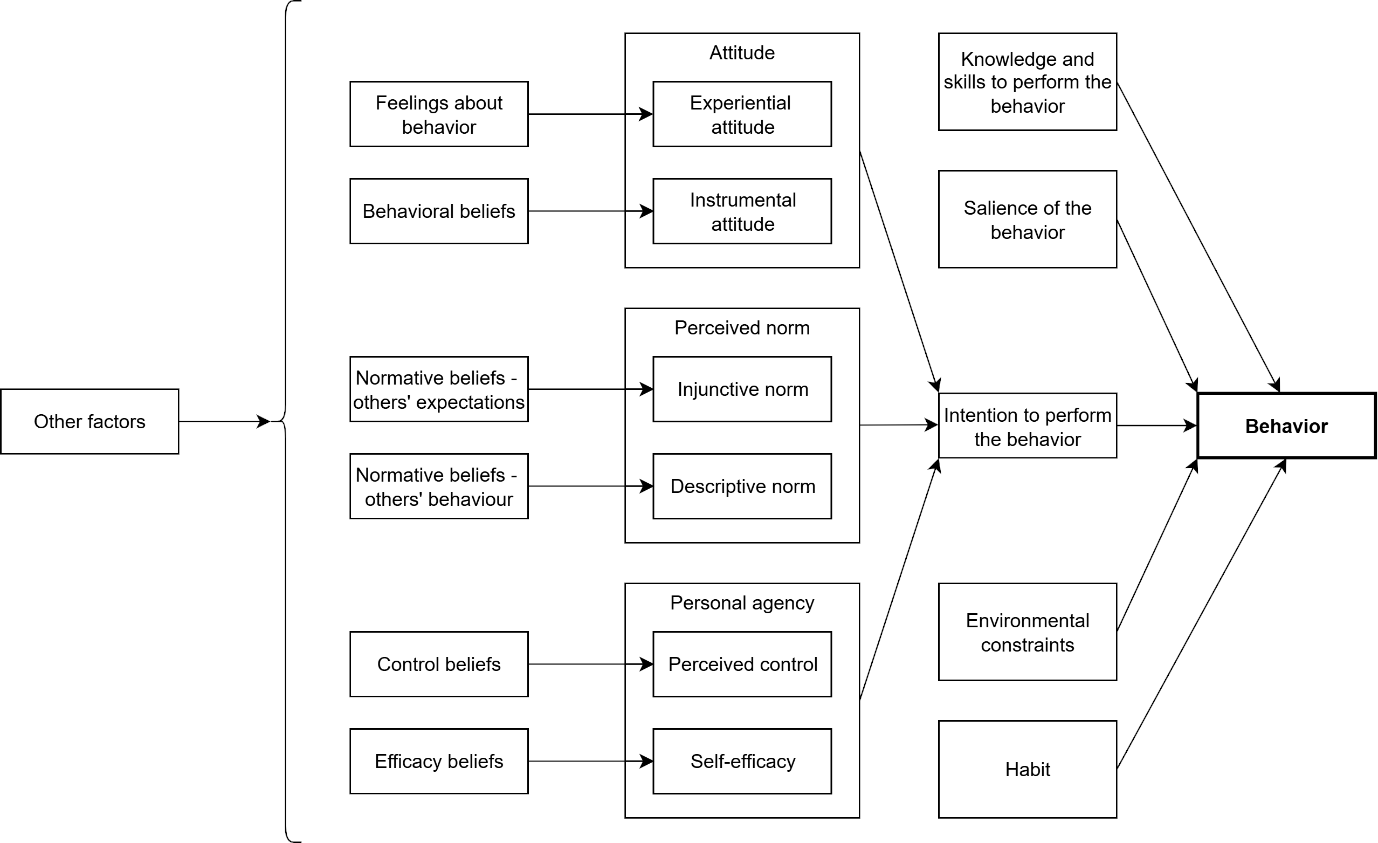
In this study the model provides a deductive framework for identifying and categorising implementation barriers. Salience was operationalised to assess practitioner awareness, attitudes to capture evaluative concerns, such as the fear of appearing propagandistic, perceived norms to gauge organisational fit, and agency to distinguish internal capability from external resource capacity. Because salient beliefs are best identified qualitatively before being measured [Montaño & Kasprzyk, 2008], we derived items directly from our interview themes. This grounds the instrument’s content validity in the specific research context, rather than relying on validated but generic scales that may lack the required specificity. This deductive approach was supplemented by inductive analysis [Pearson et al., 2025] to also capture contextual factors outside the model’s parameters, such as institutional trust.
2.2 Study design
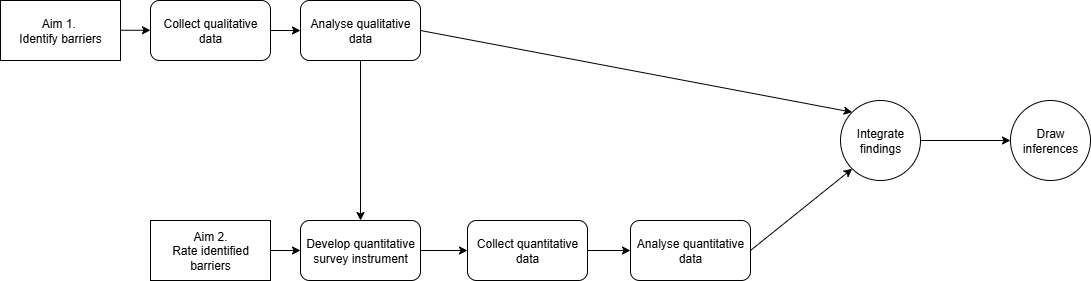
This study employs an exploratory sequential mixed-methods design [Creswell, 2021], beginning with qualitative interviews to identify relevant barriers, followed by a quantitative survey to measure their relative strength. The qualitative findings informed the survey instrument and contributed to convergent interpretation of the overall results (see Figure 2). This study was approved by the Australian National University Human Ethics Committee (Protocol H/2025/0238). Data and R code are available at https://osf.io/zgs4f/overview.
2.3 Researcher positionality
The lead researcher has professional experience in biosecurity communication, including prior working relationships with several participants, though no current employment relationships exist. This insider perspective facilitated access and contextual understanding but required reflexive attention during analysis, supported by a reflexive journal and peer debriefing. Suitable for the research questions, the investigation adopted a pragmatist orientation [Dewey, 1908].
2.4 Participants and recruitment
Participants for both phases were professional communicators who had worked on biosecurity issues within an Australian government department or agency during the past five years. We targeted this group of communicators responsible for risk management, as opposed to communicators whose roles may focus upon press agentry [Grunig & Hunt, 1984], as inoculation-based pre-bunking may be less suitable for that purpose. Recruitment proceeded through direct invitation of known contacts, snowball sampling, and a presentation to Australia’s National Biosecurity Communication and Engagement Network. Survey recruitment additionally used the Australian Science Communicators email list, and university social media accounts from December 2025 to March 2026. By using multiple channels we hoped to overcome the documented difficulties of recruiting communication practitioners for scholarly research [e.g., Blanchett et al., 2025; Hazleton & Sha, 2012].
2.5 Qualitative procedure
Eleven participants were interviewed for approximately 45 minutes via Zoom. Participants were presented with two hypothetical biosecurity scenarios. The first introduced topic-based pre-bunking in a relatively low-risk scenario, the second technique-based pre-bunking in a higher-risk scenario (see the question script in Appendix A). Following each scenario, participants were asked prepared questions and follow-up enquiries based on their responses, combining structured and adaptive interview approaches [Kidder & Fine, 1987]. Audio recordings were initially transcribed using Microsoft Word’s transcription feature, then manually verified against the recording. They were then analysed in NVivo 15 using Braun & Clarke’s [2021] six-step approach to reflexive thematic analysis, which places the researcher’s interpretation in a central role rather than striving for strict objectivity. Initial questions were designed to elicit responses likely to fit the Integrated Behavioural Model, but follow-up questions were not constrained along these lines, allowing identification of themes outside the model’s parameters (see a selection of participants’ quotes in Appendix B).
2.6 Quantitative procedure
A survey instrument was then developed in Qualtrics to measure the perceived impact of the barriers identified in the qualitative interviews, enabling a quantitative descriptive analysis of the most significant implementation challenges. Thirty-seven participants initially commenced a survey containing 38 items developed from the qualitative phase. However, one participant was excluded after indicating that they had not had communication experience with a biosecurity issue any time over the past five years. Two further responses were removed as they failed to answer any of the questions. An attention-check question was incorporated which all participants passed. This left us with 34 valid participants, representing a reported 348 years of professional communication experience.
Some of these survey participants may also have participated in the qualitative phase. This was by design, as several participants were only made aware of the concept during their interview, and we wished to give them an opportunity to consider their concerns compared to those raised by their colleagues. As the survey was anonymous, the extent of any overlap could not be determined.
Most survey items assessed the perceived strength of each barrier raised in the qualitative phase and were grouped by Integrated Behavioural Model themes, while additional items investigated overall attitudes toward pre-bunking and opportunities to facilitate implementation. These items were presented in random order, except for one question assessing overall support, which appeared last (see Appendix C). Each item asked how strongly people agreed or disagreed, on a five-point scale with “neutral” marked in the middle. That neutral midpoint represents having no leaning either way, so it is the meaningful point to test each item against. A test against this point asks whether the typical practitioner significantly endorses the statement, and the effect size indicates the strength of that potential barrier.
3 Results
3.1 Qualitative results
Practitioners’ evaluations of pre-bunking were grounded in a mental model of audience segmentation, rather than a view of the public as a monolith. Participants frequently categorised their audiences into three groups: a “core” of unpersuadable individuals prone to “rage farming” and intense distrust, a “middle core” of persuadable but hesitant individuals, and a group of potential supporters. This perceived heterogeneity drives much of the implementation hesitancy observed below. While practitioners saw pre-bunking as logically sound for the “persuadables”, they feared it may “trigger” or “enrage” the inner core, or “plant a seed of doubt” among existing supporters.
3.1.1 Theme one: salience
Most participants demonstrated low awareness of this type of pre-bunking. While some indicated they attempted to pre-empt misinformation through refutations, these efforts took the form of Q&A or FAQ documents rather than true pre-bunking forewarnings informed by inoculation theory. Participant 7 said, “I’ve never gone that far… I’ve tried to sort of say, hey, this is not a conspiracy. Or you kind of say what it isn’t as opposed to this could be misinformation.”
Two participants attributed their lack of familiarity with inoculation primarily to competing work demands that made engagement with academic literature challenging. As Participant 3 explained, “I couldn’t tell you what comms or public relations journals have published recently.”
3.1.2 Theme two: attitudes
Despite the lack of awareness, many participants began to form attitudes about the strategy once the interviewer explained the idea. Some felt it made logical sense, reasoning that forewarning could prompt audiences to evaluate misinformation more critically. Participant 2 said it was “a really sound approach” that could “help them to stop in their tracks and think about it more critically.” Others were less positive, suggesting existing approaches would be more likely to succeed without explicitly calling out misinformation: “I think you can address it without actually saying there’s misinformation out there. I don’t think you actually need to call it out.” (Participant 1).
Several specific concerns emerged. First, participants worried that pre-bunking could simply propagate misinformation, exposing audiences to claims they might not otherwise encounter. As Participant 7 put it, “You don’t want to give oxygen to that misinformation.” Second, some expressed concern that government-sourced pre-bunking could be perceived as propagandistic, undermining organisational trustworthiness: “From government, it gets a bit, you know, ‘Big Brother’, ‘Nanny State’” (Participant 5). In particular, some became concerned that the strategy could threaten certain belief systems and motivate increased misinformation spread. Participant 9 articulated this concern: “I think what you’re doing there is you’re threatening someone else’s belief system… I can see how that could enrage that. …I think they’re more likely to spread it more intensely.” This prompted some to conduct informal risk-benefit calculations, with Participant 3 concluding that “…if the risk of it outweighs the positive… then I wouldn’t use it.”
3.1.3 Theme three: agency
Participants identified barriers in both perceived and actual control. Regarding perceived control, they described the difficulty of convincing senior leaders, who typically lacked communication backgrounds, to support unconventional strategies. These decision-makers included chief veterinary or plant officers, senior bureaucrats from policy backgrounds, and political leaders. Participant 3 summarised this frustration: “Our profession is not the problem. It’s getting the sponsorship and advocacy from those who hold the purse strings and make decisions.” Others described a risk-averse culture where leaders preferred to “deal with something when it happens, not… try and debunk it before it happens” (Participant 9). Self-efficacy concerns centred on correctly anticipating which misinformation would become prevalent, with participants invoking COVID-19 as evidence of its unpredictability (Participant 7). A distinction also emerged between capability and capacity: while some cited capability limitations, others emphasised personnel, time, and money as the primary constraint, particularly during emergency responses when efforts must “focus… on the immediate legislative requirements” (Participant 2).
3.1.4 Theme four: norms
A few participants indicated that pre-bunking sat outside normal organisational approaches and anticipated it could attract disapproval. As Participant 9 reflected, “I feel it would be unlikely that as a government organisation that approach would be used.” However, this theme was less prominent than anticipated.
3.1.5 Contextual factors
Beyond the Integrated Behavioural Model framework, participants stressed that misinformation was actively hampering biosecurity responses. Participant 2 described situations where “the overwhelming majority of your time is spent trying to claw back that misinformation… And that’s really detrimental to the whole response.” This led some participants to reconsider pre-bunking’s value, particularly for high-risk scenarios where the scale of misinformation and potential harm may warrant new approaches.
3.1.6 Implementation opportunities
Participants identified promising implementation pathways. Several endorsed face-to-face delivery through community engagement sessions and briefings, seen as important given the dialogic limitations of digital and mass media channels experienced during COVID-19. Participant 9 suggested success would depend on “the language and the relationship that you have with the community and how that’s delivered.” Some suggested delivery by credible third-party sources rather than government, reasoning that this would mitigate propaganda concerns (Participant 4). Others emphasised that published academic articles alone would not convince decision-makers, who would want practical examples of where the strategy had worked for similar organisations. Finally, some participants identified that technique-based inoculation may avoid antagonising some audience segments, mitigating this general concern.
3.2 Quantitative results
In our quantitative phase, participants confirmed the strategic relevance of the misinformation problem, strongly endorsing the view that misinformation had become more of a challenge for managing biosecurity threats than five years ago (M = 4.18, SD = 0.76 on a 5-point scale; one-sample Wilcoxon signed-rank test against the scale midpoint, r = .96, p < .001), and significantly rejected the proposition that existing techniques for addressing misinformation were adequate (M = 2.47, SD = 0.96, r = -.56, p = .005). Practitioners therefore perceived both a growing threat and an inadequate response repertoire available to them.
To investigate Research Question three, identifying why the strategy had not been implemented despite this need, 21 potential barrier items were grouped according to four Integrated Behavioural Model themes, of Salience, Attitudes, Agency and Norms. Items reporting the respondent’s own knowledge of the strategy were assigned to Salience, consistent with the model’s knowledge and salience constructs [Montaño & Kasprzyk, 2008]; evaluative beliefs were assigned to Attitudes, organisational expectations to Norms, and capability, capacity, and control beliefs to Agency. Again, each item was tested against the neutral midpoint using one-sample Wilcoxon signed-rank tests, with the items corrected for multiple comparisons together as a single family using the Benjamini-Hochberg procedure [Benjamini & Hochberg, 1995]. The four theme composites were then compared using a Friedman test, with pairwise signed-rank post-hoc comparisons whose p-values were corrected as a separate family. Non-parametric methods were used throughout, given the small sample, and we controlled the false discovery rate rather than the family-wise error rate because multiple barriers may genuinely coexist [Rubin, 2021]. Internal consistency of the composites was acceptable for the four-item Salience (α = .78) and eight-item Attitudes scales (α = .83), marginal for the seven-item Agency scale (α = .68), and low for the two-item Norms scale (Spearman-Brown = .42). Because the items were derived to capture the constructs identified in the qualitative phase, we retained the full set rather than removing items to raise internal consistency. Item-level results were instead examined alongside the composite comparisons, with full statistics in Appendices D and E. Items concerning contextual factors, prior awareness of implementation evidence, and behavioural intentions were then examined independently.
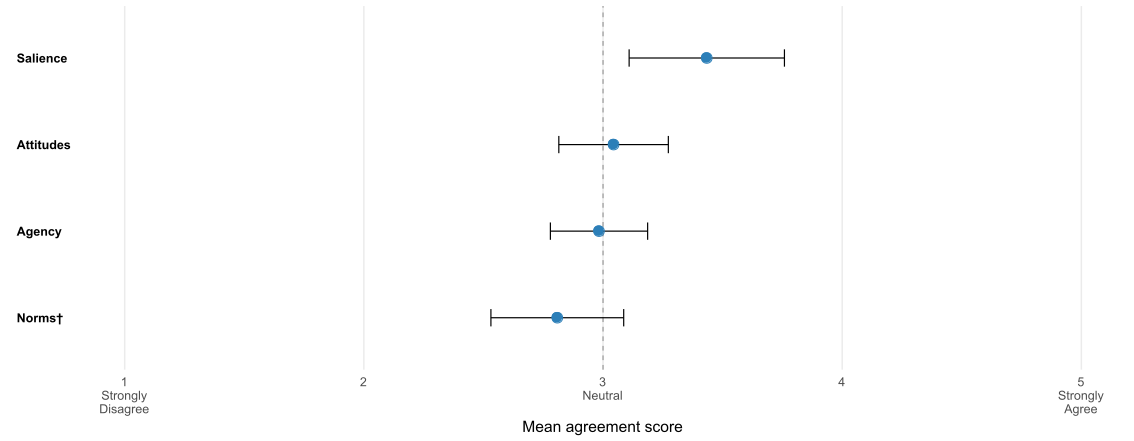
The four themes differed significantly in perceived barrier strength (Friedman χ2(3) = 12.60, p = .006), although the effect was small (Kendall’s W = .12), indicating weak agreement among respondents in how they ranked the themes. Pairwise comparisons showed this result was driven entirely by Salience, which was rated significantly higher than Attitudes (r = .45), Agency (r = .51), and Norms (r = .49; all p < .05 after correction). The remaining themes did not differ from one another, although comparisons involving Norms should be read cautiously given that scale’s low reliability.
3.2.1 Theme one: salience
Within this theme participants agreed most strongly that they were unaware of experimental evidence supporting the strategy (M = 3.79, SD = 1.25, r = .69, p = .007). Two further items pointed in the same direction but did not survive correction: lacking awareness of practical examples from similar organisations (M = 3.53) and lacking sufficient knowledge to evaluate the strategy (M = 3.30). Prior awareness of the strategy itself was not significantly different from the neutral point (M = 3.09). See Figure 3.
3.2.2 Theme two: attitudes
Two Attitudes concerns were significantly endorsed as barriers; that the strategy might motivate people to spread misinformation (M = 3.56, SD = 0.79, r = .70, p = .007), and that government messaging could be perceived as propaganda (M = 3.50, SD = 1.02, r = .48, p = .040). A third, that the strategy might backfire with some audience segments, pointed in the same direction but fell short of the corrected threshold (M = 3.44). By contrast, the concern that pre-bunking might expose audiences to misinformation they would not otherwise encounter, while prominent in the interviews, was not significantly endorsed (M = 3.29), nor were concerns about damaging organisational credibility (M = 2.88) nor appearing manipulative (M = 2.62). Set against these concerns, participants strongly agreed that pre-emptively alerting audiences made logical sense (M = 3.85, SD = 0.78, r = .88, p < .001).
3.2.3 Theme three: agency
The Agency barriers clustered near neutral, and the distinction between capacity and capability that featured in the interviews did not translate into a statistically reliable difference; neither the concern that the organisation lacked capacity (M = 3.35) nor that it lacked capability (M = 3.00) was endorsed, and the two did not differ (W = 60.5, p = .161). The strongest concern was leadership risk appetite (M = 3.53, SD = 1.05, r = .57, p = .038). Encouragingly, participants were confident in their ability to recommend pre-bunking (M = 3.47, SD = 0.83, r = .57, p = .019), despite this perceived reluctance from their leadership.
3.2.4 Theme four: norms
Norms were the weakest theme, and both items fell below the neutral point, though neither reached significance after correction: an organisational preference for reactive communication (M = 2.68) and the strategy being too different from normal approaches (M = 2.94). Organisational norms therefore did not emerge as a significant barrier, a notable result given qualitative accounts of conservative, reactive cultures.
3.2.5 Overall support and implementation insights
Turning to the items outside the model’s themes, participants’ overall support for the strategy remained positive even after they had considered each barrier (M = 3.94, SD = 0.83, r = .90, p < .001), and their intention to learn more about pre-bunking was equally strong (M = 3.94, SD = 0.81, r = .90, p < .001). Participants also preferred delivering the strategy through face-to-face channels (M = 3.38, SD = 1.07, r = .40, p = .049). This preference may reflect the low public trust in government that participants raised as a contextual barrier: consistent with Johnson and Madsen [2024], who found people reluctant to engage with inoculation from sources they distrust, face-to-face delivery could be a way to establish the trust that broadcast channels cannot.
4 Discussion
This mixed-methods investigation addresses a meaningful gap in the inoculation theory literature by examining the barriers that professional biosecurity communicators may face when considering psychological inoculation as a strategy for mitigating misinformation. By combining qualitative interviews with a quantitative survey, this study provides an integrated understanding of both the nature of these barriers and their relative strengths. The following discussion addresses each research question in turn, integrating findings from both phases.
4.1 RQ1: awareness of pre-bunking
Both phases converge on a clear finding. Awareness of psychological inoculation among Australia’s professional biosecurity communicators is limited. Qualitative participants were largely unfamiliar with the strategy, and those who attempted to anticipate misinformation did so through other mechanisms. Participants partly attributed this gap to competing work demands that prevented engagement with academic literature. The quantitative phase corroborated this, with salience emerging as the strongest barrier category overall, and participants pointed to a lack of awareness of the evidence and also indicated that a lack of practical examples from similar organisations would be a significant barrier. This is consistent with Roozenbeek et al. [2024]’s argument that “real-world” outcomes are required. More broadly, these findings align with Saladie et al. [2025] on the disconnect between communication scholarship and practice. That practitioners remain unaware of inoculation, even where misinformation poses significant strategic risks to their work, indicates that substantial knowledge translation is needed before pre-bunking can be meaningfully evaluated by those most likely to implement it.
4.2 RQ2: support for pre-bunking
Support for the strategy was positive but qualified. Qualitative participants generally found the approach logically appealing while reserving judgment pending evidence of real-world effectiveness. Quantitatively, overall support remained positive after participants had considered all identified barriers. However, this support coexisted with specific concerns about government messaging being perceived as propaganda, and potentially motivating people to spread misinformation.
Most encouragingly for proponents of inoculation theory, participants wanted to learn more about the strategy. These findings align with Blair et al. [2024], who also found optimism for inoculation among practitioners of governance or misinformation. However, we found practical concerns coexisting with that optimism, particularly regarding public reception of government-sourced pre-bunking in a post-COVID environment characterised by diminished trust. This duality suggests that moving from theoretical support to practical adoption requires addressing not just whether the strategy works, but how it will be perceived by diverse audiences and in varying organisational contexts.
4.3 RQ3: anticipated barriers
Barriers were identified across our model’s themes plus two inductive themes, and their relative strengths proved instructive. Salience emerged as the strongest barrier category. Unlike entrenched attitudes or organisational norms, awareness issues can be addressed through targeted knowledge translation as the barrier appears to be access to, rather than rejection of, relevant evidence.
Although the Attitudes theme received a lower rating than Salience, individual items within it varied considerably, but several were rated among the strongest barriers in the study. Participants worried about giving harmful claims further oxygen, about threatening audiences’ belief systems, and about sparking antagonistic responses. These concerns warrant some attention because they draw on something a survey cannot capture; practitioners’ judgements about how real audiences may react, including hostile ones. They point to a clear empirical question: do inoculation campaigns antagonise certain audience segments in real-world settings? It is plausible that this risk falls more heavily on topic-based pre-bunking, which contests specific claims, than on technique-based pre-bunking, which targets the reasoning behind them. Whether that asymmetry holds and whether it breaks down for the most strongly held beliefs, where the stakes for inoculation are arguably highest, is itself worth testing.
Agency barriers clustered near neutral, but two results within this theme are more telling than their means suggest. Practitioners identified leadership risk appetite as the strongest agency concern, yet reported significant confidence in their own ability to recommend pre-bunking despite that perceived reluctance. This interesting contrast — practitioners read to act, but anticipating hesitancy from those above them — is the clearest sign in the data that practitioners may be ahead of their organisations, and it locates the obstacle specifically at the leadership level rather than in individual capability or culture. Any attempt to move an organisation towards adoption must therefore persuade at the implementation and leadership levels, since it is leadership risk appetite, not practitioner willingness, that may be the greatest constraint to agency.
Norms did not emerge as a barrier as neither item was significantly endorsed nor rejected, making this the weakest theme. That result should be read cautiously, since the two-item Norms scale was the least reliable in the study. Taken at face value, however, it complicates the qualitative accounts of conservative, reaction-oriented organisational cultures. Rather than practitioners feeling actively constrained by organisational expectations, the low ratings suggest that any such conservatism is not experienced as an explicit expectation directed at them. The “wait and respond” posture may be habitual rather than deliberately enforced. If so, organisational norms are unlikely to be the binding constraint on adoption, and effort is better directed at the awareness and evidence barriers that rated far higher.
4.4 RQ4: overcoming barriers
The identified barriers, while substantial, are not insurmountable. First, the finding that a lack of practical examples could constrain implementation means researchers should focus upon real-world effectiveness across a range of likely contexts rather than efficacy. Second, practitioners and their organisational leaders prefer evidence of implementation in comparable contexts. This is challenging because pre-bunking has uses in many domains, but it could be achieved by continuing to work with communication practitioners to formally evaluate programs and develop them into case studies, thereby responding to concerns raised by Wang et al. [2025], that the real-world application of inoculation may be more limited than laboratory studies suggest. In the meantime, knowledge brokers may be needed to bring evidence to the practitioner community, rather than relying on communicators to encounter the strategy in academic literature.
Third, our participants strongly endorsed delivery through trusted third parties rather than government. Because the propaganda concerns they raised stem from government being the visible source, a credible non-government organisation such as an industry body, scientific organisation, or community group, could serve as the public-facing source even where government contributes to the campaign. This departs from existing gamified applications, several of which were produced through partnerships involving government or institutional actors [e.g., Basol et al., 2020; Roozenbeek & van der Linden, 2020], by shifting the third party from collaborator to sole messenger. Encouraging these organisations to take on that role may itself be challenging, however, since they are likely to face barriers similar to those identified here, compounded by the limited communication resources many of them have. That practitioners nonetheless leaned towards face-to-face delivery is notable given how heavily the inoculation literature has concentrated on digital and gamified formats, and suggests the channels researchers most often investigate may not be the most appropriate for this context. For practice, community engagement sessions and briefings may be preferable to broadcast campaigns for this purpose, offering narrowcasting to reduce the risk of antagonising sensitive segments while, for more persuadable audiences, opening the prospect of the dialogic communication our participants valued.
These last ideas deserve a note of caution. They address the concerns participants raised about trust, perceived propaganda, and the risk that a single approach could antagonise some audiences even as it works for others, but they are also the most demanding on staff, time, and money, and they reach the fewest people. This matters because participants told us that a lack of capacity, not a lack of skill, was the higher constraint, and that it bit hardest during fast-moving emergencies — the very situations in which pre-bunking may be most valuable. The approaches practitioners found most acceptable are therefore also the least able to keep pace with the scale at which misinformation often spreads. For pre-bunking, as earlier for debunking, the open question may be less whether it works in controlled or field conditions than whether it can be implemented at all given the capacity constraints, trust dynamics, and audience sensitivities our participants identified: another reminder that interventions validated in the lab transfer unevenly across contexts and into practice [Roozenbeek et al., 2024].
Face-to-face delivery is therefore best understood as a useful place to begin rather than a complete solution. It builds the trust and dialogue a purely reactive response cannot, which matters if misinformation is treated less as a discrete risk than as a symptom of thinner underlying trust [Balog-Way & McComas, 2025]. Reaching audiences at scale will eventually require combining it with the online spaces where misinformation frequently spreads, most plausibly as one layer in a broader set of responses [Bak-Coleman et al., 2022; Bode & Vraga, 2021].
Fourth, focusing on technique-based inoculation may reduce practitioner concerns about antagonising certain audience segments, offers broader protection against unrelated misinformation topics, and may help audiences understand the underlying fallacy rather than relying on topic-based inoculations or corrections. Efforts to bridge the gap between research and practice should therefore treat technique-based inoculation as a priority.
Fifth, the capacity/capability distinction suggests pre-bunking is far more feasible when incorporated into preparedness activities than when attempted during rapidly evolving emergencies. Developing materials in advance could enable rapid deployment when threats emerge, and could include training personnel to deliver pre-bunking face-to-face and establishing relationships with potential third parties. Taken together, these recommendations suggest a sequence for practitioners rather than a set of separate options. Much of the groundwork can be done during the preparedness phase, when staff are not yet under emergency pressure, leaving scaled and combined delivery to follow.
Beyond misinformation research and practice, this study speaks to the use of the Integrated Behavioural Model to understand communicators’ own choices. Besley et al. [2019] applied the model to scientists’ willingness to prioritise communication activities, predicting choice from attitudinal, normative, and efficacy beliefs from the model’s intention core. Applying the same framework to practitioners’ adoption of a specific evidence-based strategy, we find the strongest barrier lies outside that core — salience, not attitudes or agency. This suggests that planned-behaviour accounts of communicator choice may under-weight awareness and salience, particularly for strategies that have not yet completed the transition from academic to professional communities. The model’s intention constructs captured most of the barriers practitioners described, but the trust and information-environment factors that emerged inductively fell outside them, suggesting value in either extending its environmental-constraints component or treating institutional trust as a distinct factor.
4.5 Limitations and future directions
While the mixed-methods design is a strength, five limitations constrain generalisability. First, our quantitative sample is small, which reflects known difficulties in recruiting professional communicators [Blanchett et al., 2025; Hazleton & Sha, 2012], however the obvious corollary is that the present study generates an in-depth investigation with convergent mixed-methods findings. The post-COVID timing of data collection may have amplified trust and implementation concerns specific to this period and the norms scale should be read with caution given the reliability issues noted above.
Our study asked participants to reflect upon anticipated implementation barriers rather than reporting actual experience, as none had yet attempted inoculation-based pre-bunking. We hope that should inoculation be more widely adopted future research could seek the experiences of practitioners who have implemented inoculation campaigns, test empirically whether pre-bunking motivates misinformation spread or damages credibility and examine cost-effectiveness versus reactive debunking. Replication across other high-stakes science domains with similar characteristics, such as climate change and vaccination, would reveal whether these barriers are domain-specific or generalisable.
Finally, readers should note that the lead researcher recruited known contacts, and the survey may overlap with the interviewees.
5 Conclusion
This mixed-methods investigation provides the first systematic examination of professional science communicators’ perspectives on implementing psychological inoculation against misinformation. Three conclusions emerge. Most fundamentally, awareness constitutes the primary barrier to adoption. Professional biosecurity communicators remain largely unfamiliar with evidence-based inoculation approaches and, when prompted to consider them, emphasise the need for practical demonstration cases demonstrating effectiveness for comparable organisations rather than further experimental evidence of efficacy. The challenge is therefore largely not one of persuasion but of salience.
Second, when introduced to pre-bunking, practitioners are receptive. Their attitudes were cautiously positive, tempered by legitimate professional concerns about propagating misinformation, appearing propagandistic, and motivating antagonistic responses among certain audience segments. Crucially, practitioners indicated they possess the expertise to implement such strategies but frequently lack the resources to do so, a constraint most acute during the rapidly evolving biosecurity events where inoculation-based pre-bunking may offer the greatest value.
Third, these findings point toward concrete pathways for bridging the evidence-to-practice gap. Incorporating pre-bunking into preparedness planning, leveraging trusted third-party messengers, and prioritising face-to-face delivery all emerged as promising approaches. None are without challenges, but none are insurmountable. Closing the gap between demonstrated efficacy and practical implementation requires mutual engagement. Researchers must attend to practitioners’ legitimate concerns while providing actionable evidence through real-world demonstration cases, and practitioners are well-positioned to advocate for the resources and organisational conditions that would make adoption feasible.
Acknowledgments
This project was supported by the Australian Government through the Australian Research Council Training Centre in Plant Biosecurity (IC230100027).
A Script and questions used for qualitative interviews
Please refrain from providing any personally identifying information (such as your name or the name of your employer). I am not going to ask questions about your work, but instead I’m going to ask for your professional opinion about two hypothetical scenarios.
As you’re no doubt aware misinformation is a challenging problem for professional communicators. As professional communicator, this research project aims to get your views of an emerging way for professional communicators like you to deal with misinformation.
You may have heard of a communication strategy called “pre-bunking”. Many social scientists believe this strategy may have a role in preventing the harm from misinformation in today’s information environment. It is sometimes also referred to as psychological inoculation. Have you heard of this strategy?
In essence, it involves two steps: first, alerting people that they may be exposed to false and potentially harmful claims about emerging topic (such as a biosecurity outbreak), and second, refuting the misinformation claim.
Are you aware of this strategy?
Let’s discuss two hypothetical examples.
Scenario one. You have been tasked to provide communication advice to a biosecurity incident management team to help manage an outbreak of the plant bacteria Xylella. In this scenario, biosecurity officers are going to enter properties to try to respond to this invasive species that has taken hold quickly. Based on prior experience the team anticipates that some people will spread emotional and conspiracy laden rumours about the biosecurity officers’ true intentions, such as the idea that the officers are instead secretly spraying harmful chemicals or trying to find evidence of illegal activities such as drugs or guns.
In this example, you could try to pre-bunk the anticipated misinformation by directly addressing the facts in the topic. In this example, you may consider implementing a pre-bunking communication campaign that:
- Alerts people that they may shortly encounter misinformation that attempts to persuade people into refusing to allow the biosecurity officers onto your property, and
- Explains that despite the likely misinformation claims, biosecurity officers will only enter a property to protect that property from the invasive species, and are not looking for drugs or guns, or carrying any pesticides.
In a scenario like this, how likely is it that you might recommend a strategy like this?
Have you previously recommended such a strategy for a biosecurity issue?
In practice, what potential barriers do you foresee as a professional communicator in successfully recommending or implementing a pre-bunking communication campaign like this one?
Now let’s consider the other example. As opposed to the previous example that pre-bunked the topic itself, this one addresses the fallacious persuasive techniques that are often used to construct misinformation claims.
Scenario two. You have been tasked to provide communication advice to an incident management team to help manage a rapidly growing outbreak of measles. Based on prior experience the team anticipates that misinformation may shortly be spread using highly emotional language and graphics that falsely inflates the risk of vaccination.
In this example, you may implement a pre-bunking communication campaign that pre-empts this fallacious persuasive technique that is likely to accompany this misinformation. Your strategy consists of two steps:
- Explicitly alert people that they may shortly encounter misinformation that attempts to dissuade people from vaccinating themselves or their families,
- explain that using emotional language is often an attempt to make people fearful, and fear makes it harder to think logically about the benefits of vaccination.
In a scenario like this, how likely is it that you might recommend a strategy like this?
In practice, what potential barriers do you foresee as a professional communicator in successfully recommending or implementing a technique-based pre-bunking communication campaign like this one?
Social science researchers believe that this kind of technique-based pre-bunking may have the additional benefit of helping people become resilient to not only this topic of misinformation but also to other topics of misinformation that rely on these kinds of fallacious techniques.
Do you agree with this view? Why/why not?
Overall, what would need to happen before you recommend strategies like these?
Thank you for your time. This is the end of the interview. However, I am keen to interview more people with similar practical expertise and experience. Therefore, I will send you an email shortly that you may pass on to any people who you think I should interview.
B Illustrative quotes from qualitative interviews
Theme 1: salience
“I couldn’t tell you what comms or public relations journals have published recently.”
(Participant 3)
“I’ve never gone that far… I’ve tried to sort of say, hey, this is not a conspiracy. Or you kind of say what it isn’t as opposed to this could be misinformation.” (Participant 7)
Theme 2: attitudes (positive)
“I think that’s helpful because often it’s like alerting people that they might feel this
way when they see the content, and it can sort of help them to stop in their tracks and
think about it more critically. Yeah, I think that sounds like a really sound approach.”
(Participant 2)
Theme 2: attitudes (preference for existing approaches)
“I think you can address it without actually saying there’s misinformation out there. I don’t think
you actually need to call it out.” (Participant 1)
Theme 2: attitudes (concern about propagating misinformation)
“Well, I think it could encourage people to go and find that misinformation… because you don’t
want to give oxygen to that misinformation.” (Participant 7)
Theme 2: attitudes (propaganda concerns)
“I feel coming from government it could seem quite… propaganda-ish?” (Participant unidentified)
“My hesitancy around being that explicit would probably be around reception from the public. Because… it depends who’s saying it right, but like from government, it gets a bit, you know, ‘Big Brother’, ‘Nanny State’, you know. ‘Don’t tell us what to do’.” (Participant 5)
Theme 2: attitudes (audience heterogeneity)
“I really reckon you’d have to work out how it would resonate with your different segments
before you work out whether to deploy that tactic.” (Participant 3)
“I think it would work differently for different people.” (Participant 6)
Theme 2: attitudes (antagonistic responses)
“Because I think what you’re doing there is you’re threatening someone else’s belief system. So, if
there is a cohort of the community led by one or led by many, that’s of a different belief to what the
program or the authority is trying to do. Then yeah, you’re threatening that belief. So, I can see
how that could enrage that. … I think they’re more likely to spread it more intensely.”
(Participant 9)
“But like if the risk of it outweighs the positive in terms of maybe antagonising that conspiracy piece for want of a better term, then I wouldn’t use it.” (Participant 3)
Theme 3: agency (perceived control)
“But our profession is not the problem, it’s getting the sponsorship and advocacy from those who
hold the purse strings and make decisions.” (Participant 3)
“I think about the [communication-related] stuff that they’re risk averse to now. It’s like there’s really obvious things that we deal with now and they’re like, ‘Oh no, we’re not going to say that, we’re not going to talk about that’. And so getting them to take that next step is like… They do take the approach of ‘we’ll deal with something when it happens, not we’re going to try and debunk it before it happens’. So that is very much the climate we operate in.” (Participant 9)
Theme 4: agency (self-efficacy)
“Because you don’t know which way people are going to jump on things or how strongly they’re
going to feel about it. So, it’s like, OK, well, you know, we can anticipate those things. We can try
and address them. But to say that is categorically going to happen. You don’t know, I think COVID
proved that to us. You don’t know what people are going to do. Like, I’m sure they weren’t
writing, you know, pre planned messages around toilet paper [hoarding] at the time.”
(Participant 7)
Theme 4: agency (capacity)
“Probably a big one is resourcing often in an emergency response you can have really limited
resources, and you might have to just focus those efforts on like the immediate legislative
requirements that you have to do.” (Participant 2)
Theme 3: norms
“I feel it would be unlikely that as a government organisation that approach would be used.”
(Participant 9)
“Government… tends to not go down that emotive path. You know, it’s always been very cautious around anything that’s considered scare campaigns… so yeah, we have to tread a fine line with that.” (Participant 7)
“You might be better off having a reactive approach instead of a proactive attack. And that that’s kind of normally how in these situations we’ve dealt with them in my career.” (Participant 1)
Contextual factors
“I have been in situations in responses before where misinformation has started circulating and it
means that, like the overwhelming majority of your time is spent trying to claw back that
misinformation and really get the public back on side with you. And that’s really detrimental to
the whole response. And it also really affects the morale of the people who are actually out there
on the ground dealing with the response.” (Participant 2)
“So… you can see like the scale is different and in that case that’s exactly where you would deploy it because the scale is large and you want to get ahead of that misinformation.” (Participant 5)
Implementation opportunities (channel preferences)
“I think it would really come back, come down to the language and the relationship that you have
with the community and how that’s delivered. Yeah, so the approach I think would be really key
in this perhaps delivered not via — you know SMS alerts — or social media or even like
traditional media, perhaps delivered more via face-to-face communications. Building the
rapport with the community, you know, community like engagement or briefing sessions,
community halls, those kind of approaches, I think you could have more success with that.”
(Participant 9)
“I don’t know how well it would go down in written statement format, but it would be more like something that would be addressed by an actual person in an interview format.” (Participant 1)
Implementation opportunities (third-party delivery)
“But that is where my hesitancy is, particularly post COVID is a big factor there. So, like it could
work, but you’d have to really think about how you deployed it.” (Participant 5)
“If it was being communicated by, I guess a credible third-party source, then it might land better.” (Participant 4)
C Quantitative questions and theme allocations
| Variable |
Question text |
Theme |
| aware_experimental_evidence |
I am aware of experimental evidence supporting this strategy. (R) |
Salience |
| barrier_backfire_some_segments |
The risk that pre-bunking could backfire with some audience segments (even if it works with others) makes it difficult to justify using. |
Attitudes |
| barrier_capability_lacking |
Organisations like mine don’t have the capability (specialised expertise) needed to implement it. |
Agency |
| barrier_capacity_lacking |
Organisations like mine don’t have the capacity (people, time, money) to implement it. |
Agency |
| barrier_channels_difficult |
Pre-bunking would be difficult to implement through our existing communication channels. |
Contextual Factors |
| barrier_damage_credibility |
Pre-bunking could damage organisational credibility. |
Attitudes |
| barrier_detracts_proactive |
Running such a strategy may detract from other essential proactive communication activities. |
Agency |
| barrier_expose_audience |
I am concerned that by stating the misinformation in a campaign we may expose it to a greater audience. |
Attitudes |
| barrier_high_stakes_only |
Only a high-stakes biosecurity emergency would justify using this kind of pre-bunking campaign. |
Contextual Factors |
| barrier_lack_examples |
The lack of practical examples from organisations like my own is a barrier to implementing it. |
Contextual factors |
| barrier_leadership_knowledge |
The senior leadership of organisations like mine does not have the communication knowledge to fully support this strategy. |
Agency |
| barrier_leadership_risk_appetite |
The senior leadership of organisations like mine does not have the risk appetite to support this strategy. |
Agency |
| barrier_low_public_trust |
Low public trust in government makes pre-bunking less viable. |
Contextual Factors |
| barrier_motivate_misinfo |
This strategy may motivate some people to spread more misinformation. |
Attitudes |
| barrier_not_convince |
This strategy would not convince many people. |
Attitudes |
| barrier_perceived_propaganda |
Pre-bunking messages from government sources could be perceived as propaganda. |
Attitudes |
| barrier_reactive_preference |
Pre-bunking conflicts with our organisation’s preference for reactive rather than proactive communication. |
Norms |
| barrier_seen_manipulative |
This strategy would be seen as manipulative. |
Attitudes |
| barrier_too_different |
Because this is so different to the normal strategies used by organisations like mine, I cannot foresee us implementing it. |
Norms |
| confident_to_recommend |
I would feel confident recommending such a pre-bunking campaign. (R) |
Agency |
| current_techniques_adequate |
Current communication techniques for addressing misinformation in biosecurity emergencies are adequate. |
General |
| intend_to_learn_more |
I intend to learn more about this kind of pre-bunking. |
Overall Support |
| prebunk_logical_strategy |
Alerting people to misinformation before they encounter it makes logical sense as a communication strategy. (R) |
Attitudes |
| pref_face_to_face_delivery |
Pre-bunking would be more effective if delivered face-to-face rather than via mass media or advertising. |
Contextual Factors |
| pref_third_party_delivery |
Pre-bunking would be more effective if delivered by a trusted third party rather than government. |
Contextual Factors |
| prior_anticipate_misinfo_confident |
I am confident that I could correctly anticipate which misinformation is likely to spread. (R) |
Agency |
| prior_aware_practical_examples |
I am aware of practical examples of a pre-bunking campaign. (R) |
Salience |
| prior_aware_strategy |
Before today I was aware of this specific kind of pre-bunking strategy. (R) |
Salience |
| prior_knowledge_sufficient |
I have sufficient knowledge about psychological inoculation theory to either recommend it or reject it. (R) |
Salience |
D IBM barriers
| section | family | correction |
reverse-coded | variable | n | mean | sd | r_rb | p_raw | p_adj | sig |
| Salience | Barrier | BH |
TRUE | prior_knowledge_sufficient_r | 33 | 3.3 | 0.98 | 0.39 | 0.092 | 0.175 | |
| Salience | Barrier | BH |
TRUE | prior_aware_practical_examples_r | 34 | 3.53 | 1.28 | 0.49 | 0.021 | 0.062 | |
| Salience | Barrier | BH |
TRUE | aware_experimental_evidence_r | 34 | 3.79 | 1.25 | 0.69 | 0.001 | 0.007 | * |
| Salience | Barrier | BH |
TRUE | prior_aware_strategy_r | 34 | 3.09 | 1.42 | 0.13 | 0.529 | 0.617 | |
| Attitudes | Barrier | BH |
FALSE | barrier_not_convince | 34 | 2.91 | 0.97 | -0.11 | 0.613 | 0.677 | |
| Attitudes | Barrier | BH |
FALSE | barrier_expose_audience | 34 | 3.29 | 1.22 | 0.27 | 0.166 | 0.269 | |
| Attitudes | Barrier | BH |
FALSE | barrier_motivate_misinfo | 34 | 3.56 | 0.79 | 0.7 | 0.001 | 0.007 | * |
| Attitudes | Barrier | BH |
TRUE | prebunk_logical_strategy_r | 34 | 2.15 | 0.78 | -0.88 | < .001 | < .001 | * |
| Attitudes | Barrier | BH |
FALSE | barrier_seen_manipulative | 34 | 2.62 | 1.02 | -0.43 | 0.036 | 0.085 | |
| Attitudes | Barrier | BH |
FALSE | barrier_perceived_propaganda | 34 | 3.5 | 1.02 | 0.48 | 0.011 | 0.04 | * |
| Attitudes | Barrier | BH |
FALSE | barrier_damage_credibility | 34 | 2.88 | 1.12 | -0.13 | 0.509 | 0.617 | |
| Attitudes | Barrier | BH |
FALSE | barrier_backfire_some_segments | 34 | 3.44 | 1.05 | 0.46 | 0.024 | 0.062 | |
| Norms | Barrier | BH |
FALSE | barrier_too_different | 34 | 2.94 | 0.92 | -0.08 | 0.717 | 0.753 | |
| Norms | Barrier | BH |
FALSE | barrier_reactive_preference | 34 | 2.68 | 1.15 | -0.34 | 0.137 | 0.24 | |
| Agency | Barrier | BH |
FALSE | barrier_capacity_lacking | 34 | 3.35 | 1.18 | 0.33 | 0.087 | 0.175 | |
| Agency | Barrier | BH |
FALSE | barrier_capability_lacking | 34 | 3 | 1.07 | 0 | 1 | 1 | |
| Agency | Barrier | BH |
FALSE | barrier_leadership_knowledge | 34 | 2.88 | 1.07 | -0.13 | 0.521 | 0.617 | |
| Agency | Barrier | BH |
FALSE | barrier_leadership_risk_appetite | 34 | 3.53 | 1.05 | 0.57 | 0.009 | 0.038 | * |
| Agency | Barrier | BH |
FALSE | barrier_detracts_proactive | 34 | 2.76 | 1.02 | -0.26 | 0.197 | 0.296 | |
| Agency | Barrier | BH |
TRUE | confident_to_recommend_r | 34 | 2.53 | 0.83 | -0.57 | 0.004 | 0.019 | * |
| Agency | Barrier | BH |
TRUE | prior_anticipate_misinfo_confident_r | 34 | 2.82 | 1 | -0.2 | 0.312 | 0.436 | |
E Other factors
| section | family | correction |
reverse-coded | variable | n | mean | sd | r_rb | p_raw | p_adj | sig |
| Contextual | Other | none |
FALSE | current_techniques_adequate | 34 | 2.47 | 0.96 | -0.56 | 0.005 | 0.005 | * |
| Contextual | Other | none |
FALSE | barrier_low_public_trust | 34 | 3.44 | 0.99 | 0.49 | 0.016 | 0.016 | * |
| Contextual | Other | none |
FALSE | barrier_channels_difficult | 34 | 2.29 | 1 | -0.67 | 0.001 | 0.001 | * |
| Contextual | Other | none |
FALSE | barrier_high_stakes_only | 34 | 3.03 | 1.03 | 0.03 | 0.876 | 0.876 | |
| Contextual | Other | none |
FALSE | pref_third_party_delivery | 34 | 3.85 | 1.05 | 0.78 | 0 | 0 | * |
| Contextual | Other | none |
FALSE | pref_face_to_face_delivery | 34 | 3.38 | 1.07 | 0.4 | 0.049 | 0.049 | * |
| Contextual | Other | none |
FALSE | barrier_lack_examples | 34 | 3.82 | 1.03 | 0.72 | 0 | 0 | * |
| Overall | Other | none |
FALSE | intend_to_learn_more | 34 | 3.94 | 0.81 | 0.9 | 0 | 0 | * |
References
-
Ajzen, I. (1991). The theory of planned behavior. Organizational Behavior and Human Decision Processes, 50(2), 179–211. https://doi.org/10.1016/0749-5978(91)90020-t
-
Altay, S., Berriche, M., Heuer, H., Farkas, J., & Rathje, S. (2023). A survey of expert views on misinformation: definitions, determinants, solutions, and future of the field. Harvard Kennedy School Misinformation Review, 4(4). https://doi.org/10.37016/mr-2020-119
-
Bak-Coleman, J. B., Kennedy, I., Wack, M., Beers, A., Schafer, J. S., Spiro, E. S., Starbird, K., & West, J. D. (2022). Combining interventions to reduce the spread of viral misinformation. Nature Human Behaviour, 6(10), 1372–1380. https://doi.org/10.1038/s41562-022-01388-6
-
Balog-Way, D., & McComas, K. (2025). Unpacking the risk of misinformation: a communication-based critique. Risk Analysis, 45(12), 4097–4109. https://doi.org/10.1111/risa.70093
-
Banas, J. A., & Rains, S. A. (2010). A meta-analysis of research on inoculation theory. Communication Monographs, 77(3), 281–311. https://doi.org/10.1080/03637751003758193
-
Basol, M., Roozenbeek, J., Berriche, M., Uenal, F., McClanahan, W. P., & van der Linden, S. (2021). Towards psychological herd immunity: cross-cultural evidence for two prebunking interventions against COVID-19 misinformation. Big Data & Society, 8(1). https://doi.org/10.1177/20539517211013868
-
Basol, M., Roozenbeek, J., & van der Linden, S. (2020). Good news about bad news: gamified inoculation boosts confidence and cognitive immunity against fake news. Journal of Cognition, 3(1), 2. https://doi.org/10.5334/joc.91
-
Benjamini, Y., & Hochberg, Y. (1995). Controlling the false discovery rate: a practical and powerful approach to multiple testing. Journal of the Royal Statistical Society Series B: Statistical Methodology, 57(1), 289–300. https://doi.org/10.1111/j.2517-6161.1995.tb02031.x
-
Besley, J. C., O’Hara, K., & Dudo, A. (2019). Strategic science communication as planned behavior: understanding scientists’ willingness to choose specific tactics. PLoS ONE, 14(10), e0224039. https://doi.org/10.1371/journal.pone.0224039
-
Biddlestone, M., Roozenbeek, J., Suiter, J., Culloty, E., & van der Linden, S. (2025). Tune in to the prebunking network! Development and validation of six inoculation videos that prebunk manipulation tactics and logical fallacies in misinformation. Political Psychology, 46(6), 1858–1886. https://doi.org/10.1111/pops.70015
-
Blair, R. A., Gottlieb, J., Nyhan, B., Paler, L., Argote, P., & Stainfield, C. J. (2024). Interventions to counter misinformation: lessons from the Global North and applications to the Global South. Current Opinion in Psychology, 55, 101732. https://doi.org/10.1016/j.copsyc.2023.101732
-
Blanchett, N., Mellado, C., Brin, C., Nemat Allah, S., & Vallender, C. (2025). Is it us or them? The challenge of getting journalists to participate in academic research. Journalism Studies, 26(16), 2110–2128. https://doi.org/10.1080/1461670x.2023.2216796
-
Bode, L., & Vraga, E. (2021). The Swiss cheese model for mitigating online misinformation. Bulletin of the Atomic Scientists, 77(3), 129–133. https://doi.org/10.1080/00963402.2021.1912170
-
Braun, V., & Clarke, V. (2021). Thematic analysis: a practical guide. SAGE Publications. https://uk.sagepub.com/en-gb/eur/thematic-analysis/book248481
-
Chan, M.-p. S., & Albarracín, D. (2023). A meta-analysis of correction effects in science-relevant misinformation. Nature Human Behaviour, 7(9), 1514–1525. https://doi.org/10.1038/s41562-023-01623-8
-
Claeys, A.-S., & Opgenhaffen, M. (2016). Why practitioners do (not) apply crisis communication theory in practice. Journal of Public Relations Research, 28(5–6), 232–247. https://doi.org/10.1080/1062726x.2016.1261703
-
Compton, J. (2025). Inoculation theory. Review of Communication, 25(1), 1–13. https://doi.org/10.1080/15358593.2024.2370373
-
Compton, J., van der Linden, S., Cook, J., & Basol, M. (2021). Inoculation theory in the post-truth era: extant findings and new frontiers for contested science, misinformation, and conspiracy theories. Social and Personality Psychology Compass, 15(6), e12602. https://doi.org/10.1111/spc3.12602
-
Cook, J., Ecker, U. K. H., Trecek-King, M., Schade, G., Jeffers-Tracy, K., Fessmann, J., Kim, S. C., Kinkead, D., Orr, M., Vraga, E., Roberts, K., & McDowell, J. (2023). The cranky uncle game — combining humor and gamification to build student resilience against climate misinformation. Environmental Education Research, 29(4), 607–623. https://doi.org/10.1080/13504622.2022.2085671
-
Cook, J., Lepage, C., Hopkins, K. L., Cook, W., Kolog, E. A., Thomson, A., Iddrisu, I., & Burnette, S. (2024). Co-designing and pilot testing a digital game to improve vaccine attitudes and misinformation resistance in Ghana. Human Vaccines & Immunotherapeutics, 20(1), 2407204. https://doi.org/10.1080/21645515.2024.2407204
-
Cook, J., Lewandowsky, S., & Ecker, U. K. H. (2017). Neutralizing misinformation through inoculation: exposing misleading argumentation techniques reduces their influence. PLoS ONE, 12(5), e0175799. https://doi.org/10.1371/journal.pone.0175799
-
Coppock, A., Gross, K., Porter, E., Thorson, E., & Wood, T. J. (2023). Conceptual replication of four key findings about factual corrections and misinformation during the 2020 US election: evidence from panel-survey experiments. British Journal of Political Science, 53(4), 1328–1341. https://doi.org/10.1017/s0007123422000631
-
Creswell, J. W. (2021). A concise introduction to mixed methods research (2nd ed.). SAGE Publications.
-
Danielson, R. W., Jacobson, N. G., Patall, E. A., Sinatra, G. M., Adesope, O. O., Kennedy, A. A. U., Bhat, B. H., Ramazan, O., Akinrotimi, B., Nketah, G., Jin, G., & Sunday, O. J. (2025). The effectiveness of refutation text in confronting scientific misconceptions: a meta-analysis. Educational Psychologist, 60(1), 23–47. https://doi.org/10.1080/00461520.2024.2365628
-
Dewey, J. (1908). What does pragmatism mean by practical? The Journal of Philosophy, Psychology and Scientific Methods, 5(4), 85–99. https://doi.org/10.2307/2011894
-
Dodd, A., Stoeckl, N., Baumgartner, J., & Kompas, T. (2020). Key result summary: valuing Australia’s biosecurity system [CEBRA Project 170713]. Centre of Excellence for Biosecurity Risk Analysis. https://cebra.unimelb.edu.au/research/past-projects/building-scientific-capability/value-of-australias-biosecurity-system
-
Fishbein, M., & Ajzen, I. (1975). Belief, attitude, intention and behavior: an introduction to theory and research. Addison-Wesley.
-
Grunig, J. E., & Hunt, T. (1984). Managing public relations. Holt, Rinehart and Winston.
-
Hazleton, V., & Sha, B.-L. (2012). Generalizing from PRSA to public relations: how to accommodate sampling bias in public relations scholarship. Public Relations Review, 38(3), 438–445. https://doi.org/10.1016/j.pubrev.2012.01.011
-
Ivanov, B. (2017). Inoculation theory applied in health and risk messaging. In M. Powers (Ed.), Oxford Research Encyclopedia of Communication. Oxford University Press. https://doi.org/10.1093/acrefore/9780190228613.013.254
-
Johnson, A., & Madsen, J. K. (2024). Inoculation hesitancy: an exploration of challenges in scaling inoculation theory. Royal Society Open Science, 11(6), 231711. https://doi.org/10.1098/rsos.231711
-
Kemp, B., Randle, M., Hurlimann, A., & Dolnicar, S. (2012). Community acceptance of recycled water: can we inoculate the public against scare campaigns? Journal of Public Affairs, 12(4), 337–346. https://doi.org/10.1002/pa.1429
-
Kidder, L. H., & Fine, M. (1987). Qualitative and quantitative methods: when stories converge. New Directions for Program Evaluation, 1987(35), 57–75. https://doi.org/10.1002/ev.1459
-
Lewandowsky, S., Ecker, U. K. H., Seifert, C. M., Schwarz, N., & Cook, J. (2012). Misinformation and its correction: continued influence and successful debiasing. Psychological Science in the Public Interest, 13(3), 106–131. https://doi.org/10.1177/1529100612451018
-
Lu, C., Hu, B., Li, Q., Bi, C., & Ju, X.-D. (2023). Psychological inoculation for credibility assessment, sharing intention, and discernment of misinformation: systematic review and meta-analysis. Journal of Medical Internet Research, 25, e49255. https://doi.org/10.2196/49255
-
Maertens, R., Roozenbeek, J., Basol, M., & van der Linden, S. (2021). Long-term effectiveness of inoculation against misinformation: three longitudinal experiments. Journal of Experimental Psychology: Applied, 27(1), 1–16. https://doi.org/10.1037/xap0000315
-
McGuire, W. J. (1961). Resistance to persuasion conferred by active and passive prior refutation of the same and alternative counterarguments. The Journal of Abnormal and Social Psychology, 63(2), 326–332. https://doi.org/10.1037/h0048344
-
McGuire, W. J. (1964). Some contemporary approaches. In L. Berkowitz (Ed.), Advances in Experimental Social Psychology (pp. 191–229, Vol. 1). Academic Press. https://doi.org/10.1016/s0065-2601(08)60052-0
-
Montaño, D. E., & Kasprzyk, D. (2008). Theory of reasoned action, theory of planned behavior, and the integrated behavioral model. In K. Glanz, B. K. Rimer & K. Viswanath (Eds.), Health behavior and health education: theory, research, and practice (4th ed.). Wiley.
-
National Academies of Sciences, Engineering, and Medicine. (2025). Understanding and addressing misinformation about science (K. Viswanath, T. E. Taylor & H. G. Rhodes, Eds.). The National Academies Press. https://doi.org/10.17226/27894
-
Newman, E., Ecker, U., O’Neil, M., & Tay, L. Q. (2026). Information resilience: a framework for misinformation interventions. A report prepared for the National Science and Technology Council. Australian Government Office of the Chief Scientist. https://www.chiefscientist.gov.au/news-and-media/information-resilience-understanding-and-protecting-against-mis-and-disinformation
-
Oliveira, T., Cardoso, N. O., Machado, W. L., Gonçalves, R. A., Quinan, R., Salvador, E. Z., Almeida, C., & Paes, A. (2024). Confronting misinformation related to health and the environment: a systematic review. JCOM, 23(01), V01. https://doi.org/10.22323/2.23010901
-
Pearson, H., Myall, M., Darlington, A.-S., & Gibson, F. (2025). The approach and application of analysing inductive and deductive datasets: a worked example using reflexive thematic analysis. Qualitative Research in Psychology, 22(4), 842–886. https://doi.org/10.1080/14780887.2025.2499265
-
Pfau, M., & Van Bockern, S. (1994). The persistence of inoculation in conferring resistance to smoking initiation among adolescents: the second year. Human Communication Research, 20(3), 413–430. https://doi.org/10.1111/j.1468-2958.1994.tb00329.x
-
Pfau, M., Van Bockern, S., & Kang, J. G. (1992). Use of inoculation to promote resistance to smoking initiation among adolescents. Communication Monographs, 59(3), 213–230. https://doi.org/10.1080/03637759209376266
-
Porter, E., Velez, Y., & Wood, T. J. (2023). Correcting COVID-19 vaccine misinformation in 10 countries. Royal Society Open Science, 10(3), 221097. https://doi.org/10.1098/rsos.221097
-
Roozenbeek, J., Remshard, M., & Kyrychenko, Y. (2024). Beyond the headlines: on the efficacy and effectiveness of misinformation interventions. advances.in/psychology, 2, e24569. https://doi.org/10.56296/aip00019
-
Roozenbeek, J., Traberg, C. S., & van der Linden, S. (2022). Technique-based inoculation against real-world misinformation. Royal Society Open Science, 9(5), 211719. https://doi.org/10.1098/rsos.211719
-
Roozenbeek, J., & van der Linden, S. (2020). Breaking Harmony Square: a game that “inoculates” against political misinformation. Harvard Kennedy School Misinformation Review, 1(8). https://doi.org/10.37016/mr-2020-47
-
Roozenbeek, J., & van der Linden, S. (2021). Inoculation theory and misinformation. NATO Strategic Communications Centre of Excellence. https://stratcomcoe.org/publications/inoculation-theory-and-misinformation/217
-
Roozenbeek, J., van der Linden, S., Goldberg, B., Rathje, S., & Lewandowsky, S. (2022). Psychological inoculation improves resilience against misinformation on social media. Science Advances, 8(34), eabo6254. https://doi.org/10.1126/sciadv.abo6254
-
Rubin, M. (2021). When to adjust alpha during multiple testing: a consideration of disjunction, conjunction, and individual testing. Synthese, 199(3–4), 10969–11000. https://doi.org/10.1007/s11229-021-03276-4
-
Saladie, N., Llorente, C., & Revuelta, G. (2025). A scoping review on the connection between research and practice in science communication. JCOM, 24(05), V01. https://doi.org/10.22323/145520250811182624
-
Southwell, B. G., Brennen, J. S. B., Paquin, R., Boudewyns, V., & Zeng, J. (2022). Defining and measuring scientific misinformation. The ANNALS of the American Academy of Political and Social Science, 700(1), 98–111. https://doi.org/10.1177/00027162221084709
-
Spampatti, T., Hahnel, U. J. J., Trutnevyte, E., & Brosch, T. (2024). Psychological inoculation strategies to fight climate disinformation across 12 countries. Nature Human Behaviour, 8(2), 380–398. https://doi.org/10.1038/s41562-023-01736-0
-
Vraga, E. K., & Bode, L. (2020). Defining misinformation and understanding its bounded nature: using expertise and evidence for describing misinformation. Political Communication, 37(1), 136–144. https://doi.org/10.1080/10584609.2020.1716500
-
Wang, S. Y. N., Phillips, S. C., Carley, K. M., Lin, H., & Pennycook, G. (2025). Limited effectiveness of psychological inoculation against misinformation in a social media feed. PNAS Nexus, 4(6), pgaf172. https://doi.org/10.1093/pnasnexus/pgaf172
-
White, B., Phuong, L., Roach, J., Teggelove, N., & Wallace, H. (2023). Pandemics, infodemics and health promotion. Health Promotion Journal of Australia, 34(1), 169–172. https://doi.org/10.1002/hpja.644
About the authors
Matthew S. Nurse is a postdoctoral fellow at the Australian National Centre for the Public Awareness of Science at the Australian National University.
E-mail: matthew.nurse@anu.edu.au Bluesky: @mattnurse
Will J. Grant is Professor at the Australian National Centre for the Public Awareness of Science at the Australian National University.
E-mail: will.grant@anu.edu.au Bluesky: @willozap