
Acknowledgement of Country
The author acknowledges the Traditional Custodians of Country across Australia and the Nations whose knowledge systems are referenced throughout this article. She recognises the strength of Aboriginal and Torres Strait Islander Knowledge Systems that continue to care for communities and Country.
A note on ‘Country’
In Aboriginal and Torres Strait Islander Knowledge Systems, Country refers to the interconnected living system of land, water, sky, and all beings, with which people share relationships of knowledge, responsibility, and care. Country is understood as active and knowledge-holding, not merely a physical location.
On-Country describes activities, learning, or engagement that take place physically within Country — on the land itself, rather than in a classroom or institutional venue. On-Country learning treats the landscape, seasons, and living systems as active teachers, not just a setting.
1 Introduction
National Science Week is (the land now known as) Australia’s largest annual public science festival, reaching schools, libraries, museums, and community organisations nationwide. While progress has been made with some state coordinators now benchmarking Indigenous content inclusion among grant recipients for the first time [Inspiring Australia NSW, 2024], Indigenous Knowledge Systems remain underrepresented as a primary mode of scientific engagement within National Science Week’s broader program of more than 2,500 events nationally [Department of Industry, Science and Resources, 2025]. National Science Week organisers themselves continue to encourage Indigenous inclusion, though this is not yet embedded as a structural condition, a gap that the Pathway to Diversity in STEM Review [Department of Industry, Science and Resources, 2024b] has identified as requiring more ambitious and coordinated action.
This gap is salient given that Aboriginal and Torres Strait Islander peoples have developed and sustained sophisticated environmental, astronomical, and ecological knowledge over tens of thousands of years, and ‘Elevating Aboriginal and Torres Strait Islanders knowledge systems’ is one of Australia’s National Science and Research Priorities [Department of Industry, Science and Resources, 2024a].
In many Indigenous communities, and especially in Aboriginal and Torres Strait Islander communities, storytelling is a key mode through which scientific observations are generated, interpreted and transmitted. Stories encode empirical knowledge about seasonal change, animal behaviour, and cosmological events, functioning as living scientific texts passed across generations. For example, Indigenous astronomical narratives link stellar movements to ecological cues, guiding decisions about resource use and seasonal activities. Such knowledge is relational, grounded in Country, and continually updated through lived practice.
Despite this, mainstream science communication in Australia, including high-profile festivals, continues to foreground Western scientific expertise and communication norms. Even when participatory or dialogic models are used, they often struggle to recognise Indigenous epistemologies as equally authoritative. As a result, Indigenous perspectives appear only at the margins, and opportunities for reciprocal, community-led approaches to public science engagement are constrained.
Growing international and Australian scholarship calls for the decolonisation of science communication, arguing for approaches that centre Indigenous authority, respect cultural protocols, and integrate Indigenous scientific frameworks into public engagement practice [CPAS Inclusive Science Communication Collective, 2025; McKinnon, 2024; Orthia, 2020; Rasekoala, 2023; Standen, 2025]. This requires more than inclusionary gestures. It requires co-design, community governance, and rigorous attention to Indigenous intellectual property and cultural integrity.
Australian National Science Week provides a timely and influential platform through which such change could occur. With its national reach and institutional support structures, the festival is well positioned to elevate Indigenous-led storytelling, performance, and on-Country learning as legitimate forms of science communication. Indigenous astronomers, Rangers, Elders, and STEM professionals are already leading innovative programs across Australia; yet these remain under-recognised within the broader architecture of National Science Week.
Indigenous-led events during Australian National Science Week have the potential to shift public narratives about what counts as science and who is recognised as a scientist. They can also build long-term relationships between communities, educators and science organisations, creating pathways for ongoing engagement.
This article argues that Australian National Science Week can and should be reimagined as a platform for Indigenous-led science communication. Drawing on Indigenous scholarship, decolonial communication theory, and examples of current practice, the article proposes a framework for embedding Indigenous Storywork and knowledge systems within public science events. It demonstrates how Indigenous storytelling can function as a scientifically rigorous mode of public engagement and offers practical guidance for culturally grounded, relational and community-authorised programming.
2 Theoretical framework
2.1 Indigenous Knowledge Systems in Australia
Indigenous Knowledge Systems are dynamic, holistic systems of knowledge developed and passed down through generations within a particular community or culture [Rose, 1996; Williams, 2007]. They encompass a wide range of knowledge, including traditional medicine, ecological understanding, subsistence practices, and cultural expressions like stories and art. These systems are not static but continuously evolve, incorporating new information while remaining rooted in local experiences, and they play a vital role in sustainable living and adapting to challenges like climate change. Rather than separating data from meaning, as often happens in Western sciences, Indigenous science embeds observation within cultural practice, kinship obligations, and responsibilities to place.
Storywork plays a central role in how this knowledge is shared. These narratives operate as long-term records of environmental change and cosmological events. For example, stories from northern Australia that describe ancient coastal flooding preserve memories of sea-level rise more than 7,000 years ago [Nunn & Reid, 2016]. Similarly, Yorta Yorta Dreaming stories describe the Rainbow Serpent reshaping the course of the Murray River through a flick of her tail, an event geologists have since linked to seismic activity along the Cadell Fault approximately 70,000 years ago [Monica Morgan, CEO of the Yorta Yorta Nation Aboriginal Corporation, cited in Doak, 2021]. Aboriginal and Torres Strait Islander astronomical narratives likewise document detailed observations of star movements, lunar cycles, and seasonal indicators [Hamacher & Norris, 2011; Norris & Hamacher, 2009, 2015]. These examples show that Indigenous Knowledge Systems contain sophisticated modelling, predictive tools, and mechanisms to verify knowledge across generations.
2.2 Storytelling as science communication
Storytelling is widely recognised as an effective strategy for science communication because it improves comprehension, engagement, and memory [Dahlstrom, 2014]. In Indigenous contexts, however, storytelling goes beyond communication. Stories are also forms of governance, pedagogy, and ontology. They link physical phenomena with cultural meaning, often using place-based narrative, metaphor, and embodied practice.
In Australia, Indigenous stories about plants, animals, and weather patterns reflect sustained ecological expertise [Prober et al., 2011]. In Zenadh Kes (the Torres Strait), stories about winds, tides, and stars function as navigational systems [McNiven & Feldman, 2003]. These examples indicate that Indigenous storytelling is not an add-on to Western science but a parallel system of scientific explanation and communication with its own protocols and methods for validating knowledge.
2.3 Decolonising science communication
A growing body of literature argues for the need to decolonise both science education and public science communication [Bang & Medin, 2010; Finlay et al., 2021; Orthia, 2020; Ortiz et al., 2025; Ramadan, 2024; Rasekoala, 2023; Standen, 2025; Todd, 2016]. In Australia, models such as Both-Ways Learning and Two-Way Science bring Indigenous Knowledge Holders into curriculum co-design and teaching [Ober, 2009; Purdie et al., 2011]. These approaches recognise Indigenous knowledges as legitimate scientific frameworks rather than cultural embellishments.
In North America, a related framing, Two-Eyed Seeing (Etuaptmumk), developed by Mi’kmaw Elder Albert Marshall and colleagues, holds Indigenous and Western sciences together without subordinating one to the other [Bartlett et al., 2012]. This complementary rather than hierarchical approach is instructive for designing public science events such as Australian National Science Week, where both knowledge systems can inform one another on equal terms. A similar approach, He Awa Whiria (Braided Rivers) [Macfarlane et al., 2015], has been applied in Aotearoa New Zealand to bring mtauranga Mori and Western sciences into productive dialogue across research and public engagement settings.
Aotearoa New Zealand offers one of the most developed system-level examples of Indigenous knowledge integration in public science engagement, and its approaches provide useful reference points for the Australian context.
At the policy level, Vision Mtauranga, a framework embedded within New Zealand’s primary science funding body, Te Pnaha Matatini and Marsden Fund processes, requires researchers to consider how Mori knowledge, perspectives, and communities can contribute to and benefit from publicly funded science [Ministry of Research Science and Technology (Te Manat Ptaiao), 2007]. This structural embedding moves beyond inclusion as a gesture toward Indigenous knowledge as a condition of research design. More recently, Te Ara Paerangi, New Zealand’s future-oriented reform of the research, science, and innovation system, has placed Te Tiriti o Waitangi (Treaty of Waitangi) obligations at the centre of institutional practice, signalling a systemic rather than project-by-project approach to Indigenous knowledge authority [Ministry of Business Innovation & Employment (Hkina Whakatutuki), 2022].
In public engagement, the mainstreaming of Matariki as a national public holiday has normalised Indigenous astronomical and ecological knowledge within everyday civic life, creating conditions in which Indigenous science is not exotic but foundational. Science festival programming has followed this trajectory. In tepoti Dunedin, the New Zealand International Science Festival has long framed itself as a public engagement platform designed to broaden participation and accessibility in science communication [New Zealand International Science Festival, 2026]. More recently, regional initiatives such as the Te Tkohu Ngwh Mtauranga Mori Science and Design Fair have explicitly embedded mtauranga Mori within science engagement, positioning Indigenous knowledge systems alongside Western science in student-led inquiry and design-based projects [BayScience, n.d.]. Collectively, these developments illustrate a shift toward Indigenous-informed science engagement models that move beyond token inclusion toward structurally embedded and Indigenous-led forms of participation.
This commitment to non-hierarchical knowledge integration is also evident in how Aotearoa New Zealand structures its public science programming. Kaupapa Mori events and Matariki programming frequently include Mori-led, Mori-for-Mori spaces alongside public events, a model that Australian National Science Week could meaningfully adopt when supporting Nation-specific or community-internal knowledge sharing.
Australia has not yet developed equivalent structural mechanisms at the funding and policy level, though the inclusion of Aboriginal and Torres Strait Islander knowledge systems among Australia’s National Science and Research Priorities signals an emerging mandate. The Aotearoa experience suggests that this mandate requires institutional architecture: governance obligations, dedicated funding streams, and Indigenous-led evaluation; aspirational language alone is unlikely to be sufficient.
Despite this progress in education, public science communication has not always kept pace. In many science festivals and outreach programs, Indigenous contributions remain limited to cultural performance, Acknowledgements of Country, or symbolic inclusion without genuine authority or co-governance. Indigenous-led science communication is still comparatively rare and often constrained by limited funding, short timelines, and insufficient remuneration for community members.
2.4 Public science events and Indigenous participation
Public science festivals such as Australian National Science Week aim to broaden participation in science and engage diverse audiences. Broader scholarship on science communication in Australia demonstrates that public science engagement continues to privilege Western scientific expertise and provide limited structural opportunities for Indigenous leadership [Finlay et al., 2021; Judd & McKinnon, 2021], a pattern that the Pathway to Diversity in STEM Review identified as requiring urgent redress [Department of Industry, Science and Resources, 2024b].
Where Indigenous-led events do occur, such as cultural fire workshops, on-Country learning sessions, or astronomy nights guided by Indigenous experts, they demonstrate clear benefits. Evaluations show they foster cultural safety, deepen scientific engagement, and enable genuine two-way learning [Walker & Banks, 2021]. These events can strengthen public scientific literacy and support community empowerment.
However, one-off events may reproduce extractive dynamics when they are not developed collaboratively or when they rely on uncompensated cultural labour [Walter & Suina, 2019]. Sustainable engagement requires long-term relationships, Indigenous governance, and a commitment to community-driven agendas.
2.5 Why Australian National Science Week matters
Australian National Science Week is one of the most visible annual science initiatives in Australia. With its national media profile, grant funding, and broad institutional support, it can influence how the public understands what science is and who counts as a scientist.
Although many Science Week events may include Indigenous content, only a minority are Indigenous-led. Research suggests that Indigenous-led science communication not only strengthens scientific understanding but also supports identity, belonging, and STEM pathways for Indigenous young people [Jorgensen et al., 2013].
Because of this, Australian National Science Week represents a strategic opportunity: it can elevate Indigenous scientific storytelling as a valued and legitimate form of science communication, provided the work is grounded in cultural authority, community governance, and ethical collaboration.
2.6 Storywork as an Indigenous epistemology
This article draws on Indigenous Storywork, a framework developed by Stó:lo woman Jo-ann Archibald (also known as Q’um Q’um Xiiem) [2008] and expanded by Indigenous scholars across different contexts. Storywork positions stories not as symbolic artefacts, but as active forms of knowledge-making. In Australia, story carries ecological, astronomical, ethical, and historical knowledge; it is shared through narrative, ceremony, art, performance, and Country itself.
Crucially, Storywork emphasises that stories hold multiple layers: personal, communal, spiritual, and ecological, and that engaging with them requires attention to protocol, relationship, and place. For science communication, Storywork offers a culturally coherent way of understanding how Indigenous communities generate, verify, and transmit knowledge. It challenges Western assumptions that stories are merely metaphors or soft communication tools, showing instead that storytelling is a rigorous and relational scientific method.
| Box 1. Storywork as science communication: a practical illustration.
|
| For
many
Aboriginal
peoples,
stories
encode
ecological
knowledge
accumulated
over
thousands
of
years.
One
commonly
shared
example
concerns
seasonal
indicators.
In
parts
of
south-eastern
Australia,
including
Wiradjuri
Country,
the
flowering
of
particular
plants
and
the
arrival
of
specific
bird
species
signal
changing
weather
patterns,
food
availability,
and
appropriate
harvesting
times.
Rather
than
separating
observation
from
narrative,
these
relationships
are
embedded
within
stories
linking
people,
Country,
animals,
and
responsibilities.
Such
stories
transmit
empirical
environmental
knowledge,
ethical
obligations,
and
collective
memory
simultaneously.
Their
purpose
is
not
simply
to
communicate
information
but
to
sustain
relationships
between
people
and
the
living
systems
on
which
they
depend.
|
2.7 Indigenous science as relational knowing
Indigenous scholars such as Karen Martin-Booran Mirraboopa [2003] describe Indigenous science as fundamentally relational. Knowledge emerges through relationships between people, ancestors, Country, plants, animals, seasons, and cosmological forces. These relationships are lived, renewed, and evaluated through practice. Accountability and care are central to the process.
This relational worldview contrasts with Western sciences that often emphasise neutrality, distance, and objectivity [Watson, 2015]. From an Indigenous perspective, knowledge cannot be separated from responsibility. This is why storytelling functions so effectively as science communication: stories describe how beings, processes, and systems interact within webs of obligation and reciprocal care.
For Australian National Science Week, typically structured around Western styles of dissemination, bringing in relational models of knowledge sharing could shift events from one-way broadcasts toward place-based, responsibility-driven engagement.
2.8 Public science communication through an Indigenous lens
Science communication has traditionally been shaped by Western models such as the deficit, dialogue, and participation frameworks [Trench, 2008]. These models often rely on expert authority, assume one-way knowledge flow, or require audiences to adapt to Western scientific norms. When applied to Indigenous contexts, they can obscure relational knowledges and reinforce power imbalances.
An Indigenous lens reframes science communication through principles such as:
- Story as a primary mode of scientific engagement
- Country as a co-teacher and knowledge source
- Community authority over protocols and content
- Learning as relational and reciprocal
- Knowledge sharing grounded in responsibility and ethics.
Seen this way, Australian National Science Week becomes more than a venue for diverse content; it becomes a site where ways of knowing, being, and communicating science can be transformed. Indigenous-led events offer models for experiential, place-based, and relational approaches to science.
2.9 A conceptual model
This article brings the above perspectives together into a conceptual model built around three propositions:
- Indigenous storytelling is a rigorous system of science communication. Storywork demonstrates how stories carry empirical knowledge, predictive insights, and ecological understandings that have been verified across generations.
- Decolonising science communication requires Indigenous leadership and relational accountability. Indigenous-led initiatives challenge Western-centric assumptions and redistribute authority in public science spaces.
- Australian National Science Week can serve as a transformational platform when guided by Indigenous epistemologies. National Science Week events can elevate relational, story-based, and place-centred knowledge systems as equally valid scientific practices.
This model frames the analysis that follows and underpins the proposed framework for Indigenous-led Australian National Science Week programming.
3 Case examples: Indigenous-led science communication in practice
To show how Indigenous storytelling can serve as a powerful mode of science communication during Australian National Science Week, this section presents three illustrative cases. These cases are descriptive and illustrative rather than evaluative: formal evaluation data were not available for all programs, and causal claims about outcomes are not made. Where teacher or student responses are noted, these are indicative and do not represent systematic findings. They do, however, highlight how community-led, culturally grounded approaches can link story and STEM while centring Indigenous authority.
3.1 Case example 1: Indigenous Science Storytelling Series
The Indigenous Science Storytelling Series was an Australian National Science Week 2025 funded multimedia project led by the Community News Hub Aboriginal Corporation [2025]. The initiative included short films, podcasts, photo essays, and written stories showcasing Indigenous scientific expertise, including environmental management, astronomy, engineering, and traditional innovation.
Each story in the series was co-developed with Elders and Knowledge Holders. For example, one feature focused on seasonal calendars used for reading ecological shifts in rainfall, soil moisture, and animal behaviour. Another included interviews with Indigenous Rangers applying traditional knowledge to fire management, water systems, and biodiversity monitoring.
This project was designed for Two-Way Learning: Elders shared intergenerational knowledge while scientists and educators demonstrated how Indigenous systems complement and extend Western ecological understanding. Storytelling sessions were accompanied by school-ready teaching materials, enabling teachers to integrate indigenous knowledge into the STEM curriculum.
This case operationalises several core propositions of the conceptual model. The co-development of content with Elders and Knowledge Holders enacts the Storywork principle that stories are not cultural artefacts, but active forms of knowledge-making governed by protocol, relationship, and community authority [Archibald, 2008]. The deliberate framing of Indigenous ecological and astronomical knowledge as scientific reasoning rather than cultural background directly instantiates the decolonial proposition that Indigenous peoples function as researchers and knowledge authorities in their own right, not just as contributors to Western sciences agendas [Bang & Medin, 2010; Todd, 2016]. The accompanying school-ready teaching materials further demonstrate how relational Indigenous science can be translated across institutional contexts without subordinating Indigenous epistemologies to Western curriculum norms.
3.2 Case example 2: Indigenous Science Experiences @ Redfern and the Scrub
The Indigenous Science Experiences program was an Australian National Science Week 2025 initiative led by Macquarie University, delivered across two community locations: Redfern Community Centre in inner Sydney (Gadigal Country) and the Scrub at Western Sydney Parklands (Dharug and Gandangara Country). The program brought together Aboriginal and Torres Strait Islander Knowledge Holders, scientists, and educators to present Indigenous knowledge systems as living, dynamic scientific frameworks with direct relevance to contemporary life [Macquarie University, 2025].
The program featured a range of practical workshops and interactive displays spanning multiple STEM disciplines. Participants explored the science of sound through Aboriginal musical traditions, investigated the chemistry of bush foods and cultural uses of seaweeds, examined movement science through Aboriginal dance, and engaged with weaving as a form of material engineering. Alongside these hands-on activities, the program addressed how Indigenous knowledge systems inform understanding of gut health, renewable energy, and physics, framing Indigenous science not as a precursor to Western knowledge but as a parallel and complementary system of inquiry.
Two elements were particularly illustrative of Indigenous-led science communication in practice. The first was a Torres Strait Islander virtual reality (VR) experience, in which participants used VR technology to engage with cultural knowledge, demonstrating that Indigenous-led science communication can incorporate technological innovation while remaining grounded in community authority and cultural protocols. The second was a dedicated session on Aboriginal astronomy, connecting Indigenous observations of the night sky to ecological indicators, seasonal knowledge, and cosmological understanding, knowledge systems documented across millennia and increasingly recognised within contemporary astrophysics.
The dual-site model was itself significant. Delivery at Redfern Community Centre situated Indigenous science within an urban Aboriginal community context, while the Scrub at Western Sydney Parklands enabled place-based, on-Country engagement with ecological and environmental knowledge. Together, these settings demonstrated that Indigenous-led science communication is not confined to remote or regional Australia but is equally powerful and culturally grounded in urban and peri-urban contexts.
This case provides the richest illustration of relational Indigenous science in practice. The integration of story, practice, place, and technology across multiple STEM disciplines from Aboriginal musical acoustics to Torres Strait Islander VR demonstrates that Indigenous knowledge systems are not domain-specific or singular but operate as holistic, dynamic frameworks in which, as Karen Martin-Booran Mirraboopa [2003] describes, knowledge emerges through relationships between people, Country, and living systems. The dual-site model — urban Redfern and peri-urban parklands — directly challenges deficit framings that position Indigenous science communication as relevant only to remote or regional settings, strengthening the argument that place-based, community-governed engagement is scalable across diverse Australian contexts. The retention of cultural protocols as the governing condition for content design, even within a technologically innovative program, exemplifies Storywork’s insistence that rigorous Indigenous knowledge transmission requires attention to protocol and relationship, not only to content [Archibald, 2008].
3.3 Case example 3: Biodiversity Buzz — Top End Eco Science Fair
The Biodiversity Buzz: Top End Eco Science Fair, organised by Landcare Northern Territory (NT) Inc, was designed to build community understanding of ecosystems, biodiversity, and habitat preservation in northern Australia [Landcare NT, 2025].
The fair featured:
- Workshops on soil chemistry, pest management, and ecological restoration.
- Demonstrations of native plant propagation, with over 120 species available for community use.
- Activities led by First Nations Rangers, explaining cultural land management practices.
- Exhibits on Top End flora and fauna, climate adaptation, and habitat protection.
- Hands-on science activities for children, including insect surveys, mini wetland builds, and biodiversity scavenger hunts.
A highlight of the event was the integration of First Nations ecological knowledge, particularly in sessions about traditional fire management, seasonal indicators, and plant usage. The fair positioned First Nations science as an integral part of biodiversity conservation and climate resilience.
Facilitators noted that students, particularly Indigenous children, appeared to show increased curiosity and confidence in the sessions. This case highlights how story-based STEM workshops can be designed to be developmentally appropriate, culturally affirming, and scientifically substantive, while underscoring the need for community-governed evaluation frameworks to verify such outcomes.
This case illustrates the Two-Way Learning proposition most directly. By positioning First Nations ecological knowledge like traditional fire management, seasonal indicators, plant usage alongside Western biodiversity science rather than subordinate to it, the fair operationalises the Two-Eyed Seeing principle that Indigenous and Western sciences can inform one another on equal terms without either being assimilated into the other [Bartlett et al., 2012]. The facilitator observations of increased curiosity and confidence among Indigenous children, while indicative only, are consistent with scholarship identifying Indigenous-led science communication as a pathway to STEM identity development and belonging for Indigenous young people [Jorgensen et al., 2013]. The absence of formal evaluation data for this and the other cases presented here is itself a finding of significance: it points to a structural gap in how Indigenous-led science events are resourced and assessed, and reinforces the case for community-governed evaluation frameworks as a core component of the model proposed in this article.
3.4 Synthesis of case examples
Across all three cases, a set of shared principles emerges:
- Story as a bridge: narrative links ecological knowledge, scientific concepts, and community responsibilities.
- Indigenous authority: Elders, Rangers, and Indigenous scientists lead design and delivery.
- Country as co-teacher: learning happens on land, under the sky, or through ecological practices.
- Two-way learning: Indigenous and Western sciences inform one another without hierarchy.
- Relational engagement: rather than didactic teaching, engagement is grounded in relationship, respect, and shared responsibility.
Together, these examples demonstrate how Australian National Science Week can move beyond token inclusion to become a site of genuine, transformative engagement if Indigenous leadership and Storywork are centred in planning and practice. The three cases also demonstrate geographic reach: from a national multimedia platform to urban and peri-urban Sydney, to the remote Northern Territory, showing that this approach is not context-specific but scalable across diverse Australian settings.
4 Framework for Indigenous-led Australian National Science Week programming
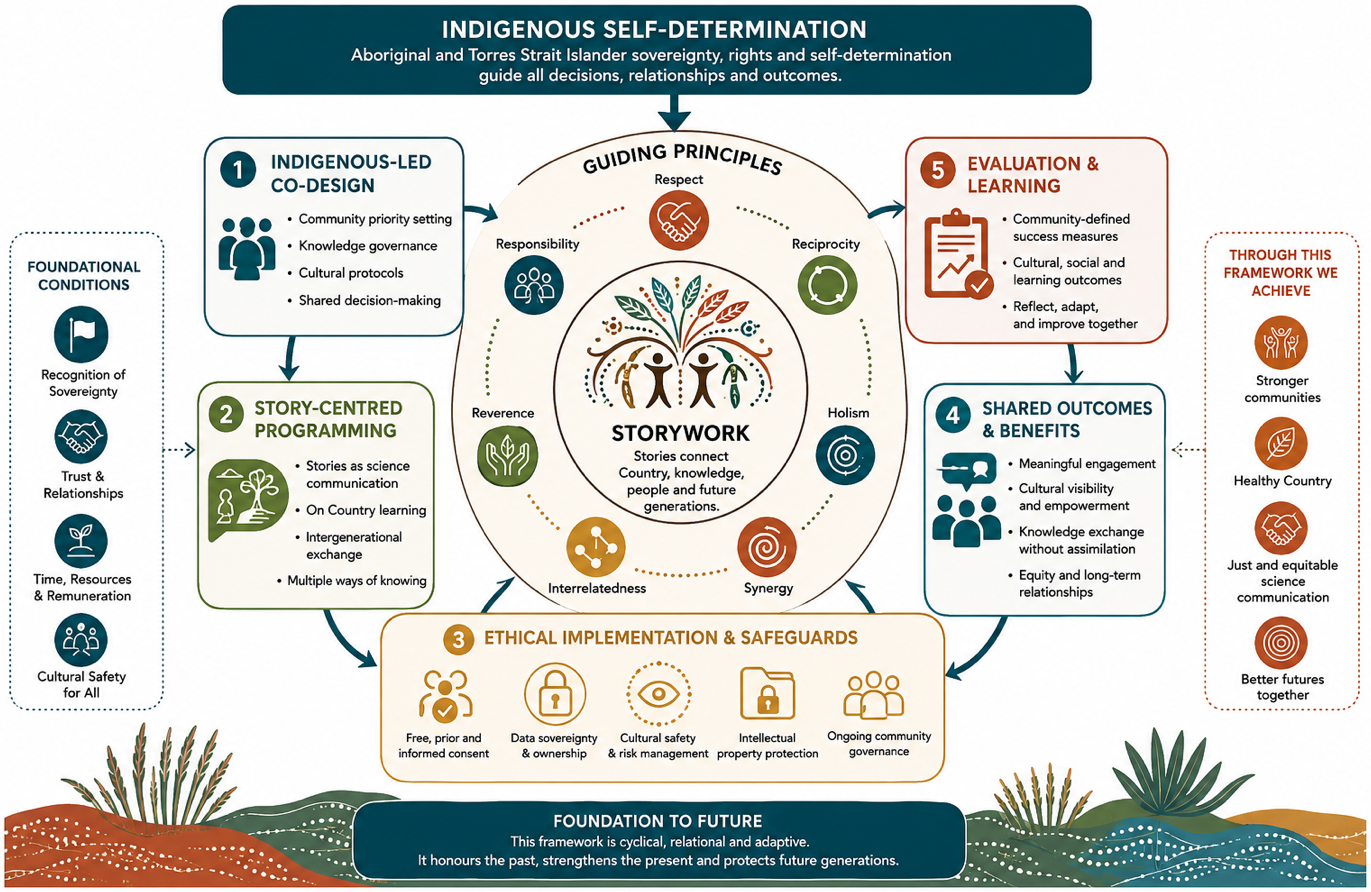
This framework translates the theoretical foundations of Indigenous Storywork, relational Indigenous science, and decolonial science communication into concrete strategies for practice. It is designed to support educators, community organisations, museums, and institutions in developing Australian National Science Week programs that are culturally safe, scientifically rigorous, and grounded in Indigenous authority. While adaptable to different regions and Nations, the framework centres relationality, co-design, and continuity as core modes of engagement. The key elements of the framework and their relationships are summarised in Figure 1.
4.1 Guiding principles
Indigenous leadership. Indigenous Knowledge Holders, Elders, and Indigenous STEM professionals must lead planning, content development, and event delivery. Leadership includes decision-making authority over what stories are shared, how scientific concepts are interpreted, and which cultural protocols must be respected.
Cultural authority and integrity. Events must honour the specificity of local knowledge systems. Avoid generic or pan-Indigenous content. Sacred, ceremonial, or restricted knowledge should never be shared publicly without explicit consent. Where uncertainty exists, the guidance of Elders must take precedence.
Relational engagement. Relationality between people, Country, non-human kin, knowledge, and responsibilities should be central to event design. Engagement activities should reveal these interconnections, helping participants understand science as embedded in ecological and cultural relationships.
Ethical protocols and intellectual property. Organisers must secure permissions for all stories, demonstrations, and content. Indigenous intellectual property must be protected, and Elders and Knowledge Holders must be appropriately compensated. Ethical engagement includes attribution, transparency, and accountability to community priorities.
Two-way learning and co-design. Programs should be co-designed through reciprocal learning, where Indigenous and Western scientific knowledge inform one another without hierarchy. Indigenous frameworks guide interpretation, sequencing, and meaning making, with Western STEM concepts supporting rather than leading.
Place-based learning. Whenever possible, events should occur on Country or include direct engagement with local landscapes, species, and seasonal indicators. Place-based learning deepens understanding and aligns with Indigenous epistemologies in which knowledge emerges through situated interaction.
Sustainability and continuity. Australian National Science Week should not be treated as a one-off event. Programs should create pathways for ongoing science learning, including partnerships, teacher resources, youth mentorships, or community-institution collaborations.
Indigenous-led, Indigenous-for-Indigenous spaces. Not all Indigenous science communication needs to be designed for public audiences. Australian National Science Week organisers should actively support and resource Indigenous-only events as valid, important, and distinct from inclusive public programming. These spaces centre intergenerational knowledge transmission, cultural safety, and community authority without the interpretive demands of cross-cultural public engagement.
Indigenous-led science communication generates different benefits, responsibilities, and accountabilities across stakeholder groups. Distinguishing these roles avoids treating ‘community’ as a homogeneous category and ensures that authority remains with Indigenous Knowledge Holders while enabling meaningful participation from institutions, educators, funders, and broader publics.
4.2 Implementation steps
Early relationship building. Initiate partnerships well ahead of Australian National Science Week. Establish shared goals, clarify expectations, and discuss boundaries. Early relationship building ensures trust and reduces extractive or rushed engagement.
Cultural governance and data sovereignty protocols. Before program design begins, partners must establish community-agreed protocols governing: what knowledge can be shared publicly and under what conditions; consent processes for any story capture, recording, or documentation; storage arrangements that keep recordings and materials under community control. These arrangements should be documented in a partnership agreement and reviewed by community governance structures prior to any public announcement or grant application. Where no community governance structure exists, this step should be used to support communities in establishing one, rather than proceeding without it. These obligations align with Indigenous Data Sovereignty principles [Walter & Suina, 2019] and should be treated as foundational rather than administrative.
Co-design of content. Indigenous leaders and collaborators jointly develop the program structure, identify relevant scientific concepts, and decide how story and experimentation will be intertwined. Accessibility (e.g., language, disabilities, age levels) should be considered from the outset.
Event delivery. Events are led by Indigenous Knowledge Holders, supported by co-facilitators as needed. Multimodal engagement: storytelling, observation, guided walks, art, performance, and experiments ensures accessibility for participants with diverse learning styles.
Documentation and reflection. Collect feedback from participants, Elders, and facilitators. Document what worked well and what needs re-framing. Reflection should be collaborative, with interpretation shaped by Indigenous leaders.
Follow-up engagement. Develop ongoing initiatives such as repeat workshops, teacher toolkits, museum partnerships, or youth science clubs.
4.3 Evaluation metrics
Evaluation should attend to both scientific and relational dimensions:
- Cultural respect. Were cultural protocols followed? Were Elders acknowledged and compensated? Did the event avoid misrepresentation or misappropriation?
- Scientific engagement. Did participants show increased understanding of STEM concepts? Were they able to apply or communicate scientific ideas?
- Relational outcomes. Did relationships between communities, institutions, and participants strengthen? Did participants report a sense of connection to Country?
- Sustainability. Did the program create pathways for ongoing engagement?
- Inclusivity. Were events accessible to Indigenous and non-Indigenous participants with diverse needs, backgrounds, and abilities?
4.4 Summary
This framework provides a practical roadmap for designing Indigenous-led programming during Australian National Science Week. It operationalises key principles: leadership, relationality, co-design, cultural integrity, and continuity to create science communication that is not merely inclusive but transformative. When implemented, this approach reframes Australian National Science Week as a space where Indigenous scientific knowledge is recognised as central to Australia’s understanding of STEM, and where story, Country, and scientific inquiry are brought into meaningful relationship.
5 Discussion
The three cases examined here demonstrate that Indigenous storytelling can function as a sophisticated and rigorous mode of science communication under the right conditions: where Indigenous Knowledge Holders lead design and delivery, where cultural protocols govern what is shared and how, and where engagement is grounded in relationship rather than extraction. Collectively, they show that Australian National Science Week can move beyond token inclusion when Indigenous authority, Storywork, and place-based learning are structurally centred rather than added on. The framework proposed in this article operationalises these conditions into practical guidance for organisers and institutions [Archibald, 2008; Bang & Medin, 2010; Prober et al., 2011; Todd, 2016] (see Table 1).
|
Stakeholder group |
Expected benefits |
Key responsibilities |
Accountability mechanisms |
|
Indigenous communities and Knowledge Holders |
Cultural visibility; strengthened intergenerational knowledge transmission; increased authority within science communication spaces; economic participation |
Lead programme design; determine cultural protocols; approve story use; define evaluation priorities |
Community governance structures; cultural authority; consent and review processes |
|
Indigenous youth and participants |
Cultural affirmation; opportunities for leadership; increased engagement with science and culture |
Participate in programme co-design where appropriate; contribute reflections and feedback |
Youth advisory mechanisms; culturally safe evaluation processes |
|
National Science Week organisers |
More inclusive programming; stronger audience engagement; improved cultural safety |
Resource Indigenous leadership; ensure fair remuneration; uphold governance agreements; support long-term partnerships |
Funding agreements; evaluation reporting; partnership reviews |
|
Science institutions and universities |
Stronger community relationships; improved public trust; broader forms of knowledge engagement |
Respect Indigenous intellectual property; share decision-making authority; support capacity-building |
Institutional ethics processes; Indigenous advisory groups |
|
Schools and educators |
More culturally responsive learning experiences; enhanced student engagement |
Prepare participants appropriately; follow cultural protocols; engage respectfully with communities |
School policies; educator reflection and evaluation |
|
General public audiences |
Exposure to diverse ways of knowing; richer understanding of science and Country |
Engage respectfully; recognise Indigenous authority and expertise |
Participant codes of conduct; event facilitation processes |
|
Funders and policy-makers |
Improved equity outcomes; stronger community impact; alignment with reconciliation commitments |
Support Indigenous-led initiatives; fund governance and relationship-building activities; require ethical practice standards |
Funding criteria; reporting requirements; independent evaluation |
5.1 Implications for policy and practice
For Aboriginal and Torres Strait Islander communities and Knowledge Holders. The implementation of this framework should be driven by Indigenous communities, not delegated to them. Indigenous Elders, Rangers, and STEM professionals must hold genuine decision-making authority over programming, not merely advisory or consultative roles. This includes control over what knowledge is shared publicly, how it is documented and stored, and who benefits from its dissemination. Community-agreed consent processes, data sovereignty protocols, and transparent remuneration arrangements should be established at the outset of any partnership, not retrofitted after program design.
For educators and schools. Indigenous-led events can be embedded into classroom programs to support inquiry-based learning, culturally responsive pedagogy, and STEM identity development. Professional learning for teachers should include Indigenous epistemologies, Storywork practices, and strategies for relational, place-based teaching [Gupta et al., 2020].
For institutions and Science Week organisers. Grant processes, planning frameworks, and event design protocols should actively prioritise Indigenous leadership and ensure appropriate remuneration for Elders and Knowledge Holders. Story-focused, on-Country, and place-based activities should be supported as core program components rather than supplementary add-ons.
For policymakers. Policy and funding structures should recognise Indigenous science communication as central to public engagement, not peripheral. Sustained investment in community partnerships, long-term programs, and capacity-building is essential to ensure lasting impact beyond the annual Science Week cycle.
5.2 Limitations and future research
While the framework and examples provide a practical model, several limitations remain. Current documentation of Indigenous-led Australian National Science Week events tends to focus on astronomy and ecological sciences, leaving areas such as engineering, mathematics, and technology less explored. Further research is needed to:
- assess long-term learning outcomes for participants
- understand impacts on Indigenous students’ STEM identity development
- analyse scalability and resourcing requirements for Indigenous-led programs
- explore region-specific and language-specific storytelling practices across Australia.
Comparative studies both within and beyond Australia could further illuminate how Indigenous science communication varies across Nations and contexts.
6 Conclusion
Indigenous storytelling is a rigorous, relational, and dynamic form of science communication. Australian National Science Week offers a significant opportunity to foreground these knowledge systems and model Indigenous-led approaches to STEM engagement. When guided by Storywork principles, cultural protocols, and Indigenous leadership, Australian National Science Week can shift from tokenistic inclusion to a transformative, community-embedded mode of science communication.
The approach proposed here is not unique to Australia. Analogous efforts to integrate Indigenous knowledge into public science engagement have been developed internationally, and these offer important points of reference. In Canada, Glen Aikenhead and colleagues have advanced Two-Eyed Seeing in science education to support Indigenous student engagement while affirming cultural identity [Aikenhead & Elliott, 2010]. In India, Rajesh Tandon and colleagues have championed participatory research traditions that recentre community knowledge in public science practice [Tandon, 2008]. In Aotearoa New Zealand, Nancy Longnecker and colleagues, alongside the broader Participatory Science Platform [Fleming et al., 2020; Longnecker, 2016], have embedded mtauranga Mori within science communication and festival programming in ways that offer a replicable model for Australia. Comparative engagement with these traditions would strengthen the evidence base for this framework and situate it within a global movement toward relational and decolonial science communication.
This shift invites a broader reimagining of science communication in Australia: one that sees science not as singular or exclusively Western, but as a dialogue among epistemologies grounded in Country, culture, and relational accountability. Such an approach enriches public engagement, supports Indigenous participation in STEM, and broadens our collective understanding of what counts as scientific knowledge and who gets to communicate it.
Positionality statement
Dr. Rachelle Warner is a proud Wiradjuri woman writing from within the knowledge traditions this article seeks to centre. She honours the knowledge-holders of Country across Australia and acknowledges that the transformation of science communication can only be achieved through their leadership, on their terms. She thanks the Aboriginal and Torres Strait Islander scholars, educators, and community members whose work, presence, and generosity inform this analysis. Where she has drawn on knowledge systems beyond her own Nation, she has sought to do so with care, and she acknowledges her ongoing responsibility to those communities. She writes with deep respect for the sovereignty that was never ceded. She is also the current Chair of National Science Week Australian Capital Territory (ACT) and a member of the National Council of Australian Science Communicators.
References
-
Aikenhead, G. S., & Elliott, D. (2010). An emerging decolonizing science education in Canada. Canadian Journal of Science, Mathematics and Technology Education, 10(4), 321–338. https://doi.org/10.1080/14926156.2010.524967
-
Archibald, J.-a. (2008). Indigenous storywork: educating the heart, mind, body, and spirit. University of British Columbia Press. https://doi.org/10.59962/9780774855440
-
Bang, M., & Medin, D. (2010). Cultural processes in science education: supporting the navigation of multiple epistemologies. Science Education, 94(6), 1008–1026. https://doi.org/10.1002/sce.20392
-
Bartlett, C., Marshall, M., & Marshall, A. (2012). Two-Eyed Seeing and other lessons learned within a co-learning journey of bringing together indigenous and mainstream knowledges and ways of knowing. Journal of Environmental Studies and Sciences, 2(4), 331–340. https://doi.org/10.1007/s13412-012-0086-8
-
BayScience. (n.d.). Te Tkohu Ngwh. Mtauranga Mori Science and Design Fair. https://www.bayscience.nz/te-tukohu-ngawha
-
Community News Hub Aboriginal Corporation. (2025). Indigenous Science Storytelling Series: celebrating knowledge & innovation [National Science Week project]. https://www.scienceweek.net.au/national-grant-round-recipients-for-2025-announced/
-
CPAS Inclusive Science Communication Collective. (2025). A proposed framework for considering “inclusive science communication” in theory and practice. Science Communication. https://doi.org/10.1177/10755470251344471
-
Dahlstrom, M. F. (2014). Using narratives and storytelling to communicate science with nonexpert audiences. Proceedings of the National Academy of Sciences, 111(supplement_4), 13614–13620. https://doi.org/10.1073/pnas.1320645111
-
Department of Industry, Science and Resources. (2024a). Australia’s National Science and Research Priorities. Australian Government. https://www.industry.gov.au/publications/national-science-and-research-priorities-2024
-
Department of Industry, Science and Resources. (2024b). Pathway to diversity in STEM review: final recommendations. Australian Government. https://www.industry.gov.au/sites/default/files/2024-02/pathway-to-diversity-in-stem-review-final-report.pdf
-
Department of Industry, Science and Resources. (2025). Prehistoric rock, Indigenous storytelling and oceanography activities feature in National Science Week 2025. Australian Government. https://www.industry.gov.au/news/prehistoric-rock-indigenous-storytelling-and-oceanography-activities-feature-national-science-week-2025
-
Doak, E. (2021, September 25). Piecing together ‘tectonic jigsaw’ shows ancient earthquakes shaped the mighty Murray River. ABC News. https://www.abc.net.au/news/2021-09-25/ancient-earthquakes-cadell-fault-diverted-murray-river/100489426
-
Finlay, S. M., Raman, S., Rasekoala, E., Mignan, V., Dawson, E., Neeley, L., & Orthia, L. A. (2021). From the margins to the mainstream: deconstructing science communication as a white, Western paradigm. JCOM, 20(01), C02. https://doi.org/10.22323/2.20010302
-
Fleming, J. S., Longnecker, N., Salmon, R. A., & Hikuroa, D. C. H. (2020). Aotearoa New Zealand: participatory science and bicultural knowledge communication. In T. Gascoigne, B. Schiele, J. Leach, M. Riedlinger, B. V. Lewenstein, L. Massarani & P. Broks (Eds.), Communicating science: a global perspective (pp. 71–102). ANU Press. https://doi.org/10.22459/CS.2020.04
-
Gupta, H., Tari-Keresztes, N., Stephens, D., Smith, J. A., Sultan, E., & Lloyd, S. (2020). A scoping review about social and emotional wellbeing programs and services targeting Aboriginal and Torres Strait Islander young people in Australia: understanding the principles guiding promising practice. BMC Public Health, 20(1), 1625. https://doi.org/10.1186/s12889-020-09730-1
-
Hamacher, D. W., & Norris, R. P. (2011). ‘Bridging the gap’ through Australian cultural astronomy. Proceedings of the International Astronomical Union, 7(S278), 282–290. https://doi.org/10.1017/s1743921311012713
-
Inspiring Australia NSW. (2024). 2024 National Science Week NSW report summary. https://inspiringnsw.org.au/2024/11/08/2024-national-science-week-nsw-report-summary/
-
Jorgensen, R., Sullivan, P., & Grootenboer, P. (Eds.). (2013). Pedagogies to enhance learning for Indigenous students: evidence-based practice. Springer. https://doi.org/10.1007/978-981-4021-84-5
-
Judd, K., & McKinnon, M. (2021). A systematic map of inclusion, equity and diversity in science communication research: do we practice what we preach? Frontiers in Communication, 6, 744365. https://doi.org/10.3389/fcomm.2021.744365
-
Landcare NT. (2025). Biodiversity Buzz: Top End Eco Science Fair [National Science Week project]. https://www.scienceweek.net.au/national-grant-round-recipients-for-2025-announced/
-
Longnecker, N. (2016). An integrated model of science communication — more than providing evidence. JCOM, 15(05), Y01. https://doi.org/10.22323/2.15050401
-
Macfarlane, S., Macfarlane, A., & Gillon, G. (2015). Sharing the food baskets of knowledge: creating the space for a blending of streams. In A. Macfarlane, S. Macfarlane & M. Webber (Eds.), Sociocultural realities: exploring new horizons (pp. 52–66). Canterbury University Press.
-
Macquarie University. (2025). Indigenous Science Experiences @ Redfern and the Scrub. https://www.scienceweek.net.au/national-grant-round-recipients-for-2025-announced/
-
Martin-Booran Mirraboopa, K. (2003). Ways of knowing, being and doing: a theoretical framework and methods for indigenous and indigenist re-search. Journal of Australian Studies, 27(76), 203–214. https://doi.org/10.1080/14443050309387838
-
McKinnon, M. (2024). Further discussion of the inherent challenges and subsequent opportunities for developing global science communication curricula. International Journal of Science Education, Part B, 14(4), 498–504. https://doi.org/10.1080/21548455.2024.2412262
-
McNiven, I. J., & Feldman, R. (2003). Ritually orchestrated seascapes: hunting magic and dugong bone mounds in Torres Strait, NE Australia. Cambridge Archaeological Journal, 13(2), 169–194. https://doi.org/10.1017/s0959774303000118
-
Ministry of Business Innovation & Employment (Hkina Whakatutuki). (2022). Te Ara Paerangi — Future Pathways White Paper. New Zealand Government. https://www.mbie.govt.nz/science-and-technology/science-and-innovation/agencies-policies-and-budget-initiatives/other-publications/white-paper
-
Ministry of Research Science and Technology (Te Manat Ptaiao). (2007). Vision Mtauranga: unlocking the innovation potential of Mori knowledge, resources and people. New Zealand Government. https://www.mbie.govt.nz/dmsdocument/3109-vision-matauranga-booklet-pdf
-
New Zealand International Science Festival. (2026). About the festival. https://scifest.org.nz/about
-
Norris, R. P., & Hamacher, D. W. (2009). The astronomy of Aboriginal Australia. Proceedings of the International Astronomical Union, 5(S260), 39–47. https://doi.org/10.1017/s1743921311002122
-
Norris, R. P., & Hamacher, D. W. (2015). Australian Aboriginal astronomy — an overview. In C. L. N. Ruggles (Ed.), Handbook of archaeoastronomy and ethnoastronomy (pp. 2215–2222). Springer. https://doi.org/10.1007/978-1-4614-6141-8_238
-
Nunn, P. D., & Reid, N. J. (2016). Aboriginal memories of inundation of the Australian coast dating from more than 7000 years ago. Australian Geographer, 47(1), 11–47. https://doi.org/10.1080/00049182.2015.1077539
-
Ober, R. (2009). Both-ways: learning from yesterday, celebrating today, strengthening tomorrow. The Australian Journal of Indigenous Education, 38(S1), 34–39. https://ajie.atsis.uq.edu.au/ajie/article/view/551
-
Orthia, L. (2020). Strategies for including communication of non-Western and indigenous knowledges in science communication histories. JCOM, 19(02), A02. https://doi.org/10.22323/2.19020202
-
Ortiz, C., Travlou, P., Siqueira, M., & Testori, G. (2025). Decolonising urban knowledge(s): an ordinary imperative in extraordinary times. City, 29(3–4), 485–501. https://doi.org/10.1080/13604813.2025.2470540
-
Prober, S. M., O’Connor, M. H., & Walsh, F. J. (2011). Australian Aboriginal peoples’ seasonal knowledge: a potential basis for shared understanding in environmental management. Ecology & Society, 16(2), 12. http://www.ecologyandsociety.org/vol16/iss2/art12/
-
Purdie, N., Milgate, G., & Bell, H. R. (2011). Two way teaching and learning: toward culturally reflective and relevant education. ACER Press. https://research.acer.edu.au/indigenous_education/38
-
Ramadan, M. E. (2024). Beyond Western perspectives: inclusive insights to decolonise and transform science communication. JCOM, 23(01), R04. https://doi.org/10.22323/2.23010704
-
Rasekoala, E. (2023). Introduction: race and sociocultural inclusion in science communication — global contemporary issues. In E. Rasekoala (Ed.), Race and sociocultural inclusion in science communication: innovation, decolonisation, and transformation (pp. 1–16). Policy Press. https://doi.org/10.1332/policypress/9781529226799.003.0001
-
Rose, D. B. (1996). Nourishing terrains: Australian Aboriginal views of landscape and wilderness. Australian Heritage Commission.
-
Standen, E. (2025). Inclusive science communication — considering decolonisation [Ph.D. Thesis]. The Australian National University. https://doi.org/10.25911/NEKJ-PV60
-
Tandon, R. (2008). Participation, citizenship and democracy: reflections on 25 years’ of PRIA. Community Development Journal, 43(3), 284–296. http://www.jstor.org/stable/44258087
-
Todd, Z. (2016). An Indigenous feminist’s take on the ontological turn: ‘ontology’ is just another word for colonialism. Journal of Historical Sociology, 29(1), 4–22. https://doi.org/10.1111/johs.12124
-
Trench, B. (2008). Towards an analytical framework of science communication models. In D. Cheng, M. Claessens, T. Gascoigne, J. Metcalfe, B. Schiele & S. Shi (Eds.), Communicating science in social contexts: new models, new practices (pp. 119–135). Springer. https://doi.org/10.1007/978-1-4020-8598-7_7
-
Walker, L., & Banks, C. (2021). Indigenous STEM Education Project. Final evaluation report: September 2014–June 2021. Commonwealth Scientific and Industrial Research Organisation (CSIRO). https://www.csiro.au/-/media/Education-and-Outreach/Impact-Library/ISEP/Files/ISEP-Final-Evaluation-report.pdf
-
Walter, M., & Suina, M. (2019). Indigenous data, indigenous methodologies and indigenous data sovereignty. International Journal of Social Research Methodology, 22(3), 233–243. https://doi.org/10.1080/13645579.2018.1531228
-
Watson, I. (2015). Aboriginal peoples, colonialism and international law: raw law. Routledge. https://doi.org/10.4324/9781315858999
-
Williams, N. M. (2007). Disciplining the savages, savaging the disciplines. The Australian Journal of Indigenous Education, 36(1), 131–134. https://doi.org/10.1017/s1326011100004579
About the author
Dr. Rachelle Warner is an Adjunct Fellow at the Adelaide Medical School, University of Adelaide. A proud Wiradjuri woman, her work sits at the intersection of regulatory practice, cultural safety, and science communication, with a research background spanning reproductive toxicology, environmental health, veterans’ health, and First Nations health equity. She holds a Ph.D. in Medicine from the University of Adelaide, a Master of Applied Science in Toxicology (RMIT), and a Bachelor of Health Sciences (First Class Honours).
E-mail: rachelle.warner@adelaide.edu.au