1 Introduction
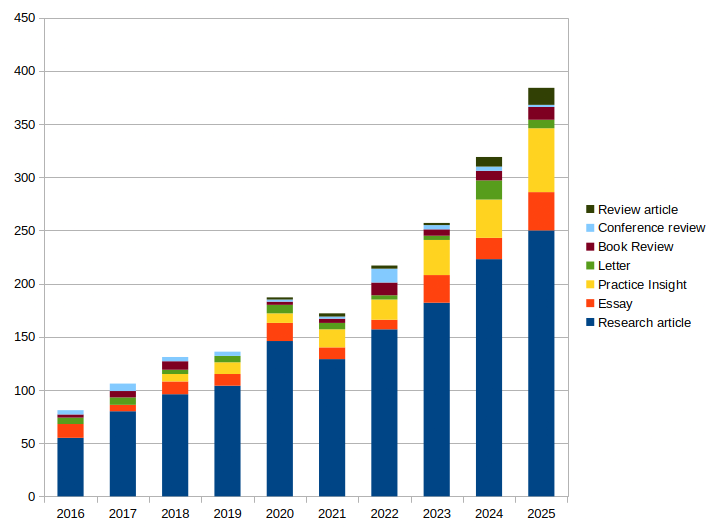
At a meeting of academic journal editors during the 76th Annual Conference of the International Communication Association (ICA) in Cape Town (4–7 June 2026), a panel of prominent editors shared two main challenges: (1) a sharp and consistent growth in the number of manuscripts submitted; and (2) increasing difficulty in securing high-quality peer reviews. At JCOM, we face the same pressures. Figure 1 illustrates the growth in the number and types of submitted items over the last decade. In 2025, only 20% of submitted items were published.
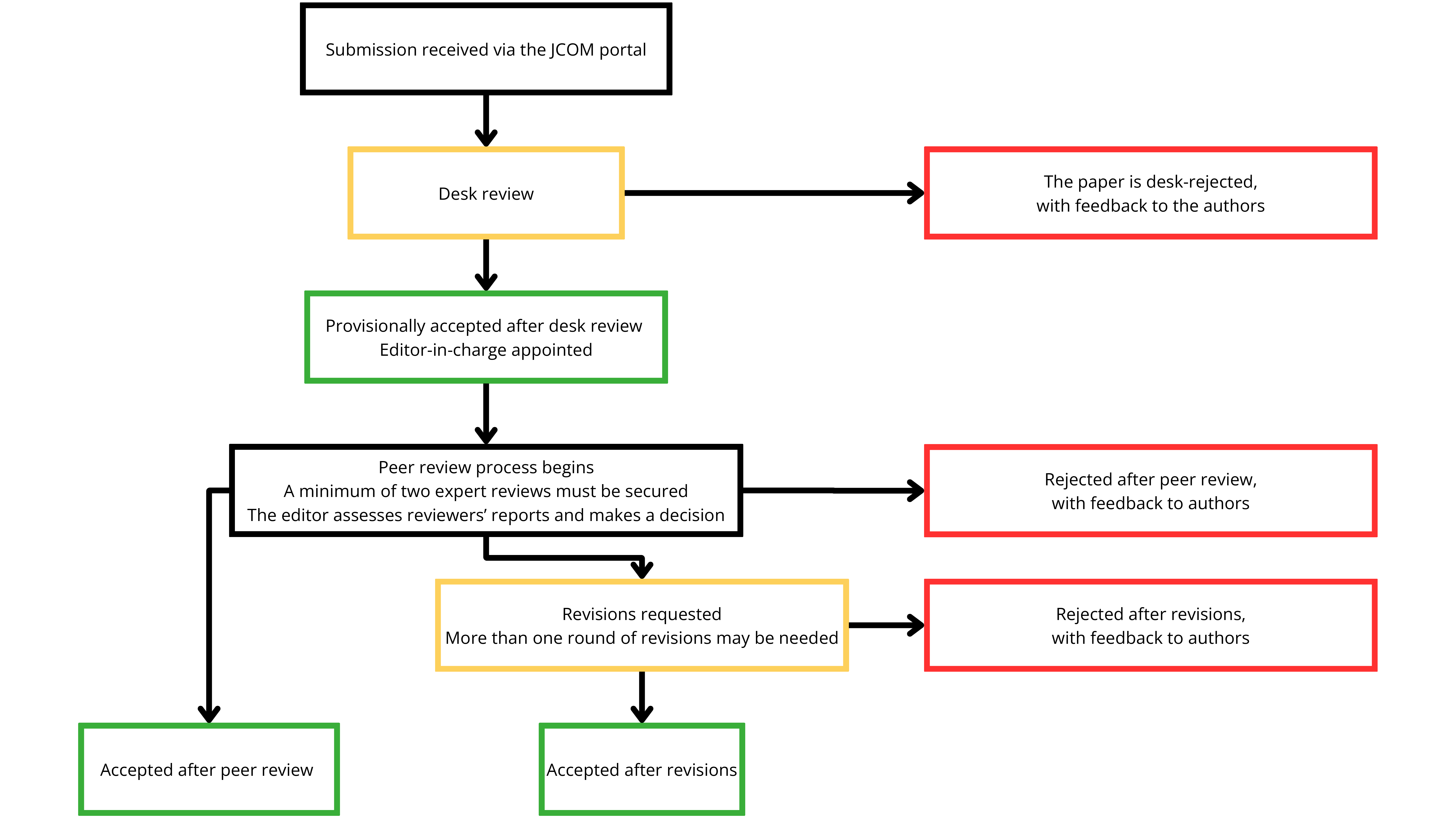
JCOM publishes between six and nine issues each year, including special issues, with between seven and 17 items in each issue. We publish research articles, practice insights, research review articles, essays, commentaries, letters, and reviews of relevant books and conferences. Given that the number of submissions we receive is likely to continue to grow, and the uncertainties associated with emerging generative AI-assisted writing and publication practices, we must continually revisit and refine our editorial practices to ensure JCOM’s rigour, impact and sustainability. Our aim is to publish high-quality and relevant content, and this guides everything we do. Before submitting, please ensure that your manuscript complies with our author guidelines, available at https://jcom.sissa.it/site/authors/. Figure 2 (below) summarises our review process.
2 Desk review
To start with, every submission undergoes a desk review to assess its suitability for peer review. This initial assessment is done by the editors, sometimes with help from members of our editorial board.
The first questions we ask when considering a new submission are: “Is this manuscript within scope and will it be relevant and interesting to our readers?” A brief (anonymised) cover letter from the authors that explains why the work fits JCOM’s scope and which article type they have chosen, and why, is really helpful. A second key question concerns innovation and novelty; therefore, we ask: “Does the manuscript provide original insights or novel perspectives into science communication research or practice?” It helps if you also highlight this in your cover letter.
We then assess whether the contribution is grounded in current knowledge about science communication scholarship and practice, even when authors choose to critique it. Showing how a manuscript builds on, extends, or productively challenges existing conversations in the field helps reviewers locate its contribution and signals that the work is a good fit for our readership. We assess whether authors have adequately cited the relevant literature and avoided unsupported claims.
Since JCOM readers value connections between science communication research and practice, we particularly welcome submissions that result from collaborations between science communication researchers and practitioners. We recognise that important science communication research and practice is taking place around the world, and we also seek perspectives and scholarship from regions and communities that are underrepresented in international science communication research and practice areas.
The first technical check concerns the article type to ensure that authors have chosen the most relevant option (see Table 1). Correct formatting is also important, and we check whether the manuscript uses the JCOM template, follows JCOM’s formatting and reference style, is within the prescribed word length for each article type, and is anonymised. We also assess whether the abstract succinctly and accurately conveys the aim, approach, key findings, argument, and significance of the work to science communication researchers and practitioners. [Note: the author template is downloadable at https://jcom.sissa.it/site/authors/.] Furthermore, we carefully review authorship and accountability during the desk review stage, and it really helps if authors ensure their profiles in the JCOM system are up to date and complete, including their social media accounts.
|
Article type |
Content |
Word limit (including abstract and references) |
|
Research article |
New empirical research, supported by a comprehensive literature review, a thorough theoretical grounding, detailed methodology, strong and original findings, and a conclusion with implications for researchers and practitioners. |
5,000 – 8,000 words |
|
Practice insight |
Practical reflections on science communication practice, including project evaluations, action research, and innovative case studies. |
3,000 – 5,000 words |
|
Essay |
Texts that explore and reflect on current issues, e.g. a policy, theory, or emerging trend in science communication, aiming to stimulate discussion. |
3,000 – 4,500 words |
|
Letter |
Responses to published papers or comments on topical issues in the field. |
1,000 words |
|
Research review (or review article) |
A comprehensive review of a topic pertinent to science communication. Please note that authors must send a short proposal before submitting a full review article.* |
9,000 words |
|
Book review |
Reviews of current and significant scholarly and non-fiction books in the field of science communication. Please pitch book reviews first.* |
1,000 words |
|
Conference review |
Reflections on recent science communication events relevant for JCOM readers. Please pitch conference reviews first.* |
1,000 words |
3 Peer review
Manuscripts that pass the desk review process are sent to at least two external reviewers. The steps outlined below mainly happen during the peer-review process.
To ensure blind peer review, it is essential that manuscripts are completely anonymous. It is the authors’ responsibility to check that they cannot be identified, either directly or indirectly, anywhere in the submission. This means removing author names, affiliations and other institutional details, acknowledgements, and self-identifying references, as well as anonymising any links that could reveal their identity, such as pre-registration records, data repositories, code, or supplementary materials.
In all articles, we consider the relevance of the approach: for answering the research questions (research articles), demonstrating practice innovation (practice insights), or developing a strong and novel argument (essays). For research articles, the rigour of the research design and implementation is key. The results (or findings) must be presented clearly and coherently. We look for sufficient detail and transparency that will allow readers to understand how the findings, insights, or conclusions were developed. The discussion should synthesise the evidence, experiences, or arguments and present a coherent and meaningful new understanding of a science communication issue, practice, or phenomenon. We consider whether the scope of the evidence and the claims made are appropriately aligned and whether the discussion and conclusions are sufficiently supported by the evidence, analysis, examples, or reasoning presented.
As a diamond open-access journal (i.e., one that charges no page fees or subscription fees and is fully open-access), we value openness and transparency throughout the research process. Therefore, wherever it is ethically and legally possible, we encourage authors to share the data, materials, and analytical code underpinning their work, and to include a clear data-availability statement explaining what can be accessed and how. Where relevant, pre-registration of study designs and transparent reporting of methods further strengthen the credibility of the research.
Where relevant, we also ask whether the authors have reflected critically and transparently on the limitations of a specific study and explained what these mean for the strength and scope of their claims. It is also important that authors include (where relevant) a clear statement of ethics clearance obtained from the relevant research organisation.
Practice insights should reflect critically on science communication practice in real-world contexts. We welcome contributions that introduce and critically examine novel, imaginative, or experimental approaches to science communication, especially those that challenge conventional thinking and practices or open new possibilities for engaging diverse publics. Submissions should go beyond describing what was done: they must analyse why the approach matters, how it addresses a clearly defined practice issue or problem, and how it contributes to broader science communication practice beyond the specific context. Authors should describe the evidence base for their practice (e.g. evaluation methodology, action research approach, or potential for such work) and discuss the implications of their findings for practitioners and researchers. Contributions should also reflect on transferability and scalability, discussing how the lessons learned could inform science communication in other contexts or settings.
Further manual and technical checks are done at the submission and production stages, including (but not limited to) the quality of the writing and referencing. Manuscripts that are well-structured and written in an accessible style facilitate the process. Please note that it is the authors’ responsibility to ensure that their manuscripts have been thoroughly proofread. The references must be complete and correctly formatted in line with the JCOM template, which follows APA 7 citation style. All the citations in the text must be included in the reference list, and all references must be cited in the text. Finally, we check whether the authors clearly and fully declare the use of AI tools, where relevant, and that these tools have been used in compliance with the JCOM guidelines for AI use – available at https://jcom.sissa.it/site/faq/. Please also refer to our previous editorial, Joubert and Riedlinger [2026], which elaborates on the risks and responsibilities of AI use.
We ask authors and reviewers to keep in mind that JCOM is read by researchers and practitioners working across many disciplines, countries, and cultural contexts. We therefore encourage authors to write for this broad and diverse audience and to make the practical implications of their work explicit for science communication researchers and practitioners, so that it can inform research-based practice and practice-led research in future.
We always welcome suggestions and ideas from our community. Whether you have a proposal for a special issue or broader thoughts on how we can continue to improve and strengthen JCOM, we would love to hear from you.
References
-
Joubert, M., & Riedlinger, M. (2026). Integrity under pressure: on generative AI, fabricated references and ethical publishing. JCOM, 25(1). https://doi.org/10.22323/388620260304154318
About the authors
Marina Joubert is an Associate Professor at the Centre for Research on Evaluation, Science and Technology (CREST), Stellenbosch University, South Africa. Her research focuses on science communication and public engagement, exploring how scientists, institutions, and communicators can engage more effectively with diverse publics. She is particularly interested in scientists as communicators, media representations of science, and the public communication of complex global health challenges, including antimicrobial resistance (#AMR) and vaccine confidence. She currently serves as the Deputy Editor of JCOM.
E-mail: marinajoubert@sun.ac.za
Michelle Riedlinger is a Chief Investigator in the Digital Media Research Centre at the Queensland University of Technology. Her research interests include emerging environmental, agricultural and health research communication practices, roles for “alternative” science communicators, online fact checking, platformised engagement with scientific research, and, most recently, generative authenticity.
E-mail: michelle.riedlinger@qut.edu.au