

1 Introduction
In recent years, scientists have increasingly leveraged social media to communicate significant scientific phenomena and achievements directly to the public in real time. These events range from the 2017 total solar eclipse to the 2018 maiden flight of SpaceX’s Falcon Heavy rocket, to the US Department of Energy’s announcement of nuclear fusion ignition in 2022. Many of these are broadcast live to the public and feature breathtaking footage or first-time releases of fascinating scientific details.
Unlike classic media events such as the 1969 moon landing [Dayan & Katz, 1992], today’s science media events unfold within distinctly different media and social contexts. First, the events are no longer explicitly framed as international contests or nationalistic spectacles as they were decades ago [Dayan & Katz, 1992]. Instead, many contemporary science media events are guided by the broader mission of engaging and inspiring the public “to expand human knowledge” and “to attract and develop a talented and diverse workforce” [NASA, 2022, p. 7]. Second, today’s events are primarily streamed on social media platforms such as YouTube and Twitch often featuring high-fidelity, multi-angle presentations. Importantly, even when originally broadcast live, the persistent and asynchronous nature of social media content [Treem & Leonardi, 2013] affords many more viewers to watch and engage with such content through rich audio-visual formats after the fact. Therefore, the science communication potential of these events may lie not only in their inspirational subject matter, but also in the rich modality through which they are presented. For example, recent science communication research demonstrates that presentation modality can significantly impact audience’s cognitive and emotional responses to contents on science topics especially those related to thought-provoking, inspiration and awe [VanDyke & Yeo, 2024].
Indeed, rich audio-visual content of science events may be well-suited to promote science to the public for two key reasons. First, most Americans learn about science and develop science interest from sources outside the classroom [Falk & Dierking, 2010], with riveting media contents playing a vital role [Stocklmayer et al., 2010]. Second, science media events often feature spectacular footage imbued with profound meanings for society and humankind. Witnessing such happenings through rich audio-visual modality may invoke the emotion of awe which can steer the audience’s attention towards fulfilling eudaimonic motivations such as self-transcendent truth-seeking and knowledge exploration through further science information-seeking [Bartsch & Schneider, 2014].
Extant research on information-seeking has largely focused on practical concerns such as solving problem, opinion formation, and closing knowledge gap on health, political or environmental topics [e.g. Liu et al., 2022; Yang et al., 2023]. Far less is known about the psychological mechanisms underlying information-seeking for self-transcendent purposes such as knowledge exploration and truth-seeking. Understanding information-seeking motivated by such eudaimonic media experiences may help science communicators better promote science to the public because repeated information-seeking in a topic helps convert situational interest (something that interests me) into the more enduring individual interest (something I am interested in) [Su, 2020].
To this end, we integrate traditional learning theory, specifically self-efficacy [Bandura, 1997], and positive psychology of media effects, particularly eudaimonic experiences [Oliver & Raney, 2019], to understand how the modality of science media events may contribute to the public’s knowledge exploration and meaning-seeking through science information seeking.
Specifically, we conducted a between-subject online experiment with two-conditions: rich modality (audio-visual format) versus lean modality (textual-imagery format). Using the maiden flight of SpaceX’s Falcon Heavy rocket as the stimulus, we assessed participants’ experience of awe, thought-provoking reflection, perceived science self-efficacy, as well as their future science information-seeking intention. The study seeks to illuminate how media modality influences the capacity of science media events to foster public engagement with science.
2 Literature review
2.1 Science media events as a rich modality genre and the evocation of awe
Following the Durkheimian tradition in sociology, media events — such as the Apollo 11 moon landing or presidential inaugurations — are theorized as society-wide mediated rituals [Dayan & Katz, 1992]. These rituals provoke profound reflections beyond individuals’ everyday concerns, connecting them to self-transcendent meanings about nature, society, or humanity. During these mediated moments, strong emotions and intensive cognitive engagement are elicited among audiences [Cui & Xu, 2020].
Dayan and Katz [1992] theorized that the impact of such events on the audience rests on both the subject matter and the presentational features of the messages. On the one hand, various “scripts” of media events, including contest, conquest, and coronation, elicit corresponding emotions and meaning-making reflections. On the other hand, these responses are also attributed to the rich audio-visual elements that are characteristic of the genre. As Dayan and Katz argued, the “formula” of this televisual genre features spectacular footage that sets the content apart from routine programming and the audience experience apart from mundane life. Broadcasters often use emotional tones of excitement, astonishment, or reverence, while emphasizing onsite audiences’ emotional responses through close-up shots and amplified cheers to create a sense of shared emotional experiences. Overall, the collective emotions shared by the media audience during such events result from both the subject matter and the rich modality of the genre.
For science media events, they typically conform to the “conquest” script — triumphs over formidable odds and expansion beyond known boundaries through extraordinary measures and massive risks. These conquest-themed media events evoke the hallmark emotion of “awe” [Dayan & Katz, 1992, p. 35]. Psychologists have shown that the elicitation of awe depends on two simultaneous cognitive appraisals: the perception of vastness and the need for cognitive accommodation [Keltner & Haidt, 2003]. Vastness can be either perceptual, such as intricate patterns of snowflakes, or conceptual, such as scientific breakthroughs with immense implications for society [Shiota et al., 2007; Yaden et al., 2016]. In science media events, this vastness can range from astronomical scales of measurement to intricate engineering feats to immense implications for human life, all representing perceptual or conceptual vastness beyond ordinary frames of reference. Need for cognitive accommodation refers to “the urge to adjust mental frames according to new incoming information” [Chirico et al., 2018, p. 2]. When awe-inspired, individuals must adjust their cognitive frames of reference they use in mundane life to accommodate the vastness and orient themselves toward a reality of a much grander scale.
While the subject of a science media event provides the basis for appraising vastness, it is the rich audio-visual modality of extraordinary scientific achievements that give audiences vivid information to perceive this vastness — thereby setting the media genre apart from leaner modality such as textual reports with static images often seen in news websites and social media posts.
We define media modality as the sensorial form in which media content is delivered [Dockter et al., 2021]. Common media modalities include textual representations, i.e., written language and linguistic scripts, graphic representations, i.e., static visual elements such as photos and drawings, and audio-visual representations, i.e., synchronized moving imagery and sound such as speech, music, and environmental noises. Media content delivered for more than one sensorial channel is therefore multimodal [Bracken & Dalessandro, 2017].
Several cognitive processes in face of rich audio-visual media modality contribute to the audience’s emotional responses to such content. On the one hand, rich and multimodal media content can heighten the audience’s attention and engage them for a longer time, which leads to better cognitive outcome such as memory [Greussing et al., 2020]. However, at the same time, audiences’ mental capacity is more heavily taxed by multimodal representations compared to leaner information channels [Fisher et al., 2019]. This can lead to audience’s stronger perception of believability and weaker critical evaluation of the media content [Sundar et al., 2021]. As a result, audiences tend to take media information at face value and rely on audio-visual cues, such as perceptual or conceptual vastness, to guide their subsequent emotional responses. Specifically, empirical studies have shown the connection between rich modality and stronger emotional responses compared to leaner channels [e.g. Hwang et al., 2021; VanDyke & Yeo, 2024].
Furthermore, since cues in media events include vivid representations of onsite individuals’ emotional reactions, a characteristic feature of the genre, the process of emotional contagion may further amplify media audiences’ emotions. Emotional contagion occurs when audiences appraise and mirror emotions based on media representations of emotions associated with the content [Cui & Xu, 2021]. Simply witnessing vivid representations of others’ emotional reactions can trigger the same emotional response, especially in rich modality media. More importantly, awe, a signature emotion of media events of conquest, is particularly prone to elicitation in social conditions [Bai et al., 2017; Van Cappellen & Saroglou, 2012] and with information-rich stimuli [Shiota et al., 2007].
In contrast, the textual-imagery format represents a lean modality. Previous studies have demonstrated the validity of using textual content as a lean modality to contrast rich media modality’s impact on audiences’ emotional and cognitive reactions, including in science communication contexts [Lee et al., 2024; VanDyke & Yeo, 2024]. Moreover, textual-imagery format is a common modality of information in the current media environment, ranging from webpages to social media. Comparing audio-visual and textual-imagery formats allows us to address both conceptual differences of modality and ecological validity of the study. Therefore, we hypothesize:
- H1:
-
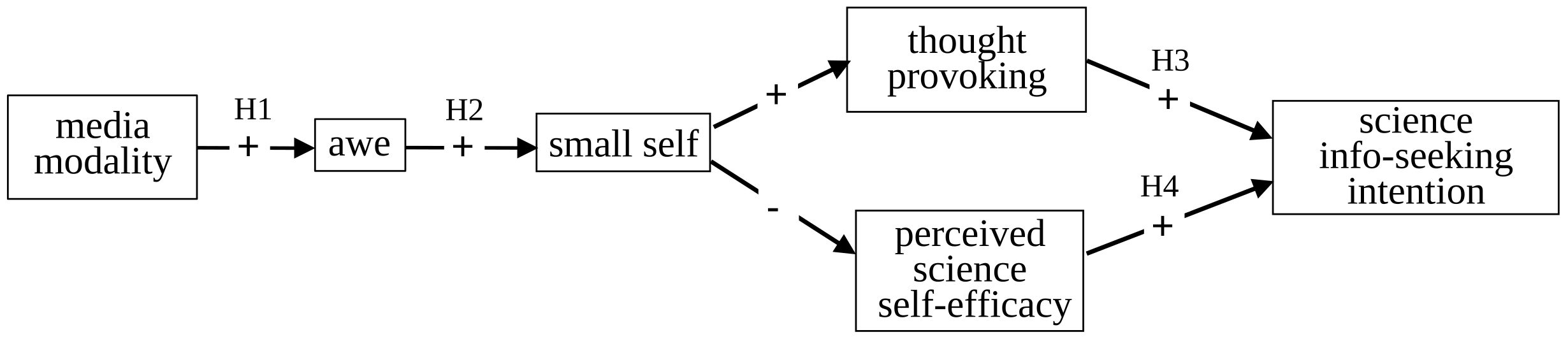
Viewers of a science media event presented in audio-visual format will report stronger experiences of awe than readers of the same event presented in textual-imagery format.
2.2 Small self: a cognitive consequence of awe
To further understand the cognitive pathways between awe and information-seeking intentions, we first examine an immediate and signature cognitive outcome of awe, i.e., the sense of small self [Piff et al., 2015]. Small self is defined as “a sense that one is a part of something larger than oneself” and often manifests metaphorically as “reduced significance the individual attaches to personal concerns and goals” [Piff et al., 2015, p. 884]. When individuals experience the vastness inherent in an awe stimulus, their sense-making or order-seeking tendency [Valdesolo & Graham, 2014] urges them to expand their mental framework of self-definition to include more universal categories. For example, Shiota et al. [2007] found that awe-inspired participants were less likely to describe themselves as “special” or “one-of-a kind”, rather they should be more likely to see themselves as members of the society, the human-species, or the nature. Such sense of small self also reflects the perception of diminished self-importance in a larger hierarchy [Bai et al., 2017; Shiota et al., 2007].
Such shifts in self-concept may significantly shape subsequent information process [Markus & Wurf, 1987]. Because our conceptual model draws on both eudaimonic, self-transcendent media experience and self-efficacy in the learning process, incorporating this self-related concept of small self allows us to pinpoint the specific psychological mechanisms underlying motivated information-seeking following awe experiences evoked by a science media event.
When consuming a science media event, audiences should experience a diminished sense of self as a cognitive consequence of awe [Piff et al., 2015]. This is because, when awe-struck, audience’s exposure to the vastness portrayed in the media event will force their mental schema to accommodate the perceived vastness. In this process, the everyday self-concept within the usual mental schema becomes subject to a larger scale or hierarchy. Usual perceptions of goals, concerns, importance and competence about the self are transcended. Thus, individuals simultaneously experience being inspired and humbled by something much greater than themselves as a result of the awe-inducing experience [Gallagher et al., 2015; Oliver et al., 2015; Yaden et al., 2019]. Therefore, we hypothesize:
- H2:
-
Awe mediates the relationship between the modality of a science media event and the perception of small self. Specifically, compared to the textual-imagery modality, the audio-visual modality of a science media event elicits stronger experiences of awe, which in turn are associated with stronger perceptions of small self.
2.3 Awe-inspired truth-seeking as a pathway toward science information-seeking
Awe, as an epistemic emotion, increases cognitive involvement [Valdesolo et al., 2017]. When individuals experience awe, their diminished sense of self leads to more immersive contemplation that transcends immediate hedonic concerns. Such intensive cognitive engagement focuses on seeking order, meaning, and explanation in the grand scheme of things [Valdesolo & Graham, 2014; Valdesolo et al., 2017], leading to new knowledge and perspectives [Chang, 2023]. In other words, awe is thought-provoking.
In media research, Oliver and Bartsch [2010] conceptualize such thought-provoking experiences of media content as a media effect known as appreciation. It is defined as a “state that is characterized by the perception of deeper meaning, the feeling of being moved, and the motivation to elaborate on thoughts and feelings inspired by the experience.” [p. 76]. In other words, awe-inspired appreciation of media content is eudaimonic and features truth-seeking motivation. Such motivation takes the form of an open-ended search for meaning and insights which starts from reflection on and realization of the insufficiency of existing mental frameworks and moves toward information-seeking related to, but not limited to, the media stimulus itself [Oliver & Raney, 2011]. Research shows that eudaimonic appreciation of a media content motivates further exposure to relevant topics and such motivated exposure fulfils a desire to understand and learn instead of hedonic purposes [Bartsch & Schneider, 2014].
Since science media events, as explicated earlier, are awe-inspiring, audiences may experience a diminished sense of self and, in turn, be motivated to engage in active truth-seeking. It is plausible that such self-transcendent and eudaimonic motivation may manifest as intentions to further seek out science information in the future, facilitating sustained re-engagement with science [Krapp & Prenzel, 2011].
Therefore, we hypothesize:
- H3:
-
Modality of a science media event (audio-visual vs. textual-imagery) influences science information-seeking intention through a sequential pathway involving awe, small-self, and thought-provoking. Specifically, a science media event presented in audio-visual format generates stronger feelings of awe than a textual-imagery description does, which heightens the sense of small self. This further increases thought-provoking, ultimately resulting in higher intention of science information-seeking.
2.4 Awe-attenuated perception of self-efficacy as a barrier to science information-seeking
While the eudaimonic experience of awe and the induced sense of small-self may boost information-seeking through provoking thoughts, they may also have an unintended effect that hinders the desire to seek out similar information. Research demonstrates that feelings of awe diminish one’s sense of self, which can lower other self-related perceptions such as self-efficacy — a factor that influences motivation to re-engage with similar contents in learning processes [Bai et al., 2017; Piff et al., 2015; Shiota et al., 2007].
Perceived self-efficacy is defined as one’s perception of their capabilities to organize and carry out courses of action to attain specific goals [Bandura, 1986]. According to the Social Cognitive Theory, media exposure to a certain topic is part of one’s symbolic environment, which requires low effort to access and can provide mastery information, varied affective experiences, and social modelling, all of which are key sources of perceived self-efficacy [Bandura, 1997]. Higher perceived self-efficacy can motivate information-seeking because individuals would feel confident on particular topics and anticipate successful comprehension and application [Eastin & LaRose, 2000]. They are also more likely to persist through challenging information [Zimmerman, 2000]. Conversely, low perceived self-efficacy may discourage information-seeking due to anticipated confusion, cognitive overload, or fear of inadequacy in processing domain-specific knowledge [Barbour et al., 2012]. In learning processes, higher perceived self-efficacy has been shown to support sustained autonomous information-seeking [Silvia, 2003], particularly in science [Krapp & Prenzel, 2011].
Following this logic, when an individual consumes a spectacular and awe-inspiring science media event, the perceptual or conceptual vastness may overwhelm their existing mental frame of reference. The diminished sense of self from such overwhelming experience lowers a task-specific self-cognition — perceived science self-efficacy. Because efficacy plays such a key role in motivated learning process, a lower perceived science self-efficacy, i.e., the sense of inability or low confidence in comprehending scientific information, will undermine their information-seeking intentions on science topics. Therefore, we hypothesize:
- H4:
-
The modality of a science media event (audio-visual vs. textual-imagery) influences science information-seeking intention through a sequential pathway involving awe, small-self, and perceived self-efficacy. Specifically, a science media event in audio-visual format generates stronger feelings of awe than a textual-imagery description does, which heightens the sense of small self. This further decreases perceived science self-efficacy, ultimately resulting in lower intention of science information-seeking.
Since we have hypothesized opposing mechanisms linking a science media event’s modality and subsequent science information-seeking intention (H3 and H4), it is important to examine the total effects to understand the overall impact of modality on science information-seeking. Therefore, we ask,
- RQ1:
-
When combining the impacts of science media event’s modality (audio-visual vs. textual-imagery) through thought-provoking and perceived science self-efficacy respectively, what is the total effect on science information-seeking intention?
Figure 1 presents the overall conceptual model.
3 Method
3.1 Sample
Participants (N = 356) were recruited from Prolific, an online research panel, in July 2023. Each participant received $3.5 for their participation. Within the sample, there were 195 females, 154 males, and 7 non-binary individuals, with an average age of 30.59 years (SD = 14.97). The sample comprised of 276 Caucasians, 29 African Americans, 14 Latinos, 23 Asian Americans or Pacific Islanders, 1 Native American, and 13 multiracial individuals. Although majority of the participants identified their country of origin as the United States (n = 320, 89.9%), thirty-six (10.1%) indicated other countries and regions such as Barbados, Canada, China, Kyrgyzstan, the Netherlands, Puerto Rico, and Trinidad and Tobago.
3.2 Procedure and stimuli
To test the hypotheses, we first randomly assigned the participants to either watch a video clip from a science media event or read a textual-imagery description of the event. The video condition (coded “2”) contained 188 participants (52.8%), and the textual condition (coded “1”) contained 168 participants (47.2%).
We selected SpaceX’s maiden launch of its then-largest rocket, Falcon Heavy, on February 6, 2018, as our stimulus event. This launch was broadcast live on YouTube and Twitch at the time. While space launches are now routinely broadcast live on social media, the Falcon Heavy launch stands out for several reasons. First, Falcon Heavy was the world’s most powerful operational space vehicle at launch — a significant achievement for a relatively young, privately owned company — making the launch a typical media event of conquest. Second, the event featured the first successful simultaneous double side-booster landing, captured with stunning footage from both onboard cameras and ground perspectives. Third, as a commemorative payload, the launch carried a Tesla Roadster convertible with an astronaut manikin driver (dubbed “Starman”) into deep space. These unique views broadcast to the audience made the audio-visual presentation of the event rich in vivid spectacles.
The stimulus video features the first 8 minutes of the launch between the final countdown and the double-booster landing, including double booster separation, first stage separation, fairing deployment exposing the Roadster and Starman in space, the boosters’ return entry burns, landing burns, and the simultaneous landing of the two boosters. The video includes live shots from over a dozen cameras on the ground and aboard the rocket. Viewers can hear technical callouts from the control room as well as the broadcast hosts’ enthusiastic commentary.
The textual-imagery condition presents a written description of the launch. It is 1,012 words long with 13 screenshots taken from the broadcast. It describes the major developments during the launch, explains the camera views in the screenshots, and the enthusiastic reaction of the onsite audience, which the video version showed for a few seconds. While the textual description captures the same key events and technical milestones as the video, it necessarily condenses the audiovisual information into written narrative form. On average, it took the participants 292.1 seconds (SD = 102.8 seconds) to read the textual stimulus. Stimulus designs striving to maintain content equivalence between video and textual conditions tend to result in shorter exposure in the textual condition due to the nonlinear nature of reading activity [Mason et al., 2022]. This design choice prioritizes content equivalence over temporal equivalence, as forcing equal exposure times would require either extending the text with redundant information or truncating the video to remove key elements.
After exposure to the stimuli, participants were directed to an online questionnaire. Participants self-reported their emotional experiences and perceptions about the media content they had just consumed as well as their demographic information.
3.3 Measurements
All constructs were measured using 5-point scales. Unless otherwise noted, anchors ranged from 1 (Strongly Disagree) to 5 (Strongly Agree). Complete wording for all measurement items is provided in Table 1.
|
Variable |
Items | Mean | SD |
α(AVE) / item loading |
Based on |
| Awe | 2.87 | 1.20 |
n/a |
McPhetres [2019] |
|
|
To what extent did you experience “awe” | |||||
| Small self | 2.60 | 1.03 |
.89 (.67) |
Piff et al. [2015] |
|
|
I feel my own issues and concerns do not matter as much in the grand scheme of things | 2.68 | 1.20 |
.85 | ||
|
I feel insignificant in the grand scheme of things | 2.58 | 1.22 |
.92 | ||
|
I feel small relative to something more powerful than myself | 2.41 | 1.18 |
.69 | ||
|
I feel my life is mundane relative to something extraordinary | 2.72 | 1.18 |
.72 | ||
| Thought-provoking | 3.42 | 1.00 |
.83 (.62) |
Oliver & Bartsch [2010] |
|
|
The video/text makes me think about meaningful issues | 3.29 | 1.16 |
.78 | ||
|
The video/text is thought-provoking | 3.72 | 1.13 |
.79 | ||
|
I find myself thinking about more profound things when watching the video/reading the text | 3.24 | 1.19 |
.81 | ||
| Perceived science self-efficacy | 3.14 | 1.04 |
.93 (.77) |
OECD [2009] |
|
|
I feel that learning science and technology topics is easy for me | 3.03 | 1.15 |
.86 | ||
|
I feel that I can usually give good answers to science and technology topics | 3.09 | 1.16 |
.86 | ||
|
I feel that I can learn science and technology topics quickly | 3.16 | 1.18 |
.92 | ||
|
I feel that I can easily understand new ideas in science and technology | 3.28 | 1.08 |
.85 | ||
| Intention of science information seeking | 3.54 | .93 |
.86 (.62) |
Metag [2020] |
|
|
Listen to scientists and engineers explaining their jobs | 3.28 | 1.19 |
.73 | ||
|
Read more news and stories about science and technology | 3.53 | 1.10 |
.86 | ||
|
Watch stuff explaining science and technology | 3.67 | 1.08 |
.90 | ||
|
Visit a museum of science and technology | 3.66 | 1.09 |
.60 | ||
3.3.1 Awe
Following McPhetres [2019], awe was measured with a single item asking participants the extent to which they felt awe (1 = very slightly or not at all, 5 = extremely). This single-item approach has been validated across diverse stimuli [Chirico et al., 2017, 2018]. The mean of reported awe was 2.87 (SD = 1.20).
3.3.2 Small self
Adapted from Piff et al. [2015], the four-item small-self scale measures the feeling of being smaller and less significant in the grand scheme of things. The scale demonstrated high internal consistency (M = 2.60, SD = 1.03, α = .89).
3.3.3 Thought-provoking
We measured the experience of thought-provoking using a three-item scale adapted from Oliver and Bartsch [2010] and Chang [2023]. The items formed a reliable measurement of thought-provoking (M = 3.42, SD = 1.00, α = .83).
3.3.4 Perceived science self-efficacy
Participants’ perceived self-efficacy in understanding science and technologies was measured with four items based on the international survey of the Program for International Student Assessment (PISA) [OECD, 2009]. Because perceived self-efficacy focuses on task-specific performance expectations rather than global self-concept [Zimmerman, 2000], we selected the PISA measurement for its applicability in the context of science education. The questions formed a reliable measurement (M = 3.14, SD = 1.04, α = .93).
3.3.5 Intention of science information-seeking
Following McPhetres [2019] and Metag [2020], we gauged participants’ intention of science information-seeking induced by the media stimuli with measurements of intention to seek science information through four distinct sources ranging from 1 (Definitely Not) to 5 (Definitely Yes). The questions formed a reliable measurement of science information seeking intention (M = 3.54 SD = .93, α = .86).
3.3.6 Happiness
We measured happiness as a control variable. McPhetres [2019] found that the relationship between awe and knowledge gap disappears after positive emotion is entered as a control. Although such control did not influence the relationship between awe and science information-seeking intention, McPhetres [2019] cautioned scholars about the unclear relationship between the awe-inducing manipulation and emotional outcomes. Thus, we included happiness in both the measurement model and the structural model as a control variable. Happiness was measured with a single item on a 5-point scale (M = 2.24, SD = 1.40).
3.3.7 Measurement model
We conducted a confirmatory factor analysis to validate the measurement model using the lavaan package [Rosseel, 2012] in R [R Core Team, 2021]. All questionnaire items with their respective latent constructs were entered into the measurement model, along with modality, awe, and happiness as single-item observed variables. Considering the chi-square test’s sensitivity to sample size, we follow Jöreskog and Sörbom’s [1993] recommendation of χ2/df ≤ 3 as a criterion of model fit. A good fit of the model was achieved based on Hu & Bentler’s [1999] criteria (χ2(117) = 225.87, p < .01, χ2/df = 1.93, CFI = .972, TLI = .964, RMSEA = .049, SRMR = .033). Item loadings ranged from .60 to .92. Table 1 presents the descriptive statistics for each construct and corresponding item, as well as item loadings.
3.4 Data analysis
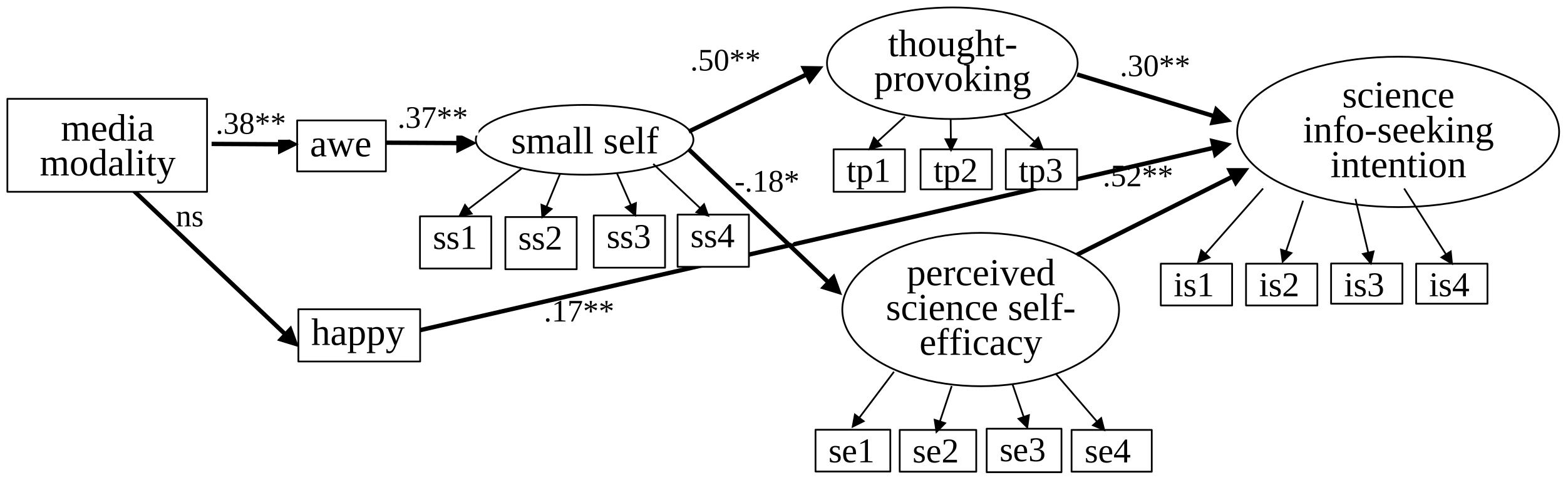
We used structural equation modelling to test the hypotheses in one overall model (Figure 2). The model specifies a three-step mediation process from the modality of science media event (rich modality: audio-visual = 2 vs. lean modality: textual-imagery = 1) to awe, to small self, to thought-provoking and perceived self-efficacy simultaneously, and finally to science information-seeking intentions. Happiness, as explained earlier, was entered as a control variable mediating the effect of modality on information-seeking intentions [McPhetres, 2019]. Based on the criteria recommended by Jöreskog and Sörbom [1993] and Hu and Bentler [1999], the model achieved a good fit (χ2(124) = 196.65, p < .01, χ2/df = 1.59, CFI = .982, TLI = .977, RMSEA = .039, SRMR = .055).
4 Results
H1 hypothesizes that modality of science media event will have a significant effect on the emotion of awe such that viewers of the science media event in audio-visual format will experience stronger awe than readers of the textual-imagery description. The path coefficient from modality to awe was significant (β = .331, p < .001, 95% CI: [.240, .418]). Therefore, H1 was supported.
H2 hypothesizes that awe will mediate the relationship between media modality and the perception of small self, such that viewers of a science media event in rich modality, compared to readers of the leaner textual-imagery description, will experience stronger emotion of awe which will increase the sense of small self. The indirect effect of media modality on sense of small self was significant (point estimate: = .131, p < .001, 95% CI [.085, .189]). H2 was supported.
H3 hypothesizes that the emotion of awe, the sense of small self, and the experience of thought-provoking sequentially mediate the effect of media modality on science information-seeking intention such that participants watching the rich modality video will have stronger intentions to seek science-related information in the future. A significant and positive indirect effect through the hypothesized path was found (point estimate: .009, p < .01, 95% CI [.004, .016]). Therefore, H3 was supported albeit with a relatively small effect size.
H4 hypothesizes that the emotion of awe, the sense of small self, and the perception of science self-efficacy will sequentially mediate the effect of media modality on information-seeking intention such that watching the media event video will result in lower intentions to seek science-related information in the future compared to the textual-imagery condition. A significant negative indirect effect following the hypothesized path was found (point estimate: -.008, p < .05, 95% CI [-.017, -.001]). H4 was also supported.
Comparing the two indirect pathways reveals a notable theoretical tension. The positive indirect effect through thought-provoking (H3: point estimate = .009, p < .01) and the negative indirect effect through perceived self-efficacy (H4: point estimate = -.008, p < .05) are nearly equal in magnitude but opposite in direction. On one hand, the vivid representations of scientific achievements provoke transcendent reflection and truth-seeking motivations — the audience are inspired by such eudaimonic effect. On the other hand, the same spectacular content can overwhelm viewers, diminishing their perceived self-efficacy in comprehending science — the audience feel intimidated. These countervailing forces represent a fundamental paradox in using awe-inspiring media for science communication.
RQ1 asks about the total effect of media modality on information-seeking intention when combining the impacts through thought-provoking and perceived science self-efficacy. As anticipated from the nearly equivalent magnitudes of the opposing pathways, the total effect of modality of science media event on science information-seeking intentions was non-significant (point estimate: .001, p > .05, 95% CI [-.008, .011]. Modality’s positive contribution to participants’ science information-seeking intentions through the thought-provoking path was offset by its negative impact through the self-efficacy path. Ultimately, the intentions did not differ between audiences exposed to the two media modalities.
5 Discussion
The study investigates the relationship between the modality in which audience consume a science media event and their subsequent intentions to seek out science-related information. Specifically, we examine how rich and lean modalities of a science media event induce awe which in turn leads to divergent cognitive processing. We found empirical support for the awe-inducing effect of watching a science media event in the audio-visual format compared to reading a textual-imagery description of the event.
More importantly, the emotional experience of awe triggered two parallel cognitive mechanisms through the perception of small self. Awe increased science information-seeking intentions through higher thought-provoking while simultaneously decreasing those same intentions through reduced perceived self-efficacy. These countervailing forces ultimately neutralized the effect of modality on science information-seeking intentions. The findings offer the following insights into the genre of science media events and their potential role in promoting public engagement with science.
5.1 Media events in rich modality as inspiring media
This study contributes to the broader research on the effects of inspiring media [Oliver et al., 2021]. Scholars have shown that enjoyment of media narratives and even reality competition shows goes beyond self-focused hedonic pleasure to include the appreciation of moral beauty that transcends mundane and ego-centric concerns [Chang, 2023; Oliver & Bartsch, 2011]. The current study complements extant literature on eudaimonic media effects by focusing on media modality of short-lived and intensive media experiences such as media events in the science context. The findings are aligned with those of VanDyke and Yeo [2024] who found that audio-visual content of science topics enhances emotions and subsequent information-seeking intentions.
The original media event theory [Dayan & Katz, 1992] does not clearly distinguish message content (what they call “script”) from message characteristics (or “formula”) when theorizing its emotional and cognitive impacts on the audience. This study disentangles the influence of media modality of this genre in the science context. We show that, when the science subject is held constant, compared to the textual-imagery format, the vivid audio-visual representations of a scientific breakthrough, from witnessing spectacles in motion to hearing cheers of the enthusiastic crowd and the excited tone of the hosts, inspired stronger awe in participants, what Durkheim [1995] called emotional effervescence.
The distinction between modality and subject is an important one especially for science communicators. We show that how we present scientific events may be as consequential as what we present. Science media events in rich modality are particularly well-suited for inspiring the audience because they often combine spectacular visuals with profound meanings, steering audiences toward eudaimonic motivations for knowledge exploration and transcendent reflection.
5.2 Understanding the dual-pathway paradox in science communication
Our study reveals a theoretical paradox: awe elicited by rich audio-visual science content simultaneously promotes and undermines information-seeking intention through distinct psychological mechanisms. Understanding both pathways is essential for comprehending how inspiring media operates in the science communication context.
The positive pathway operates through eudaimonic truth-seeking. When struck by awe, viewers experienced a diminished sense of self, which redirected cognitive resources toward contemplation of self-transcendent meanings. This thought-provoking state increased information-seeking intention. Bartsch and Schneider [2014] documented similar processes in political communication, showing that eudaimonic entertainment characterized by moving and thought-provoking content stimulates reflective cognition and heightens information-seeking intentions. Our work extends this to science contexts, demonstrating that awe-induced reflection motivates a distinctive form of information-seeking — one driven not by practical problem-solving or opinion formation, but by personal fulfilment and meaning-making.
This eudaimonic pathway prompts elaborate cognitive processing rather than heuristic processing. The small-self experience enables viewers to transcend immediate personal concerns and engage with profound questions such as humanity’s place in the cosmos. Such transcendent reflection, even from a serendipitous exposure to vivid media representations, can potentially initiate interest development processes, where repeated, self-motivated information-seeking accumulates knowledge and builds more sustained interest in science topics [Guo & Fryer, 2025; Tan et al., 2024]. Information-seeking becomes a behavioural manifestation of converting situational interest (“something interesting”) triggered by the captivating event into more enduring individual interest (something I am interested in) [Su, 2020].
However, the negative pathway reveals awe’s unintended consequence. The same small-self perception that enables self-transcendent reflection also undermines viewers’ perceived science self-efficacy, which in turn decreases information-seeking intention. This finding illuminates critical tension in using awe-inspiring science events for public engagement. The perceptual or conceptual vastness that makes science events awe-inspiring can simultaneously create psychological distance, making science feel overwhelming or beyond one’s capability to comprehend. Perceived self-efficacy — one’s belief in their capacity to successfully engage with a task — is a fundamental prerequisite for sustained engagement [Bandura, 1997]. When awe makes people feel small and insignificant, it inadvertently signals that science is “too much for someone like me”.
Importantly, these pathways demonstrated nearly equal magnitude, resulting in a statistically non-significant total effect. This does not mean the absence of media effects, rather it demonstrates competing psychological forces at equilibrium. This study reveals that awe’s effects cannot be characterized as uniformly positive or negative. Rather, it is simultaneously inspiring and intimidating, so that subsequent cognitive processes work against each other.
It should also be noted that these competing mechanisms may work differently for different audience groups. While our experimental design randomized exposure, in natural settings both trait-level and state-level factors may shape individuals’ exposure to and experiences of awe-inspiring science content. Research has shown that people who have less need for cognitive closure are prone to experience awe due to their willingness to accommodate changes in their mental frames of reference [Shiota et al., 2007]. More critically, while familiarity with the stimulus may desensitize an individual to experience awe [Ochadleus et al., 2023], familiarity with the subject matter about the stimulus, may actually amplify people’s experience of awe because their domain-specific knowledge affords them to more readily grasp the perceptual or conceptual vastness that the less knowledgeable may not recognize, especially in science [Cuzzolino, 2021]. This creates a circular relationship: individuals with greater affinity to science are not only more likely to seek out science media events in the first place but are also better positioned to experience awe and resist threats to their science self-efficacy, which in turn may reinforce their engagement.
This suggests that rich audio-visual science events might inadvertently widen engagement gaps rather than close them, creating a virtuous cycle for the already-engaged while erecting barriers for those we most hope to reach. While the current study focused on the main effect of media modality as a situational factor, future research should examine how individual differences in science attitudes and knowledge moderate both exposure patterns and the strength of the modality-awe relationship.
5.3 Practical implications for science communicators
Our findings carry important implications for practitioners seeking to leverage inspiring science media for public engagement. First, science communicators should recognize that rich audio-visual formats are powerful tools for inducing awe and provoking transcendent reflection. Emotional and cognitive reactions to spectacular science events can effectively inspire eudaimonic motivations for knowledge exploration. However, presenting awe-inspiring content alone may be insufficient or even be counterproductive if the self-efficacy barrier is not addressed.
We recommend intervention designs that pair awe-inspiring content with self-efficacy supports. Effective strategies identified in social cognitive research include: (1) vicarious experience — showing diverse, relatable role models successfully engaging with science; (2) social persuasion — providing affirming messages about viewers’ capabilities and potential; (3) mastery experiences — creating opportunities for successful engagement, such as accessible explanations or interactive elements that allow audiences to experience competence [Bandura, 1986; Luzzo et al., 1999].
Second, science communicators should consider audience segmentation. The same rich modality content may work differently for audiences with different levels of science attitudes. For those with lower initial science engagement, gradually building competence and confidence before exposure to highly awe-inspiring content may be necessary. For those already familiar and enthusiastic about science, vivid science events may effectively deepen commitment through eudaimonic experiences without triggering self-efficacy concerns.
5.4 Limitations
The findings of the current study should also be interpreted with the following limitations in mind. First, we only measured science information-seeking intention instead of objective behavioural data. It is well-known that further barriers exist between behavioural intention and actual behaviour. Future studies may want to observe actual selective exposure or persistence of attention on task [Ainley et al., 2002]. Second, this single-shot study cannot address whether repeated exposure shifts the balance between the thought-provoking pathway and the self-efficacy pathway or whether the paradoxical effects of the two pathways persist over time. Third, the Falcon Heavy launch is the only science event we used in the stimuli. Thus, our research findings may be confounded by the idiosyncrasy of the stimuli. Fourth, our experimental design involved a temporal asymmetry between conditions, with the audiovisual stimulus lasting 8 minutes while participants spent an average of approximately 5 minutes reading the textual-imagery description. This reflects an inherent challenge in media modality research: achieving content equivalence often precludes temporal equivalence [Mason et al., 2022]. We prioritized content equivalence by ensuring both conditions conveyed the same key events and technical achievements, though in different modalities. However, this design choice means we cannot fully disentangle the effects of modality from the effects of exposure duration. Future research should explore whether specific time thresholds are necessary for inducing awe in science media events or statistically control for exposure duration to isolate modality effects. Lastly, we only manipulated media modality to induce different levels of awe. Relations among the subsequent variables in the model are based on cross-sectional data. As Chan et al. [2022] argued, such research design cannot rule out alternative explanations. Future studies should try to employ longitudinal designs or manipulations of mediating variables to directly test causal relationships. Nonetheless, this study demonstrates the potential of inspiring science media events in the promotion of public interest in science and explicates the psychological mechanisms underlying these effects to inform better designs of science campaigns.
Acknowledgments
The study is funded by a faculty research and development grant from the College of Charleston.
Data availability statement. The study’s dataset is available from the author upon reasonable request. The experimental stimuli can be found at https://osf.io/4xvq8/overview?view_only=2867d7c7be5540c8844ed34878e3ef77.
References
-
Ainley, M., Hidi, S., & Berndorff, D. (2002). Interest, learning, and the psychological processes that mediate their relationship. Journal of Educational Psychology, 94(3), 545–561. https://doi.org/10.1037/0022-0663.94.3.545
-
Bai, Y., Maruskin, L. A., Chen, S., Gordon, A. M., Stellar, J. E., McNeil, G. D., Peng, K., & Keltner, D. (2017). Awe, the diminished self, and collective engagement: universals and cultural variations in the small self. Journal of Personality and Social Psychology, 113(2), 185–209. https://doi.org/10.1037/pspa0000087
-
Bandura, A. (1986). Social foundations of thought and action: a social cognitive theory. Prentice-Hall.
-
Bandura, A. (1997). Self-efficacy: the exercise of control. W.H. Freeman & Co.
-
Barbour, J. B., Rintamaki, L. S., Ramsey, J. A., & Brashers, D. E. (2012). Avoiding health information. Journal of Health Communication, 17(2), 212–229. https://doi.org/10.1080/10810730.2011.585691
-
Bartsch, A., & Schneider, F. M. (2014). Entertainment and politics revisited: how non-escapist forms of entertainment can stimulate political interest and information seeking. Journal of Communication, 64(3), 369–396. https://doi.org/10.1111/jcom.12095
-
Bracken, C. C., & Dalessandro, A. (2017). Modality and medium characteristics. In P. Rössler, C. A. Hoffner & L. Zoonen (Eds.), The international encyclopedia of media effects (pp. 1–12). Wiley. https://doi.org/10.1002/9781118783764.wbieme0205
-
Chan, M., Hu, P., & Mak, M. K. F. (2022). Mediation analysis and warranted inferences in media and communication research: examining research design in communication journals from 1996 to 2017. Journalism & Mass Communication Quarterly, 99(2), 463–486. https://doi.org/10.1177/1077699020961519
-
Chang, C. (2023). Being inspired by media content: psychological processes leading to inspiration. Media Psychology, 26(1), 72–87. https://doi.org/10.1080/15213269.2022.2097927
-
Chirico, A., Cipresso, P., Yaden, D. B., Biassoni, F., Riva, G., & Gaggioli, A. (2017). Effectiveness of immersive videos in inducing awe: an experimental study. Scientific Reports, 7(1), 1218. https://doi.org/10.1038/s41598-017-01242-0
-
Chirico, A., Ferrise, F., Cordella, L., & Gaggioli, A. (2018). Designing awe in virtual reality: an experimental study. Frontiers in Psychology, 8, 2351. https://doi.org/10.3389/fpsyg.2017.02351
-
Cui, X., & Xu, Q. (2020). The roles of identity and emotion in media events’ social integration mechanism: a case study of the 2017 U.S. presidential inauguration. Atlantic Journal of Communication, 28(2), 138–152. https://doi.org/10.1080/15456870.2019.1613406
-
Cui, X., & Xu, Q. (2021). Television vs social media: examining the effects of media platforms on audience’s emotion and sense of social solidarity during a media event. Western Journal of Communication, 85(5), 632–653. https://doi.org/10.1080/10570314.2021.1970216
-
Cuzzolino, M. P. (2021). “The awe is in the process”: the nature and impact of professional scientists’ experiences of awe. Science Education, 105(4), 681–706. https://doi.org/10.1002/sce.21625
-
Dayan, D., & Katz, E. (1992). Media events: the live broadcasting of history. Harvard University Press.
-
Dockter, C. E., Lee, S., Boman, C. D., Hinnant, A., & Cameron, G. T. (2021). The impact of retransmission and modality on communicating health research findings via social media. Health Communication, 36(10), 1231–1241. https://doi.org/10.1080/10410236.2020.1749354
-
Durkheim, E. (1995). The elementary forms of religious life (K. E. Fields, Trans.). Free Press.
-
Eastin, M. S., & LaRose, R. (2000). Internet self-efficacy and the psychology of the digital divide. Journal of Computer-Mediated Communication, 6(1), JCMC611. https://doi.org/10.1111/j.1083-6101.2000.tb00110.x
-
Falk, J. H., & Dierking, L. D. (2010). The 95 percent solution. American Scientist, 98(6), 486–493. https://doi.org/10.1511/2010.87.486
-
Fisher, J. T., Hopp, F. R., & Weber, R. (2019). Modality-specific effects of perceptual load in multimedia processing. Media and Communication, 7(4), 149–165. https://doi.org/10.17645/mac.v7i4.2388
-
Gallagher, S., Reinerman-Jones, L., Janz, B., Bockelman, P., & Trempler, J. (2015). A neurophenomenology of awe and wonder: towards a non-reductionist cognitive science. Palgrave Macmillan. https://doi.org/10.1057/9781137496058
-
Greussing, E., Kessler, S. H., & Boomgaarden, H. G. (2020). Learning from science news via interactive and animated data visualizations: an investigation combining eye tracking, online survey, and cued retrospective reporting. Science Communication, 42(6), 803–828. https://doi.org/10.1177/1075547020962100
-
Guo, Z., & Fryer, L. K. (2025). What really elicits learners’ situational interest in learning activities: a scoping review of six most commonly researched types of situational interest sources in educational settings. Current Psychology, 44(1), 587–601. https://doi.org/10.1007/s12144-024-07176-x
-
Hu, L.-t., & Bentler, P. M. (1999). Cutoff criteria for fit indexes in covariance structure analysis: conventional criteria versus new alternatives. Structural Equation Modeling: a Multidisciplinary Journal, 6(1), 1–55. https://doi.org/10.1080/10705519909540118
-
Hwang, J., Borah, P., Shah, D., & Brauer, M. (2021). The relationship among COVID-19 information seeking, news media use, and emotional distress at the onset of the pandemic. International Journal of Environmental Research and Public Health, 18(24), 13198. https://doi.org/10.3390/ijerph182413198
-
Jöreskog, K. G., & Sörbom, D. (1993). LISREL 8: structural equation modeling with the SIMPLIS command language. Scientific Software International.
-
Keltner, D., & Haidt, J. (2003). Approaching awe, a moral, spiritual, and aesthetic emotion. Cognition and Emotion, 17(2), 297–314. https://doi.org/10.1080/02699930302297
-
Krapp, A., & Prenzel, M. (2011). Research on interest in science: theories, methods, and findings. International Journal of Science Education, 33(1), 27–50. https://doi.org/10.1080/09500693.2010.518645
-
Lee, J., Hameleers, M., & Shin, S. Y. (2024). The emotional effects of multimodal disinformation: how multimodality, issue relevance, and anxiety affect misperceptions about the flu vaccine. New Media & Society, 26(12), 6838–6860. https://doi.org/10.1177/14614448231153959
-
Liu, Z., Yang, J. Z., & Feeley, T. H. (2022). Reduced Risk Information Seeking Model (RISK): a meta-analysis. Science Communication, 44(6), 787–813. https://doi.org/10.1177/10755470221144453
-
Luzzo, D. A., Hasper, P., Albert, K. A., Bibby, M. A., & Martinelli, E. A. (1999). Effects of self-efficacy-enhancing interventions on the math/science self-efficacy and career interests, goals, and actions of career undecided college students. Journal of Counseling Psychology, 46(2), 233–243. https://doi.org/10.1037/0022-0167.46.2.233
-
Markus, H., & Wurf, E. (1987). The dynamic self-concept: a social psychological perspective. Annual Review of Psychology, 38, 299–337. https://doi.org/10.1146/annurev.ps.38.020187.001503
-
Mason, L., Tarchi, C., Ronconi, A., Manzione, L., Latini, N., & Bråten, I. (2022). Do medium and context matter when learning from multiple complementary digital texts and videos? Instructional Science, 50(5), 653–679. https://doi.org/10.1007/s11251-022-09591-8
-
McPhetres, J. (2019). Oh, the things you don’t know: awe promotes awareness of knowledge gaps and science interest. Cognition and Emotion, 33(8), 1599–1615. https://doi.org/10.1080/02699931.2019.1585331
-
Metag, J. (2020). What drives science media use? Predictors of media use for information about science and research in digital information environments. Public Understanding of Science, 29(6), 561–578. https://doi.org/10.1177/0963662520935062
-
NASA. (2022). NASA strategic plan 2022. https://assets.science.nasa.gov/content/dam/science/cds/about-us/science-strategy/2022/fy_22_strategic_plan_tagged.pdf
-
Ochadleus, C., Kirby, C., & Scollon, C. N. (2023). It’s awe-fully unfamiliar: the effect of familiarity on awe within a virtual reality setting. Frontiers in Psychology, 14, 1096283. https://doi.org/10.3389/fpsyg.2023.1096283
-
OECD. (2009). PISA 2006 Technical Report. https://www.oecd.org/en/about/programmes/pisa/pisa-data.html
-
Oliver, M. B., & Bartsch, A. (2010). Appreciation as audience response: exploring entertainment gratifications beyond hedonism. Human Communication Research, 36(1), 53–81. https://doi.org/10.1111/j.1468-2958.2009.01368.x
-
Oliver, M. B., & Bartsch, A. (2011). Appreciation of entertainment: the importance of meaningfulness via virtue and wisdom. Journal of Media Psychology, 23(1), 29–33. https://doi.org/10.1027/1864-1105/a000029
-
Oliver, M. B., Kim, K., Hoewe, J., Chung, M.-Y., Ash, E., Woolley, J. K., & Shade, D. D. (2015). Media-induced elevation as a means of enhancing feelings of intergroup connectedness. Journal of Social Issues, 71(1), 106–122. https://doi.org/10.1111/josi.12099
-
Oliver, M. B., & Raney, A. A. (2011). Entertainment as pleasurable and meaningful: identifying hedonic and eudaimonic motivations for entertainment consumption. Journal of Communication, 61(5), 984–1004. https://doi.org/10.1111/j.1460-2466.2011.01585.x
-
Oliver, M. B., & Raney, A. A. (2019). Positive media psychology: emerging scholarship and a roadmap for emerging technologies. In J. A. M. Velázquez & C. M. Pulido (Eds.), The Routledge handbook of positive communication: contributions of an emerging community of research on communication for happiness and social change (pp. 111–119). Routledge. https://doi.org/10.4324/9781315207759
-
Oliver, M. B., Raney, A. A., Bartsch, A., Janicke-Bowles, S., Appel, M., & Dale, K. (2021). Model of inspiring media. Journal of Media Psychology, 33(4), 191–201. https://doi.org/10.1027/1864-1105/a000305
-
Piff, P. K., Dietze, P., Feinberg, M., Stancato, D. M., & Keltner, D. (2015). Awe, the small self, and prosocial behavior. Journal of Personality and Social Psychology, 108(6), 883–899. https://doi.org/10.1037/pspi0000018
-
R Core Team. (2021). R: a language and environment for statistical computing. R Foundation for Statistical Computing. https://www.R-project.org
-
Rosseel, Y. (2012). lavaan: an R package for structural equation modeling. Journal of Statistical Software, 48(2), 1–36. https://doi.org/10.18637/jss.v048.i02
-
Shiota, M. N., Keltner, D., & Mossman, A. (2007). The nature of awe: elicitors, appraisals, and effects on self-concept. Cognition and Emotion, 21(5), 944–963. https://doi.org/10.1080/02699930600923668
-
Silvia, P. J. (2003). Self-efficacy and interest: experimental studies of optimal incompetence. Journal of Vocational Behavior, 62(2), 237–249. https://doi.org/10.1016/s0001-8791(02)00013-1
-
Stocklmayer, S. M., Rennie, L. J., & Gilbert, J. K. (2010). The roles of the formal and informal sectors in the provision of effective science education. Studies in Science Education, 46(1), 1–44. https://doi.org/10.1080/03057260903562284
-
Su, R. (2020). The three faces of interests: an integrative review of interest research in vocational, organizational, and educational psychology. Journal of Vocational Behavior, 116, 103240. https://doi.org/10.1016/j.jvb.2018.10.016
-
Sundar, S. S., Molina, M. D., & Cho, E. (2021). Seeing is believing: is video modality more powerful in spreading fake news via online messaging apps? Journal of Computer-Mediated Communication, 26(6), 301–319. https://doi.org/10.1093/jcmc/zmab010
-
Tan, A. L., Gillies, R., & Jamaludin, A. (2024). A new model for tracing interest: the growth cycle of interest framework. Current Psychology, 43(41), 32210–32222. https://doi.org/10.1007/s12144-024-06771-2
-
Treem, J. W., & Leonardi, P. M. (2013). Social media use in organizations: exploring the affordances of visibility, editability, persistence, and association. Annals of the International Communication Association, 36(1), 143–189. https://doi.org/10.1080/23808985.2013.11679130
-
Valdesolo, P., & Graham, J. (2014). Awe, uncertainty, and agency detection. Psychological Science, 25(1), 170–178. https://doi.org/10.1177/0956797613501884
-
Valdesolo, P., Shtulman, A., & Baron, A. S. (2017). Science is awe-some: the emotional antecedents of science learning. Emotion Review, 9(3), 215–221. https://doi.org/10.1177/1754073916673212
-
Van Cappellen, P., & Saroglou, V. (2012). Awe activates religious and spiritual feelings and behavioral intentions. Psychology of Religion and Spirituality, 4(3), 223–236. https://doi.org/10.1037/a0025986
-
VanDyke, M. S., & Yeo, S. K. (2024). Can media inspire public engagement with astronomy? Assessing information modalities and potential mechanisms for inspiration in a basic science context. JCOM, 23(07), A02. https://doi.org/10.22323/2.23070202
-
Yaden, D. B., Iwry, J., Slack, K. J., Eichstaedt, J. C., Zhao, Y., Vaillant, G. E., & Newberg, A. B. (2016). The overview effect: awe and self-transcendent experience in space flight. Psychology of Consciousness: Theory, Research, and Practice, 3(1), 1–11. https://doi.org/10.1037/cns0000086
-
Yaden, D. B., Kaufman, S. B., Hyde, E., Chirico, A., Gaggioli, A., Zhang, J. W., & Keltner, D. (2019). The development of the Awe Experience Scale (AWE-S): a multifactorial measure for a complex emotion. The Journal of Positive Psychology, 14(4), 474–488. https://doi.org/10.1080/17439760.2018.1484940
-
Yang, Q., Van Stee, S. K., & Rains, S. A. (2023). Comprehensive model of information seeking: a meta-analysis. Journal of Health Communication, 28(6), 360–374. https://doi.org/10.1080/10810730.2023.2214097
-
Zimmerman, B. J. (2000). Self-efficacy: an essential motive to learn. Contemporary Educational Psychology, 25(1), 82–91. https://doi.org/10.1006/ceps.1999.1016
About the author
Xi Cui is an associate professor in the Department of Communication at the College of Charleston. His research focuses on the emotional and cognitive processing of live media events.
E-mail: cuix@cofc.edu