
1 Introduction
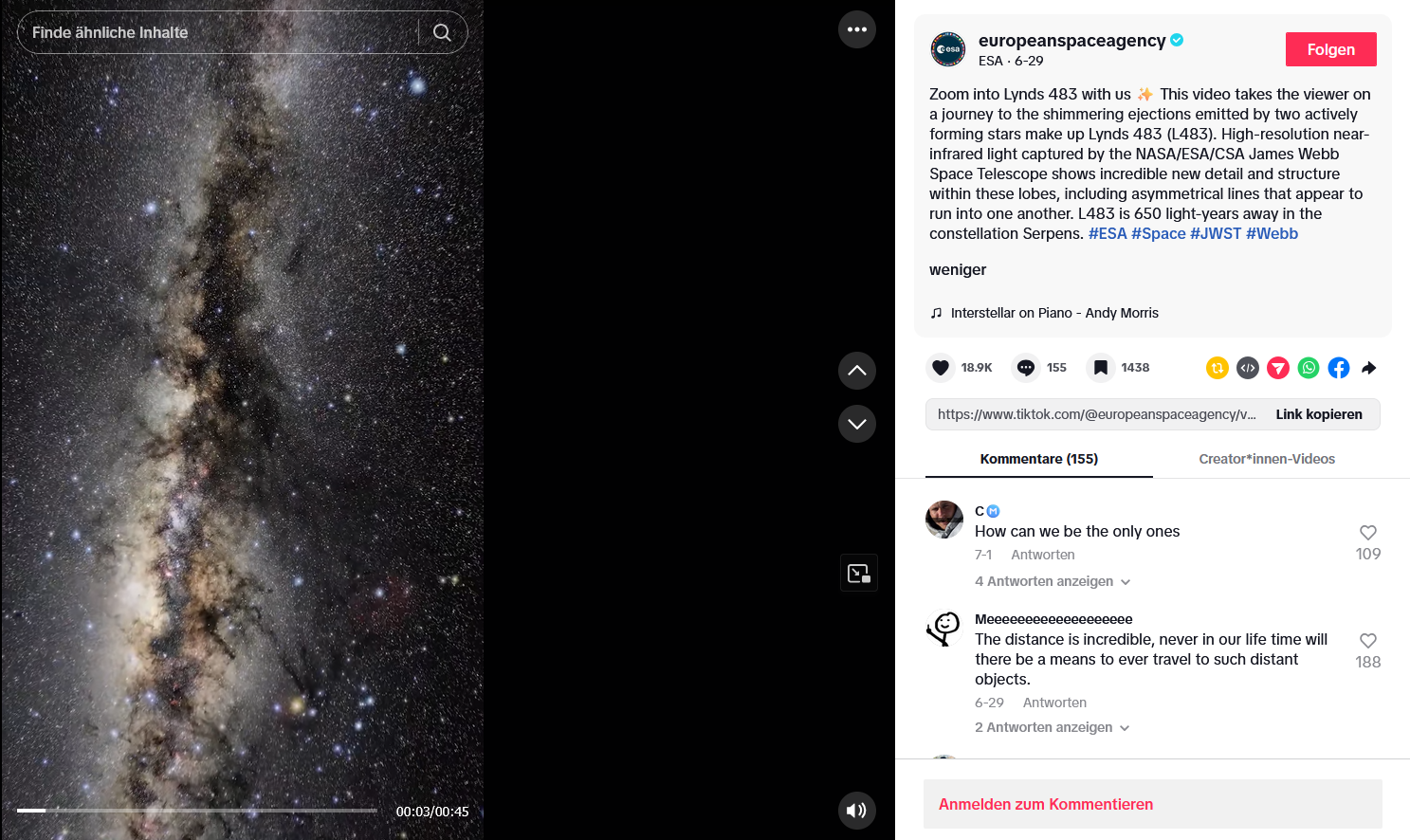
One of the most striking examples of multimodal science communication in recent years was NASA’s coverage of the James Webb Space Telescope’s first images in July 2022. The release was not confined to a single channel or medium and also distinctly multimodal. High-resolution astronomical photographs were streamed live on global television, simultaneously shared across social media platforms together with annotated infographics, accompanied by press conferences that blended scientific explanation with emotional storytelling, and supported by interactive web visualisations where users could zoom in to view cosmic structures in detail. The scientific message was thus conveyed through visuals, spoken narratives, technical data, and participatory digital tools — that is, through a rich combination of different communicative modes. Videos of the telescope continue to circulate on social media channels (see Figure 1).
This case is one of many examples to illustrate that science communication has evolved into a distinctly multimodal practice [Christ & Huhn, 2024]. Multimodality describes the production and interpretation of meaning through the combined use of multiple communicative modes — such as language, visuals, gestures, and sound — that jointly shape how messages are understood [Jewitt, 2017]. Although combining text, visuals, sound, and interactivity is not new, its prominence has surged with the rise of digital communication and particularly in light of recent developments in memes, AI-generated content, deepfakes, and short video platforms [Zeng et al., 2021].
In this essay, we argue that science communication research and practice have yet to adequately engage with the implications of this shift. Although a growing body of research has explored science communication on platforms that rely on different modalities, such as TikTok [Christ & Huhn, 2024; Zeng et al., 2021] and YouTube [Allgaier, 2019b; Humprecht & Kessler, 2024], we believe that three issues require closer attention. First, multimodality should be analysed in greater depth by moving beyond the analysis of individual modes (e.g., visual content) to examine how different modes interact within a single message. Second, multimodal science communication is particularly important in the context of highly contested issues. Third, from a methodological perspective, there is a need to further develop computational approaches capable of capturing and analysing multimodal content.
We argue that multimodality fundamentally reshapes contestation dynamics by accelerating the circulation of contested interpretations of science, amplifying emotional and heuristic processing of scientific claims, and enabling personalised and visually persuasive forms of critique that can outpace and undermine text-based, evidence-oriented scientific discourse. This, in turn, changes how scientific authority, uncertainty, and credibility are negotiated in the public sphere.
Accordingly, we will outline the relevance of multimodal content for science communication in general, and for contested scientific issues in particular. We will then review existing research and conclude by identifying promising directions for future inquiry in this area.
2 The relevance of multimodality in science communication
Multimodality is grounded in the assumption that ‘meanings are made, distributed, received, interpreted, and remade in interpretation through many representational and communicative modes’ [Jewitt, 2017, p. 15]. These modes are rooted in sensory functions such as seeing, feeling, smelling, or hearing, giving rise to modalities including language (spoken or written), visual elements (images, videos), audio signals, and gestures [Baltrusaitis et al., 2019]. While these modes have always coexisted in human cognition, their integration in public discourse has historically been limited by the physical constraints of the medium used to carry them.
Early forms of science communication exemplified these limitations. They primarily involved the writing of press releases and responding to press inquiries, with core messages conveyed through text and infographics in newspapers or via audio in radio programmes. However, while multiple modalities were used to disseminate scientific knowledge, they operated largely in isolation from one another [Lutkewitte, 2014]. Newspapers could not embed audio tracks, radio broadcasts displayed no infographics, and press releases contained no videos. Thus, while science communication was multimodal to some extent, it remained limited by the affordances of traditional mass media. Moreover, scientists depended on intermediaries, such as journalists, press offices, and broadcasters, to translate their work for public audiences.
This structural configuration has fundamentally changed with the advent of digital communication. Digital technologies enable the integration of multiple modes within a single medium on a single platform. In particular, social media platforms have dissolved the formerly parallel existence of modalities. A single post on Instagram or TikTok combines video, text overlays, audio, and interactive elements. Similarly, online newspapers and science outlets (e.g. Scientific American) routinely integrate video interviews with written articles, interactive data visualisations, and audio podcasts. This shift represents not merely a quantitative increase in available modes but a qualitatively new form of science communication in which the boundaries between formerly separate communication channels dissolve and new possibilities for knowledge presentation emerge.
Perhaps even more transformative has been the democratisation of multimodal content creation. Smartphones enable the production of videos, photos, and audio content at any time and place [see, for journalism, Westlund & Quinn, 2018]. Individual researchers can now create visual content themselves, without relying exclusively on institutional or journalistic intermediaries. As a result, the temporal and spatial dimensions of science communication have shifted [Tsatsou, 2009]: content creation is now possible anytime and anywhere — a flexibility that was previously mostly limited to text production. This has dramatically accelerated the speed at which multimodal content is generated and disseminated.
For science communication, these developments weaken the long-standing dominance of textual formats — not only in public-facing communication but increasingly within scientific discourse itself [K. Krause, 2016; Krukowski & Goldstein, 2023]. Graphical and video abstracts have become more common, reflecting broader changes in communicative practices. The rise of multimodality is particularly pronounced in external communication, where posts from university press offices routinely integrate multiple modes and where such formats are often explicitly requested by media outlets. This shift reflects changing usage patterns: reading long texts is declining in favour of short videos [Gattringer, 2025] and visual content [Newman et al., 2025].
Multimodality provides distinctive advantages for science communication. It makes invisible scientific phenomena more visible, accessible, and relatable through animations and visualisations — as exemplified by the JWST images that made distant galaxies tangible. Video excels at demonstrating processes over time, while visual representations transform complex data into intuitively graspable patterns. Multimodality also democratises access: visual explanations can reach audiences regardless of literacy levels [Schnotz, 2002], while captions and audio descriptions appeal to a range of ability levels [Raja, 2016]. Multimodal approaches also achieve greater reach and engagement [Lazard & Atkinson, 2014], and video content especially increases learning effects [Greussing et al., 2020; Poehls et al., 2025]. Moreover, showing scientific procedures and researchers themselves may function as a trust cue, potentially strengthening perceived credibility [Schröder et al., 2025].
However, it must be noted that multimodality introduces significant risks. Visual modalities carry implicit credibility, activating a ‘seeing is believing’ heuristic [Sundar, 2008] that can make misinformation presented in professional-looking videos appear authoritative. AI-generated deepfakes can fabricate convincing visual ‘evidence’, undermining trust [Twomey et al., 2023]. In addition, the pressure to produce content quickly can conflict with scientific rigour: high-quality multimodal communication requires time, expertise, and resources, which may exacerbate existing inequalities in who is able to communicate science effectively [Graves et al., 2022]. Finally, multimodal science communication requires new literacies and skills that many researchers lack [Rodríguez Estrada & Davis, 2014].
Despite these challenges, multimodal science communication has become essential for making scientific concepts comprehensible and accessible to diverse audiences. These considerations become even more critical when communicating about contested issues.
3 Multimodal science communication and contested issues
In the political context, contestation is defined as ‘a social practice of merely objecting to norms (principles, rules, or values) by rejecting them or refusing to implement them, and as a mode of critique through critical engagement in a discourse about them’ [Wiener, 2017, p. 109]. Contested issues are complex and multifaceted, often involving conflicts over facts, values, or policies that significantly impact social change. Different stakeholders hold divergent views and interests, leading to debates over their meaning and resolution [Lidskog & Olausson, 2013].
In science, contestation is a ruling principle, meaning that findings are contested, revised, or reformulated [Zachmann et al., 2023]. However, scientific evidence is not contested solely within the scientific system; it is increasingly politicised in debates outside academia [Druckman, 2017; Zachmann et al., 2023]. This politicisation of science is often driven by elite actors such as politicians or journalists [Schmid-Petri et al., 2022], but it also emerges in less curated information environments, including social media platforms and comment sections. In these settings, the authority of scientific evidence is increasingly challenged, with post-factual voices often gaining substantial attention [Benkler et al., 2017].
Scientific uncertainty further contributes to contestation, particularly in fields that rely on probabilistic models or long-term projections. Climate change prediction models, for instance, necessarily entail uncertainty, which can itself become a focal point of public dispute [Druckman, 2017]. Such uncertainty can be exploited to undermine support for evidence-based policy interventions [Kreps & Kriner, 2020] and to erode trust in science as a whole [Rutjens et al., 2021], even for widely agreed-upon topics such as the anthropogenic causes of climate change [Hornsey & Fielding, 2017].
Forms of evidence contestation can extend beyond disagreements over findings to encompass more radical questioning of scientific methods of evidence generation [Zachmann et al., 2023]. Science-related populist attitudes among parts of the audience demonstrate that science as a knowledge-creating institution is increasingly challenged [Mede & Schäfer, 2020]. Beyond contesting scientific findings themselves, these challenges increasingly manifest as direct attacks on scientists and scientific institutions [Nölleke et al., 2023]. Research shows for topics such as genomic science and climate change that such contestation is frequently personalised, focusing on the morality, motives, or credibility of individual scientists [Kinnebrock & Bilandzic, 2023; Samoilenko & Cook, 2023]. New technological developments, such as AI and video manipulation techniques, further facilitate the production and dissemination of content used in these personalised attacks [Doss et al., 2023].
At first glance, the growing public contestation of science and the rise of multimodal content may appear to be entirely separate developments. On closer inspection, however, there are compelling reasons to believe that multimodality plays a central role in intensifying and shaping contemporary forms of scientific contestation.
First, multimodal content tends to generate greater engagement due to the inclusion of visual elements [Li & Xie, 2019]. This could be particularly significant for contested issues where polarising opinions are transmitted [Jasser et al., 2021]. A compelling video questioning vaccine safety, for example, can attract millions of views within hours, establishing interpretive frames before scientific institutions have an opportunity to respond with countervailing evidence. Memes represent a particularly effective form of multimodal contestation [Blackmore et al., 2000; Roslyng & Larsen, 2021]. By combining image, text, and cultural references, memes can distill complex scientific issues [Francisco Junior et al., 2023] into emotionally resonant messages that travel across platforms and communities [Rodríguez-Ferrándiz et al., 2023]. The algorithmic amplification of such multimodal content then causes contestation to outpace more measured, evidence-based responses confined to text-heavy formats.
Second, the visual and emotional affordances of multimodal communication make it particularly effective for shaping perceptions when audiences lack the expertise to evaluate complex scientific claims [Schnotz, 2002]. Audiences often rely on heuristics rather than systematic evidence evaluation [Chaiken, 1980; Sundar, 2008]. Multimodal content provides rich opportunities for deploying such cues — for instance, through the apparent authority of professional production values, the emotional impact of selected imagery, or the implicit credibility of visual ‘evidence’. While these cues can be beneficial for legitimate science communication, they also render audiences more susceptible to strategically crafted multimodal contestation. Such problematic multimodal content often functions through remediation — that is, repurposing, recontextualising, or attacking legacy scientific media [Toivanen et al., 2021], which makes manipulation even more difficult to recognise. For example, clips from scientific presentations can be edited to suggest contradictions, or data visualisations can be redesigned to support alternative interpretations, thereby undermining the authority of the original scientific communication. Moreover, multimodality enables personalisation and parasocial connection as social presence increases [Ijsselsteijn & Riva, 2003], creating trust based on presentation style or shared identity [Walter et al., 2013].
These factors — viral spread, emotional persuasiveness, and personalisation — make multimodality particularly powerful in contested science contexts. Thus, it is necessary to systematically understand how contested issues are negotiated in different modalities and what this means for citizens’ perceptions of these issues.
4 Existing research on multimodal science communication
Most research that moves beyond written science communication has focused on visual modalities. However, a growing body of scholarship also addresses interactive visualisations, science communication on video platforms, and the role of mis- and disinformation in multimodal environments. We highlight several defining subfields in the following sections.
4.1 Visual science communication
There is a significant body of research on visual science communication [Metag, 2019, 2020; Pauwels, 2019] and endeavours are underway to institutionalise this work, as exemplified by the Kiel Science Communication Network1 in Germany. While graphs and diagrams have always been an integral part of scholarly science communication [Cooper et al., 2002], visuals are strategically employed for external science communication by NGOs [Wozniak et al., 2016], scientific organisations, and in journalistic media outlets [Harvard & Hyvönen, 2023; Hayes & O’Neill, 2025] so that these visual materials circulate across the news media ecosystem [Hayes & O’Neill, 2024]. Images of scientific content on social media have been under scrutiny, showing, for example, specific features of denialist multimodal communication (e.g., linking climate denial with the chemtrails conspiracy theory) [Gardam et al., 2025]. The content of science imagery varies with regard to media outlets and also in relation to the scientific topic that is being visualised [Hayes & O’Neill, 2021]. Furthermore, the ways in which science is visualised change over time [Lopes & Azevedo, 2023] with visuals being shown to intensify cognitive effects related to memory and comprehension while also influencing attitudes toward scientific issues [Bingaman et al., 2021; Metag et al., 2016].
4.2 Science communication on (short) video platforms
Science communication on (short) video platforms such as YouTube, TikTok, and Instagram has received growing scholarly attention in recent years [Allgaier, 2019a; Bucher et al., 2022; Christ & Huhn, 2024; Zeng et al., 2021]. Research demonstrates that the presentation of scientific topics varies greatly on such platforms and is in constant flux. Studies range from analyses of gender representation in YouTube and TikTok videos [Chen et al., 2023] to YouTube content failing to support the scientific consensus about anthropogenic climate change [Allgaier, 2019a] and to uncritical or oversimplified presentations of science on TikTok [Zeng et al., 2021]. Overall, this literature highlights both the breadth of scientific content on video platforms and the importance of platform-specific affordances in shaping communication practices [Christ & Huhn, 2024]. Such content can have various effects, including differences in the perceived trustworthiness of scientific experts depending on the format in which they appear [Reif et al., 2020].
4.3 Podcasts in science communication
Over the past decade, podcasts have emerged as a prominent medium for science communication, a trend that accelerated during the COVID-19 pandemic [Newman & Gallo, 2020; Yuan et al., 2021]. Podcasts are audio-based communication formats that centre around sound and speech. Research shows that podcasters aim to spark excitement and interest in science [Yuan et al., 2021] and that listening to science podcasts may reduce anxiety, particularly during periods of crisis such as the COVID-19 pandemic [Gaiser & Utz, 2022]. Moreover, the multimodal environment of podcasts matters — for example, YouTube comments can offer valuable insights into audience reception [Gaiser & Utz, 2022].
4.4 Interactive data visualisations and virtual reality
Interactive data visualisations have become increasingly important for communicating scientific information in online news and digital environments. In some cases, these formats even incorporate immersive elements such as virtual or augmented reality [Barnidge et al., 2021]. Such tools have been promoted as a means of enabling more immediate and engaging encounters with abstract scientific phenomena [Greussing et al., 2020]. Research shows that engaging with such data visualisations can positively influence attitudes toward climate change, such as by strengthening the belief that climate change is real [Herring et al., 2016]. However, such positive effects are not consistent because interactive visualisations may also have detrimental effects due to information overload or misinterpretations [Barnidge et al., 2021; Greussing et al., 2020].
4.5 Disinformation and multimodal science communication: deepfakes and AI-generated content
Attention has also centred on the problem of mis- and disinformation when disseminating multimodal content. Science videos on TikTok often contain pseudoscience [Zeng et al., 2021] and YouTube videos feature false information about COVID-19 vaccinations [Humprecht & Kessler, 2024]. Moreover, technologies such as generative AI raise new concerns over the authenticity and credibility of scientific communication [Lee & Shin, 2021; Lu & Yuan, 2024]. AI can create a wide range of visuals or multimodal content to present scientific findings; however, these depictions are not necessarily correct and AI may be used to alter existing scientific visualisations [Klein-Avraham et al., 2024; Schäfer, 2023].
5 Research in the field of multimodal science communication: thoughts on the way forward
Although research has examined various forms of multimodal science communication — including its producers, its representations of scientific topics, and its effects — important gaps remain.
First, although various channels as well as different formats have been studied, research that thoroughly examines how multiple modalities are integrated and function jointly remains scarce. Even though studies exist that, for example, differentiate between text-only, static, or animated visualisations [e.g. Greussing et al., 2020], research needs to be more comprehensive and study elements such as spoken language, text overlays, moving images, and animations and their interplay. Drawing more on semiotics and multimodal analysis [Jewitt, 2017] might help here to derive typologies and systematisations that can guide science communication research.
Second, we argue that attention to multimodality is particularly crucial in the context of contested scientific issues. Multimodal communication about contested issues requires special attention because of its potential to reach diverse audiences, its emotional persuasiveness, and its potential to increase the feeling of proximity to research and scientists. For practical science communication, this presents numerous opportunities. However, the characteristics of multimodal communication are also strategically exploited by actors far removed from science, especially in the context of contested issues. Therefore, a more comprehensive understanding of how different modalities interact is especially important for topics that are debated controversially in the (digital) public sphere.
Third, we see a need for more refined methods to study multimodal content in science communication. Much progress has been made in computational methods, and this should be especially leveraged for multimodal science communication research. Many existing studies on (mostly visual) multimodal science communication rely on manual content analyses or qualitative methods. Tools such as the Interactive Image Analysis Tool2 developed in the context of the Climate Vision Project or the Image Machine3 [Burgess et al., 2021] that simulates machine vision infrastructures on social media platforms, need to be implemented and further developed. Multimodal content derived, analysed, and classified with such tools can then be used as stimuli in surveys and experiments to study effects on the credibility of content, trust in science, anti-science attitudes, or emotions.
Addressing these gaps can provide substantial insights into how controversial scientific topics are communicated across different modalities and how this shapes public perceptions. Future research should examine how contested scientific issues are represented across modalities in online environments and how audiences perceive, interpret, and cognitively process these representations. Furthermore, the production of multimodal science communication should be researched — for example, how journalists assess such content and navigate the challenges of creating it. In addition, work at the intersection of online and offline communication would be valuable. Studies could examine how multimodal science content circulates between these spheres, how it emerges in offline contexts before moving online (and vice versa), and how it is transformed as it travels through the broader information ecosystem.
This essay contributes to current debates by conceptualising multimodality as a structural transformation of science communication driven by platform logics, algorithmic amplification, and the politicisation of evidence, particularly in digitally mediated, contested issue contexts. Since multimodality is so tightly connected to platform logics, it also connects to the current debate on scholarly access to proprietary platform data [N. M. Krause et al., 2025]. It shows how multimodality enhances science communication by increasing accessibility, engagement, learning, and trust through visual and audiovisual representation, while simultaneously heightening the risk of misinformation, credibility misattribution, inequality, and reduced scientific rigour due to persuasive visuals or AI manipulation.
These risks and benefits also translate into potential best practices and pitfalls for science communicators, journalists, and institutions when implementing multimodal communication practices. Best practices may include transparently visualising uncertainty (e.g., annotated climate model videos that explain ranges rather than single outcomes) and combining modalities in ways that reinforce evidence rather than emotion alone, while also communicating how data are produced. Potential pitfalls arise when communicators adopt platform affordances uncritically: multimodal formats may trigger ‘seeing is believing’ heuristics, while simplified visuals may unintentionally reinforce polarising frames, thereby mirroring the multimodal strategies used in science denialist communication or misinformation.
Acknowledgments
This work was supported by the Volkswagen Foundation under the grant 0072497-00.
AI tools (DeepL and ChatGPT) were used for language editing purposes.
References
-
Allgaier, J. (2019a). Science and Environmental Communication on YouTube: Strategically Distorted Communications in Online Videos on Climate Change and Climate Engineering. Frontiers in Communication, 4. https://doi.org/10.3389/fcomm.2019.00036
-
Allgaier, J. (2019b). Science and Medicine on YouTube. In J. Hunsinger, M. M. Allen & L. Klastrup (Eds.), Second International Handbook of Internet Research (pp. 7–21, Vol. 9). Springer Netherlands. https://doi.org/10.1007/978-94-024-1555-1_1
-
Baltrusaitis, T., Ahuja, C., & Morency, L.-P. (2019). Multimodal Machine Learning: A Survey and Taxonomy. IEEE Transactions on Pattern Analysis and Machine Intelligence, 41(2), 423–443. https://doi.org/10.1109/tpami.2018.2798607
-
Barnidge, M., Sherrill, L. A., Kim, B., Cooks, E., Deavours, D., Viehouser, M., Broussard, R., & Zhang, J. (2021). The Effects of Virtual Reality News on Learning about Climate Change. Mass Communication and Society, 25(1), 1–24. https://doi.org/10.1080/15205436.2021.1925300
-
Benkler, Y., Faris, R., Roberts, H., & Zuckerman, E. (2017). Study: Breitbart-led right-wing media ecosystem altered broader media agenda [last accessed 2 March 2026]. Columbia Journalism Review. https://www.cjr.org/analysis/breitbart-media-trump-harvard-study.php
-
Bingaman, J., Brewer, P. R., Paintsil, A., & Wilson, D. C. (2021). “Siri, Show Me Scary Images of AI”: Effects of Text-Based Frames and Visuals on Support for Artificial Intelligence. Science Communication, 43(3), 388–401. https://doi.org/10.1177/1075547021998069
-
Blackmore, S., Dugatkin, L. A., Boyd, R., Richerson, P. J., & Plotkin, H. (2000). The power of memes. Scientific American, 283, 64–73. https://www.scientificamerican.com/issue/sa/2000/10-01/
-
Bucher, H.-J., Boy, B., & Christ, K. (2022). Audiovisuelle Wissenschaftskommunikation auf YouTube: Eine Rezeptionsstudie zur Vermittlungsleistung von Wissenschaftsvideos [Audiovisual Science Communication on YouTube: A Reception Study on the Communicative Effectiveness of Science Videos]. Springer Fachmedien Wiesbaden. https://doi.org/10.1007/978-3-658-35618-7
-
Burgess, J., Angus, D., Carah, N., Andrejevic, M., Hawker, K., Lewis, K., Obeid, A. K., Smith, A., Tan, J., Fordyce, R., Trott, V., & Li, L. (2021). Critical simulation as hybrid digital method for exploring the data operations and vernacular cultures of visual social media platforms. https://doi.org/10.31235/osf.io/2cwsu
-
Chaiken, S. (1980). Heuristic versus systematic information processing and the use of source versus message cues in persuasion. Journal of Personality and Social Psychology, 39(5), 752–766. https://doi.org/10.1037/0022-3514.39.5.752
-
Chen, K., Duan, Z., & Kim, S. J. (2023). Uncovering gender stereotypes in controversial science discourse: evidence from computational text and visual analyses across digital platforms (S. González-Bailón & E.-Á. Horvát, Eds.). Journal of Computer-Mediated Communication, 29(1). https://doi.org/10.1093/jcmc/zmad052
-
Christ, K., & Huhn, M. (2024). „Den Elfenbeinturm aufbrechen.“ Multimodale Wissenschaftskommunikation auf TikTok. Communicatio Socialis, 57(2), 242–258. https://doi.org/10.5771/0010-3497-2024-2-242
-
Cooper, R. J., Schriger, D. L., & Close, R. J. H. (2002). Graphical literacy: The quality of graphs in a large-circulation journal. Annals of Emergency Medicine, 40(3), 317–322. https://doi.org/10.1067/mem.2002.127327
-
Doss, C., Mondschein, J., Shu, D., Wolfson, T., Kopecky, D., Fitton-Kane, V. A., Bush, L., & Tucker, C. (2023). Deepfakes and scientific knowledge dissemination. Scientific Reports, 13(1), 13429. https://doi.org/10.1038/s41598-023-39944-3
-
Druckman, J. N. (2017). The crisis of politicization within and beyond science. Nature Human Behaviour, 1(9), 615–617. https://doi.org/10.1038/s41562-017-0183-5
-
Francisco Junior, W. E., Albuquerque, T. C. C. d., Costa, B. L. d. S., & Lima Gomes, R. (2023). Science by means of memes? Meanings of Covid-19 in Brazil based on Instagram posts. JCOM, 22(04), A03. https://doi.org/10.22323/2.22040203
-
Gaiser, F., & Utz, S. (2022). “My daily dose of sedation” The secret to success of the science communication podcast ‘Coronavirus-Update’ with the virologist Christian Drosten and its effect on listeners. Studies in Communication and Media, 11(3), 427–452. https://doi.org/10.5771/2192-4007-2022-3-427
-
Gardam, C., Riedlinger, M., Angus, D., & (Jane) Tan, X. Y. (2025). Multimodal narratives of climate denial: A novel, visual-first methodology for analysing conspiracy theory discourse on Instagram. Discourse, Context & Media, 68, 100946. https://doi.org/10.1016/j.dcm.2025.100946
-
Gattringer, K. (2025). Nutzungsdynamik im deutschen Medienmarkt abgeschwächt. Media Perspektiven, 26. https://www.media-perspektiven.de/fileadmin/user_upload/media-perspektiven/pdf/2025/MP_26_2025_ARD_ZDF-Medienstudie_Nutzungsdynamik_im_deutschen_Medienmarkt_abgeschwaecht_01.pdf
-
Graves, J. L., Kearney, M., Barabino, G., & Malcom, S. (2022). Inequality in science and the case for a new agenda. Proceedings of the National Academy of Sciences, 119(10), e2117831119. https://doi.org/10.1073/pnas.2117831119
-
Greussing, E., Kessler, S. H., & Boomgaarden, H. G. (2020). Learning From Science News via Interactive and Animated Data Visualizations: An Investigation Combining Eye Tracking, Online Survey, and Cued Retrospective Reporting. Science Communication, 42(6), 803–828. https://doi.org/10.1177/1075547020962100
-
Harvard, J., & Hyvönen, M. (2023). Gateway Visuals: Strategies of Climate Photographers in the Digital Age. Visual Communication Quarterly, 30(4), 221–233. https://doi.org/10.1080/15551393.2023.2267432
-
Hayes, S., & O’Neill, S. (2021). The Greta effect: Visualising climate protest in UK media and the Getty images collections. Global Environmental Change, 71, 102392. https://doi.org/10.1016/j.gloenvcha.2021.102392
-
Hayes, S., & O’Neill, S. (2024). Visual Politics, Protest, and Power: Who Shaped the Climate Visual Discourse at COP26? Journalism Studies, 26(4), 441–463. https://doi.org/10.1080/1461670x.2024.2436912
-
Hayes, S., & O’Neill, S. (2025). Transformative journalisms and the seductive power of imagery in digital climate niche journalism. Journalism, 0(0). https://doi.org/10.1177/14648849251372742
-
Herring, J., VanDyke, M. S., Cummins, R. G., & Melton, F. (2016). Communicating Local Climate Risks Online Through an Interactive Data Visualization. Environmental Communication, 11(1), 90–105. https://doi.org/10.1080/17524032.2016.1176946
-
Hornsey, M. J., & Fielding, K. S. (2017). Attitude roots and Jiu Jitsu persuasion: Understanding and overcoming the motivated rejection of science. American Psychologist, 72(5), 459–473. https://doi.org/10.1037/a0040437
-
Humprecht, E., & Kessler, S. H. (2024). Unveiling misinformation on YouTube: examining the content of COVID-19 vaccination misinformation videos in Switzerland. Frontiers in Communication, 9. https://doi.org/10.3389/fcomm.2024.1250024
-
Ijsselsteijn, W., & Riva, G. (2003). Being There: The experience of presence in mediated environments. In G. Riva, F. Davide & W. Ijsselsteijn (Eds.), Being there. Concepts, effects and measurements of user presence in synthetic environments (pp. 3–16). IOS Press. https://psycnet.apa.org/record/2003-07184-001
-
Jasser, J., Garibay, I., Scheinert, S., & Mantzaris, A. V. (2021). Controversial information spreads faster and further than non-controversial information in Reddit. Journal of Computational Social Science, 5(1), 111–122. https://doi.org/10.1007/s42001-021-00121-z
-
Jewitt, C. (2017). An introduction to multimodality. In C. Jewitt (Ed.), The Routledge handbook of multimodal analysis (2nd ed., pp. 15–30). Routledge Taylor & Francis Group. https://www.routledge.com/The-Routledge-Handbook-of-Multimodal-Analysis/Jewitt/p/book/9781138245198
-
Kinnebrock, S., & Bilandzic, H. (2023). Stories about Villains, Mad Scientists and Failure. In M. G. Bondio, K. Zachmann, S. Jukola & O. Sparschuh (Eds.), Evidence Contestation (pp. 303–325). Routledge. https://doi.org/10.4324/9781003273509-17
-
Klein-Avraham, I., Greussing, E., Taddicken, M., Dabran-Zivan, S., Jonas, E., & Baram-Tsabari, A. (2024). How to make sense of generative AI as a science communication researcher? A conceptual framework in the context of critical engagement with scientific information. JCOM, 23(06). https://doi.org/10.22323/2.23060205
-
Krause, K. (2016). A framework for visual communication at Nature. Public Understanding of Science, 26(1), 15–24. https://doi.org/10.1177/0963662516640966
-
Krause, N. M., Freiling, I., & Scheufele, D. A. (2025). Our changing information ecosystem for science and why it matters for effective science communication. Proceedings of the National Academy of Sciences, 122(27), e2400928121. https://doi.org/10.1073/pnas.2400928121
-
Kreps, S. E., & Kriner, D. L. (2020). Model uncertainty, political contestation, and public trust in science: Evidence from the COVID-19 pandemic. Science Advances, 6(43), eabd4563. https://doi.org/10.1126/sciadv.abd4563
-
Krukowski, R. A., & Goldstein, C. M. (2023). The potential for graphical abstracts to enhance science communication. Translational Behavioral Medicine, 13(12), 891–895. https://doi.org/10.1093/tbm/ibad069
-
Lazard, A., & Atkinson, L. (2014). Putting Environmental Infographics Center Stage: The Role of Visuals at the Elaboration Likelihood Model’s Critical Point of Persuasion. Science Communication, 37(1), 6–33. https://doi.org/10.1177/1075547014555997
-
Lee, J., & Shin, S. Y. (2021). Something that They Never Said: Multimodal Disinformation and Source Vividness in Understanding the Power of AI-Enabled Deepfake News. Media Psychology, 25(4), 531–546. https://doi.org/10.1080/15213269.2021.2007489
-
Li, Y., & Xie, Y. (2019). Is a Picture Worth a Thousand Words? An Empirical Study of Image Content and Social Media Engagement. Journal of Marketing Research, 57(1), 1–19. https://doi.org/10.1177/0022243719881113
-
Lidskog, R., & Olausson, U. (2013). To spray or not to spray: The discursive construction of contested environmental issues in the news media. Discourse, Context & Media, 2(3), 123–130. https://doi.org/10.1016/j.dcm.2013.06.001
-
Lopes, L. S., & Azevedo, J. (2023). The Images of Climate Change over the Last 20 Years: What Has Changed in the Portuguese Press? Journalism and Media, 4(3), 743–759. https://doi.org/10.3390/journalmedia4030047
-
Lu, H., & Yuan, S. (2024). “I know it’s a deepfake”: the role of AI disclaimers and comprehension in the processing of deepfake parodies. Journal of Communication, 74(5), 359–373. https://doi.org/10.1093/joc/jqae022
-
Lutkewitte, C. (Ed.). (2014). Multimodal composition: A critical sourcebook. Bedford/St Martin’s. https://openlibrary.org/books/OL28307406M/Multimodal_Composition
-
Mede, N. G., & Schäfer, M. S. (2020). Science-related populism: Conceptualizing populist demands toward science. Public Understanding of Science, 29(5), 473–491. https://doi.org/10.1177/0963662520924259
-
Metag, J. (2019). Visuelle Wissenschaftskommunikation. In K. Lobinger (Ed.), Handbuch Visuelle Kommunikationsforschung (pp. 291–312). Springer VS. https://doi.org/10.1007/978-3-658-06508-9_35
-
Metag, J. (2020). Climate change visuals: a review of their effects on cognition, emotion and behaviour. In D. Holmes & L. M. Richardson (Eds.), Elgar handbooks in energy, the environment and climate change. Research handbook on communicating climate change (pp. 153–160). Edward Elgar Publishing. https://doi.org/10.4337/9781789900408.00025
-
Metag, J., Schäfer, M. S., Füchslin, T., Barsuhn, T., & Kleinen-von Königslöw, K. (2016). Perceptions of Climate Change Imagery: Evoked Salience and Self-Efficacy in Germany, Switzerland, and Austria. Science Communication, 38(2), 197–227. https://doi.org/10.1177/1075547016635181
-
Newman, N., Arguedas, A. R., Robertson, C. T., Nielsen, R. K., & Fletcher, R. (2025). Reuters Institute Digital News Report 2025. Reuters Institute for the Study of Journalism. https://reutersinstitute.politics.ox.ac.uk/sites/default/files/2025-06/Digital_News-Report_2025.pdf
-
Newman, N., & Gallo, N. (2020). Daily news podcasts: Building new habits in the shadow of coronavirus. Reuters Institute for the Study of Journalism. https://doi.org/10.60625/RISJ-25Y1-WM88
-
Nölleke, D., Leonhardt, B. M., & Hanusch, F. (2023). “The chilling effect”: Medical scientists’ responses to audience feedback on their media appearances during the COVID-19 pandemic. Public Understanding of Science, 32(5), 546–560. https://doi.org/10.1177/09636625221146749
-
Pauwels, L. (2019). On the nature and role of visual representations in knowledge production and science communication. In A. Leßmöllmann, M. Dascal & T. Gloning (Eds.), Science Communication (pp. 235–256). De Gruyter. https://doi.org/10.1515/9783110255522-011
-
Poehls, J., Meuschke, M., Carvalhais, N., & Lawonn, K. (2025). Either Or: Interactive Articles or Videos for Climate Science Communication. Computer Graphics Forum, 44(3), e70129. https://doi.org/10.1111/cgf.70129
-
Raja, D. S. (2016). Bridging the Disability Divide through Digital Technologies. World Bank. https://knowledgehub.easpd.eu/pluginfile.php/312/mod_glossary/attachment/259/268-BridgingtheDisabilityDividethroughDigitalTechnologyRAJA.pdf
-
Reif, A., Kneisel, T., Schäfer, M., & Taddicken, M. (2020). Why Are Scientific Experts Perceived as Trustworthy? Emotional Assessment within TV and YouTube Videos. Media and Communication, 8(1), 191–205. https://doi.org/10.17645/mac.v8i1.2536
-
Rodríguez Estrada, F. C., & Davis, L. S. (2014). Improving Visual Communication of Science Through the Incorporation of Graphic Design Theories and Practices Into Science Communication. Science Communication, 37(1), 140–148. https://doi.org/10.1177/1075547014562914
-
Rodríguez-Ferrándiz, R., Sánchez-Olmos, C., & Hidalgo-Marí, T. (2023). For the sake of sharing: Fake news as memes. In M. Filimowicz (Ed.), Information Disorder (pp. 46–68). Routledge. https://doi.org/10.4324/9781003299936-3
-
Roslyng, M. M., & Larsen, G. (2021). The struggle between the power of language and the language of power: Pro- and anti-vaccination memes and the discursive construction of knowledge. Journal of Language and Politics, 20(6), 894–912. https://doi.org/10.1075/jlp.19101.ros
-
Rutjens, B. T., van der Linden, S., & van der Lee, R. (2021). Science skepticism in times of COVID-19. Group Processes & Intergroup Relations, 24(2), 276–283. https://doi.org/10.1177/1368430220981415
-
Samoilenko, S. A., & Cook, J. (2023). Developing an Ad Hominem typology for classifying climate misinformation. Climate Policy, 1–14. https://doi.org/10.1080/14693062.2023.2245792
-
Schäfer, M. S. (2023). The Notorious GPT: science communication in the age of artificial intelligence. JCOM, 22(02), Y02. https://doi.org/10.22323/2.22020402
-
Schmid-Petri, H., Bienzeisler, N., & Beseler, A. (2022). Chapter Three. Effects of politicization on the practice of science. In T. Bolsen & R. Palm (Eds.), Progress in Molecular Biology and Translational Science. Molecular Biology and Clinical Medicine in the Age of Politicization (pp. 45–63, Vol. 188). Elsevier. https://doi.org/10.1016/bs.pmbts.2021.11.005
-
Schnotz, W. (2002). Commentary: Towards an Integrated View of Learning from Text and Visual Displays. Educational Psychology Review, 14(1), 101–120. https://doi.org/10.1023/a:1013136727916
-
Schröder, J. T., Brück, J., & Guenther, L. (2025). Identifying trust cues: how trust in science is mediated in content about science. JCOM, 24(01). https://doi.org/10.22323/2.24010206
-
Sundar, S. S. (2008). The MAIN model: A heuristic approach to understanding technology effects on credibility. Digital Media, Youth, and Credibility, 73–100. https://doi.org/10.1162/dmal.9780262562324.073
-
Toivanen, P., Nelimarkka, M., & Valaskivi, K. (2021). Remediation in the hybrid media environment: Understanding countermedia in context. New Media & Society, 24(9), 2127–2152. https://doi.org/10.1177/1461444821992701
-
Tsatsou, P. (2009). Reconceptualising “time” and “space” in the era of electronic media and communications. Journal of Media and Communication, 11–32. https://www.oalib.com/research/2290999
-
Twomey, J., Ching, D., Aylett, M. P., Quayle, M., Linehan, C., & Murphy, G. (2023). Do deepfake videos undermine our epistemic trust? A thematic analysis of tweets that discuss deepfakes in the Russian invasion of Ukraine (R. Mehmood, Ed.). PLOS ONE, 18(10), e0291668. https://doi.org/10.1371/journal.pone.0291668
-
Walter, N., Ortbach, K., Niehaves, B., & Becker, J. (2013). Trust Needs Touch: Understanding the Building of Trust through Social Presence. AMCIS 2013 Proceedings. https://aisel.aisnet.org/amcis2013/HumanComputerInteraction/GeneralPresentations/9
-
Westlund, O., & Quinn, S. (2018). Mobile Journalism and MoJos. Oxford Research Encyclopedia of Communication. https://doi.org/10.1093/acrefore/9780190228613.013.841
-
Wiener, A. (2017). A Theory of Contestation—A Concise Summary of Its Argument and Concepts. Polity, 49(1), 109–125. https://doi.org/10.1086/690100
-
Wozniak, A., Wessler, H., & Lück, J. (2016). Who Prevails in the Visual Framing Contest about the United Nations Climate Change Conferences? Journalism Studies, 18(11), 1433–1452. https://doi.org/10.1080/1461670x.2015.1131129
-
Yuan, S., Kanthawala, S., & Ott-Fulmore, T. (2021). “Listening” to Science: Science Podcasters’ View and Practice in Strategic Science Communication. Science Communication, 44(2), 200–222. https://doi.org/10.1177/10755470211065068
-
Zachmann, K., Jukola, S., Sparschuh, O., & Bondio, M. G. (2023). Introduction. In M. G. Bondio, K. Zachmann, S. Jukola & O. Sparschuh (Eds.), Evidence Contestation (pp. 1–30). Routledge. https://doi.org/10.4324/9781003273509-1
-
Zeng, J., Schäfer, M. S., & Allgaier, J. (2021). Reposting “Till Albert Einstein Is TikTok Famous”: The Memetic Construction of Science on TikTok. International Journal of Communication, 15, 3216–3247. https://ijoc.org/index.php/ijoc/article/view/14547
Notes
1. Kiel Science Communication Network: https://www.kielscn.de/en/.
2. Interactive Image Analysis Tool: https://web.informatik.uni-mannheim.de/climatevisions/tool-box/.
3. Image Machine: https://github.com/qut-dmrc/ImageMachine.
About the authors
Julia Metag is Professor at the Department of Communication at the University of Muenster, Germany. She earned her doctoral degree from the University of Muenster. Her research is centered on science communication and political communication, with a specific emphasis on the audience perspective and digital media environments. She heads the Hot Science Communication Lab (https://www.uni-muenster.de/HotSciCommLab/en/index.html), is Co-PI of the Science Barometer, Switzerland and currently Co-PI of a project on communication by private universities as well as PI in the DFG-funded research unit DISELMA — Digital Media in Chronic Disease Self-Management.
E-mail: julia.metag@uni-muenster.de Bluesky: @juliametag
Florian Wintterlin is a Senior Research and Teaching Associate at the Department of Communication at the University of Muenster, Germany, where his research focuses on the societal implications of digitalization. He investigates topics such as misinformation, trust, populism, and multimodality within the contexts of journalism, political communication, and science communication.
E-mail: florian.wintterlin@uni-muenster.de Bluesky: @wintterlin